


Here is an example account, invented for this post but built the way plenty of real ones were. A plumbing company in Austin spends about $6,000 a month on Google Ads and gets roughly 900 clicks for it. An agency set it up in 2019 as single keyword ad groups, which was textbook practice at the time: 140 ad groups, each holding one keyword in phrase and exact match, each with its own ads.
Open that account today and the problems are easy to find. Those 900 clicks spread across 140 ad groups come to about six clicks per ad group per month, which is too few to tell a good ad from a bad one. A search for "emergency plumbers austin" doesn't count as identical to the keyword [emergency plumber austin] under Google's rules, so Google decides which of several look-alike ad groups gets it. And the long-tail exact keywords that were supposed to catch precise searches sit at "Low search volume," switched off.
Our verdict: single keyword ad groups are no longer worth building as a whole-account structure in 2026. Google matches keywords on meaning and picks the ad group with its own relevance check. Your keyword only controls the route when a search is identical to it. Build themed ad groups of roughly 5 to 20 keywords that share one intent and one landing page, and save one-keyword ad groups for the handful of terms that need their own ad or page.
What a single keyword ad group is, and why everyone built one
A single keyword ad group (SKAG) holds one keyword, usually in phrase and exact match, with ads written for that keyword alone.
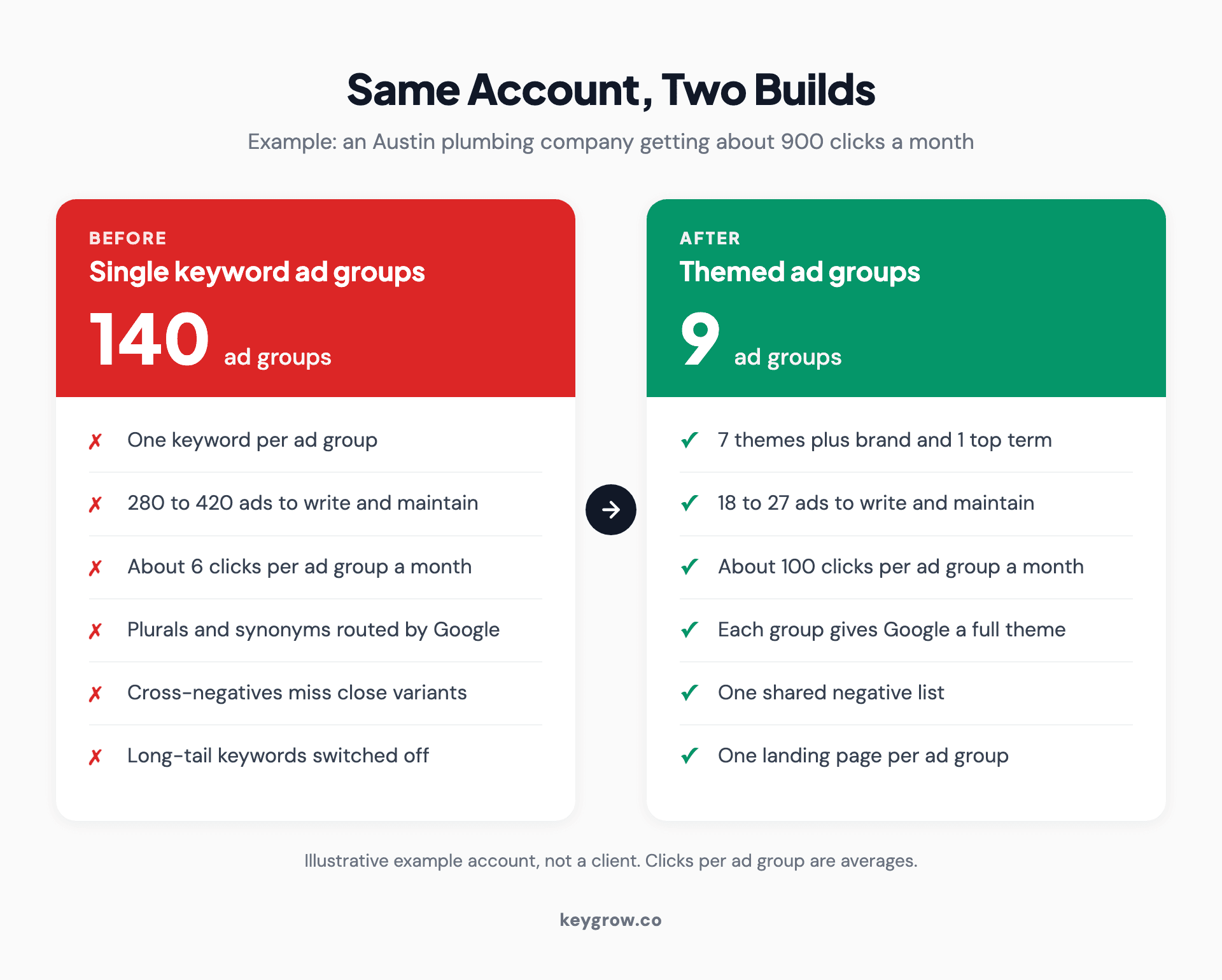
Before and after cards for the same example plumbing account: a single keyword ad group build with 140 ad groups, 280 to 420 ads and about 6 clicks per ad group a month, versus a themed build with 9 ad groups, 18 to 27 ads and about 100 clicks per ad group a month.
From about 2014 to 2019 the logic was hard to argue with. Exact match meant something close to exact. The text ads of the time let you put the keyword word for word in the headline, so the ad mirrored the search. That lifted clickthrough rate and ad relevance. Quality Score followed, and cost per click came down with it. Reporting was clean too, since every search term in an ad group traced back to a single keyword.
It was also easy to teach. An agency could hand a junior account manager one rule (new search term, new ad group) and get a consistent account back, which explains a lot about how fast the method spread.
Back then a SKAG usually carried the same keyword three times, in exact, phrase and broad match modifier. Broad match modifier is gone now, so a modern SKAG is the keyword in exact and phrase.
The appeal was control. You decided exactly which ad answered exactly which search. In 2026 you keep a sliver of that, and only for searches that match your keyword word for word.
The changes that broke the SKAG model, 2014 to 2026
Exact match stopped meaning exact, the old ad format vanished, and Google started choosing the ad group. Each change removed one reason SKAGs worked.
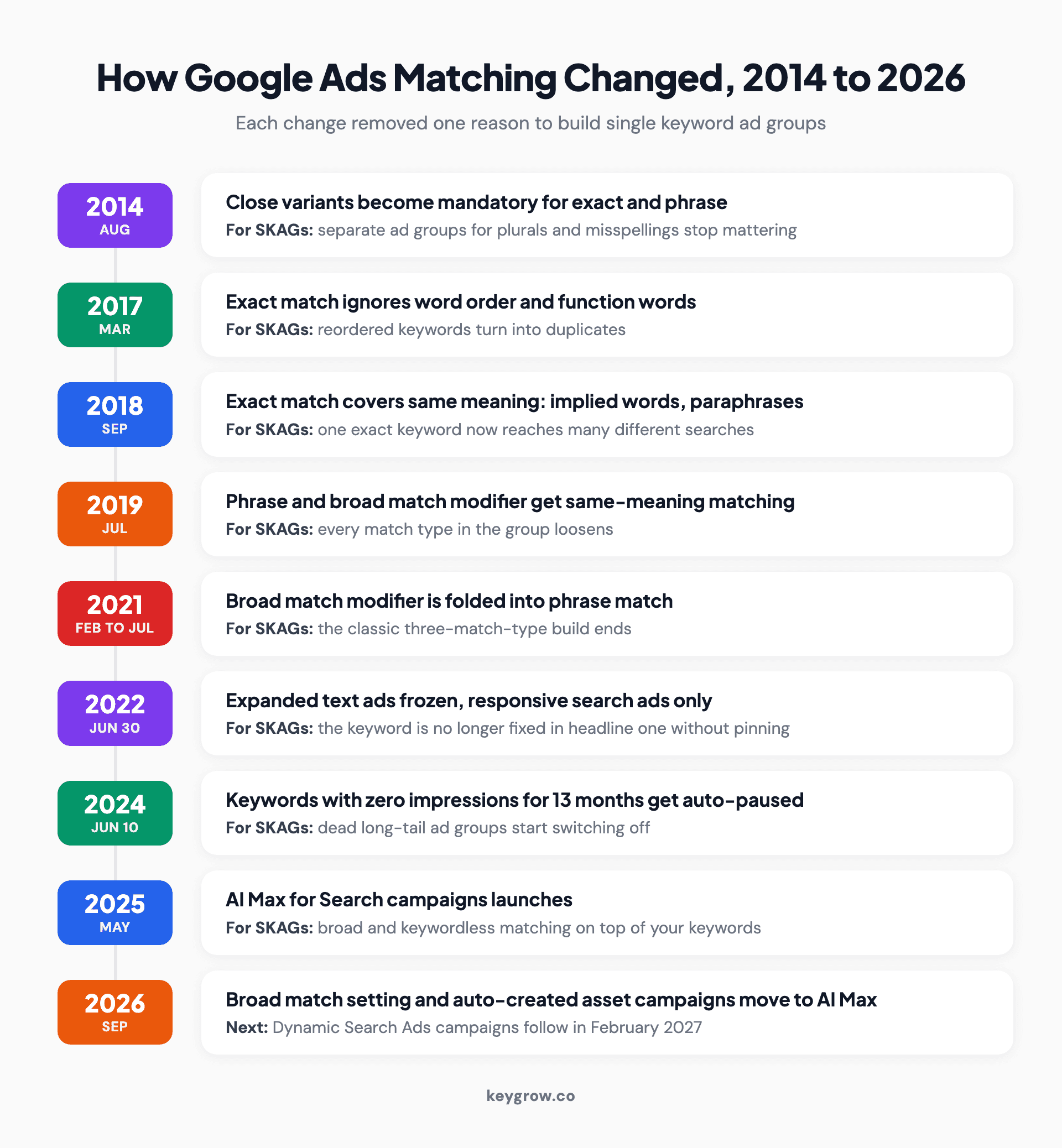
Timeline of Google Ads changes that weakened single keyword ad groups, from close variants in 2014 and same-meaning exact match in 2018 to the end of expanded text ads in 2022, keyword auto-pause in 2024, AI Max in 2025 and automatic AI Max upgrades in 2026.
Three of those changes do most of the damage.
The biggest is that exact match now matches meaning. Google's own definition says exact match ads "may show on searches that have the same meaning or same intent as the keyword." That has been true since September 2018. Your [emergency plumber austin] keyword can show for "austin emergency plumber" and "emergency plumbers in austin" whether or not you built ad groups for them, so the reason to build those extra ad groups is gone.
The ad stopped mirroring the keyword, too. Since June 30, 2022, nobody can create or edit expanded text ads. Responsive search ads mix up to 15 headlines and 4 descriptions, and Google decides the combination. You can pin the keyword into headline one, but Google says pinning "isn't recommended for most advertisers and can affect ad strength." If you have to pin, its own advice is to pin two or three headlines to the same position rather than one.
The third change, Google choosing the ad group, gets its own section below, because it breaks the core promise of the whole method.
Then there is where the platform is heading. Google launched AI Max for Search campaigns in May 2025, which adds broad and keywordless matching on top of your keywords. Google's own schedule moves campaigns that use the campaign-level broad match setting or automatically created assets to AI Max automatically from September 2026, with Dynamic Search Ads campaigns following in February 2027. And in Google's AI Max announcement, the biggest promised lift, 27 percent more conversions or conversion value at a similar CPA or ROAS, went to campaigns still running mostly exact and phrase keywords. That is Google grading its own product, so test it rather than trust it. It still tells you exactly which accounts Google wants to change.
Google picks the ad group now, not you
Your exact keyword only wins identical searches automatically. Google's AI routes everything else, and it reads every keyword in each ad group to decide.
When several keywords in your account could match a search, Google runs a fixed order to decide which one serves:
- An exact match keyword identical to the search wins.
- Next, a phrase or broad match keyword (AI Max included) that is identical to the search.
- If nothing is identical, Google's AI picks the most relevant ad group, judged on "the meaning and context of the search term, all the keywords in an ad group, and landing pages within the ad group."
- Any remaining tie goes to the highest Ad Rank.
The catch sits in the fine print of Google's prioritization rules. "Identical" includes spell-corrected searches, but it "doesn't include plurals or synonyms." So a SKAG only controls step one. The plural, the synonym and the reworded version all fall through to step three, where a one-keyword ad group gives Google the least context to work with. The same page spells out the fix in plain words: "Structure your ad groups thematically to clarify which ad group should match for a given search."
That order also settles fights between your Search campaigns and Performance Max. An identical exact match keyword in Search beats Performance Max outright, while identical phrase and broad keywords only share priority with an identical Performance Max search theme. It is one more reason your brand terms belong in exact match, in a group of their own.

A person typing a search into a smartphone, the kind of query Google now routes to an ad group by meaning rather than exact wording.
It gets narrower every year. Searches that start in AI Mode, AI Overviews, Lens or autocomplete "are not considered technically identical to a keyword," according to the same page, so even a perfect exact match keyword may not get priority on them. As more searching moves into those formats, step one covers less of your traffic.
One myth worth clearing up while we are here. SKAG critics say overlapping keywords make you bid against yourself. They don't. Google states that when several of your keywords could match the same search, "they don't compete with each other in the auction." Only one enters. So overlap doesn't raise your prices. It hands the routing decision to Google.
The Smart Bidding objection is weaker than it sounds
Smart Bidding works at the campaign or portfolio level and learns across campaigns, so splitting ad groups doesn't starve it the way critics claim.
The most repeated case against SKAGs is "data fragmentation": split your keywords 140 ways and the algorithm has nothing to learn from. That overstates it. A Smart Bidding strategy is set on a campaign, or shared across campaigns as a portfolio, and it bids at auction time using signals like device, location, time of day and the actual search. Google also says Smart Bidding can optimize on data from all of your campaigns, so even a new campaign with no history of its own can benefit.
What Google does ask for is conversion volume over time. It suggests judging Smart Bidding over periods with at least 30 conversions, or 50 for Target ROAS, and says separate Target CPA goals for individual ad groups aren't recommended "as it can restrict Smart Bidding." Those are campaign-level concerns. A campaign with 140 ad groups and 40 conversions a month only has a bidding problem if you start setting targets ad group by ad group.
The pro-SKAG camp makes this point well. A 2024 Search Engine Land column by an agency owner who still builds SKAGs argued that data volume only matters where bidding happens, at the campaign level, and recommended grouping enough SKAGs into each campaign to reach at least 30 conversions a month, ideally 100. On bidding, he's right.
Where granularity does hurt is the ads. A responsive search ad only serves inside its own ad group, so everything it learns about which headlines work comes from that one group's traffic. Six clicks a month is closer to a rumor than a test.
The real cost of a SKAG build in 2026
You pay in ad-writing hours, keywords that switch themselves off, negatives that leak and a Quality Score chase Google says not to run.
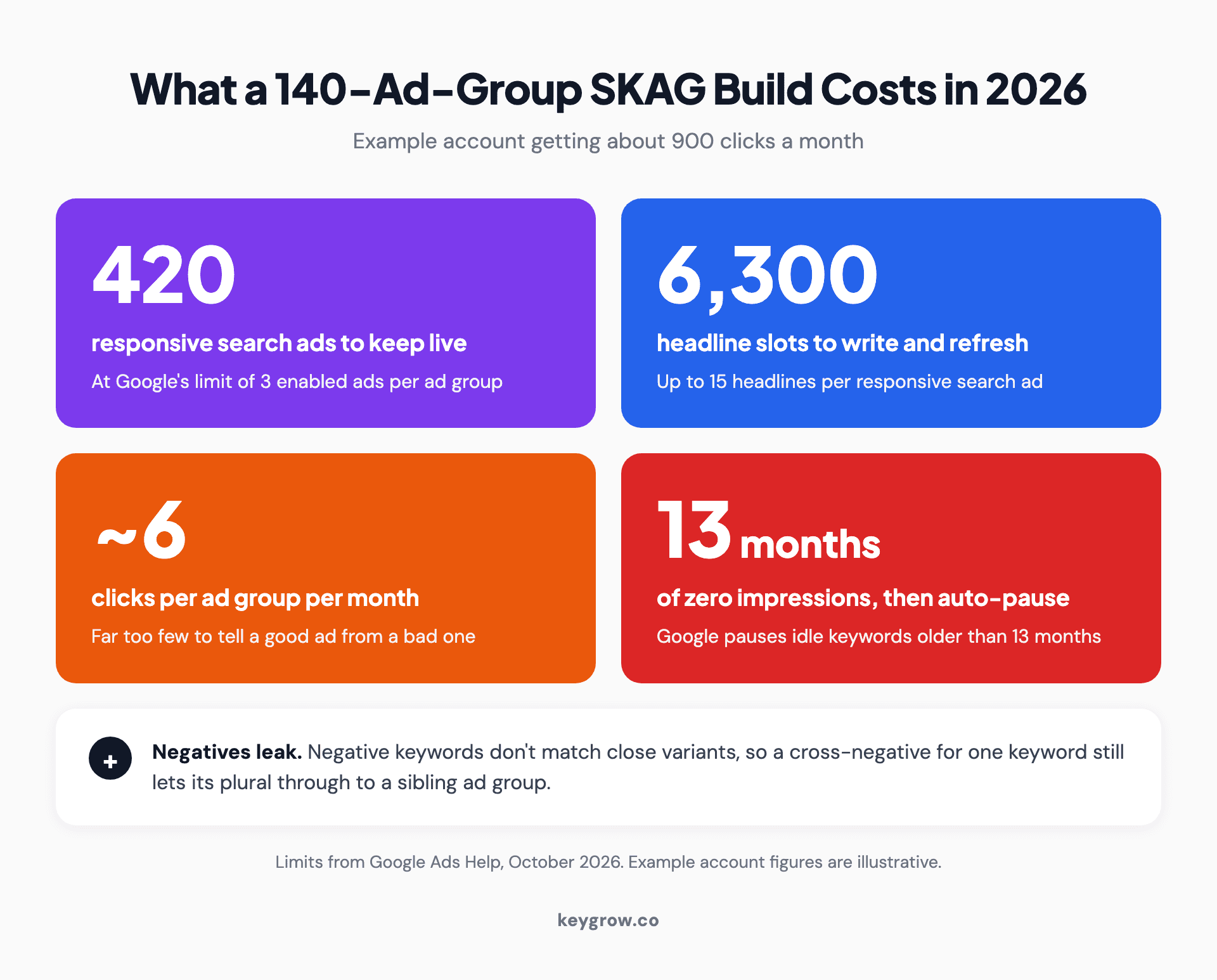
Stat strip of what a 140 ad group single keyword build costs: up to 420 responsive search ads, up to 6,300 headline slots, about 6 clicks per ad group a month, keywords auto-paused after 13 months without an impression, and cross-negatives that miss close variants.
Ad copy at scale
Google allows 3 enabled responsive search ads per ad group, each with up to 15 headlines and 4 descriptions. Even at a sensible two or three ads per group (our guide to how many responsive search ads to run explains why that's the right count), the example account needs 280 to 420 ads and as many as 6,300 headline slots. Nobody keeps 6,300 headlines fresh. The usual shortcut is one template cloned 140 times with the keyword swapped in, which is a themed ad group with extra steps.
Keywords that switch themselves off
The long-tail exact keywords SKAG builds love are the ones most likely to show "Low search volume." Google gives that status to keywords with very little search history, judged on worldwide searches over the past twelve months, and keeps them out of auctions until volume picks up.
Since June 10, 2024, Google also auto-pauses keywords created more than 13 months ago that have had zero impressions in the past 13 months. Unpause one and it gets paused again after three more months of nothing. A big SKAG build quietly shrinks on its own.
Negatives that leak
SKAG builds route traffic with cross-negatives: each keyword goes in as a negative in its sibling ad groups. But Google says negative keywords "won't match to close variants or other expansions," while your positive keywords will. So [emergency plumber austin] added as a negative elsewhere doesn't stop "emergency plumbers austin" from serving through a sibling group. You have to add the plurals and synonyms yourself, group by group, and the list grows with every new ad group.
A score Google tells you not to chase
The SKAG pitch leans hard on Quality Score. Google is unusually blunt about that number: it is "not an input in the ad auction" and "should not be optimized or aggregated with the rest of your data." What feeds the auction is Google's auction-time read of expected clickthrough rate, ad relevance and landing page experience, so relevance still matters. But the ad relevance rating compares you with other advertisers whose ads showed for the exact same search over the last 90 days. A themed group whose ad speaks to one clear intent can earn "Above average" without a single SKAG in the account.
Do SKAGs still help anywhere?
Yes, for a short list: your brand, very expensive clicks, the few terms that carry the account, and searches that need their own page.
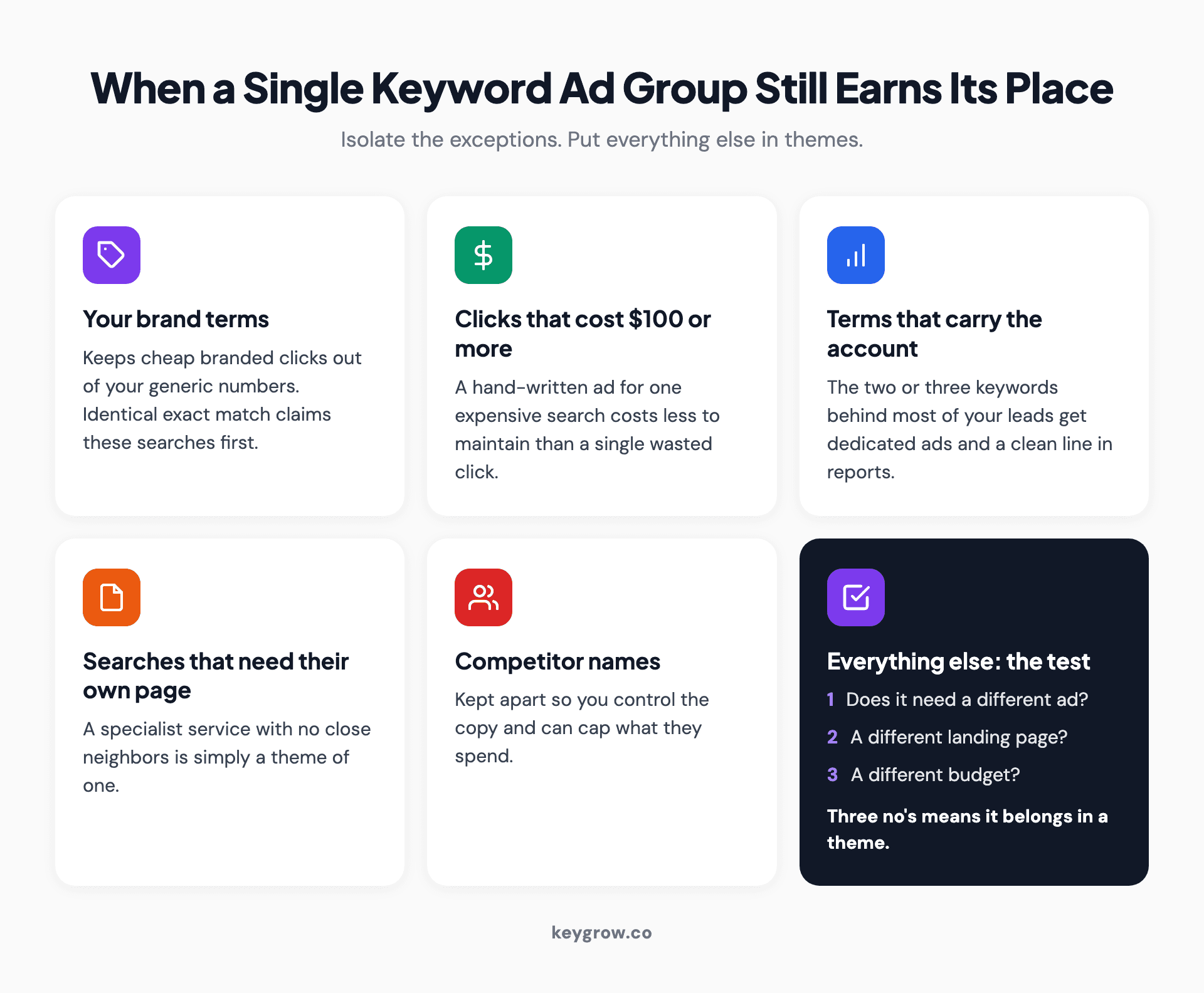
Icon grid of the cases where a single keyword ad group still earns its place: brand terms, clicks that cost $100 or more, the terms that carry the account, searches that need their own landing page, competitor names, plus a three-question test for any other keyword.
- Your brand name. Give brand terms their own ad group, or their own campaign, so cheap branded clicks don't flatter your generic numbers and the ad can talk to someone who already knows you. Identical exact match priority also means your brand keyword reliably claims its own searches.
- Clicks that cost real money. When one click runs $100 or more, as "car accident lawyer" can in major markets, an ad written for that single search costs less to maintain than one wasted click.
- The two or three terms that carry the account. If one keyword drives a big share of your leads, an ad group of its own gives it dedicated ads and a clean line in the report you can watch week to week.
- Searches that need a different page. A specialist service with its own landing page and no close neighbors is simply a theme of one, and that's fine.
- Competitor names. Keep them apart so you control the copy and can cap what they spend.
For anything else, one test settles it. Would this keyword get a different ad, a different landing page or a different budget than the keywords around it? If the answer is no all three times, it doesn't need its own ad group.
SKAGs vs themed ad groups vs one consolidated campaign
Themed ad groups keep most of a SKAG's relevance at a fraction of the upkeep. Full consolidation suits large accounts with heavy conversion volume.
| Single keyword ad groups | Themed ad groups (STAGs) | Consolidated (Hagakure style) | |
|---|---|---|---|
| Keywords per ad group | 1, in exact and phrase | About 5 to 20 sharing one intent | Everything that shares a landing page |
| Who decides routing | You, until a search isn't identical | You set the themes, Google picks within them | Mostly Google |
| Ad copy | Most specific | Specific to one intent | Broad, leans on automation |
| Setup and upkeep | Heaviest | Moderate | Lightest |
| Time to a readable ad test | Slowest | Reasonable | Fastest |
| Match types | Exact and phrase | Exact and phrase, broad where tracking is solid | Broad with Smart Bidding |
| What it needs | Hours every month | One landing page per theme | High conversion volume |
| Best for | Brand and a few high-value terms | Most local and niche service accounts | Large accounts with lots of data |
The right-hand column is roughly the Hagakure approach, popularized by a Think with Google article: as few campaigns as possible, Dynamic Search Ads folded into the same campaign, broad match plus Smart Bidding. Its usual rule of thumb is one ad group per landing page, and only for pages that can collect about 3,000 impressions a week. Two problems for a local business. Most of its ad groups will never reach that number, and Dynamic Search Ads are being absorbed into AI Max.
For a plumbing company or a law firm, the middle column is the default.
Check the landing page before you touch structure
No ad group structure fixes a landing page that confuses visitors. Look at what happens after the click before you rebuild anything.
An eviction law firm came to us already running ads to an existing landing page and getting almost nothing: 1 conversion a week from 22 clicks, at $240 per conversion. Session recordings showed visitors landing and not knowing what to do next. We built a separate page around one clear action, rewrote the ads to give searchers a reason to click, restructured the campaigns and tested side campaigns on small slices of budget, then kept the ones that worked. Within a week the firm had 21 conversions from 189 clicks, at $31.79 each (September to October 2022).

A laptop showing wireframe sketches of a landing page layout, the stage where a page gets rebuilt around one clear action.
Structure was part of that fix. But the recordings pointed at the page, and no ad group map would have changed what visitors saw after they clicked.
It's also why we don't trust SKAG case studies that lead with clickthrough rate and Quality Score screenshots. Neither one pays rent. Judge any restructure, ours included, by cost per conversion: for that firm it went from $240 to $31.79. If you're unsure what number to aim for, our breakdown of a good conversion rate for Google Ads shows how to find your break-even rate instead of borrowing an industry average.
How to move a SKAG account to themed ad groups
Group keywords by intent and landing page, keep a few isolated, rewrite ads per theme, then test the new structure against the old before switching.
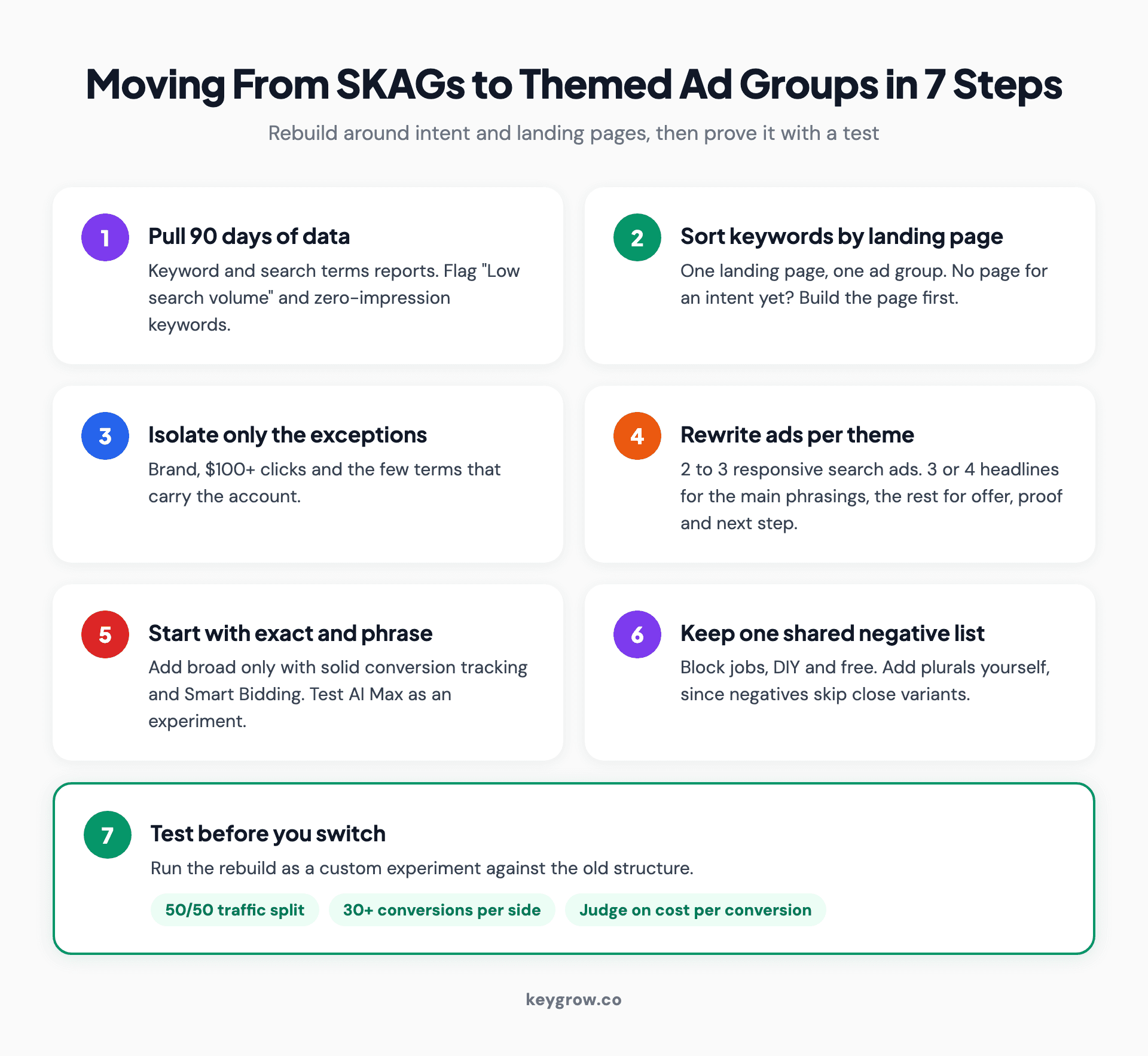
Numbered checklist for moving a single keyword ad group account to themed ad groups in seven steps, from pulling 90 days of data to testing the rebuild as a 50/50 experiment judged on cost per conversion.
- Pull 90 days of data. Export the keyword and search terms reports. Mark which keywords spend and convert, and flag anything on "Low search volume" or sitting at zero impressions.
- Sort keywords by the page they should land on. One landing page, one ad group. In the example account, 140 ad groups collapse into seven themes (emergency plumbing, water heater repair, water heater installation, drain cleaning, sewer line repair, leak detection and repiping) plus brand and the single biggest-spending term kept on their own. Nine ad groups instead of 140. If an intent has no page yet, that's a page to build, not an ad group to invent.
- Run the isolation test from the section above on anything you want to keep separate.
- Write two or three responsive search ads per theme. Use three or four headlines for the main ways people phrase the search, and spend the rest on the offer, proof and the next step.
- Start with exact and phrase match. Add broad match only where conversion tracking is solid and Smart Bidding is on. Our guide to broad match in Google Ads covers when that trade pays. If you want to try AI Max, run it as an experiment first.
- Replace cross-negatives with one shared list of searches you never want, such as jobs, DIY and free. Our guide to negative keywords in Google Ads covers where each one belongs. Add plurals yourself, since negatives skip close variants.
- Test before you switch. Run the rebuild as a custom experiment on a 50/50 split, let each side collect at least 30 conversions, and judge it on cost per conversion.
What one themed ad group looks like
Take the water heater repair theme from the example account. It holds five keywords: [water heater repair austin], "water heater repair", [hot water heater repair], "water heater not working" and [tankless water heater repair]. It sends every click to one page about water heater repair. One of its responsive search ads might use headlines like these:
- Water Heater Repair in Austin
- Hot Water Heater Repair
- Tankless Water Heater Repair
- No Hot Water? We Fix It Today
- Leaking Water Heater? Call Now
- Upfront Price Before We Start
- Licensed Austin Plumbers
- Book a Same-Day Visit
Three headlines carry the main phrasings and the rest sell the visit. Google can pair any of them with any keyword in the group, and that's fine, because every keyword in it wants the same thing: hot water, soon. That is the whole test of a theme. In the SKAG build, those same five searches needed five ad groups and up to fifteen ads saying nearly the same thing.
There's no magic number of ad groups. The example account landed on nine; yours might be four or twenty. What matters is that every group passes the one-ad test: could a single, specific ad answer every keyword in it?
Keeping themes tight after the rebuild
Fold new searches into their themes, block junk, and split off a new ad group only when a search needs its own ad or page.
The search terms report is where a themed account stays healthy or slowly turns back into a junk drawer. Here is a week of made-up search terms from the example account's water heater repair group, and what to do with each:
| Search term | What it is | What to do |
|---|---|---|
| water heater repair austin | Identical to an exact keyword | Nothing, it went where it should |
| water heaters repair austin | Plural close variant | Nothing, close variants already cover it |
| hot water heater leaking | Same intent, new wording | Add it to the group as a phrase keyword |
| water heater replacement cost | Different intent: replacement pricing | Move it to the installation theme, or give it a group if you have a cost page |
| water heater repair jobs | A job seeker | Add "jobs" to the shared negative list |
The old SKAG reflex was to give every search term with a few clicks its own ad group. Ask one question first instead: does this search need a different ad or a different landing page? Plurals, reorderings and synonyms almost never do. A new service or a price-shopping search usually does.
Budget follows the same logic. If one theme starts eating most of its campaign's budget, move it into a campaign of its own so you can fund it on purpose. More ad groups have never fixed a budget problem.
FAQs
Are single keyword ad groups still relevant in 2026?
Mostly not as a whole-account structure. Google matches exact keywords on meaning and routes any search that isn't identical through its own relevance check, so most of the control SKAGs promised is gone. They still make sense for a handful of terms that need their own ad or landing page, such as your brand.
What is the difference between a SKAG and a STAG?
A SKAG holds one keyword, usually in exact and phrase match. A STAG, or single theme ad group, holds several keywords that share one intent and can share one ad and one landing page. STAGs fit the way Google matches searches today, so they are the better default for most accounts.
How many keywords should be in an ad group?
For most small and mid-size accounts, about 5 to 20 keywords that share one intent and one landing page. Google doesn't publish a recommended number. Its technical limit is 20,000 targeting items per ad group, and nobody should read that as a target.
Do keywords in different ad groups compete against each other?
No. Google says that when several of your keywords could match the same search, they don't compete with each other in the auction, and only one enters. Overlap still matters, because Google rather than you decides which ad group serves that search.
Do single keyword ad groups work with Smart Bidding?
Yes, the bidding itself works. Smart Bidding sets bids at the campaign or portfolio level and can learn from data across your campaigns. The drag comes from thin data on each ad and the hours it takes to maintain hundreds of them.
Should I convert my existing SKAG account?
Only if the structure is costing you something you can point to: very few clicks per ad group, a pile of "Low search volume" keywords, or ads nobody has refreshed in a year. If the account converts well and someone keeps it maintained, consolidate gradually, starting with the low-traffic groups, and test the change as an experiment.
What to build instead
For most local and niche service businesses, this is the build we'd put in place today:
- One Search campaign per service line or margin tier
- Themed ad groups of 5 to 20 keywords, each sharing one intent and one landing page
- Exact and phrase match as the base, with broad added only where your tracking can support it
- One shared negative list, reviewed every week
- One-keyword ad groups for your brand and the few terms that need their own ad, page or budget
You keep plenty of control in that setup. It just lives in the themes and pages you choose rather than in one ad per keyword.
If your account has one service, one location and fewer than about 20 keywords, skip the restructuring debate entirely. Two to four themed ad groups and a weekly look at the search terms report will do, and you don't need an agency for that.
If it's bigger, still built as SKAGs, and you'd rather hand the rebuild to someone who does this every week, our PPC management team works month-to-month, and you can cancel anytime.