


Use Google Ads broad match only when Smart Bidding has a real conversion to chase, about 30 of them a month, and your exact and phrase keywords have run out of room. Until then, phrase and exact are the better bet.
Most of that verdict comes from Google's own help pages, which rarely talk advertisers out of spending. Read them side by side and they say something simple: if a campaign doesn't have the data for Smart Bidding, it isn't ready for broad match either.
One 2026 change matters before you start. Google retired the campaign-level broad match switch and moved those campaigns into AI Max, which reaches further than broad keywords do.
The decision path, in four questions
Four yes-or-no checks decide it: Smart Bidding, a conversion that means a customer, enough volume to judge, and exact keywords with no room left.
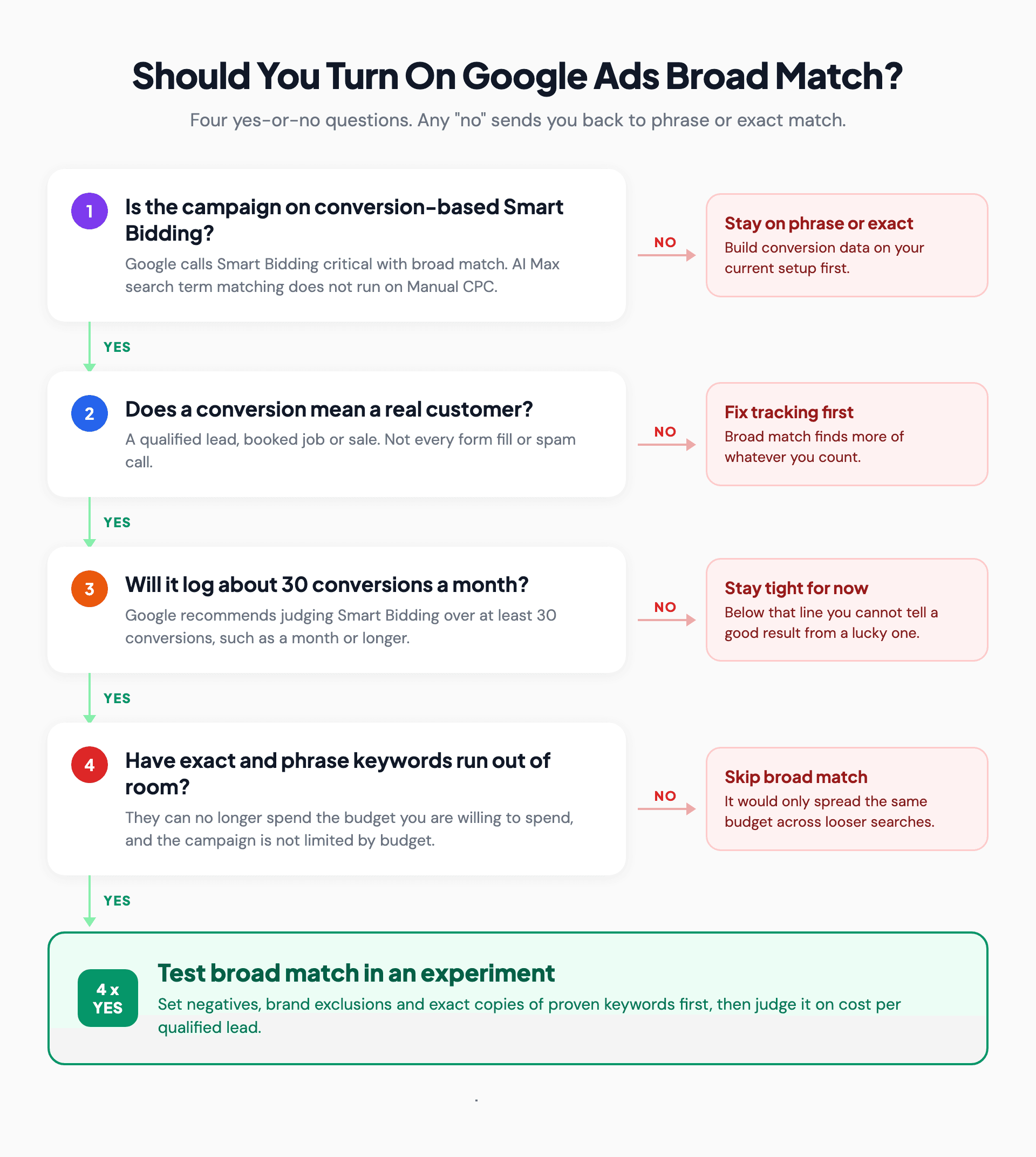
Flow diagram of the Google Ads broad match decision path: four yes-or-no questions on Smart Bidding, conversion quality, 30 conversions a month and keyword headroom, each with an exit to phrase or exact match, ending in a broad match experiment with guardrails.
- Is the campaign on conversion-based Smart Bidding? Broad match relies on the bidder to price every search. Google only offered its campaign-level broad match setting to campaigns on conversion-based Smart Bidding, and AI Max search term matching doesn't work with Manual CPC at all. If you set bids by hand, stop here.
- Does a conversion mean a customer? Smart Bidding chases whatever you count. Count every form fill, spam included, and broad match brings you more form fills.
- Will the campaign log about 30 conversions a month? That's the window Google recommends for judging Smart Bidding. Below it, you can't tell a good result from a lucky one, and the bidder has little to learn from.
- Have your exact and phrase keywords run out of room? If they can't spend the budget you're willing to spend, broad match is how you reach more searches. If the campaign is already limited by budget, broad just spreads the same money across looser traffic. Google says as much about AI Max: it won't be effective in budget-limited campaigns.
Four yeses: test broad match in an experiment, with the guardrails below. Any no: stay tight and fix that first.
What can a broad match keyword trigger?
Broad match shows your ad on searches related to your keyword, including searches that don't contain its direct meaning. Google decides what counts as related.
To decide, Google's keyword matching page says broad match can weigh the searcher's recent search activity, the content of your landing pages and assets, and the other keywords in the ad group. It's also the default: type a keyword without quotes or brackets and it's broad. Broader types include the narrower ones, so a broad keyword covers everything its phrase and exact versions would, plus more.
Google's search terms help page shows what "more" can look like. A broad match keyword for purple flowers matched a search for pink flowers. Fine if you sell both. A paid click on the wrong product if you don't.
This is why Google ties broad match to Smart Bidding. In its own example, the keyword boots matches both "leather boots" and "boot repairs," and Smart Bidding can bid differently on each, because the first searcher is more likely to buy a new pair. On Manual CPC, both searches get the same keyword bid.
| Match type | How you type it | Can show your ad on | What it needs |
|---|---|---|---|
| Broad | water heater repair | Searches related to the keyword, even without its direct meaning | Smart Bidding, negatives, a weekly search terms review |
| Phrase | "water heater repair" | Searches that include the keyword's meaning | Negatives; runs on any bid strategy |
| Exact | [water heater repair] | Searches with the same meaning or intent | The least data; runs on any bid strategy |
Two old rules are dead. Broad match modifier disappeared in 2021, when Google folded it into phrase match. And exact match hasn't meant word for word in years.

A person typing a search into a smartphone, the kind of query a Google Ads broad match keyword can match.
What changed in 2026
Broad match keywords work as they did. The campaign-level setting that forced every keyword in a campaign to broad is gone. According to Google's migration notice, new ones were blocked on August 3, 2026, and existing campaigns began moving into AI Max on September 1 with search term matching switched on.
Search term matching uses broad match plus keywordless matching, so it reaches further than broad keywords alone. Those matches now show "AI Max" as the match type in the search terms report, with a source column saying which of the two found them.
Does broad match cost more per conversion?
Usually, yes. Optmyzr's February 2026 data puts broad at $24.11 per non-brand conversion against $16.91 for exact, though lead gen tells a messier story.
Optmyzr's 2026 study covered 30,000 Google Ads accounts. Advertisers trust broad more than they used to: its share of keyword spend climbed from 33% in 2022 to 39% in 2026, while exact fell from 37% to 28%.
Performance hasn't kept pace with the trust. Across non-brand campaigns, exact posted a 13.9% click-through rate to broad's 8.8%. On branded terms, exact led on almost every metric.
Lead gen accounts, the ones without revenue tracking, broke the pattern. Phrase was cheapest at $40.30 per conversion, with broad close behind. Exact was the most expensive, at $58.08.
Hold the applause. In a lead gen account a "conversion" is whatever the account counts, usually a form fill or a call. The study can't see which of those became customers. Neither can Smart Bidding, unless you tell it.
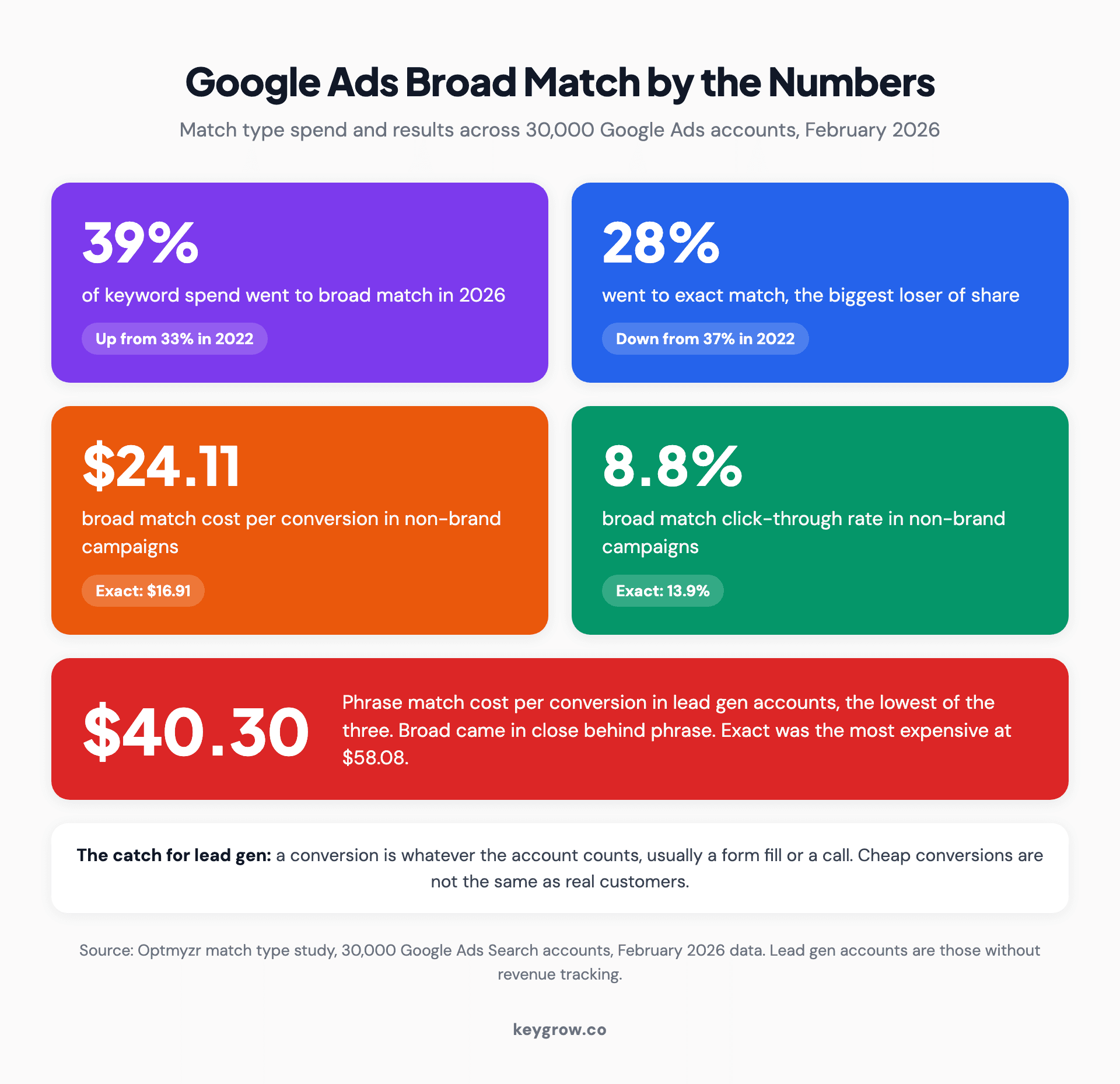
Stat strip of February 2026 Google Ads match type data from 30,000 accounts: broad match at 39 percent of keyword spend and exact at 28 percent, broad cost per non-brand conversion of $24.11 against $16.91 for exact, click-through rates of 8.8 and 13.9 percent, and phrase match cheapest in lead gen at $40.30.
Smart Bidding and conversion data decide whether it works
Broad match finds the searches and Smart Bidding prices them, using your conversion data. Feed it a sloppy conversion and broad match gets expensive fast.
Google's wording is blunt. It calls Smart Bidding "critical" with broad match, because every search differs and each bid should reflect the signals present at auction time. Elsewhere, Google tells advertisers whose Maximize conversions campaigns lack historical data to switch to Maximize clicks or Manual CPC and build conversion data first.
How much data counts as enough? Google publishes no minimum for broad match itself, but it recommends judging Smart Bidding over periods with at least 30 conversions, such as a month or longer (50 for Target ROAS). Our piece on what automated bidding can't fix covers what happens to campaigns below that line.
We treat 30 a month as the floor.
For lead generation, the conversion action is the whole game. Google Ads now has Qualified leads and Converted leads goals, fed from your CRM, so the bidder can optimize past the form fill. Aim Smart Bidding at qualified leads and broad match goes looking for more people like your real customers. Leave it on raw form fills and it finds the cheapest form fills, which are rarely customers.
Any of the four Smart Bidding strategies works with broad match: Maximize conversions, Maximize conversion value, Target CPA or Target ROAS. Choosing between the two target strategies is its own decision, worked through in Target ROAS vs Target CPA. One update to note: since August 17, 2026, budget-limited campaigns on a target deliver toward the number you set instead of beating it, so base the target on your recent actual results.
Six guardrails to set before launch
Broad match needs fences: negatives that include plurals and synonyms, brand exclusions, exact copies of proven terms, a real conversion goal and weekly reviews.

A curved road lined with a metal guardrail, a picture of the limits a Google Ads broad match campaign needs before launch.
- A shared negative list, with plurals and synonyms. Here's the asymmetry that trips people up: broad match expands by meaning, but Google says negative keywords won't match close variants. Add the singular, plural and synonym versions yourself. Misspellings are the exception, and negatives cover those automatically. Starting from zero? Our negative keywords guide lists the junk themes worth blocking on day one.
- Account-level negatives for universal junk. Jobs, free, DIY. One list covers the search inventory of your Search, Performance Max and several other campaign types, up to 1,000 terms.
- Brand exclusions. Block competitor brands you don't want to pay for. Google began moving Search campaign brand settings into AI Max in 2025, so a new exclusion list now sits behind the AI Max toggle. Turning AI Max on also switches on search term matching, text customization and final URL expansion, and each of those can be turned off separately.
- Exact copies of proven keywords. When a search is identical to an exact match keyword, Google prioritizes that keyword over broad, phrase and Performance Max. Your best terms stay with the ad and landing page built for them.
- A conversion goal that means money. Qualified leads, booked jobs or sales.
- A weekly search terms review. The report lists only terms "used by a significant number of people," and the low-volume ones stay hidden. Search terms insights rolls those into themes, so check both. Block whole themes rather than single queries.
The limits are generous for a local business, but they exist:
| Negative keyword limit | Amount |
|---|---|
| Per campaign | 10,000 |
| Shared lists per account | 20 |
| Keywords per shared list | 5,000 |
| Account-level list | 1,000 |
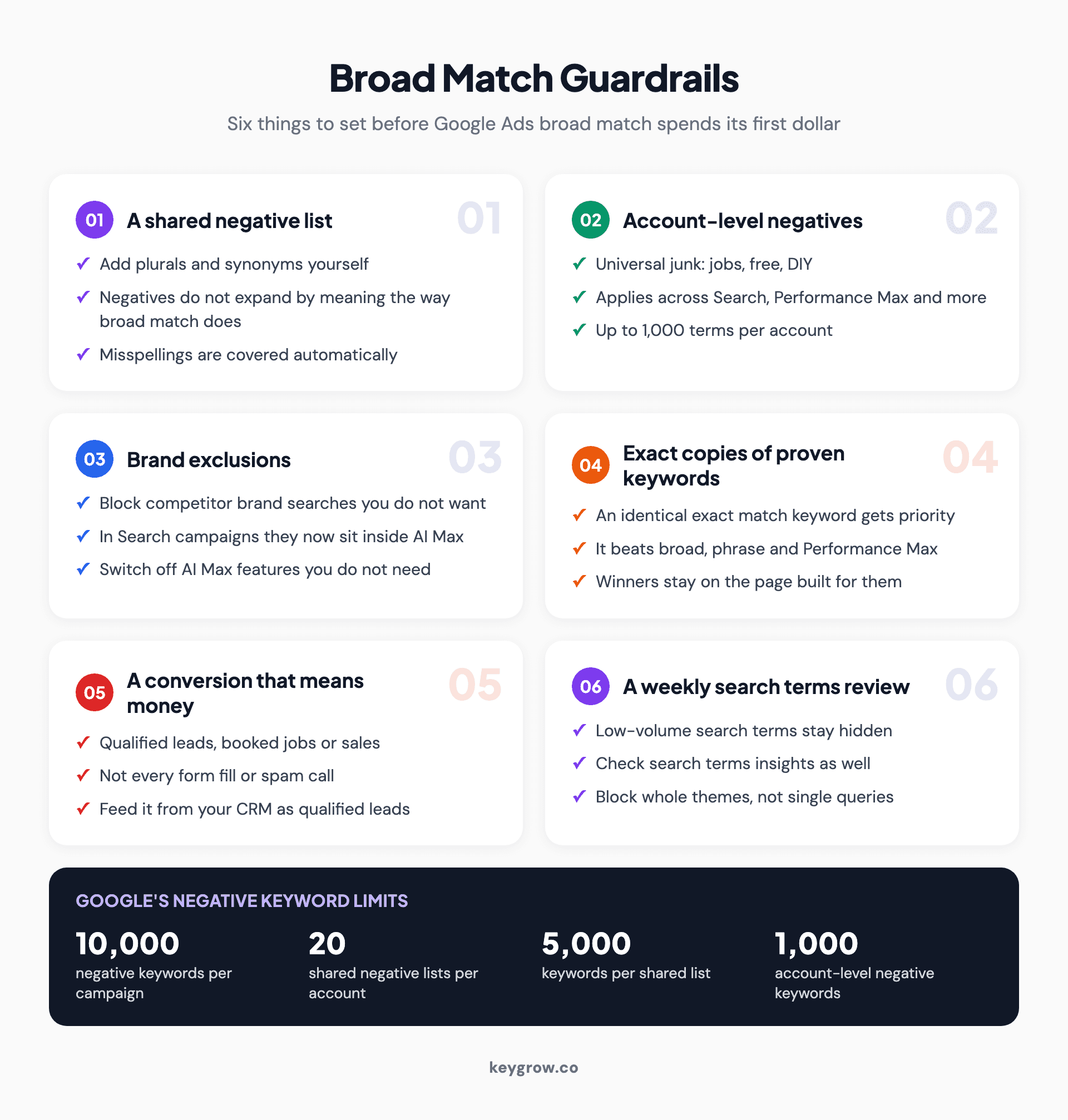
Checklist of six Google Ads broad match guardrails: a shared negative list with plurals and synonyms, account-level negatives, brand exclusions, exact copies of proven keywords, a qualified-lead conversion goal and a weekly search terms review, plus Google's negative keyword limits.
When to stay on phrase or exact
Stay tight when conversions are scarce, leads need filtering, the budget is already capped, or your search terms mean different things to different people.
That covers more businesses than Google's documentation lets on:
- Campaigns under about 30 conversions a month, which describes plenty of single-location service businesses.
- Lead gen accounts that can't yet tell Google which leads turned into customers.
- Campaigns limited by budget, where exact and phrase can't fund the searches you already have.
- Brand campaigns, where exact led Optmyzr's 2026 data on almost every metric.
- Niches where one phrase covers buyers, sellers, students and job hunters.

A single-story house with a front lawn, representing the homeowners a cash home buyer's Google Ads campaign needs to reach.
Skip the negatives and broad match turns into a donation to Google.
We saw it with a cash home buyer whose ads pulled in plenty of leads, most of them junk. More traffic wasn't the answer. Filtering was: serious-intent keywords in single keyword ad groups, negative keywords, and qualifying language in the ads. Between December and January, serious leads went up 600% with no increase in budget, and cost per lead dropped from $313 to $124. The account gathered conversion data first and moved to automated bidding after.
That order is the lesson. Tight match types first, automation once the data exists.
Now the part agencies tend to skip. If you run one campaign, get a handful of leads a month, and your exact and phrase keywords already spend the whole budget, you don't need broad match. You don't need us to manage that decision either. Keep the keywords tight, read the search terms every Friday, and put any spare money into the landing page.
FAQs
How does broad match work in Google Ads?
Broad match lets your ad show on any search Google judges related to your keyword, including searches that don't contain its direct meaning. Google weighs the searcher's recent activity, your landing pages and your other keywords to decide what counts as related.
What's a benefit of using broad match keywords?
Reach. Google says broad match helps you attract more visitors, spend less time building keyword lists and focus spending on keywords that work, and it gives Smart Bidding more searches to learn from. That benefit only holds when the bidder has good conversion data to separate useful searches from junk.
Is broad match better than exact match?
Not on efficiency, on average. In Optmyzr's February 2026 data from 30,000 accounts, exact match had a lower cost per non-brand conversion, $16.91 against $24.11, and a higher click-through rate. Broad match wins on reach, so it earns its place once exact keywords have captured most of the searches open to them.
Can you use broad match with Manual CPC?
You can add broad match keywords to a Manual CPC campaign, but Google advises against it. Google calls Smart Bidding critical with broad match because each search needs its own bid. AI Max search term matching doesn't work with Manual CPC at all.
What happened to broad match modifier?
Google retired it. In February 2021 Google began folding broad match modifier into phrase match, and since July 2021 you can't create new modifier keywords. Old ones still run, but they behave exactly like phrase match.
How is AI Max different from broad match?
AI Max is a bundle of features inside Search campaigns, not a match type. Its search term matching uses broad match plus keywordless technology, and the bundle also includes text customization and final URL expansion. Campaigns that used the campaign-level broad match setting began moving to AI Max in September 2026.
Turn it on with guardrails
If all four answers were yes, don't convert every keyword at once. Run an experiment. Google's broad match experiment splits traffic inside your existing campaign: the control keeps your current keywords, and the trial adds broad versions of them. It needs a Smart Bidding strategy and won't run with a shared budget or a portfolio strategy.
Then give it room. Adding keywords counts as a composition change to the bid strategy, and Google says calibration typically takes one to two conversion cycles. Block plainly wrong searches right away, but leave targets and budgets alone for the first two weeks. Judge the result on cost per qualified lead across at least 30 conversions.
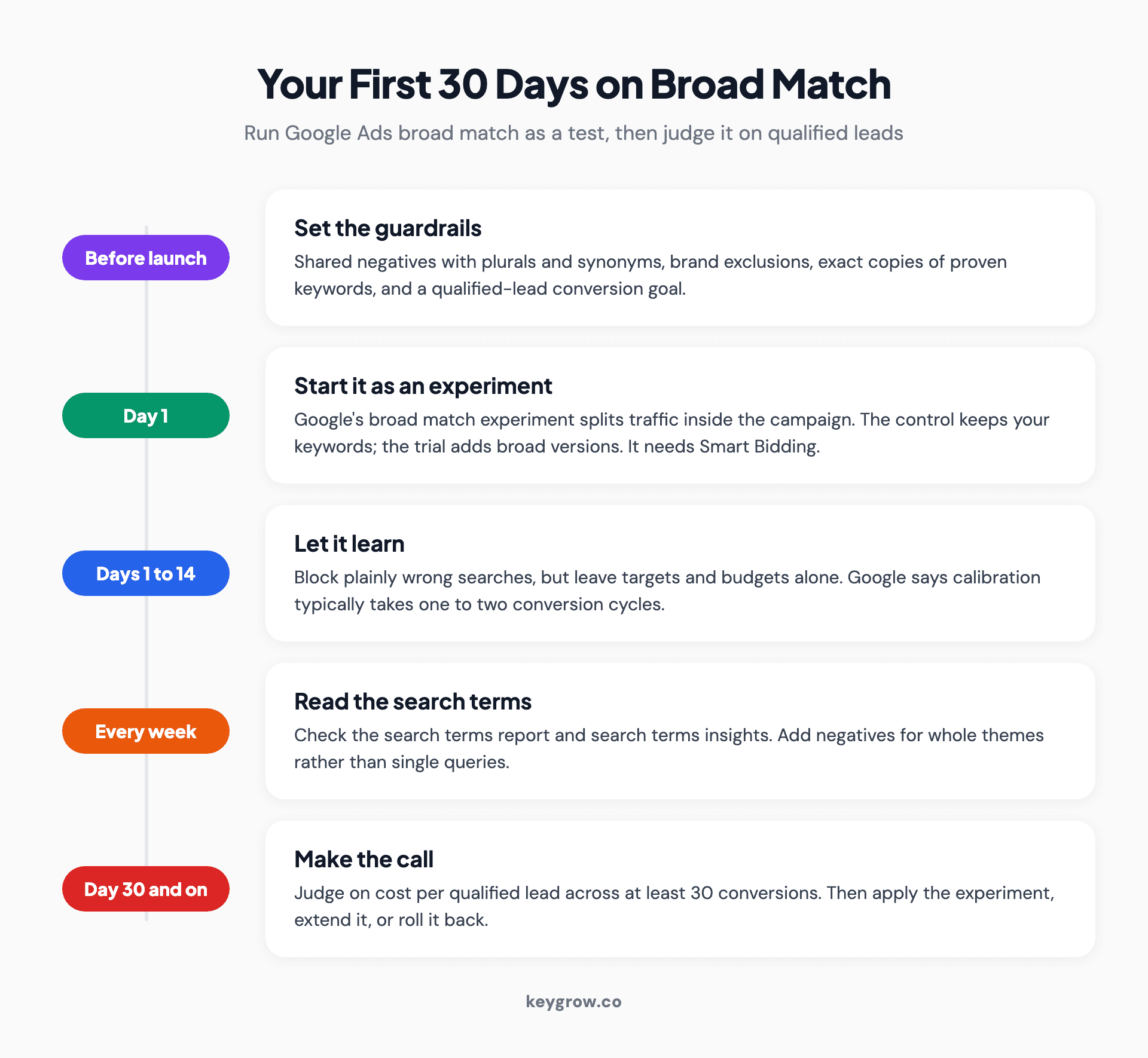
Timeline of the first 30 days on Google Ads broad match: guardrails before launch, an in-campaign experiment, a two-week learning window, weekly search terms reviews, and a decision on cost per qualified lead after 30 conversions.
If you'd rather have someone run the test and read the search terms with you, our PPC team does this for clients every week and reports on cost per qualified lead, not clicks. We work month-to-month.