

Do your conversions have different values? If one sale can be worth $40 and the next $400, and you can tell Google Ads which is which, use Target ROAS. If every conversion is worth roughly the same to you, or you can't measure the difference yet, use Target CPA. That is the whole target ROAS vs target CPA decision, and most accounts can settle it before lunch.
Both are Smart Bidding strategies. The store and roofer examples below are illustrations, not client results. Side by side, the two look like this:
| Target CPA | Target ROAS | |
|---|---|---|
| Optimizes for | As many conversions as possible at an average cost | As much conversion value as possible at an average return |
| History needed to switch it on | None | 15 conversions in the past 30 days (Search and Shopping) |
| Needs conversion values | No | Yes, at least two different values |
| Judge results over | At least 30 conversions | At least 50 conversions |
| Best fit | Leads or sales of similar value | Sales or leads whose values differ, reported accurately |
| Typical failure | Buys the cheapest conversions, which are often the worst | Chases values that are wrong, guessed or late |
| To get more volume | Raise the target | Lower the target |
Same click, two bids: the worked example
Target CPA pays roughly the same for every conversion. Target ROAS pays in proportion to each conversion's value. Two searches show the difference.
A hypothetical store sells espresso machines at $400 and descaling kits at $40, both at a 40% gross margin. Kit shoppers buy about 5% of the time and machine shoppers about 2%. We made both rates up, but cheaper items usually do convert more readily.
Google doesn't publish its formula, but a simplified model gets the direction right: the bid is roughly the chance a click converts times what a conversion may cost.
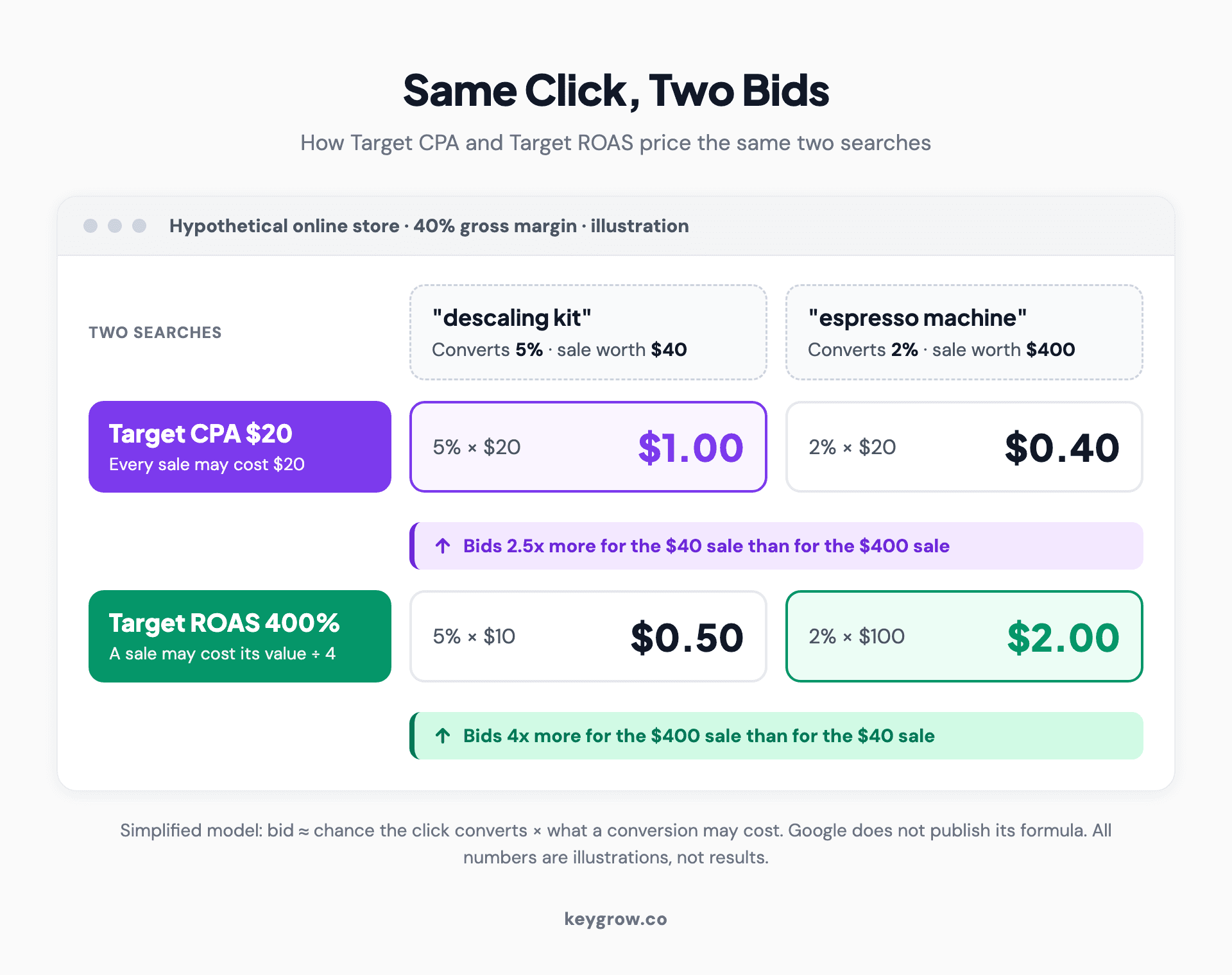
Annotated worked example comparing Target CPA and Target ROAS bids for the same two searches in a hypothetical store: on a $20 Target CPA the descaling kit click gets a $1.00 bid and the espresso machine click $0.40, while on a 400% Target ROAS the kit click gets $0.50 and the machine click $2.00.
Same store, opposite priorities. Now take the ad cost out of each sale.
| Per sale (illustration) | Descaling kit ($40) | Espresso machine ($400) |
|---|---|---|
| Gross profit at a 40% margin | $16 | $160 |
| Ad cost on a $20 Target CPA | $20 | $20 |
| Profit after ads, Target CPA | -$4 | +$140 |
| Ad cost on a 400% Target ROAS | $10 | $100 |
| Profit after ads, Target ROAS | +$6 | +$60 |
The CPA target loses $4 a kit yet chases kits harder, since they're cheaper to win. Its $140 per machine mostly stays on paper, because a $0.40 bid loses most auctions where a competitor values that shopper properly. The ROAS target clears break-even on both, which at a 40% margin is 1 ÷ 0.40 = 250%.
Change one fact and the gap disappears. If the store sold only machines, a 400% Target ROAS would allow $100 per conversion, exactly what a $100 Target CPA allows. With equal values the two targets are one instruction written two ways, and Target CPA is the simpler one to run.
The lead generation version, where the value shows up late
Lead generation runs the same math with one complication: nobody knows a lead's value when the form arrives. It shows up weeks later in your CRM.
Take a hypothetical roofer. Repair requests close 40% of the time at an average of $800, so each repair lead is worth 0.40 × $800 = $320 in expected revenue. Replacement quotes close 15% of the time at an average of $12,000, which puts each one at 0.15 × $12,000 = $1,800.
Repair searchers fill in the form more often, 8% against 3%, so a $100 Target CPA bids $8.00 for a repair click and $3.00 for a replacement click. A 400% Target ROAS lets each lead cost a quarter of its value, which flips the bids to $6.40 and $13.50.

Two roofers in safety harnesses working on the shingles of a residential roof.
The catch: Google can't see the $12,000 job at the moment of the click, so you have to tell it. Google's value-based bidding guide accepts revenue or proxy values like a lead score, as long as at least two different values come through. In practice that means a separate conversion action per lead type with a fixed value from your close rates, or each closed job's real amount, sent back from your CRM as an offline conversion. Our guide to working out what a lead is worth covers the close-rate math.
How much data does each target need?
Target CPA can start with no conversion history. Target ROAS on Search needs 15 conversions in 30 days and two or more distinct values.
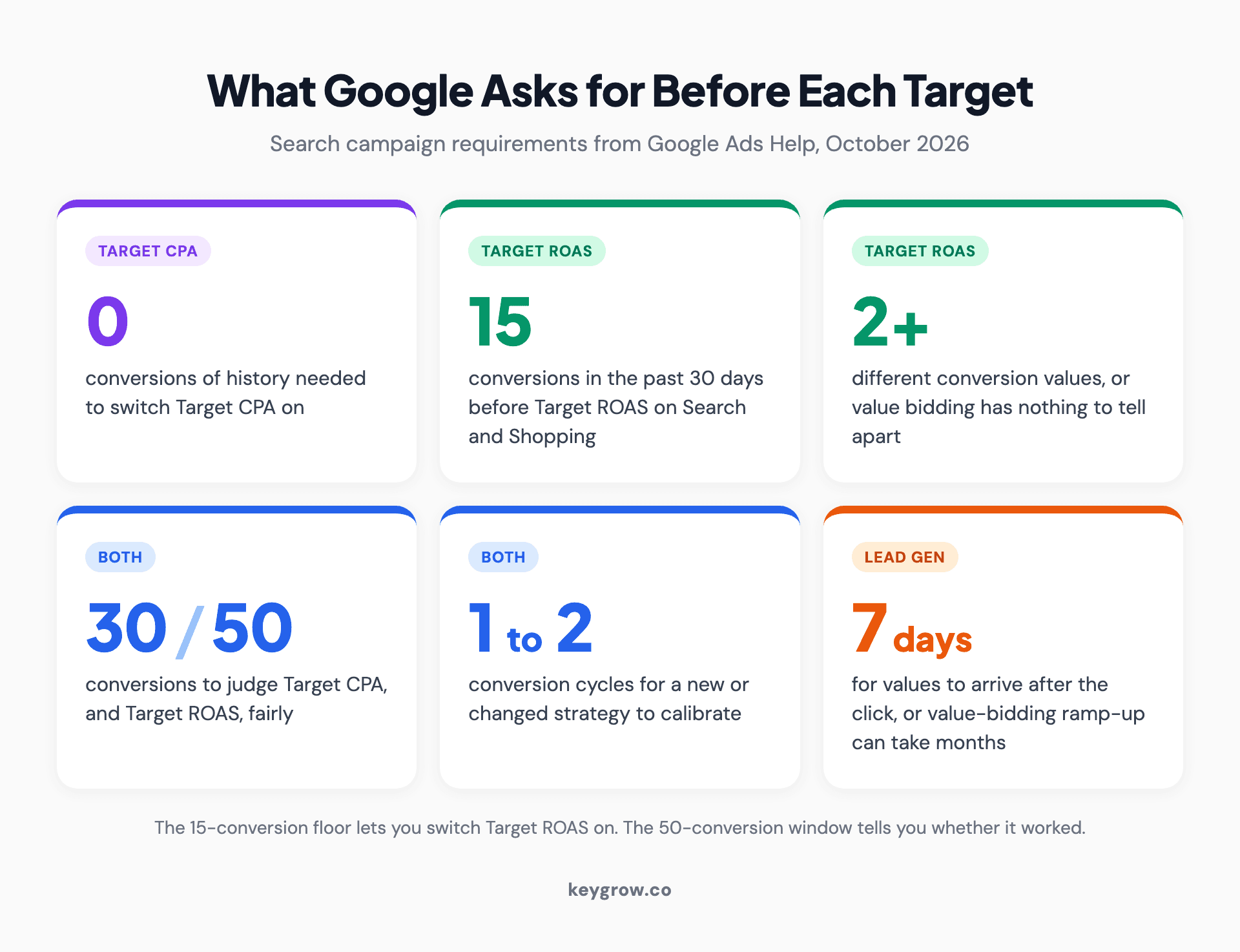
Six sourced Google Ads requirements for choosing between Target CPA and Target ROAS: zero conversions of history to start Target CPA, 15 conversions in 30 days for Target ROAS on Search, two or more different conversion values, 30 conversions to judge Target CPA and 50 to judge Target ROAS, one to two conversion cycles to calibrate, and value uploads inside seven days of the click.
Google's Target ROAS documentation counts those 15 conversions at the conversion tracking level. Google suggests judging Target ROAS over at least 50 conversions (30 for Target CPA), so an account doing 16 a month needs about three months before the verdict means much.
Learning takes one to two conversion cycles, the usual gap between a click and its conversion. Google says that if no conversion data comes back within seven days of the click, or all of it takes longer than seven days to arrive, the initial ramp-up of value bidding "may take several months."
A CPA target buys the cheapest conversions, not the best ones
Target CPA counts every conversion as identical. If junk form fills and serious inquiries both count as one, the bidder buys whichever is cheaper, usually the junk.

A white and green For Sale sign standing outside a property.
We saw how much of this sits outside the bid strategy with a cash home buyer who was drowning in junk leads. Negative keywords, tighter match types and qualifying language in the ads stopped the wrong people clicking, and serious leads rose 600% between December and January without a bigger budget.
That's why we think more traffic is the wrong fix for bad lead quality. A lower CPA just buys more bad leads, faster.
So fix what you count first: a qualified lead from your CRM instead of every form submission. If the tag itself counts page loads or spam, start with the conversion tracking setup. Lead quality also sits near the top of what automated bidding cannot fix.
What changed in Google Ads in 2026
Both targets still exist. Google began renaming them in June 2026 without changing how they bid, then changed their budget-limited behavior in August.
Your account may still show the old names: "Maximize conversions with a Target CPA" and "Maximize conversion value with a Target ROAS."
The budget change went live on August 17, 2026 and finished rolling out on August 27. Before it, budget-limited campaigns on either strategy could beat their targets. Google's update notice gives the example of a $10 Target CPA that had been achieving $5: it now drifts toward $10 unless you lower the target, and Google won't lower it for you. Campaigns that aren't limited by budget behave as before.
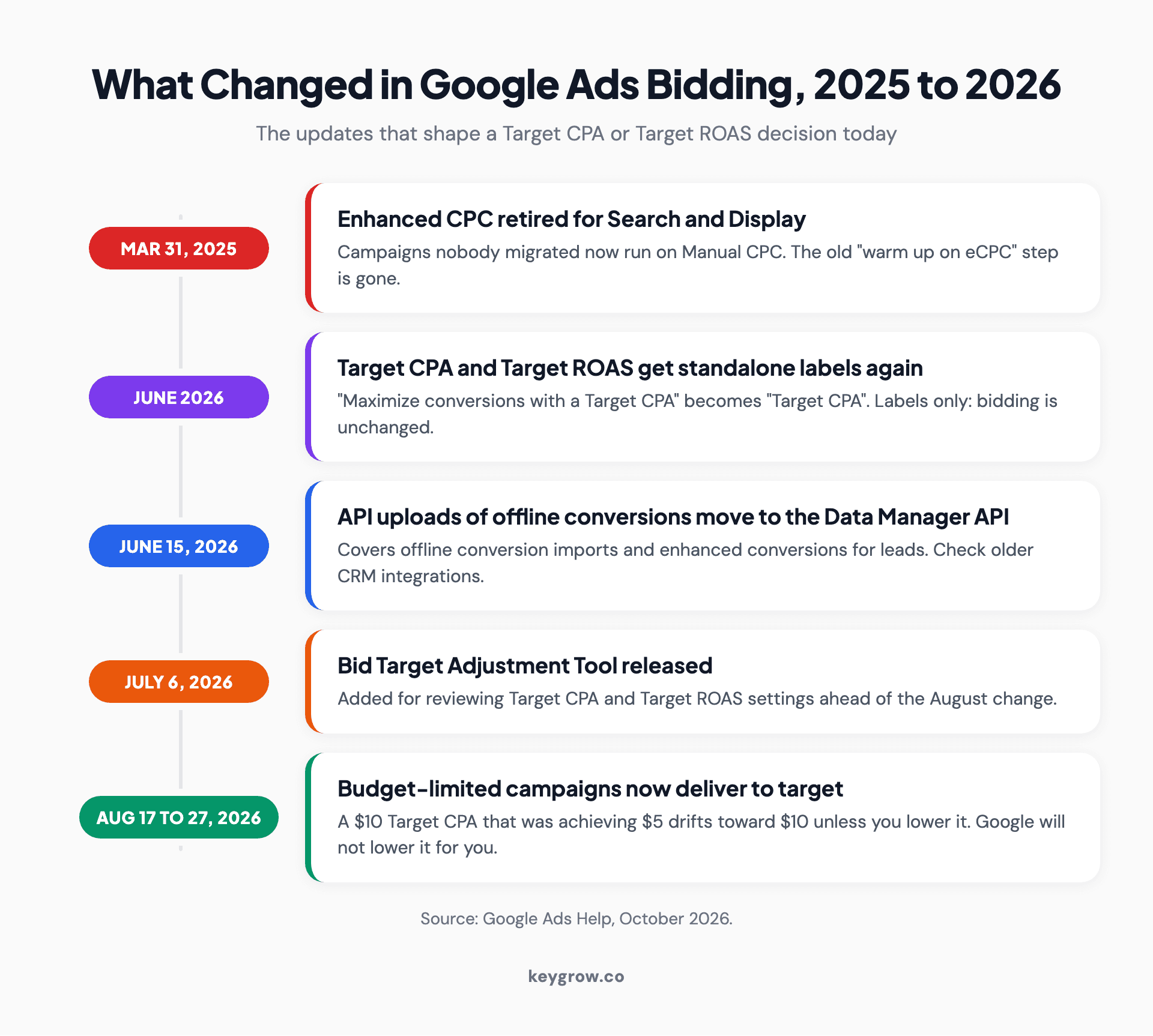
Timeline of Google Ads bidding changes from 2025 to 2026: Enhanced CPC retired for Search and Display in March 2025, Target CPA and Target ROAS relabeled as standalone strategies from June 2026, API uploads of offline conversions moved to the Data Manager API on June 15, 2026, a Bid Target Adjustment Tool added on July 6, 2026, and budget-limited target campaigns delivering to target from August 17 to 27, 2026.
A loose target set "to give the algorithm room" no longer hides behind the budget cap: the number in the box is now the number you get.
Set the first target from your own numbers
Start from recent history, not the number you wish for: 30 days of cost per conversion, or four weeks of conversion value divided by cost.
For Target CPA, divide spend by conversions over the last 30 days, leaving out the most recent conversion-delay window. The roofer spent $4,500 and got 45 leads, so it starts at $100. Set $60 just because it's the number you want, and the bidder sits out most auctions. Google warns that a target set too low can mean fewer conversions overall.
For Target ROAS, take the "Conv. value/cost" column for the prior four weeks, again excluding the delay window, and multiply by 100. The store spent $3,000 and recorded $12,600 in conversion value: 420%. Google says to set the target from that four-week figure, so 400% is a sensible opening number, well clear of the 250% break-even. Our break-even ROAS calculator runs that check for any margin.
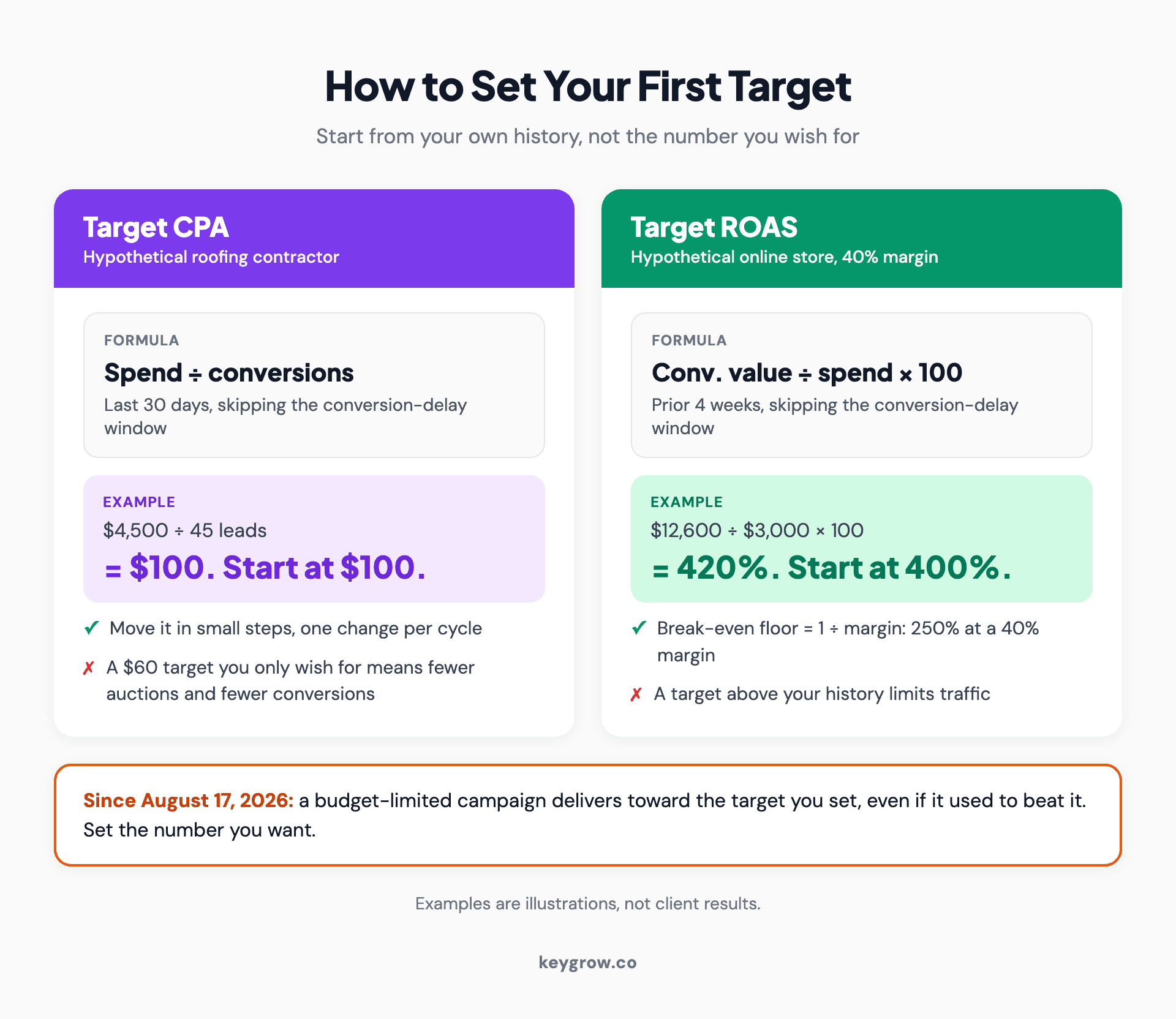
Two-card guide to setting a first Target CPA and Target ROAS from history: Target CPA equals spend divided by conversions over the last 30 days, shown as $4,500 divided by 45 leads equals $100, and Target ROAS equals conversion value divided by spend over the prior four weeks, shown as $12,600 divided by $3,000 equals 420%, with a break-even floor of 250% at a 40% margin.
If you're switching an existing campaign, report conversion values on Target CPA first. Google's pages variously ask for three weeks, four weeks or up to three conversion cycles, so use whichever is longest for you. Then give the new target one to two conversion cycles before you judge it.
When to stay on Target CPA, or skip both
Stay on Target CPA when values are similar, missing, guessed or slow to arrive. Skip both while a campaign is still collecting its first conversions.
A dental practice bidding on new-patient bookings, or a house cleaner with one price list, doesn't have enough value spread for a ROAS target to use. Moving either to Target ROAS adds a value pipeline to maintain and buys nothing.
A brand-new campaign can technically run Target CPA, but one with four conversions a month is a guess with a settings page attached. Google's advice for automated bidding without enough data is to build conversions first on Maximize clicks or Manual CPC.
Here is the part agencies rarely say out loud. If you run one campaign with one conversion value and a steady 30 or more conversions a month, you don't need us for this. Set Target CPA from your last 30 days, look at it once a conversion cycle, and put the fee you saved into your landing page.
FAQs
Is Target ROAS better than Target CPA?
Neither is better in general. Target ROAS wins when conversions have meaningfully different values and you can report them accurately. Target CPA wins when values are similar or unknown, and it needs less data to run well.
Can I use Target ROAS for lead generation?
Yes, if your leads carry at least two different values. Those can be fixed values per lead type, lead-score values or real amounts from your CRM. Without values, every lead looks identical to the bidder, and Target CPA is the better choice.
How many conversions do I need for Target ROAS?
For Search and Shopping campaigns, Google requires at least 15 conversions in the past 30 days at the conversion tracking level. It also suggests judging Target ROAS over at least 50 conversions before trusting the results.
What is the difference between Target ROAS and Maximize conversion value?
Maximize conversion value spends your full budget to get as much conversion value as it can, with no efficiency limit. Target ROAS adds the return you want, so it may underspend when it can't find enough value at that return.
Before you flip the bid strategy
Ask the opening question again: do your conversions have different values, and can Google see them? If both answers are yes and you clear 15 conversions a month, Target ROAS is worth the setup. If either answer is no, Target CPA is the right call for now, and there is nothing second-rate about it.
If you'd rather have someone check the conversion setup and values first, that review is part of our PPC management, which runs month to month.


