

Fund Google Ads first. Add Microsoft Ads once your Google campaigns make money, as a test with a slice of the budget and a review date. The one case where Microsoft earns a place on day one: you sell to businesses whose buyers search from work computers, and Google's prices have pushed you off the terms that matter.
That is the verdict on Microsoft Ads vs Google Ads for most businesses in 2026, and the reasoning is mostly arithmetic. Google carried 85.19 percent of US search traffic in September 2026, and 94.13 percent on phones, according to StatCounter. Bing, Yahoo and DuckDuckGo, the engines that show Microsoft's ads, carried 14.28 percent between them. Their clicks cost less, though by less than most comparison articles claim, because the number they quote comes from 2017.
Every figure below is dated and sourced.
Choose Google if, choose Microsoft if
Google wins on volume, phones and speed of learning. Microsoft wins on desktop buyers, B2B job data and thinner auctions, once Google already works.
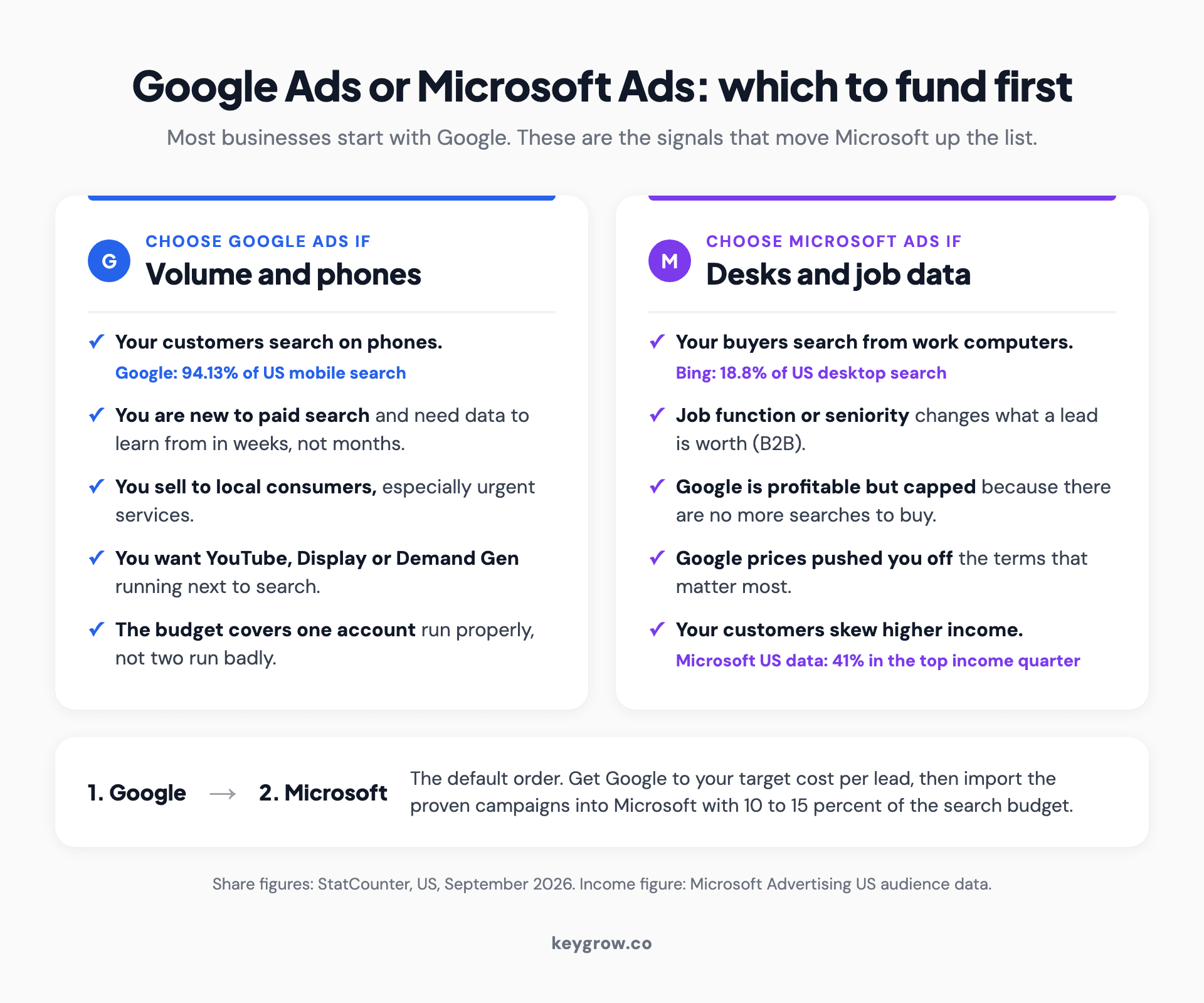
Two comparison cards showing when to choose Google Ads (phone searchers, new accounts, local consumer services, YouTube and Display, one-account budgets) and when to choose Microsoft Ads (desktop buyers, B2B job data, Google campaigns capped by volume, priced-out terms, higher-income customers).
Google is the default for almost everyone. Phone searches happen there, and a new account learns in weeks rather than months. If the budget covers one account run properly, run the Google one.
Microsoft goes first only when your buyers sit at desks, a lead's value depends on their job, and Google has priced you off the terms that matter. Otherwise, add it once Google is profitable. It pays most when Google is capped, with no more searches to buy.
Microsoft Ads vs Google Ads, side by side
Google reaches more people with more formats. Microsoft reaches a smaller, desktop-heavy audience for less per click, plus LinkedIn data Google cannot match.
| Google Ads | Microsoft Ads | |
|---|---|---|
| US search share, Sept 2026 | 85.19% overall, 74.71% on desktop, 94.13% on mobile | Bing 9.89% overall, 18.8% on desktop, 2.15% on mobile. With Yahoo and DuckDuckGo: 14.28% |
| Cost per click | Higher. Median $1.33 (Databox, Nov 2024). Search CPCs up 1% year over year in Q2 2026 (Tinuiti) | Lower but rising. Median $0.97 (Databox, Nov 2024). CPCs up 19% year over year in Q2 2026 (Tinuiti) |
| Audience | Almost everyone online, dominant on phones | Desktop-heavy. 54% under 45, 41% in the top quarter of household income (Microsoft's US data) |
| Targeting | Keywords, audience segments, Customer Match, demographics, locations | The same, plus LinkedIn company, industry, job function and job seniority as search bid adjustments |
| Ad formats | Search, Shopping, Performance Max, AI Max, Demand Gen, Display, YouTube, App | Search, Dynamic Search ads, multimedia ads, Shopping, Performance Max, AI Max, Audience ads (native, display, video, CTV), vertical ads |
| Search partners | Hundreds of non-Google sites plus YouTube, off with one setting per Search campaign | Yahoo, AOL, DuckDuckGo, Ecosia and syndicated sites such as CBS and Forbes |
| Ads in AI answers | Above, below and inside AI Overviews (inside: English, 12 countries including the US). No opt-out, no separate reporting | In Copilot in every English-speaking market since March 2025, built from your existing ads |
How much of search does Microsoft reach?
In the US, Bing handled 9.89 percent of search traffic in September 2026: 18.8 percent on desktop and 2.15 percent on phones, per StatCounter.
Add Yahoo's 2.64 percent and DuckDuckGo's 1.75 percent, and the three engines carry 14.28 percent. For every 100 visits Google sent to websites in September, they sent about 17. On desktops, about 33. On phones, about 6.
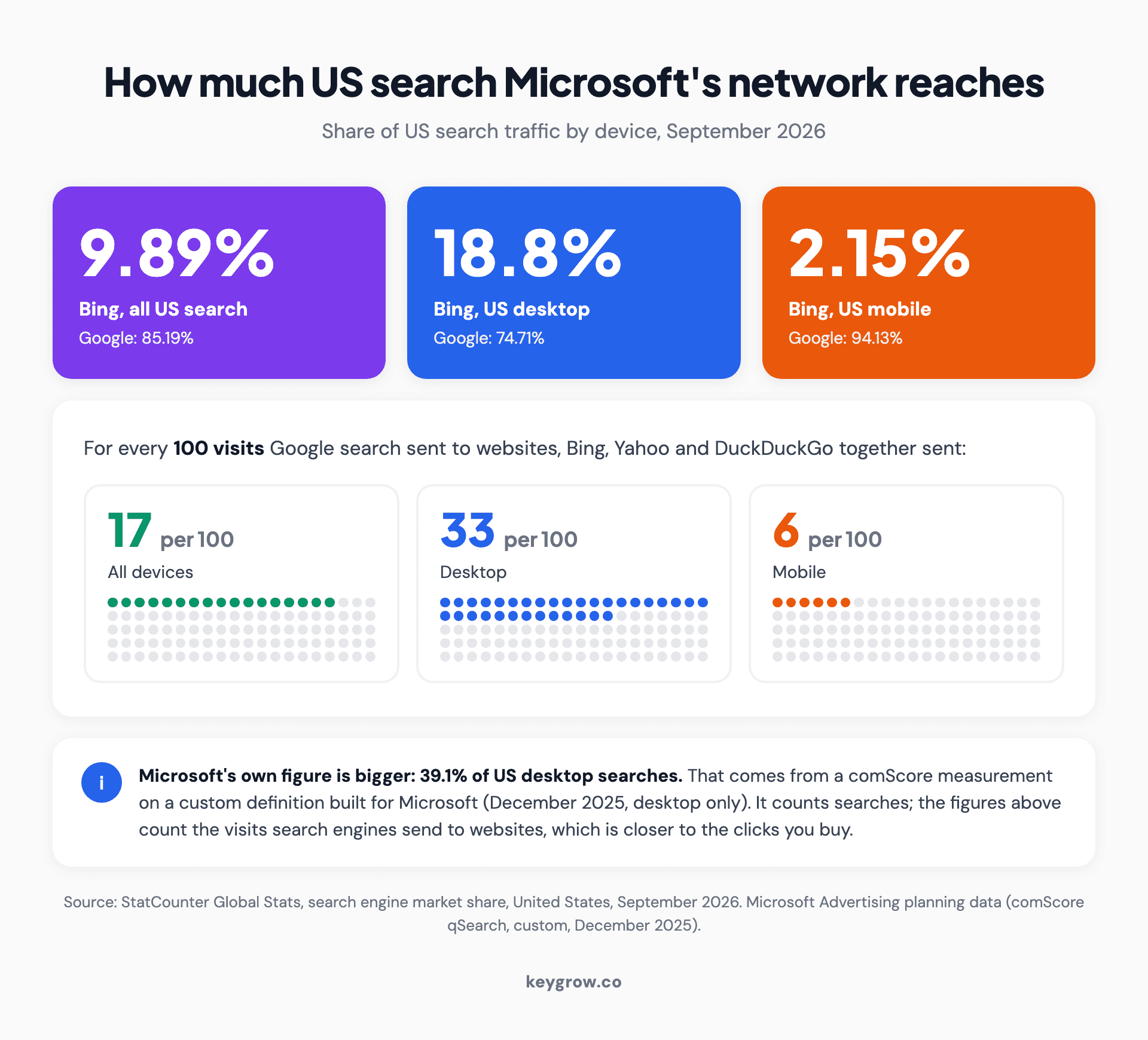
Stat strip of US search share in September 2026: Bing at 9.89 percent of all search traffic, 18.8 percent on desktop and 2.15 percent on mobile, with Bing, Yahoo and DuckDuckGo sending about 17, 33 and 6 visits for every 100 from Google across all devices, desktop and mobile.
Microsoft's own advertiser planning data claims 39.1 percent of US desktop searches, from a comScore measurement built on a custom definition for Microsoft (December 2025). That figure counts searches. StatCounter counts the visits search engines send to websites, closer to what you buy: clicks. Plan with StatCounter's smaller number and let the account prove the bigger one.
Microsoft clicks are cheaper, but the famous 33 percent is from 2017
Microsoft clicks usually cost less than Google's. The gap is smaller than the famous 33 percent, and it shrank in 2026 as Microsoft prices rose.
That 33 percent traces back to a WordStream study of 1,242 US accounts that advertised between July and September 2017. The same study reported a $1.54 average CPC, a 2.83 percent click-through rate and a 2.94 percent conversion rate. Bing Ads did not even become Microsoft Advertising until April 2019. Those figures still turn up in 2026 posts, sometimes beside this year's Google numbers, where the old CPC flatters Microsoft and the old rates get used against it.
Databox's benchmark groups show a smaller gap: a November 2024 median CPC of $0.97 on Microsoft and $1.33 on Google, roughly 27 percent lower, with Microsoft's click-through rate about half of Google's (2.14 against 4.31 percent). Then Tinuiti's Q2 2026 benchmark found Microsoft search CPCs up 19 percent year over year, against 1 percent for Google overall, as reported in July.
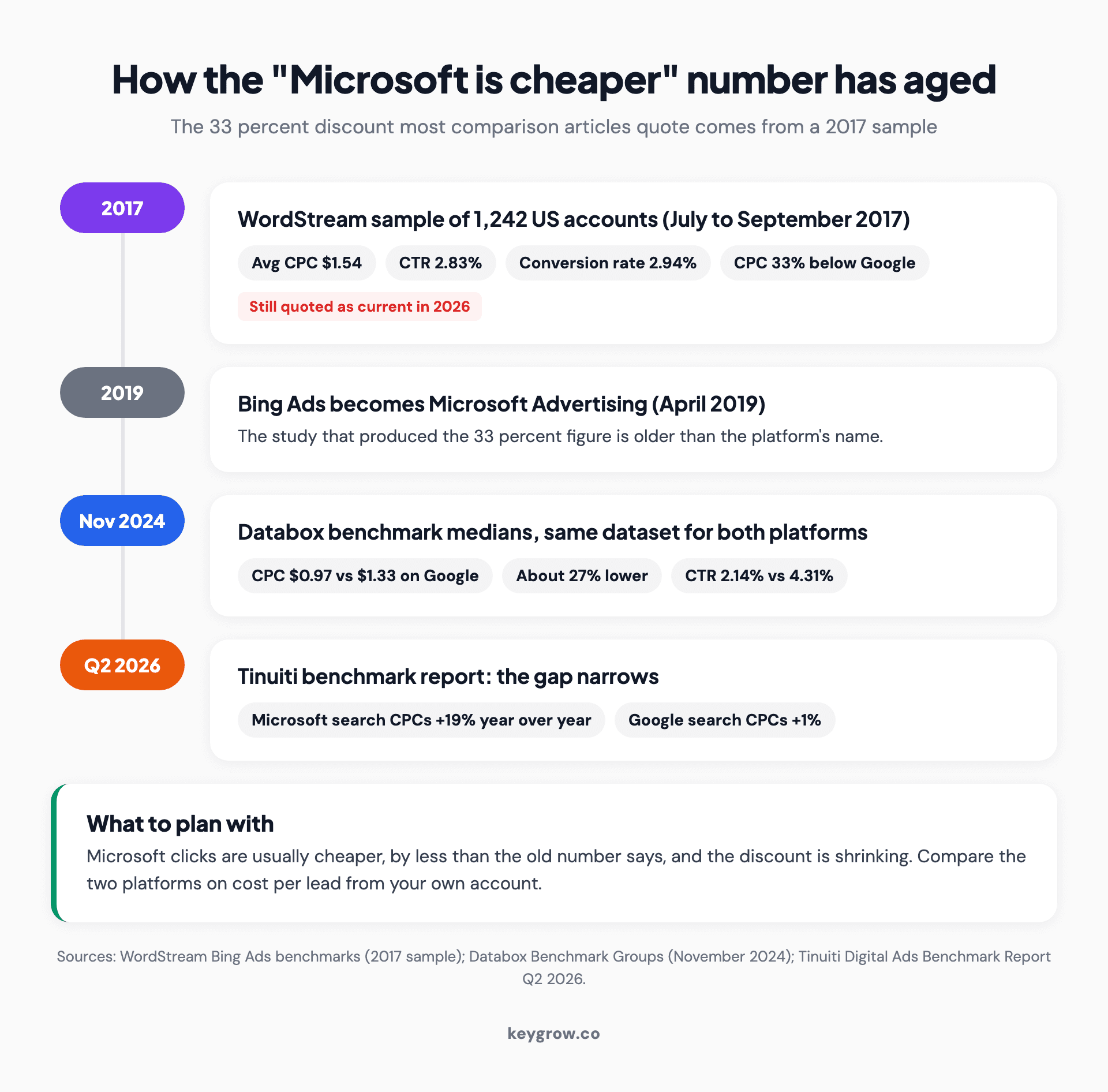
Timeline of the Microsoft Ads cost advantage: a 2017 study of 1,242 accounts found clicks 33 percent cheaper, November 2024 benchmark medians showed $0.97 against $1.33, and in Q2 2026 Microsoft CPCs rose 19 percent year over year against Google's 1 percent.
Judge the two on cost per lead. A 27 percent discount on a click is worth nothing if the click converts 27 percent less often. Weighing cost per click against cost per customer works here the same way it does for Google against Meta.
Who is on the other end of a Bing search
Searchers on Microsoft's network skew toward desktops and higher incomes more than toward older ages, per StatCounter and Microsoft's US audience data.
The usual line is that they are older, yet 54 percent of US users on Microsoft's search network are under 45. Money and education stand out more: 41 percent have household income in the top quarter, and 49 percent graduated from college.

An office worker typing at a laptop on a shared desk in a modern office with a blue feature wall.
Device matters too. Windows ships with Edge, and Edge searches Bing unless someone changes it, so a buyer at a work desk may well be searching on Microsoft. A dental practice whose patients book from their phones is mostly a Google business. A firm selling payroll services to accounting practices is a different case.
What LinkedIn targeting does inside a search campaign
In Microsoft search campaigns, LinkedIn profile targeting raises or lowers your bid for matching people. It does not stop the ad showing to everyone else.
Several comparison posts promise search ads shown only to vice presidents at software companies. Microsoft's help page says LinkedIn profile targeting "will not narrow your ads' audience" and works as "bid only," not "target and bid."
You can adjust bids by company (up to 1,000 per ad group), industry, job function and, new in 2026, job seniority from Entry to CXO, and exclude the industries that click and never buy.
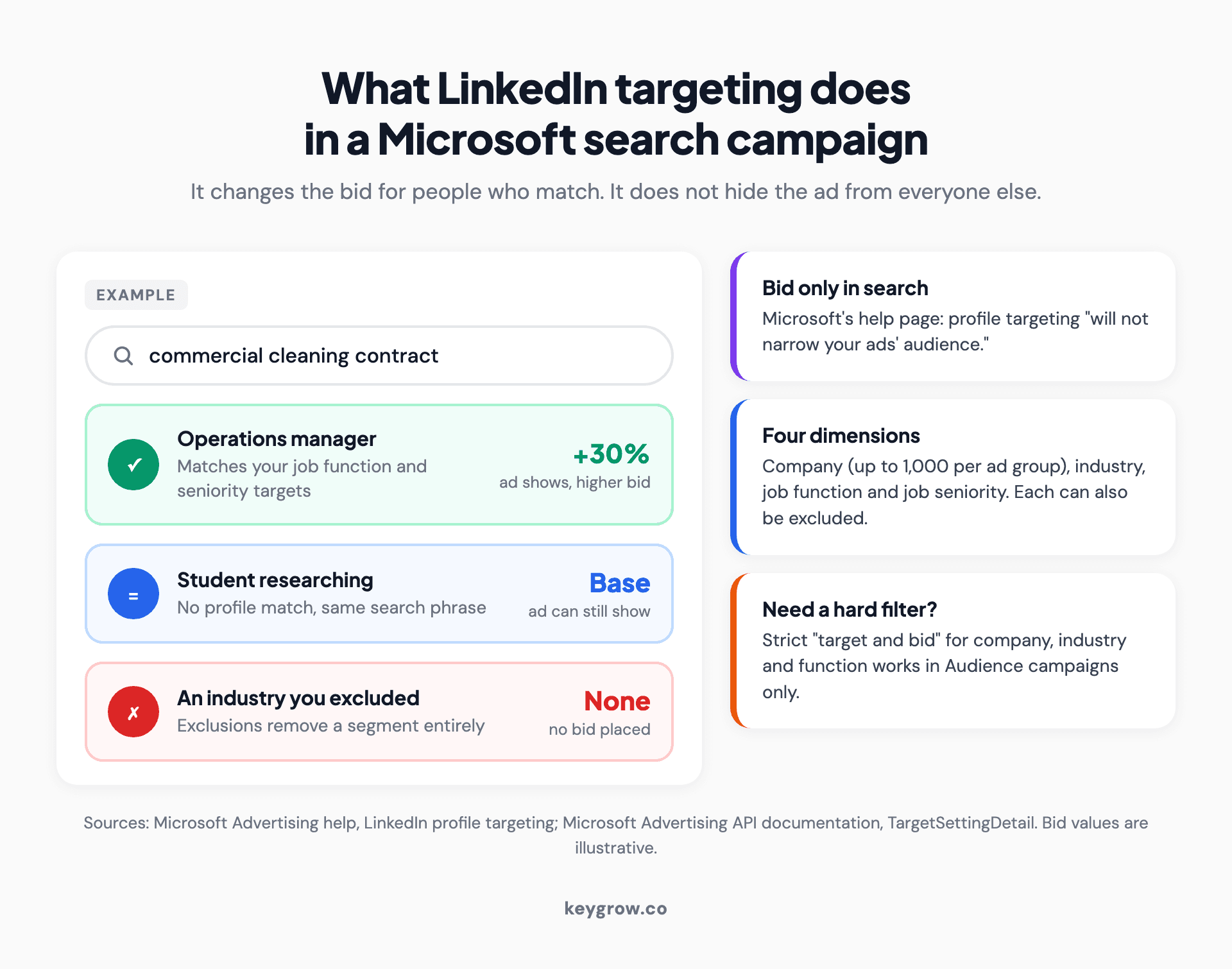
Annotated example of LinkedIn profile targeting in a Microsoft search campaign: an operations manager matching the target gets a 30 percent higher bid, a student searching the same phrase still sees the ad at the base bid, and excluded industries are not bid on.
Microsoft's API documentation allows a hard filter only in Audience campaigns, which run on MSN, Outlook and partner sites rather than in search results. In search you buy intent from everyone, and pay a premium for the people whose profile says they can sign the order.
How to import your Google campaigns without importing the problems
Microsoft's Google Import copies campaigns, keywords, ads, assets, targeting, bids and budgets in a few clicks. The review afterward is where the real work is.
1. Fix Google first. The import copies everything, including the broad match keyword that has bought junk clicks for months. Clean that up with our guide to negative keywords in Google Ads, then import only campaigns that already hit your target cost per lead.
2. Install the UET tag. Microsoft records conversions with its own tag, Universal Event Tracking. Until it fires, automated bidding has nothing to learn from.
3. Review what came across. Microsoft's checklist puts budgets, bids, locations and tracking first, then keywords, match types and negatives, then the ads. Some extensions may need fixing by hand, Microsoft warns. Check each campaign's bid strategy too. Microsoft now pairs a target CPA with Maximize conversions and a target ROAS with Maximize conversion value, and our guide to target CPA or target ROAS covers which to pick.
4. Set the networks. "Microsoft sites and select traffic" drops the wider partner pool, so start there for lead generation and move to the full network once partner traffic converts. A Microsoft support moderator confirmed in January 2026 that search campaigns can spill into audience placements, and recommended website exclusions to limit that.
5. Limit what the sync can overwrite. Scheduled imports keep Microsoft in step with Google daily, weekly or monthly, and they can undo budget and bid changes you made in Microsoft. Switch those fields off.
None of this needs an agency. Microsoft built the import for people who run their own Google account, and an afternoon covers it.
Give Microsoft a slice and a deadline
Start Microsoft at roughly its share of search, 10 to 15 percent of your search budget for most US accounts, with a fixed review date.
That range mirrors the network's share, about 14 percent of US search traffic. Desktop-heavy B2B can justify up to about 25 percent, its share of desktop search. Mobile-first local services should start lower, or not at all.
Agree on the date and the bar before launch. A cost per lead within 20 percent of Google's on the same campaigns is a reasonable one. Conversions arrive slowly at Microsoft's volume, and a test with no end date runs forever on hope.
This is how we test any new channel or campaign. An eviction law firm came to us at 1 conversion a week, $240 each. We rebuilt the landing page, restructured the campaigns and ran side campaigns on small budget slices, and within a week it had 21 conversions at $31.79 each (September to October 2022). The page did much of that work, so credit the slices only for keeping each failed test cheap.
When Microsoft Ads is not worth the setup time
Skip Microsoft for now if Google is not profitable, tracking is broken, your customers search on phones, or nobody will check a second account weekly.
Any agency that adds Microsoft Ads to every proposal without asking where your customers search is selling, not consulting. On US phones, the engines carrying Microsoft's ads get 5.28 percent of search traffic. Google gets 94.13 percent.

A man looking down at the smartphone he is holding in both hands outside a building.
We would tell you to wait when:
FAQs
Is Microsoft Ads better than Google Ads?
For most businesses, not as the first platform. Microsoft is often the better second platform, with cheaper clicks and LinkedIn bid adjustments for B2B.
Is Microsoft Ads cheaper than Google Ads?
Usually per click, though by less than the 33 percent most articles repeat, a figure from a 2017 study. Databox's November 2024 medians were $0.97 on Microsoft against $1.33 on Google, and Tinuiti found Microsoft CPCs up 19 percent year over year in Q2 2026.
Which converts better, Microsoft Ads or Google Ads?
Neither has a proven edge. We could not find a current, credible benchmark that compares the two. The 2.94 percent Microsoft conversion rate that still circulates comes from a 2017 WordStream study. Compare cost per lead on the same campaigns in your own account.
Can I import my Google Ads campaigns into Microsoft Ads?
Yes. Microsoft's Google Import copies campaigns, keywords, ads, assets, targeting, bids and budgets, and it can repeat the import daily, weekly or monthly. You still need to install Microsoft's UET tag for conversion tracking, then review budgets, locations, match types and negatives.
Is Microsoft Ads worth it for a small business?
It is worth a test if your Google campaigns already make money and some customers search from desktops. If they mostly search on phones, or Google is not profitable yet, fix Google first.
Which one to fund first
Google, in almost every case. Get it to a cost per lead you would happily pay all day, then give Microsoft its slice and review date, sooner if your buyers are businesses searching from desks.
Our PPC management runs both platforms month to month, and if Microsoft is not worth adding to your account yet, we will say so.


