

Most small businesses should not start with YouTube ads. That is an odd thing for a PPC agency to say about a Google product, so here is the reasoning up front. YouTube ads for small business work when three things are already true: you capture most of the people searching for what you sell, your product is something buyers want to see before they commit, and you can fund the learning period Google itself recommends, which is about $100 a day until the campaign has 50 conversions. Miss any of those and a search campaign will make you more money first.
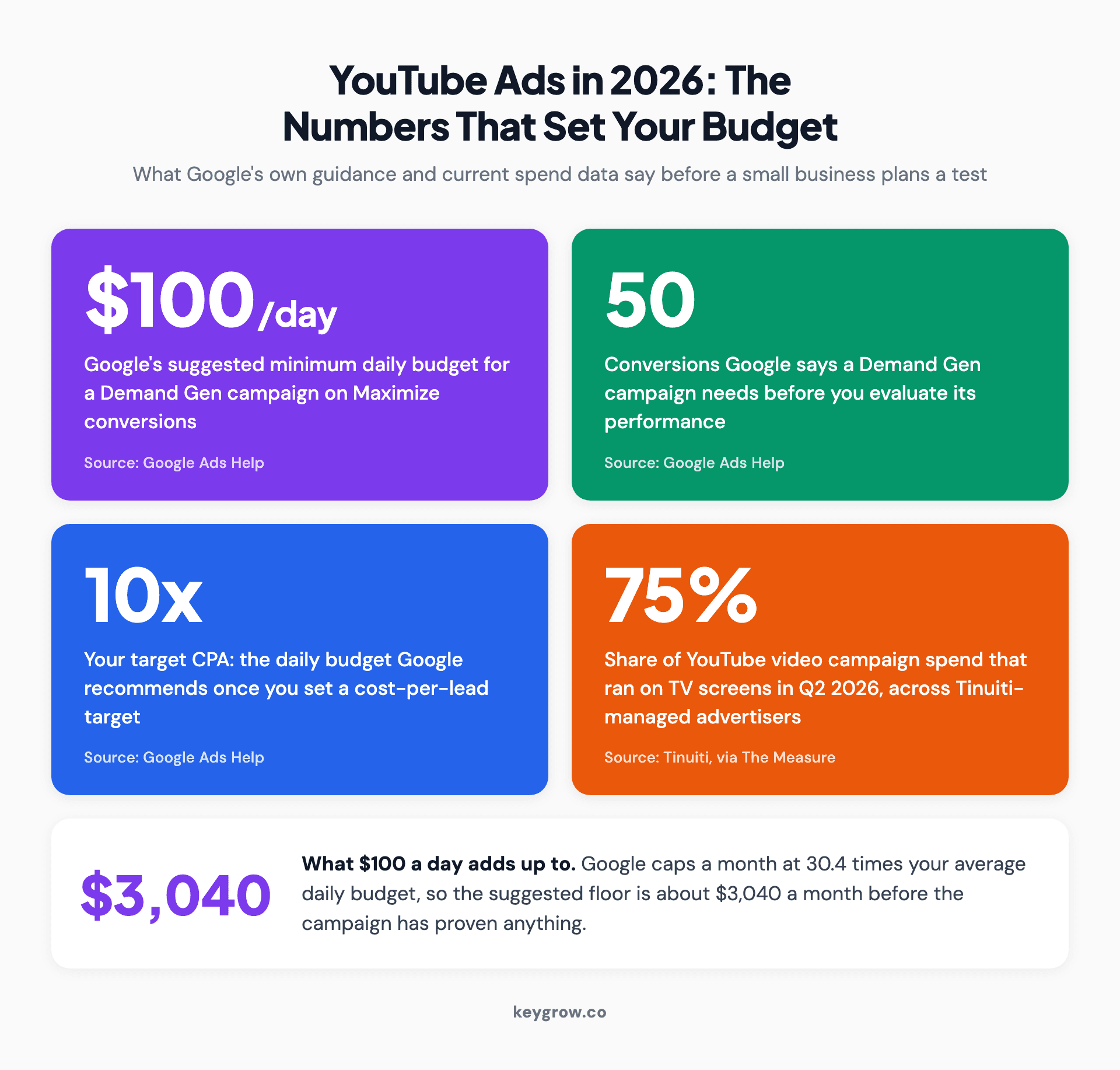
Stat strip of five sourced YouTube ads numbers for 2026: Google's $100 daily minimum for Demand Gen on Maximize conversions, its 50-conversion rule, its 10x target CPA budget rule, the 75 percent of YouTube video campaign spend that ran on TV screens in Q2 2026, and the $3,040 monthly cap at $100 a day.
YouTube does a different job than search
Search ads catch people already asking for what you sell. YouTube ads reach people watching something else, so they create demand instead of collecting it.
A plumber's search ad can ring the phone within the hour. A remodeler's YouTube ad plants a name that pays off days or weeks later as a search for that name, if you can trace it at all. That's why our guide on how to use Google Ads for a small business puts YouTube on the "later" list.
YouTube is also turning into television. In Q2 2026, TV screens took 75 percent of the spend on YouTube video campaigns among the advertisers Tinuiti manages, as reported by The Measure.

A bright living room with a large TV on a low wooden console, the kind of screen where most YouTube video ad spend now plays.
For a local business counting form fills, that shift is a warning. A living room TV is a fine place to be remembered and a poor place to ask for a click.
Are YouTube ads worth it for a small business?
Yes, once you win your local searches, sell something buyers want to see first, and can fund Google's learning period. Four signs say you're ready:
You already win the searches in your area. Your search campaigns are profitable but can't spend their full budget, because only so many people search "roof replacement" in your county each week. YouTube is one of the few levers that creates more searches.
You sell something people research with their eyes. Remodels, pools, landscaping, cosmetic dentistry, custom homes. A 30-second walk-through of a finished job does work no text ad can.
You have an audience worth reminding. Site visitors who didn't book, past customers, your email list. They already know your name.
Someone on your team can carry a video. The owner talking to camera on a real job site is about the cheapest credible ad a local business can make. Open on the viewer's problem in the five seconds before the skip button appears. A phone shoots it fine.

A camera operator filming a man speaking to camera, the simple talking-head setup that works for a small business video ad.
Wait if any of these describe you:
Until then, tighten the search campaigns and fix the page your ads land on, and keep the Google Business Profile reviews coming. That usually pays back faster than a first video campaign.
What you can buy on YouTube in 2026
Three campaign families cover YouTube now: Demand Gen for leads and sales, Video view campaigns for views, and Video reach campaigns for awareness.
Demand Gen is the one a lead-focused small business would use. It runs video and image ads across YouTube (including Shorts), Discover, Gmail and the Display Network unless you limit it to YouTube, and its YouTube placements bill per 1,000 impressions.
Older guides still teach Video action campaigns, TrueView discovery ads and overlay ads. Google stopped letting advertisers create Video action campaigns in April 2025 and moved the last of them into Demand Gen by April 2026, according to Google's upgrade notice.
The ads themselves come in six video formats: skippable in-stream, non-skippable in-stream, in-feed, bumper, Shorts and Masthead. The campaign decides which you get, and Google often picks the mix.
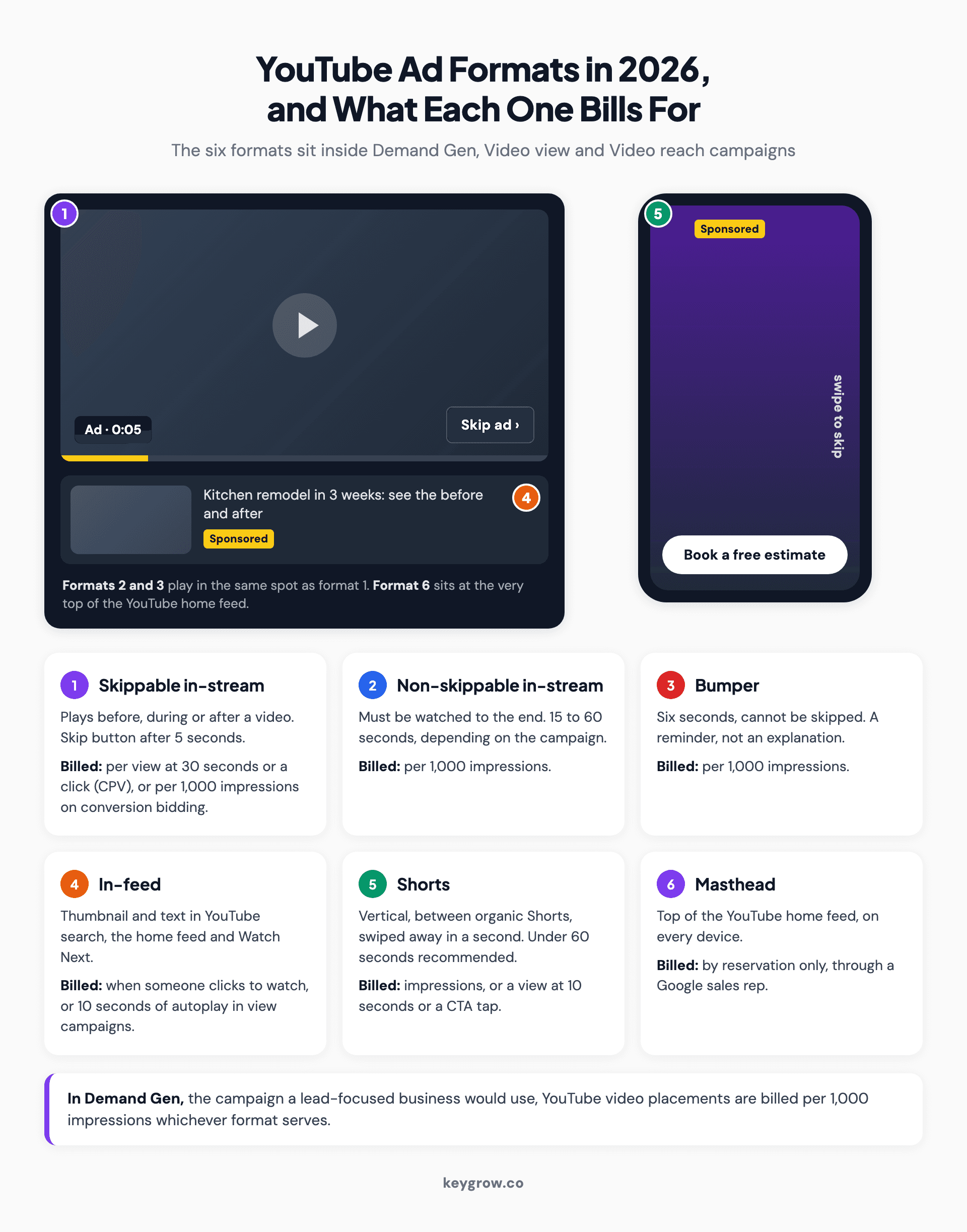
Annotated mockup of the six YouTube ad formats in 2026, skippable in-stream, non-skippable in-stream, bumper, in-feed, Shorts and Masthead, with how each one is billed.
How much do YouTube ads cost a small business?
Views can be cheap. The expensive part is the learning period: Google suggests $100 a day on Maximize conversions and 50 conversions before you judge results.
The most transparent dataset we found is AdConversion's analysis of $1,041,978 in YouTube spend from B2B software companies in 2023 and 2024, each spending more than $10,000. It averaged $0.05 per view (range $0.01 to $0.19), a $9 CPM (range $1 to $23) and $3.56 per click. Treat it as a rough range check, since these are software companies and the data is two years old.
Here's what Google's Demand Gen guidance means at different lead costs:
| YouTube cost per lead | Spend to reach 50 conversions | Days at $100 a day | Google's minimum daily budget on Target CPA (10x) |
|---|---|---|---|
| $40 | $2,000 | 20 | $400 |
| $60 | $3,000 | 30 | $600 |
| $100 | $5,000 | 50 | $1,000 |
| $150 | $7,500 | 75 | $1,500 |
The last column applies if you bid on Target CPA instead, where Google asks for a daily budget of at least 10 times your target.
Google caps a month at 30.4 times your average daily budget, so $100 a day is a $3,040 monthly ceiling. If your whole ad budget is a few thousand dollars a month, that's all of it on one experiment. Until your own data says otherwise, assume a YouTube lead will cost more than a search lead.
Video view and reach campaigns can run on less, and Demand Gen on Maximize clicks has no minimum. They buy attention and site visits, though, and Google's own performance guide says click bidding should not be used for conversion efficiency.
Target the searchers, not the scrollers
Useful local YouTube targeting is a tight radius, people who searched your services on Google, your site visitors and your customer list.
Demand Gen's default location option reaches people in your area plus people who have shown interest in it. If you only want people who are in, or regularly in, the place you target, Google's location documentation suggests "Presence" instead. Pick it if you drive to your customers.
Then add a custom segment of people who searched your best keywords on Google. No interest category comes close. Google's Demand Gen material suggests 10 to 15 keywords. Pull them from search terms that already convert. Give website visitors their own ad group so you can see what they cost, and add your customer list through Customer Match.
Where YouTube clicks land decides what they cost
Send YouTube clicks to a page that continues the video's single offer. A homepage asks a cold viewer to do the navigating, and most won't.
Sending ad traffic to your homepage is the most expensive default in PPC, and YouTube makes it worse.
A mobile car detailing business came to us paying $100 per booking from Google Ads, with every click going to its homepage. We rebuilt the campaign structure around high-intent searches and sent the traffic to a dedicated booking page. Between August and December 2022, cost per booking fell to $22, bookings grew 650 percent and monthly revenue went from $1.2K to $5.1K. The full breakdown is on our case studies page.
That was a search-led account, where visitors had typed what they wanted. A YouTube viewer arrives colder and needs a page that repeats the video's hook. We made the longer case in landing page vs homepage.
What to measure on a YouTube test
Judge YouTube on click-through leads, engaged-view leads counted separately, and changes in searches for your business name. View rate only grades your opening seconds.
Google Ads counts two kinds of YouTube conversion. A click-through conversion is someone who clicked, then called or filled in your form. An engaged-view conversion is someone who watched at least 10 seconds of your skippable ad (5 seconds for in-feed and Shorts), didn't click, and converted later inside the window, 3 days by default for website conversions.
Both land in one Conversions column, and some of those engaged viewers would have found you anyway, so the total flatters YouTube. Segment the report by "Ad event type" to split them, and judge the click-through cost per lead against your search cost per lead. Count engaged-view leads too, at a discount.
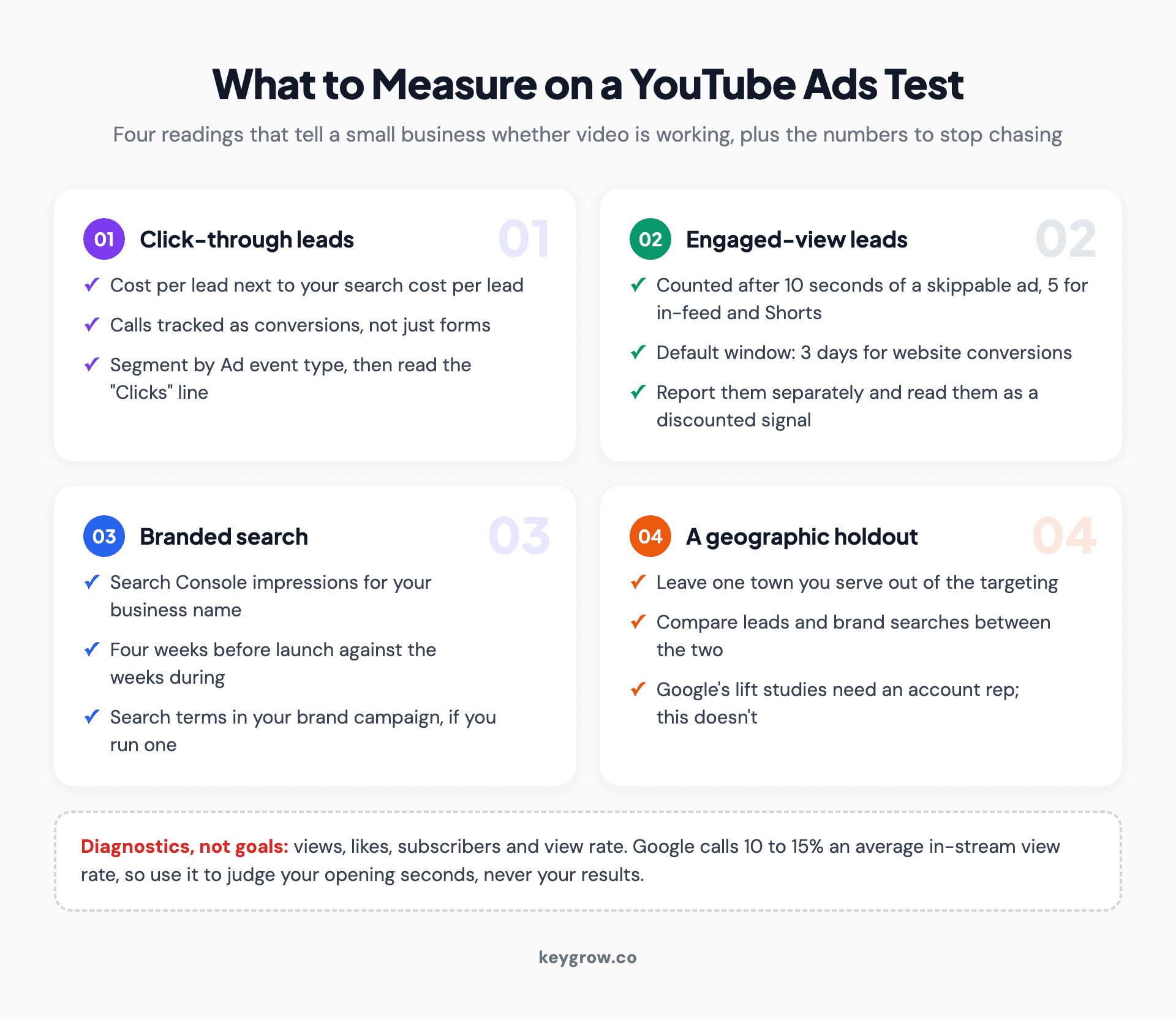
Checklist of what to measure on a YouTube ads test: click-through leads, engaged-view leads counted separately, branded search, and a geographic holdout, with views and view rate marked as diagnostics.
Then compare branded search impressions in Google Search Console during the test with the four weeks before launch. Google's own lift studies need an account representative, and most small advertisers don't have one. The do-it-yourself version is a geographic holdout: if you serve several towns, leave one out and compare.
FAQs
How much do YouTube ads cost per month for a small business?
There is no fixed minimum, but Google suggests at least $100 a day for a Demand Gen campaign on Maximize conversions, a monthly ceiling of $3,040. View and reach campaigns can run on less, but they buy views and impressions rather than leads.
Can YouTube ads target only my local area?
Yes. Demand Gen supports radius targeting, and its "Presence" option limits ads to people who are in or regularly in your area rather than people who have only shown interest in it.
Do I need a YouTube channel to run YouTube ads?
No, not one you have to build. The video has to be on YouTube, public or unlisted, but Google Ads can upload it to a storage channel YouTube creates for you. If you do have a channel, linking it lets you remarket to people who watched your videos.
How long should a YouTube ad be for a small business?
For skippable in-stream, 15 to 30 seconds is practical, with the offer before the 30-second mark where cost-per-view billing starts. Google sets no maximum for skippable ads and recommends under three minutes. Shorts ads should run under 60 seconds, and bumpers are six seconds.
What a first test should look like
One Demand Gen campaign with one offer, run to a fixed end date against a pass mark you wrote down before launch.
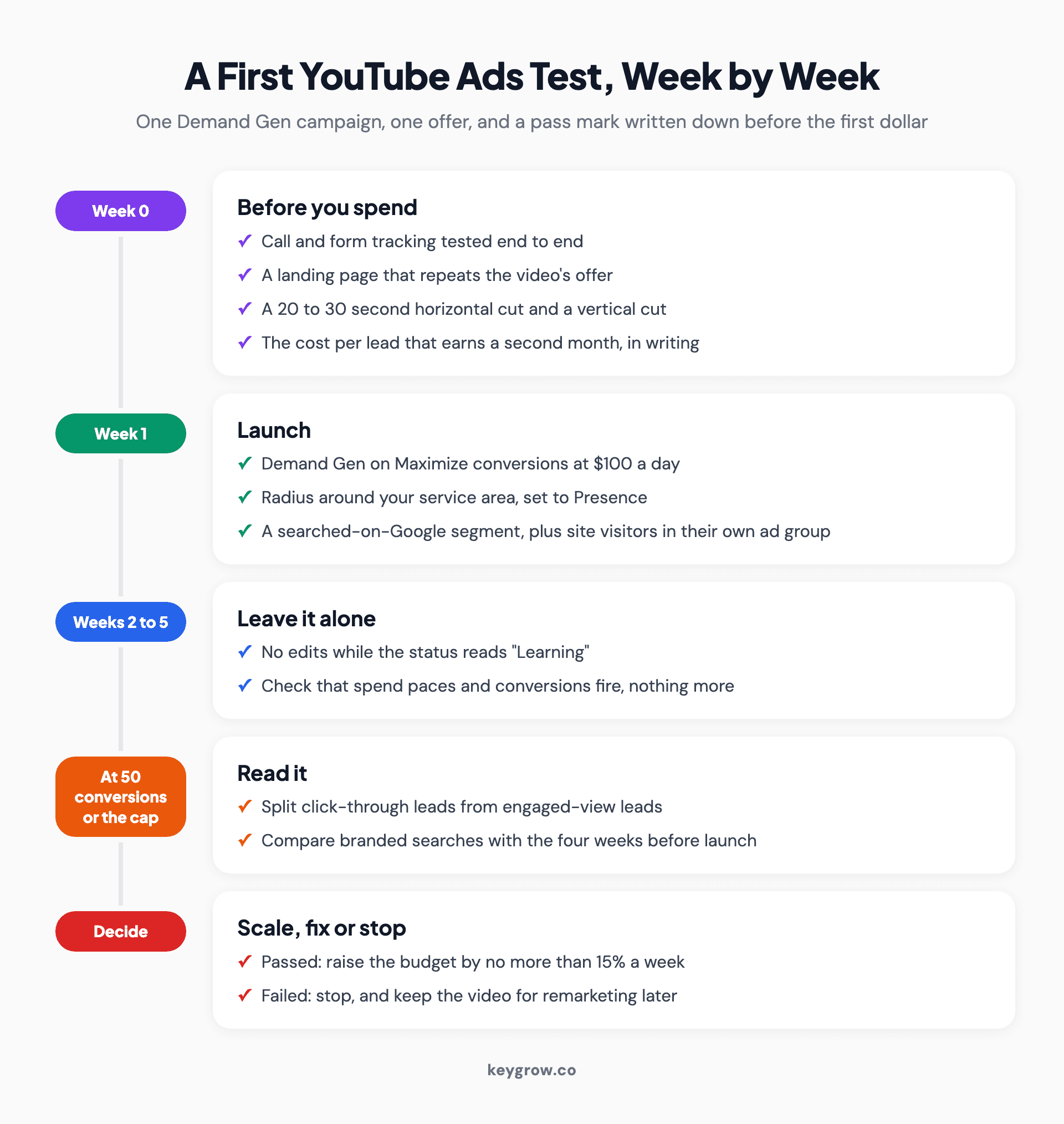
Week-by-week timeline for a first YouTube ads test, from tracking and landing page prep, to a $100-a-day Demand Gen launch, a hands-off learning period, reading results at 50 conversions, and the decision to scale, fix or stop.
Before launch, test call and form tracking end to end, build the landing page, and shoot a 20 to 30 second horizontal cut plus a vertical one. Then write down the cost per click-through lead that earns a second month. Your search cost per lead is a fair yardstick.
In week one, launch Demand Gen on Maximize conversions at $100 a day, with your service radius set to Presence, your searched-on-Google segment, and site visitors in their own ad group. Through weeks two to five, change nothing while the status reads "Learning."
At 50 conversions or your spend cap, apply your rule. If the test passed, raise the budget by no more than 15 percent a week, Google's own pacing advice. If it failed, stop. You found out for the price of one campaign instead of a year of hoping.
You don't need an agency to run this test. For a second opinion on whether your search campaigns are really capped, talk to our PPC management team. We work month to month and will tell you when the honest answer is "not yet." Tell us about your account and we'll take a look.


