


PPC is worth it when three things are true: real search demand exists for what you sell, your margins can absorb the cost of a lead, and your website actually converts the traffic it gets. When all three line up, paid search is one of the fastest, most measurable ways to buy customers. When even one is missing, it quietly burns cash, which is exactly what happened to whoever told you PPC is a scam.
So the honest answer is "it depends," but not in the useless hand-waving way most articles mean it. It depends on specific, checkable conditions, and you can run the numbers in about five minutes before you spend a dollar. This guide gives you that math, the real 2026 costs, and the situations where the answer is a firm no.
The three conditions that decide it
PPC pays off only when demand, margins, and conversion-readiness all check out. Miss one and the money leaks no matter how good the ads are.
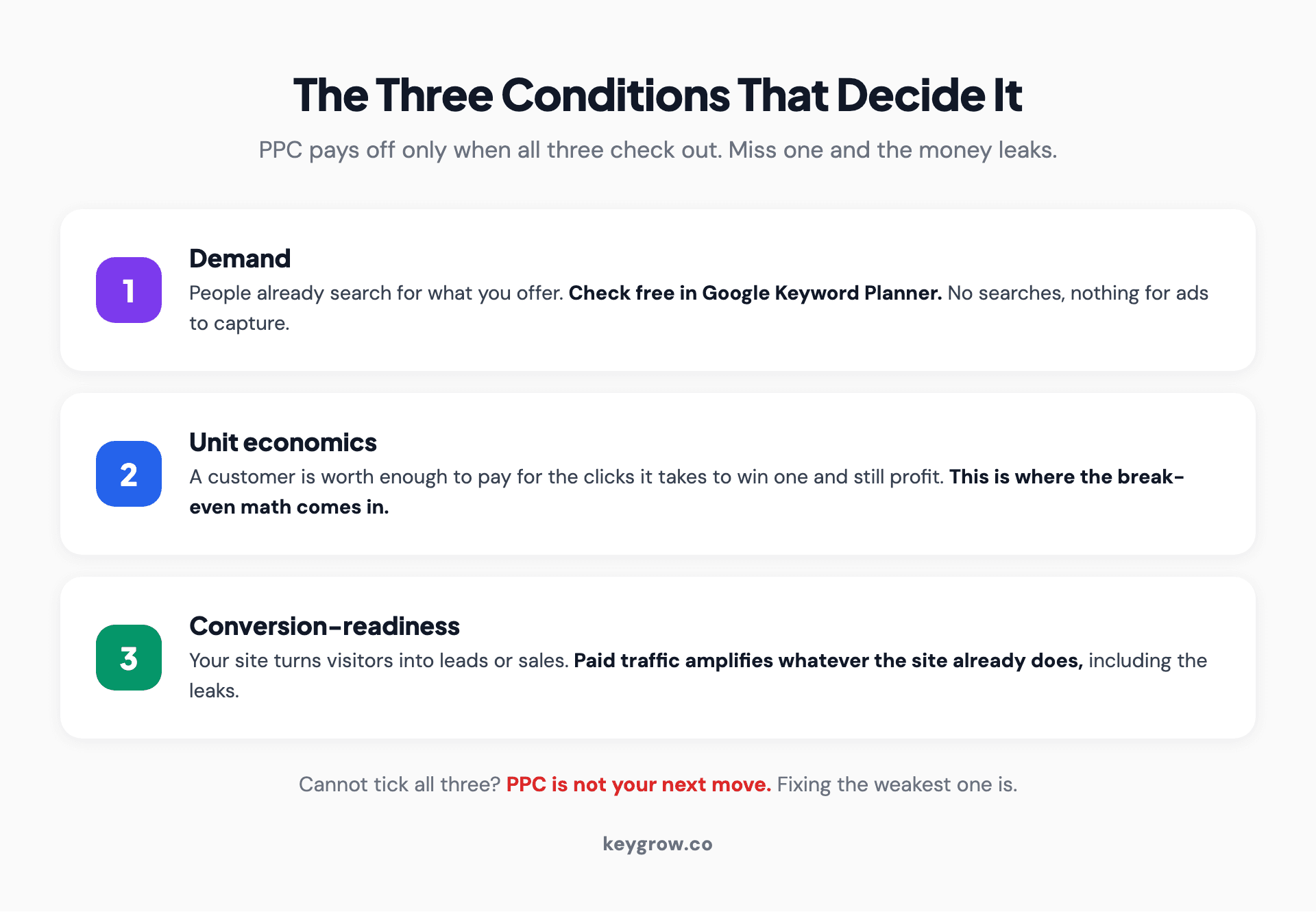
The three conditions that decide whether PPC is worth it: demand you can verify in Keyword Planner, unit economics that let a customer pay back the clicks, and a website ready to convert.
Before any campaign, confirm all three:
- Demand: People are already searching for what you offer. You can check for free in Google Keyword Planner. If nobody searches for your product, search ads have nothing to capture, and you need a demand-creation channel instead.
- Unit economics: A customer is worth enough that you can pay for the clicks it takes to win one and still profit. This is the part everyone skips, and it is where the math below comes in.
- Conversion-readiness: Your site turns visitors into leads or sales. Paid traffic amplifies whatever your site already does. Send clicks to a slow, confusing page and you are paying to find out faster that it does not convert.
If you cannot tick all three, PPC is not your next move. Fixing the weakest one is.
Run the break-even math before you spend
Divide what a customer is worth by the click cost and conversion rate you can realistically expect. If the numbers do not clear your margin, PPC loses money at any budget. For B2B specifically, how to budget for B2B PPC runs the same math backward from a revenue goal.
Here is the five-minute version. You need three inputs: your average customer value (or lifetime value if they repeat), your gross margin, and your industry's benchmark click cost and conversion rate.
Step one, your ceiling. Maximum you can pay to acquire a customer = customer value times gross margin. A dentist whose new patient is worth $1,500 over time at a 60 percent margin can spend up to $900 to win one and still break even.
Step two, your likely cost. Cost per lead = cost per click divided by conversion rate. Using 2026 dentist benchmarks, about $8.00 per click at a 10.67 percent conversion rate, each lead costs roughly $73 in ad spend (LocaliQ reports $72.97; dividing $8.00 by 0.1067 gives about $75, a lead cost rather than a guaranteed booked patient).
Step three, the verdict. A $73 cost per lead against a $900 ceiling clears easily, even after allowing for the fact that not every lead books, so PPC is worth it for that dentist. Now run it for a business selling a $40 one-time product at a 30 percent margin: the ceiling is $12, and if clicks cost $3 at a 5 percent conversion rate, each lead costs $60 in ad spend. That business loses money on every sale. Same channel, opposite answer.
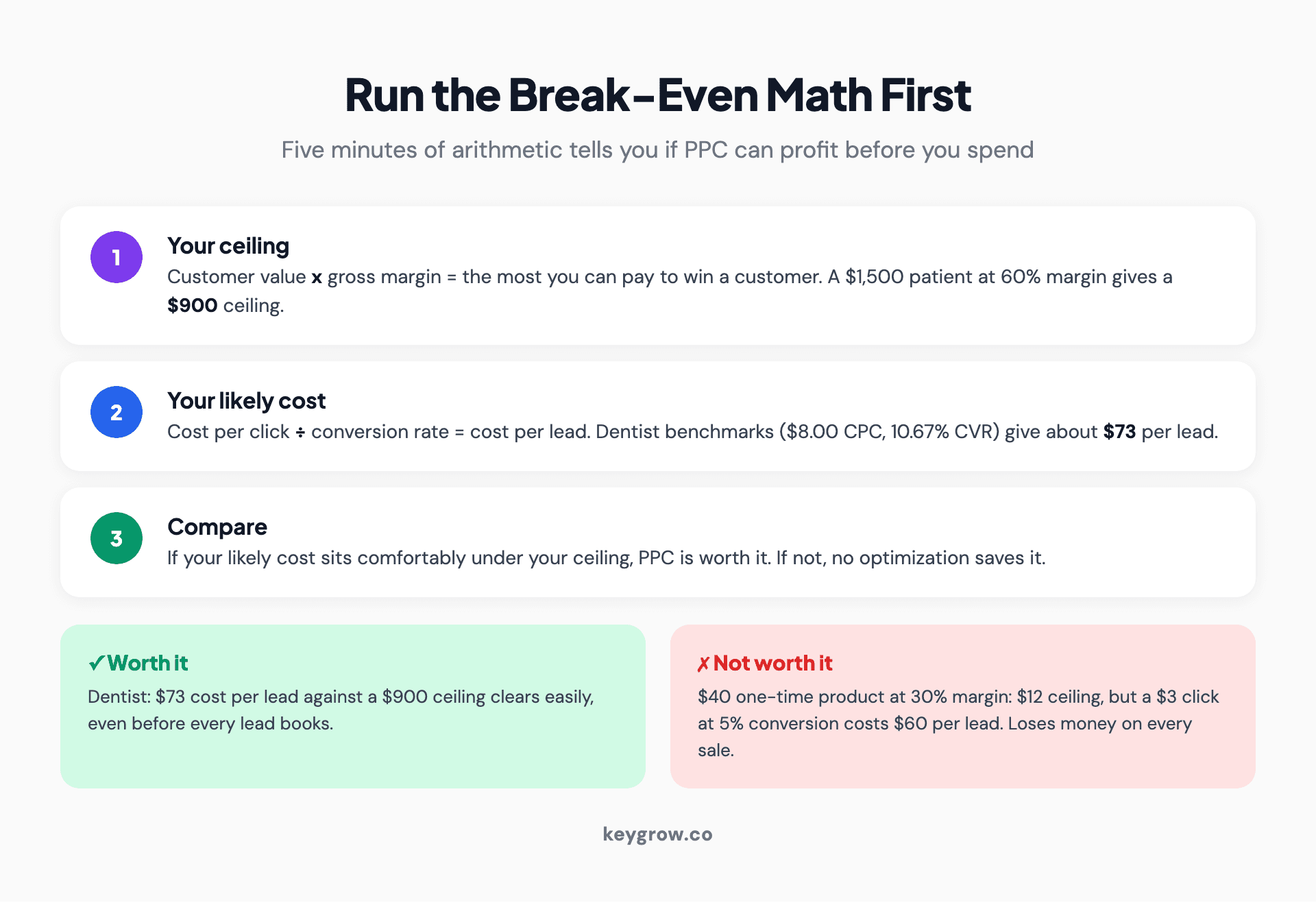
Three-step break-even worksheet for PPC: multiply customer value by margin to get your acquisition ceiling, divide cost per click by conversion rate to get your likely cost per customer, then compare, with a profitable dental example and an unprofitable low-margin example.
Run this before you launch. If your likely cost sits comfortably under your ceiling, PPC is probably worth it. If it does not, no amount of optimization saves you, because the math was broken before the first click.
What PPC actually costs in 2026
Across all industries, the average search ad runs about $5.42 per click with an 8.18 percent conversion rate and a $66.69 cost per lead. Your industry can be far higher or lower.
Vague "it depends" answers are useless when you are trying to budget. Here are real 2026 numbers from LocaliQ's benchmarks, drawn from thousands of campaigns.
| Industry | Avg cost per click | Avg cost per lead |
|---|---|---|
| Arts and entertainment | $1.63 | $26.84 |
| Restaurants and food | $2.05 | $30.57 |
| Real estate | $3.22 | $102.51 |
| Physicians and surgeons | $4.76 | $40.04 |
| Dentists | $8.00 | $72.97 |
| Attorneys and legal | $9.87 | $131.63 |
Two things worth knowing. First, the spread is enormous: a legal click costs six times an entertainment click, so a budget that is generous in one field is hopeless in another. Second, a genuinely encouraging 2026 signal, the average cost per lead actually fell year over year for the first time in several years. Costs are not only climbing. If you run search alongside organic, the two channels are measurable in different ways worth understanding before you set a budget.

A person reviewing numbers with a calculator and coffee at a desk, working out whether the ad spend pays back.
When PPC is not worth it
Skip PPC, or fix the problem first, if your margins cannot absorb the cost per lead, there is no search demand, your site cannot convert, or your budget is too small to gather data.
Be honest with yourself against this list. If you run a small business specifically, our verdict on whether Google Ads are worth it for a small business walks the same test.
- Thin margins with no repeat business. If a customer is worth under roughly $300 and never comes back, the benchmark cost per lead often eats the whole profit. Fix the offer before the ads.
- No real search demand. A brand-new or unusual product nobody searches for cannot be sold on search ads. That is a job for social or content, not PPC.
- A website that cannot convert. Slow load, no clear offer, no tracking. Paid traffic will simply reveal the leak faster and more expensively. We watched a detailing client pay around $100 per booking sending clicks to their homepage; a dedicated landing page took it to $22, same ads. The page was the problem, not the channel.
- A budget too small to learn. Automated bidding needs roughly 30 conversions a month to optimize. At $20 a day in a $5 click market, you get four clicks a day, which is weeks to gather usable data and a long, expensive learning period.
None of these mean PPC is bad. They mean the conditions are not ready, and spending anyway just finds out faster that the funnel is broken.
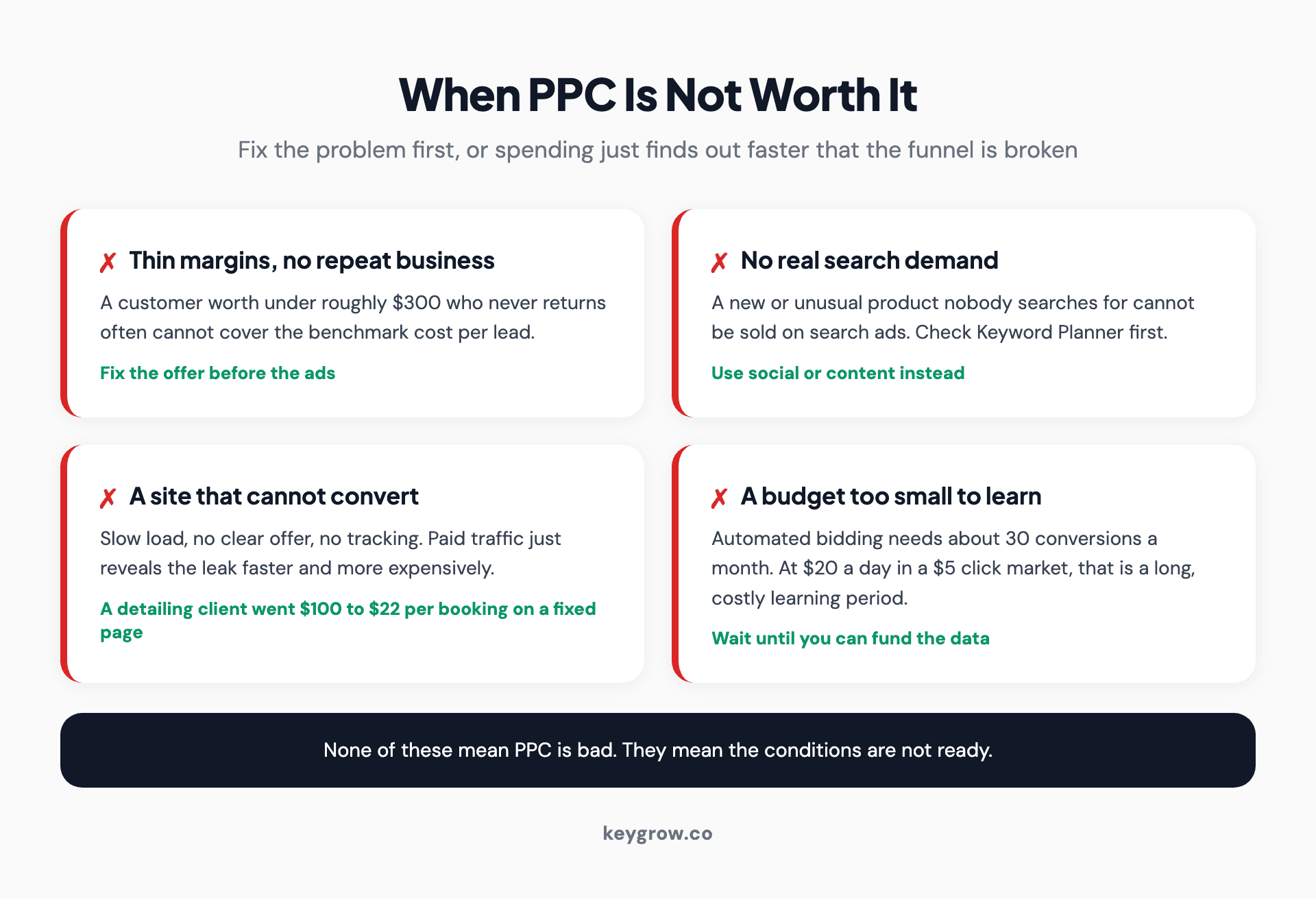
Checklist of four situations where PPC is not worth it: margins too thin, no search demand, a website that cannot convert, and a budget too small to reach the data threshold automated bidding needs.
About that "$2 for every $1" claim
You will see the figure that Google Ads returns $2 for every $1 spent, or a bigger $8-for-$1 number. Treat them as marketing figures from the company selling the ads, not a forecast for your account.
The $2 is Google's own claim for Google Ads specifically. The bigger $8 folds in organic search clicks and the value of Google Search alongside the ads, so it is not a return on ad spend at all. Both trace back to Google's economic-impact methodology, built on assumptions its own chief economist published back in 2009 and never materially updated since. It makes no adjustment for AI Overviews or today's search behavior. It is Google-authored, over fifteen years old, and self-serving.
Your real return comes from the break-even math above, run with your numbers, not from a slogan. A realistic, well-managed search campaign in a decent-margin business can absolutely be profitable. Just do not budget around a figure whose only source is the platform charging you.
If you decide to try it
Start small and controlled: one tight campaign, conversion tracking installed first, and a 60 to 90 day window before you judge it. Anything less is guessing.
A low-risk first test looks like this. Pick your highest-intent keywords only, not broad terms. Install conversion tracking before you spend, so every dollar is traceable to a result. Point the ads at a dedicated landing page built to convert, not your homepage. Give it enough budget to clear roughly 30 conversions a month, and let it run 60 to 90 days before deciding, because automated bidding needs that runway to learn.
Judge it on cost per lead and, better, cost per customer, not on clicks or impressions. If those numbers beat the ceiling you calculated, scale up. If they do not after a genuine test, you have your answer, and you spent a defined amount to get it rather than an open-ended one.
FAQs
Is PPC worth it for a small business?
Yes, when there is search demand for what you sell, your margins can absorb the cost per lead, and your website converts. Run the break-even math first: if a customer is worth well more than it costs to acquire one, PPC is likely worth it. If not, fix the weak link before spending.
Is $500 or $1,000 a month enough for Google Ads?
It can be for a local business with a tight keyword list in a lower-cost industry, but in expensive fields like legal, a small budget may not clear the roughly 30 conversions a month automated bidding needs to optimize. Match the budget to your click costs, not to a round number.
How much does PPC cost for a small business per month?
Most small businesses start around $1,000 to $2,500 a month in ad spend, plus management if you use an agency. The right figure depends on your industry's click cost: at $2 a click you get far more data per dollar than at $10 a click, so higher-cost fields need bigger budgets to work.
Why am I getting clicks but no sales?
Almost always a conversion problem, not a traffic problem. The ad did its job by earning the click, but the landing page, offer, or follow-up is losing the visitor. Check page speed, whether the offer is clear, and whether your tracking is even recording conversions correctly before blaming the ads.
How long before I know if PPC is working?
Give it 60 to 90 days. Automated bidding needs roughly 30 conversions a month to optimize, and early data is noisy while the system learns. Judging a campaign in its first two weeks usually measures the learning period, not the real performance.
Is PPC or SEO better?
They do different jobs. PPC buys traffic instantly and stops when the budget stops; SEO compounds slowly and keeps working after you stop paying. Most established businesses run both, using paid for speed and organic for durable, lower-cost traffic. If you can only fund one, it comes down to how fast you need customers.
Run the numbers first
Whether PPC is worth it is not a matter of opinion or vibe. It is arithmetic: demand, margins, and a site that converts. Run the break-even math with your own numbers and you will know before you spend whether paid search will pay you back or bleed you.
If the math clears and you want a second set of eyes, our team will audit the opportunity and tell you honestly whether the channel fits, month-to-month, no lock-in. And if the numbers do not clear yet, we will tell you that too, because spending on ads that cannot profit is not a service worth selling.