


To budget for B2B PPC, work backward from a revenue goal through your funnel to a monthly spend, then sanity-check that number against a simple percentage of revenue. The bottom-up method tells you what you need to spend to hit a target; the top-down method tells you what you can afford. When the two roughly agree, you have a budget. When they do not, you have found a problem worth solving before you launch.
B2B makes this harder than consumer PPC for reasons worth naming up front, because they change every number that follows.
Why B2B PPC budgeting is its own problem
Three things make B2B budgets behave differently from a local service or an online store.
Search volume is thin. A niche B2B term might get 30 searches a month, not 3,000, so you cannot buy your way to fast data. Clicks are expensive. Business Services keywords average about $5.58 per click and $103.54 per lead, per WordStream benchmarks, and specialized terms run higher. And the sale takes months, often with a buying committee doing research you never see. A lead today might close next quarter, which wrecks any budget built on this month's numbers. Every method below is really a way to plan around those three facts.
Method 1: bottom-up from a revenue goal
This is the method that ties spend to the business, and the one to lead with. You work backward through your funnel.
Start with the revenue you want from paid search, then divide down through your real conversion rates. Here is a worked example, using round numbers for clarity rather than a promise.
- Goal: $200,000 in new revenue from PPC this quarter
- Average deal size: $10,000, so you need 20 new customers
- Lead-to-customer close rate: 10 percent, so you need 200 qualified leads
- Cost per qualified lead: $250 (your own number, not a benchmark)
- Budget: 200 leads times $250 equals $50,000 for the quarter, about $16,700 a month
The power of this method is that every input is yours. If you do not know your close rate or your cost per qualified lead, that is the first thing to fix, because without them any budget is a guess. Our guide on measuring the lifetime value of PPC leads covers how to pin those numbers down.
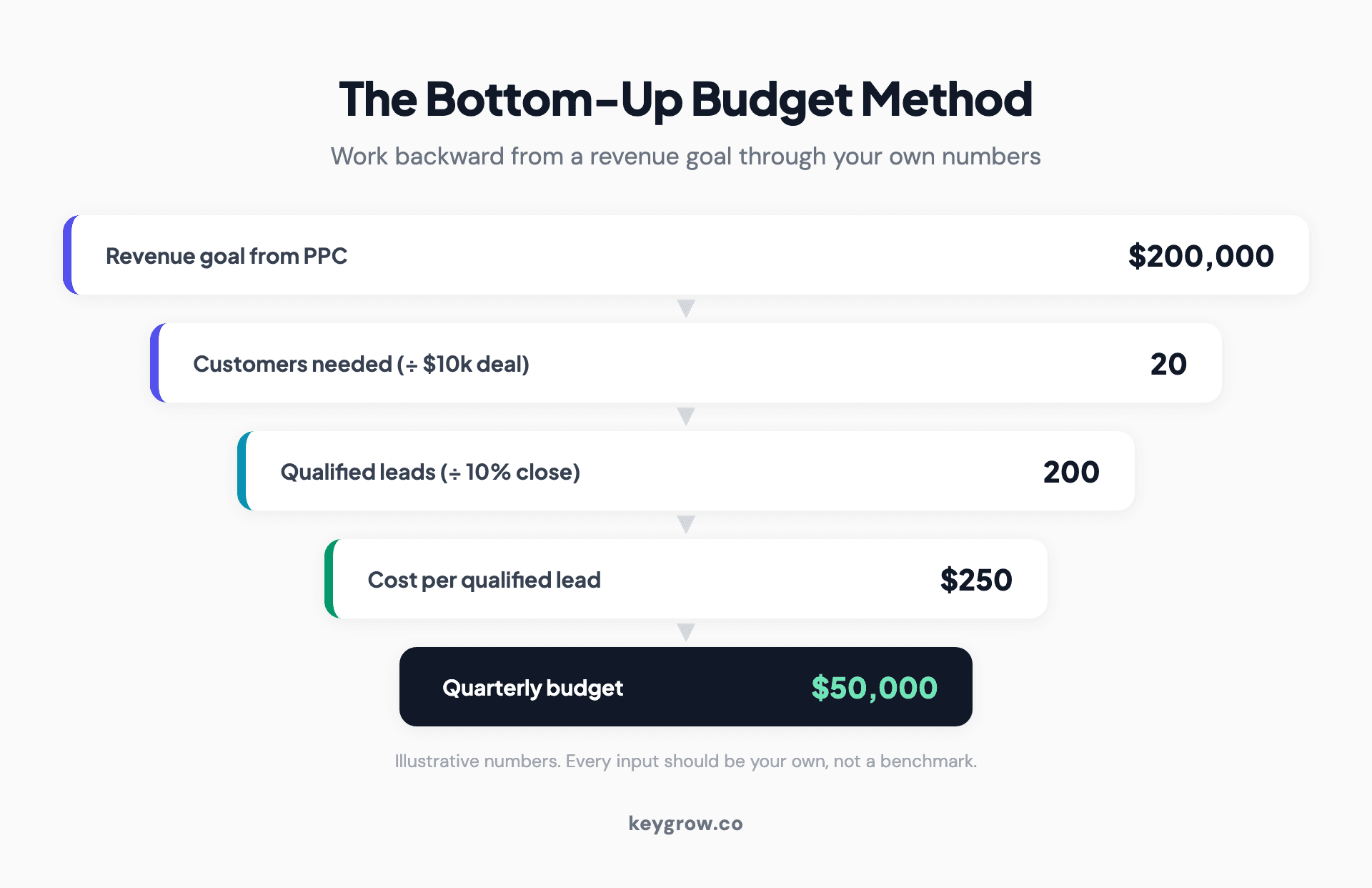
A bottom-up budget funnel working from a 200,000 dollar revenue goal down through customers needed, qualified leads, and cost per lead to a quarterly budget.
Method 2: top-down from revenue
The bottom-up number needs a reality check, and the top-down method is it.
Companies spend, on average, around 7.7 percent of revenue on all of marketing, according to Gartner's 2025 survey of large-company marketing leaders. PPC is one slice of that marketing budget, not the whole thing. So if your bottom-up math says you should spend $16,700 a month on paid search but that would eat your entire marketing budget three times over, the goal is unrealistic, not the method. Top-down keeps ambition honest. Bottom-up keeps it connected to revenue. You want both.
The number that caps everything: lifetime value
Before you finalize any budget, find the ceiling. The most you can afford to pay for a customer is set by what that customer is worth over time, not by what one deal pays today.
If a client is worth $10,000 on the first order but $40,000 over three years, the second number is the one that should govern your bids. B2B lives and dies on lifetime value, because the sales cycle is long and the relationships are longer. A cost per lead that looks reckless against a single sale can be a bargain against a multi-year account. Set your maximum cost per lead from lifetime value, then let that cap protect you from overpaying in a hot auction.
The minimum viable budget
There is a floor below which a B2B campaign cannot tell you anything, and spending under it is worse than not spending at all. You pay for clicks but never gather enough data to know what worked.
Reverse-engineer the floor from data, not from a gut feel. You need roughly 30 conversions a month before optimization signals are trustworthy. Work back from there:
- Target: 30 conversions a month to optimize on
- Conversion rate: 5 percent, so you need 600 clicks
- CPC: $6, so 600 clicks costs about $3,600 a month
That is the floor for one focused campaign, not a recommendation. If your budget cannot clear it, do not spread it across five campaigns where each starves. Put it behind one tight campaign, gather real data, and expand from there. A thin budget spread thin is the most common way B2B accounts waste money.
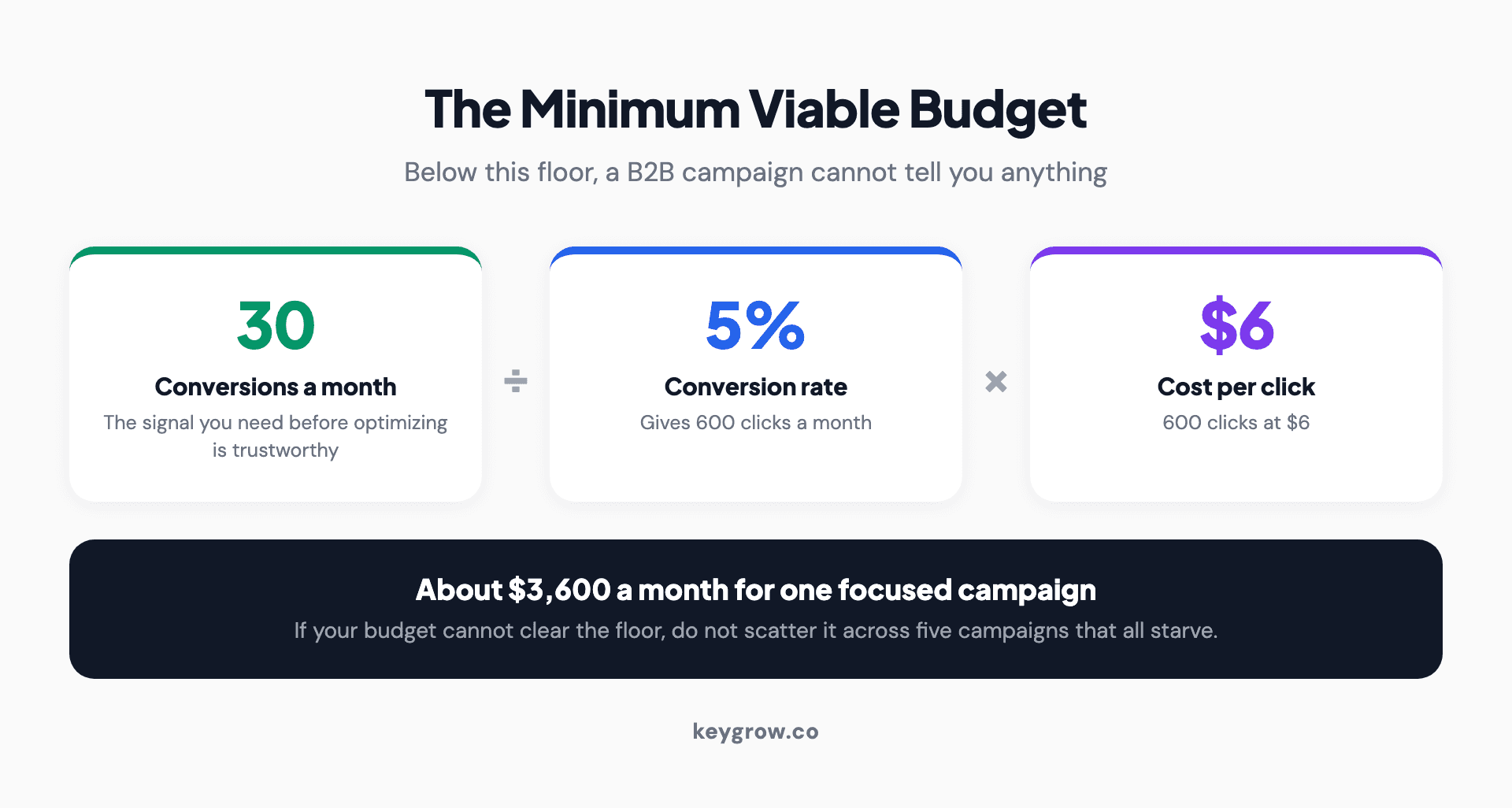
The minimum viable B2B budget: 30 conversions a month divided by a 5 percent conversion rate is 600 clicks, times a 6 dollar cost per click, is about 3,600 dollars a month.
Budget for pipeline, not this month's leads
Here is the discipline most B2B accounts miss, and the one that separates a real program from a money pit. You are budgeting now for pipeline that will not close for six to twelve months, so you cannot judge this month's spend by this month's revenue.

Close-up of financial figures on a page, representing budgeting a B2B PPC spend to pipeline rather than this month's leads.
That means two things. First, close the loop: import your closed-won deals back into Google Ads through offline conversion tracking, so the platform optimizes toward leads that actually became customers, not just anyone who filled a form. Second, report to pipeline and revenue, never to clicks or leads alone. Impressions and clicks do not pay rent, and a B2B report that opens with them is hiding the number that matters. If your agency's report leads with traffic instead of pipeline, ask why. Judge the budget on the deals it eventually sources, on a timeline that matches how your buyers actually buy.
Where the money should go
Once you have the number, split it by the job each channel does rather than spreading it evenly.
Google Search is your intent engine, where people actively look for what you sell, and it usually earns the largest share. LinkedIn reaches buyers by role and company when the search volume is too thin to scale, at a price: LinkedIn clicks average about $11.12 against roughly $5.45 on Google, per Search Engine Land analysis, so treat it as precision, not volume. Remarketing is cheap and closes the long gap between first touch and a signed deal. And hold back a small testing reserve, maybe 10 percent, for new keywords and channels, kept separate from the budget you are counting on. B2B buyers who take months to decide need to keep seeing you, which is what remarketing and a patient budget are for. For SaaS and other considered purchases, our SaaS marketing work is built around exactly this long-cycle math.
The budget mistakes that waste B2B spend
Most B2B budgets do not fail because the number was wrong. They fail because of how the money gets spent. A few patterns account for most of the waste.
Spreading too thin is the big one: a budget carved across eight campaigns so none of them ever gathers enough data to optimize. Skipping negative keywords is next, since a B2B account with no exclusions pays premium prices for job seekers, students, and free-tool hunters. Then there is set-and-forget, where a campaign launches and nobody touches it for a quarter, and its opposite, editing during the learning phase, where an anxious owner changes bids every day and never lets the algorithm settle. And the quiet killer: running for months with no revenue tracking, so you are optimizing toward form fills that sales quietly marks as junk. Fix these before you add budget, because more money into a leaky account just leaks faster.
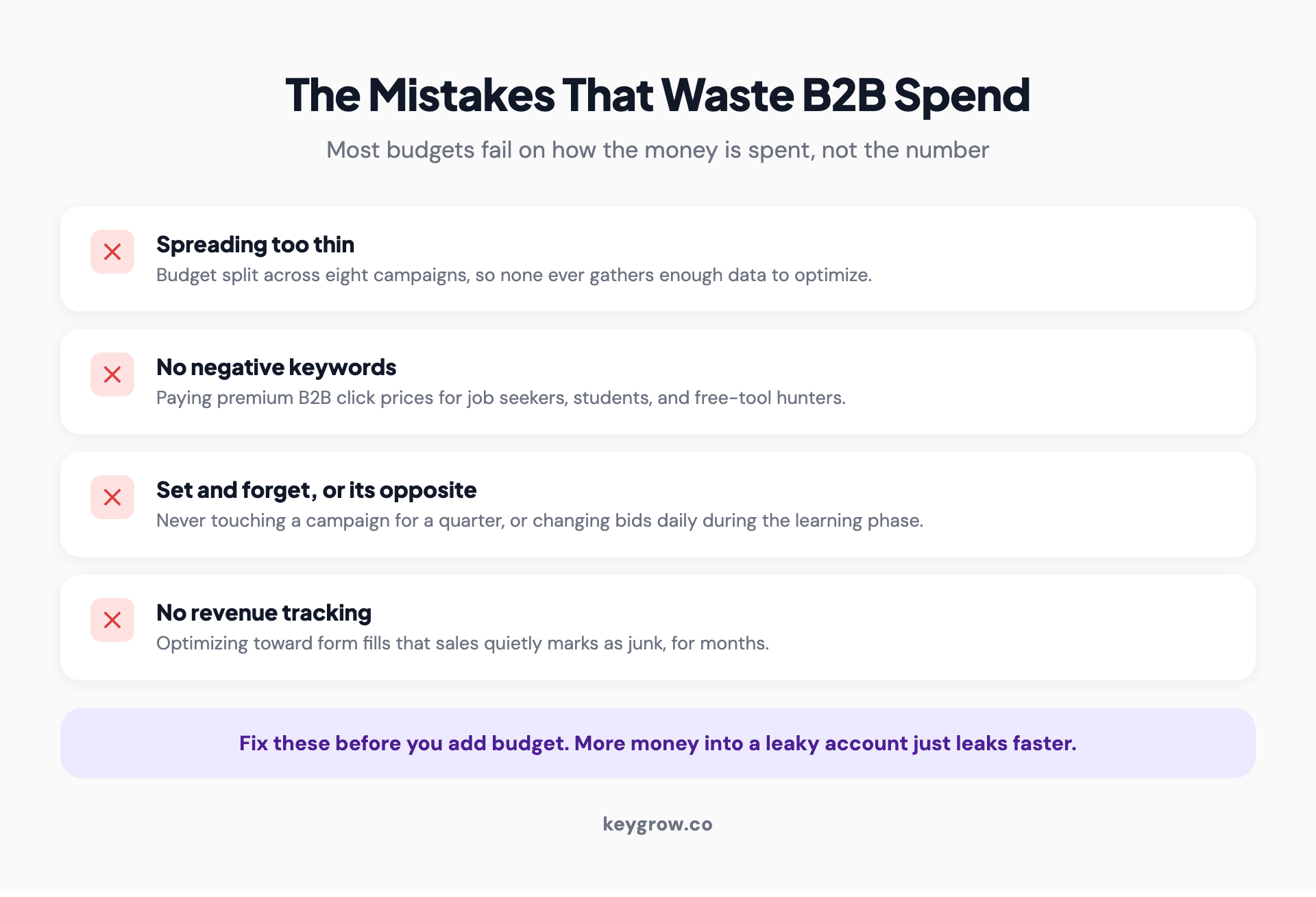
Four mistakes that waste B2B PPC spend: spreading too thin, no negative keywords, set-and-forget or its opposite, and no revenue tracking.
When to raise, cut, or hold
A budget is a starting hypothesis, not a setting you lock and forget. Adjust it on signals, not nerves.
The cleanest signal is impression share. If your campaigns are eligible to show far more often than they do, you are budget-limited and leaving demand on the table, so raise it. If you are already capturing most of the available impressions, more budget just buys worse clicks, so hold and improve conversion instead. On cadence, give a new B2B campaign a full 30 days before judging anything, since the sales cycle hides early signal, then review on a 45-to-60-day rhythm that matches how slowly the pipeline actually moves. The mistake is judging a long-cycle channel on a short-cycle clock and cutting a budget the week before its leads would have closed.
FAQs
How much should a B2B company spend on PPC per month?
Enough to clear the minimum viable budget for at least one focused campaign, which is often a few thousand dollars a month once you account for high B2B click costs. The right number comes from working backward from your revenue goal through your close rate and cost per lead, then checking it against a sensible percentage of revenue. There is no universal figure, because deal sizes and margins vary too much.
How do you calculate a B2B PPC budget?
Use the bottom-up method: start with your revenue goal, divide by average deal size to get customers needed, divide by close rate to get leads needed, then multiply by your cost per qualified lead. That gives a required spend. Check it against a top-down percentage of revenue to confirm you can afford it.
What is the minimum budget for B2B Google Ads?
Below roughly 30 conversions a month, a campaign cannot gather enough data to optimize reliably. Work back from that: 30 conversions at a 5 percent conversion rate is 600 clicks, and 600 clicks at a $6 CPC is about $3,600 a month for one focused campaign. Spreading less than that across many campaigns starves all of them.
Why are B2B PPC clicks so expensive?
Fewer people search niche B2B terms, and the ones who do are worth a lot, so more advertisers bid hard for a small pool of clicks. High deal values justify high bids, which pushes cost per click and cost per lead well above consumer averages. That is also why lifetime value, not a single sale, should set your bid ceiling.
Should I put my B2B budget into LinkedIn or Google Ads?
Usually Google first, LinkedIn second. Google Search captures people actively looking for a solution, which converts efficiently. LinkedIn reaches specific roles and companies when search volume is too thin, but at roughly double the cost per click, so it works best as targeted reach rather than your main volume channel.
What to do next
Run the bottom-up math with your own close rate and cost per lead, check it against a percentage of revenue you can live with, and set your maximum cost per lead from lifetime value rather than a single sale. Then fund one focused campaign above the minimum viable budget instead of scattering the money. Our budget calculator will do the arithmetic if you feed it your numbers.
If your sales cycle is long and you want a budget tied to pipeline rather than vanity metrics, that is the kind of account our paid search team is built for. Bring your close rate and deal size to the get started page and we will help you size it honestly.