

Google Ads are worth it for a small business when three things are true: people are already searching for what you sell, each customer is worth enough to absorb the cost of a lead, and you can send those clicks to a page built to convert. Get those right and Google Ads can be the fastest, most measurable way to buy customers. Get them wrong and it is the fastest way to burn a small budget. So the honest answer is not yes or no, it is "it depends, and here is exactly what it depends on."
Let me walk through who it works for, what it really costs, the budget you need before it can work at all, and the situations where the answer is a clear no.
Do Google Ads actually work for a small business?
Yes, when there is existing demand to capture. Google Ads put you in front of people actively searching for your product or service, which is closer to a sale than almost any other channel. They do not create demand, they capture it.
That distinction matters. A Facebook or Instagram ad interrupts someone scrolling; a Google search ad answers someone who typed "emergency plumber near me" thirty seconds ago. The intent is already there. That is why the returns can be strong: Google's own economists estimate that, on average, advertisers get about $2 in value for every $1 they spend, and they call that a conservative figure. Well-run accounts in the right niche do much better, which is the broader case for whether PPC is worth it at all. The catch is the phrase "in the right niche," which is the whole question.
Who Google Ads works best for
Google Ads works best for businesses with high-intent searches and real value per customer. Home services, legal and medical practices, and any business that runs on calls, quotes, or bookings tend to see the strongest returns.
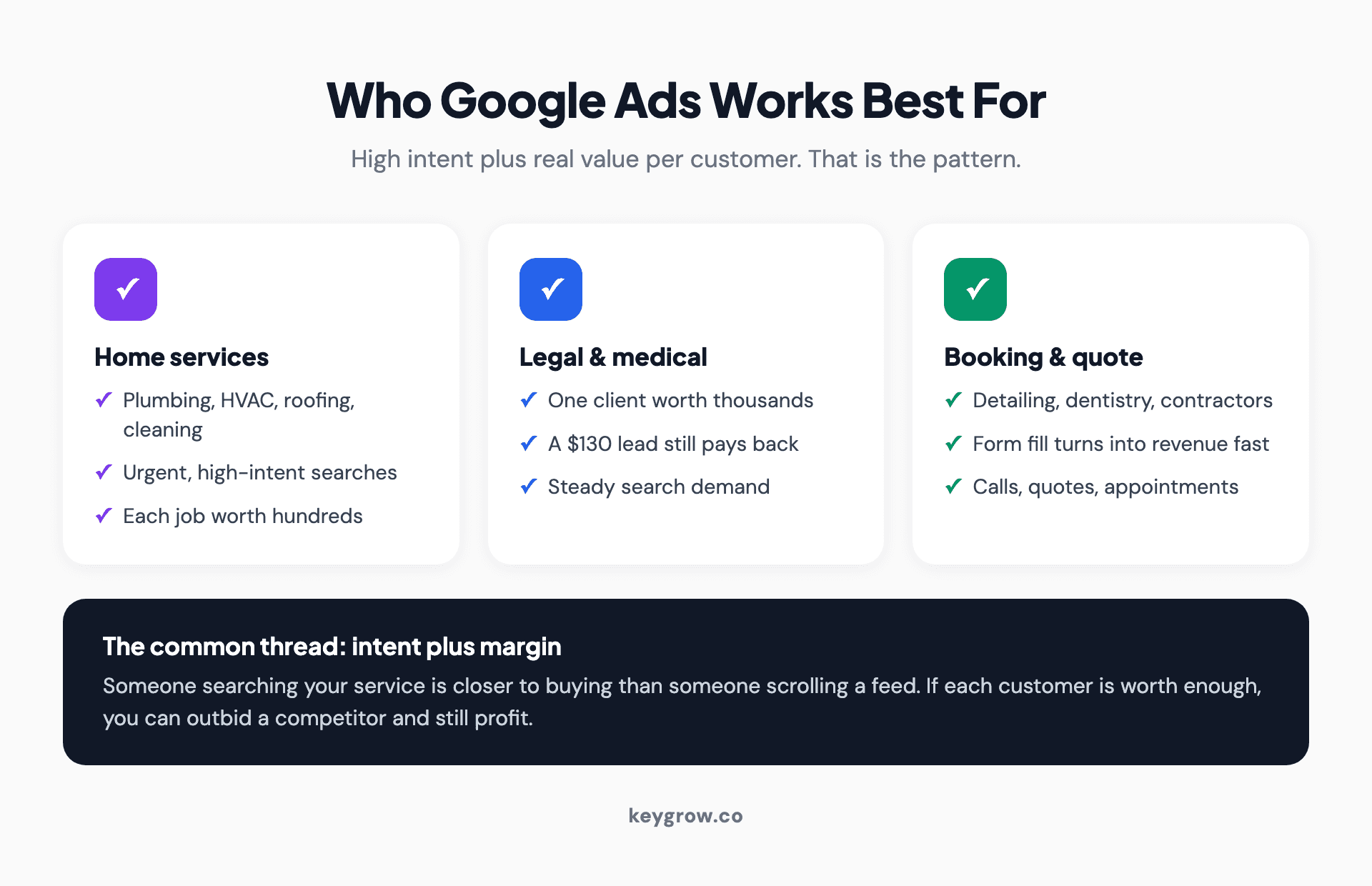
Who Google Ads works best for: home services with urgent high-intent searches, legal and medical where one client is worth thousands, and booking or quote businesses, all sharing high intent plus real margin per customer.
The common thread is intent plus margin. Someone searching your service is closer to buying than someone scrolling a feed, and if each customer is worth enough, you can pay a healthy price per lead and still profit. A plumber whose average job is $400, a law firm where one case is worth thousands, a detailing shop booking $150 appointments: all of them can absorb a lead that costs $30, $60, even $100 and come out ahead. The businesses that struggle are the ones selling a $15 product once, where the math never clears.
What Google Ads actually costs
Across all industries, the average cost per click is about $4.66 and the average cost per lead is about $66.69, but the range is enormous. Cheap local niches run a dollar or two per click; competitive ones like legal run far higher.
Per WordStream's 2024 benchmarks, across roughly 18,000 US campaigns, the average cost per click landed at $4.66 and the average cost per lead at $66.69, with an average conversion rate near 7 percent. But averages hide everything that matters here. Legal keywords average a $144 cost per lead. Home services sit around $82. Auto repair and restaurants are under $35. Your real number depends on your industry and your city, so treat these as a starting map, not a quote. The point for a small business is simple: know roughly what a lead costs in your niche before you decide whether the customers it brings are worth it, and our guide on lowering your cost per click shows how to improve that number.
The budget that lets the bidding actually work
There is a minimum budget below which Google Ads cannot optimize, and spending under it wastes money. Automated bidding needs roughly 30 conversions a month to learn, so your budget has to be big enough to produce that many.
This is the part almost no one explains. Google recommends evaluating a bidding strategy over at least 30 conversions in 30 days, because that is roughly how much data the system needs to find your best clicks. Below that, the algorithm is guessing, and so are you.
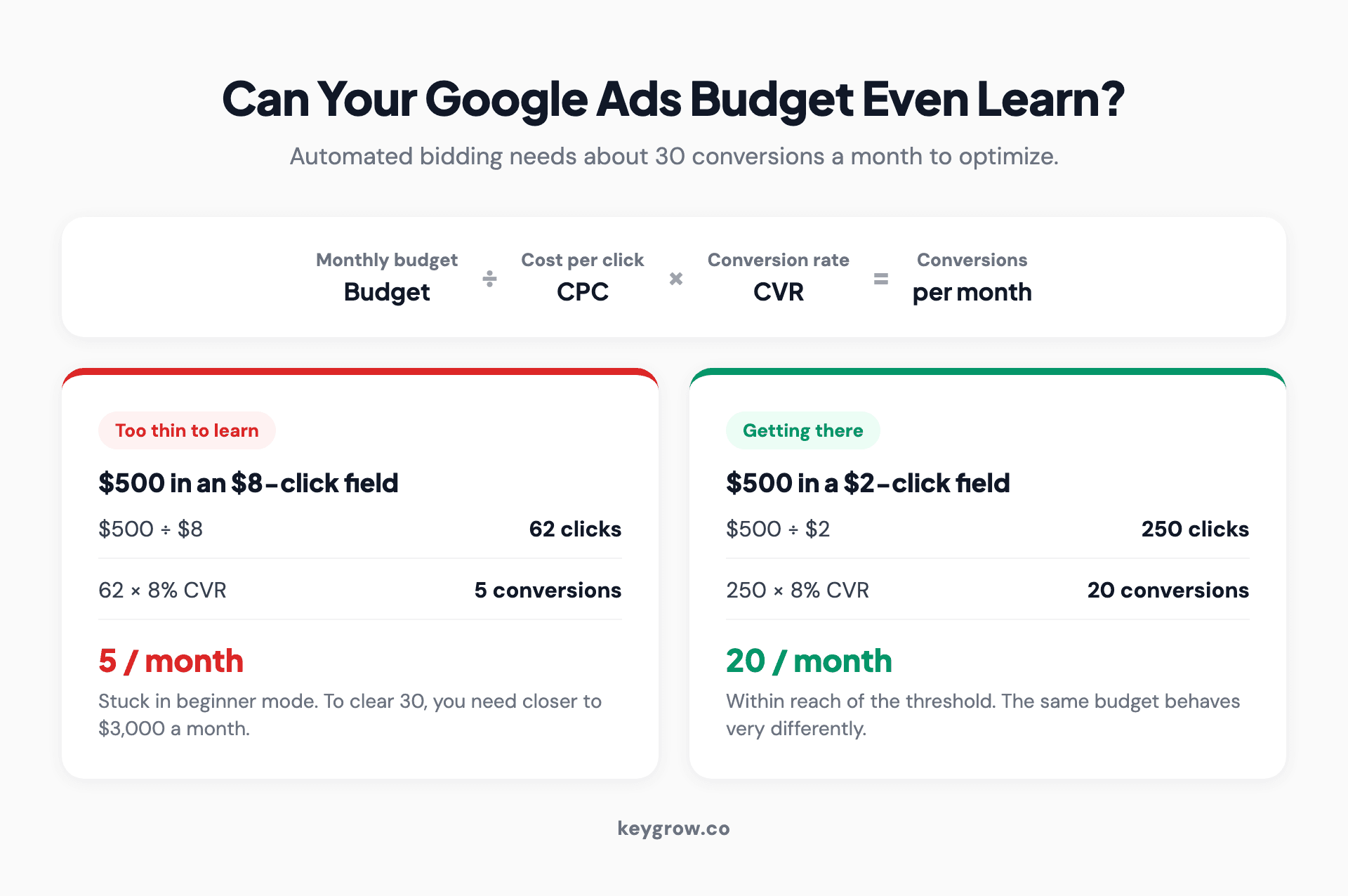
Whether your Google Ads budget can learn: automated bidding needs about 30 conversions a month, so $500 in an $8-per-click market yields about 5 conversions (too thin), while the same $500 in a $2-per-click market yields about 20.
Work the math backward from 30 conversions. At the all-industry average cost per lead of about $67, reaching 30 leads a month takes roughly $2,000 in spend. In home services, closer to $2,500. In legal, closer to $4,300. That does not mean you cannot start smaller, but it does mean a $300-a-month budget in an expensive niche will never gather enough data to improve, so it stays stuck in beginner mode forever. When you are ready to launch properly, our step-by-step small business guide covers the setup, the defaults to refuse, and the first 30 days. If your budget cannot clear the learning threshold for one focused campaign, tighten your targeting to a smaller service or area where it can, rather than spreading it thin. Our budget calculator will do the arithmetic if you feed it your numbers.
The ad is only half the job
The ad gets the click; the landing page turns it into a customer. Sending paid traffic to your homepage is the most expensive default in Google Ads, and fixing the page often matters more than fixing the ad.
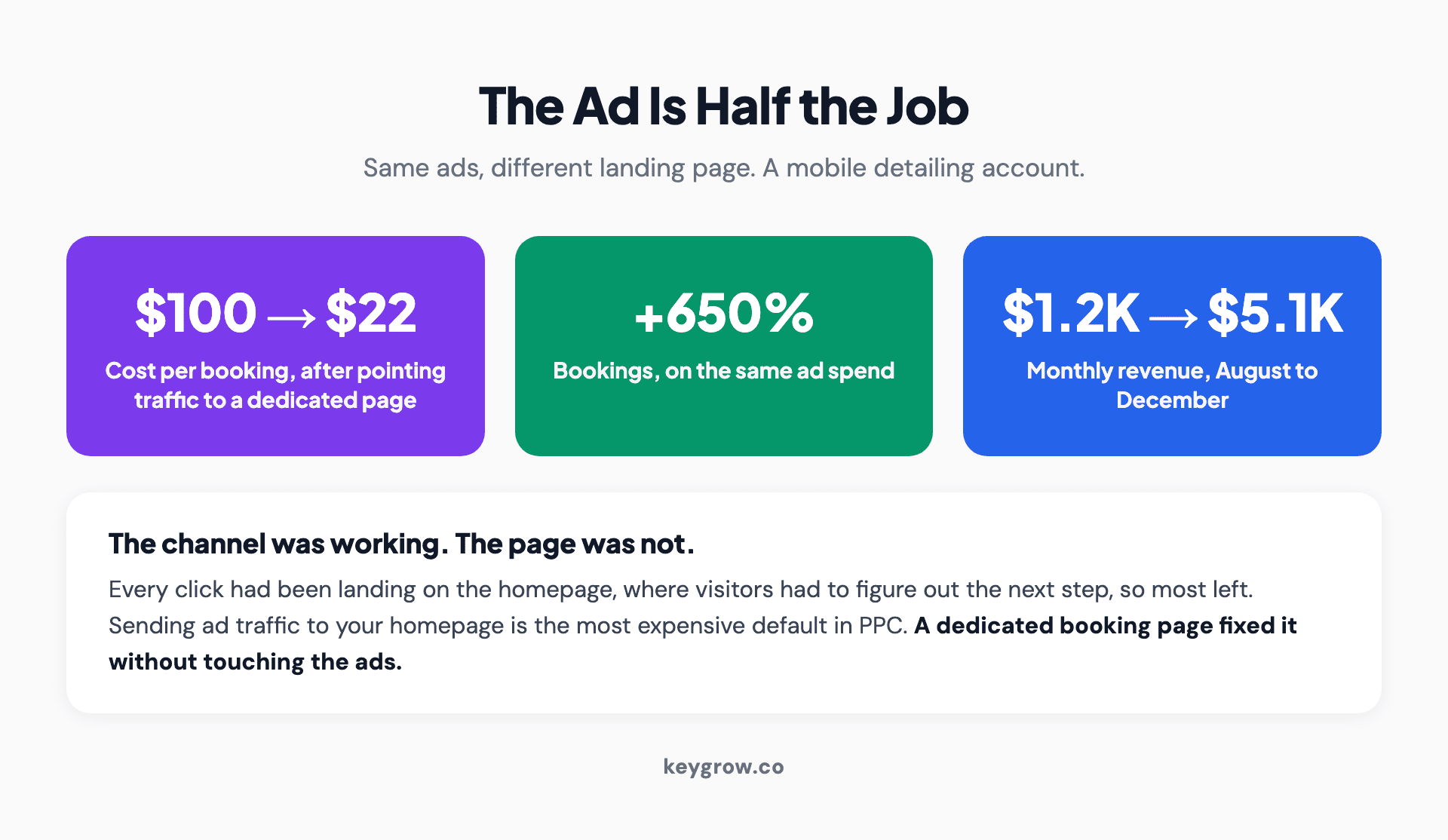
A mobile detailing account where the same ads, pointed at a dedicated landing page, took cost per booking from $100 to $22, grew bookings 650 percent, and lifted monthly revenue from $1.2K to $5.1K between August and December.
We saw this with a mobile detailing client paying about $100 per booking. Nothing was wrong with the ads. Every click was landing on the homepage, where visitors had to figure out the next step, so most left. We pointed the same traffic at a dedicated booking page built around one clear action, and cost per booking dropped to $22, bookings grew 650 percent, and monthly revenue went from $1.2K to $5.1K, all on the same ad spend. The channel was working the whole time. The page was not. If you are deciding whether Google Ads is worth it, judge it with a real landing page in place, not your homepage.
When Google Ads is not worth it
Google Ads is not worth it, at least not yet, when your margins are too thin to absorb a lead, nobody is searching for what you sell, your page cannot convert, or your budget is below the learning threshold. None of these is a verdict on the channel. The conditions just are not ready.
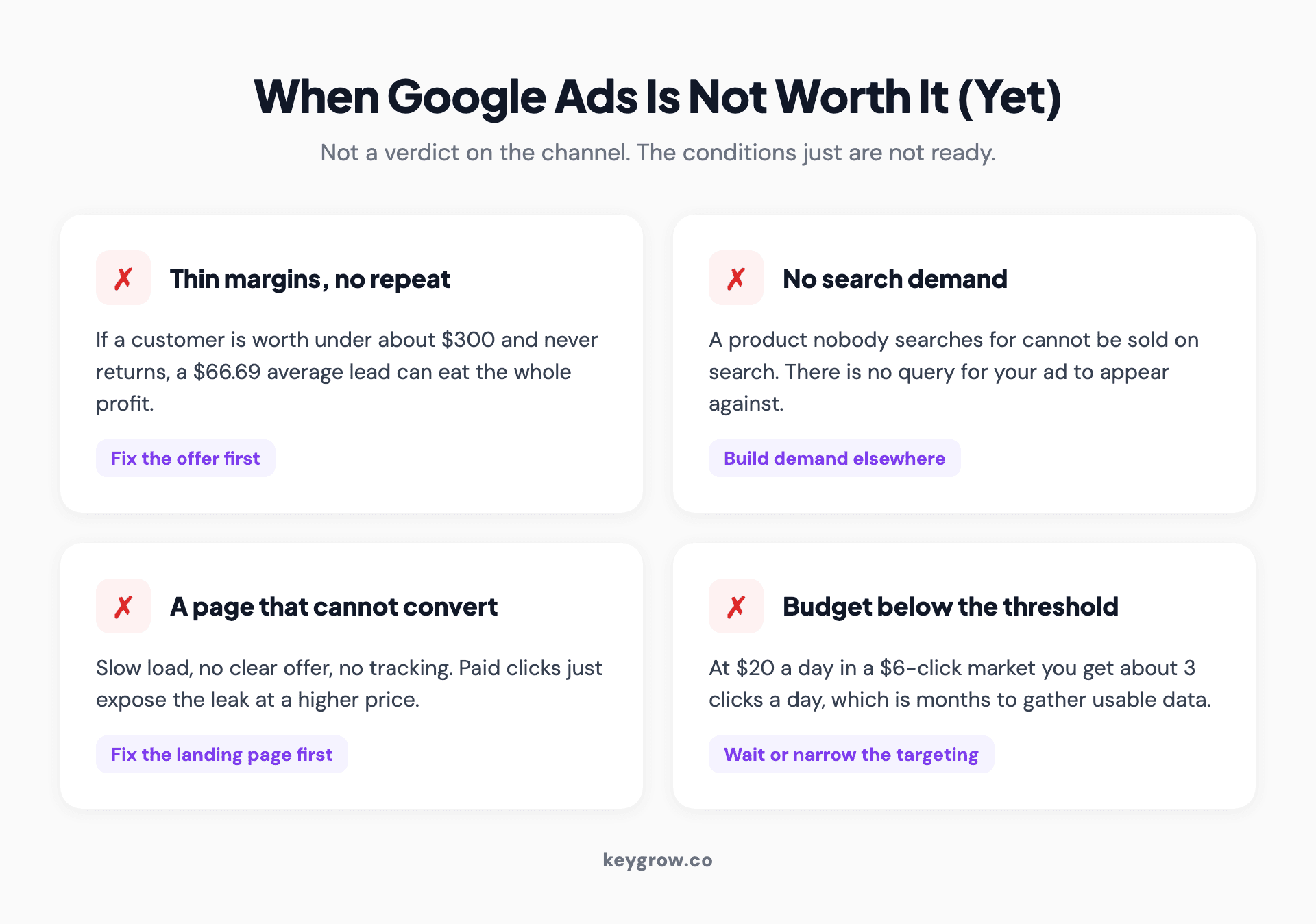
When Google Ads is not worth it yet: thin margins with no repeat purchase, no search demand for what you sell, a landing page that cannot convert, or a budget below the learning threshold, each with the fix to make first.
The four honest disqualifiers:
Telling you when not to spend is not something an agency selling ad management usually does, which is exactly why it matters. If one of these describes you, the money is better spent fixing the condition than running ads into it.
FAQs
How much should a small business spend on Google Ads per month?
Enough to gather real data, which usually means enough to produce around 30 conversions a month for one focused campaign. At an average cost per lead near $67 that is roughly $2,000, though it is less in cheap local niches and more in expensive ones like legal. Spending far below your niche's learning threshold rarely works, because the bidding never gets enough data to improve.
Is $10 or $20 a day enough for Google Ads?
It can be, but only in a low-cost local niche where clicks run a dollar or two, or for a very tightly targeted campaign. In an average or expensive market, $10 to $20 a day buys only a handful of clicks and takes months to gather enough conversions for the bidding to optimize. If that is your budget, narrow the targeting hard so the spend concentrates.
Do Google Ads work better than SEO for a small business?
They do different jobs. Google Ads turn on immediately and are the right tool when you need customers this month, but you pay for every click. SEO is slower and compounds into traffic you do not pay for per visit. Most small businesses do best running ads for immediate demand while building SEO for the long term, not choosing one.
How long does it take for Google Ads to work?
Ads can produce calls within days, which is the main advantage over SEO. But give a new campaign 30 to 60 days to gather enough conversion data for the bidding to stabilize and for you to prune wasteful search terms. Judge it on cost per booked job over a couple of months, not on the first week's clicks.
When are Google Ads not worth it for a small business?
When your margins are too thin to absorb the cost of a lead, when nobody searches for what you sell, when your landing page cannot convert, or when your budget is too small to gather learning data. In each case the fix is to solve that condition first, then run ads. Spending into any of them loses money regardless of how good the account is.
The verdict
Google Ads are worth it for a small business with real search demand, enough margin per customer to absorb a lead, a page that converts, and a budget that can gather data. If all four are true, few channels buy customers faster or more measurably. If one is missing, fix it before you spend.
If you want a straight answer on whether your business clears that bar, that is the honest conversation our Google Ads team has before taking anyone on. Bring your average customer value and your target area to the get started page and we will tell you if it is worth it, or what to fix first.


