


PPC advertising drives sales for online stores by putting product ads in front of shoppers at the exact moment they search, then charging only for the click. Shopping and Performance Max campaigns capture buying intent, your product page converts a percentage of those clicks into orders, and remarketing recovers a slice of the roughly 70 percent who abandon their carts.
That is the mechanism. Whether it makes your store money is arithmetic, not faith. The pool is certainly big enough: US ecommerce hit $326.7 billion in the first quarter of 2026, 16.9 percent of all retail, per the Census Bureau. But a pool that size rewards stores that know their numbers and quietly drains the ones guessing. This guide covers how a click becomes a sale, which campaign types matter in 2026, and a worked break-even example you can rerun with your own margins before spending a dollar.
How a click becomes a sale
A shopper searches for a product, sees your ad with photo and price, clicks to your product page, then buys, leaves, or gets pulled back later by remarketing.
The chain has four links. A weak one anywhere breaks the whole thing.
The search. Someone types "waterproof hiking backpack 40l" into Google. That query carries more purchase intent than any social media impression ever will. They are not discovering backpacks. They are choosing one.
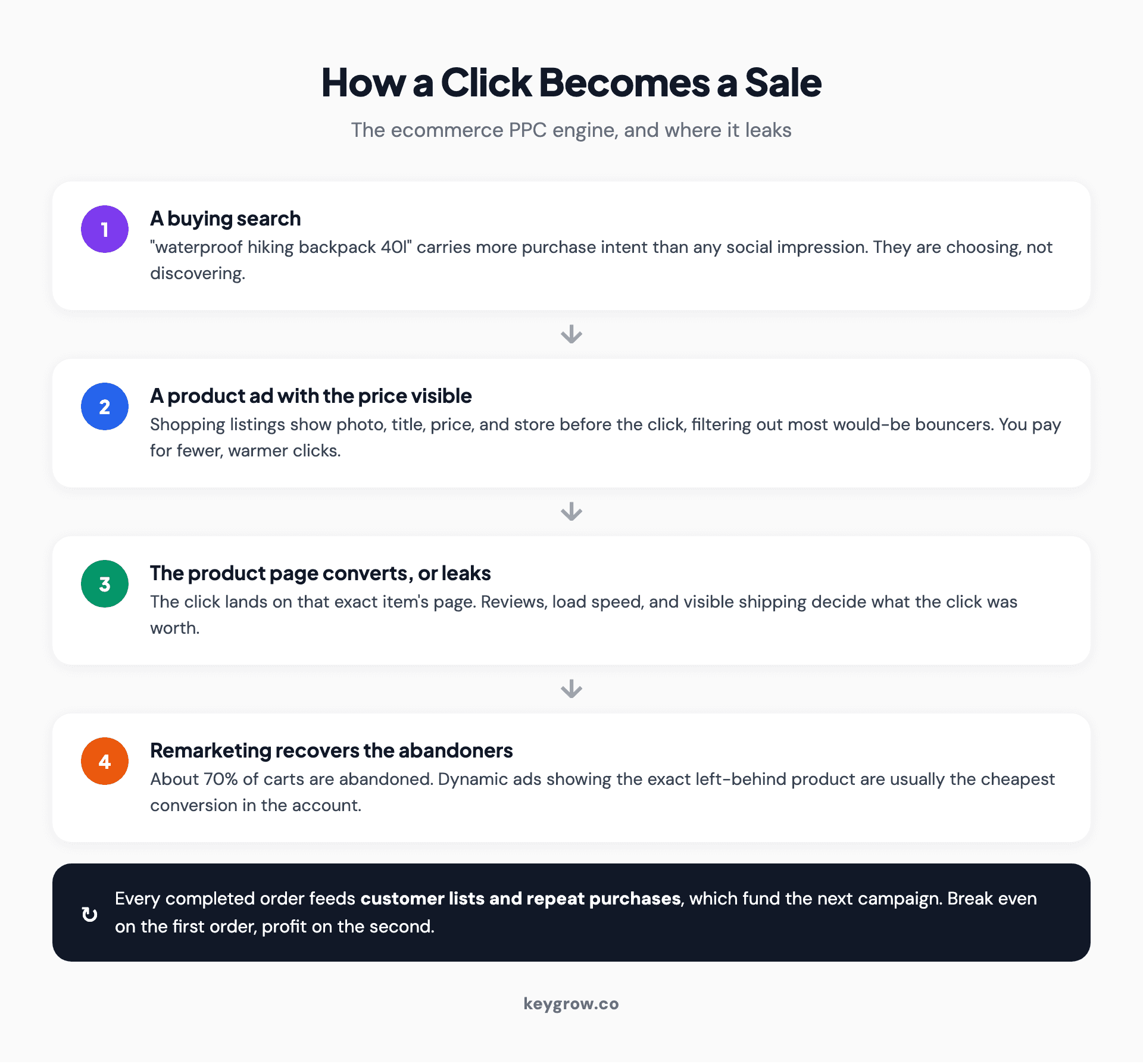
Flow diagram of the ecommerce PPC engine: buying search, product ad, product page, then remarketing recovering abandoned carts into repeat customers.
The ad. For online stores this is usually a Shopping listing: product photo, title, price, and store name, generated from your Merchant Center feed rather than from keywords you pick. The shopper sees your price before they ever click, which quietly filters out most of the people who would have bounced anyway. You pay for fewer, warmer clicks.
The page. The click should land on the product page for that exact item, not your homepage. Sending ad traffic to a homepage is the most expensive default in PPC. We watched a service client pay around $100 per booking pointing clicks at their homepage; a dedicated page took that to $22. Stores are no different, and product page basics like reviews, load speed, and visible shipping costs decide what a click is worth. The ad is half the job. The page is the other half.
The follow-up. Most clicks do not buy on the first visit. The average documented cart abandonment rate across 50 studies is 70.22 percent, per the Baymard Institute. Remarketing exists because of that number. More on it below.
The campaign types that matter, ranked by job
Shopping and Performance Max capture buying intent, Search covers your brand and problem queries, and remarketing recovers abandoners. Most stores should fund them in that order.
| Campaign type | Its job | When it earns budget |
|---|---|---|
| Shopping | Product photo, price, and store name on buying searches | First dollar for almost every store |
| Performance Max | Same product feed, automated across Search, YouTube, Display, Gmail, Discover, and Maps | Once conversion tracking is solid |
| Search | Brand terms, plus problem queries your products solve | Defending your name; intent Shopping misses |
| Remarketing | Pull back cart abandoners and past visitors | The moment you have traffic worth recovering |
Product listings are also where the growth is. Shopping ad clicks grew 18 percent year over year in the first quarter of 2026, against 11 percent for text search ads, per Tinuiti's tracking. Ads that show the product and the price fit how people buy now, and Google keeps giving them more shelf space.
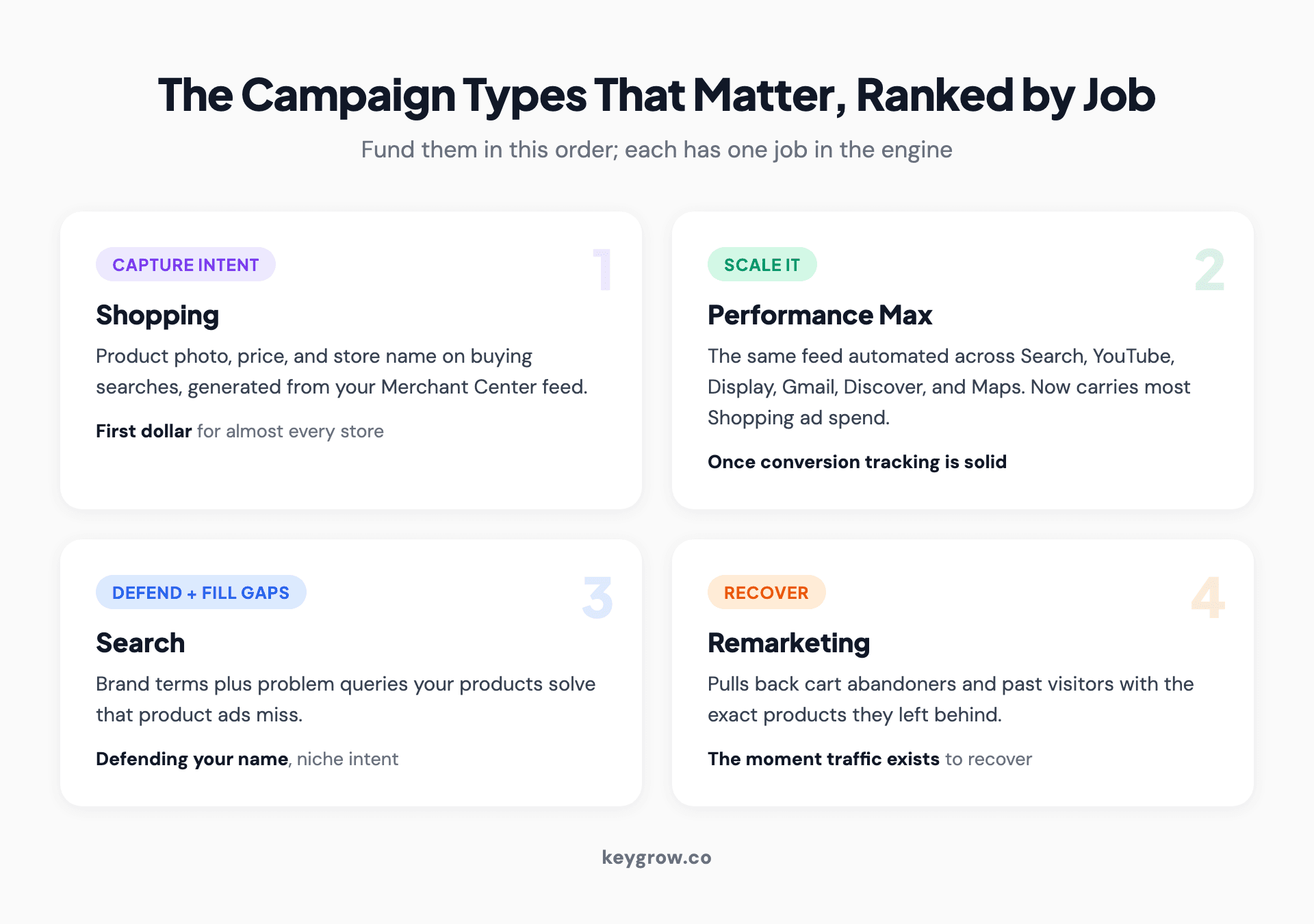
Four-card ranking of ecommerce PPC campaign types by job: Shopping captures intent, Performance Max scales it, Search defends the brand, remarketing recovers carts.
Performance Max or standard Shopping?
Performance Max now takes about 68 percent of Google Shopping ad spend and converts slightly better, but it hides data that standard Shopping shows you. We have broken down what Shopping ads cost in detail, including the budget math for a new store.
Performance Max runs one automated campaign across Google's channels, including Search, YouTube, Display, Gmail, Discover, and Maps, plus Shopping placements through your Merchant Center feed. By the third quarter of 2025 it had taken 68 percent of Shopping ad-listing spend, and measured conversion rates ran about 2 percent higher than standard Shopping campaigns in Tinuiti's benchmark data.
The trade-off is control. Standard Shopping gives you direct command of search terms and negative keywords. Performance Max has narrowed that gap since 2025 (it now shows search terms and accepts campaign-level negative keywords), but it still decides for itself how your budget spreads across channels, which works well when it has clean conversion data to learn from and poorly when it does not.
A practical rule we use: if your account is new or produces fewer than roughly 50 conversions a month, start with standard Shopping so you can see what is happening. Move budget to Performance Max once tracking is reliable and the feed is in good shape. Automation is only as smart as the data you feed it.
The break-even math, worked through
Divide your average order's price by its gross profit to get break-even ROAS, then check whether realistic click costs and conversion rates can clear it.
Say your average order is $60 and your gross margin is 40 percent, so each order carries $24 of gross profit. Break-even ROAS is 60 divided by 24, which is 2.5. Below 2.5, every "sale" the ads drive loses money.
Now plug in directional benchmarks. Older cross-industry data compiled in Store Growers' benchmarks put the average Shopping campaign click at $0.66 with a 1.91 percent conversion rate; costs have shifted since, but Shopping clicks still typically run well under a dollar, so the shape of the math holds. At those numbers a sale costs $0.66 divided by 0.0191, about $34.55. That is a 1.74 ROAS on a $60 order. At average performance, this store loses roughly $10.55 per order.
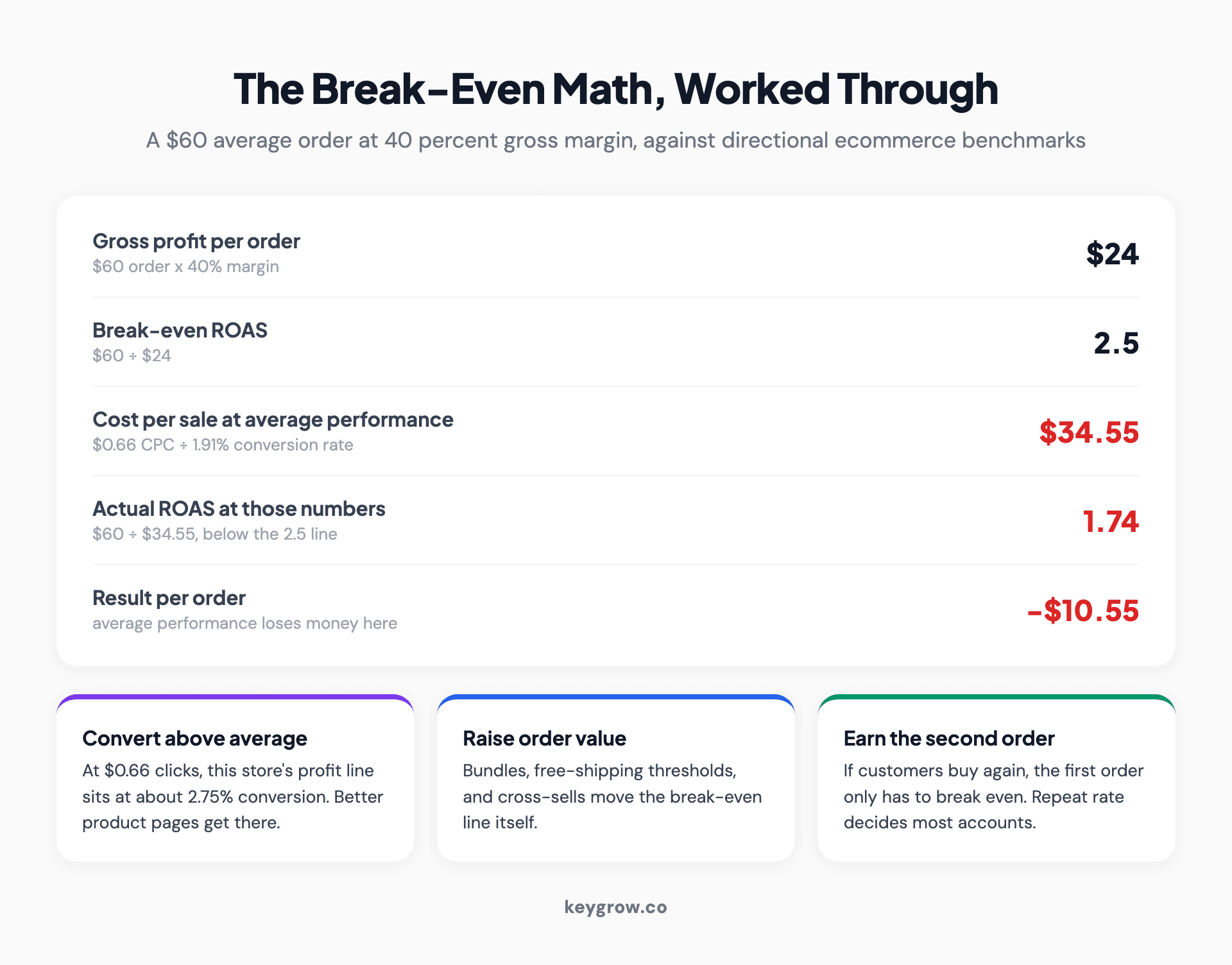
Worked break-even math for ecommerce PPC: a $60 order at 40 percent margin needs 2.5 ROAS, average performance delivers 1.74, and the three levers that close the gap.
That is not an argument against PPC. It is the honest starting position, and it points at the three levers that make the engine profitable:
- Convert above average. At $0.66 clicks, the profit line for this store sits at about 2.75 percent conversion. Better product pages get you there.
- Raise average order value. Bundles, free-shipping thresholds, and cross-sells move the break-even line itself.
- Earn the second order. If a customer buys again, the first order only has to break even. Repeat purchase rate is the quiet variable that decides most ecommerce ad accounts.
Run your own numbers through our break-even ROAS calculator before you spend. Five minutes of arithmetic beats three months of hopeful spending.
The 70 percent leak is the cheapest revenue in the account
Seven in ten carts are abandoned. Ads that pull those shoppers back convert warmer traffic at a lower cost than any cold campaign.
Baymard's research puts average cart abandonment at 70.22 percent and estimates about $260 billion in lost orders across the US and EU are recoverable through better checkout design alone. The top fixable reason shoppers quit: extra costs like shipping and fees showing up too late, cited by 40 percent.
So the play has two halves. First, fix what makes people leave, starting with showing shipping costs early. Paying for clicks into a checkout that surprises people with fees is filling a leaking bucket. Second, remarket to the rest. These are people who found your product, clicked your ad, and put the item in a cart. You already paid for that intent once. Dynamic remarketing that shows the exact abandoned product is usually the cheapest conversion in the whole account.
Every completed order then feeds the flywheel: customer lists power Customer Match audiences you can target, bid up, or exclude in the next campaign, which is how stores turn a break-even first order into a profitable second one.
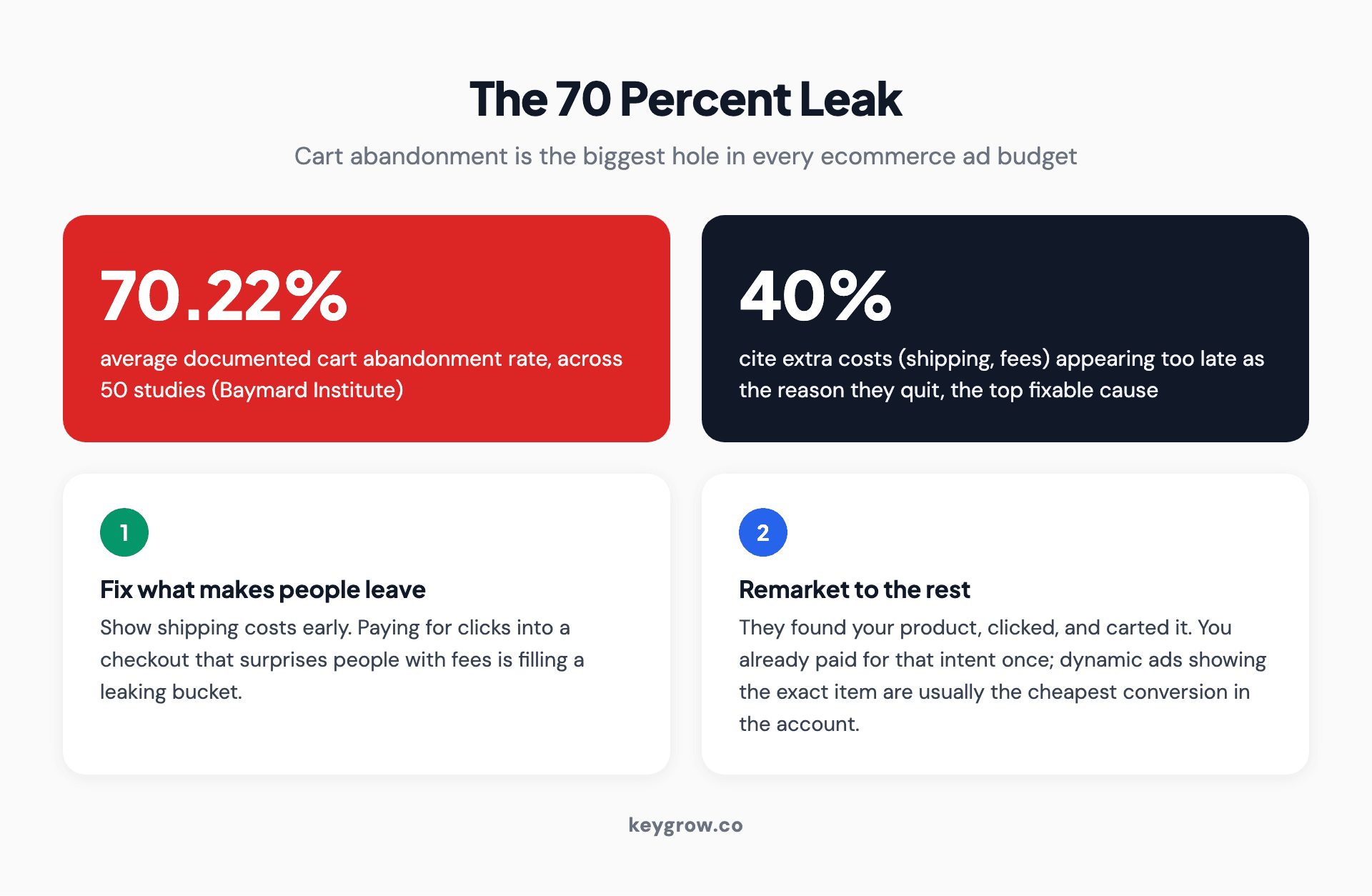
Stat card showing 70.22 percent of ecommerce carts are abandoned, the top reasons why, and the two-step recovery play of fixing checkout then remarketing.
What results to expect, and when
Expect a 2 to 3 percent conversion rate, a target ROAS near 4:1 depending on your margin, and two to three months before performance stabilizes.
Typical ecommerce conversion rates sit around 2 to 3 percent of clicks. The common ROAS target is 4:1, with 3:1 to 5:1 considered healthy, but the section above matters more than the convention: a 65 percent margin store thrives at 3:1 while a 20 percent margin store loses money at the same number.

Stacked cardboard parcels packed for delivery from an online store.
On timing, first sales can arrive within days of ads going live. Stable, optimizable performance takes longer, because smart bidding needs conversion volume to learn from and you need search-term data to cut waste. Budget two to three months of managed spend before judging the channel.
One more expectation worth calibrating: in a 2025 Shopify survey of 500 merchants, 31 percent of store owners earning $1 million or more named paid advertising their most effective growth channel. A strong showing, and still not a majority. PPC is a powerful tool, not a business model. It works best next to SEO and email rather than instead of them.
When PPC will not drive sales for your store
Thin margins, broken product pages, missing conversion tracking, or a budget spread across five platforms will lose money no matter how good the ads are.
Skip PPC for now, or fix these first, if any of the following is true:
- Your break-even ROAS is above 3 and nothing repeats. Low margin, low order value, one-time purchases: the math rarely clears. Fix the offer before the ads.
- You have no conversion tracking. Every automated bid strategy optimizes toward whatever you measure. Measure nothing and it optimizes toward nothing.
- Your product pages leak. Slow loading, no reviews, shipping costs hidden until checkout. Paid traffic amplifies whatever the site already does, including the leaks.
- Your budget is split across every platform at once. $1,500 a month spread over five channels teaches you nothing. Prove the math on Google Shopping first, then expand.
And an honest note: a small store with more time than money can set up its own Merchant Center feed and a standard Shopping campaign. The setup is well documented and the stakes at low spend are small. An agency earns its fee when the account is spending enough that feed optimization, campaign structure, and testing discipline return more than they cost.
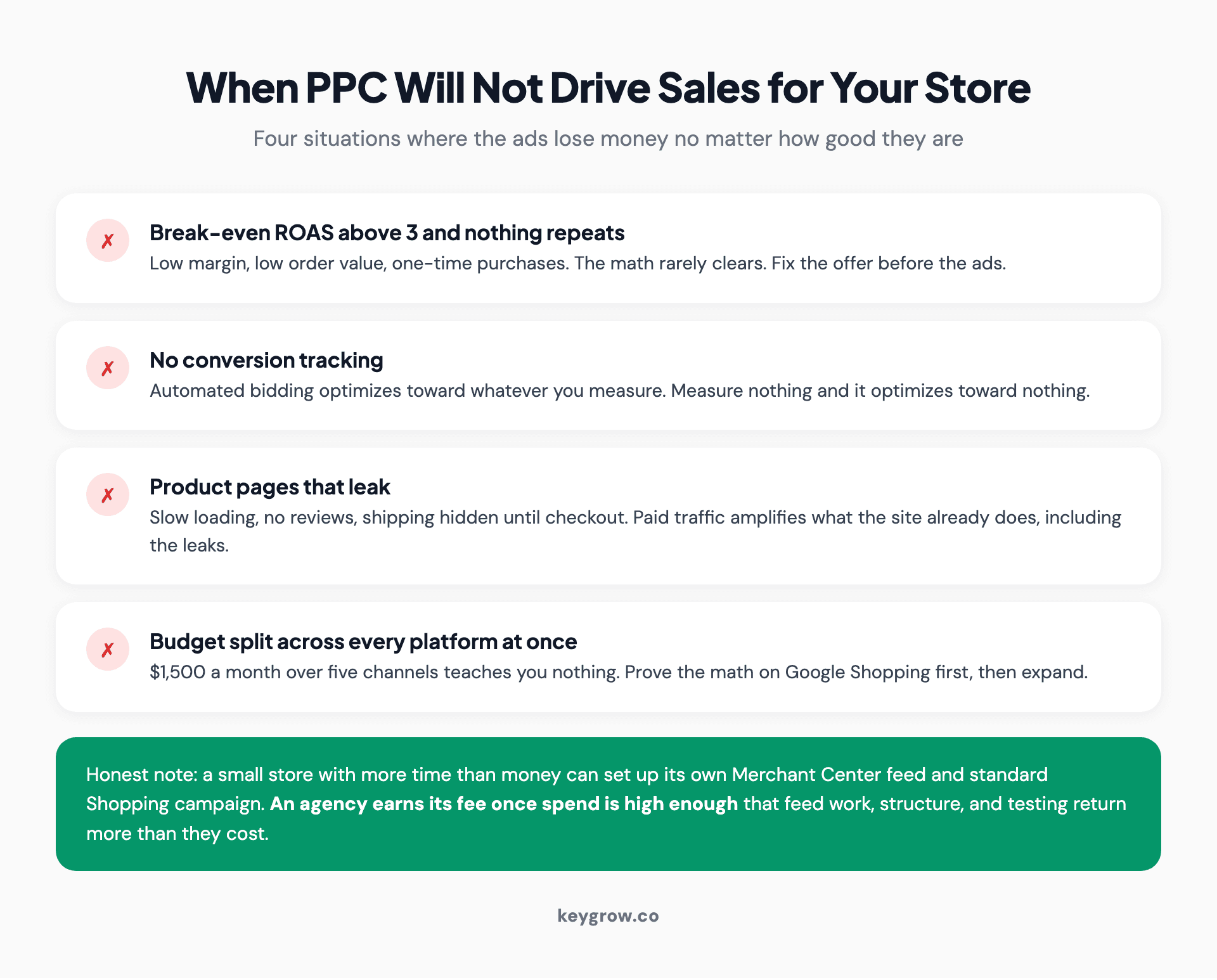
Checklist of four situations where PPC will lose money for an online store: bad break-even math, no tracking, leaking product pages, and scattered budget.
FAQs
Does PPC really work for online stores?
Yes, when the margins support it. PPC puts product ads in front of shoppers who are actively searching to buy, which is the highest-intent traffic available. Whether those sales are profitable depends on your gross margin, conversion rate, and repeat purchase rate, which is why the break-even math matters more than the channel itself.
How much does PPC cost for a small online store?
There is no fixed price; you set the budget and pay per click. Ecommerce clicks often cost well under a dollar on Shopping campaigns, and a practical starting budget is one that generates enough conversions for the bidding algorithms to learn from: Google's stated minimum for value-based bidding is 15 conversions in 30 days, and many practitioners prefer closer to 50 a month. For many small stores that means $1,000 to $3,000 a month.
What is a good ROAS for ecommerce PPC?
The common target is 4:1, meaning four dollars of revenue per dollar of ad spend, with 3:1 to 5:1 considered healthy. The honest answer depends on your gross margin: divide your average order value by its gross profit to find your break-even ROAS, then aim comfortably above it.
Should I use Google Shopping or Performance Max?
Start with standard Shopping if your account is new or has limited conversion data, because it shows you search terms and gives you control. Performance Max tends to convert slightly better once conversion tracking is reliable and your product feed is clean, which is why it now carries most Shopping ad spend.
Is PPC better than SEO for an online store?
They do different jobs. PPC produces sales within days and scales with budget, while SEO compounds over months and keeps producing after you stop paying for clicks. Most established stores run both: ads for immediate revenue and new product pushes, organic for durable traffic that lowers blended acquisition cost.
How long does it take for PPC to generate sales?
First sales can arrive within days of campaign approval if the product and page are solid. Stable, profitable performance usually takes two to three months, because automated bidding needs accumulated conversion data and you need search-term reports to cut wasted spend.
How do I recover abandoned carts with PPC?
Build a remarketing audience of visitors who added to cart without purchasing, then run dynamic remarketing ads that show the exact products they left behind. Pair the ads with checkout fixes, especially showing shipping costs early, since surprise fees are the most cited fixable reason for abandonment.
Start with the math, not the ads
PPC drives sales for online stores through a simple, repeatable engine: capture buying intent with product ads, convert it on a page built to sell, recover the abandoners, and feed every customer back into the targeting. The stores it fails are almost always the ones that skipped the arithmetic.
So do the five-minute version today. Pull your average order value and gross margin, find your break-even ROAS, and check it against realistic click costs. If the numbers clear, our ecommerce team manages Shopping, Performance Max, and remarketing month-to-month, and you can request a free audit of an existing account. If they do not clear yet, fix the offer first. The ads will still be there when the math works.