

Your traffic fell off a cliff overnight. You opened Analytics, watched the line drop like a stone, and typed the question into Google with a pit in your stomach: what happened to my rankings. Before you panic, here is the answer most pages bury.
So what is a Google penalty in SEO. A Google penalty is a manual action: a human reviewer at Google looked at your site, decided it broke the spam guidelines, and applied a demotion or removal that shows up as a notice inside Google Search Console. That is the only thing Google officially calls a penalty. Everything else, the core update drop, the helpful content slide, the day your competitor outranked you, is something different. It feels identical. It is not the same thing, and it does not get fixed the same way.
That distinction is the whole game. If you treat an algorithmic drop like a penalty, you will spend weeks writing reconsideration requests to a system that has no human on the other end to read them. So before you touch anything, run one 60-second test that tells you which situation you are actually in.
Did Google actually penalize you, or did the algorithm just move on?
Most ranking drops are not penalties. They are algorithmic re-evaluations, and the difference matters because the recovery path is completely different.
Here is the reality. Google's systems process an enormous volume of spam quietly, every day, without ever sending a notice. Per Google's own figures, its systems find 40 billion spammy pages every single day (see Google How Search Works). Almost none of that volume turns into a manual penalty. Manual actions are rare, deliberate, and announced. They are the exception, not the rule.
When your traffic drops and there is no notice in Search Console, the most likely explanation is an algorithm update. Google runs core updates and spam updates on a rolling schedule, and those updates re-rank the entire web at once. Your page did not get punished. The bar moved, and a page that used to clear it no longer does. That is suppression, not a penalty, and Google is explicit that core updates are not penalties.

Stressed business owner holding his head with his hand, looking worried in natural indoor light
The emotional experience is the same either way. Revenue stops. The phone goes quiet. You assume you did something wrong. But the fix for a true manual action (clean up the violation, ask a human to re-review) is the opposite of the fix for an algorithmic drop (improve the page, wait for the next update cycle, no request needed). Diagnose first. Pick the path second.
The 60-second test: open the Manual Actions report
There is exactly one place that gives you a definitive answer, and it takes under a minute. Open Google Search Console, then go to Security and Manual Actions, then Manual Actions.
You will see one of two things:
1. "No issues detected." You do not have a penalty. Full stop. Whatever happened to your rankings was algorithmic, technical, or competitive. Skip the reconsideration request entirely; it will do nothing for you.
2. A listed action with a description. This is a real manual action. Google is telling you exactly what it found and whether the demotion is site-wide or page-level. This is the only scenario where the word "penalty" technically applies.
That is the test. If the report is clean, stop thinking about penalties and start thinking about update timing and technical health. If the report shows an action, you have a clear, fixable problem with a defined process.
The next move depends on what you saw. A clean report sends you down one road. A listed action sends you down a completely different one. Below is the decision flow, then both roads in detail.
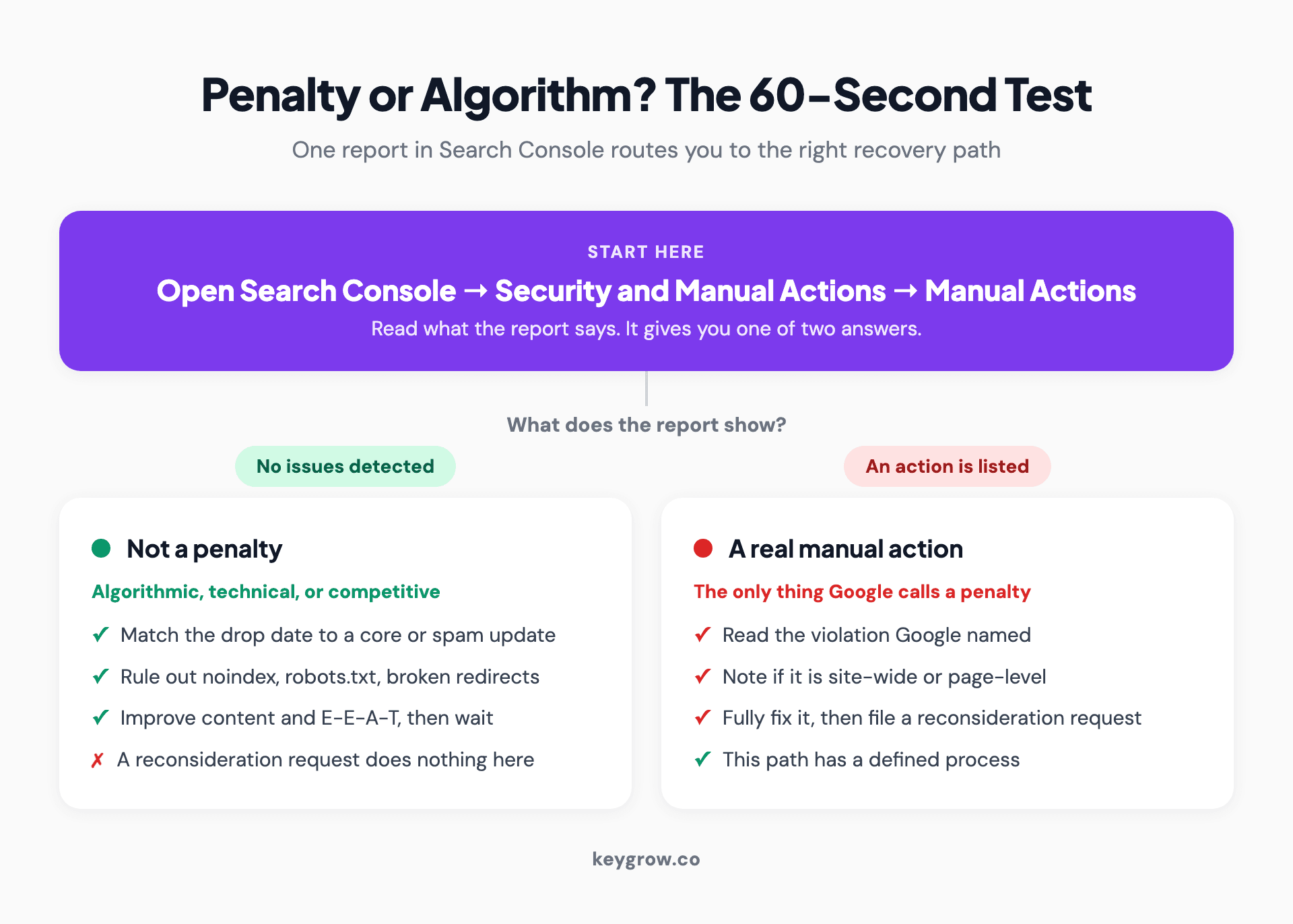
Decision tree showing how to tell a Google penalty from an algorithmic drop: open the Manual Actions report in Search Console, then branch to manual action recovery if a notice exists or algorithmic and technical checks if the report is clean
Manual actions: the only thing Google officially calls a penalty
A manual action is a human-issued demotion or removal applied when a reviewer confirms your site violates Google's spam policies. It is the textbook definition of what is a Google penalty in SEO, and it is the only ranking problem that comes with a notice you can read.
Most guides list five or six generic causes and stop at examples from a decade ago. Here is the current list of manual action types straight from Google's own report, including the additions from the 2024 to 2025 policy updates:
The notice will tell you whether the action is site-wide (your whole domain is demoted) or partial / page-level (only specific URLs are affected). Page-level actions are far easier to recover from because you can isolate and fix the exact pages named. Site-wide actions, especially link-related ones, take more work and longer to clear.
If you have been hit with an unnatural-links action, it is worth understanding whether your link problems are self-inflicted. We wrote about affiliate links and SEO because affiliate-heavy pages are a common, avoidable trigger for thin-content and unnatural-link actions.
Algorithmic suppression: real, painful, and technically not a penalty
Algorithmic suppression is when a Google algorithm update re-evaluates your site and decides it no longer deserves its old rankings. There is no notice, no reviewer, and no reconsideration process, because no human made a decision about your specific site.
This is where the SERP gets dishonest. Page after page defines "penalty" as a manual action, then lets you believe your core-update drop is a penalty you can appeal. It is not. The March 2024 core update was built to cut low-quality, unoriginal content in results, and Google said it expected a roughly 40 percent reduction, later reporting the actual figure reached 45 percent (per Google's Search blog). If your site was part of that 45 percent, no button in Search Console will bring it back. The next update will, if you have improved the content by then.
How to confirm you are in this bucket:
This is the most common reader mistake on this entire topic. People feel punished, so they act punished: they file reconsideration requests, they tear pages down in a panic, they buy disavow services. None of it touches an algorithmic drop. The only levers that work are better content, stronger first-hand experience and expertise, and patience until the next update reassesses the site.
Same symptom, different cause: ranking drops that are not penalties at all
Before you blame Google's algorithm, rule out the boring stuff, because a surprising share of "penalties" are self-inflicted technical errors that look identical in the traffic graph.
Run through this list first. Any one of these can erase your rankings overnight with no penalty and no algorithm update involved:
The fastest way to separate these from a real algorithmic re-evaluation is a proper technical pass. If you have never run one, our guide on conducting a technical SEO site audit walks through the exact crawl-and-index checks that catch noindex and robots.txt mistakes in minutes. A site audit is also where you catch the boring breakages before they cost you a quarter, which is part of why an SEO audit matters in the first place.
Here is the honest part. This is the moment to not panic-hire an agency. If your drop traces to an accidental noindex or a missing batch of redirects, that is a same-day developer fix, not a six-month retainer. Plenty of agencies will happily sell you a "penalty recovery" package for a problem your own Search Console diagnosed in 60 seconds. Confirm the cause before you sign anything.
If it is a manual action: how to fix it and write a reconsideration request that gets approved
If Search Console shows a manual action, the recovery path is concrete: fully fix the violation, document what you did, then submit a reconsideration request. The order matters, and "fully" is the word that gets requests rejected.
A reconsideration request is only relevant after a manual action or a security issue, and a strong one explains the exact issue, the steps you took to fix it, and the outcome (per Google Search Console Help). Most rejected requests fail for the same reasons:
1. Partial fixes. You cleaned up some unnatural links but left obvious ones. The reviewer finds them in 30 seconds and declines.
2. No documentation. You said you fixed it but showed no evidence. Reviewers want a paper trail: a spreadsheet of links you removed, screenshots, dates, outreach records.
3. Defensiveness. Arguing that the action was unfair instead of demonstrating the cleanup. The reviewer is not the appeals court; they check whether the violation is gone.
4. Re-submitting too fast. Sending another request before the first decision lands resets your place in the queue.
What a strong reconsideration request actually contains:
For link actions specifically, the work is removal first, disavow last. Try to get bad links taken down (outreach, removal requests). Only disavow what you genuinely cannot remove, and only after a documented effort. We will come back to the disavow tool below, because the conventional advice on it is mostly wrong now.
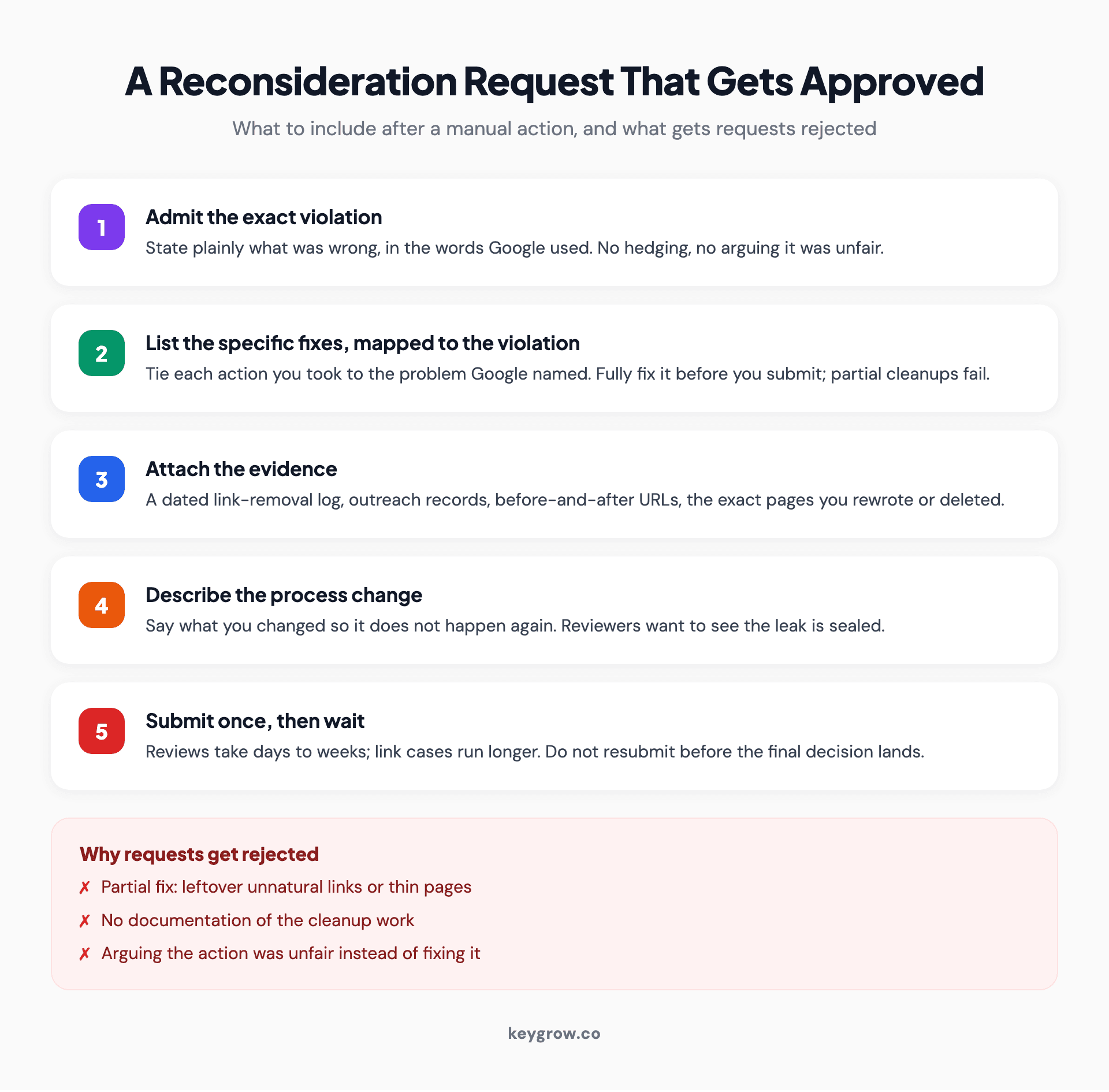
Numbered checklist of what a strong Google reconsideration request includes: admit the exact violation, list specific fixes mapped to it, attach a dated link-removal log and before-after evidence, describe the process change, then submit once and wait for the decision
If it is algorithmic: why a reconsideration request will not help
If your Manual Actions report is clean, do not file a reconsideration request. There is no human decision to reconsider, so the request goes nowhere. This is the single most common and most expensive mistake people make after a drop.
An algorithmic drop is a verdict from a system, not a sanction from a person. The recovery work is rebuilding the site's quality signals so the next update scores you higher:
The opinion I will stake here, with a number behind it: "page one in 30 days" is a red flag, full stop. Our strongest organic case took a full 12 months of consistent work to reach 1,519 percent traffic growth, with no shortcuts. Recovery from an algorithmic drop runs on the same compounding clock. Anyone promising to "lift your penalty in a week" when you have no manual action is selling you a fix for a problem you do not have.
How long recovery really takes for each path
Recovery time depends entirely on which problem you have, and the two paths are not close. Anyone quoting you a single timeline for "Google penalties" is guessing.
| Situation | What you do | Realistic recovery time |
|---|---|---|
| Manual action (page-level) | Fix the named pages, submit reconsideration | Several days to a few weeks after a successful request |
| Manual action (link-related, site-wide) | Remove and disavow, document, submit | Often longer; link reviews take more time |
| Algorithmic suppression (core or spam update) | Improve content and E-E-A-T, wait | Next relevant update cycle, frequently months |
| Technical break (noindex, robots, redirects) | Fix the error, request re-crawl | Days, once Google recrawls |
| Lost to a stronger competitor | Out-create and out-earn them | Months, the normal SEO clock |
On the manual-action side, Google's own guidance is clear: most reconsideration reviews take several days or weeks, link-related requests can take longer, and you should not resubmit before you get a final decision (per Google Search Console Help, linked above). On the algorithmic side, the honest answer is that you are waiting for the next update, and Google does not run those on demand.
The technical-break path is the good news here. If your "penalty" is actually an accidental noindex, fixing it and requesting a re-crawl can restore rankings within days. That is one more reason to run the 60-second test and the technical checks before you assume the worst.
How to stay off Google's radar in the first place
The cheapest penalty is the one you never trigger. Prevention is almost entirely about not doing the things on the manual-action list, plus a few habits that catch problems early.
The practical prevention checklist:
None of this is glamorous, and none of it requires a tool you do not already have. Google gives you the Manual Actions report, the index coverage report, and performance data for free. Most "penalty prevention" is just reading them.
FAQs
How do I know if my site has a Google penalty or just lost rankings to an algorithm update?
Open Google Search Console, go to Security and Manual Actions, then Manual Actions. If it says "No issues detected," you do not have a penalty; your drop is algorithmic, technical, or competitive. If it lists an action, that is a true manual action with a defined recovery process. Then cross-reference your drop date against published core and spam update dates to confirm an algorithmic cause.
How long does a Google penalty last, and how long does recovery take?
A manual action lasts until you fix the violation and Google approves your reconsideration request, which typically takes several days to a few weeks (link-related cases run longer), per Google Search Console Help. An algorithmic drop has no fixed duration; recovery happens at the next relevant core or spam update once you have genuinely improved the site, which is often months away. Technical breaks like an accidental noindex can recover within days of a re-crawl.
Can you recover from a Google manual action, and how do you submit a reconsideration request?
Yes. Fully fix the violation, document exactly what you did, then submit a reconsideration request from the Manual Actions report. A strong request names the issue, lists the specific fixes mapped to it, and includes evidence like a dated link-removal log. Requests get rejected for partial fixes, missing documentation, or arguing the action was unfair instead of showing the cleanup.
Is a Google core update a penalty?
No. A core update is an algorithmic re-evaluation that re-ranks the whole web at once, and Google states explicitly that core updates are not penalties. There is no notice in Search Console and no reconsideration process. If your traffic dropped during a core update with a clean Manual Actions report, you were suppressed, not penalized, and the fix is better content plus waiting for the next update.
Will the disavow tool fix a link penalty, and do I still need it in 2026?
Mostly no. Google now says the vast majority of sites never need the disavow tool, and reckless disavowing can hurt you by removing links that were helping. Use it only for a specific unnatural-links manual action or a clear pattern of paid or spammy links you cannot get removed, and only after a documented removal effort. For an algorithmic drop with no manual action, disavowing does nothing.
Why did my reconsideration request get rejected?
Almost always because the fix was partial or undocumented. Reviewers check whether the violation is actually gone; if they find leftover unnatural links or thin pages you said you removed, they decline. Other common reasons: no evidence of the work, arguing the action was unfair, or resubmitting before the first decision arrived. Fix everything, document it, submit once, and wait.
Diagnose before you fix
The most useful thing you can do after a traffic drop is the least dramatic: open the Manual Actions report and read it. If it is clean, you do not have a penalty, and no reconsideration request, disavow file, or panic agency retainer will help. You have an algorithmic re-evaluation or a technical break, and each has its own fix.
A true Google penalty is a manual action, it is rare, and it always announces itself. Everything else that feels like a penalty is a different problem wearing the same costume. Sort which one you have first, then spend your effort on the path that actually works.
If you have run the test, confirmed the cause, and want a second set of eyes before you commit time or budget to recovery, that is exactly the kind of diagnosis we do. We are month-to-month and we will tell you if it is a same-day developer fix rather than a project worth hiring for. Get started here and we will look at it with you.


