

A founder showed me an analytics report last year that he thought proved SEO was a waste. One page on his site had pulled 18 visitors the previous month. Eighteen. On the desk next to the laptop was a signed contract worth a little over six figures. The deal had started with one of those 18 visitors reading that page at 11pm.
That gap is the whole reason why SEO is important for B2B. In consumer marketing, traffic and revenue move roughly together. In B2B, a page with almost no traffic can carry the entire pipeline, because the people searching are a tiny set of buyers each worth a fortune, and they are doing the research before they ever talk to you. The honest answer is not that B2B SEO brings more traffic. It usually brings less. It matters because of who that traffic is and what one of them is worth.
This is a field guide to that idea, settled with numbers instead of adjectives: the deal-size math, the buying committee you are actually writing for, the timeline tied to your sales cycle, where B2C SEO genuinely wins, and what AI Overviews did to the picture in 2025.

A professional reviewing work on a laptop alone in a dimly lit office at night, researching independently
Why does low search volume mean higher value in B2B?
Low search volume in B2B usually signals high intent, not low opportunity. The handful of people searching a niche term are often the exact buyers, evaluators, and decision-makers who control a large purchase, so each visitor is worth far more than a casual consumer click.
A B2C keyword like a running shoe brand might get tens of thousands of searches a month. Most of those people are browsing, comparing, or killing time. A B2B keyword like "SOC 2 compliance automation for fintech" might get 40 searches a month, and nearly every one of them is a person with a real budget and a problem your product happens to solve.
The trap is that low volume looks like failure in an analytics dashboard. An executive sees a page pulling 18 visits and assumes the channel is broken. The same executive would never apply that logic to a salesperson who closed one six-figure deal from 18 conversations. In B2B, you measure the channel by the value of who shows up, not the size of the crowd.
Search still does most of the heavy lifting in getting those people to you. Organic search drives 53% of all trackable website traffic on average, and for B2B sites total search activity accounts for over 76% of trackable traffic. The buyers are searching. The only question is whether you are the result they find.
The math: what is one keyword worth when the deal is $50,000?
Here is the calculation no competitor on this topic seems willing to show. Run the same model on a B2B keyword and a B2C keyword and the B2B term wins by a wide margin, even though it has a thousand times less traffic.
Take a B2B keyword with 40 searches a month. Say you rank well enough to capture 30% of clicks, which is 12 visitors. B2B landing pages convert visitors to leads at a few percent, so call it 4% to a qualified lead, which is roughly one lead every two months. If your sales team closes one in four qualified leads and your average contract is worth $50,000, that keyword produces about $75,000 in new business a year from 40 monthly searches.
Now the B2C version. A keyword with 20,000 searches a month, 30% click capture, 6,000 visitors. Consumer e-commerce converts around 2%, so 120 orders. At an average order value of $60, that is $7,200 a month, or about $86,400 a year. Higher, but it took 500 times the traffic to get there, and you are competing with the entire internet for those 20,000 searches. The B2B term, with 40 searches, was almost uncontested.
That is the mechanic everyone repeats and nobody proves: in B2B, value per search is the metric, not search volume. A keyword with 20 searches a month can out-earn one with 20,000 because the math runs on deal size, not click count.
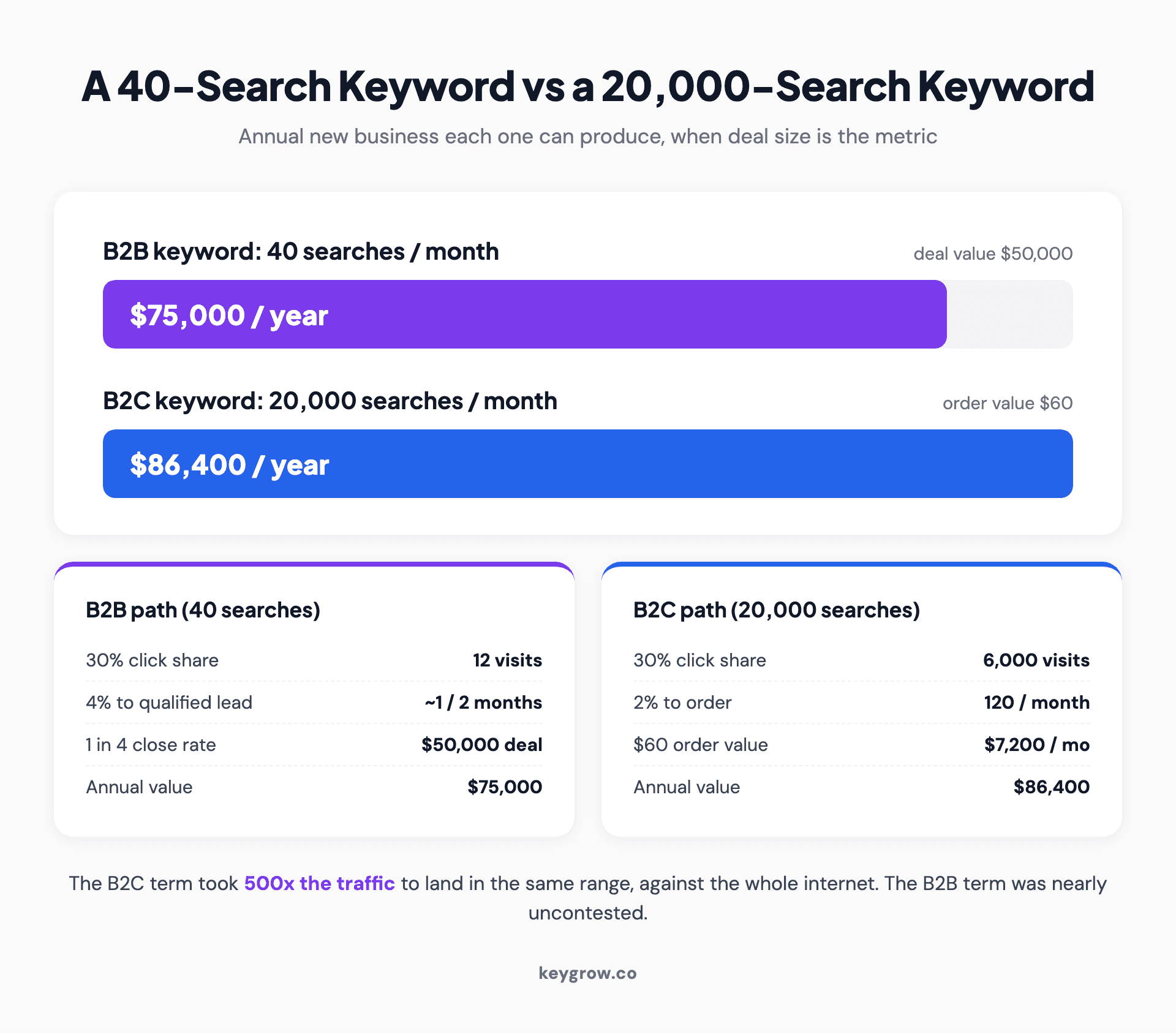
Bar chart comparing the annual revenue value of a low-volume B2B keyword with 40 monthly searches against a high-volume B2C keyword with 20,000 monthly searches, showing how B2B deal size makes the smaller keyword competitive
If you want to do this for your own keywords before committing budget, the inputs are simple: monthly volume, realistic click share, lead conversion rate, close rate, and average contract value. We break the full model down in our guide on how to measure SEO ROI.
Who are you really optimizing for? Inside the buying committee
You are not writing for one buyer. You are writing for a committee of six to ten people, each of whom searches for something different. B2B SEO works when your content answers the specific question each role on that committee is googling, not when it ranks for one keyword.
Gartner research puts a typical B2B buying group for a complex solution at six to ten decision-makers, each arriving with four or five pieces of information they gathered on their own. That last detail is the one most articles skip. Those people are not researching together in a meeting. They are researching alone, on their own time, often before anyone has contacted your sales team. The same Gartner work found that buyers spend only about 17% of their total buying time meeting with any potential supplier, and a Gartner sales survey found 61% of B2B buyers prefer a rep-free buying experience.
If 83% of the buying journey happens without you in the room, the content they find while you are absent is your sales pitch. Much of that discovery now happens off your site entirely, which is the argument for LinkedIn marketing for B2B running alongside search. So map it. The technical evaluator is searching for documentation, integration details, and security specifics. The economic buyer wants ROI math and pricing models. The end user wants to know if it will make their day easier. Procurement wants comparison criteria and contract terms.
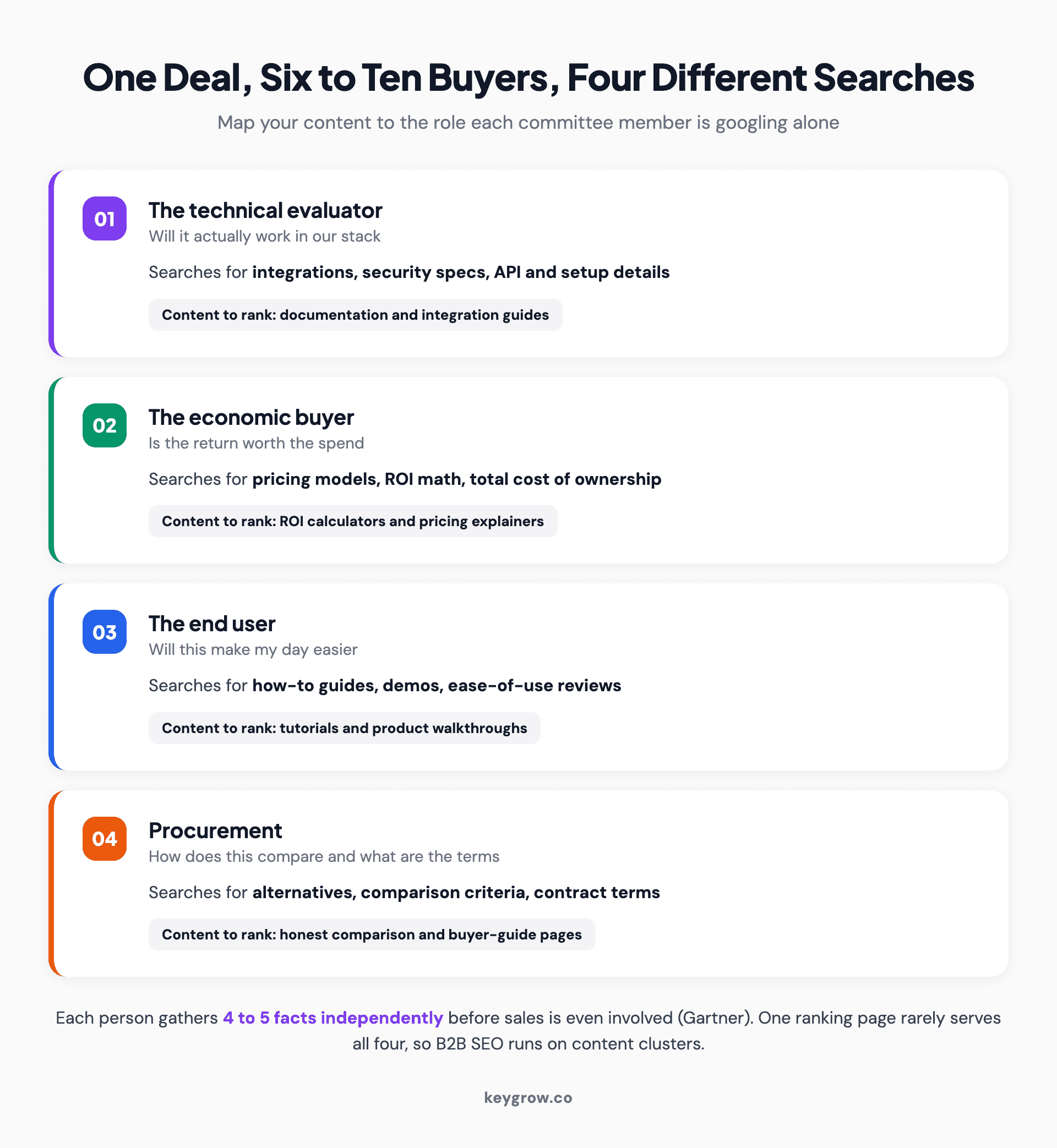
Numbered layout mapping four roles in the B2B buying committee to the specific content each one searches for: technical evaluator seeking docs, economic buyer seeking ROI, end user seeking ease of use, and procurement seeking comparison criteria
One ranking page rarely satisfies all four. That is why B2B SEO leans on clusters: a pricing explainer, a security overview, an integration guide, an honest comparison page, each ranking for the term one committee member types at midnight. Blog content is a big part of how you cover the informational end of that map, which is why we argue that blogs do help SEO when they answer real buyer questions instead of chasing volume.
How SEO compounds across a long sales cycle
SEO compounds because the page you publish today keeps working through a sales cycle that can run half a year, while paid search stops the moment you stop paying. In a market where most deals take months to close, the channel that keeps earning between touches has a structural advantage.
The cycle is genuinely long. Data compiled by Marketing Charts found that 74.6% of B2B sales to new customers take at least four months to close, and 46.4% take seven months or more. A buyer might read your comparison page in February, your security overview in April, and finally book a call in August. With paid search, you pay for every one of those visits, every month, forever. With organic, you paid once to earn the ranking and it kept serving that buyer through the whole cycle.
Here is the pattern in practice. A doctor's practice in Dubai committed to SEO for a full year. Months one through three looked unimpressive on the surface, the kind of stretch where a nervous owner kills the project. By month twelve, organic traffic had grown 1,519% and the practice was fielding 130+ patient calls a month. Same site, same client, no shortcuts. The early months were not wasted. They were the part of the compounding curve that looks flat right before it bends.
That shape is exactly why SEO takes time, and why it pays to start the engine well before a deal you want to influence would close. Paid search is rent. Organic is an asset you own.
Where B2C SEO genuinely beats B2B SEO
B2C SEO is genuinely faster, cheaper to test, and easier to attribute than B2B SEO. Anyone telling you B2B SEO wins on every axis is selling you something. It wins on value per visitor, and that is enough, but it loses on speed, volume, and clarity, and pretending otherwise insults a skeptical reader.
Speed: a consumer can read a review and buy in the same session. A B2B buyer reads, leaves, consults four colleagues, and resurfaces in five months. B2C SEO converts in one visit; B2B SEO plants a seed and waits.
Volume for testing: a B2C page getting 6,000 visits a month gives you statistically real data on headlines, layout, and CTAs within days. A B2B page getting 12 visits a month will take a year to tell you anything with confidence. High traffic is a testing luxury B2B rarely has.
Attribution: when someone buys shoes after one click, last-click attribution is roughly honest. When a deal closes after 20+ touches across six people over seven months, last-click is a lie that usually credits whatever was clicked last and makes SEO look worse than it was. B2C attribution is cleaner because the path is shorter.
So when is B2B SEO genuinely not worth it? If your entire addressable market is a few hundred named accounts, nobody is googling generic terms, and you already have warm relationships with all of them, SEO is the wrong first dollar. Targeted outbound and account-based plays will beat it. SEO earns its keep when buyers you cannot name are out there searching for what you do. If they are not searching, do not pretend organic will find them.
What AI Overviews changed for B2B search in 2025
AI Overviews cut clicks on broad consumer queries hard, but they changed B2B search far less, because the niche, high-intent questions B2B buyers ask are exactly the ones AI summaries handle worst. The doom narrative is real for head consumer terms and overstated for B2B.
The drop is measured, not speculative. Pew Research Center found that when a Google search returned an AI Overview, only 8% of users clicked a traditional result link, versus 15% when no AI summary appeared, and just 1% clicked a link inside the Overview itself. That is a real click loss, and any B2C site living on informational head terms should be worried.
B2B behaves differently for two reasons. First, the questions are specific enough that an AI summary often cannot answer them well. "Does this tool support SAML SSO with our identity provider and meet HIPAA" is not a question a generic three-sentence summary resolves. The buyer still clicks through to your documentation. Second, AI engines have to cite somewhere, and they pull from pages that answer the question directly and carry authority. Being the page the AI pulls from is the new version of ranking.
That shifts the job from "rank number one" to "be the source the answer is built from." The tactics that earn that, answer-first structure, real specifics, and authority, are the same ones that already win in B2B. The work is maintaining pages that both rank and get cited as AI search keeps moving.

A small B2B team gathered around a laptop in an office, collaborating on a shared buying decision
How do you measure B2B SEO when the deal closes six months later?
You measure B2B SEO with leading indicators, not last-click revenue, because the deal closes too far downstream for last-click to credit organic fairly. Track assisted conversions, branded search growth, and pipeline influence, and you will see the channel working long before the contract is signed.
Last-click attribution is the quiet killer of B2B SEO budgets. A deal touches 20+ pieces of content across half a dozen people over seven months, then last-click hands all the credit to the demo-request form or the final paid retargeting ad. Organic, which did the early educating, shows up with a rounding error of revenue. The channel did the work and the report buried it.
Better signals to watch:
The deeper point is that judging a six-month-cycle channel by last-click is like grading a teacher only on the day a student graduates. We go further into the leading-indicator approach in our breakdown of how to measure SEO ROI.
The mistakes that make leaders kill B2B SEO too early
Most B2B SEO does not fail. It gets killed before it can work, usually by a leader reacting to the wrong number. If you recognize your own company in this list, the problem is the measurement, not the channel.
1. Judging it by raw traffic. Eighteen visitors looks like nothing until you learn three of them were target accounts. Volume is the wrong scorecard in B2B.
2. Quitting at month three. The compounding curve looks flat right before it bends. The doctor's practice above looked unremarkable through quarter one and grew 1,519% by month twelve. Quitting in month three means paying for the hard part and leaving before the payoff.
3. Trusting last-click attribution. It credits the bottom of the funnel and buries the content that started the deal. If your report shows organic driving almost no revenue on a seven-month cycle, suspect the model before you cut the budget.
4. Chasing high-volume head terms. A B2B company ranking for a generic 50,000-search term usually attracts students and tire-kickers, not buyers. The 40-search term closes deals.
5. Treating it like a campaign with an end date. It is an asset you build and maintain, closer to R&D than to an ad flight.
This is also where my one strong opinion goes, and it has a number behind it. Any agency promising page one in 30 days is a red flag, full stop. Our strongest organic result took 12 months to reach 1,519% traffic growth. Anyone promising page one in a month is either targeting keywords nobody searches or about to burn your domain. In B2B, where the keywords that matter are low-volume and competitive, fast promises are even less believable than usual.
For the broader question of whether the investment pays off at all, we lay out the honest case in are SEO services worth it.
FAQs
Is SEO worth it for B2B with such low keyword search volume?
Usually yes, because low volume in B2B signals high intent. The few people searching a niche term are often the exact buyers, and one closed deal can be worth tens of thousands of dollars. The right metric is value per visitor, not visitor count. A keyword with 40 searches a month can out-earn one with 20,000 once you factor in deal size and close rate.
How long does B2B SEO take to show results?
Plan for traction over 6 to 12 months, tied to your sales cycle. Since 74.6% of B2B deals take at least four months to close per Marketing Charts data, your SEO needs to be working before a deal you want to influence would land. Early months look flat by design. One client practice grew organic traffic 1,519% by month twelve after an unremarkable first quarter.
What is the difference between B2B SEO and B2C SEO?
B2B SEO targets low-volume, high-intent keywords searched by a buying committee of six to ten people over a long cycle, and it wins on value per visitor. B2C SEO targets high-volume keywords with shorter cycles and converts faster, with cleaner attribution and more traffic for testing. B2B trades speed and volume for the size of each deal.
How do you measure the ROI of B2B SEO with a long sales cycle?
Use leading indicators instead of last-click revenue. Track assisted conversions, branded search growth, pipeline influence, and lead quality from organic. Last-click attribution credits the final touch and buries the content that started a deal months earlier, which makes SEO look worse than it performed on a multi-touch, multi-month path.
Does SEO still matter for B2B now that AI Overviews answer questions directly?
Yes, and arguably more. Pew Research found AI Overviews cut clicks on broad queries, but B2B questions are specific enough that AI summaries often cannot answer them, so buyers still click through to documentation and comparison pages. The job shifts from ranking first to being the authoritative source the AI answer is built from.
Should B2B companies do SEO or paid search first?
Run paid search first if you need pipeline this quarter, and start SEO in parallel as the compounding asset. Paid delivers leads immediately but stops the day you stop paying. SEO takes months to build but keeps serving buyers across a long cycle without per-click cost. Most B2B companies need both: paid for now, organic for the asset you own later.
Make the case to your own CFO
If you have to defend B2B SEO internally, do not lead with traffic. Lead with the math. Pull your three most valuable target keywords, multiply realistic click share by your lead conversion rate, close rate, and average contract value, and show the annual pipeline each keyword can produce. A 40-search keyword tied to a $50,000 deal is a stronger slide than a 20,000-search keyword that brings tire-kickers.
Then set the expectation honestly: traction over 6 to 12 months, measured by assisted conversions and pipeline influence rather than last-click revenue, on a cycle where most deals take four-plus months to close anyway. That framing survives a skeptical CFO because it speaks the language they already use for any long-horizon investment.
And if your market is a few hundred named accounts who already know you, say so and skip it. SEO is for the buyers you cannot name who are out there searching right now. If that describes your market, the channel that puts you in front of them while they research alone, 83% of the journey, is not optional. If you want a second set of eyes on whether your keywords carry that kind of deal-size value, that is the kind of audit our team does before recommending anyone spend a dollar. You can reach us through keygrow.co/get-started. We are month-to-month, cancel anytime, because the math should keep us hired, not a contract.


