

An AEO strategy is a plan to make your business the answer that AI engines cite, not just a page that ranks. You build it in four phases on top of the SEO foundation you already have: audit where AI engines mention you today, create answer-first content for the questions your buyers actually ask, get the technical and schema layer right so that content is easy to extract, and earn the off-site authority that makes engines trust you. Then you measure against a fixed baseline and repeat. This guide lays it out as a 90-day roadmap you can actually run.
The reason to treat AEO as a strategy rather than a checklist is that the individual tactics only work in sequence. Publishing answer content before you know where you stand, or chasing citations before your technical foundation can be crawled, wastes the effort. Here is the whole plan, the data behind it, and how to measure something that no longer produces a click.
What an AEO strategy is, and why you need a plan
Answer engine optimization is the practice of getting cited in AI-generated answers from tools like Google's AI Overviews, ChatGPT, Perplexity, and Gemini. A strategy ties the tactics, question research, content, schema, and authority, into a sequence with a baseline and a way to measure progress.
You will see the same work called AEO, GEO (generative engine optimization), or AI SEO. The labels overlap; the goal is identical. What makes it strategic rather than a to-do list is that AI visibility compounds the same way SEO does, and it depends on a foundation that has to be built in order.

A wall of colored sticky notes from a marketing planning session, representing mapping an answer engine optimization strategy across phases.
The shift is real and measurable. SparkToro found that 68 percent of US Google searches ended without a click in early 2026, up from about 60 percent two years earlier, as AI answers absorb more of the results page. AI Overviews now appear on roughly half of Google searches and are most common on informational queries. The question has changed from "how do I rank" to "how do I become the source," because ranking-era habits like burying the answer and padding word count now actively work against you. ChatGPT cites only about 15 percent of the pages it pulls in to build an answer, so the entire game is landing in that thin slice.
How answer engines decide what to cite
Answer engines work in three stages: they interpret the question, retrieve a set of candidate sources, then generate an answer and decide which sources to name. Every tactic in an AEO strategy targets one of those three stages.
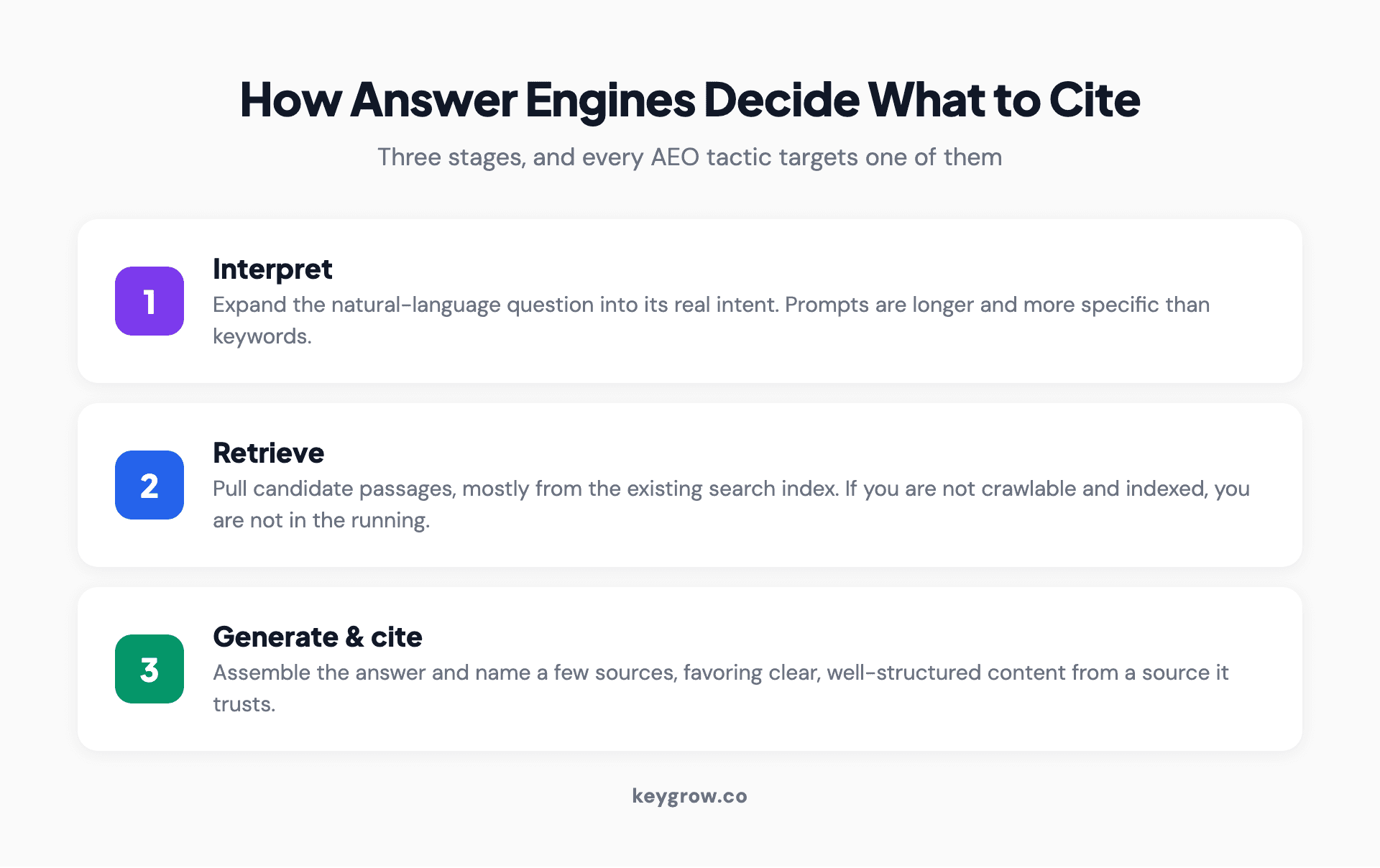
How answer engines decide what to cite, in three stages: interpret the query and its intent, retrieve candidate sources from the index, then generate the answer and choose which sources to cite based on clarity, structure, and authority.
Understanding the pipeline tells you where to spend effort:
Your strategy is simply making sure you show up well at all three stages. The four phases below do exactly that.
The 90-day AEO roadmap
Run your AEO strategy in four phases over about 90 days: audit and foundation, content, technical, then authority. Each phase has a clear focus and a gate you clear before moving on, so you build in the right order instead of doing everything at once badly.
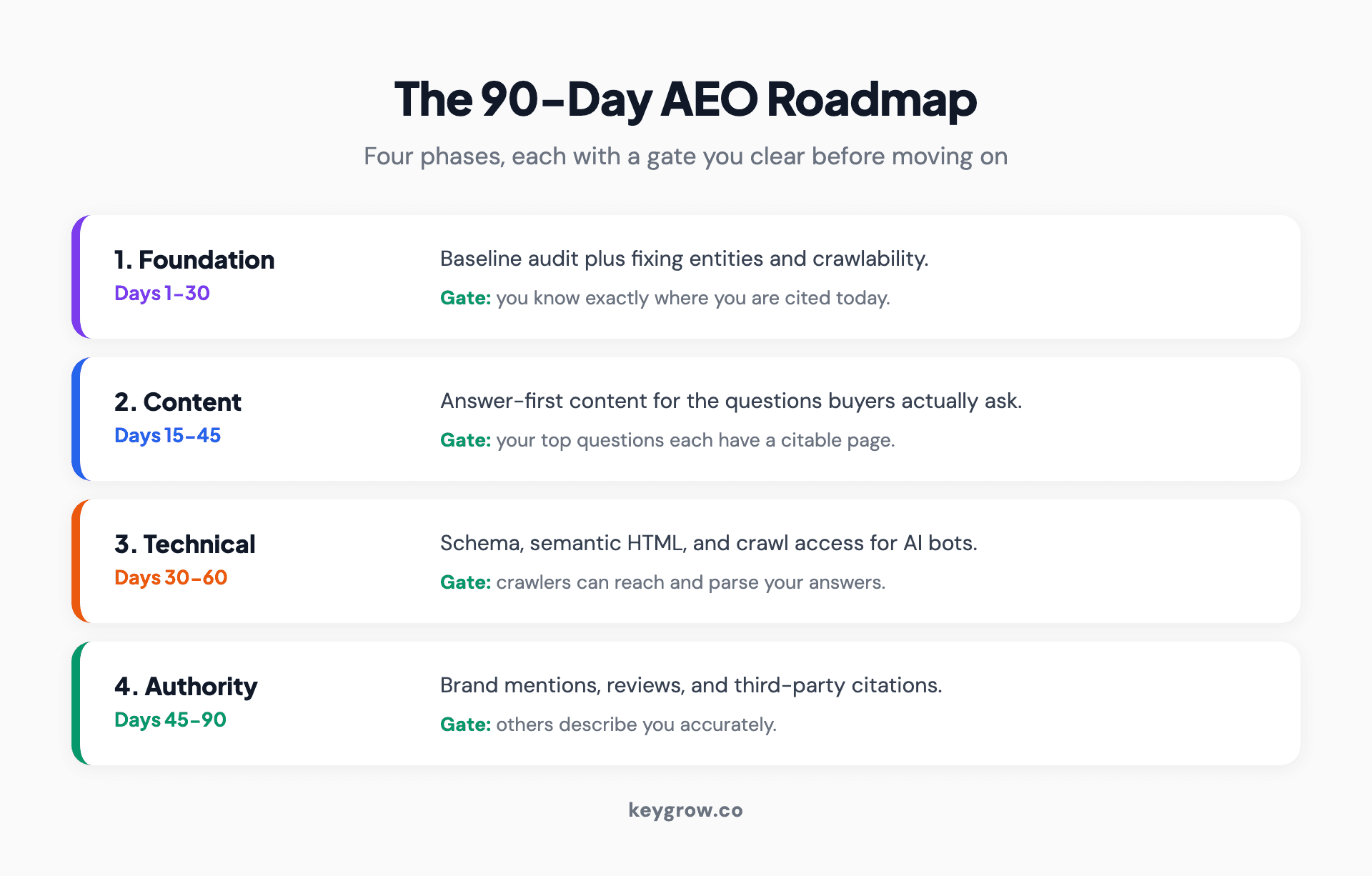
A 90-day AEO roadmap in four phases: days 1 to 30 audit and fix the foundation, days 15 to 45 build citable content, days 30 to 60 get the technical and schema layer right, and days 45 to 90 earn off-site authority, each with its own success gate.
The phases overlap on purpose, but the order of emphasis matters:
| Phase | Focus | Gate before you move on |
|---|---|---|
| 1. Foundation (days 1-30) | Baseline audit + fix entities and crawlability | You know exactly where you are cited today |
| 2. Content (days 15-45) | Answer-first content for real questions | Your top questions have a citable page |
| 3. Technical (days 30-60) | Schema, semantic HTML, crawl access | AI crawlers can reach and parse your answers |
| 4. Authority (days 45-90) | Brand mentions, reviews, citations | Third parties describe you accurately |
The rest of this guide is those four phases in detail, plus how to measure the whole thing.
Phase 1: Audit your AI visibility and fix the foundation
Start by finding out where you stand. Build a set of 30 to 50 real buyer questions, run each through the major AI engines, and log whether you are cited, mentioned, or absent. You cannot improve a number you have never measured, and most businesses have never looked.
This baseline audit is the single most skipped step, and the one that makes everything after it measurable. For each prompt, record the engine, whether you were cited with a link, whether you were named without a link, the sentiment, and which competitor or source won the citation instead. Run each prompt logged out, with a fixed region, two or three times, because AI answers vary between sessions and you want a stable reading. That log becomes both your audit and the start of your AEO tracking system.
While you are in the account, fix the foundation the retrieval stage depends on: make sure your key pages are crawlable and indexed, that your business entity (name, category, location, what you do) is stated consistently across your site and profiles, and that the pages which already rank are the ones you reinforce first. Roughly 26 percent of brands have zero presence in AI Overviews, and the fastest way off that list is strengthening pages that already have some authority, not starting from scratch. The gate for this phase: you can name exactly which questions you win, which you lose, and to whom.
Phase 2: Build content answer engines actually cite
Create content that answers one question at a time, up front, in language a machine can lift. Lead every section with a direct 40-to-60-word answer, write headings as the questions people ask, and back your claims with specific data. This is where most of the citation gains come from.
There is real research on what moves the needle here. A study from Princeton and Georgia Tech tested generative-answer optimization across thousands of queries and found that adding relevant statistics lifted a page's visibility in AI answers by up to 40 percent, and adding citations and quotations produced similar gains, while keyword stuffing did nothing.
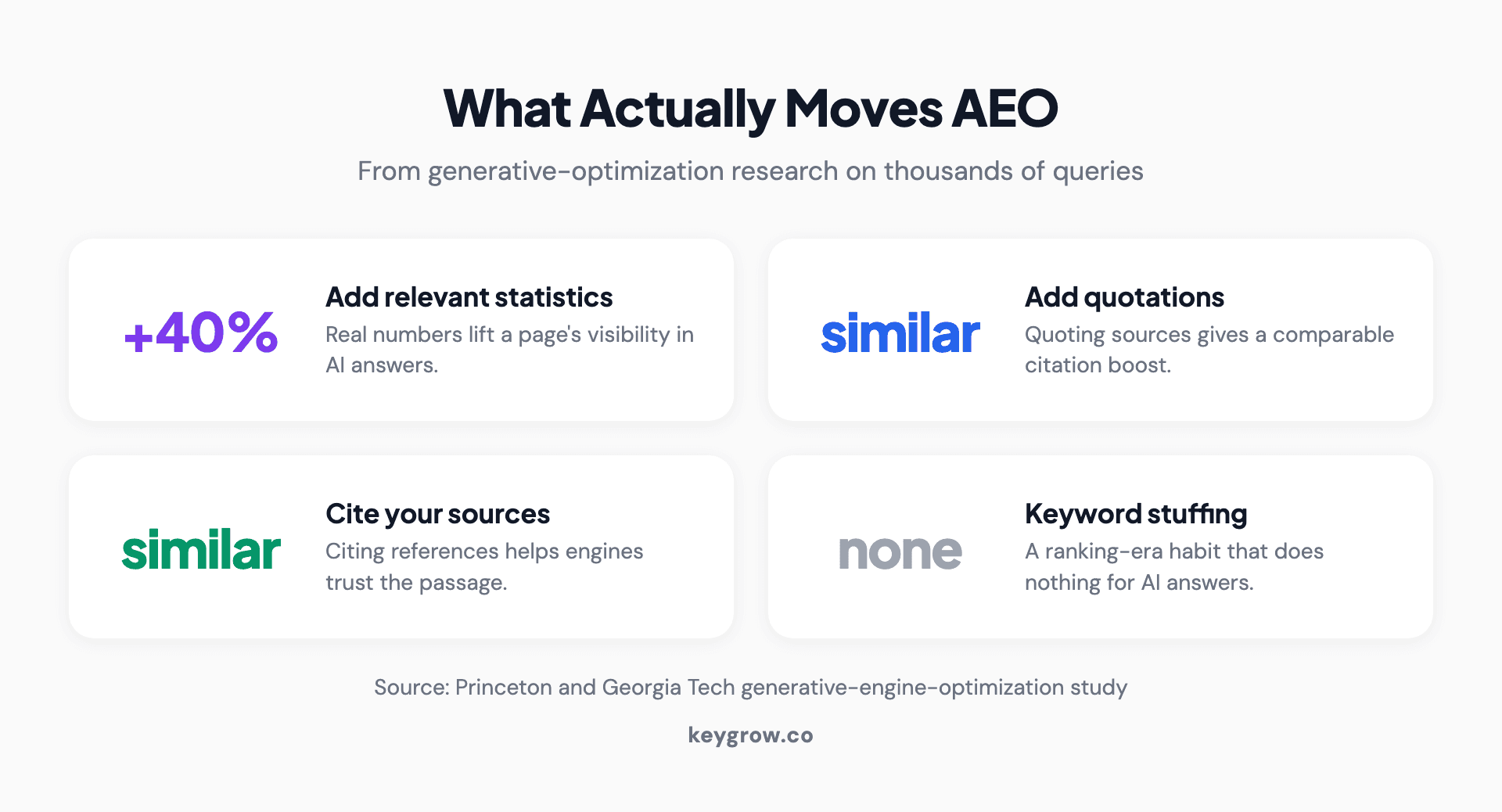
What actually moves AEO, from generative-optimization research: adding relevant statistics lifts AI-answer visibility by up to 40 percent, quotations and cited sources give similar gains, and keyword stuffing has no effect.
So the content playbook is concrete:
Your gate for this phase: every priority question from the audit has a page that answers it cleanly and could be quoted without the rest of the article.
Phase 3: Get the technical and schema layer right
Make your answer content easy for engines to reach and parse. That means clean semantic HTML, correct heading hierarchy, structured data on your key pages, and crawl access for AI bots. Schema does not create good structure, it confirms the structure you already built.
The technical layer is what lets the retrieval and generation stages work on your content instead of tripping over it. The pieces that matter most:
The gate: an AI crawler can reach your priority pages, and their structure makes the answer obvious. This phase overlaps Phase 2 because structure and schema are two sides of the same page.
Phase 4: Build authority off your own site
Engines cite sources they trust, and trust is built as much off your site as on it. Earn brand mentions, gather reviews, and get cited in the editorial, comparison, and community content that AI models learn from. Most citations do not point at your own pages.
This is the phase businesses skip and then wonder why great content is not getting cited. The pattern in the data is blunt: most of the citations that mention a brand come from third-party coverage, reviews, and editorial, not from the brand's own pages. What that means for your strategy:
The gate: third parties describe your business accurately and you are starting to appear in their content, not only your own.
How to measure AEO when there is no click
Measure AEO with a stack of proxies, since the click is gone. Track your citation and mention coverage, your share of voice against competitors, the sentiment of how you are described, branded-search lift, and the AI referral traffic that does arrive. No single number tells the story, but together they do.
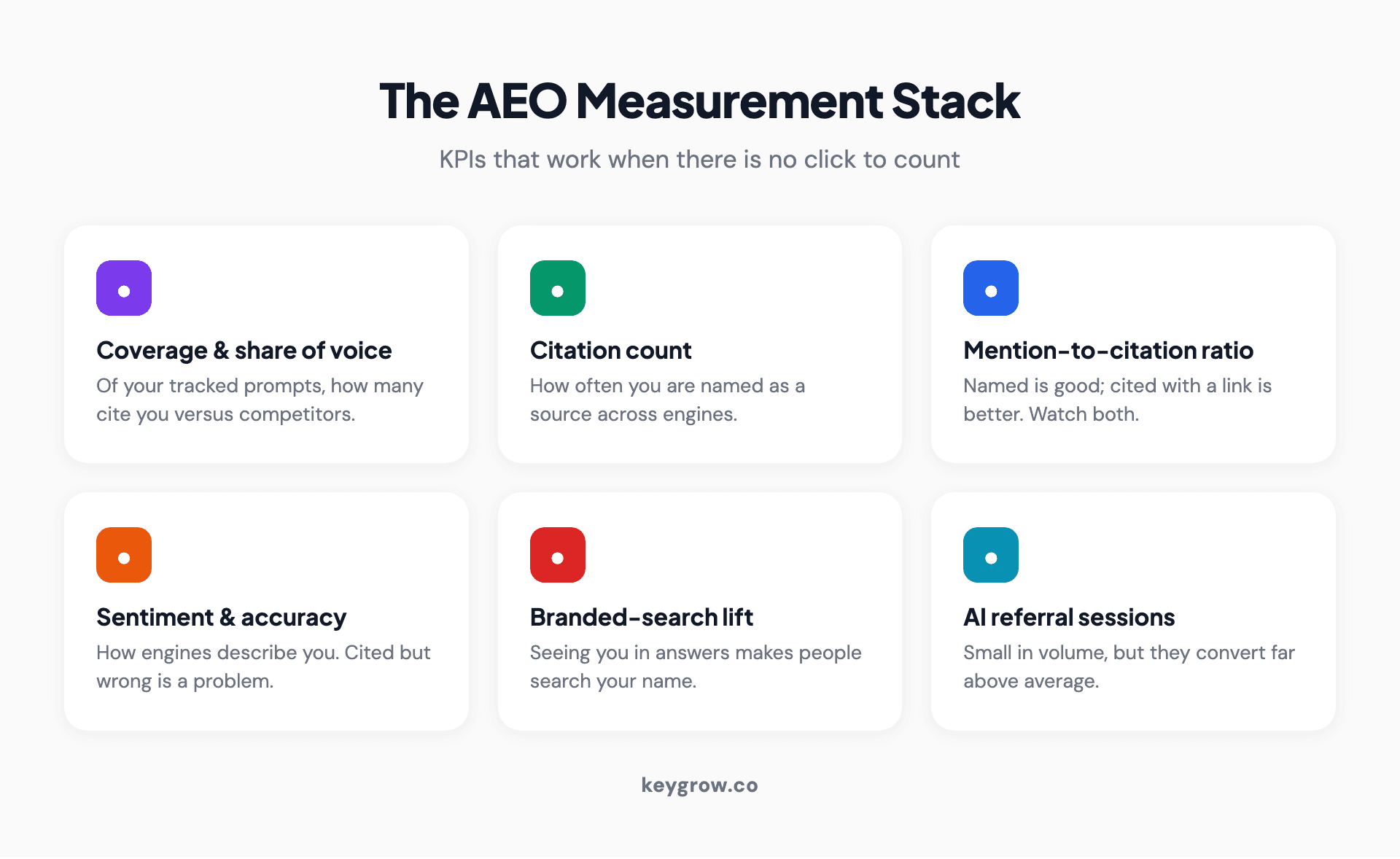
An AEO measurement stack that works without click data: prompt and answer coverage, citation count and share of voice, mention-versus-citation ratio, sentiment and accuracy, branded-search lift, and AI referral sessions and their conversion rate.
The KPIs that actually work in a zero-click world:
Defining the exact targets for these is its own job, covered in measuring AEO success. The point of measurement here is to re-run your baseline prompt set on a schedule and watch these move.
AEO is built on SEO, not instead of it
Do not start your AEO strategy from zero. AI engines retrieve overwhelmingly from the existing search index, so the crawlability, authority, and structured content that power SEO are the same things that make you citable. AEO is a layer on top, not a replacement.
This is the honest position the hype tends to skip. Even as sourcing diversifies, ranking still gates most citations: studies consistently find the large majority of AI answer citations come from pages already ranking on page one or two. The businesses that win at AEO are the ones with a healthy SEO foundation who add the answer layer on top, not the ones who abandon SEO to chase AI. If you want the full comparison, see how AEO differs from traditional SEO. The practical upshot for your roadmap: Phase 1 starts with pages that already rank because they are the closest to being cited.
Common mistakes to avoid
Most AEO strategies fail for the same few reasons: skipping the baseline audit, writing for keywords instead of questions, treating schema as the whole plan, ignoring off-site authority, and expecting results in weeks.
The recurring errors:
How long an AEO strategy takes
Expect first movement in 2 to 6 weeks, meaningful visibility in 2 to 3 months, and compounding gains after that. AEO follows the same slow-then-steep curve as SEO, because it runs on the same foundation.
The quick wins come from fixing structure and schema on pages that already rank, which can start getting cited within weeks. The durable gains, new citable content and earned authority, build over months. Judge the strategy on your tracked prompt set over a quarter, not on the first week's answers, and keep re-running the baseline so you can see the trend rather than react to the noise of day-to-day answer variance.
FAQs
What is the difference between AEO, GEO, and SEO?
SEO optimizes to rank pages and earn clicks. AEO, answer engine optimization, optimizes to be the cited answer inside AI results. GEO, generative engine optimization, is a near-synonym for AEO focused on generative AI answers. In practice AEO and GEO describe the same work, and both are built on top of SEO rather than replacing it.
How long does an AEO strategy take to work?
First movement usually appears in 2 to 6 weeks, mostly from structure and schema fixes on pages that already rank. Meaningful visibility takes 2 to 3 months, and the gains compound after that as content and authority build. It follows the same slow-then-steep curve as SEO, so judge it over a quarter, not a few weeks.
How do you measure AEO without click data?
Use a stack of proxies: how many of your tracked prompts cite or mention you, your share of voice against competitors, the sentiment and accuracy of how you are described, branded-search lift, and the conversion rate of the AI referral traffic that does arrive. Re-run a fixed prompt set on a schedule and watch those move rather than looking for a single click-based number.
Which AI engines should I prioritize?
Start with where your audience already is, which for most businesses means Google's AI Overviews, since Google still handles the majority of searches. Add ChatGPT and Perplexity next, especially for considered or B2B purchases that get researched there. Your baseline audit tells you which engines your buyers' questions actually trigger, so let that decide the order.
Do backlinks still matter for AEO?
Yes. Authority still governs whether an engine trusts and cites you, and links remain a real authority signal carried over from SEO. AEO adds other signals too, unlinked brand mentions, reviews, and being recognized as a consistent entity, but it does not make links irrelevant. Off-site authority is Phase 4 of the roadmap for a reason.
Can a small business do AEO effectively?
Yes. Much of AEO is within reach without a big budget: the baseline audit is a spreadsheet, answer-first content is a writing discipline, and reviews and entity consistency are free to build. Paid tools save time at scale but are not required to start. A focused small business can often out-answer a larger competitor on the specific questions its customers ask.
Will AEO replace SEO?
No. AEO is built on the SEO stack. Answer engines retrieve from the search index, so crawlability, indexing, authority, and structured content still decide whether your content can be found and quoted. AEO adds answer-first structure and citation tracking on top of SEO; it does not remove the need for it.
The bottom line
An AEO strategy is a 90-day, four-phase plan built on your existing SEO: audit where you stand, create content engines can cite, get the technical layer right, and earn off-site authority, then measure against a fixed baseline and repeat. Start with the pages that already rank, back your content with real data, and judge it on a tracked prompt set over a quarter.
If you would rather have a team run the audit, build the answer content, and track the citations, that is exactly what our answer engine optimization service does. Bring your top customer questions to the get started page and we will build the baseline and the roadmap with you.


