


How much does AEO cost? For most businesses in 2026, answer engine optimization runs about $1,000 to $2,500 a month for entry-level monitoring, $3,000 to $8,000 a month for active optimization at a mid-market agency, and $10,000 or more for enterprise programs. If you would rather do it yourself, the software stack costs roughly $0 to $500 a month. A one-time audit lands between $2,500 and $10,000, and hourly consulting runs $150 to $500.
That is the number you came for. Now here is the part almost nobody says out loud: nearly every AEO price published online, including the ones above, is an agency's own rate card, not independent market data. There is no census of what AEO costs. What follows is the overlapping range across several published rate cards, plus an honest read on what actually drives the price and when paying for it is premature.
AEO is answer engine optimization: the work of getting your business quoted inside AI answers from ChatGPT, Google's AI Overviews, Perplexity, and similar tools, instead of just ranking blue links. It is a close cousin to SEO, and the pricing reflects that overlap.
What you actually pay, by delivery model
There are four ways to buy AEO, and they cost wildly different amounts. The short version: retainers buy ongoing work and a team, tools buy visibility data, audits buy a plan, and hourly buys an expert's time in small doses.
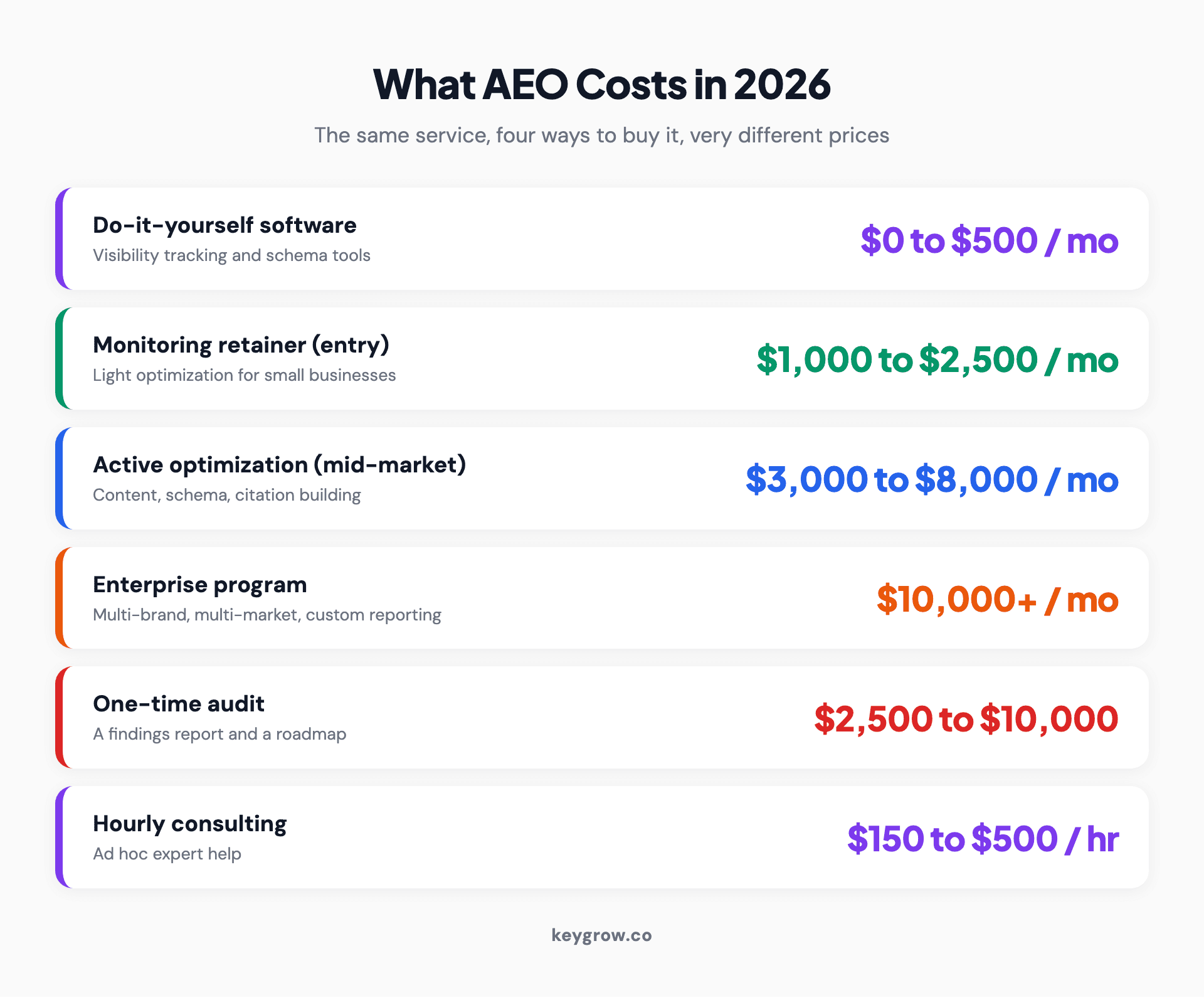
AEO cost in 2026 by delivery model: do-it-yourself software $0 to $500 a month, entry-level monitoring retainer $1,000 to $2,500 a month, mid-market active optimization $3,000 to $8,000 a month, enterprise programs $10,000 or more a month, one-time audit $2,500 to $10,000, and hourly consulting $150 to $500 an hour.
| Delivery model | Typical price | What you get | Best for |
|---|---|---|---|
| DIY software stack | $0 to $500 / mo | Visibility tracking, schema tools, prompt monitoring | Owners with time, one location |
| Monthly retainer (entry) | $1,000 to $2,500 / mo | Monitoring plus light optimization | Small businesses testing AEO |
| Monthly retainer (mid-market) | $3,000 to $8,000 / mo | Active content, schema, citation building | Competitive niches, real growth goals |
| Monthly retainer (enterprise) | $10,000+ / mo | Multi-brand, multi-market, custom reporting | Large sites, big teams |
| One-time audit | $2,500 to $10,000 | A findings report and a roadmap | Deciding whether to commit |
| Hourly consulting | $150 to $500 / hr | Ad hoc expert help | Filling a specific gap |
These ranges hold up because four to five independent agency rate cards land on roughly the same numbers. When several sellers who do not talk to each other quote the same range, the range is probably real. The huge spread inside each row is the honest part: a $1,500 retainer and a $2,500 retainer buy very different amounts of work, and no two agencies scope it the same way.
Retainers dominate because AEO, like SEO, is not a one-time fix. You are competing for a citation slot that changes as AI models update and as competitors publish. That is ongoing work, so it is priced as an ongoing service.
AEO, GEO, and SEO: three terms, one blurred bill
People use AEO, GEO, and SEO interchangeably, and that confusion shows up on your invoice. Here is the plain-language difference, because you should know what you are paying for.
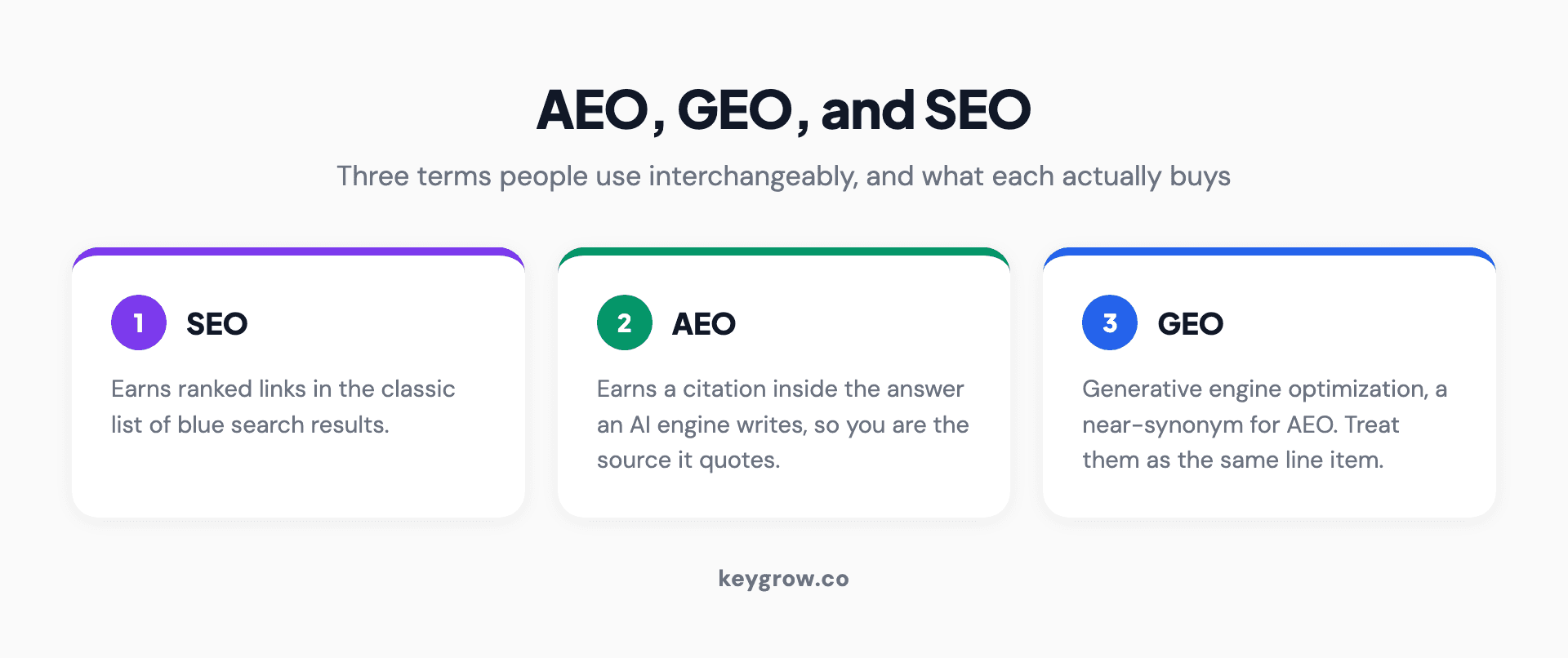
AEO versus GEO versus SEO defined: SEO earns ranked links in traditional search results, AEO earns citations inside answer engines like ChatGPT and AI Overviews, and GEO is generative engine optimization, a near-synonym for AEO focused on generative AI answers.
SEO earns you ranked links in the classic list of blue results. AEO earns you a mention inside the answer an AI engine writes, so your business is the source it quotes. GEO, generative engine optimization, is a near-synonym for AEO that some agencies prefer; treat them as the same line item unless a provider can explain a real difference.
The reason this matters for cost: much of the underlying work overlaps. Clean structure, clear answers, schema markup, and authoritative content help all three. So if an agency quotes AEO as a brand new service with a brand new price on top of your SEO, ask what is genuinely additional. Often the honest answer is a shift in emphasis, not a second full program. We break down the moving parts in our guide to AEO measurement, and the foundations in our AI search optimization primer.
What makes AEO cost more or less
Two businesses can get quotes $6,000 apart for what sounds like the same service. The gap is not random. Six things move the number.
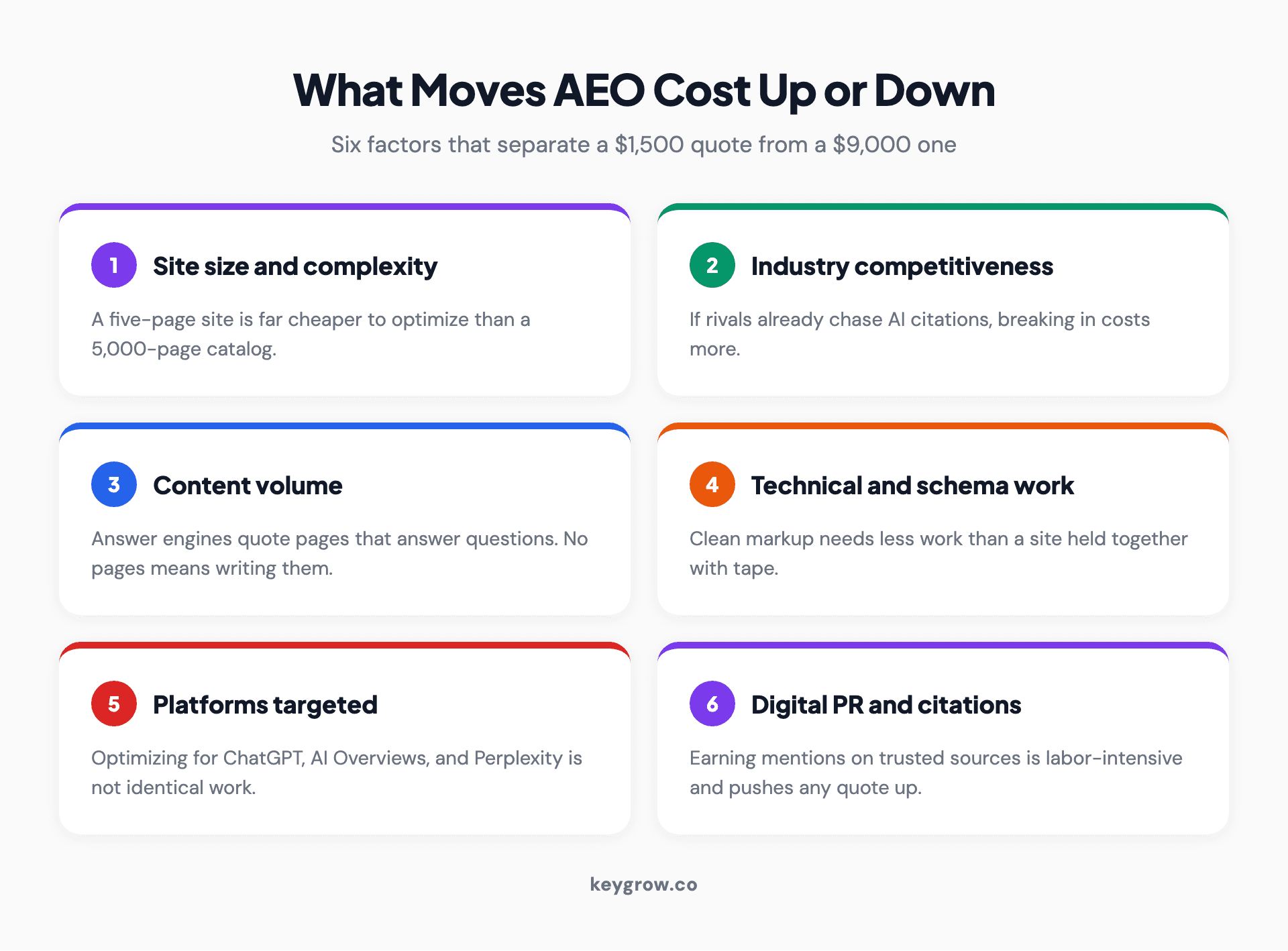
Six factors that move AEO cost up or down: site size and complexity, industry competitiveness, how much new content is needed, technical and schema work required, how many AI platforms you target, and how much digital PR and citation building is included.
Site size and complexity come first. A five-page local site is cheaper to optimize than a 5,000-page catalog. Industry competitiveness is next: if every competitor is already chasing AI citations in your category, it costs more to break in. Content volume matters because answer engines quote pages that actually answer questions, and if you have none, someone has to write them. Technical and schema work is a swing factor; a site with clean markup needs less than one held together with tape.
The last two are where budgets balloon. The more AI platforms you target, the more the work multiplies, since optimizing for ChatGPT, AI Overviews, and Perplexity is not identical. And digital PR, earning mentions on sources the AI models trust, is labor-intensive and pushes any quote toward its ceiling. When you see a $10,000 retainer, citation building is usually why.
Why almost no agency posts its AEO prices
Notice how hard it was to find a straight number before you landed here. That is deliberate, and it is worth understanding before you pay anyone.
Agencies keep prices off the page for three ordinary reasons: scopes vary so much that one number would mislead, they want a sales call before you see a figure, and AEO is new enough that few want to commit to public rates. None of that is sinister. But it does mean the burden is on you to compare scopes, not just prices. A $2,000 retainer that includes content beats a $3,000 one that is only monitoring.
Here is the honest part the rate cards skip. AEO is priced as if the payoff is certain, and it is not yet. Gartner predicted in early 2024 that search engine volume would fall 25 percent by 2026 as people moved to AI chatbots. It is 2026, and that has not happened; traditional search still carries the overwhelming majority of queries, a gap Search Engine Journal and others flagged. AEO matters and it is growing, but budget for it as a rising channel worth a slice of your spend, not as an emergency that justifies panic pricing.
Is AEO worth paying for, and when
AEO is worth paying for once you already have baseline authority and content worth quoting. If you do not, a retainer pays an expert to optimize pages that answer engines have no reason to cite yet.
The value case is real. The behavior of AI search rewards being the clearest source, not the loudest advertiser. In one analysis of the pages ChatGPT pulls in to answer a query, only about 15 percent were actually cited, so the question has shifted from how do I rank to how do I become the source it trusts. Winning that slot puts your business inside the answer a buyer reads before they ever reach a list of links. That is genuinely valuable, and it compounds the same slow way organic authority does. Do not expect week-one citations to translate into revenue by month two.
On timelines, expect early citations on low-competition questions within four to six weeks, and a real program to take three to six months to show its shape. Anyone promising instant AI dominance is selling the same fantasy as page one in 30 days.
When to skip the retainer and DIY instead
Plenty of businesses should not pay for AEO yet. If you are a single location with more time than money, or your site has thin content and no schema, spend $0 to $500 a month fixing foundations first.
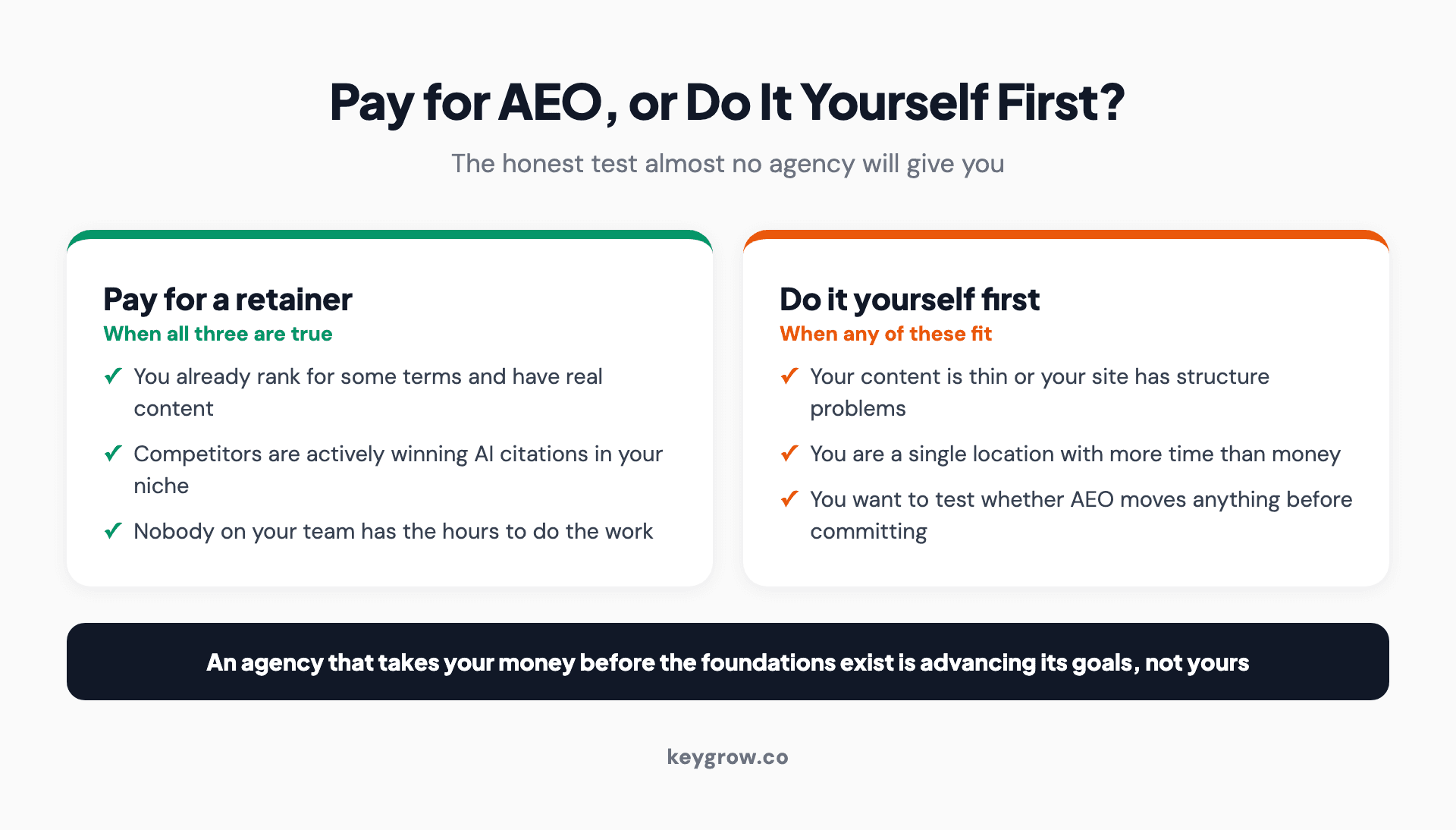
When to pay for AEO versus when to do it yourself: pay for a retainer if you have baseline authority, competitive pressure, and no in-house time; do it yourself first if you are a single location, have thin content, or want to test AEO before committing budget.
You are ready to pay for AEO when three things are true: you already rank for some terms and have real content, competitors are actively winning AI citations in your niche, and nobody on your team has the hours to do the work. Miss all three and a retainer is premature.
Skip it for now if your content is thin, your site has crawl or structure problems, or you simply want to test whether AEO moves anything for your business before committing a budget. The foundational work, clean schema, a few genuinely answer-shaped pages, an accurate business profile, is the same work a retainer would start with anyway. Doing it yourself first is not a shortcut; it is due diligence. An agency that takes your money before those foundations exist is advancing its goals, not yours.
The low-cost AEO starter stack
You can do meaningful AEO for the price of a couple of tools and your own time. Here is the stack that gets a small business into AI answers without a retainer.
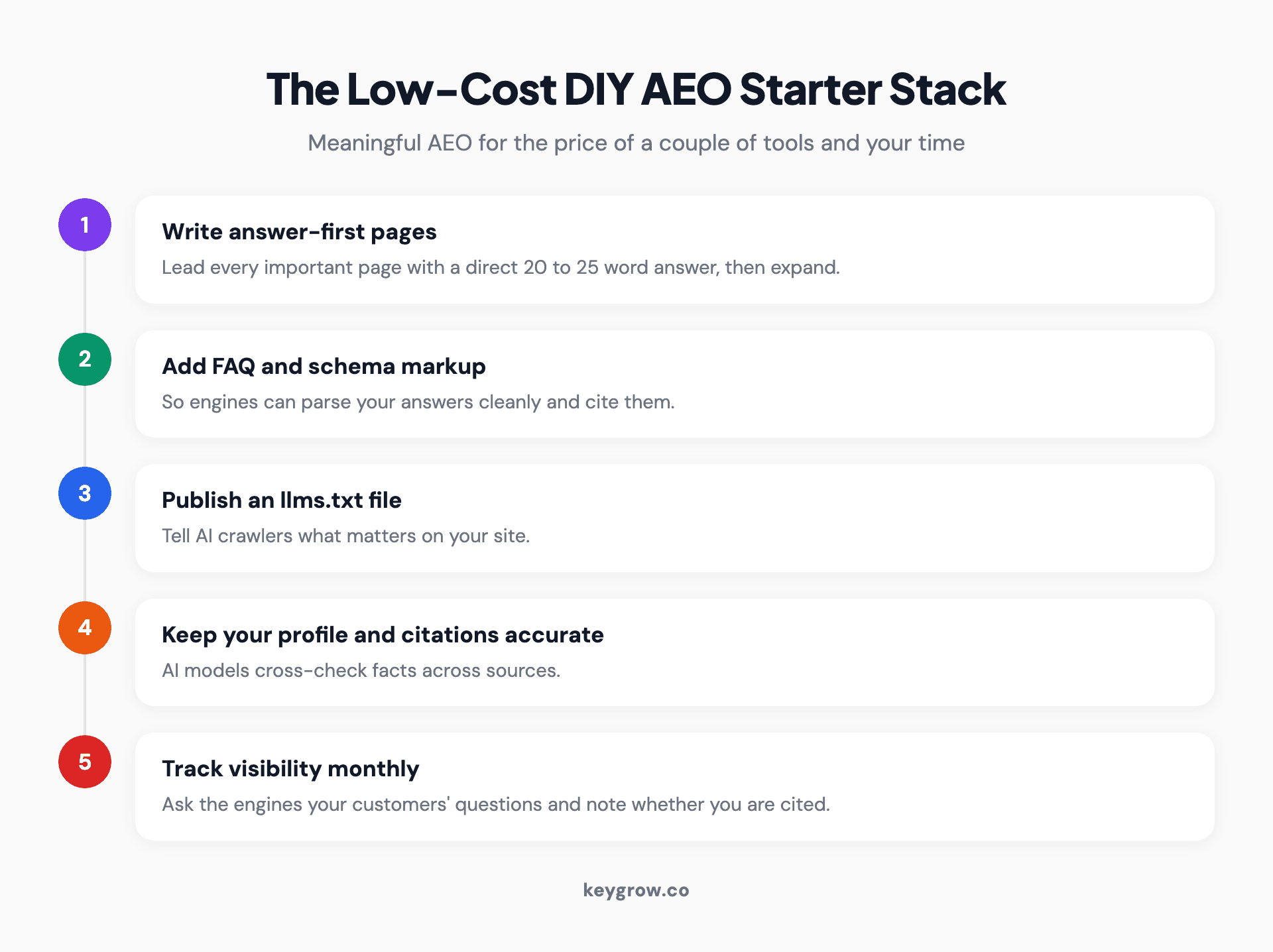
A low-cost do-it-yourself AEO starter stack: write answer-first pages that lead with a direct 20 to 25 word answer, add FAQ and schema markup, publish an llms.txt file, keep your business profile and citations accurate, and track your AI visibility monthly with a monitoring tool.
Start with answer-first pages: lead every important page with a direct, self-contained answer of about 20 to 25 words, then expand. That single format change does more for AEO than most paid work. Add FAQ sections and schema markup so engines can parse your answers cleanly. Publish an llms.txt file to tell AI crawlers what matters on your site; our free llms.txt generator builds one in a minute.
Keep your business profile and citations accurate everywhere, since AI models cross-check facts across sources. Then track your visibility monthly with an AI-monitoring tool. Paid visibility trackers commonly run from the low tens to a few hundred dollars a month, and several offer free tiers to start.
The monthly routine is light once it is set up: ask the AI engines a handful of the questions your customers actually type, note whether you get mentioned and how you are described, and fix anything wrong at the source. An hour or two a month keeps you honest about whether the work is landing. That is the whole entry-level program, and for many local businesses it is enough for a good while before a retainer earns its keep.
Does AEO cost more for some industries or multiple locations?
Yes on both counts, and the reasons are the same two cost drivers turned up to full volume. Industry competitiveness and scale are what separate a $1,500 quote from a $9,000 one.
In a crowded category where every competitor is already fighting for AI citations, breaking in takes more content, more digital PR, and more ongoing work, so the retainer climbs. A quiet niche where almost nobody has optimized for answer engines is cheaper to win, sometimes dramatically, because being the clearest source is easy when few others are trying. Regulated fields like law, finance, and medicine cost more still, since AI models are cautious about who they cite on sensitive topics, and earning that trust takes verifiable expertise and authoritative sources.
Multiple locations multiply the work rather than adding to it. Each location needs its own accurate profile, its own local answer content, and its own citation footprint, so a ten-location business is closer to running ten small AEO programs than one large one. If you are multi-location, expect pricing to scale with locations, and ask any agency exactly how they handle the per-location work before you sign.
What a fair AEO quote looks like
When you do collect quotes, compare scope line by line, not headline prices. A fair proposal names the platforms it targets, the content it will produce, the schema and technical work included, how it will report citations, and what the first 90 days look like. Vague retainers that promise AI visibility without saying how are the red flag.
If you want that scoped honestly, our AEO service is month-to-month, so the work has to keep earning its place. And if your foundations are not ready, our expert team will tell you to fix those first rather than sell you a retainer you are not ready for.
FAQs
How much does AEO cost per month?
Entry-level monitoring retainers run about $1,000 to $2,500 a month, mid-market active optimization runs $3,000 to $8,000, and enterprise programs start around $10,000. Doing it yourself with software costs roughly $0 to $500 a month. The spread is wide because scopes vary enormously, so compare what each price actually includes.
What is the difference between AEO, GEO, and SEO?
SEO earns ranked links in traditional search results. AEO earns citations inside AI answers from tools like ChatGPT and Google's AI Overviews. GEO, generative engine optimization, is a near-synonym for AEO. Much of the underlying work overlaps, which is why the three often share a bill.
Is AEO more expensive than SEO?
Not usually on its own. Because AEO shares foundations with SEO, most agencies deliver it as part of or alongside an SEO program rather than as a separate full-price service. If a provider quotes AEO as a brand new cost on top of SEO, ask what work is genuinely additional.
Can I do AEO myself without hiring an agency?
Yes, and many small businesses should start there. Answer-first pages, FAQ and schema markup, an accurate business profile, and a monthly visibility check cover the basics for $0 to $500 a month. Hire help once competition rises or you run out of time to do the work.
How long does AEO take to show results?
Expect early citations on low-competition questions within four to six weeks, and a real program to take three to six months to show its shape. Like organic search, AEO compounds slowly. Anyone promising instant AI dominance is overselling.
Who should not pay for AEO yet?
Businesses with thin content, unresolved technical or crawl problems, or no baseline authority. A retainer optimizes pages that answer engines have no reason to cite. Fix the foundations first, then pay for AEO once there is something worth quoting.
Why do so few AEO agencies publish their prices?
Mostly because scopes vary so widely that one public number would mislead, and because most agencies want a conversation before quoting. AEO is also young enough that few firms will commit to a public rate card. The practical consequence: compare quotes on scope, deliverables, and reporting, never on the headline price alone.
Where this leaves your budget
AEO in 2026 costs what you would expect a young cousin of SEO to cost: a few hundred to a few thousand a month for most businesses, more for competitive enterprise work, and near zero if you have the time to do the basics yourself. The honest framing is that the whole market is quoting from rate cards, not census data, so scope beats sticker price every time.
Do the foundational work first, budget for AEO as a rising channel rather than a panic, and pay for a retainer when you have something worth citing and no time to do it yourself. The same logic applies to the thing AEO runs on top of, and we broke that down separately in what a website costs. If you want a straight read on which side of that line you are on, tell us about your business and we will tell you honestly.