

There is one statistic the entire first page of Google repeats about this topic: that structured data delivers a "43 percent boost in AI visibility." Trace it back and you reach an agency blog with no study behind it. Then in May 2026, Ahrefs ran a controlled test on 1,885 pages that added schema, and the citation lift came out to roughly zero. So before we list anything, a promise: in this guide, every "foundation" gets rated by named evidence, not vibes.
The honest answer to what elements are foundational for seo with ai is that the foundations have not changed much, they have just gotten less forgiving. Crawlability, indexing, clear extractable answers, entity clarity, and E-E-A-T are the elements that carry weight across AI search. Structured data helps in specific places and is oversold in most. A handful of newer tactics getting airtime right now do not hold up at all. The rest of this post sorts the real foundations from the hype, in priority order, with sources you can check.
Which AI search are you actually optimizing for?
There is no single "AI." A searcher is dealing with three surfaces, and they do not share a rulebook.
The first is Google AI Overviews and AI Mode, which sit on top of Google's classic ranking systems. The second is third-party assistants like ChatGPT and Perplexity, which run their own crawlers and pick sources in ways nobody outside those labs can fully see. The third is the traditional blue-link index, which still feeds the other two.
Treating these as one blob is the core mistake every competing article on this keyword makes. Google's AI features draw heavily on its existing rankings. Per BrightEdge, 54 percent of AI Overview citations come from pages already ranking in the organic results. So the pipeline into Google's AI answers is mostly the pipeline you already know. The assistants are murkier, but they crawl HTML and reward content that is easy to read and clearly sourced. We go deeper on the differences in our guide to AI search optimization.

A person working at a desk with a laptop and phone in natural office light
The practical takeaway: you are not picking one surface to optimize for. You are building foundations that all three reward, then adjusting at the margins. Most of the margin work is smaller than the hype suggests.
Did AI reset the board, or does old SEO still matter?
Old-school SEO still matters, and Google says so in plain language. Its own documentation on generative AI features answers the question "do SEO best practices still apply" with, and this is a direct quote, "In short, yes."
That same page makes three claims the competing articles quietly ignore. Structured data "isn't required" for generative AI in Search. An LLMs.txt file is not used by Google. And rewriting your content into "chunks" for AI is unnecessary. The one hard requirement Google states is that your content must be crawlable, because its generative models work from publicly accessible, crawlable pages. You can read it yourself in the Google AI guide.
So the board did not reset. The stakes moved. When an AI summary appears, people click less. Pew Research Center found that users clicked a traditional result only 8 percent of the time when an AI summary was present, versus 15 percent when it was not, and only 1 percent clicked a link inside the summary. Roughly 18 percent of searches Pew studied in March 2025 produced an AI summary. The foundations are the same. The cost of being left out of the answer is higher.
Foundation 1: Can crawlers, including the AI ones, read your page?
If a crawler cannot read the page, nothing else on this list matters. This is the most foundational element for SEO with AI, and it has a new wrinkle in 2026.
Googlebot renders JavaScript. Most AI crawlers do not. According to Search Engine Land, the crawlers behind tools like Perplexity, Gemini, Claude, and OpenAI's models load raw HTML and do not execute JavaScript to build the page. If your content only appears after a script runs in the browser, those crawlers see a near-empty shell.
That single fact undoes a lot of modern site builds. A JavaScript-heavy single-page app can rank fine in Google, because Googlebot waits for the render, while being almost invisible to the assistants. The fix is server-side rendering or static generation so the important text is in the HTML on first load.
Freshness matters here too. The same Search Engine Land guide cites Seer Interactive finding that about 65 percent of AI crawl activity targeted content updated in the past year, and about 90 percent within three years. Stale pages get crawled less.
Here is the part agencies skip: this is often a free fix. If your developer can ship server-rendered HTML, you have done more for AI visibility than any schema project will do. That is not an opinion we are guessing at; it follows directly from how these crawlers behave.
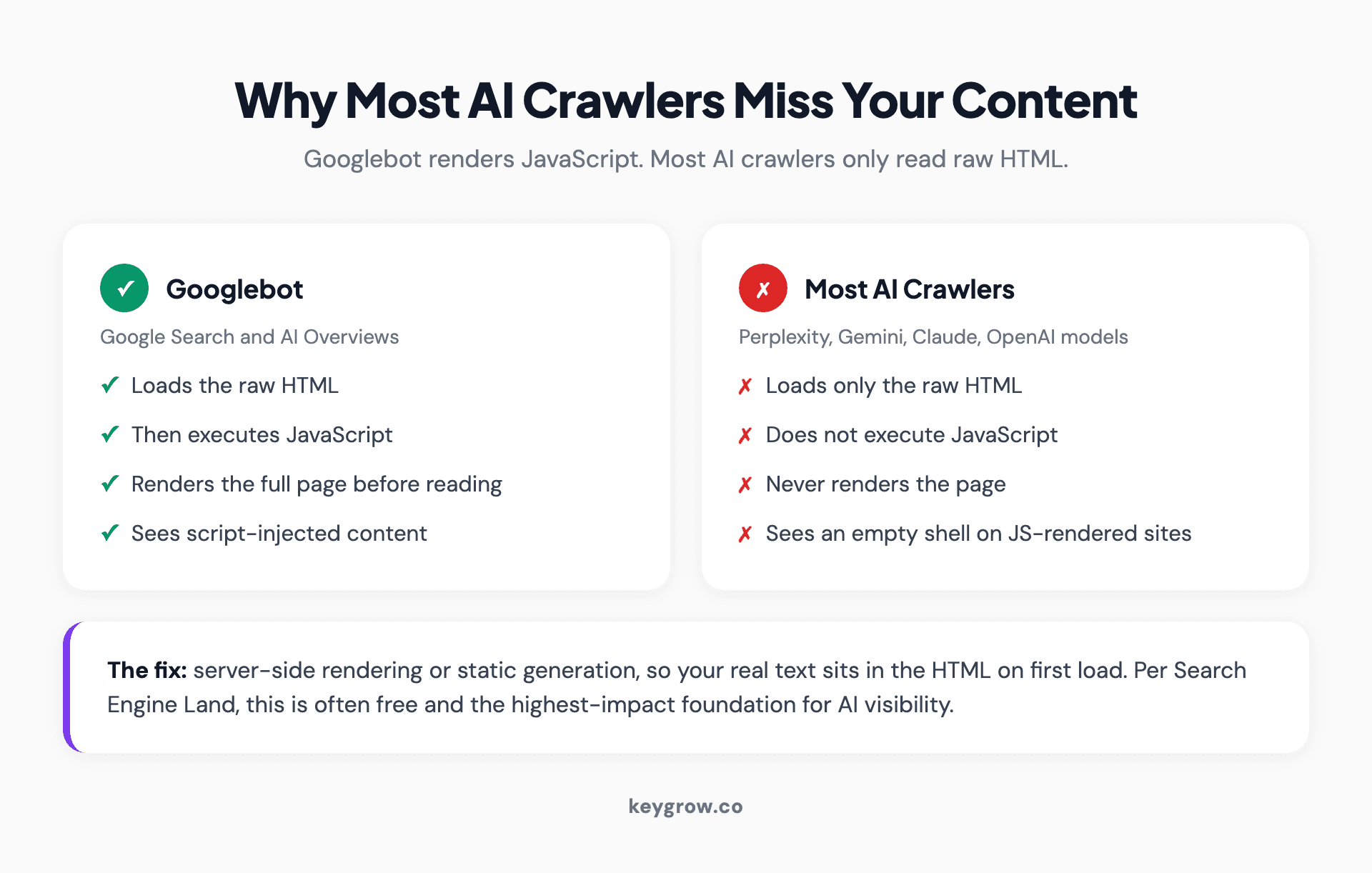
Diagram comparing how Googlebot renders JavaScript while most AI crawlers like GPTBot, ClaudeBot and PerplexityBot read only raw HTML, showing a JavaScript-rendered page appearing empty to AI crawlers
Foundation 2: Indexing and the ranking pipeline that feeds AI
Getting crawled is step one. Getting indexed and ranked is what actually puts you in the candidate pool an AI answer is built from.
This is where the BrightEdge number earns its keep. With 54 percent of AI Overview citations coming from pages already ranking organically, classic ranking works as the on-ramp to AI visibility rather than a separate game. A page that does not rank for a query is rarely the page an AI cites for it.
The same logic extends to the assistants. ChatGPT search runs on Bing's index, which is why a site that ignores Bing is invisible to a growing slice of AI search. If you have only ever thought about Google, our breakdown of how SEO works in Bing is worth ten minutes.
The practical move is unglamorous: keep your sitemap clean, fix the pages stuck in "crawled, not indexed," and earn rankings the normal way. The compounding nature of that work is real. A doctor's practice in Dubai we worked with committed to SEO for a full year. Months one through three looked unremarkable. By month twelve, organic traffic had grown 1,519 percent and the practice was taking 130-plus patient calls a month. Same site, no shortcuts. That foundation is also the one feeding AI answers now.
Foundation 3: Clear, extractable answers
An answer engine quotes passages, not pages. The foundational skill is writing passages that can be lifted out and still make sense. That is what "extractable" means.
A quotable passage does three things. It states a self-contained claim that needs no surrounding paragraph to be true. It sits close to the question it answers, so the question-to-answer distance is short. And it defines its terms instead of assuming context. Vague "use Q&A headers" advice misses why the format works: the proximity and self-containment are doing the job, not the question mark.
This is also where ranking-era habits hurt. Burying the answer four paragraphs down and padding word count both lower the odds of being quoted. Put the answer in the first 100 words under a heading, then earn the rest of the section. Roughly 44 percent of AI citations come from the first third of a page, from our own AEO research, so the top of the page is prime real estate.

Close-up of a marketer reviewing and editing content on a laptop screen
If you want a concrete framework for structuring content this way, we cover it in optimizing your website for ChatGPT.
Foundation 4: Entity and topic clarity
AI systems need to know who you are and what you are about before they will cite you with confidence. That is entity clarity, and it is more foundational than most schema work.
In practice it means being consistent and specific. Use the same business name everywhere. Be explicit about what you do and where. Build enough related content that a topic clearly belongs to you rather than appearing once and vanishing. When a model has a clear sense that your site is the authoritative source on "eviction filings in Texas," you become a safer pick to quote than a site that mentions it in passing.
This is less about a single tag and more about coverage and consistency over time. The question moved from "how do I rank" to "how do I become the source," and entity clarity is how a machine decides you qualify. A clean internal linking structure helps, because it shows the relationships between your pages, and so does covering a topic in enough depth that the cluster reads as deliberate.
Foundation 5: E-E-A-T and trust as inclusion criteria
Experience, expertise, authoritativeness, and trust have crossed over from ranking factors into inclusion criteria. They help decide whether an AI will surface you at all.
The logic is straightforward. An answer engine is staking its own credibility on what it quotes, so it leans toward sources that look trustworthy. Named authors with real credentials, citations to primary sources, accurate information, a real business with a real address and contact details, and active review profiles all feed that judgment. Our published data shows active review-platform profiles correlate with roughly 3x citation probability.
Here is the honest caveat. None of us can see exactly how a given model weights these signals, so anyone selling you a precise "E-E-A-T score" is selling certainty that does not exist. What we can say is that the inputs (real expertise, real sources, real trust signals) are the same ones Google has rewarded for years, which is why building them is rarely wasted effort.
This is also where the foundations and the hype start to diverge sharply.
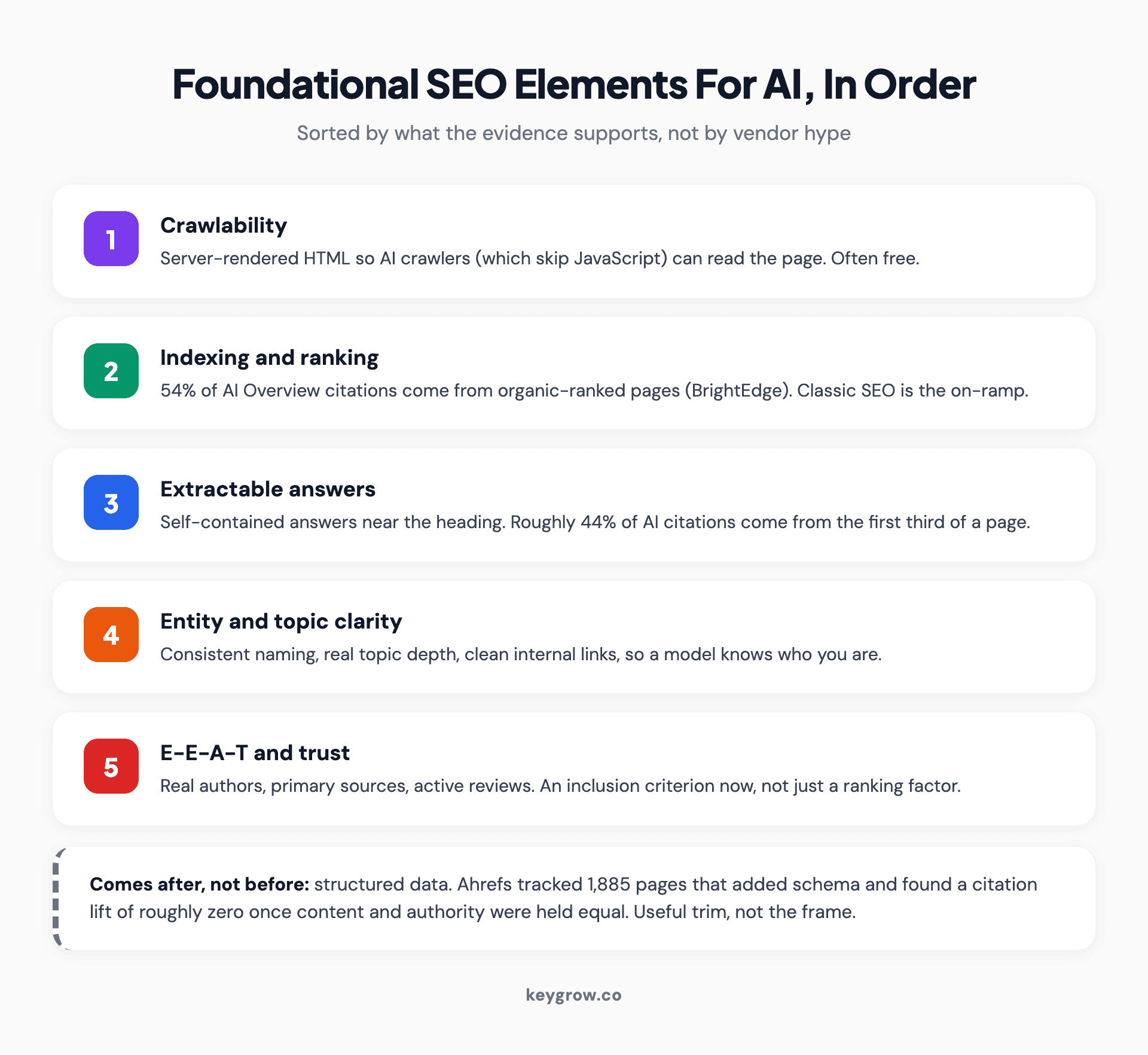
Numbered priority list of the five foundational SEO elements for AI search ranked from crawlability and indexing through extractable answers, entity clarity, and E-E-A-T, with structured data shown as situational rather than foundational
Where does structured data really fit?
Structured data is useful, platform-specific, and badly oversold. It earns a place on a foundations list only with caveats, and only after the five elements above.
Here is what the evidence actually shows. Ahrefs tracked 1,885 pages that added JSON-LD schema between August 2025 and March 2026 against 4,000 control pages. The citation change was plus 2.4 percent on Google AI Mode and plus 2.2 percent on ChatGPT, both statistically indistinguishable from zero, and minus 4.6 percent on AI Overviews. Across 6 million URLs, AI-cited pages were about 3x more likely to have schema, but Ahrefs attributes that to confounding: schema-rich sites tend to be better maintained and more authoritative to begin with. The schema is a symptom of a good site, not the cause of the citation. The full breakdown is in the Ahrefs schema study.
That does not mean ignore it. Schema's confirmed benefit is platform-specific. Google said in April 2025 that structured data gives an advantage, and Microsoft confirmed schema helps its assistant understand content. ChatGPT and Perplexity have not disclosed using it, and a December 2024 study found no correlation between schema coverage and AI citation rates. Search Engine Land's write-up on this, free of the usual marketing spin, is a good read on schema without the hype.
So mark up the things schema has always helped with: articles, FAQs, products, local business details, reviews. Just do not expect it to move AI citations on its own, and do not let a vendor sell it as the foundation. It is the trim, not the frame.
The hype list: tactics the evidence does not back
A few tactics are getting real airtime and do not survive contact with the sources. Naming them is the most useful thing this post can do for a reader with a limited budget.
When is chasing this stuff worth it? Almost never, until the five foundations are solid. If your pages are not server-rendered and crawlable, no LLMs.txt file will save you. Fix the frame first.
This is the one strong stance we will plant a flag on, and the number backs it: a tactic whose controlled-test lift is roughly zero (Ahrefs) does not belong above crawlability on anyone's to-do list. If an agency leads its AI pitch with schema, ask what their evidence is. If the answer is the 43 percent stat, you have your answer.
If you only fix five things this quarter, fix these
Limited budget is the normal case, not the exception. Here is the priority order, and it follows the evidence above, not the loudest vendor.
1. Make the page server-rendered and crawlable. AI crawlers skip JavaScript. This is often free and the single highest-impact fix you have.
2. Get indexed and earn the ranking. 54 percent of AI Overview citations come from organic-ranked pages (BrightEdge). Classic SEO is the on-ramp.
3. Write extractable answers. Put the self-contained answer in the first 100 words of each section. Most citations come from the top.
4. Build entity and topic clarity. Consistent naming, real depth on your topics, clean internal links so a machine can tell what you are about.
5. Strengthen E-E-A-T. Real authors, real sources, real reviews. The inputs you already know, weighted higher than before.
Schema and the lower-priority tactics come after these are solid. If you are weighing whether AI search needs a separate playbook from your existing SEO, our take on whether SEO and GEO work together is the next read, alongside our look at how AI Overviews affect SEO.
FAQs
Does traditional SEO still work for AI search, or do I need a separate GEO strategy?
Traditional SEO still works, and Google's own documentation confirms its SEO best practices apply to generative AI features. You do not need a wholly separate strategy so much as an extension of the one you have. The biggest additions are server-side rendering for AI crawlers and writing more extractable answers. The foundations of crawlability, indexing, and E-E-A-T carry straight over.
Is schema markup required to get cited by AI like ChatGPT or Google AI Overviews?
No. Google's documentation states structured data "isn't required" for its generative AI features, and Ahrefs' 2026 controlled test found schema produced roughly zero citation lift once content and authority were held equal. Schema still helps with specific results like articles, FAQs, and products, and Microsoft has confirmed it helps its assistant. Use it for what it has always done, not as your main AI play.
Do AI crawlers like GPTBot and PerplexityBot read JavaScript-rendered content?
Mostly no. Per Search Engine Land, the major AI crawlers load raw HTML and do not execute JavaScript, unlike Googlebot which renders it. If your content only appears after a script runs, those crawlers see an empty shell. Server-side rendering or static generation puts your text in the HTML where they can read it.
Should I create an LLMs.txt file to help AI tools find my content?
Probably not as a priority. Google's documentation says it does not use LLMs.txt files, so building one to court Google AI features has no documented payoff. The time is better spent on crawlable, server-rendered pages and clear extractable content. If a tool you specifically care about documents support for it later, revisit then.
What is the single most important foundational element for SEO with AI?
Crawlability. If a crawler, especially an AI crawler that does not run JavaScript, cannot read your page, nothing else matters. Server-rendered HTML that contains your actual content on first load is the base everything else sits on. It is also frequently the cheapest fix on the list.
How is optimizing for Google AI Overviews different from optimizing for ChatGPT or Perplexity?
Google AI Overviews lean on Google's existing rankings, so 54 percent of their citations come from organic-ranked pages, which means classic SEO is your main lever. ChatGPT and Perplexity run their own HTML-first crawlers and select sources more opaquely, rewarding clear, well-sourced, easily readable content. The shared foundation is crawlable pages with extractable answers. The difference is mostly in how much classic ranking versus raw readability carries the result.
Build the boring foundations; let everyone else chase the hype
The reason this keyword attracts so much hand-waving is that the honest answer is unglamorous. Make your pages crawlable, get them indexed and ranked, write answers a machine can lift, be clear about who you are, and earn real trust signals. That is the whole foundation, and four of those five predate AI by a decade.
The tactics with the loudest marketing (schema as a magic boost, LLMs.txt, chunking) are the ones with the weakest evidence behind them. A controlled test putting schema's AI lift at roughly zero should reorder anyone's priorities.
If you want a partner who will tell you when a tactic is not worth your money, that is the kind of work we do, month-to-month and cancel anytime. And if your site already has solid foundations and a developer who can ship server-rendered HTML, you may not need us at all. That is allowed to be the answer. Get in touch when the opportunity cost of doing it yourself stops making sense.


