

Picture your customer asking ChatGPT for the best provider in your city. It answers in a tidy paragraph and cites three sources. None of them is you, not because your site is bad, but because it is not in Bing's index, and that is where ChatGPT looks.
That is the part most "Bing SEO" guides written this year still have not caught up to. So here is the direct answer to how SEO works in Bing: it works much like Google, with a handful of real differences in how Bing weights keywords, links, and social signals. But the reason Bing suddenly deserves your attention in 2026 has almost nothing to do with Bing.com traffic and almost everything to do with AI search. This is a field guide to both: the mechanics that are genuinely different, the 30-minute baseline everyone should do, and an honest read on who should bother going further.
Why Bing suddenly matters again, and it is not the traffic
Bing matters now as the index behind a fast-growing share of AI answers. Its search-engine market share is almost beside the point. Optimizing for Bing is no longer about chasing a small slice of clicks. It is about being retrievable when an AI tool goes looking for a source.
Start with the uncomfortable number, because honesty is the point of this guide. Bing's direct search share is modest: StatCounter pegs it at about 5 percent worldwide across all devices as of May 2026, rising to roughly 13 percent on US desktop. Real, but not the kind of figure that reorders your priorities on its own. If market share were the whole story, Bing would stay a footnote.
It is not the whole story anymore, because of where Bing's index now feeds. ChatGPT search does not run its own crawler of the open web. As TechTarget reports from OpenAI's own documentation, ChatGPT search uses third-party search providers, including Microsoft Bing, to pull live web results. Yoast puts it bluntly: if your site is not in Bing's index, it will not appear in ChatGPT's results. The same Microsoft search foundation powers Copilot, which Microsoft built directly into Bing with its 2025 Copilot Search release, and Copilot is not a side experiment. Microsoft reported 20 million paid Microsoft 365 Copilot seats by early 2026.
So here is the one opinion worth taking from this guide: Bing is no longer optional. Being absent from its index now means being invisible to a chunk of AI search that grows every quarter.
It helps to see the actual path, because this is where competitors wave their hands. Being in Bing's index is the entry ticket. Being cited in an AI answer is a separate gate.
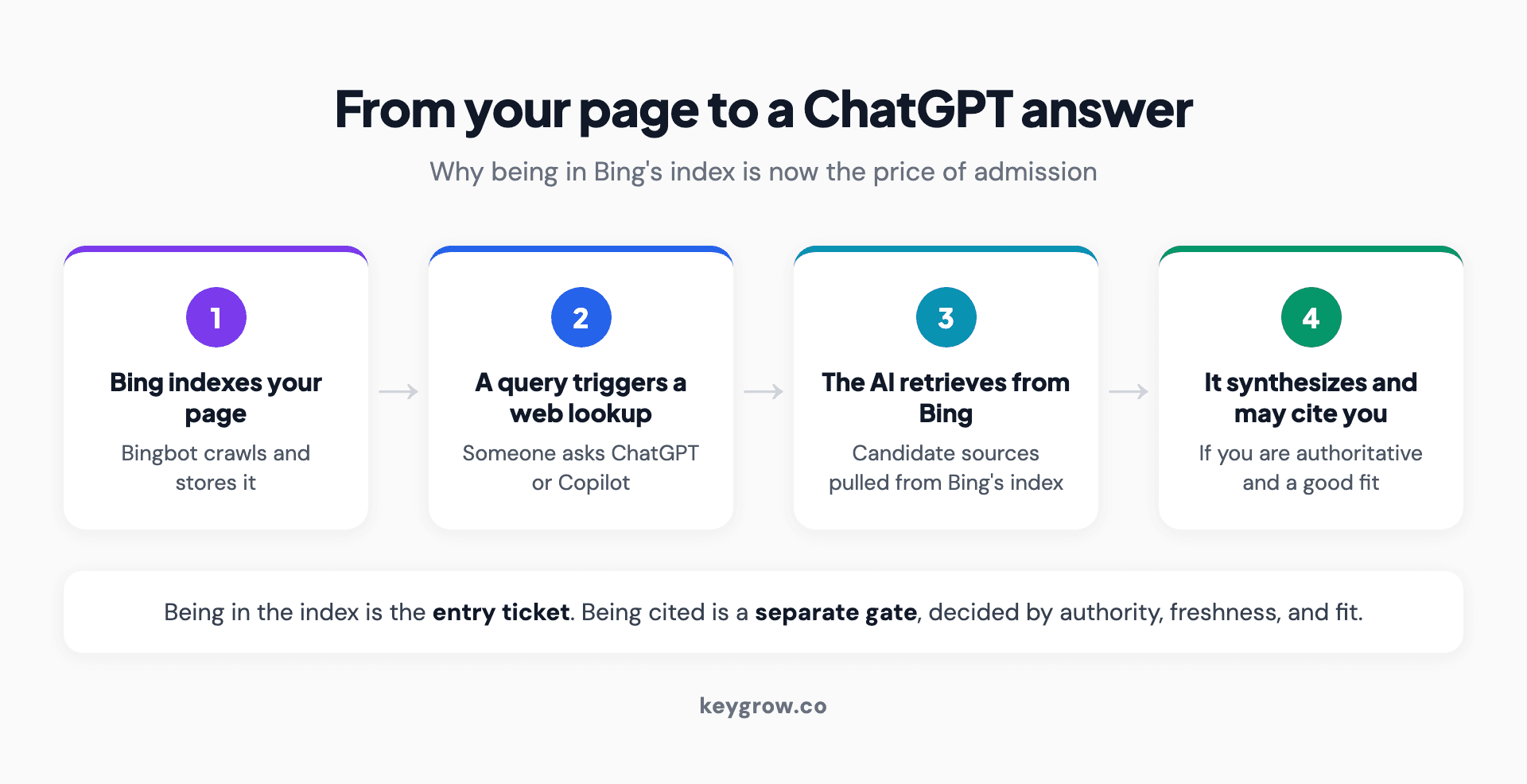
Infographic showing a four-step horizontal flow titled from your page to a ChatGPT answer. Step 1: Bing crawls and indexes your page. Step 2: a user asks ChatGPT or Copilot a question that triggers a live web lookup. Step 3: the AI retrieves candidate sources from Bing's index. Step 4: the model synthesizes an answer and may cite your page if it is authoritative, fresh, and a good fit. A caption notes that indexing is the entry ticket and citation is a separate gate.
Your page gets crawled and indexed by Bing. When someone asks ChatGPT or Copilot something that triggers a live web lookup, the tool retrieves candidate pages from that index, then the model writes an answer and may cite a few of them. Indexing gets you into the pool. Whether you actually get cited still depends on authority, freshness, and how well your page fits the question, the same qualities that earn rankings. One more thing competitors blur: this is a Bing-specific advantage. Google's Gemini and AI Overviews pull from Google's own index, which we covered in AI Overviews and SEO. Optimizing for Bing is not generic "AI SEO." It is the Microsoft and OpenAI half of it.
How Bing actually ranks a page
Bing ranks pages on the same broad signals Google does: relevance to the query, the authority and quality of the page and its links, freshness, and how users engage with the result. It uses machine learning to weigh those signals, then orders the results.
If you understand Google ranking, you already understand most of Bing. Bing wants to return the page that best answers the query from a source it trusts. It reads your content and on-page signals to judge relevance, looks at links and site reputation to judge authority, factors in how current the page is, and watches whether searchers who click stay or bounce back. None of that will surprise you.
What is worth internalizing is that Bing has historically been more literal than Google. Google has spent years getting better at understanding meaning, synonyms, and intent behind sloppy queries. Bing leans more on the words actually on the page matching the words in the query. That single tendency explains most of the genuine differences below, and it is why the keyword work you may have relaxed for Google still pulls weight on Bing.
What is genuinely different from Google, and what is identical
Most of your Google SEO carries over to Bing unchanged. A handful of things are genuinely weighted differently, and those are the only places worth spending separate effort. Here is the honest split, so you do not waste time redoing work that already counts.
The differences are well documented. Opace documents that Bing prefers exact keyword matches in your content, titles, and meta tags where Google rewards natural, contextual use; that Bing gives real weight to keywords in the domain and URL where Google offers only a minor boost; that Bing treats social signals as a direct ranking factor while Google says it does not; and that Bing favors fewer, more authoritative backlinks over sheer link volume.
| Identical to Google (do it once, it counts on both) | Genuinely different on Bing (worth separate attention) |
|---|---|
| Helpful, relevant content that answers the query | Exact-match keywords in title, H1, URL, and first paragraph carry more weight |
| Clean technical setup: HTTPS, speed, crawlable HTML | Keywords in the domain and URL get real credit, not just a minor nudge |
| Title tags, headings, internal links, image alt text | Social shares and engagement act as a direct ranking signal |
| Schema markup and structured data | Bing favors a few authoritative backlinks over link volume |
| Earning genuine authority over time | Meta tags and descriptions carry more ranking weight |
A practical read of that table: write the same genuinely useful content you would for Google, then on your most important pages, make sure the exact phrase people search actually appears in the title and opening, and treat social engagement as a mild bonus rather than an afterthought. That is the whole "Bing is different" story. Everything else in those competitor tip-lists is ordinary SEO wearing a Bing badge, and we make the broader case for keyword precision in do keywords still matter.
Set up Bing in about 30 minutes
The baseline almost every site should do takes well under an hour and is mostly a one-time job. It gets you indexed, gets you instant re-indexing, and confirms you are eligible to show up in Bing and the AI tools it feeds.
Work through this once:
1. Claim Bing Webmaster Tools. It is free, and it is your equivalent of Google Search Console for Bing.
2. Import from Google Search Console. Bing offers a one-click import, so if your Google setup is done, this copies most of it across in seconds.
3. Submit your XML sitemap. The same sitemap you gave Google. This tells Bing what to crawl.
4. Wire up IndexNow. This is the real Bing-side advantage. IndexNow lets you instantly notify Bing the moment you publish or update a page, instead of waiting days to be recrawled. Bing supports it; Google does not. Many platforms and SEO plugins enable it with a single toggle.
5. Validate your schema. Use Bing's markup tools to confirm your structured data is readable, since clean schema helps machines, including AI tools, parse what your page is about.
6. Confirm you are indexed. Check that your key pages actually appear in Bing, and over the following weeks, that they start surfacing in Copilot answers for queries you should win.
That is the entry ticket. For most sites, doing this well is 80 percent of the available Bing upside, because it makes you retrievable everywhere Bing's index reaches. If indexing or crawlability is shaky, that is a job for a proper technical SEO audit.
Should you actually invest in Bing? An honest filter
Almost everyone should do the 30-minute baseline above. Only a subset should invest in dedicated Bing ranking work beyond it. The deciding factor is your audience and where your search demand actually lives, so here is a filter no competitor will give you.
Lean in and spend real effort on Bing when:
Do the baseline and move on, without dedicated effort, when:
The honest reframe that ties it together: even when Bing clicks will not move your numbers, the baseline is still worth half an hour because it is your AI-search entry ticket. So the split is simple. Almost everyone should be indexed and pinging IndexNow. Only some should chase Bing rankings on purpose. Knowing which one you are is the whole decision, and it is the same kind of honest call we make about AI search optimization and optimizing for ChatGPT.
FAQs
How does Bing rank websites?
Bing ranks pages on relevance to the query, the authority and quality of the page and its backlinks, freshness, and how users engage with the result, weighed together by machine learning. The signals are broadly the same as Google's. The main practical difference is that Bing is more literal: it leans harder on the exact words on your page matching the words in the search.
Is Bing SEO different from Google SEO?
Mostly the same, with a few real differences. Bing weights exact-match keywords in your title, URL, and domain more heavily, treats social signals as a direct ranking factor where Google does not, and favors fewer authoritative backlinks over volume. Everything else, helpful content, clean technical setup, schema, internal links, carries over from Google unchanged. So you optimize once and tune a handful of things for Bing.
Does ChatGPT use Bing for search?
Yes. ChatGPT search does not crawl the open web itself. Per OpenAI's own documentation, it uses third-party search providers including Microsoft Bing to fetch live results. The practical consequence is direct: if your site is not in Bing's index, it cannot appear as a source in ChatGPT search. That is the single biggest reason Bing SEO matters in 2026, even for businesses that get little direct Bing traffic.
Does optimizing for Bing help with Microsoft Copilot and AI search?
Yes. Microsoft built Copilot Search into Bing, and Copilot draws on the same Microsoft search foundation. Getting indexed by Bing and keeping your pages fresh and well-structured is what makes you eligible to be retrieved and cited in those AI answers. Being indexed is the entry ticket; being cited then depends on your page's authority, freshness, and fit for the question, much like earning a ranking.
Is Bing SEO worth it in 2026?
For the 30-minute baseline, almost always yes, because it is cheap and it is your entry ticket to ChatGPT and Copilot answers. For dedicated, ongoing Bing ranking work, only if your audience skews US, desktop, B2B, or higher-income, where Bing is strongest. If you are mobile-first, B2C, or selling outside the US, do the baseline and put your real effort into Google.
How long does Bing take to index a site?
Normally days to a few weeks after Bing discovers your pages through a sitemap or links. You can speed this up dramatically with IndexNow, which lets you notify Bing the instant you publish or change a page, so new content can be picked up almost immediately rather than waiting for the next crawl.
Do social signals affect Bing rankings?
Yes, more than on Google. Bing has stated it treats social engagement, shares and activity around your content, as a direct ranking signal, where Google says it does not use social signals directly. It is not a top factor, so do not chase it at the expense of content and links, but genuine social engagement is a mild ranking positive on Bing in a way it is not on Google.
Are exact-match keywords more important on Bing than on Google?
Yes. Bing is more literal than Google, so having the exact phrase someone searches appear in your title, H1, URL, and opening paragraph carries more weight on Bing. Google has moved toward understanding meaning and context, so it rewards natural language and synonyms more. The fix is easy: on your priority pages, make sure the actual target phrase appears naturally near the top.
How much search market share does Bing have?
Around 5 percent worldwide across all devices as of May 2026 per StatCounter, climbing to roughly 13 percent on US desktop, its strongest segment. The number is modest on purpose, and it is why the case for Bing rests on AI-search reach and a higher-income desktop audience rather than raw click volume.
Should small businesses bother optimizing for Bing?
Do the baseline, yes. It is half an hour and it keeps you eligible for AI-search answers and the desktop, higher-income users Bing carries. Whether to go further depends on your customers. A US-focused B2B or professional service should pay real attention to Bing; a local B2C business chasing a young, mobile audience can set the baseline and spend its time on Google instead.
The index behind the answer
Go back to that ChatGPT answer with three citations and your site missing. In 2026 that scene is the real stakes of Bing SEO, not a few percent of search clicks. The mechanics of how SEO works in Bing are close enough to Google that you can cover them in an afternoon: write genuinely useful content, get the exact phrase into your important titles, earn a few authoritative links, and keep the technical basics clean. The differences are real but few.
What changed is what Bing's index now feeds. It is the retrieval layer behind ChatGPT search and Microsoft Copilot, so being in it is the price of admission to a growing share of the answers your customers trust. Do the 30-minute baseline no matter who you are, then decide honestly whether your audience justifies going further. If you want a straight read on whether Bing and AI search are worth real effort for your specific business, or whether your time belongs on Google, that is a conversation our SEO team is glad to have. Tell us about your site and we will tell you where you are actually invisible, and whether it matters.


