

AEO services are the work of getting your business quoted inside AI answers: the ones ChatGPT, Perplexity, and Google's AI Overviews hand people instead of a list of blue links. In practice that means answer-first content, structured data, third-party citations, AI crawler access, and monitoring which prompts you show up for.
That is the definition. Here is the part the service pages leave out.
Right now AI referrals are about one percent of web traffic, and they convert several times better than ordinary organic visits. Both of those numbers are true at the same time, and holding both is the difference between buying AEO sensibly and buying it because someone told you search was dead.
What is actually included in AEO services

Someone reading an AI assistant answer on a laptop screen while researching a purchase.
Most providers bundle the same eight deliverables. The labels vary, the work does not.
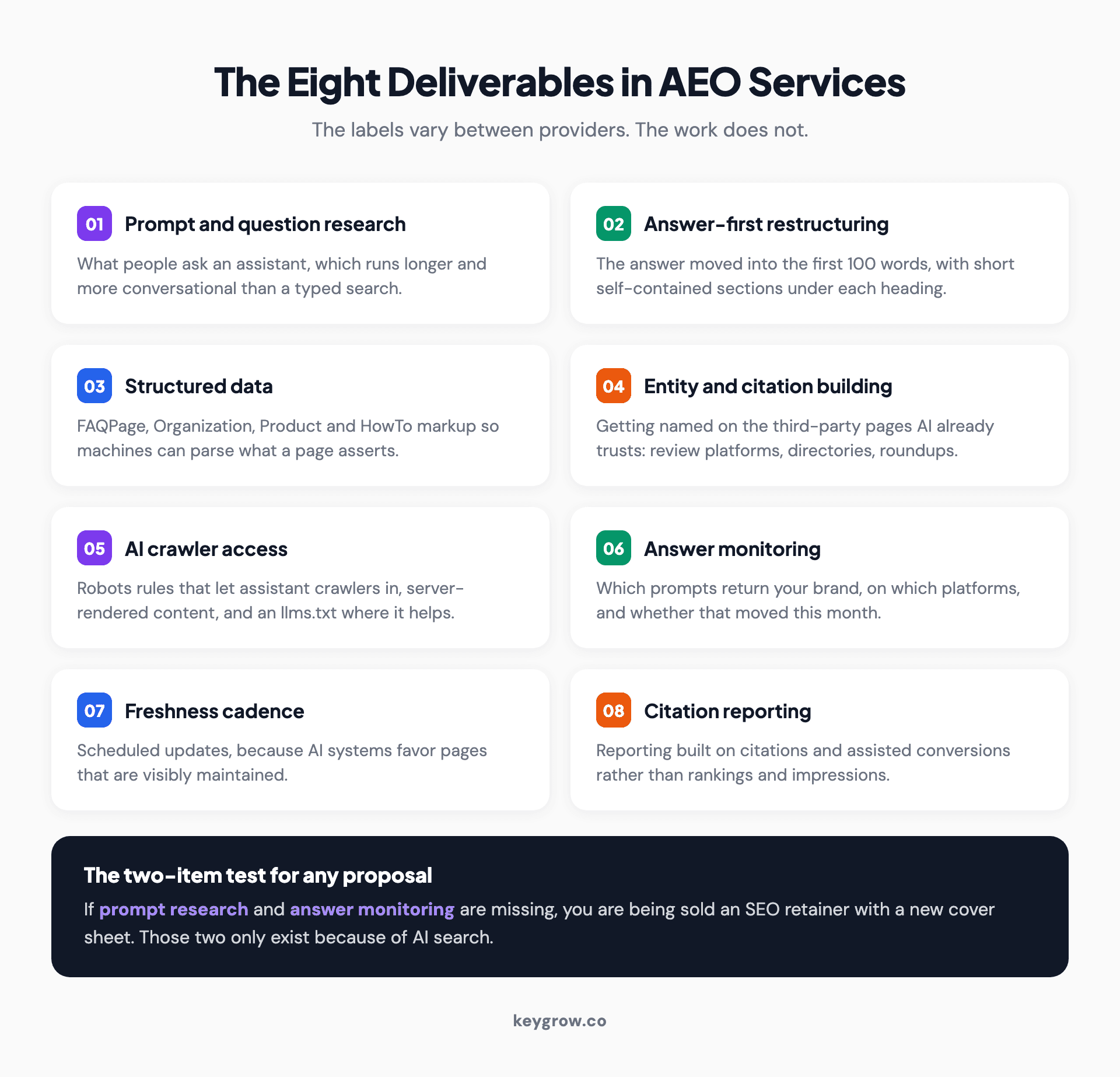
Eight AEO service deliverables laid out as cards: prompt research, answer-first restructuring, structured data, entity and citation building, AI crawler access, answer monitoring, freshness cadence, and citation reporting.
| Deliverable | What it means in practice |
|---|---|
| Prompt and question research | Finding what people ask an assistant, which is longer and more conversational than what they type into a search box |
| Answer-first restructuring | Rewriting pages so the answer sits in the first 100 words, with short self-contained sections under each heading |
| Structured data | FAQPage, Organization, Product, and HowTo markup so machines can parse what a page asserts |
| Entity and citation building | Getting the brand named on the third-party pages AI systems already trust: review platforms, directories, industry roundups |
| AI crawler access | Robots rules that let assistant crawlers in, server-rendered content, and an llms.txt file where it helps |
| Answer monitoring | Tracking which prompts return your brand, on which platforms, and whether that changed this month |
| Freshness cadence | Scheduled updates, because AI systems favor recently maintained pages |
| Citation reporting | Reporting built on citations and assisted conversions rather than rankings |
If a proposal is missing prompt research or answer monitoring, you are being sold an SEO retainer with a new cover sheet. Those two are the ones that only exist because of AI search.
The first four are where most of the hours go. The last four are where most of the difference shows up, and they are the ones a cheap package quietly drops.
Answer-first restructuring is the deliverable people find hardest to picture, so here is an invented example of the shape it takes. Before, a pricing page opens with two paragraphs about the company's founding and its commitment to service, and the actual price range appears under a heading two screens down. An assistant reading that page cannot extract an answer to "how much does X cost" without guessing, so it quotes a competitor who stated a number in their first line.
After, the same page opens with the range in a sentence a machine can lift whole, something in the shape of "most projects run between this and that, depending on how many locations you serve." Then the founding story, the caveats, and the detail, in that order. Nothing was deleted. The page was reordered so the answer comes first and the context follows.
That single move, applied across a site's twenty most-asked questions, is the bulk of what a first AEO engagement delivers. It is also why the work is cheaper on a well-structured site and expensive on one built as a brochure.
Which parts are new work, and which are SEO with a new invoice line
About half of what gets sold as AEO is technical SEO that a competent provider was already doing for you. Knowing which half protects you from paying twice.
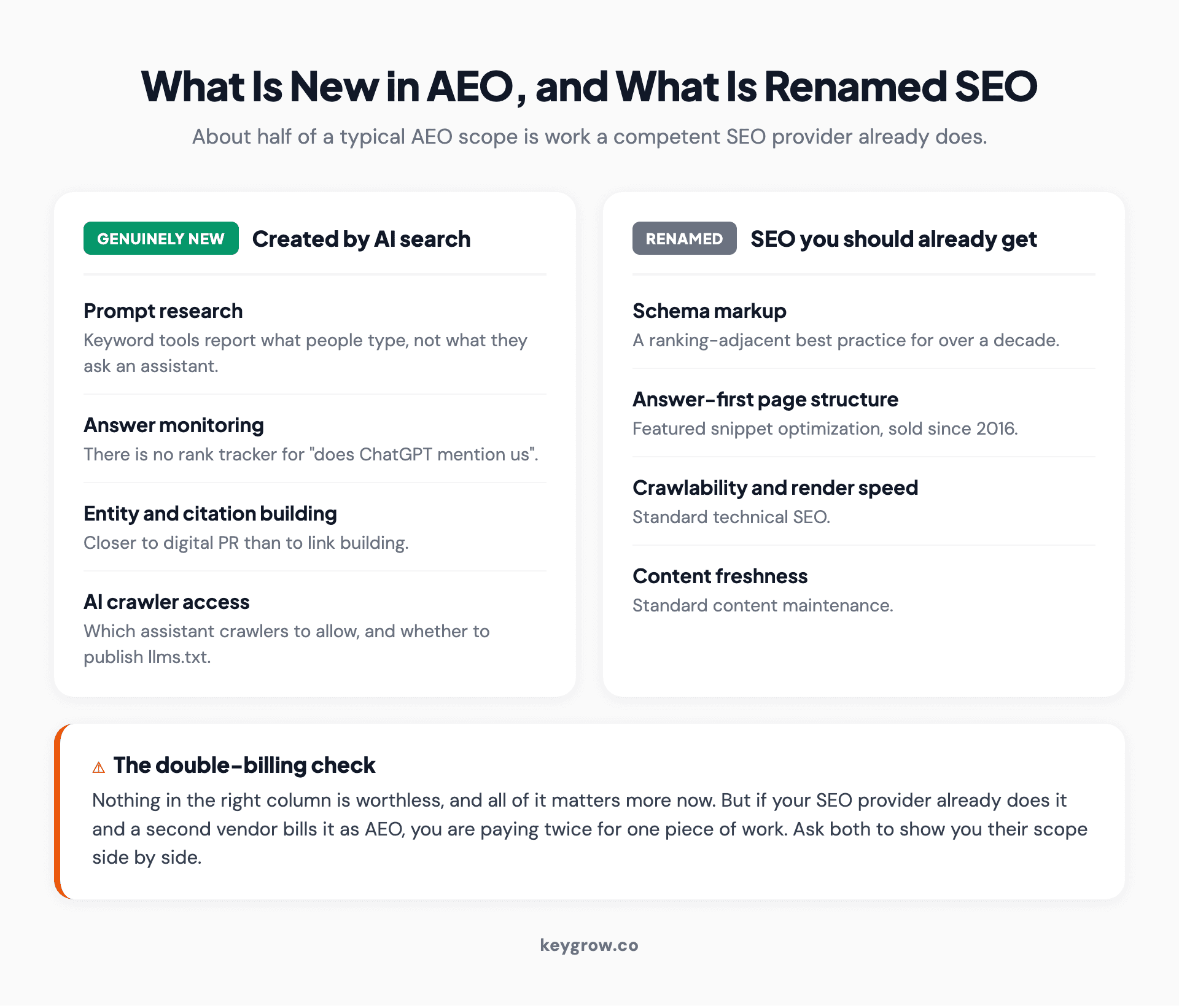
Two column comparison separating genuinely new AEO work such as prompt research and answer monitoring from renamed SEO work such as schema markup and crawlability.
Genuinely new work, created by AI search:
Work that is just SEO, renamed:
None of that second list is worthless. It is genuinely more valuable now than it was. But if your current SEO provider is already doing it and a second vendor bills you for it as AEO, you are paying twice for one piece of work. Ask both to show you their scope side by side.
The two numbers that should set your expectations
AI referral traffic is small and unusually valuable. Any honest scoping conversation starts by admitting both halves.
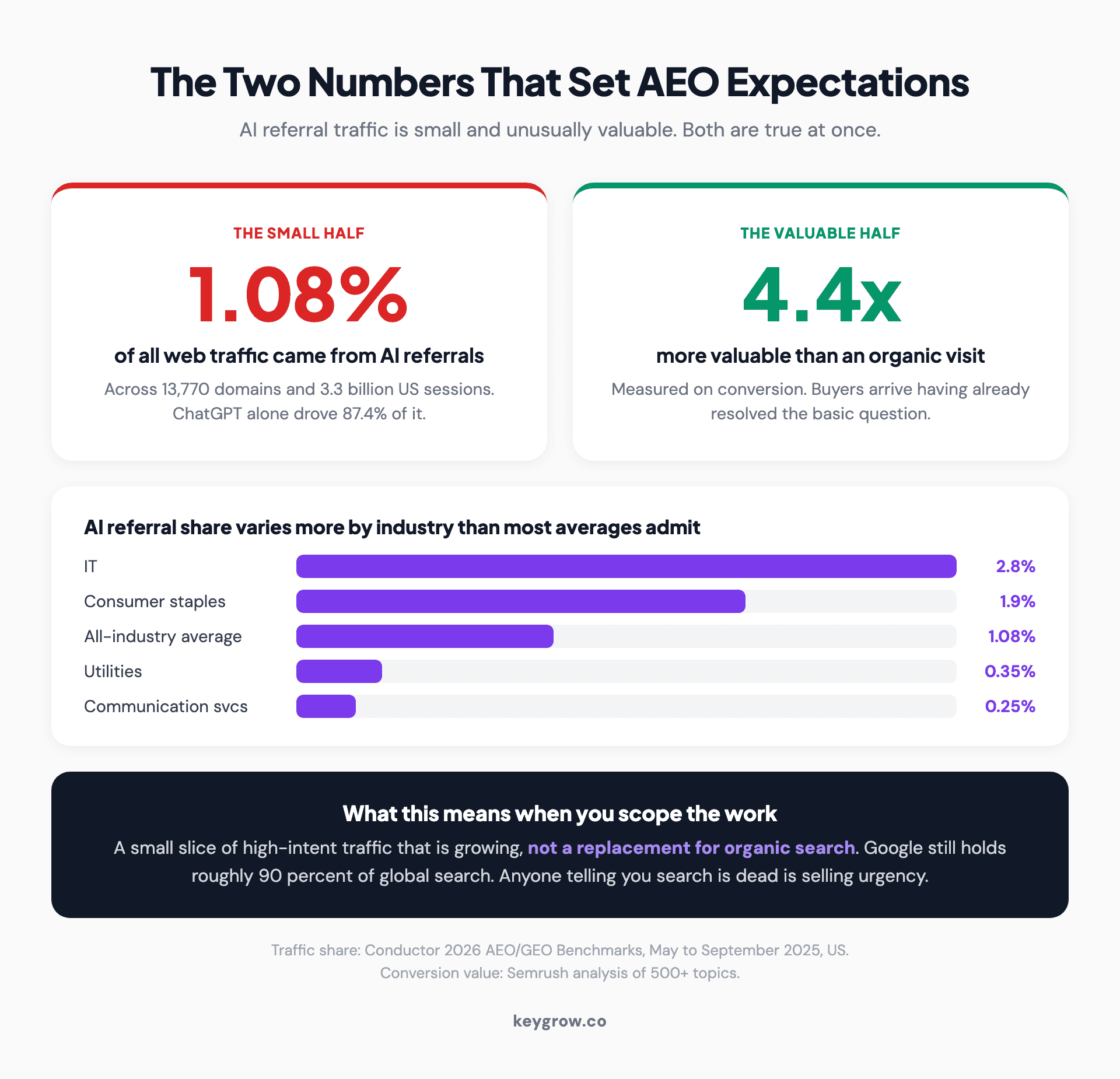
AI referrals are 1.08 percent of web traffic but convert 4.4 times better than organic visits, with a breakdown of referral share by industry from IT at 2.8 percent down to communication services at 0.25 percent.
On the small side: Conductor's 2026 benchmarks, covering 13,770 domains and more than 3.3 billion US sessions between May and September 2025, found AI referrals averaged 1.08 percent of all web traffic. Search Engine Land reported the same dataset showing ChatGPT alone drove 87.4 percent of those referrals. Industry matters: IT sat near 2.8 percent, utilities near 0.35 percent.
On the valuable side: Semrush's analysis of more than 500 topics found the average AI search visitor is 4.4 times as valuable as the average visit from traditional organic search, measured on conversion. That tracks with how people use assistants. Someone arriving from an AI answer has already had the basic question resolved and is following a citation to verify or to act.
So the realistic pitch is a small slice of high-intent traffic that is growing, not a replacement for organic search. Google still holds roughly 90 percent of global search. Anyone telling you search is dead is selling urgency rather than a service.
This is also where the widely repeated forecast about search volume collapsing by 2026 deserves retiring. It is 2026. Absolute search volume did not fall off a cliff. What did happen is subtler and more interesting: people run fewer searches per task because summaries answer the easy part, so the searches that remain skew toward the harder, higher-intent questions. That shift is the actual argument for AEO, and it is a better one than the prediction that failed.
How AEO services get packaged and priced
Three shapes, and the one you are offered says a lot about what you will get.

A marketing lead reviewing an agency proposal and scope document at a desk.
Bolted onto an existing SEO retainer is the most common and usually the most sensible, because the work shares a foundation. A standalone AEO retainer makes sense for larger sites with in-house SEO already handled. A one-time audit and remediation project suits businesses that want the structural fixes without an ongoing commitment, and it is the right first purchase more often than providers admit.
We do not publish flat pricing for this, and be wary of anyone who quotes a number before looking at your site, since the work depends entirely on how much structural repair the existing pages need. We covered the market ranges in more detail in our breakdown of what AEO costs.
One pricing red flag worth naming: a twelve-month lock-in on a channel this young. The tooling is changing every quarter. An agency that needs a year of your commitment before it will start is managing its own risk, not yours. We work month to month for exactly this reason.
How you can tell whether it is working
Citations first, traffic second, revenue third. In that order, because that is the order the effects arrive in.
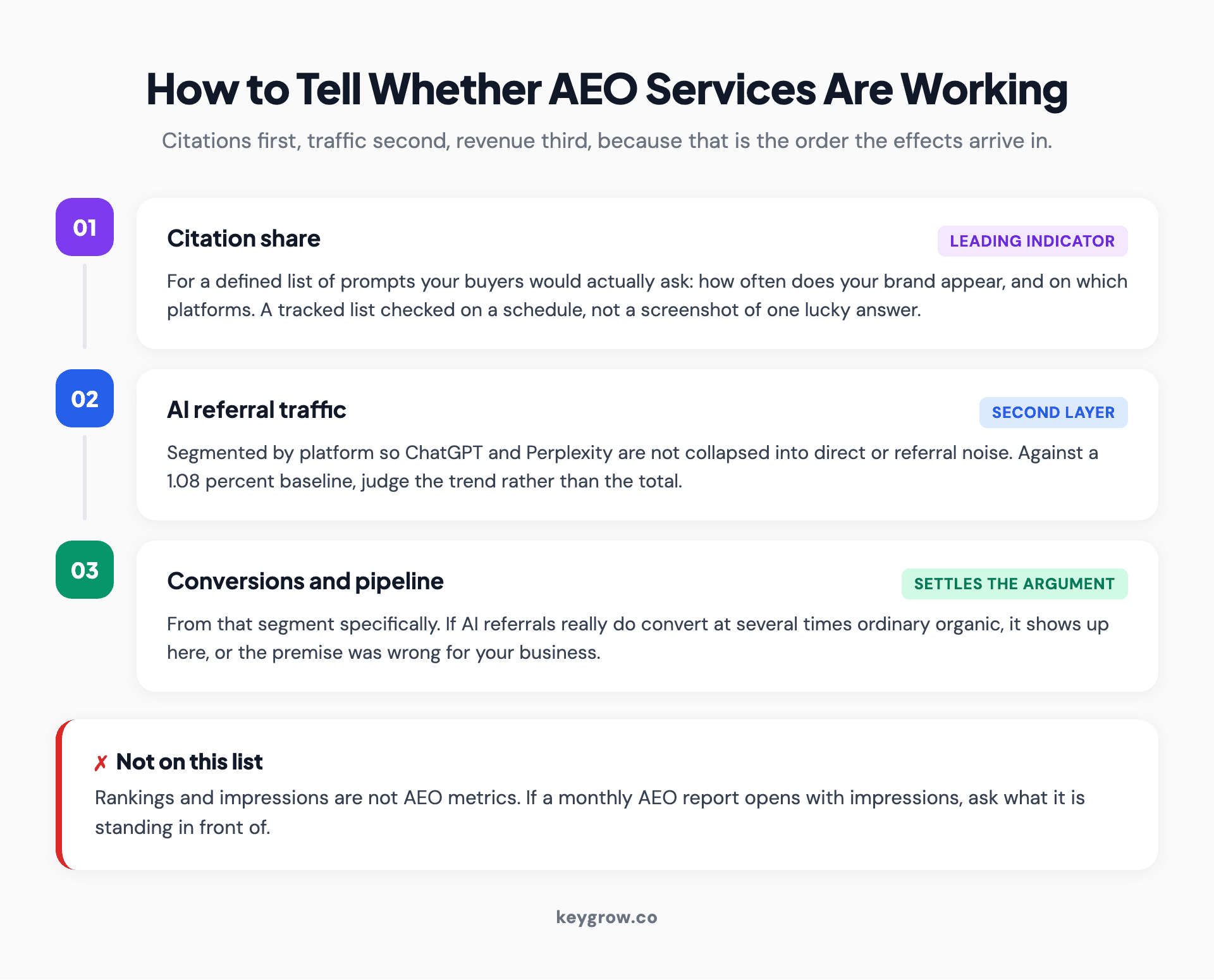
Three measurement layers for AEO: citation share as the leading indicator, AI referral traffic segmented by platform, then conversions and pipeline, with rankings and impressions excluded.
Citation share is the leading indicator: for a defined set of prompts your buyers would actually ask, how often does your brand appear, and on which platforms. This should be a tracked list, checked on a schedule, not a screenshot of one lucky ChatGPT answer.
Referral traffic from AI sources is the second layer. Segment it in analytics so ChatGPT, Perplexity, and the rest are not collapsed into direct or referral noise. Given the 1.08 percent baseline, expect the absolute numbers to look unimpressive for a while, and judge the trend rather than the total.
Then the only number that settles the argument: conversions and pipeline from that segment. If AI referrals really do convert at several times the rate of ordinary organic, that shows up here or the premise was wrong for your business.
Rankings are not on this list. Neither are impressions. If a monthly AEO report opens with impressions, ask what it is hiding. We wrote a fuller method in how to track AEO.
Who should buy AEO services right now
Buy if your customers research before they buy, and if your organic foundations already work.
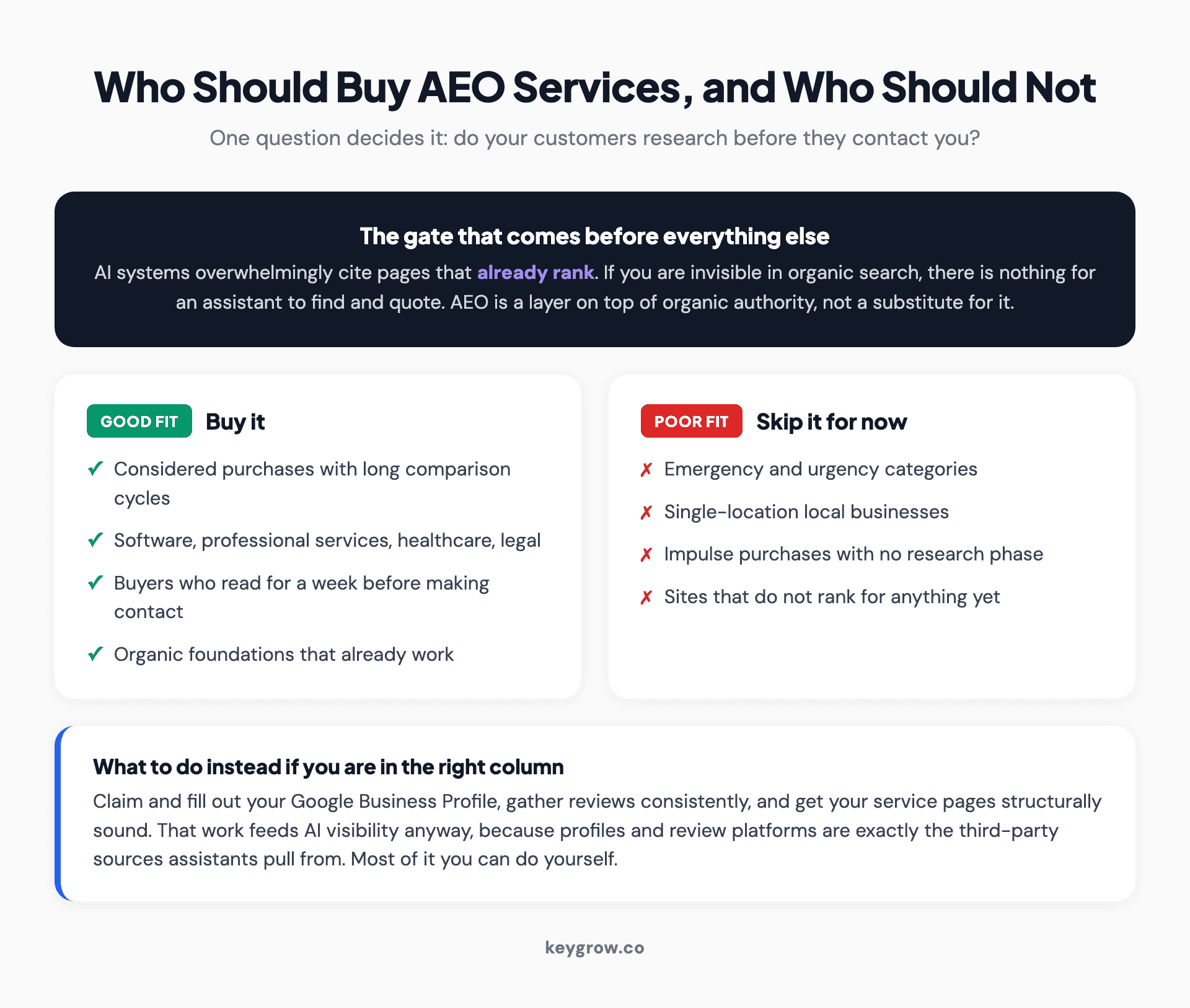
Good fit and poor fit lists for AEO services, with the gating rule that AI systems mostly cite pages which already rank organically.
The clearest fits are businesses with considered purchases and long comparison cycles: software, professional services, healthcare, legal, anything where someone reads for a week before contacting you. Those are the queries assistants handle well, and the buyers who arrive already informed are the 4.4x visitors.
The second condition matters more than the first. AEO is a layer on top of organic authority, not a substitute for it. AI systems overwhelmingly cite pages that already rank; if you are invisible in organic search, there is nothing for an assistant to find and quote.
A medical practice we worked with in Dubai is the clearest illustration we have of the foundation part. Twelve months of straightforward organic work, technical fixes, content, and authority building, took their organic traffic up 1,519 percent and their inbound to 130-plus patient calls a month. That was SEO, not AEO, and that is the point. The AEO layer needs something underneath it to work with.
Who should not, and what to do instead
Skip AEO services if you sell urgency, if you are a single-location local business, or if your site does not rank for anything yet.
Nobody with a burst pipe opens ChatGPT. Emergency and impulse categories are still won in the map pack and in paid search, and money spent on AEO for a 24-hour locksmith is money not spent on the things that actually ring the phone.
If you are a one-location business, the honest advice is to claim and fill out your Google Business Profile, gather reviews consistently, and get your service pages structurally sound. That work feeds AI visibility anyway, because review platforms and profiles are exactly the third-party sources assistants pull from, and you can do most of it yourself.
And if you do not rank organically, buy SEO. An agency that will not tell you that, and takes the AEO retainer anyway, is selling rather than consulting. We turn down this profile regularly. It is a slower conversation and a better outcome, and you can read our comparison of how AEO differs from SEO if you want the distinction in full.
Six questions to ask before you sign
Ask these in the first call. The answers separate the operators from the rebrands.
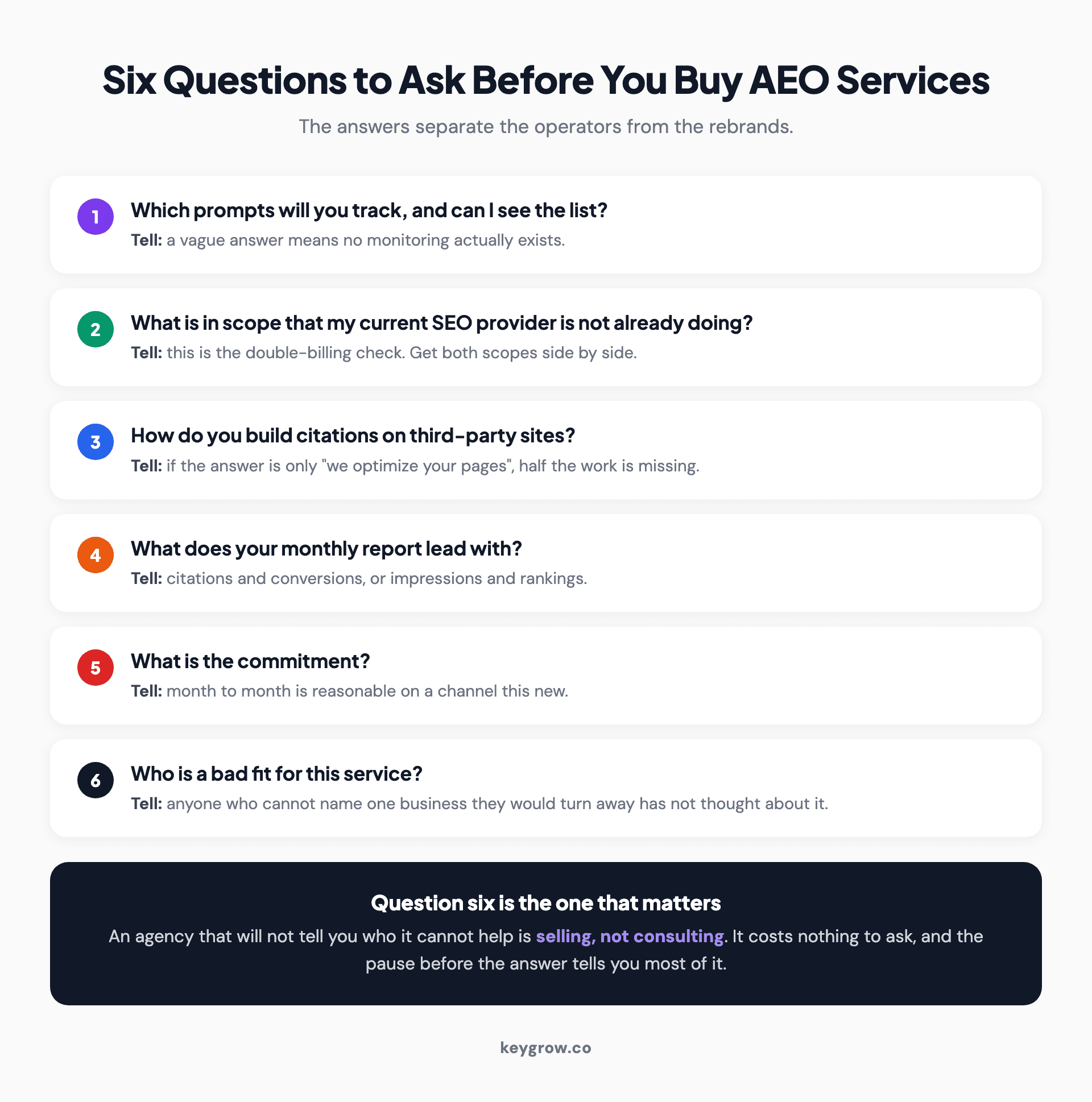
Six numbered questions to ask an AEO provider before signing, each paired with what the answer reveals about whether the service is real.
1. Which prompts will you track, and can I see the list? Vague answers here mean no monitoring exists.
2. What is in scope that my current SEO provider is not already doing? This is the double-billing test.
3. How do you build citations on third-party sites? If the answer is only "we will optimize your pages", half the work is missing.
4. What does your monthly report lead with? Citations and conversions, or impressions and rankings.
5. What is the commitment? Month to month is reasonable on a channel this new.
6. Who is a bad fit for this service? Anyone who cannot name a single type of business they would turn away has not thought about it, or will not say.
That last one is the most revealing question on the list, and it costs nothing to ask.
FAQs
What are AEO services in simple terms?
AEO services are the work of getting a business cited inside AI-generated answers rather than only ranked in search results. The bundle usually covers prompt research, answer-first content structure, schema markup, third-party citation building, AI crawler access, and monitoring which prompts return your brand.
Are AEO services different from SEO services?
Partly. Roughly half the deliverables, including schema, page structure, crawlability, and content freshness, are established SEO practices that matter more now. The genuinely new parts are prompt research, AI answer monitoring, entity building on the sources assistants trust, and AI crawler access decisions.
Is AEO worth paying for when AI traffic is only about one percent?
For businesses with long, research-heavy buying cycles, usually yes, because that traffic converts several times better than ordinary organic and the share is growing. For emergency services and impulse purchases it is a poor use of budget today. Judge it on your own conversion data, not on the category average.
Do I need SEO before I buy AEO services?
Yes, in almost every case. AI systems mostly cite pages that already rank well, so a site with no organic visibility gives an assistant nothing to quote. Fixing organic foundations first makes the AEO layer far cheaper and faster when you do add it.
How long do AEO services take to show results?
Citation changes can appear within four to eight weeks on pages that only needed structural fixes. Meaningful referral traffic and pipeline take longer, usually two to three quarters, because it depends on third-party citations and organic authority that build slowly.
What should an AEO report actually contain?
Citation share across a defined prompt list, AI referral traffic segmented by platform, and conversions or pipeline from that segment. Rankings and impressions are not AEO metrics, and a report that leads with them is usually avoiding the harder numbers.
Can I do AEO myself instead of hiring someone?
A good deal of it, yes. Putting the answer in the first 100 words, adding FAQ schema, keeping sections short, and claiming your profiles on review platforms are all things an in-house marketer can do. The parts that genuinely need a provider are sustained citation building and consistent monitoring across platforms.
How to decide
Start with one question: do your customers spend time researching before they contact you? If they do, AEO services are worth scoping, and the honest version of that scope is an add-on to organic search rather than a replacement for it.
If they do not, or if you are not ranking organically yet, the money does more elsewhere this year. That answer costs us business and it is still the right one.
For anyone in between, the cheapest useful first step is a one-time audit rather than a retainer. Find out how many of your pages already answer a question in the first paragraph, whether your schema is valid, and whether you appear for even five prompts a buyer would plausibly ask. You will learn more from that than from three months of a package you did not need. Our AEO service page covers how we scope it, and schema markup for AEO walks through the structured data piece if you want to try it yourself first.


