


Google Ads management services all sell the same thing: a person or a team running your account for a monthly fee. Structure, keywords, negative lists, ad copy, bid strategy settings, conversion tracking and reporting. The market rate is 10 to 20 percent of ad spend, or a flat fee that usually starts near $500 and runs to $5,000 a month.
Every page selling the service will tell you that much. Here is the part they leave out.
The fee is a second cost per lead. Your media buys leads at one price, and the management fee raises that price before a single lead reaches you. Which means a percentage fee has to earn back exactly its own percentage just to break even. Hire at 15 percent and the account has to end up 15 percent better than the version you would have run yourself, every month, before you are ahead.
Sometimes that is easy. In a neglected account it takes an afternoon. Sometimes it is close to impossible. This is a guide to working out which one you are.
What you are actually buying
The deliverable is account management, not advertising. The ad spend is separate and it goes to Google, not to the agency.
| Included nearly everywhere | Included by the good ones | Almost always billed separately |
|---|---|---|
| Campaign and ad group structure | Conversion tracking audit and repair | Landing page design and build |
| Keyword research and match types | Weekly search terms review | Video and display creative |
| Negative keyword lists | Offline conversion imports | Call tracking software |
| Ad copy writing and testing | Shopping feed management | Reporting dashboard licenses |
| Bid strategy selection | Audience signals and exclusions | CRM integration work |
| Monthly reporting | Written landing page feedback | Your ad spend |
The middle column is where the difference lives. Almost anyone can write ad copy and add keywords. Far fewer will open your conversion tracking, find that it is counting three page views and a phone number click as the same event, and tell you that your last twelve months of reporting was fiction.
Ask for the middle column by name during the sales call. The answers separate people quickly.
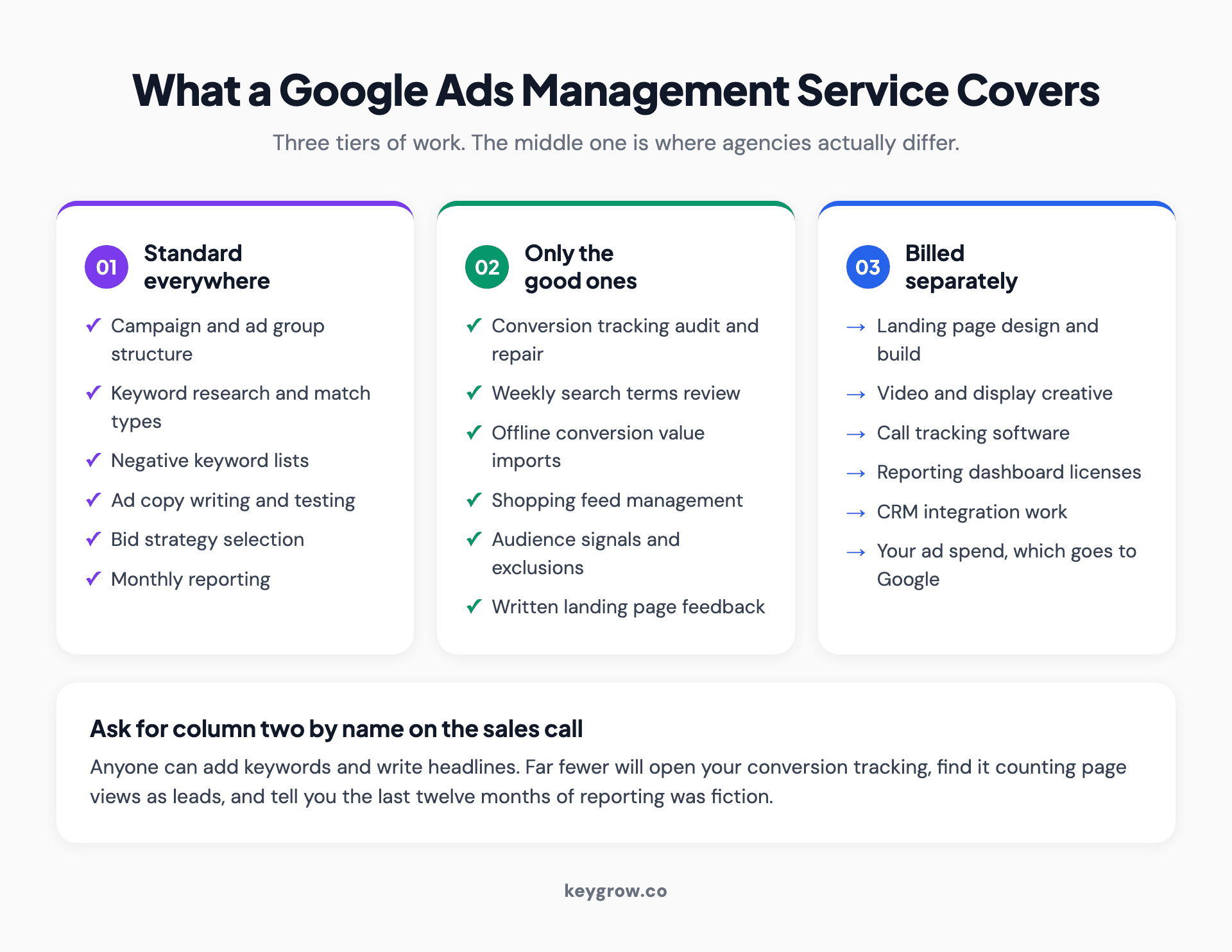
Three cards showing what a Google Ads management service covers: the work included nearly everywhere, the work only good managers do, and the items almost always billed separately.
Three fee models, and the conflict built into each
Nobody will volunteer the conflict of interest in their own pricing, so here they are.
| Model | Typical rate | The built-in conflict |
|---|---|---|
| Percentage of spend | 10 to 20 percent, usually a $500 minimum | Paid more when you spend more, including when spending less would perform better |
| Flat monthly fee | $500 to $5,000 depending on account size | No upside in growing the account, and quiet incentive to spend fewer hours on it |
| Hybrid | A base fee plus a smaller percentage | Softer version of both, and harder to compare against quotes |
| Performance or cost per lead | Varies wildly | Incentive to count weak actions as conversions, since the count is the invoice |
None of these is disqualifying. Every pricing model has a pull in some direction and the honest ones will say so out loud. The answer you want to hear is a manager who names their own model's weak spot before you do.
One practical note on the percentage model: it makes your fee move with your budget, so a seasonal business paying 15 percent pays much more in peak months for roughly the same amount of work. If your spend swings hard through the year, a flat fee or a hybrid usually costs less over twelve months.

Colleagues working at computers across an open plan office.
Do the fee arithmetic before you sign anything
Work out what the fee does to your cost per lead. It takes two minutes and it reframes the entire decision.
The figures below are illustrative, so substitute your own:
| Line | Figure |
|---|---|
| Monthly ad spend | $4,000 |
| Management fee at 15 percent | $600 |
| Leads produced by the media | 33 |
| Cost per lead, media only | $121 |
| **Cost per lead, fee included** | **$139** |
| **What the fee has to produce to break even** | **5 more leads a month, every month** |
Look at the shape of it rather than the numbers. A 15 percent fee needs a 15 percent improvement. A 20 percent fee needs 20 percent. The percentage is your hurdle rate and it does not move when your budget does, which is why a bigger budget makes management easier to justify and a small one makes it nearly impossible.
Run the same arithmetic on a flat fee and you get a different shape. A $1,200 flat fee on $12,000 of spend is a 10 percent hurdle. The same $1,200 on $2,000 of spend is a 60 percent hurdle, and no manager alive clears 60 percent month after month. Our budget calculator will do the forward version if you want to test a few spend levels.
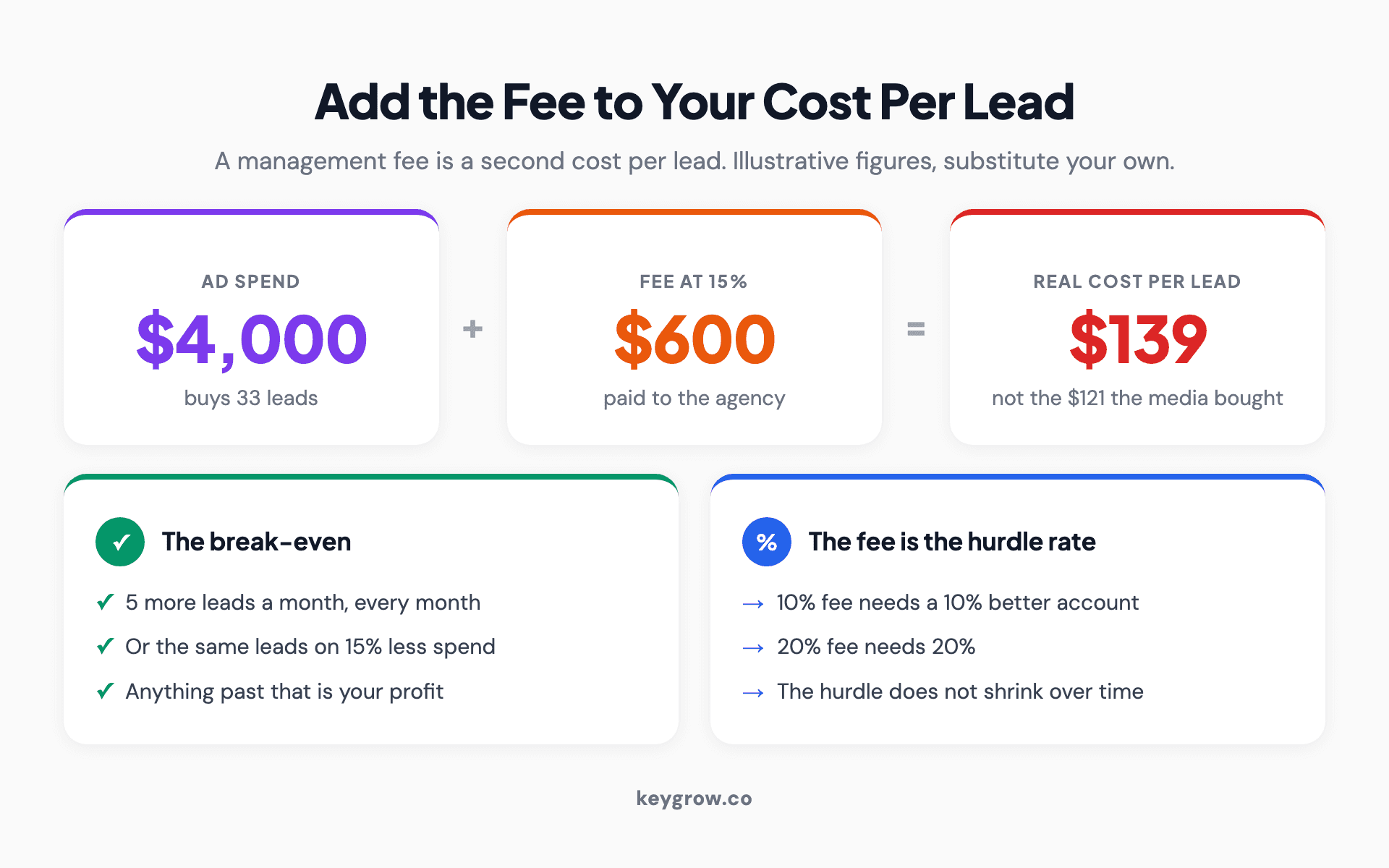
A flow diagram showing how a fifteen percent management fee raises cost per lead from $121 to $139 and sets a break-even hurdle of five extra leads per month.
Whether you clear the hurdle depends on how bad your account is right now
This is the part that decides the outcome, and it has nothing to do with the agency.
Broad match without a maintained negative list is a donation to Google, and in the unmanaged accounts we audit the waste typically runs 20 to 30 percent of budget. If that describes your account, a competent manager clears a 15 percent hurdle in week one by reading the search terms report and blocking the obvious. There is no skill ceiling being tested. The gains are sitting in a tab nobody opened.
If your account is already tight, negatives maintained, tracking clean, structure sane, the same manager has to find that 15 percent somewhere much harder. Landing pages, offer, bid strategy inputs, feed quality. It is real work with a real chance of failing.
So the honest version of "is a management service worth it" is a question about your own account, not theirs. Pull your search terms report for the last 90 days, sort by cost, and read the bottom half. You will know in ten minutes.
A mobile detailing client of ours makes the point at the extreme end. They were paying around $100 per booking, sending every click to their homepage. Restructured campaigns and a dedicated booking page took cost per conversion to $22 between August and December, with bookings up 650 percent and monthly revenue from $1.2K to $5.1K. A management fee disappears inside a move like that. But the move existed because the starting point was bad, and that is the whole point.

A woman reviewing performance charts and graphs on a laptop at a desk.
When you should not buy this at all
There is a spend floor below which management fees cannot pay for themselves, and most agencies will not tell you where it is.
Roughly speaking: under about $2,500 a month in ad spend, a $500 minimum fee is 20 percent or more of your budget going to overhead, and the account has to keep beating that number forever. Under $1,500 you are usually better off spending the fee on clicks.
What to do instead, in order:
- Pay once for a proper setup. Structure, tracking, negatives, a real landing page. A one-time build is a fair thing to buy and it is where most of the value is anyway.
- Run it yourself on a weekly rhythm. Search terms on Monday, a look at the conversion column, budget checks. Forty minutes a week covers a small account.
- Buy a paid audit each quarter. Someone experienced reviewing the account for a few hours, twice or four times a year, costs a fraction of a retainer. Our walkthrough of how to run a PPC audit shows what should be in one.
Three other situations where you should hold off regardless of budget. If nobody answers the phone during business hours, fix that before buying traffic management. If you cannot take on more work this quarter, more leads is a cost, not a win. And if you have no conversion tracking you trust, buy the tracking work on its own first, because everything a manager does downstream depends on it.
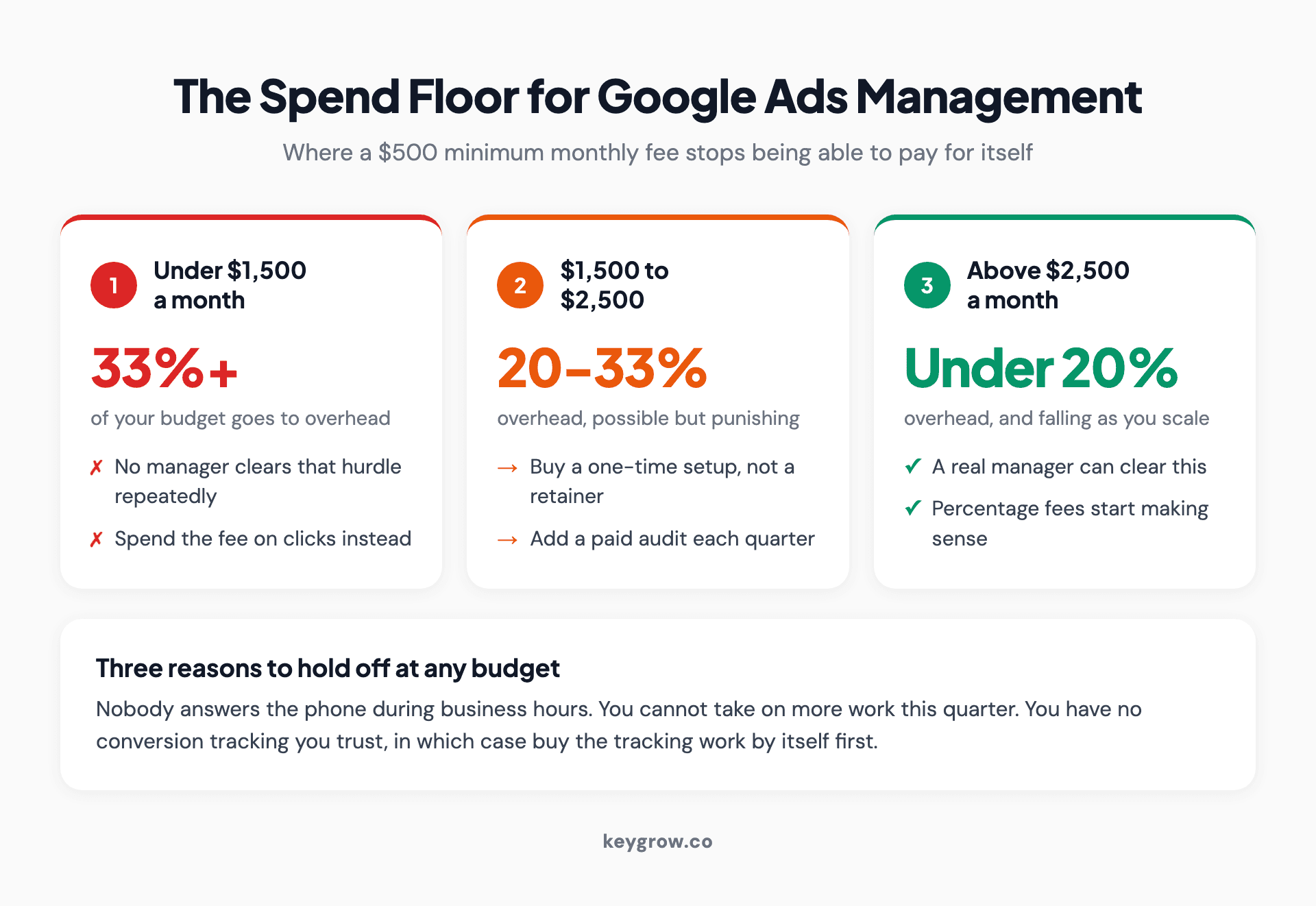
A three-tier stat strip showing the spend floor for Google Ads management: unworkable below $1,500 a month, hard to justify to $2,500, and viable above it.
What a manager still does now that Google sets the bids
Automation took away the job people picture when they imagine account management. Nobody adjusts device bid modifiers by hand at 11pm anymore, and anyone selling you that as the work is describing 2016.
The job moved upstream, to the inputs the automation runs on. According to Google's Smart Bidding documentation, the bidding strategies optimize across more than 20 contextual signals in every auction, and Google recommends at least 30 conversions in the last 30 days before you can evaluate performance properly, or 50 for target ROAS.
Which relocates the work to five places:
- Deciding what counts as a conversion. If newsletter signups and quote requests both feed bidding, the algorithm will happily buy you newsletter signups. This single setting ruins more accounts than any bid strategy choice.
- Feeding back values. A $400 job and a $9,000 job should not be the same conversion. Importing real values, or at least tiered proxy values, changes what the system chases.
- Volume management. Under the 30 conversion threshold, smart bidding is guessing. Getting an account above that line, by consolidating campaigns or counting an earlier action, is a structural decision.
- Negatives and match types. Automation optimizes within the traffic you allow. It will not decide that "free" shoppers were never your customer.
- Assets and offer. Headlines, extensions, page match. The parts the machine cannot generate opinions about.
That is the honest job description in 2026. If a prospective manager cannot describe their work in roughly those terms, they are selling last decade's service.
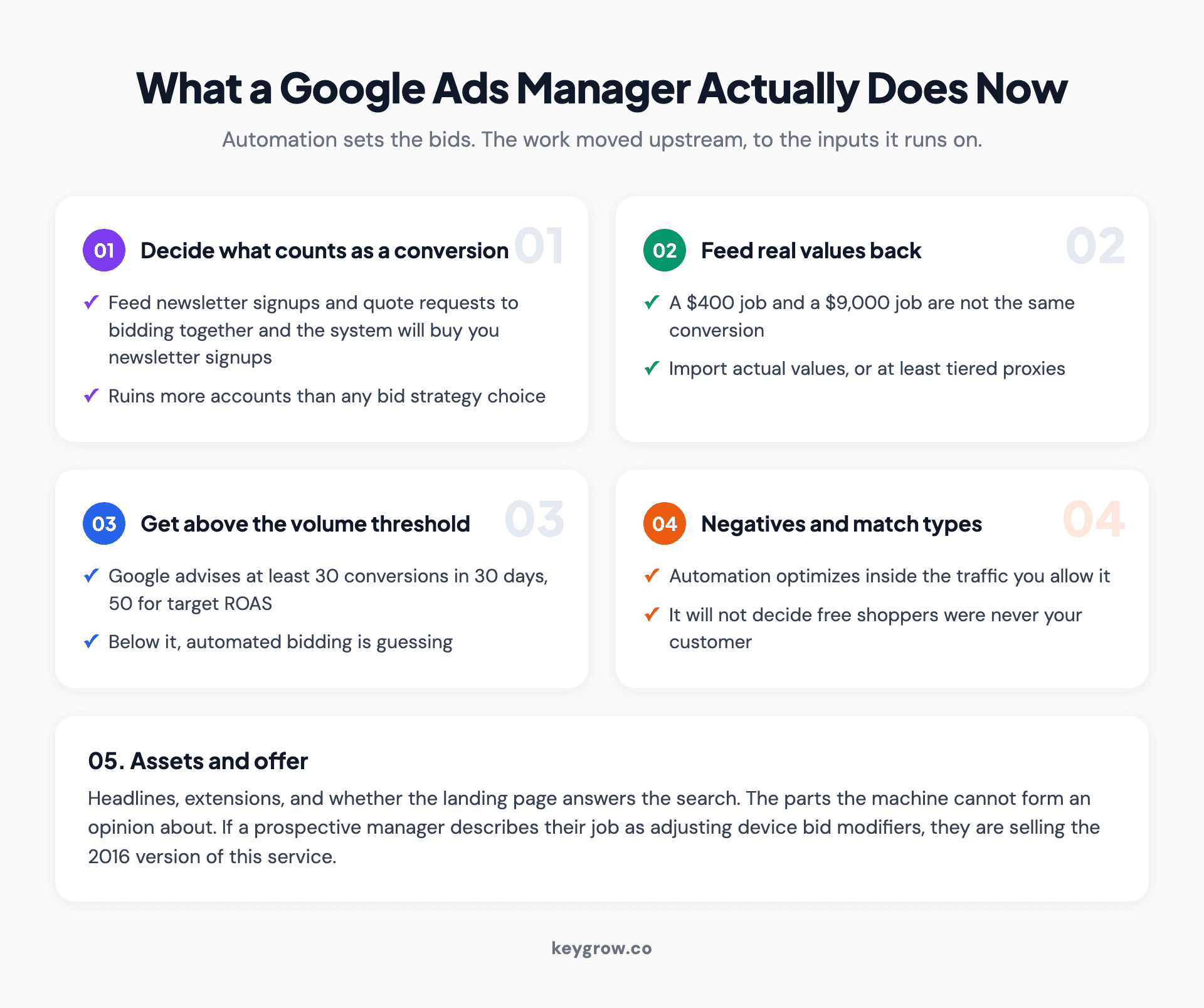
Five numbered cards naming where Google Ads management work moved once automation took over bidding: conversion definitions, value feedback, conversion volume, negatives and match types, and assets.
Three checks that tell you whether work is happening
Reports are written by the person being reviewed. These three are not.
Change history. In the Campaigns menu, change history lists every change made to the account for the past two years, filterable by type and by who made it. Set it to the last 30 days. A managed account should show regular, varied, explainable activity. If it shows four budget nudges and nothing else, you are paying a retainer for a monthly glance.
The search terms report. Sort by cost, descending, last 30 days. Read the top fifty. If more than a handful are searches you would never pay for, the negative work is not being done. Our guide to negative keyword lists covers how the maintenance should actually run.
The conversions column. Open the conversion actions list and check what is set to primary. Page views, clicks on a phone number that never connected, and form loads all inflate a report and all corrupt bidding. This one takes ninety seconds and finds problems in a surprising share of accounts.
None of these require you to know Google Ads. They require you to look.
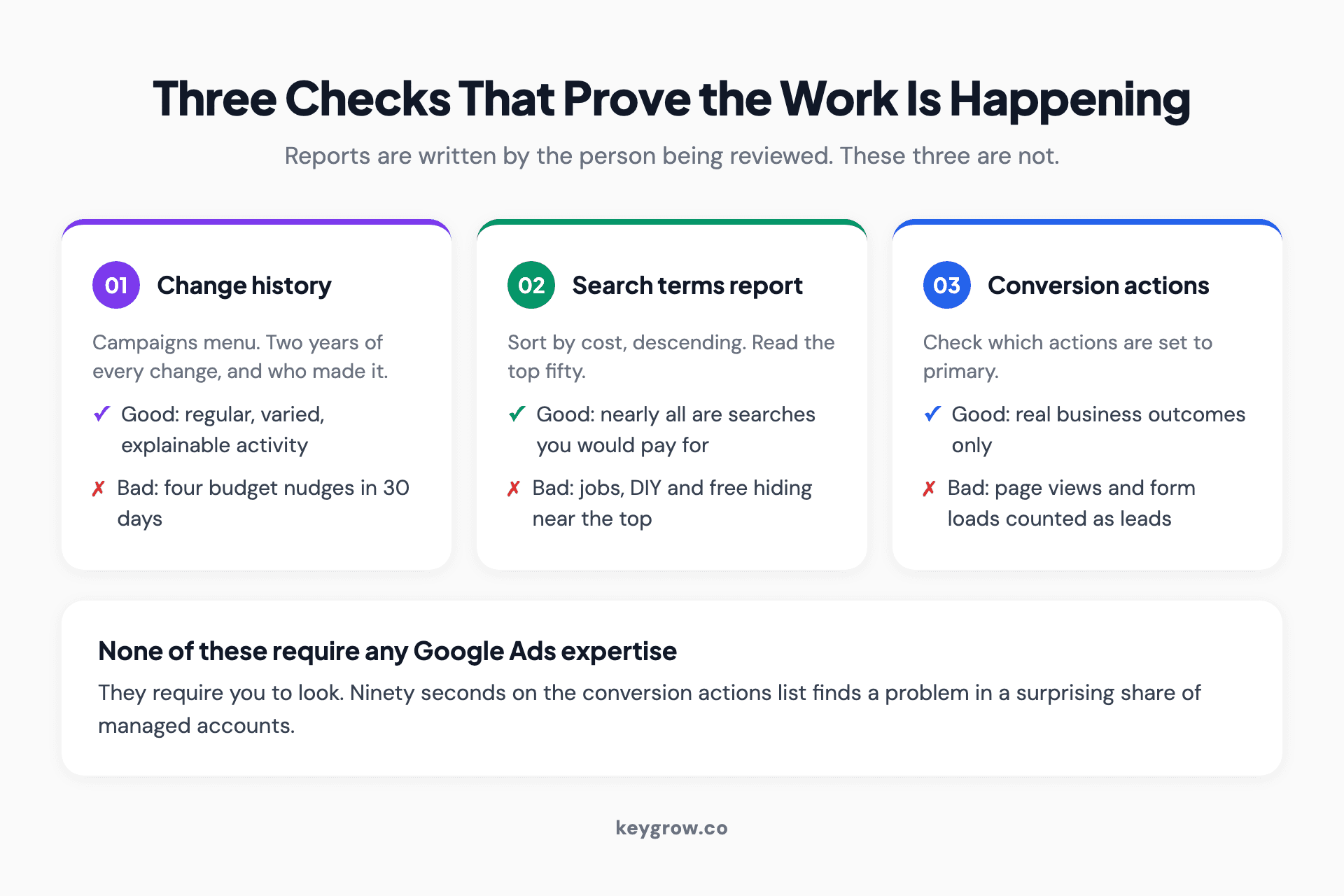
Three numbered checks a business owner can run without Google Ads expertise: change history, the search terms report sorted by cost, and the primary conversion actions list.
Keep the account in your own name
The account, the tags and the data history belong in your name, with the agency added as a user. This is the single most expensive detail people get wrong.
When an agency owns the Google Ads account, leaving means starting over. You lose the conversion history that smart bidding trained on, which in practice means a fresh learning period and worse performance for weeks. You lose the change record. Sometimes you lose the tracking setup itself, because the tags live in a container you do not control.
Insist on four things at the start:
- The Google Ads account created under your billing, with the agency linked through their manager account
- The GA4 property owned by you
- The Google Tag Manager container owned by you
- Admin access to your own Google Business Profile
An agency that will not work this way is telling you something about how their client relationships usually end. On the same theme, KeyGrow works month to month and you can cancel anytime, which is less a selling point than a description of what happens when the account ownership is arranged correctly: leaving is easy, so keeping you has to be earned.
Partner badges, incidentally, tell you less than people assume. Google's Partner requirements are a minimum 70 percent optimization score, $10,000 of 90-day spend across managed accounts, and at least 50 percent of account strategists certified. Optimization score is Google's own recommendation-acceptance metric, which means part of the badge is a measure of how readily an agency does what Google suggests. Useful as a floor. Not evidence of judgment.
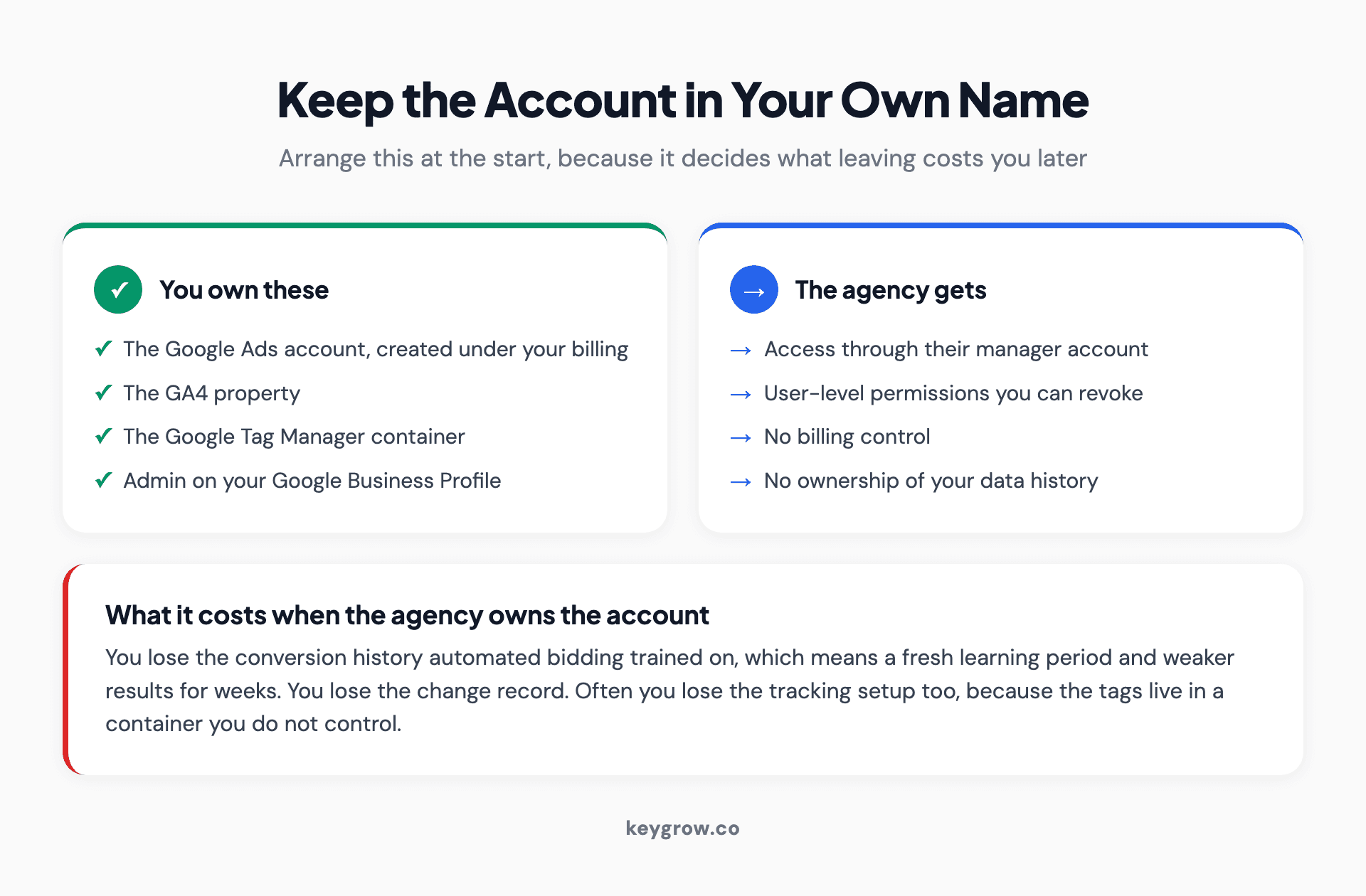
Two cards listing what to own in your own name before hiring a Google Ads manager: the ads account, the GA4 property, the tag manager container, and the business profile.
What to ask before you sign
Six questions, in the order that saves the most time:
- Which of my conversion actions would you set as primary, and why? Tests whether they will look at the account before quoting.
- What is your fee model, and what does it push you to do that I should watch? Anyone who says "no conflict at all" has not thought about it.
- Who does the daily work, and how many accounts do they hold? A named person with fifteen accounts is a different service from a pool with sixty each.
- What happens in month one, specifically? Vague answers here become vague months.
- Who owns the account and the tags? Covered above. The wrong answer ends the call.
- What is the notice period? Long lock-ins tend to appear where results do not.
There is a longer version of this in our list of questions to ask a management company, and a fuller framework in how to choose a PPC agency. If you only want a diagnosis rather than an operator, Google Ads consulting is the cheaper product and the trade-offs are different.
FAQs
How much do Google Ads management services cost?
Most agencies charge either 10 to 20 percent of monthly ad spend, usually with a minimum around $500, or a flat monthly fee between $500 and $5,000 depending on account size and complexity. Freelancers typically sit at the lower end and one-time setup or audit fees are commonly charged separately. The fee never includes the ad spend itself, which goes directly to Google.
What is included in Google Ads management?
Standard inclusions are campaign structure, keyword and negative keyword research, ad copy writing and testing, bid strategy configuration, conversion tracking and monthly reporting. Better services also audit and repair your conversion tracking, review the search terms report weekly, import offline conversion values and give written feedback on landing pages. Landing page builds, creative production and call tracking software are usually extra.
Is a Google Ads management service worth it?
It depends far more on your current account than on the agency. If your account has no maintained negative list and untrustworthy conversion tracking, a competent manager usually recovers their fee in the first month. If the account is already well run, the fee has to be earned through harder gains and can easily fail to pay for itself. Work out the fee as a percentage of spend, then ask whether the account can realistically improve by that much.
What is the minimum ad spend for hiring a Google Ads agency?
As a rough floor, below about $2,500 a month a $500 minimum fee consumes 20 percent or more of your budget, and below $1,500 it becomes very hard to justify. Under those levels most businesses do better paying once for a proper setup, running the account themselves on a weekly rhythm, and buying a paid audit each quarter.
Should the agency own my Google Ads account?
No. The account should be created under your billing with the agency added through their manager account, and you should own the GA4 property and the tag manager container. If the agency owns the account, leaving costs you the conversion history that automated bidding relies on, which means a fresh learning period and weaker results for several weeks.
How do I know if my Google Ads agency is actually doing anything?
Check three things yourself. Change history in the Campaigns menu shows every account change for the past two years, including who made it. The search terms report sorted by cost shows whether negative keyword work is happening. The conversion actions list shows whether the numbers in your report describe real business outcomes. None of these need any Google Ads expertise.
Does a Google Partner badge mean an agency is good?
It means they meet a floor. The requirements are a 70 percent optimization score, $10,000 in ad spend over 90 days across managed accounts, and half of account strategists certified. Optimization score partly measures how readily an agency accepts Google's own recommendations, so the badge proves activity and scale rather than judgment. Treat it as a filter, not as evidence.
How long before a Google Ads management service shows results?
Expect meaningful change in four to eight weeks for most accounts, and longer where the sales cycle is long. The first two weeks usually go to tracking repair, negatives and restructuring, which often makes the reported numbers look worse before they look better because the counting finally became accurate. Judge on cost per genuine lead across a full quarter.
Buy the account, not the badge
Strip the sales language out of this decision and only two questions are left. How much slack is in my account right now, and does the fee cost less than that slack is worth.
If your search terms report is full of things you would never pay for and your conversion column counts page views, the answer is yes and it is not close. If you have been running a tight account for two years, the fee is a real bet and you should treat it as one.
Either way, own the account, ask for the middle column of that first table by name, and check the change history yourself in month two.
If you want that work done against genuine cost per lead rather than impressions, our PPC management is month to month and you can cancel anytime. If your spend is below the floor described above, we will tell you that instead of taking the retainer.