


Before you compare a single Google Ads consulting quote, answer this: who is going to do the work afterwards?
That question decides the purchase, and almost nobody asks it before the call. Google Ads consulting sells you judgment. Somebody looks at your account, tells you what is wrong, in what order, and why. What it does not sell you is the person who then goes and changes 40 keywords, rebuilds the tracking and rewrites the landing page.
If you have that person, consulting is usually the cheaper and better buy. If you do not, an audit becomes a PDF that ages quietly in a shared drive while the account keeps doing exactly what it was doing.
Consulting and management are different products
The words get used interchangeably in sales copy. They should not be.
| Consulting | Management | |
|---|---|---|
| What you rent | Judgment and diagnosis | Judgment plus execution |
| Billing | Hourly, per project, or a small monthly advisory | Percentage of spend or a monthly retainer |
| Who touches the account | Usually you, or your team | The agency |
| Typical engagement | One audit, a plan, a few review calls | Ongoing, month after month |
| Fails when | Nobody implements the plan | You cannot tell whether work is happening |
| Best fit | You have hands, you lack a diagnosis | You have neither hands nor a diagnosis |
The last row is the whole decision. Consulting is what you buy when the scarce thing in your business is knowing what to do. Management is what you buy when the scarce thing is somebody to do it. Most businesses are short of one of those, not both, and pay for both anyway.
If you land on the management side of that table, our guide to Google Ads management services walks through fee models and the spend floor.
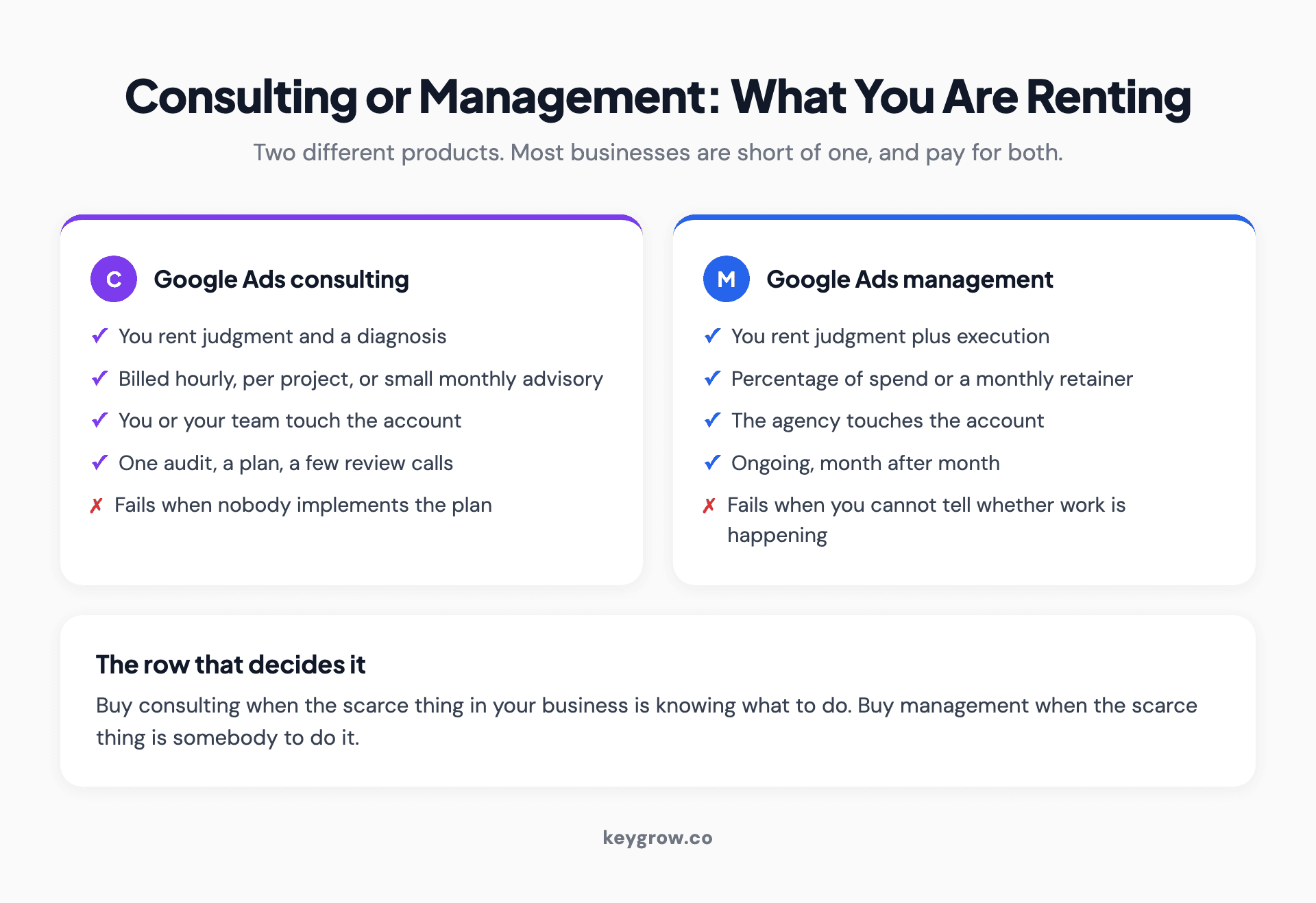
Two cards comparing Google Ads consulting against management, showing that consulting rents judgment while management rents judgment plus execution.
What an engagement actually produces
Ask for the deliverable in writing before you agree to anything. Consulting goes wrong most often because both sides had a different picture of what would arrive.
The four formats you will be offered:
A one-time audit. A written review of the account with prioritized findings. Should include the specific setting or campaign each finding refers to, the estimated impact, and how long each fix takes. A good one is 15 to 25 findings ranked by value, not 60 items with no ranking.
A strategy document. Forward-looking rather than diagnostic. Campaign structure, budget allocation across campaign types, keyword strategy, what to measure. Useful when you are starting or restarting rather than repairing.
Ongoing advisory. A recurring call, usually monthly or fortnightly, where somebody experienced reviews what you did and tells you what to do next. Typically four to eight hours a month. This is the format most in-house marketers actually need and the one least often sold to them.
Project work. A specific problem, scoped and fixed. Conversion tracking rebuilt. A Shopping feed cleaned up. A Performance Max campaign diagnosed. Priced as a project, delivered in weeks, then it ends.
The one thing to insist on regardless of format: a walkthrough call after delivery. A document you read alone answers the questions the consultant anticipated. A call answers yours.
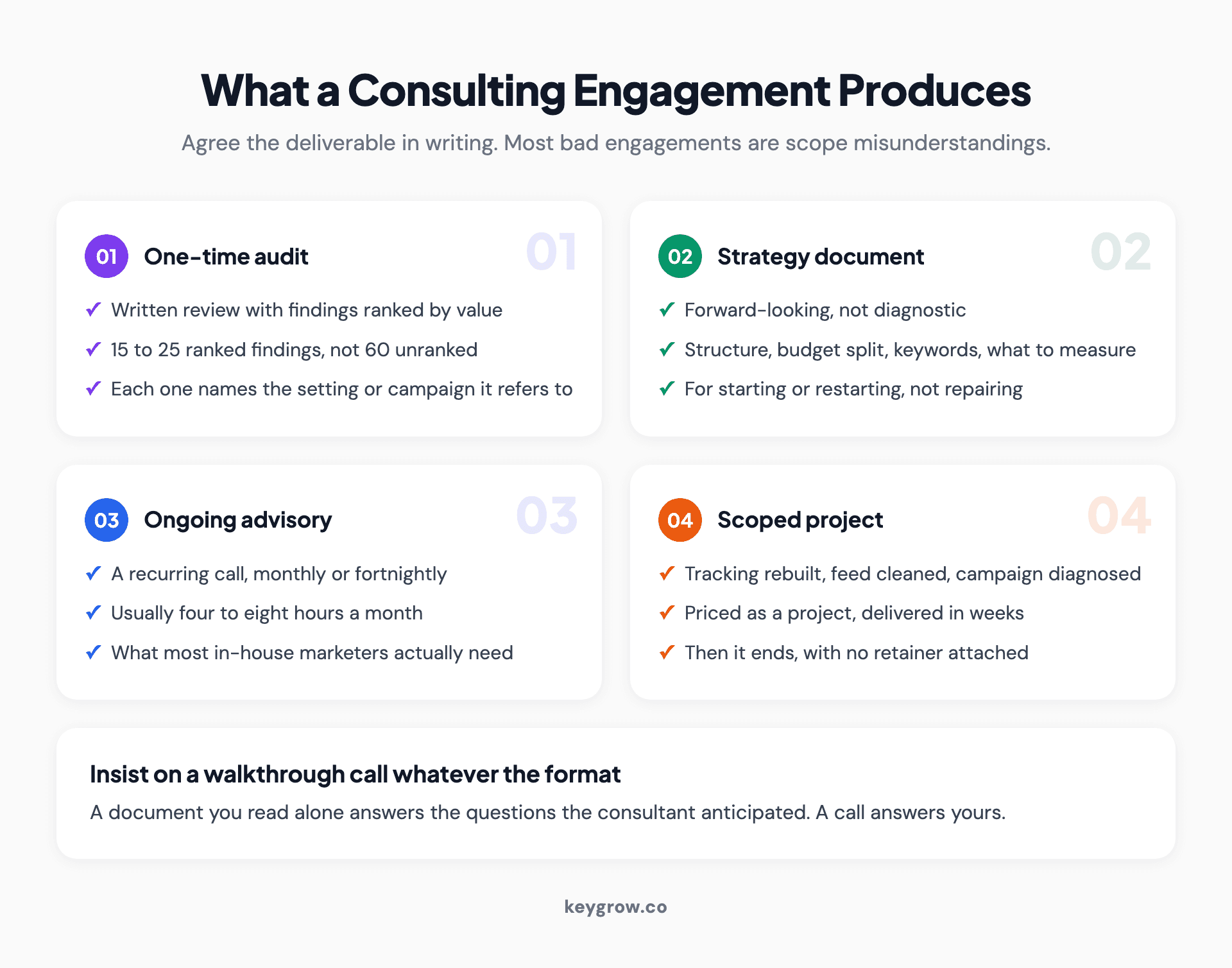
Four cards describing the formats a Google Ads consulting engagement is sold in: one-time audit, strategy document, ongoing advisory, and scoped project work.
What Google Ads consulting costs
Consulting is billed by the hour or by the project, which is the structural difference from management and the reason the arithmetic works out differently.
Published market rates sit roughly here, and one consultancy's rate card is unusually open about it:
| Format | Common range |
|---|---|
| Hourly | $150 to $400 |
| Single strategy session | $300 to $600 |
| Account audit | $500 to $2,000 |
| Strategy document | $1,000 to $3,000 |
| Account rebuild as a project | $2,000 to $5,000 and up |
| Monthly advisory | $1,500 to $4,000, usually 4 to 8 hours |
Treat those as market ranges rather than quotes. What matters is the shape: a $1,200 audit is a one-time cost, while $1,200 a month of management is $14,400 a year. If the audit finds three fixable problems and someone in your business implements them, the audit was the better purchase by a wide margin.
The catch is in that second clause, and it is the entire subject of the next section.
The execution gap is what actually kills consulting engagements
Advice has a shelf life. A diagnosis is worth the most on the day it arrives and close to nothing by month six, because by then the account has drifted, the auction has moved, and the person who was going to implement it got busy.
So before buying, total the implementation hours honestly. A typical audit produces something like this:
| Finding | Rough implementation time |
|---|---|
| Rebuild conversion tracking so it counts real outcomes | 3 to 6 hours |
| Build and apply a proper negative keyword list | 2 to 4 hours |
| Restructure campaigns around how you actually sell | 4 to 8 hours |
| Rewrite ad copy and assets for the top campaigns | 3 to 5 hours |
| Fix or rebuild the landing page | 10 to 30 hours, or outsourced |
| Set up value-based conversion imports | 4 to 8 hours |
That is 26 to 61 hours before the landing page, and the landing page is usually the item with the largest effect. If nobody in your business has those hours inside the next three weeks, you are not buying a solution. You are buying a very clear description of your problem.
Two ways out of that, both fine. Buy consulting plus implementation as a separate scoped project, so the diagnosis and the hands are contracted together but you still are not on a permanent retainer. Or accept that management is the honest purchase for your situation and read the fee arithmetic before you sign one.
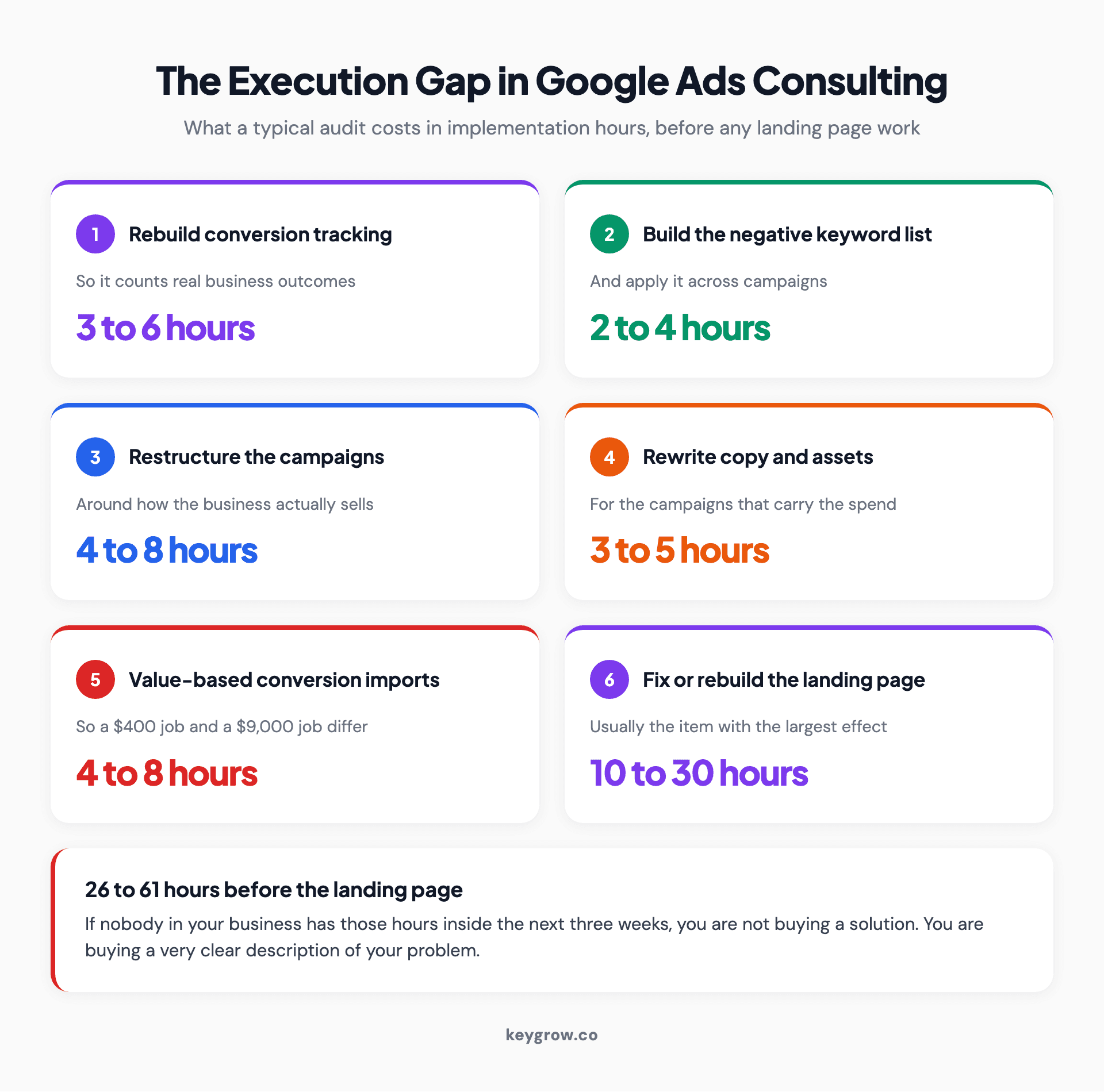
A stacked list of six common audit findings with implementation hours beside each, totalling 26 to 61 hours before any landing page work.
Four situations where consulting is clearly the right buy
You have an in-house marketer. Somebody competent runs the account but has never run a hundred of them. They can execute anything, they just do not know which thing to execute first. A monthly advisory call is the highest value marketing spend in that business and it costs a fraction of a retainer.
You already have an agency and something feels off. Numbers look fine in the report and the phone is quiet. An independent audit, from someone with no interest in taking over the account, settles it in a week. Ask up front whether the consultant will pitch for the management work, because if they will, the audit is a sales document.
You are deciding whether to run Google Ads at all. Nobody wants to be paid to say no, which is why this question is so badly served. A few hours of paid time to model the auction in your market, the realistic cost per lead and what a customer is worth to you is far cheaper than finding out over a six-month test.
A specific thing is broken. Tracking that never worked properly. A Shopping feed rejecting half the catalog. A Performance Max campaign that eats budget and reports conversions your CRM has never seen. These are project problems, and project pricing beats a retainer for them every time.
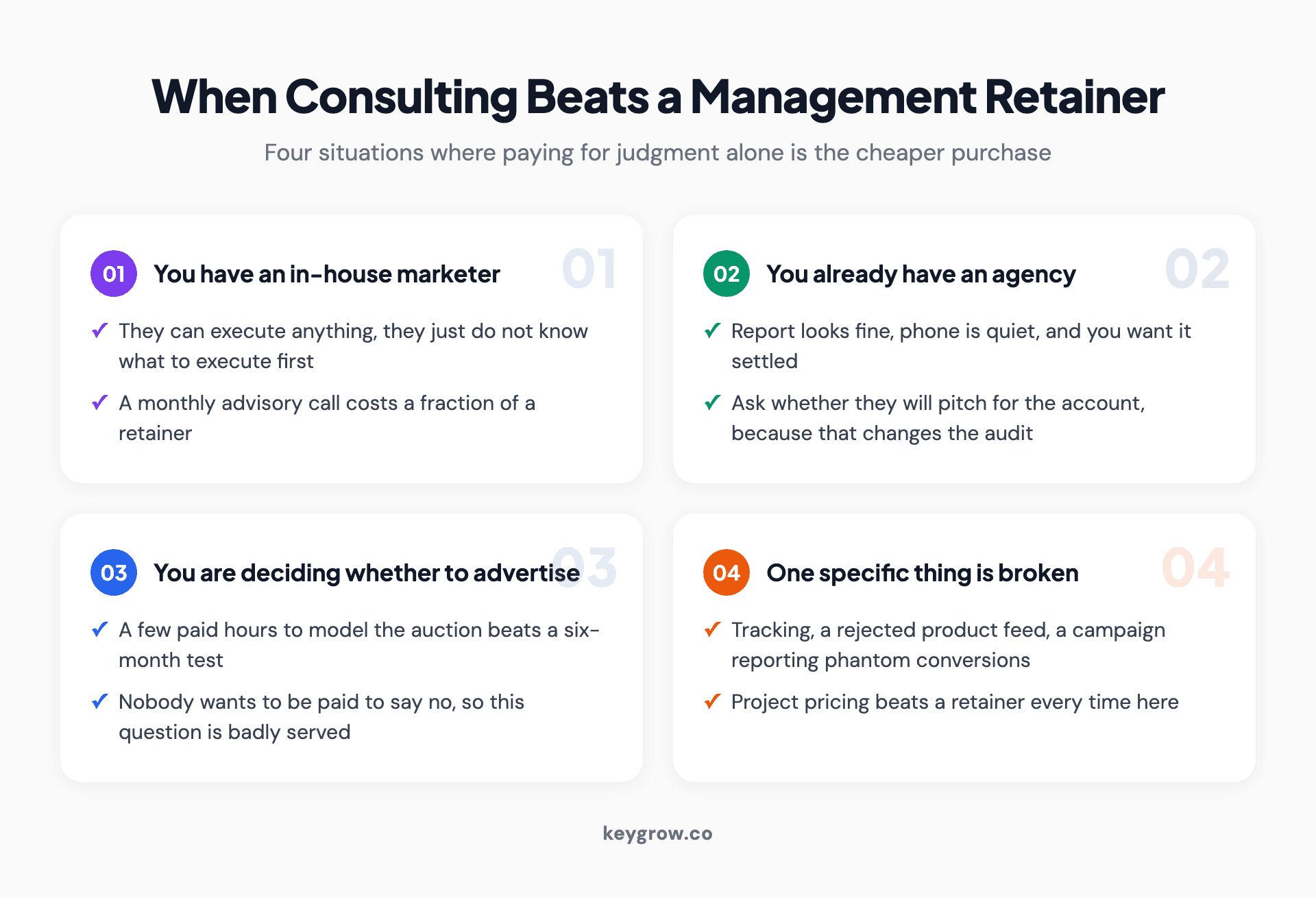
Four cards naming the situations where Google Ads consulting beats a management retainer: an in-house marketer, a second opinion on an existing agency, a go or no-go decision, and one specific broken thing.
When you should not buy consulting
An agency that will not tell you who is a bad fit is selling, not consulting, so here is our list.
Your account is too new to diagnose. Under a few hundred clicks and a couple of dozen conversions there is nothing to read. An audit of a three-week-old account is opinion dressed as analysis. Run it for a quarter first.
Your spend is small and your time is not. Below roughly $1,500 a month, the money is better spent on a one-time setup done properly and on your own attention. The same trade sits behind our note on the opportunity cost of PPC: hire help when the value of your own hours beats the fee, not before.
You already know what is wrong. People often do. If you can name the three things you have been avoiding, you do not need a consultant to name them back to you at $300 an hour. Buy the implementation.
Nobody will own the outcome. If the plan lands on a team that did not ask for it, in a business where nobody has authority to change the website, the engagement is already over. This is the most common quiet failure and it has nothing to do with the quality of the advice.

Five people around a table in discussion during a working session.
What a real audit looks like, and what a bad one looks like
The bad version is easy to produce and easy to spot once you know the pattern.
The 60-point checklist. Every account fails a long enough checklist. Volume of findings is not evidence of insight; ranked findings are. If nothing is marked as most important, nobody made a judgment call.
Google's recommendations, reprinted. Some audits are the Recommendations tab with a cover page. Worth knowing what that tab measures: optimization score is described by Google as an estimate of how well your account is set to perform, calculated from your statistics and settings together with the impact of available recommendations and your recent recommendations history. Applying a recommendation moves it. So does dismissing one. It is a measure of how settled your account is against Google's current suggestion list, which is useful information and is not a strategy.
No mention of the landing page or the offer. Most accounts that are losing money are losing it after the click. An audit that stays inside the ads interface has looked at half the problem.
No implementation estimates. Findings without hours attached are not prioritized, whatever the document says. Impact divided by effort is the ranking that matters.
No named person and no session. A report generated by a tool, emailed, with no call, is a product. It can still be worth $200. It is not worth $1,500.
Our own walkthrough of how to run a PPC audit covers what should be in the document if you would rather do the first pass yourself.
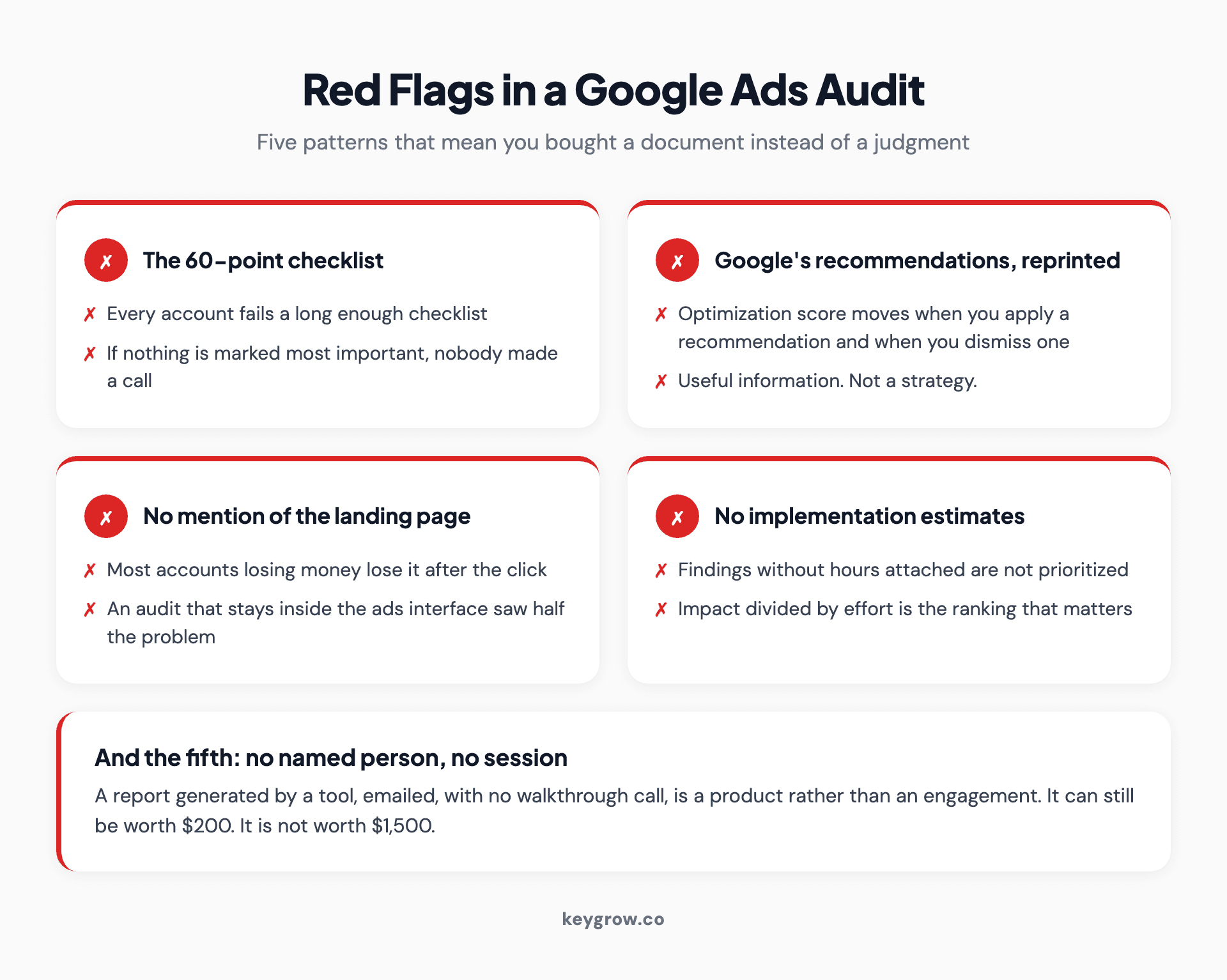
Five red flag cards describing a weak Google Ads audit: a 60-point checklist, Google's own recommendations reprinted, no landing page review, no implementation estimates, and no walkthrough call.
Brief the consultant properly and you get judgment instead of a checklist
You control the quality of the output more than you think. Most weak audits are weak because the brief was "have a look at our account."
Give them four things before they start:
- What a customer is worth. Average order value or lifetime value, and your close rate from lead to sale. Without this, every recommendation is guesswork about what a good cost per lead would be.
- What you cannot change. No new landing pages this quarter. Legal has to approve every headline. You cannot take work outside three counties. Constraints make advice usable.
- The one number that has to move. Cost per booked job, qualified leads per week, revenue from paid. Naming it forces prioritization.
- Read-only access, up front. Google Ads, GA4, and the search terms report at minimum. A consultant quoting without account access is quoting on assumptions.
Then ask for the deliverable to include the implementation hours. That single request changes what gets written. It is also worth having them show you the account's location targeting settings on the call, since that is where wasted local spend usually hides.
An eviction law firm we worked with shows why the diagnosis and the hands both have to exist. They were running ads to a landing page that already existed and getting one conversion a week from 22 clicks, at $240 each. The diagnosis was not complicated: visitors arrived and could not tell what to do next. But the diagnosis alone would have changed nothing. Rebuilding the page around a single action and restructuring the campaigns took it to 21 conversions from 189 clicks at $31.79 within a week. Somebody had to actually do that.
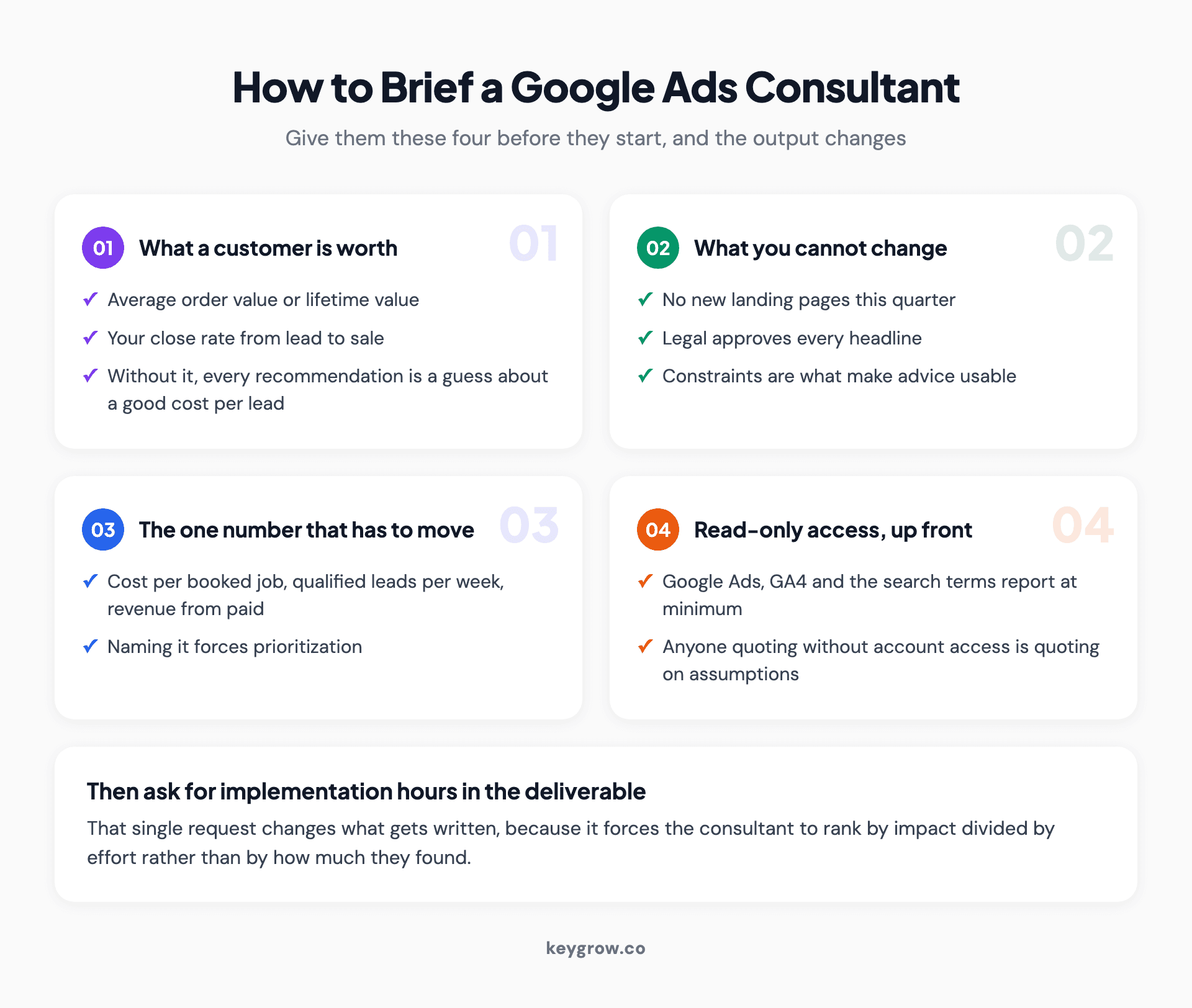
Four numbered cards showing what to give a Google Ads consultant before they start: customer value, fixed constraints, the one number that has to move, and read-only account access.
FAQs
What does a Google Ads consultant do?
A Google Ads consultant reviews your account, diagnoses what is limiting performance, and tells you what to change and in what order. The work usually arrives as a written audit or strategy document plus a walkthrough call, and sometimes as a recurring advisory session. Unlike a management service, a consultant generally does not make the day-to-day changes in the account, so somebody on your side has to implement the plan.
How much does Google Ads consulting cost?
Market rates run roughly $150 to $400 an hour, $500 to $2,000 for an account audit, $1,000 to $3,000 for a strategy document, and $1,500 to $4,000 a month for ongoing advisory of four to eight hours. Project work such as an account rebuild commonly starts around $2,000. These are one-time or hourly costs, which is what makes them cheaper than a retainer when you have someone able to implement.
Is a Google Ads consultant better than an agency?
Neither is better in general, they solve different shortages. Buy consulting when you have someone who can execute but not diagnose, which describes most businesses with an in-house marketer. Buy management when nobody in the business has the hours to make the changes. The failure mode of consulting is an unimplemented plan, and the failure mode of management is not being able to tell whether work is happening.
Can a consultant work alongside my existing agency?
Yes, and it is one of the most useful ways to buy consulting. An independent audit from someone who will not be pitching for the account gives you a second opinion on whether the work is sound. Ask directly whether they intend to bid for the management contract, because a consultant who does has an incentive to find the account broken.
What access does a Google Ads consultant need?
Read-only access to the Google Ads account and the GA4 property covers most of an audit, plus the search terms report and, for ecommerce, the Merchant Center account. Keep ownership of the account in your own name and grant access through their manager account rather than transferring anything. Anyone quoting a detailed plan without ever seeing the account is quoting on assumptions.
How long does a Google Ads consulting engagement take?
An audit is normally delivered in one to two weeks, a strategy document in two to three, and project work such as a tracking rebuild in two to six weeks depending on the site. Implementation is the longer half: a typical audit produces 26 to 61 hours of work before any landing page changes, so plan for a quarter between receiving the plan and judging the result.
Should I hire a consultant for a brand new Google Ads account?
Usually not for an audit, since there is no performance history to read, but often yes for a strategy session or a paid setup. The valuable version at that stage is someone modeling whether the auction in your market is affordable given what a customer is worth to you, before you have spent anything. That is a few hours of work and it occasionally ends with advice not to run ads at all.
If you only take one thing from this
Consulting is not a cheaper agency. It is a different purchase, and it only works when the hands exist on your side of the table.
So do the boring version of the maths before you buy. Count the hours the plan will need, look at who in your business genuinely has them in the next three weeks, and be honest about the answer. If the hours are there, buy the diagnosis and keep your money. If they are not, buy management and stop pretending otherwise, or scope the implementation into the project so the plan arrives with somebody attached to it.
We do both, and we will tell you which one your situation calls for before you buy anything. Our PPC management runs month to month with no lock-in, and if the answer is that you need an audit and nothing else, we would rather say so. There is a fuller framework for vetting either kind of provider in how to choose a PPC agency.