


To implement schema markup for AEO, you add JSON-LD structured data to your key pages, usually Organization, Article, and FAQPage, and you make every field match what a visitor can actually see. Schema confirms structure rather than creating it, so get the page structure for AEO right first. If you are weighing FAQ markup specifically, how FAQs help with AEO covers what changed after Google removed the FAQ rich result. Google recommends JSON-LD for exactly this, and once you know which types to use, the setup takes an afternoon.
The part most guides skip is what schema does and does not do. Structured data is how you make your content legible to answer engines, not a lever that forces them to cite you. Get that distinction right and you spend your time where it pays off, on clear answers and clean markup, instead of chasing a citation boost the data says is not there.
What schema markup actually does for answer engines
Schema markup gives answer engines a machine-readable summary of your page: what it is, who published it, and how its facts relate. It removes guesswork, so an engine parsing your content is more confident about what it is looking at.
That is the honest ceiling of it. Schema helps an engine understand and trust structured facts. It does not, on its own, make you the answer. When Ahrefs tracked 1,885 pages that added JSON-LD between August 2025 and March 2026 and compared them against 4,000 similar control pages, the citation changes were tiny: plus 2.4 percent in Google's AI Mode, plus 2.2 percent in ChatGPT, both statistically indistinguishable from zero, and minus 4.6 percent in AI Overviews. An earlier pass across 6 million URLs found cited pages were almost three times more likely to have JSON-LD, but that gap comes from the kind of sites that add schema, not from the schema itself. Well-run sites do many things right at once.
So the reason to implement schema for AEO is not a citation cheat code. It is entity clarity and eligibility. You make your identity and your facts unambiguous, and you stay eligible for the structured features that still exist. The content still has to earn the citation, in AI Overviews and everywhere else.
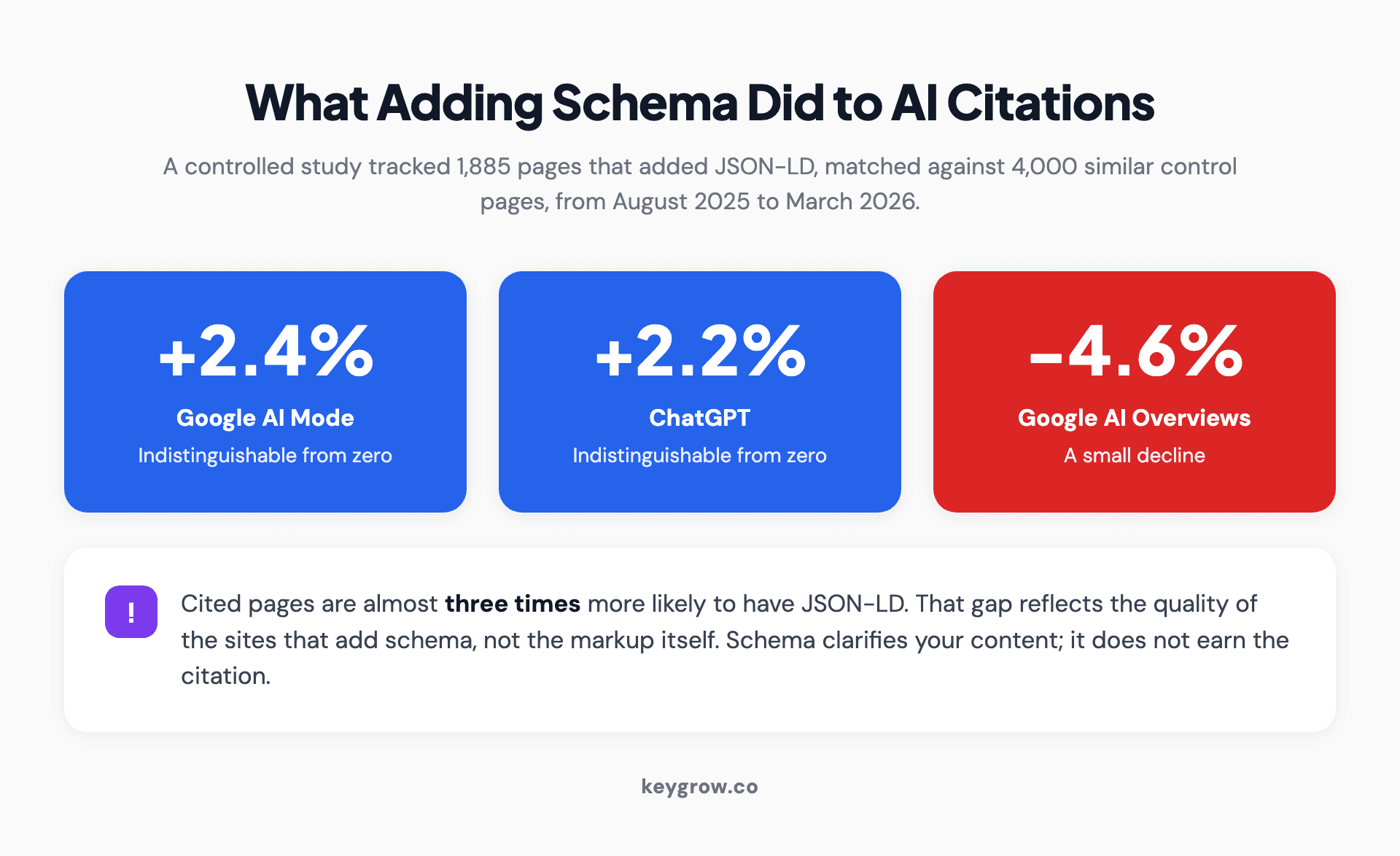
Stat strip showing the Ahrefs 2026 controlled result: adding schema changed AI citations by plus 2.4 percent in AI Mode, plus 2.2 percent in ChatGPT, and minus 4.6 percent in AI Overviews, with a note that the 3x correlation reflects site quality, not the markup.
The schema types worth your time
Most pages need three or four schema types, not a dozen. Adding markup you do not need is not the same as adding value, and types that do not match your page dilute the clarity you are trying to create.
Start with the types that map to what your page genuinely is.
| Schema type | What it tells an engine | Where to use it |
|---|---|---|
| Organization | Who publishes this and how to verify the brand | Once, site-wide (home or a global include) |
| Article / BlogPosting | This is editorial content, by this author, on this date | Every blog post and guide |
| FAQPage | These exact questions have these exact answers | Pages with a real question-and-answer section |
| Product / Offer | This item, its price, availability, and rating | Ecommerce and product pages |
| LocalBusiness | Name, address, phone, hours, service area | Local and service-business sites |
| BreadcrumbList | Where this page sits in the site structure | Any page with a breadcrumb trail |
The first three cover most editorial and answer-focused sites. If you sell products or serve a local area, add Product or LocalBusiness. Leave the rest until you have a page that actually is the thing the schema describes. There is no prize for the longest markup.
What a working setup looks like
A solid AEO schema setup is a small stack of JSON-LD, not one giant block. On a typical post you run three objects that reference each other so an engine reads them as one connected entity.
Those three are an Organization object that establishes the publisher, an Article object for the post itself, and a FAQPage object when the post answers discrete questions. Each sits in its own script tag in the page head, and linking them by a shared identity is what turns three loose facts into one clear picture of who wrote what.

A screen of code representing JSON-LD structured data added to a web page so answer engines can read it.
You do not have to hand-write any of it. A generator like our schema markup generator outputs valid JSON-LD you paste into the head, and most modern platforms inject Article and Organization markup for you. The KeyGrow blog you are reading builds its BlogPosting and FAQPage markup automatically from the post content, so the visible page and the structured data cannot drift apart.
Whatever you use, get these properties right, because they are the ones engines lean on:
- Organization: name, url, logo, and a sameAs array of links to your verified profiles. The sameAs array is how you connect your brand to its known identities elsewhere.
- Article: headline, an author with a real name, a datePublished date, and an image that actually appears on the page.
- FAQPage: each question paired with the exact answer shown on the page, with nothing invented purely for the markup.
Implement it in four moves
Once you know the types, implementation is short. Four moves take you from nothing to validated markup that answer engines and search engines can both use.
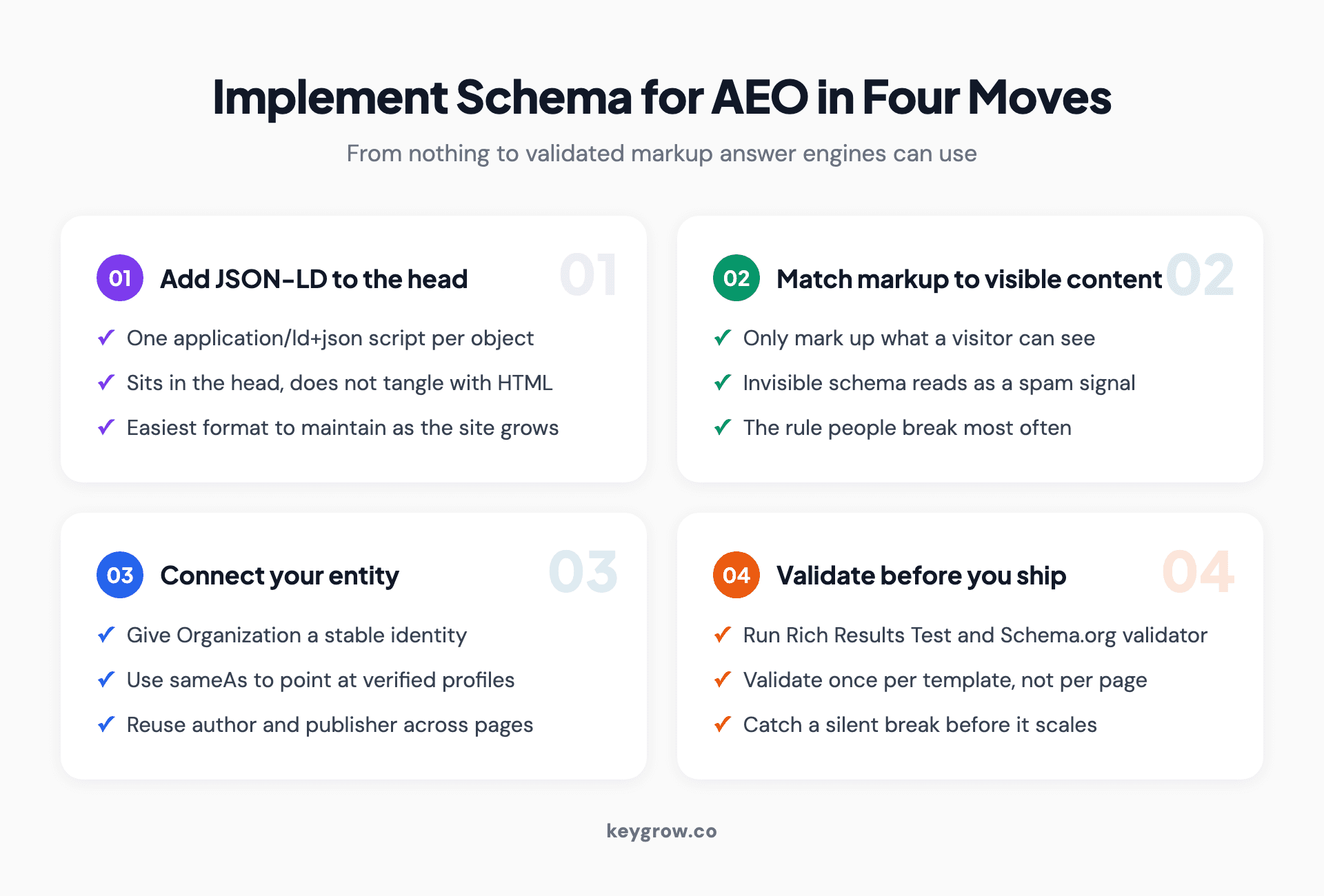
Four-step process for implementing schema markup for AEO: add JSON-LD to the page head, match the markup to visible content, connect your entity with sameAs, and validate each template before shipping.
Work through them in order.
- 1. Add the JSON-LD to the page head. Put each schema object in its own script tag of type application/ld+json. JSON-LD is the preferred format because it sits in the head and does not tangle with your HTML, which makes it the easiest to maintain as your site grows.
- 2. Match the markup to visible content. This is the rule people break most. Google is explicit about this: do not add structured data about information that is not visible to the user, even if the information is accurate. Invisible schema is not a shortcut, it reads as a spam signal.
- 3. Connect your entity. Give your Organization a stable identity and use sameAs to point at the profiles that confirm it. Reuse the same author and publisher details across pages so engines resolve one consistent brand, not a new one on every post.
- 4. Validate before you ship. Run every template through Google's Rich Results Test and the Schema.org validator. Validate once per template rather than once per page, and you catch a silent break before it scales across a thousand URLs.
The schema myths AEO guides keep repeating
A lot of AEO advice is recycled from the rich-results era and quietly out of date. Three myths in particular waste people's time.
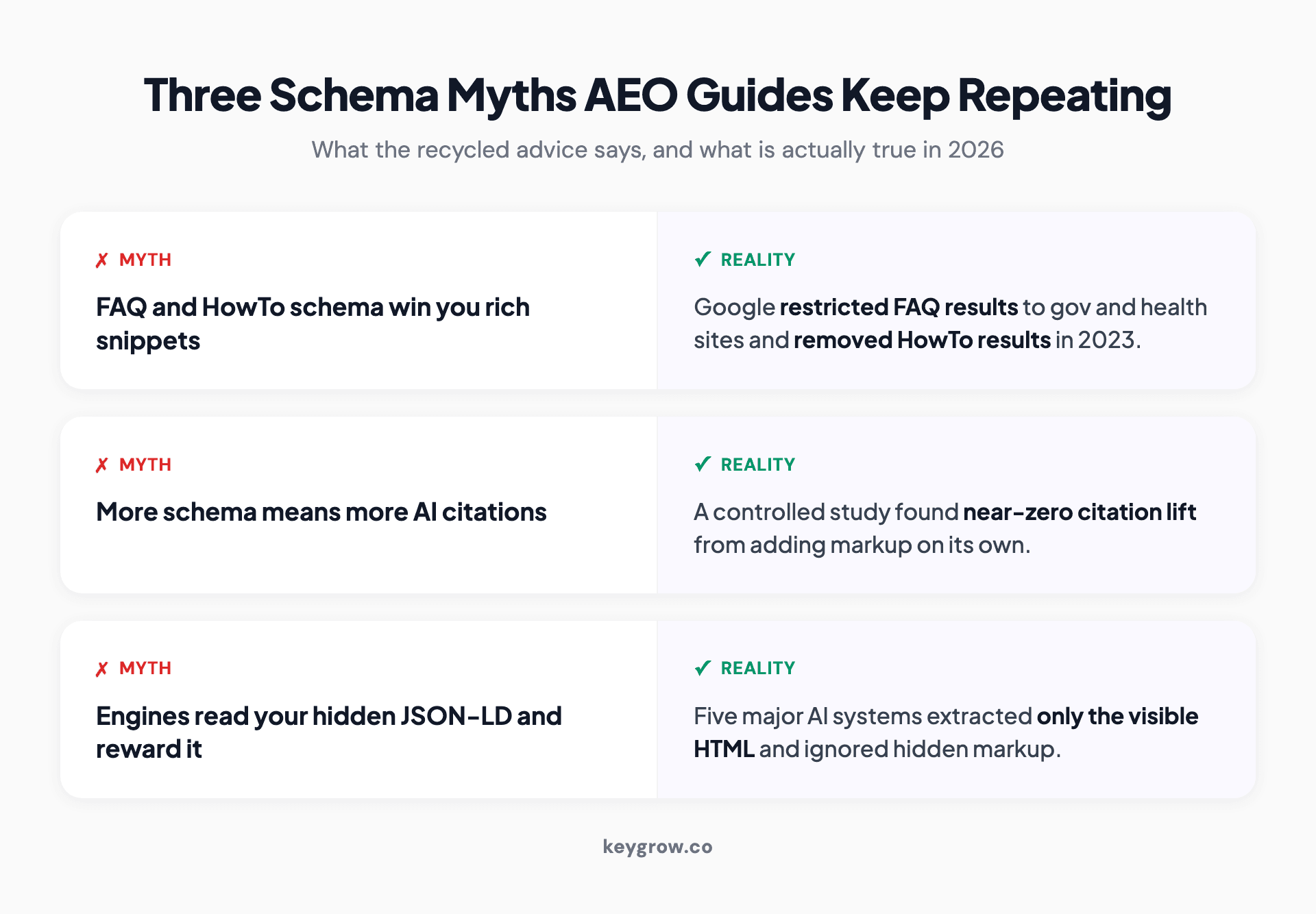
Three schema myths for AEO and the reality behind each: FAQ and HowTo schema no longer earn rich snippets, more schema does not mean more AI citations, and engines extract visible HTML rather than hidden markup.
Myth: FAQ and HowTo schema win you rich snippets. Not anymore. Google restricted FAQ rich results to well-known, authoritative government and health websites in September 2023, and removed HowTo rich results in the same period. If a 2026 guide still sells FAQPage schema as a rich-snippet play, it is describing a feature Google switched off years ago. FAQPage markup can still help answer engines parse a clean set of questions, which is why we keep using it, just not for the reason those guides give. It is worth knowing what still earns rich results today before you invest in any of it.
Myth: more schema means more AI citations. The controlled data says no. Adding markup barely moved citations in the Ahrefs test above, and stacking extra types on a page does not compound. What compounds is the underlying signal, whether your page is genuinely the clearest, most trustworthy answer. Schema describes that signal; it does not manufacture it. Our own AI search playbook covers what actually moves the needle.
Myth: engines read your hidden JSON-LD and reward it. Often they do not. When researchers fed pages to five major AI systems, the systems extracted only the visible HTML and ignored hidden JSON-LD, Microdata, and RDFa. Schema still feeds the traditional index that AI Overviews and AI Mode draw on, so it keeps its place, but this is a hard argument for putting your real answer in visible text, not tucked inside the markup.
How to tell it is working
You will not see a citation spike from schema, so do not measure it that way. Measure the two things schema actually affects: whether your markup is valid, and whether the search features that still exist are showing.
- Check validity in Google's Rich Results Test and Search Console. If a template throws errors, fix the template, not the page.
- Watch Search Console's enhancement reports for the result types that survive, such as Product, Review, and Breadcrumb. Those still drive visible search features.
- Track your presence in AI answers separately, by running the prompts your customers would ask and noting whether you appear. That movement comes from content and authority, with schema in a supporting role.
If your markup validates and your entity stays consistent, schema is doing its job. Judging it by AI citations will only tell you what the study already showed: on its own, it barely moves them.
When schema markup is not your problem
For a lot of sites, structured data is not the bottleneck, and treating it as one is a way to feel productive while avoiding the real work.
If you run a single-location business and you are choosing between a week on schema and a week on answering your customers' actual questions in plain writing, write the answers. Schema on a thin page just describes thin content precisely. The DIY version of the basics is genuinely doable: claim and complete your business profile, add Organization and LocalBusiness markup once with a generator, mark up your posts as Articles, and validate the templates. That covers the entity and eligibility basics for most small sites in an afternoon.
Pay for help when you have real scale, hundreds of pages or templated markup across a large site, where one silent schema error can quietly break a thousand URLs at once. And if an agency is quoting AEO as a brand-new service whose main deliverable is basic structured data you could generate for free, ask what is genuinely new about it.
FAQs
What is schema markup for AEO?
Schema markup for AEO is structured data, usually written in JSON-LD, that describes your page to answer engines in a machine-readable way. It labels what the page is, who published it, and how its facts connect, so AI systems and search engines can understand and trust your content more easily. It supports answer engine optimization, but it does not replace clear, well-written content.
Which schema types matter most for AEO?
For most sites, Organization, Article or BlogPosting, and FAQPage cover the essentials. Ecommerce pages should add Product, and local or service businesses should add LocalBusiness. These map directly to what the page is, which is the point. Adding schema types that do not match your page adds clutter, not clarity.
Does schema markup increase AI citations?
On its own, barely. A controlled 2026 study that tracked pages adding JSON-LD found citation changes close to zero across AI Overviews, AI Mode, and ChatGPT. Pages with schema do get cited more often, but that is because well-run sites tend to add schema and also do everything else right. Schema helps engines understand you, and the content earns the citation.
Is JSON-LD better than microdata for AEO?
For most people, yes. Google treats JSON-LD, microdata, and RDFa as equally valid, but recommends JSON-LD because it lives in the page head, is easy to maintain, and does not tangle with your HTML. It is the simplest format to scale across templates without breaking your layout.
Do FAQ and HowTo schema still get rich results?
No, not for most sites. Google restricted FAQ rich results to authoritative government and health sites in September 2023 and removed HowTo rich results in the same period. FAQ markup can still help answer engines parse your questions, so it is worth keeping on genuine question-and-answer pages, just not as a rich-snippet strategy.
Can I add schema markup myself without a developer?
Usually yes. A schema generator produces valid JSON-LD you paste into your page head, and many content platforms add Article and Organization markup automatically. The two rules that keep you safe are to match every property to visible content and to validate each template before publishing. Large sites with templated markup are where professional help pays off.
Where this leaves you
Schema markup for AEO is worth doing, and it is smaller than most guides make it sound. Add JSON-LD for the three or four types that match your page, keep every field honest to what visitors see, connect your entity, and validate. Then stop, because the next hour is better spent making the page itself the clearest answer to the question you want to win.
If you would rather have the whole answer-engine setup handled, the structured data, the entity clarity, and the content that actually gets cited, our AEO team builds it as one system, month-to-month. Schema is the easy part. Being the best answer on the page is the work.