


FAQs still help with AEO, just not the way they used to. Answer Engine Optimization is the work of getting cited by AI answer engines like Google's AI Overviews, ChatGPT, and Perplexity, and those engines love content shaped as a clear question with a clear answer under it. That is exactly what a good FAQ is. So even though Google removed the FAQ rich result from search entirely in May 2026, a well-built FAQ section is arguably more useful now than it was when it earned you a dropdown in the results.
The confusion is understandable. For years the whole point of an FAQ was the visible SERP feature. That feature is gone. What replaced its value is a different kind of visibility, in the answers machines write, and FAQs feed that beautifully.
First, what actually changed
The FAQ rich result died in two steps, and knowing both keeps you from acting on outdated advice.
In August 2023, Google restricted FAQ rich results to authoritative government and health sites, a response to how badly the markup had been abused by everyone slapping fake questions on every page. Most articles you will find still stop there. They are out of date.
The second step is the one that matters. According to Google Search Central, FAQ rich results were removed for all sites starting May 7, 2026, with reporting and testing-tool support following. The visible FAQ dropdown is now gone for everyone, government and health included. Google has confirmed the markup can stay on your pages without causing problems; it simply produces no visible result anymore. So the reason to build FAQs is no longer the rich result. It is everything downstream of it.
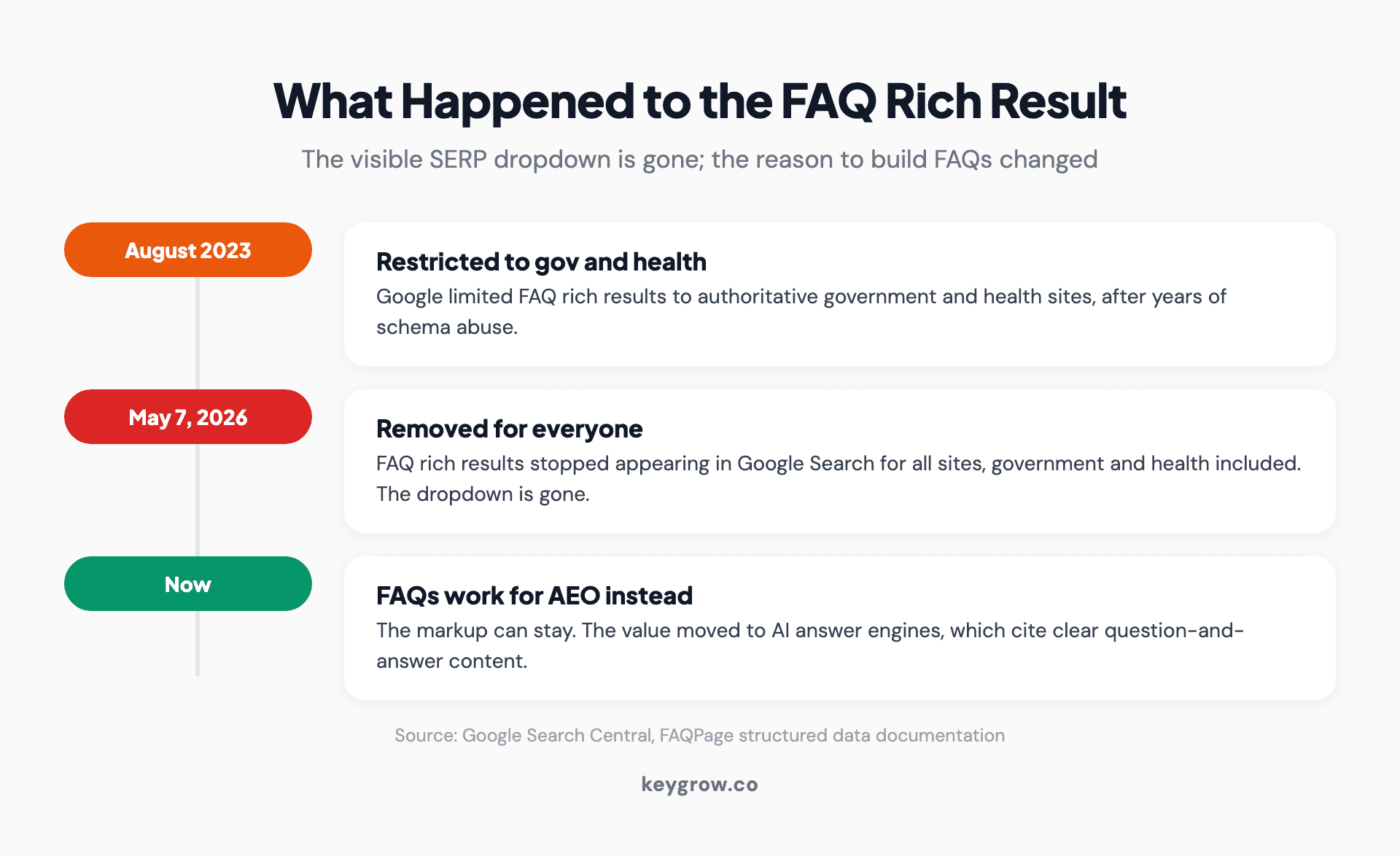
Timeline of the FAQ rich result: restricted to government and health sites in August 2023, removed for all sites in May 2026, and now valuable for AEO instead.
So why bother with FAQs at all now
Because the question changed from "how do I rank" to "how do I become the source the answer is built from." ChatGPT cites only about 15 percent of the pages it retrieves, and roughly 44 percent of AI citations come from the first third of a page. Content that answers a specific question, immediately and in full, is what gets pulled into that small cited slice. Ranking-era habits, burying the answer and padding for word count, actively work against you now.
FAQs fit the pattern almost too well. An AI prompt is usually a question. An FAQ is a question with a self-contained answer. When a model is assembling a response, a page that already phrased the query and answered it in two clean sentences is easy to lift. The correlational data backs this up, even if you should read it with a skeptic's eye. AirOps research found FAQ schema on about 10.5 percent of AI-cited pages versus 5.4 percent of uncited ones, and pages whose headings matched the user's actual question earned a 41 percent citation rate against 29 percent for weak matches. Those are vendor numbers from one dataset, not laws of physics, but the direction is consistent with everything else we see: match the question, answer it first, get cited more.
What a good AEO FAQ actually looks like
The format does the work, not the label. A section titled "FAQ" full of vague marketing answers helps nothing. A few rules separate a citable FAQ from filler.
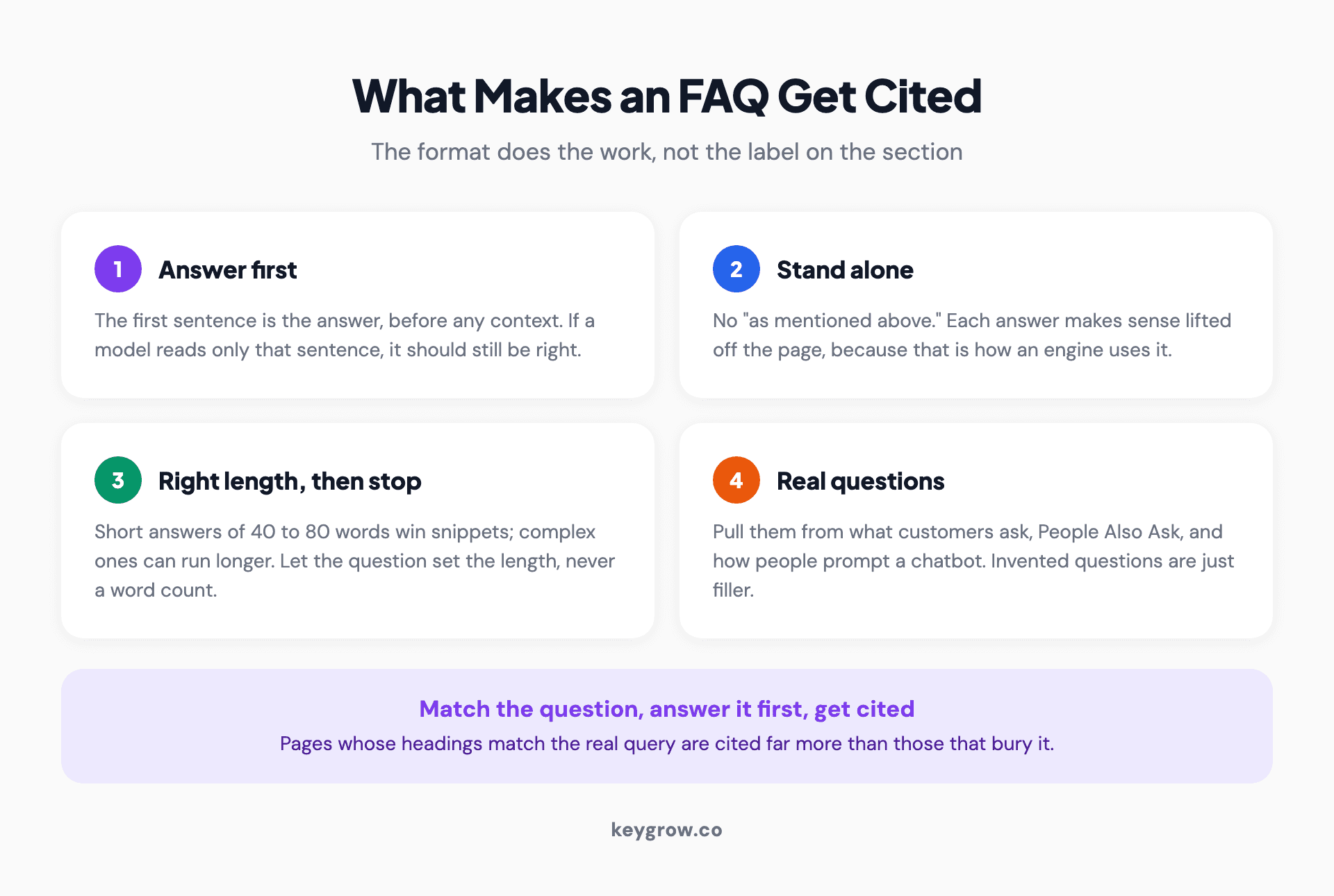
Four rules for an FAQ that gets cited by answer engines: answer first, make each answer stand alone, use the right length then stop, and pull from real questions.
Answer first. The first sentence under the question is the answer, stated plainly, before any context. If a model reads only that sentence, it should still be right.
Make each answer stand alone. Do not write "as mentioned above" or lean on the paragraph before it. Every answer should make sense lifted out of the page completely, because that is exactly how an answer engine will use it.
Keep it tight, then stop. There is a genuine debate about ideal length. Some analyses point to short 40-to-80-word answers winning snippet-style citations; others argue longer 130-to-160-word answers get pulled more often for complex questions. The honest read is that length follows the question. A yes-or-no gets a crisp answer; a "how does X work" earns a few more sentences. Padding a simple answer to hit a word count is the old game, and it loses the new one.
Real questions matter more than clever ones. Pull them from what customers actually ask you, from the People Also Ask box, and from how people phrase things to a chatbot. Invent questions nobody asks and you have written filler with a question mark on it.
Does the schema still matter?
Here is where we will be honest rather than sell you certainty. FAQPage schema is now cheap insurance with an unclear upside.
The case for keeping it: structured markup makes your Q&A explicitly machine-readable, and Microsoft has said schema helps its language models understand content. The case against overrating it: a December 2024 analysis found no measurable correlation between schema coverage and AI citation rates. Both can be true. The likeliest explanation is that the visible, well-written Q&A text does the load-bearing work, and the schema is a low-cost label on top that may or may not help a given engine.
So mark up your FAQs, because it is nearly free and cannot hurt, but do not expect the markup alone to earn citations. If you want the mechanics of doing it right, our guide on schema markup for AEO covers the setup, and our schema markup generator will build valid FAQPage JSON-LD for you. The words are what get cited. The schema just helps a machine be sure of what it is reading.
FAQs do not belong only on an FAQ page
The old instinct was to dump every question onto a single FAQ page. For AEO, that is backwards. Put questions where they are relevant: a few on each service page, a couple on a product page, a targeted set at the bottom of a blog post. A question about pricing belongs on the pricing page, near the answer, where both a reader and a model expect to find it.

A person typing a question into a smartphone, the kind of conversational query an answer engine pulls FAQ answers to satisfy.
This is also how you catch conversational, long-tail queries that a keyword-stuffed body never will. Someone asking a chatbot "how much does it cost to fix a slab leak in Phoenix" is speaking in a full question. A service page that has literally asked and answered that question is the page that gets quoted.
When an FAQ is just filler
Not every page needs one, and pretending otherwise is how the format got abused into a rich-result ban in the first place. Skip the FAQ when you are only restating the page in question form, when the "questions" are things no real person asks, or when you are padding a thin page instead of fixing it. An FAQ earns its place when there are genuine recurring questions the page does not otherwise answer. If you cannot name five things customers actually ask, you do not need the section, and a single-location business can absolutely write its own FAQs without hiring anyone. The bar is usefulness, not word count.
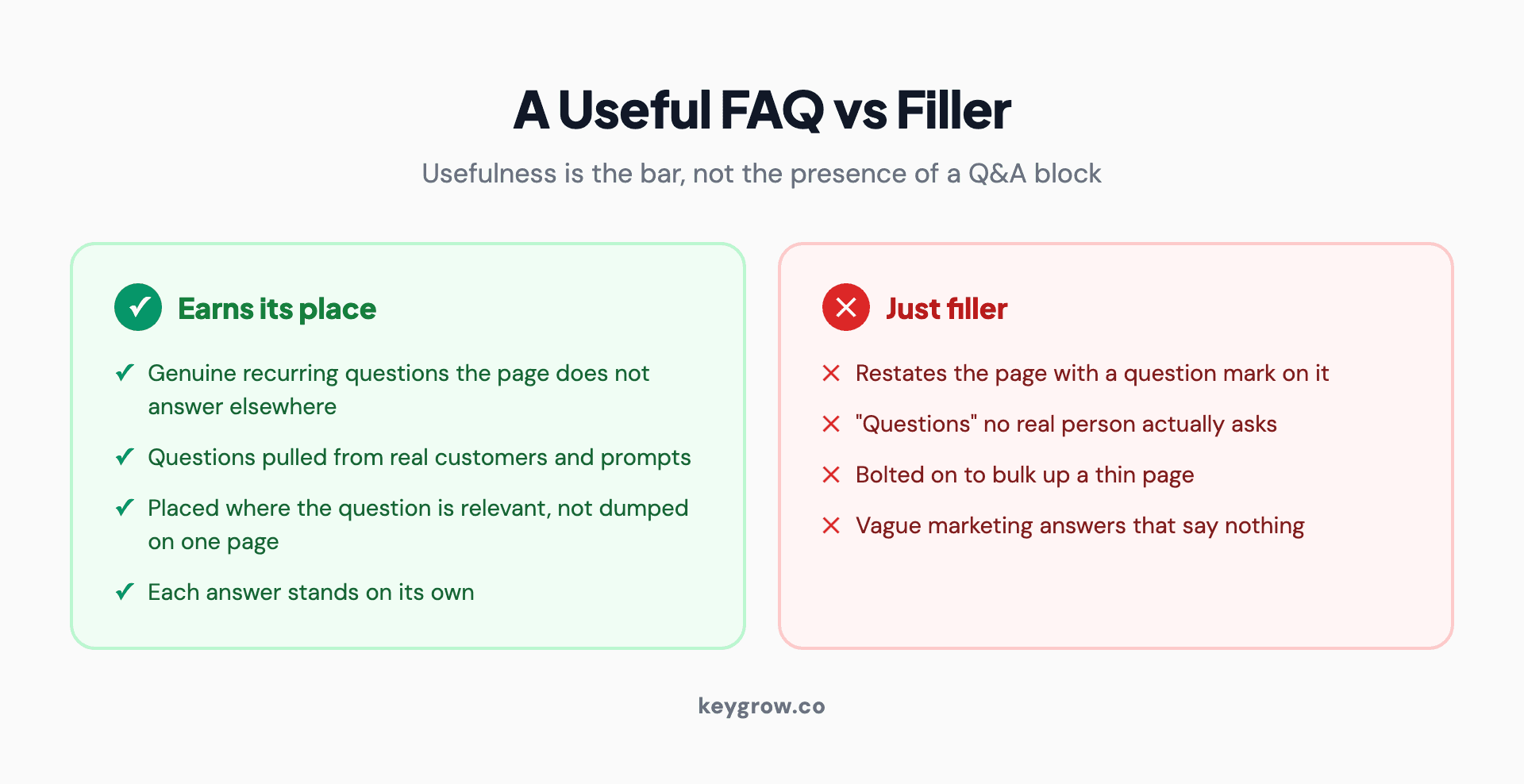
Two-column comparison of an FAQ that earns its place versus one that is just filler, with usefulness as the bar rather than the presence of a question block.
FAQs
Do FAQs still help SEO now that Google removed FAQ rich results?
They no longer earn the visible FAQ dropdown, which Google removed for all sites in May 2026. They still help by making a page answer real questions clearly, which supports AI citations, voice results, and plain readability. The visible feature is gone, but the reason FAQs work for answer engines is not.
Does FAQ schema still work after Google's changes?
FAQPage schema no longer produces a rich result in Google Search. It remains valid markup and can stay on your pages without causing problems, and it may help AI systems read your Q&A content, though the evidence for a citation boost from schema alone is mixed. Treat it as cheap insurance layered on well-written answers, not as a standalone tactic.
How does FAQ content help AI search citations?
Answer engines assemble responses by pulling clear, self-contained answers to specific questions. An FAQ that phrases the real query and answers it in the first sentence is easy for a model to lift and cite. Content that matches the question and answers it first tends to get cited noticeably more often than content that buries the answer.
How long should an FAQ answer be for AEO?
Long enough to answer completely, then stop. Short answers of roughly 40 to 80 words tend to win snippet-style citations, while more complex questions can justify 130 to 160 words. Let the question decide the length rather than padding to a target, since padding is exactly what the new answer engines penalize.
Should every page have an FAQ section?
No. An FAQ earns its place when a page has genuine recurring questions it does not otherwise answer. If your questions are ones no real person asks, or you are using them to bulk up a thin page, skip the section and improve the page instead. Usefulness is the bar, not the presence of a Q&A block.
Our take
The FAQ rich result is gone, and good riddance to the abuse that killed it. What survives is the honest version of the format: a real question, answered first, standing on its own. That is what answer engines cite, and it is what a rushed reader wants too. Build FAQs where customers actually have questions, mark them up because it is cheap, and judge every answer by whether it would be right if a machine quoted only its first sentence.
If you are trying to figure out where you stand in AI answers and whether your content is built to be cited, that is the core of what our AEO service does, and our guide on what AEO costs is a fair place to start. Tell us what you are working on through the get started page.