


To structure a page for AEO, lead every section with a direct 40-to-60-word answer, write headings as the exact questions people ask, and break the body into short self-contained chunks that make sense lifted out on their own. Answer engines do not read your page top to bottom and reward the best essay. They retrieve the single passage that best answers a query and quote it. Structure is what decides whether that passage is yours.
That is the whole idea, and most guides stop there. The part they skip is why self-contained chunks win, which is the thing that tells you how to write every other element on the page.
Why structure decides whether you get cited
Answer engines pull passages, not pages. They break content into chunks, match a chunk to the query, and cite the one that answers it cleanly, so the unit you are really optimizing is the passage, not the article.
This is a real shift from classic SEO, where a long, deep page could rank on the strength of the whole. Now more of your traffic never becomes a click at all. In the US, SparkToro measured zero-click Google searches at 68 percent in early 2026, up from about 60 percent two years earlier. When the answer is delivered on the results page or inside a chatbot, being the quoted source is the visibility. And when an AI summary does appear, Pew Research found people click a traditional link only 8 percent of the time, versus 15 percent without one. A page that buries its answer in paragraph six is invisible to that process even if every fact in it is correct.
Answer-first structure is not a style preference, it is close to non-negotiable. Roughly 44 percent of AI citations come from the first third of a page, so where you put the answer changes whether you get pulled at all.
The anatomy of a citable chunk
A citable chunk answers one question completely, names its own subject, and needs no other part of the page to make sense. If a passage only works because of the sentence above it, an engine cannot quote it cleanly.
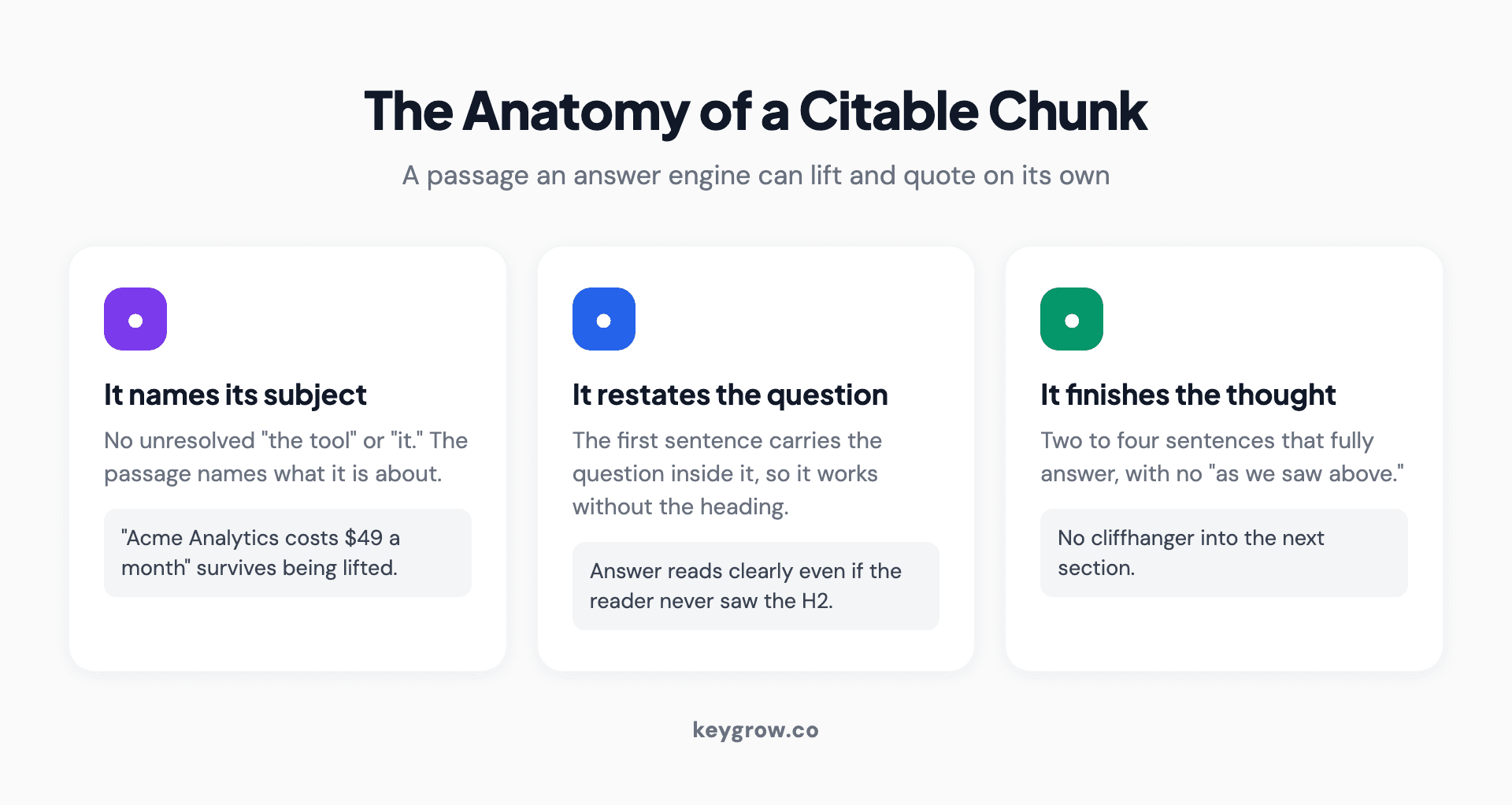
The anatomy of a citable chunk for AEO: it names its own subject, restates the question it answers, and delivers a complete answer in two to four sentences.
Three things make a chunk self-contained:
- It names its subject. "The tool costs $49 a month" fails out of context because "the tool" is unresolved. "Acme Analytics costs $49 a month" survives being lifted.
- It restates the question. The answer works even if the reader never saw the heading, because the first sentence carries the question inside it.
- It finishes the thought. Two to four sentences that fully answer, with no "as we saw above" and no cliffhanger into the next section.
Write every paragraph as if it might be the only sentence of yours a machine ever quotes. Because it might be.
The page skeleton that works
Use a fixed skeleton: H1 with the entity and query, a short summary block, question-form H2s each opening with a direct answer, supporting lists or tables, an FAQ, and a schema layer underneath.
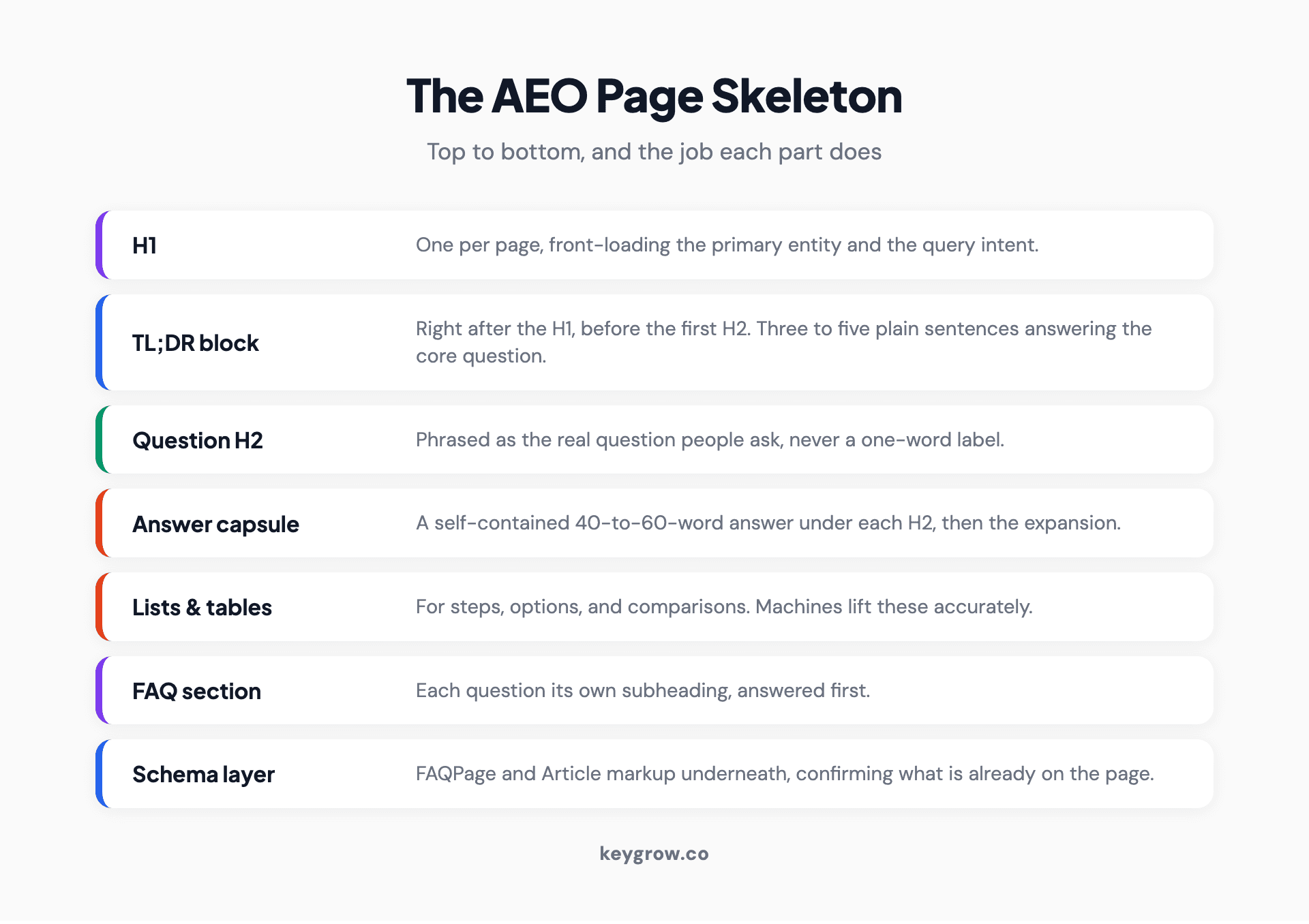
An annotated AEO page skeleton: H1 with the primary entity, a TL;DR summary block, question H2s each followed by a 45-word answer capsule, supporting lists and tables, an FAQ section, and a structured-data layer.
Top to bottom, the parts and what each one does:
- One H1 that front-loads the primary entity and the query intent. One H1 per page, always.
- A TL;DR or key-takeaways block right after the H1, before the first H2. Three to five plain sentences that answer the core question, so a fast reader and a fast crawler both get the answer immediately.
- Question-form H2s that mirror how people actually ask, phrased as full questions or clear statements, never one-word labels like "Overview."
- An answer capsule under each H2: a self-contained 40-to-60-word answer, then the expansion. This is the single highest-value habit on the page.
- Lists and tables for anything with steps, options, or comparisons. Ordered lists for sequences, tables for data. Machines lift these more accurately than prose.
- An FAQ section where each question is its own subheading with an answer-first reply.
- A structured-data layer underneath, which supports the structure without replacing it.
Get the heading hierarchy right
Use one H1, then nest H2s and H3s in real order, and never skip a level to get a font size. Engines read the heading tree to understand what each passage is about, so a broken hierarchy hides your answers.
The heading structure is not decoration, it is the map an engine uses to figure out which chunk answers which question. A few rules that carry most of the weight: exactly one H1 per page, stating the primary topic. H2s for the main sections, each naming a question or claim. H3s only for sub-points that genuinely sit under an H2. Do not jump from an H2 to an H4 because you liked the smaller text, and do not use a heading tag on something that is not a heading. Clean, semantic HTML (real headings, real lists, real tables) lets an engine parse the page the way you intend, which is the quiet prerequisite for every other habit here.
Where schema fits (and where it does not)
Schema helps engines confirm what your content is, but it does not rescue a badly structured page. Mark up what is already on the page, do not invent structure through code.
FAQPage and Article or BlogPosting schema are the sensible starting points, and a how-to page can add HowTo markup. The mistake is treating schema as the whole AEO plan. The structured data is a translation layer that labels content the reader can already see. If the answer is not written clearly on the page, no amount of markup makes it quotable. Get the visible structure right first, then add schema as confirmation. Our schema markup guide for AEO covers which types to use, and the schema markup generator will build the JSON-LD once your content is set.
A messy paragraph, rewritten to be extractable
The fastest way to see the difference is a rewrite. Same facts, restructured so a machine can lift the answer.
Before, a typical narrative paragraph:
> There are a lot of factors that go into how long local SEO takes, and it really depends on your situation. Competition is a big one, and so is your starting point. In our experience it can be a while before you see much, but it does pay off eventually if you stick with it.
Nothing there is quotable. It never states a number, never names its subject in a liftable way, and hedges instead of answering.
After, answer-first and self-contained:
> Local SEO typically takes three to six months to produce meaningful movement, and closer to a year for competitive markets. New sites and businesses in crowded categories sit at the longer end. The timeline depends mostly on competition and your starting authority, not on how much you spend in month one.
The second version leads with the answer, carries its own subject, and gives a specific range. That is the entire job, repeated section by section down the page.
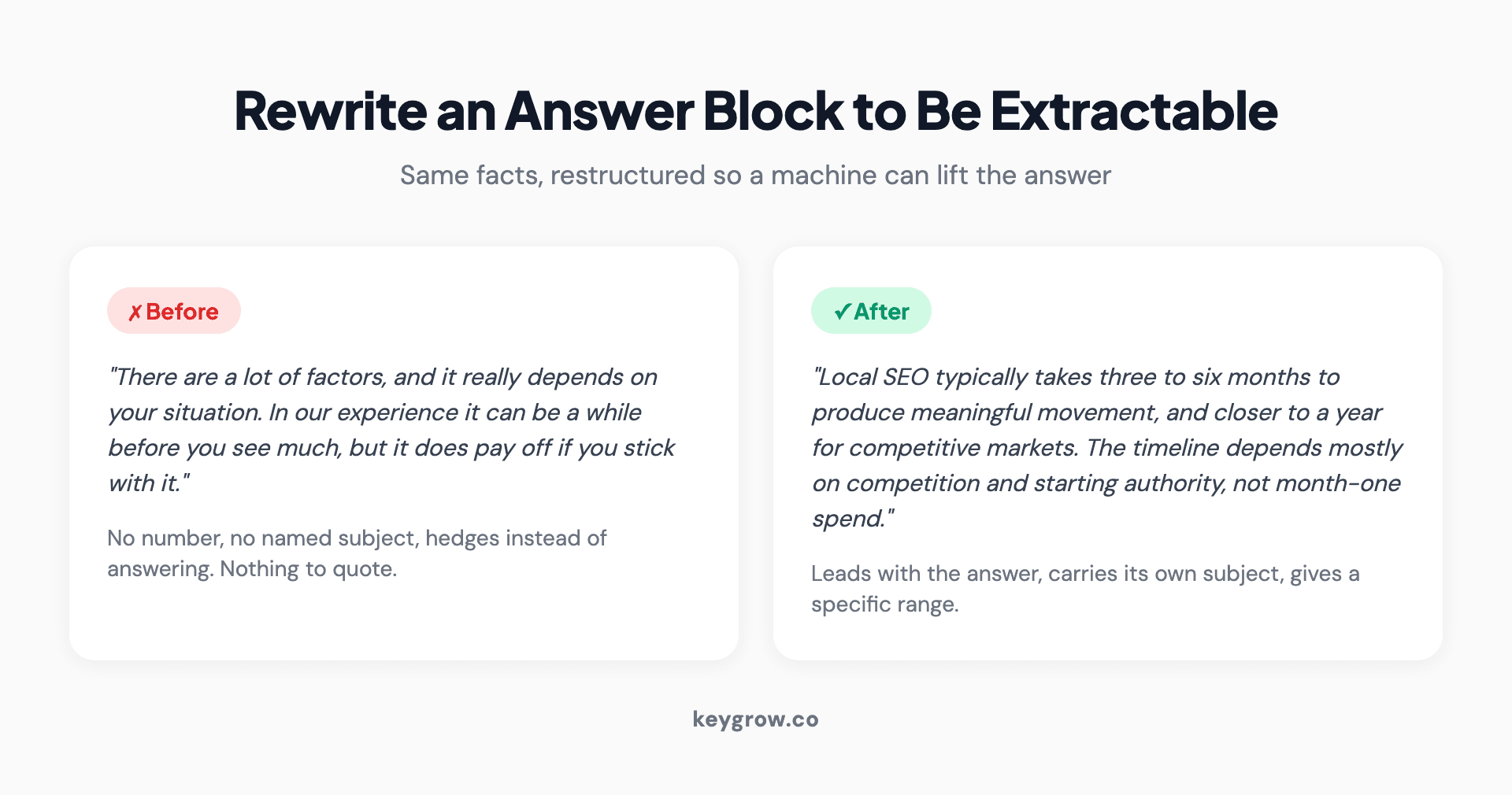
A before-and-after comparison of an answer block for AEO: the before is a vague hedging paragraph with no number, the after leads with a specific answer, names its subject, and gives a concrete range an engine can quote.
The trade-off nobody mentions
Answer-first structure can cost you some on-page reading time, and that is a fair trade, not a free lunch. When you give the answer up top, some readers take it and leave. You win the citation and the credit, and you lose a little scroll depth.
For most informational content that is the right trade in 2026, because the alternative is not getting cited at all. The exception is a high-intent commercial page where you need the visitor on the site to convert. There, keep the answer clear but make the reason to keep reading, the proof, the offer, the next step, just as strong. Structure for extraction where the goal is visibility, and structure for conversion where the goal is a sale. Knowing which page is which is the actual skill.
FAQs
What does answer-first structure mean?
Answer-first, sometimes called inverted-pyramid, means you give the direct answer to a heading immediately below it, then add context, evidence, and nuance afterward. The reader and the answer engine both get the conclusion first. It is the opposite of building up to a reveal, which buries the one sentence a machine wants to quote.
How long should the answer block under each heading be?
Aim for 40 to 60 words. That is long enough to answer completely and short enough for an engine to lift as a clean passage. Say the answer in the first sentence, then use the remaining two or three sentences for the key qualifier or example, and move detail into the section below.
Where should the TL;DR go?
Put it directly after the H1 and before the first H2. A short summary or key-takeaways block in that position answers the core question at the top of the page, which is where both a skimming reader and a crawler look first. Keep it to three to five plain sentences.
Should H2s be questions or statements?
Either works, as long as they name what the section answers. Questions that match how people actually search are ideal because they map directly to queries. Clear declarative statements are fine too. Avoid vague one-word labels, which give an engine nothing to match a query against.
Is schema markup required for AEO?
No. Structured data helps engines confirm what your content is, but it does not create structure that is not already on the page. Well-written, answer-first content gets cited without schema, and poorly structured content does not get rescued by it. Add FAQPage and Article schema as confirmation once the visible structure is right.
Do answer engines prefer lists and tables over paragraphs?
For anything with steps, options, or comparisons, yes. Ordered lists, unordered lists, and tables are easier for engines to parse and lift accurately than the same information wrapped in prose. Use them wherever the content is genuinely a sequence or a set, and keep narrative for the parts that are genuinely narrative.
The one habit that matters most
If you change one thing, make every section answer its own heading in the first 40 to 60 words, in a passage that names its subject and stands on its own. The skeleton, the schema, and the tables all support that habit. They do not replace it.
When you want the structure built and the citations tracked rather than doing it section by section yourself, our answer engine optimization team does exactly that. Send your top customer questions to the get started page and we will show you which pages are close to citable and what to restructure first.