


You can't pay Google to rank higher in the map pack. Google's Business Profile help says so in one line: "There's no way to request or pay for a better local ranking on Google."
What Google Maps advertising buys is a labeled spot beside the free results: a square pin on the map, a Sponsored listing atop the results, or a suggestion while someone types. It runs through an ordinary Google Ads campaign linked to your Business Profile. You pay mostly per click, and the spot vanishes when the budget does.
Where do Google Maps ads show up?
Four places, per Google's help center: square promoted pins, map search ads at the top of results, map suggest ads in autocomplete, and placesheet ads on business pages.
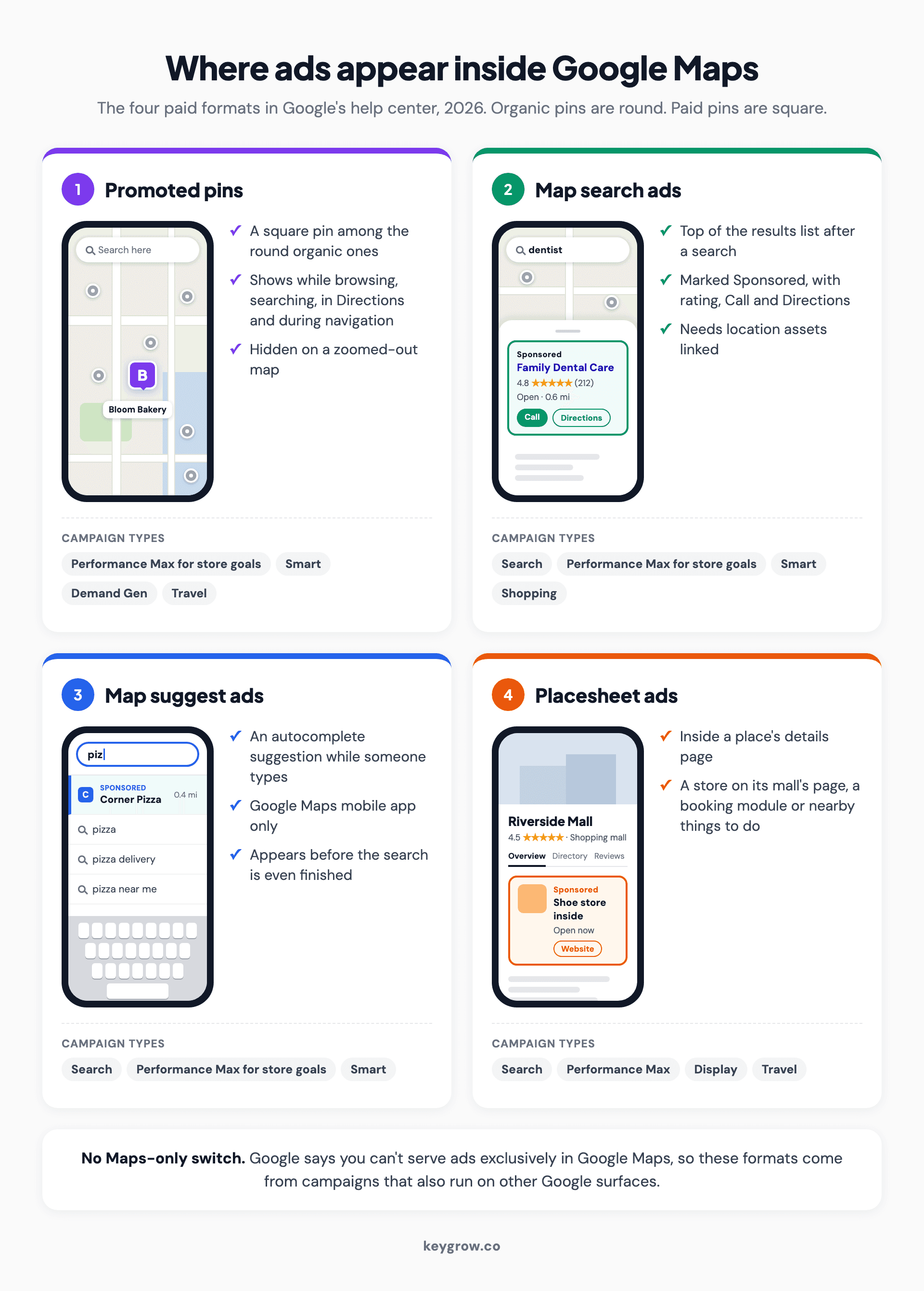
Annotated mockup of the four places ads appear inside Google Maps in 2026: a square promoted pin among round organic pins on the map, a Sponsored map search ad at the top of the results list, a map suggest ad in the search bar's autocomplete, and a placesheet ad inside a business details page.
Promoted pins are the square ones. Organic pins are round.
That shape is the quickest way to tell paid from earned. Google shows promoted pins while people browse, search, follow directions and, now and then, during driving navigation, but never on a zoomed-out map. In Performance Max for store goals the pin carries your logo.
Map search ads sit at the top of the results list after a search, beside a "Sponsored" label. Map suggest ads appear in autocomplete, in the Maps mobile app only. Placesheet ads live inside a place's details page, like a store promoted on its mall's page.
There's no Maps-only campaign. Google says you "can't serve ads exclusively in Google Maps," so ads arrive through Search with location assets, Performance Max for store goals, Smart campaigns, and Demand Gen, which Google opened to Maps inventory in 2026. In Google's help center, the Search and Performance Max versions go by Local Ads, a different product from Local Services Ads. The old Local campaigns are gone, folded into Performance Max.
Myth: running ads lifts your organic map ranking
It doesn't. Google ranks the organic map pack on relevance, distance and prominence, and says its search results are independent of its advertising programs.

A white-fronted shop on a tree-lined street, the kind of storefront that earns its organic map listing through its profile and reviews rather than its ad budget.
Google's page on ads versus results is blunt: "Google's search results are independent of Google's advertising programs." The map listings sit on the results side of that line. Spend $10,000 a month on ads and your organic spot for "dentist near me" stays where your profile, reviews and distance from the searcher put it.
A few pages ranking for this very term still suggest an ad gives your free listing a lift. If it did, every map pack would be a list of the biggest advertisers.
What money buys is speed.
Three of our local SEO clients show how slowly the free route pays off: a phone repair shop reached 115+ monthly phone calls in 7 months, a real estate office 90+ in 7 months, and a junk removal company 50+ in 6 months, all from almost no inbound calls. A paid listing can appear the week a campaign is approved, and it vanishes the day the budget runs out. Our Google Maps SEO guide covers the free side.
Paid pin, organic pack or Local Services Ads?
Three products share the map. Ads rent a labeled slot by the click, organic ranking is earned rather than bought, and Local Services Ads bill per lead.
| Paid Maps ads | Organic map pack | Local Services Ads | |
|---|---|---|---|
| What you pay for | Clicks on the pin, call, directions or website. Logo pins in store-goal campaigns bill per 1,000 views | Nothing to Google. You pay in time, or an SEO fee | Valid leads, such as calls and messages |
| Where it shows | Maps pins, results, autocomplete and place pages, plus Search and other Google surfaces | The map pack in Search and the Maps results list | The top of Search and inside Google Maps |
| What it needs | A linked Business Profile or your own Maps locations, location assets and an eligible campaign | A verified, complete profile, reviews and proximity to the searcher | An eligible service category, Google's business checks and a Business Profile |
| Who it suits | Storefronts people visit: dental offices, restaurants, shops, clinics | Every local business, as the base layer | Trades in eligible service categories, including service-area businesses |
Most owners end up with the organic layer plus one paid option. Which one depends on whether customers come to you or you go to them.
Myth: Maps ads need Search partners switched on
Partners have nothing to do with it. Google lists Maps among its own search sites, and Maps ads need a linked Business Profile plus location assets.
Google's Search Network page lists Google Maps and the Maps app as Google search sites, apart from search partners, so turning partners off doesn't touch Maps. The real requirements:
- a Business Profile linked to Google Ads, approved by the profile's owner or manager
- location assets applied to the campaign, since one set to "No location asset" ignores the link
- an eligible campaign, such as Search, Performance Max, Smart or Demand Gen
- an address that passes policy: real, open and belonging to the business in the ad
Verification isn't on that list. Google's Business Profile help says you "don't need a verified account to run Google Ads location assets."
Two edge cases. Without a Business Profile link, Google Ads has let you pick up to 10 of your own locations from Google Maps since September 2025. Brands that sell through stores they don't own use affiliate location assets, which reached promoted pins in Demand Gen in September 2026.
What does Google Maps advertising cost?
There's no separate Maps price. You pay the auction-set cost per click, charged once per interaction, whether someone taps call, directions or your pin.
Google's Local Ads page lists the paid clicks: the headline, a sitelink, the map, the Call, Directions or Website buttons, and the pin itself. Tap three and you're charged for one. Swiping through photos is free. The main exception is a branded logo pin in Performance Max for store goals, which bills per thousand views.
The price is a standard cost per click from the ad auction, so your industry and market set it. LocaliQ's 2026 benchmarks, built from thousands of its customers' Google Ads and Microsoft Ads campaigns, put the all-industry average at $5.42 a click. For local categories:
| Industry | Average cost per click | Average cost per lead |
|---|---|---|
| Attorneys and legal services | $9.87 | $131.63 |
| Home and home improvement | $8.33 | $90.92 |
| Dentists and dental services | $8.00 | $72.97 |
| Health and fitness | $6.17 | $67.36 |
| Physicians and surgeons | $4.76 | $40.04 |
| Beauty and personal care | $4.62 | $39.25 |
| Auto repair, service and parts | $4.35 | $29.96 |
| Restaurants and food | $2.05 | $30.57 |
They're averages across thousands of campaigns.
Your own price is set auction by auction, and no budget buys a fixed position on Maps or anywhere else.
Myth: every directions tap is a new customer
Google counts directions and call taps for 30 days after an ad interaction, even taps on your free listing, so the totals run generous.
Maps ads reach your reports two ways. Segmenting clicks by click type splits out get location details, get directions and mobile clicks-to-call. And once location assets are live, Google adds local actions conversions for directions, call and website taps.
The catch is in Google's wording: a local action counts when it happens "while or after engaging with your ads," inside a 30-day default window. Tap the ad on Monday, tap Directions on the free listing two weeks later, and that's a conversion.
Fair as a signal. As proof of new business, it flatters the campaign.
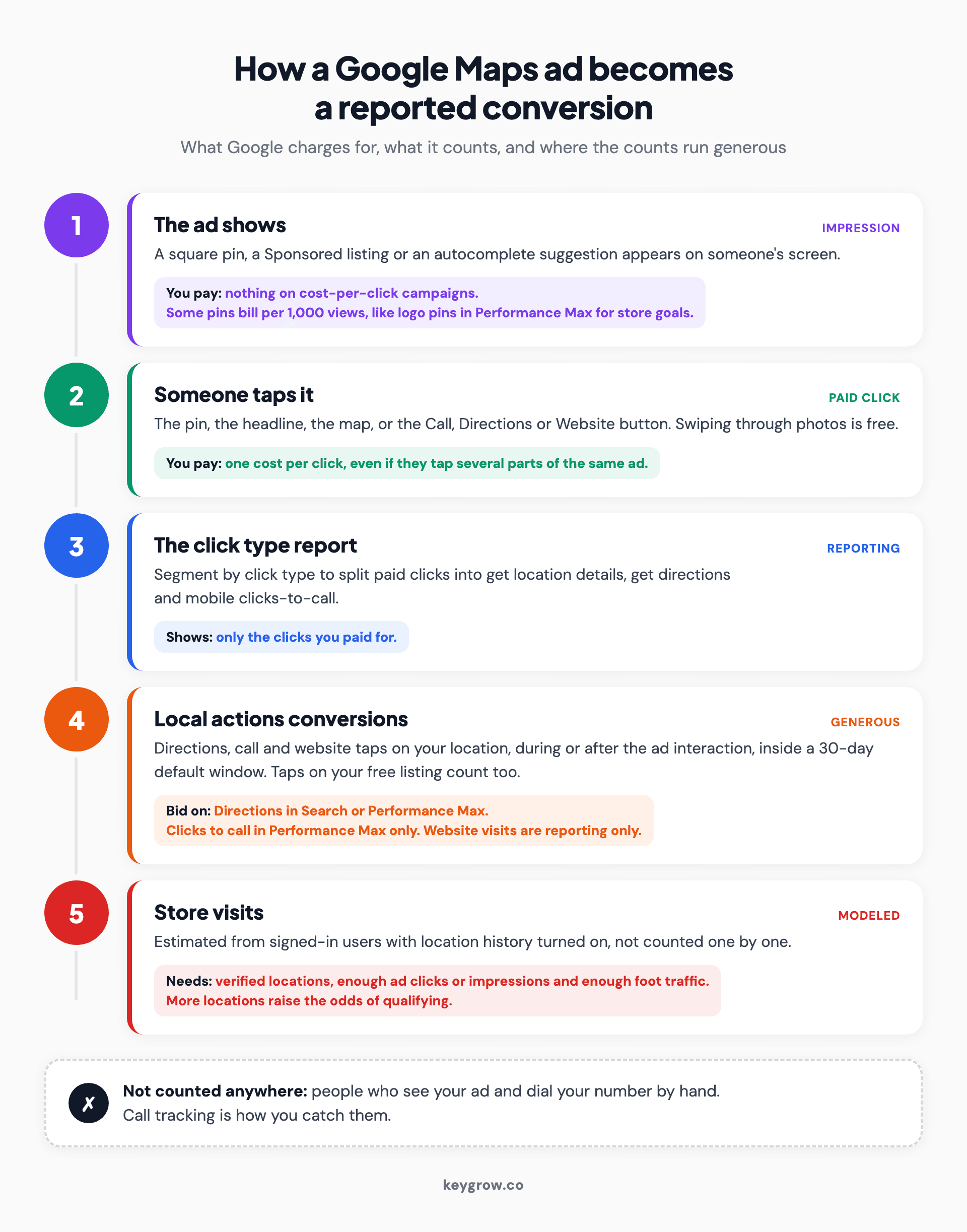
Process flow of how a Google Maps ad becomes a reported conversion: the ad is shown, an interaction is charged once as a cost per click, the click type report splits location details, directions and calls, local actions conversions count taps for up to 30 days including on the free listing, and store visits are modeled only for eligible accounts.
Store visits are modeled estimates, and Google reports them only for accounts with verified locations, enough ad clicks or impressions and enough foot traffic to pass its privacy thresholds. Google adds that more locations raise the odds, which tells a single-location shop what to expect.
None of this catches the person who saw your pin and dialed by hand. That's the gap call tracking closes, and it's the number we'd trust over every column above.
Who should skip Google Maps ads
Skip them if you have no storefront, a weak profile, a budget that buys a few dozen clicks, or nobody free to answer the phone.

An electrician working on the meter and service panel outside a customer's house, the kind of service-area trade that usually does better with Local Services Ads than with a paid map pin.
An agency that won't tell you who's a bad fit is selling, not consulting. So here's our list.
Service-area businesses without a storefront. Google's own help page on Maps ads points them to Local Services Ads, which bill per lead. Searchlight Digital's February 2026 data, unpacked in our Local Services Ads breakdown, puts the average home services LSA lead at $53, against LocaliQ's $90.92 search average for home improvement.
Anyone with a weak or half-finished profile. Maps ads pull in your star rating, hours and photos. A 3.4-star profile with last year's hours is an expensive thing to promote.
Small budgets in pricey categories. At the 2026 attorney averages, $500 a month buys about 50 clicks and fewer than four leads, too few to tell a working campaign from a lucky week.
Businesses that miss calls. You pay for the tap, answered or not.
If you're the opposite case, a single-location shop with a well-kept profile, you don't need an agency to start. One Search campaign, location assets on and a tight radius will get you running in an afternoon.
How to advertise on Google Maps: the setup checklist
Fix the profile, link it, apply location assets, choose Search or Performance Max, keep the radius tight, then track calls before you raise the budget.
- Fix the profile first. Fill in Address line 1, which Google Ads requires, and match the name, hours and category to reality, because the ad pulls them in.
- Verify it for the free listing. Ads can run without verification, but only verified businesses show their details on Maps, so verify your Business Profile too.
- Link it in Google Ads under Assets, then Location, then Our locations. If Google flags odd capitals or symbols in the name, fix them in the profile and relink.
- Apply the asset at the account or campaign level, make sure nothing says "No location asset," and allow a day or two to sync.
- Choose the campaign. Search controls which searches you pay for. Performance Max for store goals suits store visits and adds logo pins and Waze. Don't hunt for a Local campaign, since those now live inside Performance Max.
- Keep targeting local: a radius you can serve, local-intent keywords and negatives for job hunters and DIY searches.
- Measure calls with call reporting and call tracking, and count directions or calls as primary conversions only if they turn into sales.
- Check week one by segmenting clicks by type. If your own ad seems missing, zoom in, since promoted pins hide on a zoomed-out map, or accept that a rival won that search.
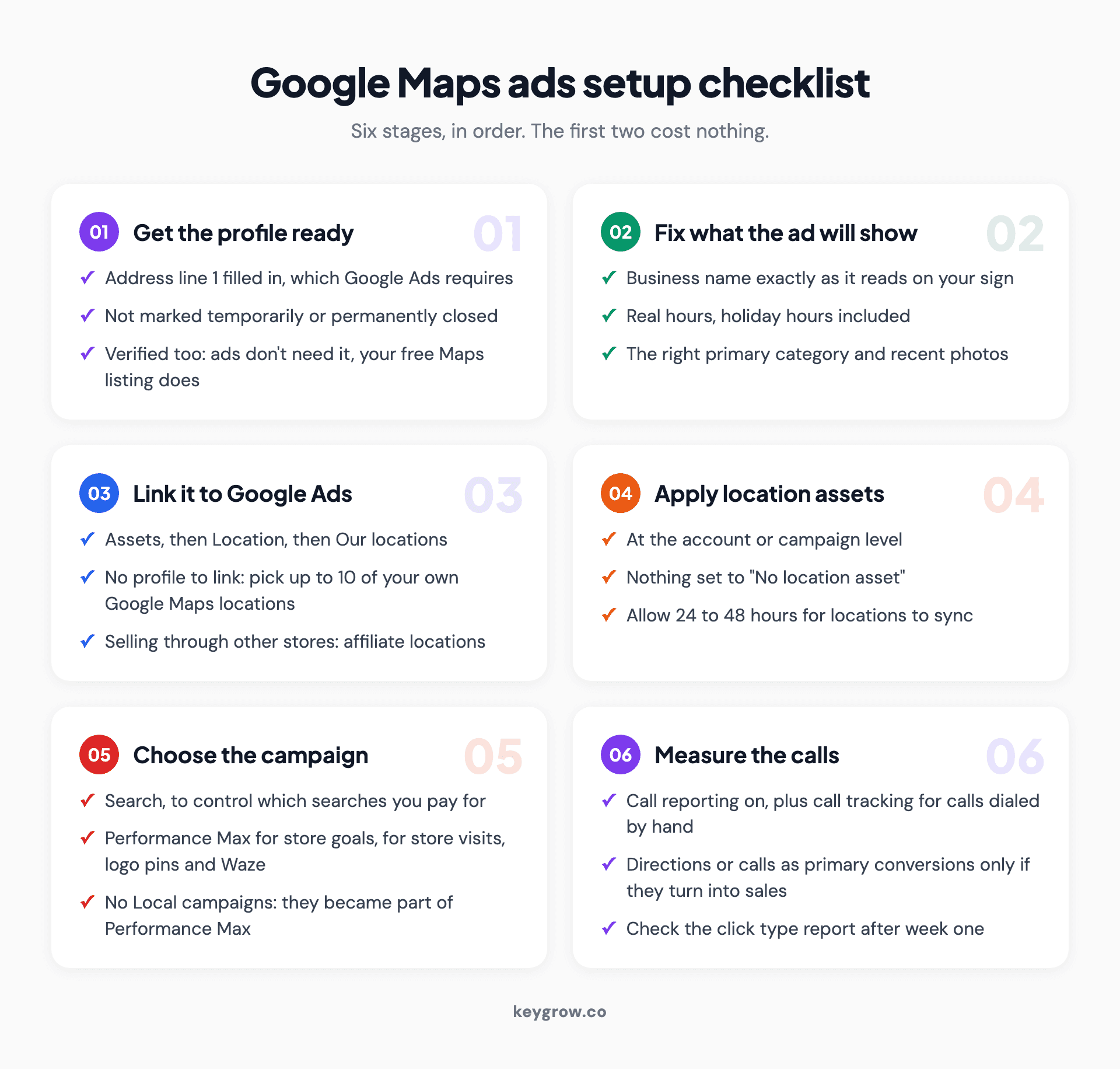
Checklist grid for setting up Google Maps ads in six stages: get the Business Profile ready, fix what the ad will show, link the profile to Google Ads, apply location assets, choose a Search or Performance Max for store goals campaign, and measure calls and click types.
FAQs
Is advertising on Google Maps free?
Being on Google Maps is free: a verified Business Profile puts you in the organic results. Advertising isn't. Most Maps ads bill per click, while branded logo pins in store-goal campaigns bill per thousand views.
Can I run ads only on Google Maps?
Not with a standard campaign. Google says you can't serve ads exclusively in Google Maps, so Search and Performance Max campaigns also run elsewhere. Demand Gen added Maps as a selectable channel in 2026, the closest thing to a Maps-only placement.
Can a service-area business advertise on Google Maps?
It can run search ads, but Maps formats are built on location assets, which pull a business address from your profile. Google points service businesses without a storefront to Local Services Ads, which show on Search and Maps and bill per lead.
How long before ads show on Google Maps?
Linked locations take a day or two to sync into Google Ads, and new ads pass Google's review before they serve. After that, showing depends on each auction: your bid, your ad and where the searcher is.
Why isn't my ad showing on Google Maps?
Usually it's a profile that isn't linked, locations that haven't synced yet, a campaign set to no location asset, targeting that excludes where you're searching from, or a zoomed-out map, which hides promoted pins. Sometimes a competitor is just winning the slot.
Fix the profile, then pay for the pin
Every Maps ad borrows from your Business Profile: the address, the hours, the rating and the photos. Fix those first, because an ad only puts the profile in front of more people.
Then run one tight campaign for a month and count calls, not clicks.
If you want a second opinion on whether Maps ads fit your business, our PPC team will give you a straight answer, including when that answer is to skip them.