

The short verdict: Google Local Services Ads are worth it if you're a licensed, urgent-response trade that answers its phone, with leads averaging $53 and a 43.9 percent booking rate across recent tracked data. They're a poor fit for high-ticket, low-frequency trades and for any business that responds to inquiries slowly, and they cannot be scaled the way regular ads can.
One more thing before the details, because it matters more than any benchmark: most of what ranks for this question describes a version of LSAs that no longer exists. Google rewrote the program's rules across 2024 and 2025, removing lead disputes, retiring the Google Guaranteed badge, and changing how credits work. Advice built on the old system, and much of page one is, will cost you money. Here's the current picture.
What LSAs are, in 2026 terms
Local Services Ads are the profile boxes at the very top of search results for local service queries: business name, star rating, review count, and a "Google Verified" badge. They also show on Google Maps. You don't bid on keywords and you don't pay for clicks. You pay per lead, when someone contacts you through the ad.
Three structural differences from regular Google Ads decide everything downstream:
The rules changed in 2024-2025, and most advice hasn't caught up
If you remember LSAs as "dispute the junk leads and recover the cost," that system is gone. The changes, in sequence:
August 2024: manual lead disputes removed. Google's machine-learning system now reviews every lead automatically, within about 72 hours, and applies credits within 30 days. You can no longer argue your case per-lead, and credits for "job type I don't service" and "area I don't serve" were discontinued. In practice, agencies that recovered a meaningful share of client spend through manual disputes now report automated credits returning roughly 6 to 7 percent, per The Media Captain's data. Budget for that difference: junk-lead protection got weaker, and the responsibility for filtering moved to your job-type and service-area settings.
November 2024: a Google Business Profile became mandatory. Your LSA and your profile now rise and fall together, so review-building pays into both.
October 20, 2025: the badges consolidated. Google Guaranteed, Google Screened, and License Verified all became a single "Google Verified" badge, and the money-back promise to consumers behind the old green checkmark was discontinued weeks later, on November 7, 2025. If your ads, scripts, or website still say "Google Guaranteed," that's now describing a program that no longer exists.
And the changes aren't finished. Google has announced that LSA campaigns will begin migrating into Performance Max with pay-per-lead goals, phased in from August 2026 for select US service categories. Pay-per-lead pricing survives the move, but the standalone LSA product described here is on the clock, which makes this a channel to run on current numbers and re-check each quarter.
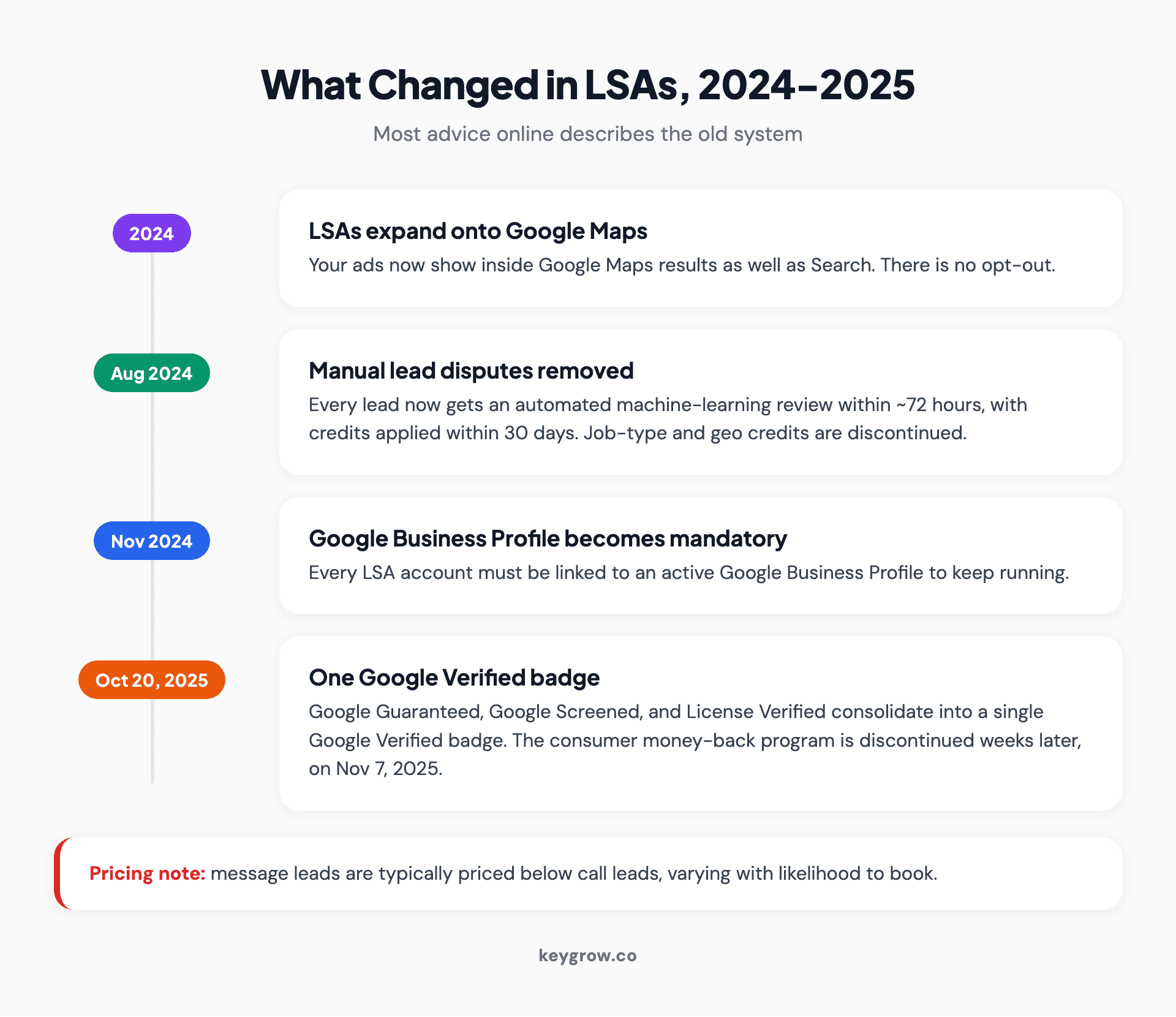
Timeline of Google Local Services Ads rule changes from August 2024 through October 2025: manual disputes replaced by automated credits, mandatory Business Profiles, Maps expansion, and badge consolidation into Google Verified.
None of these changes kills the channel. But every one of them shifts the worth-it math, which is why the numbers below matter more than the four-year-old blog posts above them in the search results.
What LSA leads actually cost
The most useful current dataset tracks $6.72 million in LSA spend across 888 contractors and 126,650 leads in a single month (February 2026), published by Searchlight Digital. Their headline numbers: a $53 average cost per lead, a 43.9 percent average booking rate, $233 per paying customer, and 7.84x return on ad spend measured against closed jobs.
By trade, from the same dataset and from The Media Captain's hundred-plus client accounts cited above:
| Trade | Typical LSA cost per lead |
|---|---|
| Dog training | ~$30 |
| Locksmith | ~$34 |
| Electrical | $39 |
| Estate law | ~$45 |
| HVAC | $51-$80 |
| Plumbing | $57-$69 |
| Water heater | $71 |
| Roofing | ~$162 |
| Personal injury law | ~$249 |
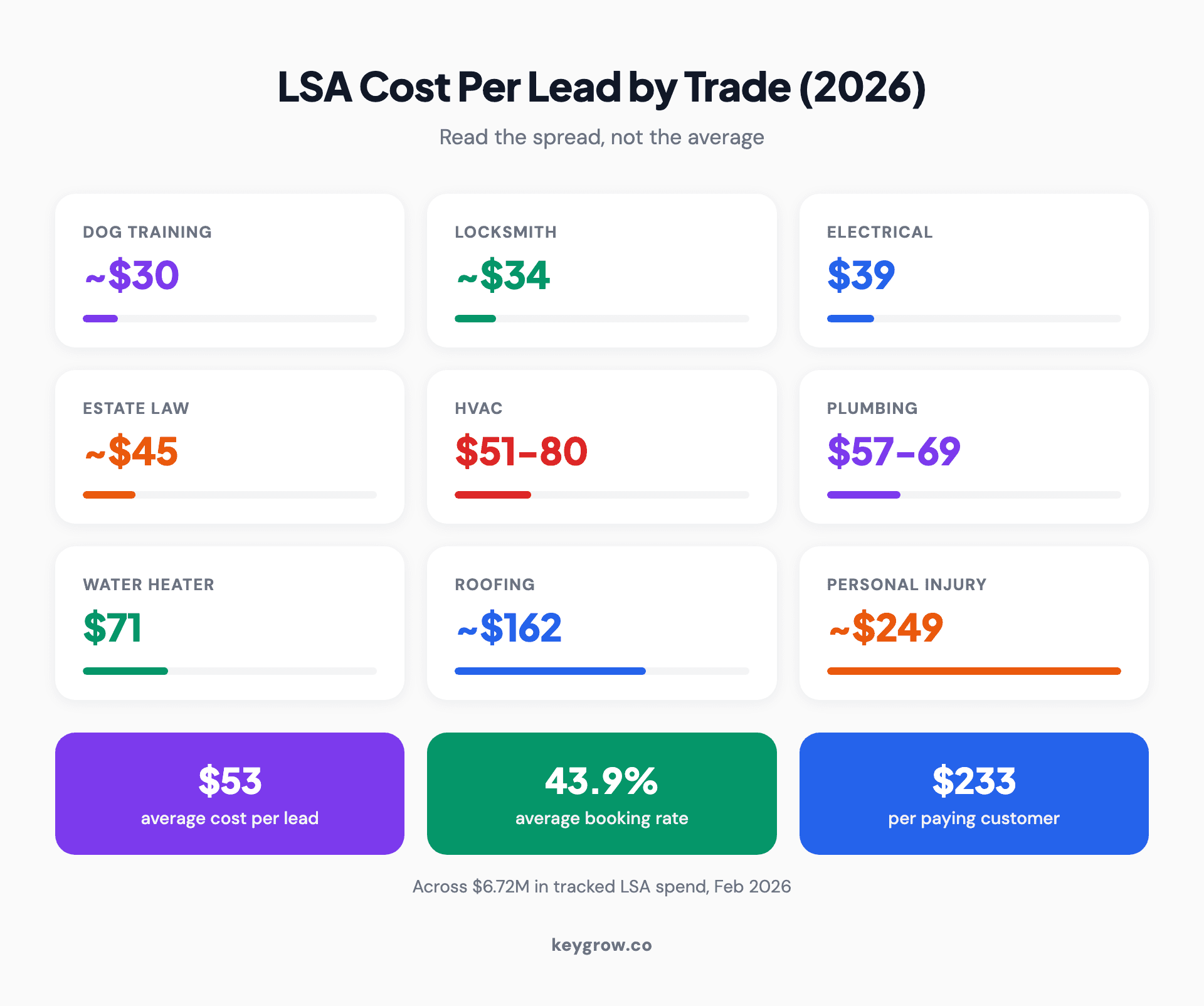
Google Local Services Ads cost per lead by trade in 2026, from roughly $30 for dog training and $39 for electrical up to $162 for roofing and $249 for personal injury law.
Read the spread before the average. A locksmith buying $34 leads for jobs booked the same hour lives in a different economy than a personal injury firm paying $249 per contact in a market where one signed case is worth six figures. Both can work. What matters is your trade's line, not the average.
LSA vs regular PPC: the side-by-side nobody publishes
Here's the comparison that decides where your next dollar goes. Home services search ads (the regular kind) average $90.92 per lead, with plumbing at $129, HVAC at $128, and roofing at $228, per LocaliQ's benchmarks.
Put the two channels side by side for the same trades:
| Trade | LSA cost per lead | PPC search cost per lead |
|---|---|---|
| Plumbing | $57-$69 | ~$129 |
| HVAC | $51-$80 | ~$128 |
| Electrical | $39 | ~$94 |
| Roofing | ~$162 | ~$228 |
For urgent-response trades, LSA leads run roughly half the price of PPC leads. Work it through to a booked job: at a $60 LSA lead and the dataset's 43.9 percent book rate, a booked plumbing job costs about $137 in ad spend. The same job through search ads, at $129 a lead and a typical 30-40 percent booking rate on called-in leads, runs $320 to $430. That gap is the entire case for LSAs in one calculation.
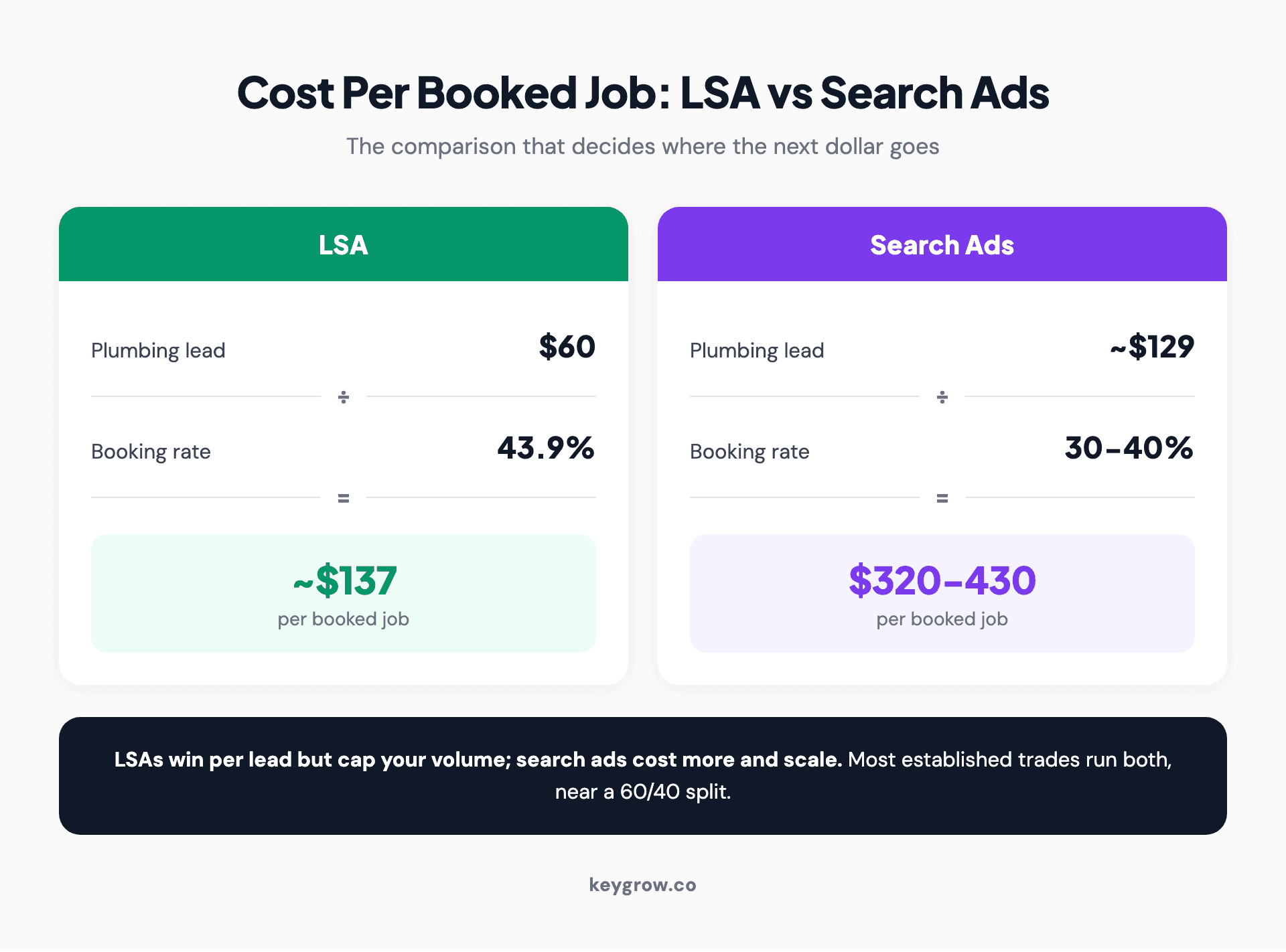
Worked cost-per-booked-job comparison showing a plumbing job costing about $137 through Local Services Ads versus $320 to $430 through regular search ads.
So why doesn't everyone move every dollar to LSAs? Because of the catch in the next section: you can't buy more volume. LSAs hand you a cheaper lead but cap how many you get. PPC costs more per lead and scales with budget. That's why the practical answer for most established trades is both, and the observed split across managed accounts sits around 60/40 LSA-to-PPC.
Which trades win, and which lose
Pay-per-lead economics reward some business models and quietly punish others. The only published per-vertical divergence data, agency case studies from Portent back in 2020, made the pattern visible early: an HVAC client's cost per sale through LSAs came in about half of paid search, while a moving company's cost per sale ran two to three times higher than its text ads, despite a 90-percent-plus lead rate. The pattern has held since, and it generalizes.
LSAs favor: urgent, high-frequency repair trades. Plumbing, HVAC, electrical, locksmiths, garage doors, appliance repair. The caller needs help today, books on the first call, and the job closes at a predictable ticket. High book rates make per-lead pricing cheap.
LSAs punish: high-ticket, long-cycle, comparison-shopped work. Moving, remodeling, roofing replacements shopped across three quotes, and any trade where callers gather estimates for weeks. You pay full price for every contact while your booking rate, and the whole per-lead math, sags. Roofing's $162 leads can still work, but only with an intake operation built to win the three-quote game.

Plumber repairing pipework under a sink, one of the urgent-response trades where Local Services Ads consistently pay off.
And LSAs reward operations over budgets. Rankings weight reviews and responsiveness heavily, so the practical competition is about answer speed and review count. A business that misses calls doesn't just lose those leads, it slides down the rankings and gets fewer. If nobody can reliably pick up the phone between jobs, fix that before spending here.
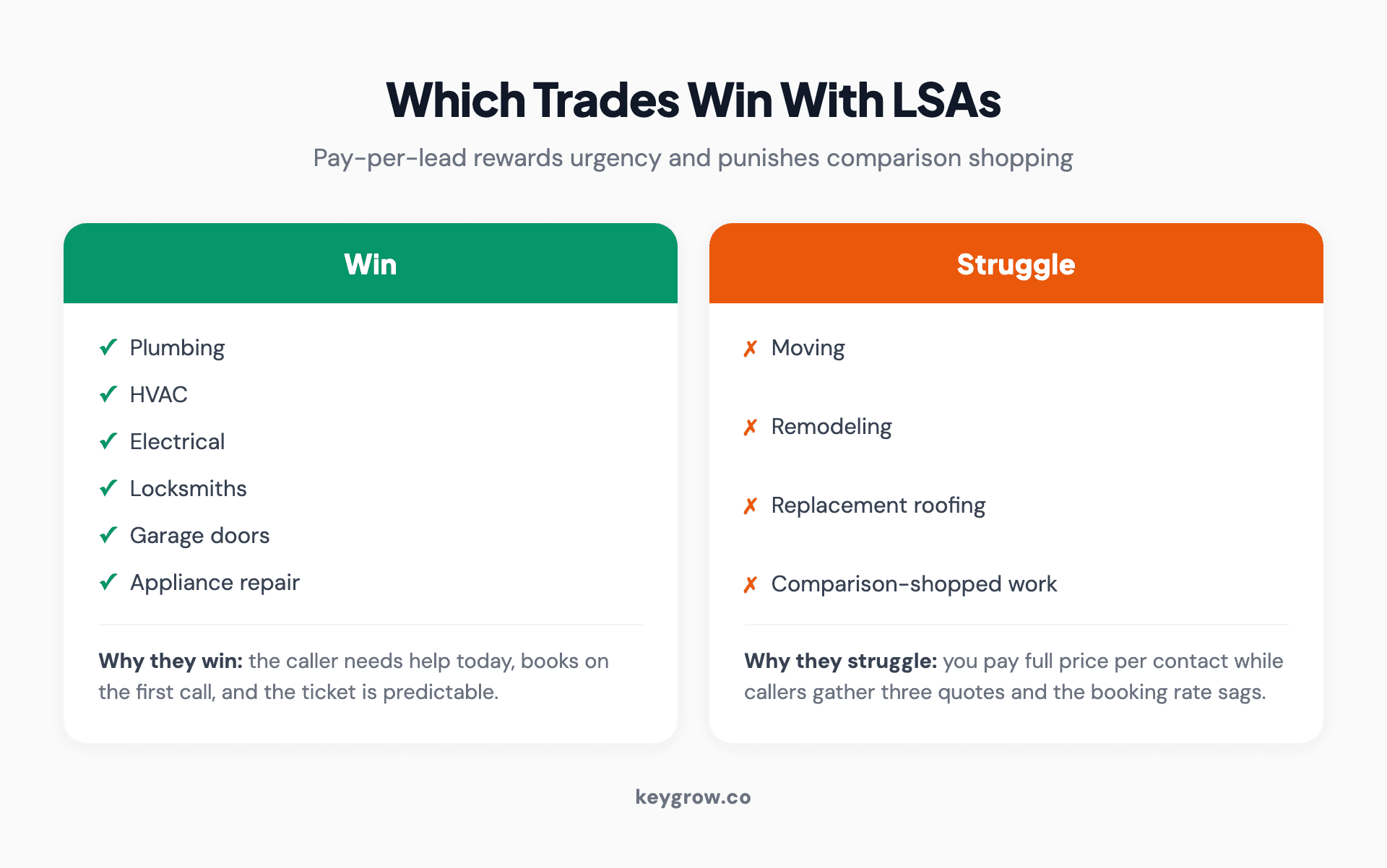
Two-column comparison of trades that win with Local Services Ads (urgent repair trades with high booking rates) versus trades that struggle (high-ticket comparison-shopped work).
An agency that won't tell you who's a bad fit is selling, not consulting, so here it is plainly: if you're a mover or a bid-three-contractors remodeler, LSAs deserve a cautious test at most, and your money likely works harder in search ads with aggressive qualification. We turn away work on this basis, and any honest shop will.
The structural catches nobody mentions
Four more realities to price in before you enable the channel.
Volume is capped by demand. Your service area, trade, and ranking set a ceiling on lead flow, and once you're capturing most of it, extra budget buys nothing more. LSAs are a tap you open, not a dial you turn. Growth budgets need somewhere else to go, usually search ads.
Google holds the steering wheel. Job types and service areas are your only real targeting. No keywords, no ad copy, no audiences, no landing pages. When lead quality drifts, your levers are settings and answer speed, not campaign surgery.
Reviews function like a second bid. In our experience, accounts under roughly 10 to 15 reviews struggle for impressions in competitive metros. Your review-generation process is functionally part of your bidding strategy, which is good news for operators who've built one and bad news for everyone else.
The credit system is now a black box. With manual disputes gone, the roughly 6-7 percent automated return is what junk-lead protection looks like. Tighten your job types and service area settings, because prevention is the only filter you control now.

Team reviewing lead quality and response times in an evening strategy meeting.
How to decide, in four questions
1. Are you eligible? Licensed, insured, able to pass the checks. If not, the decision is made for you.
2. Is your trade urgent-response? Same-day-need work says yes. Three-quotes-over-three-weeks work says be careful.
3. Can you answer the phone live, most of the time? Responsiveness drives both your booking rate and your ranking. A missed-call culture turns cheap leads expensive.
4. Does the math clear? Your trade's cost per lead, times your realistic booking rate, against your average ticket and margin. The break-even logic is the same one we walk through in our PPC ROI playbook, and it takes ten minutes with real numbers.
Four yeses: turn LSAs on, and run them alongside search ads rather than instead of them, with something near that 60/40 split as a starting allocation. On budgets: LSAs take a weekly budget based on the leads you can handle, you can pause anytime without penalty, and because volume caps itself, overspending is rarer than under-answering. The realistic failure mode isn't burning money on bad clicks, it's paying for good leads your front desk never converts. Our comparison of PPC options for local businesses covers how the pieces fit, and we've seen the pairing work well even in niche trades like asphalt and paving.
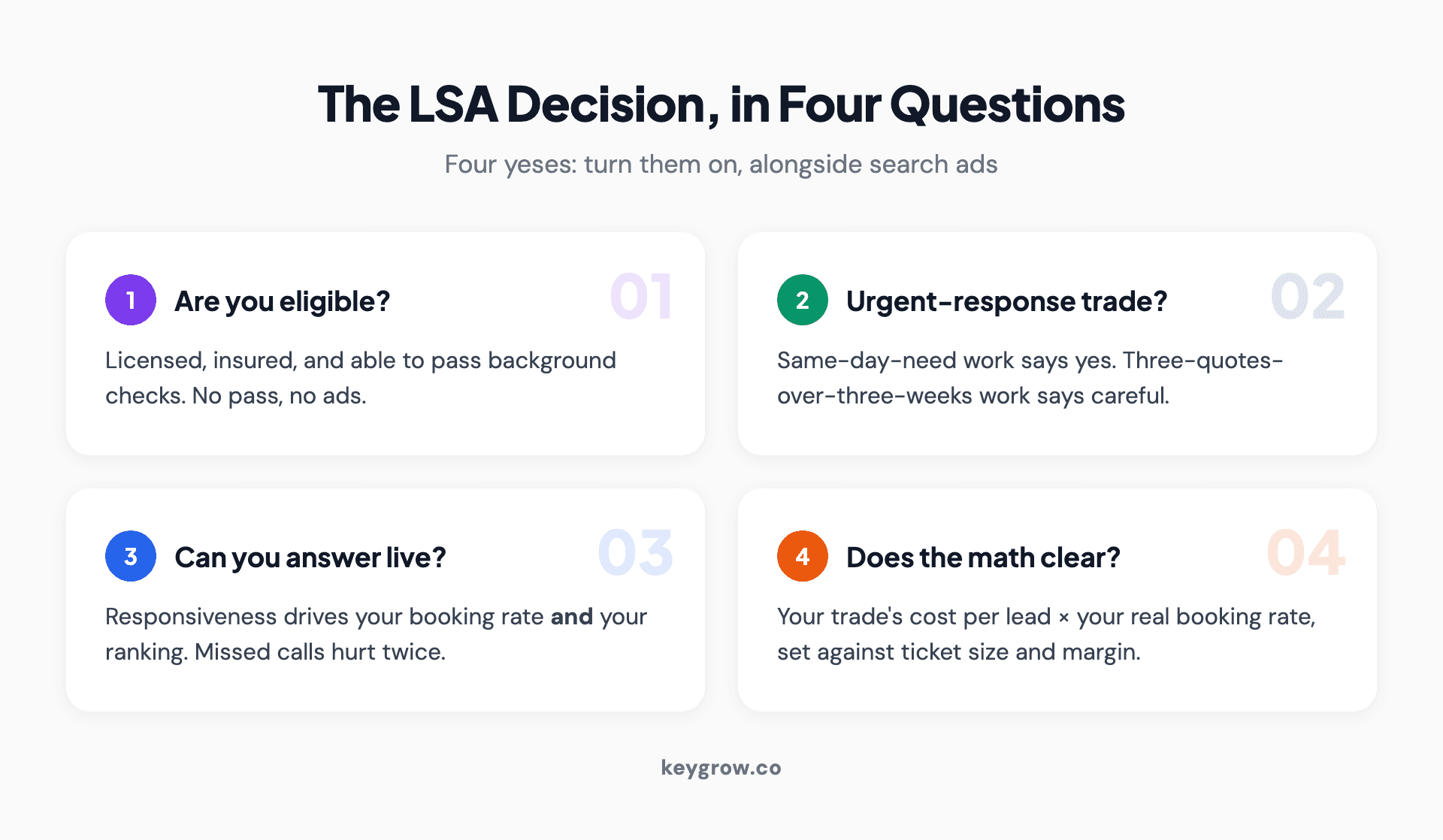
Four-question decision checklist for Local Services Ads: eligibility, urgent-response demand, live answer capability, and break-even math.
One honest note on DIY: LSA setup is the most do-it-yourself product Google has shipped. Verification, profile, job types, budget, done. If LSAs are all you run, you likely don't need to pay anyone for management, and you should be suspicious of fees for "LSA optimization" beyond review strategy and settings hygiene. Management earns its keep when LSAs sit inside a larger paid program with search campaigns, tracking, and budget decisions across channels, which is the PPC management work we actually charge for.
FAQs
How much do Google Local Services Ads cost per lead?
Recent tracked data puts the average at $53 per lead, with wide variance by trade: electrical around $39, plumbing $57 to $69, HVAC $51 to $80, roofing around $162, and personal injury law near $249. Message leads are typically priced below phone leads, varying with likelihood to book. Your market's competitiveness moves these numbers, so treat your first month as calibration.
Can I run Local Services Ads and Google Ads at the same time?
Yes, and most established local businesses should. LSAs deliver cheaper leads but cap your volume; search ads cost more per lead but scale with budget. Managed accounts commonly settle around a 60/40 LSA-to-search split, letting LSAs fill first and paid search carry growth beyond the cap.
Do I need a lot of reviews for LSAs to work?
Reviews weigh on rankings almost like a second bid. In competitive metros, accounts with fewer than roughly 10 to 15 reviews tend to struggle for impressions in our experience, and every review after that improves both ranking and conversion. If your review base is thin, start the generation process before or alongside launch rather than waiting.
Can I still dispute bad LSA leads?
Not manually. Google removed per-lead disputes in August 2024 and replaced them with automated review of every lead, with credits applied within 30 days. Credits for wrong job types and out-of-area leads were discontinued, so your job-type and service-area settings are now your only junk-lead filter. Expect automated credits to return a mid-single-digit percentage of spend, well below what aggressive manual disputing used to recover.
What does the Google Verified badge mean?
It's the single badge that replaced Google Guaranteed, Google Screened, and License Verified in October 2025, confirming the business passed licensing and background verification. The consumer money-back program from the old Google Guaranteed badge was discontinued on November 7, 2025, shortly after the consolidation. The badge still signals vetting, it just no longer carries a consumer payout promise behind it.
Do Local Services Ads hurt my SEO?
They don't affect your rankings, but they do sit above everything else on the page, including the map pack and organic results, and they absorb clicks that would otherwise flow down. That's an argument for being in them rather than against: when LSAs are present in your market, part of the traffic your SEO earned is being intercepted at the top of the page.
So, should you turn them on?
If you're a licensed urgent-response trade with live answer capability and a working review engine, yes, and you should have done it already: half-price leads with a booking rate near 44 percent is the best per-dollar deal in local advertising right now. If you're comparison-shopped, high-ticket, or slow to the phone, the same pricing model quietly works against you, and search ads with hard qualification deserve the budget instead.
Either way, decide on this year's rules, not 2022's. If you want a second opinion with your trade's actual numbers, we'll run the math with you, including the version where the answer is "skip them."


