


An apartment community does not lose money on bad leads. It loses money on empty days. A unit renting at $1,800 a month burns about $59 for every day it sits vacant, and that number, not your cost per lead, is what should decide the budget.
Google Ads for apartments is unusual for a second reason. Housing is one of three categories where Google has switched off demographic and postal code targeting entirely in the US and Canada. You cannot aim at an age, a household type, or a zip code. The tools most advertisers reach for are simply not there.
Put those two facts together and the shape of the job is clear. You are buying speed, using a blunt instrument, against a cost that accrues daily whether you act or not.
What a vacant day actually costs
Work out your own number before anything else. It reframes every decision that follows.
| Monthly rent | Cost per vacant day | Cost of 10 extra vacant days |
|---|---|---|
| $1,200 | $39.47 | $394.70 |
| $1,800 | $59.18 | $591.80 |
| $2,500 | $82.19 | $821.90 |
| $3,500 | $115.07 | $1,150.70 |
Now hold that against what a renter lead costs. Real estate runs a $102.51 average cost per lead in WordStream's 2026 benchmarks, with a $3.22 cost per click and a 3.70 percent conversion rate.
At $1,800 rent, a single $102.51 lead that fills a unit two days sooner has already paid for itself. Fill it a week sooner and the lead was worth four times what it cost.
That is the arithmetic almost no apartment marketing budget is built on. Most are set as a fixed monthly figure decided in a budget meeting, disconnected from occupancy, and then held flat while units sit empty. The correct behavior is closer to the opposite: spend hard when you have vacancy and coming turnover, pull back when you are full.
This is also why we would say, with the obvious self-interest declared, that generalist help is a poor fit here. An agency that does not know a vacant day at your community costs $59 will optimize toward a lower cost per lead and congratulate itself while units sit empty for another two weeks. Cheaper leads are not the goal. Fewer vacant days is the goal, and those two targets pull in different directions more often than you would think.
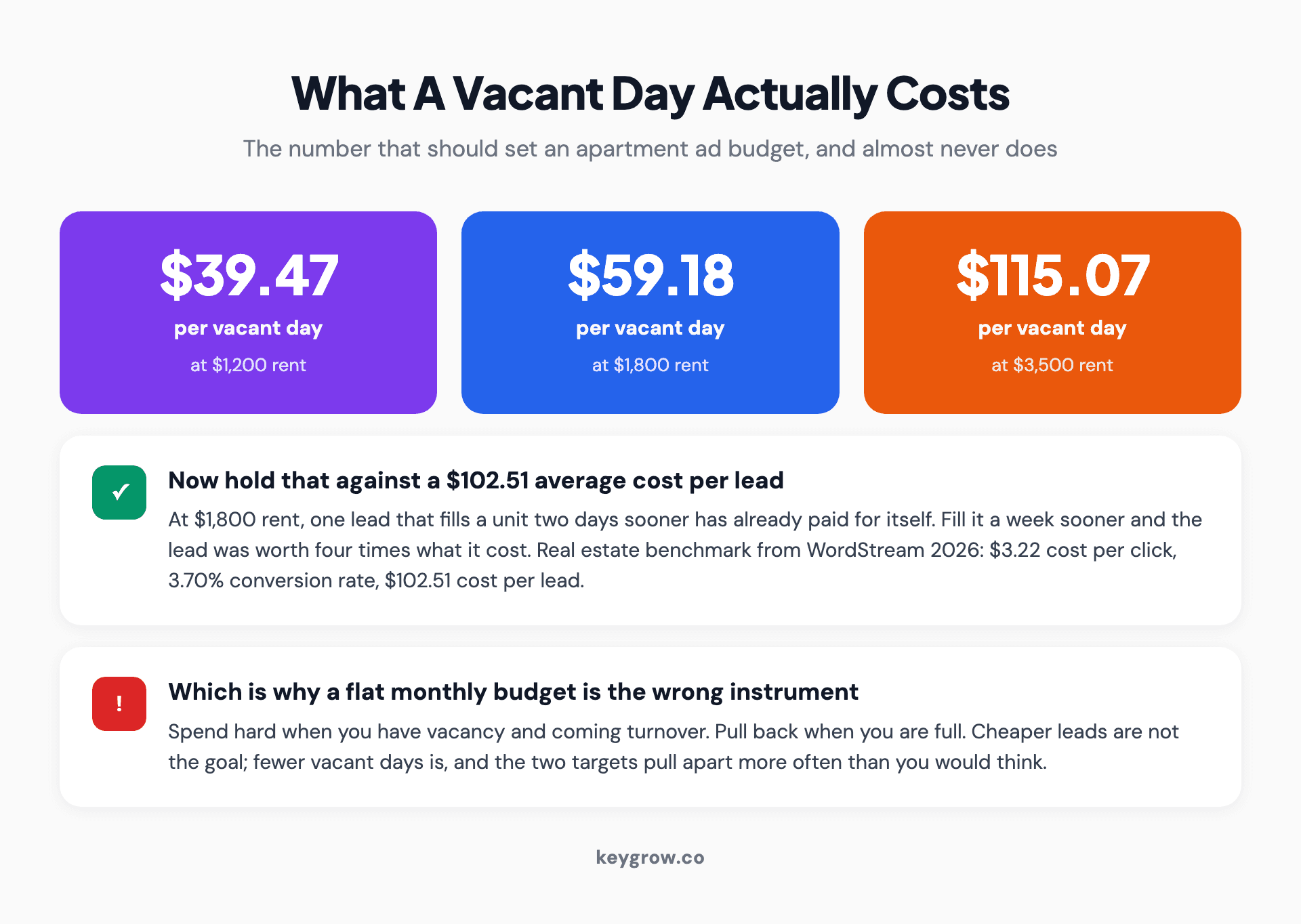
Three stat cards showing the cost of a vacant apartment day at $39.47, $59.18 and $115.07 for rents of $1,200, $1,800 and $3,500, set against a $102.51 average cost per lead.
Housing is a restricted category, and the restrictions are strict
This is the part that catches new apartment advertisers, and it is not optional or gradual.
Under Google's housing policy, advertisers in housing categories in the United States and Canada, including individual properties for rent, cannot target by gender, age, parental status, marital status, or zip code. Radius targeting is permitted but requires setting at least one kilometer around any given location.
Two operational details from the policy FAQs matter more than the headline:
Demographics must be set to enable, not partially excluded. Age, parental status and gender all have to be enabled. You cannot have one set to exclude and the others enabled. Advertisers routinely trip this by excluding one age bracket for reasons that feel practical rather than discriminatory.
There is a 60-day clock and it has teeth. Advertisers have 60 days to accept the policy. After that, ads using the restricted targeting stop serving, and you cannot create new campaigns in the account until the policy is accepted. That second consequence is the one that hurts, because it arrives in the middle of a lease-up.
Customer Match and remarketing are restricted only where the lists were built using those demographic or zip code signals. A list of past website visitors is fine. A list segmented by age is not.
None of this is Google being difficult. Housing discrimination in advertising is a real and heavily litigated area, and the platform has removed the levers rather than police their use. Treat compliance as a fixed constraint of the category, like a building code.
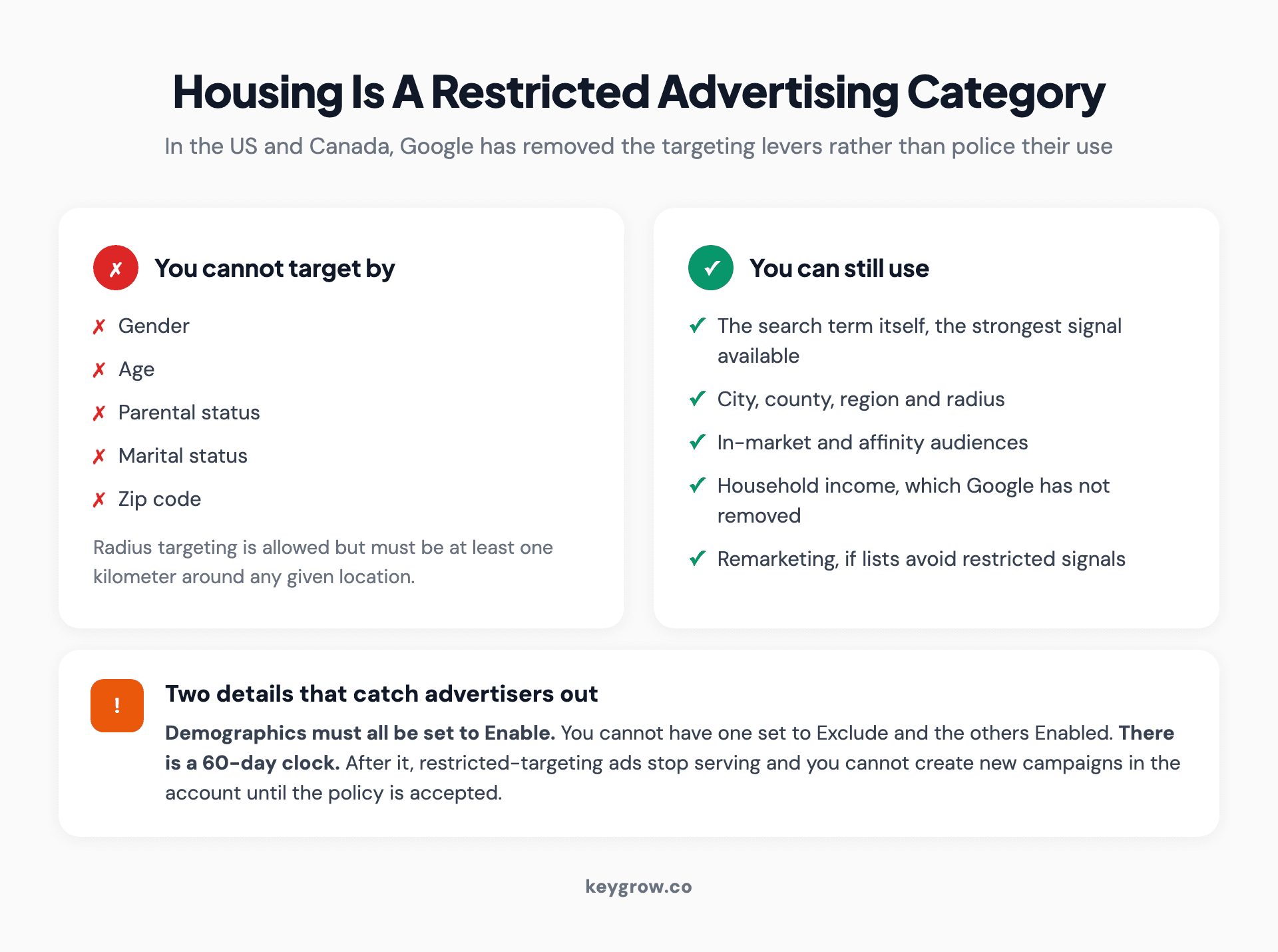
Two-column card layout of Google's housing advertising restrictions, listing the blocked targeting options including age and zip code against what remains available such as search terms and household income.
What you can still target, and it is enough
The restrictions sound worse than they play out, because the thing that actually works in this category was never demographic.
You still have:
- The search term itself, which is the strongest signal available. Someone typing "2 bedroom apartments near [neighborhood]" has told you more than any age bracket would.
- Geography above the zip code level: city, county, region, and radius at one kilometer or wider.
- In-market and affinity audiences, including people actively shopping for an apartment.
- Household income targeting, which Google has not removed, unlike some other platforms.
- Device, schedule and remarketing, provided the lists are not built on restricted signals.
A renter searching for a two-bedroom in a named neighborhood at 9pm on a phone is a better prospect than any demographic segment you could have built. The keyword does the work the targeting used to.

An apartment tower with stacked glass balconies photographed against a pink dusk sky.
The account is a speed problem
Every day of delay between the search and the scheduled tour costs you a vacant day. Design the account around compressing that gap rather than around volume.
Three things move it:
Answer speed. Rental inquiries decay fast, and the community that replies in ten minutes books the tour that the community replying tomorrow does not. If nobody is covering inquiries in the evening and at weekends, when renters actually search, fix that before increasing spend.
Self-service scheduling. A form that says "we will be in touch" adds a full cycle. A calendar that lets someone pick Saturday at 11am removes it. This single change usually does more for time-to-lease than any bidding work.
Ad-to-page continuity. Someone searching for a two-bedroom should land on two-bedroom availability with prices, not on a community homepage with a video tour of the pool.
Call and form extensions, location assets and a click-to-call number on mobile are all cheap to set up and all shave hours off the same gap.
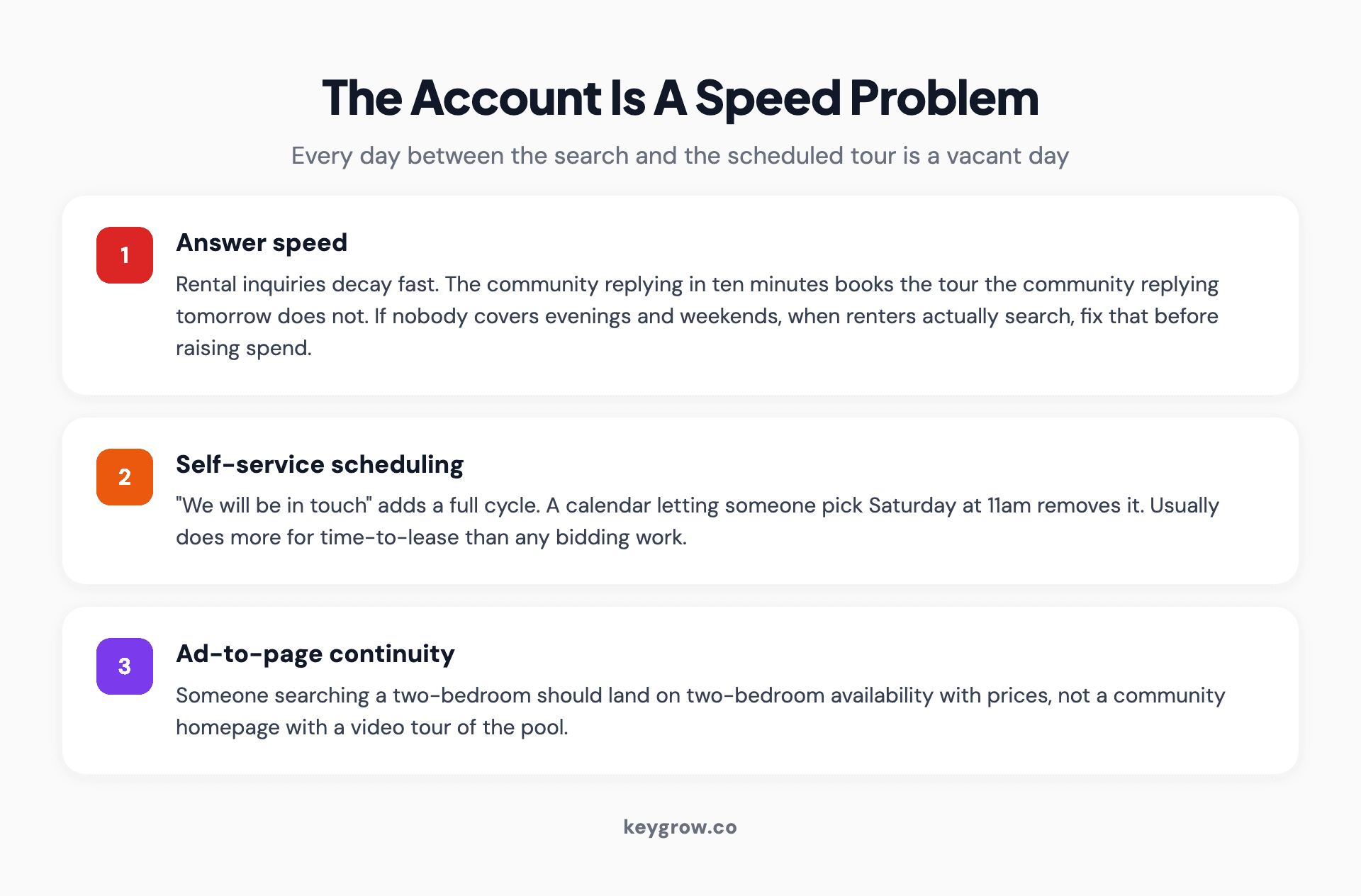
Three numbered cards on compressing the gap between search and scheduled tour: answer speed, self-service scheduling and ad-to-page continuity.
Which searches renters actually make
Buy the searches that contain a unit type, a place, or a constraint. Skip the ones that describe a mood.
Worth buying:
- Bedroom count plus neighborhood. "2 bedroom apartments [neighborhood]" is the core of the account.
- Constraint searches. Pet friendly, in-unit laundry, parking included, furnished, short term lease. These convert well because the constraint is the whole reason they are searching.
- Your own community name. Renters search it after seeing your building or a listing elsewhere, and listing sites will bid on it if you do not.
- Move-in timing terms. Available now, immediate move in.
- Nearby anchors, where proximity is the actual selling point: near a named campus, near a named hospital, near a transit line.
Block from day one: *buy, for sale, houses, homes for sale, mortgage, section 8* if you do not participate, *cheap, free, rent to own,* and every furniture, moving-company and utility-provider term. Also block *jobs* and *leasing agent*, which pull in job seekers. The negative keyword method is standard here; the list just needs to be built before launch rather than after the first month's report.
One warning specific to this category. Broad match plus automated bidding on housing terms will find you an enormous volume of people researching how to rent, how to break a lease, or what a credit score needs to be. The intent gap between "apartments for rent [neighborhood]" and "apartment rental tips" is total, and only one of them will ever sign.
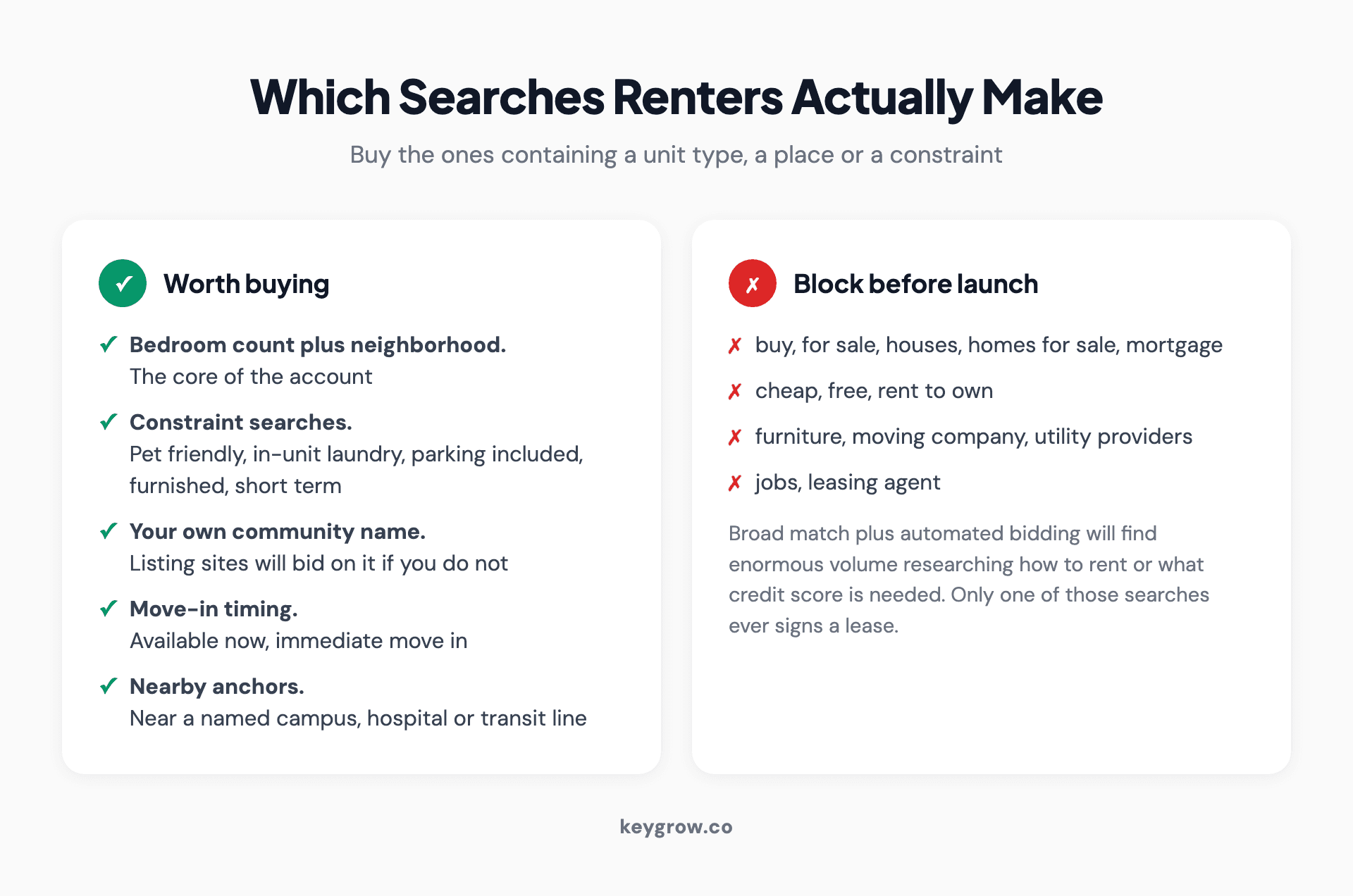
Two-column card layout of apartment searches worth buying, such as bedroom count plus neighborhood and constraint terms, against the keywords to block before launch.
What the page has to settle before they leave
Renters comparing four communities are looking for four facts, and most apartment sites bury all four behind a form.
- Is anything available in the size I want, and when? Live availability, or at least honest current inventory. "Contact us for availability" reads as no.
- What does it cost, all in? A rent range plus the fees that will appear later: pet rent, parking, amenity, utility. Communities that publish this get fewer inquiries and far better ones.
- What is the building actually like? Real photos of the actual unit type, floor plans, and a video walkthrough. Not the lobby and the gym six times.
- How do I see it? A booking calendar with real slots, including evenings and weekends, plus a self-guided option if you offer one.
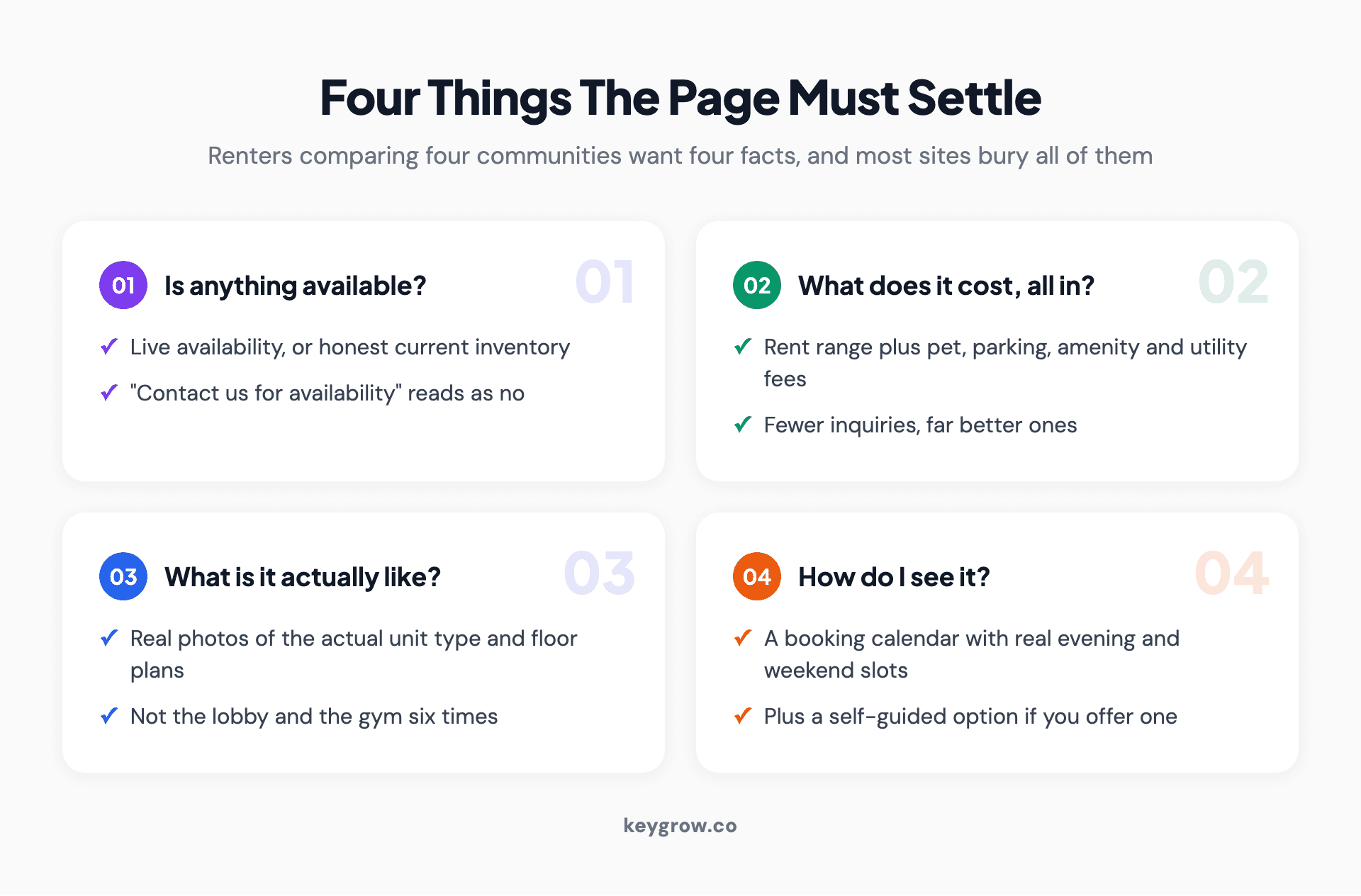
Four numbered cards covering what an apartment landing page must settle: availability, all-in cost, what the building is actually like, and how to book a tour.
We rebuilt a junk removal client's landing page and lead form submissions rose 180 percent in eight weeks on the same traffic. The mechanism transfers directly: the traffic was never the problem, the form standing between the visitor and the next step was. In apartments that form is usually asking for a phone number before it has shown a price.
If you are weighing a dedicated page against your existing community site, the trade-offs are in our note on ad landing pages.
Measure days to lease, not cost per lead
Track the whole chain, and judge the program on the last link.
The chain runs: click, inquiry, tour scheduled, tour attended, application, signed lease, move-in date. Cost per lead tells you about the first two steps and nothing about the ones that pay rent.
Two numbers are worth reporting monthly:
- Cost per signed lease, which is your real acquisition cost and usually a small fraction of a month's rent.
- Average days from inquiry to signed lease, which is the number the whole account exists to reduce.
Feed lease values back into Google Ads where your systems allow it, using the approach in our guide to lead value from PPC, so bidding optimizes toward the unit types that actually get signed rather than toward whichever inquiry is cheapest to generate. Studios and three-bedrooms should not be treated as interchangeable conversions when one of them is sitting empty.
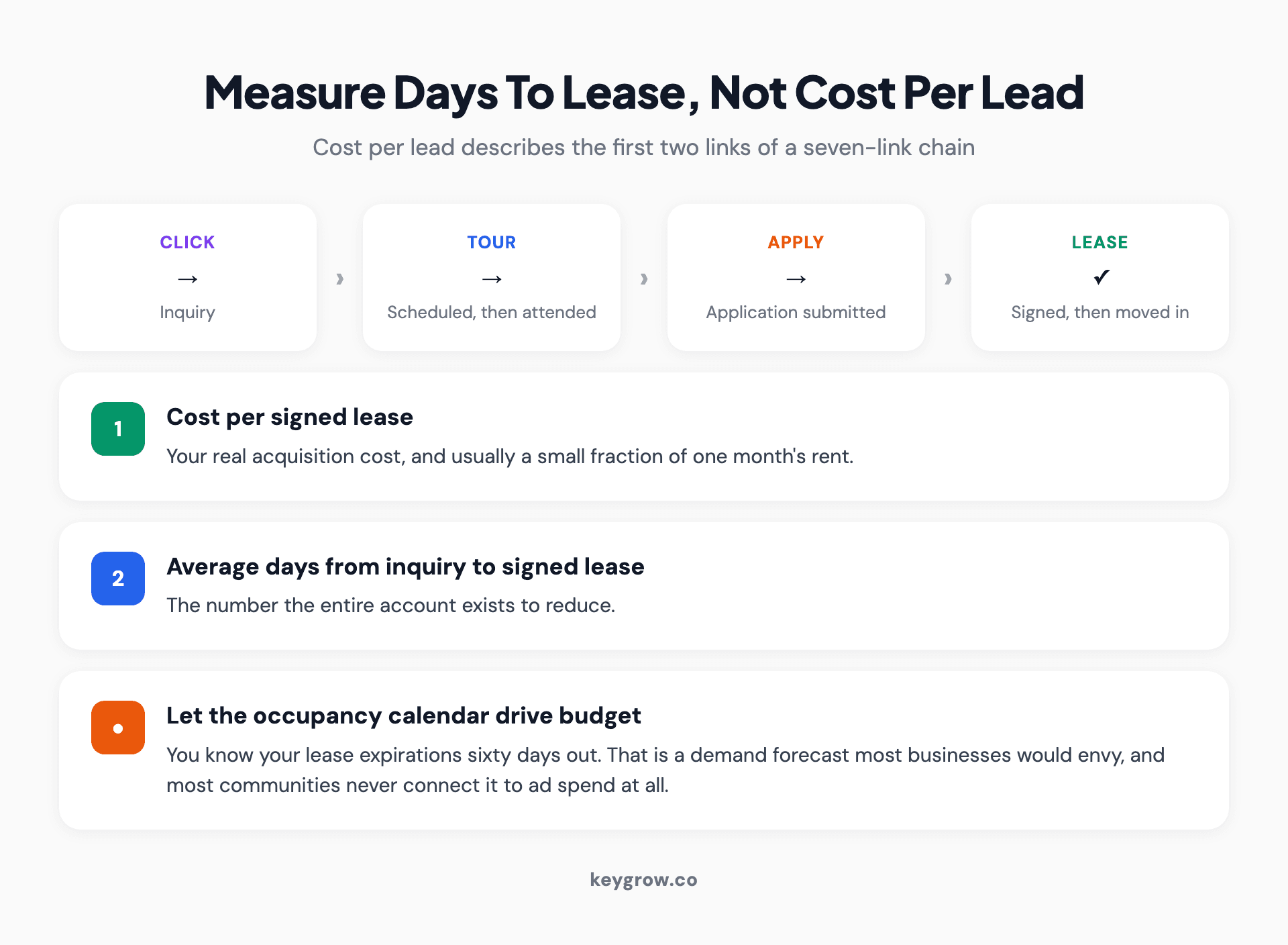
A four-stage flow from click to signed lease, with the two numbers worth reporting monthly: cost per signed lease and average days from inquiry to signed lease.
The occupancy calendar should also drive budget. You know your lease expirations sixty days out. That is a demand forecast most businesses would envy, and most communities do not connect it to ad spend at all.
Communities that should skip this entirely
Some apartment properties should not be buying search ads, and it is worth being blunt about which.
If you are at 97 percent occupancy with a waiting list, stop. You are paying to generate tours you cannot serve, and the reputational cost of unreturned inquiries is real.
If your listings on the large rental marketplaces are already producing more qualified tours than your leasing team can handle, fix the staffing before adding a channel. Search ads will not help a bottleneck that sits after the inquiry.
If nobody answers inquiries outside business hours, address that first. Renters search evenings and weekends, and an unanswered Saturday inquiry at these lead costs is expensive twice over.
And if you manage a single small building where the entire annual turnover is three units, the math rarely supports a managed program. Claim the Google Business Profile, keep the listings accurate, and spend the money on photography. Our note on real estate marketing covers where paid search does fit in property.
FAQs
Can you target by age or zip code for apartment ads on Google?
No. Housing is a restricted category for personalized advertising in the United States and Canada, so gender, age, parental status, marital status and zip code targeting are all unavailable. Radius targeting is permitted but must be set to at least one kilometer around any location, and demographics must be set to enable rather than partially excluded.
How much should an apartment community spend on Google Ads?
Set it against your vacancy cost rather than as a flat monthly figure. A unit renting at $1,800 costs about $59 for every vacant day, so a lead near the $102.51 real estate average pays for itself if it fills the unit two days sooner. Spend up when you have vacancy and upcoming turnover, and pull back when you are full.
What are the best keywords for apartment Google Ads?
Bedroom count plus neighborhood is the core, followed by constraint searches like pet friendly, in-unit laundry or parking included, plus your own community name and move-in timing terms. Avoid general research phrases about renting, which carry high volume and almost no leasing intent.
Do Google Ads work for apartments compared to rental listing sites?
They serve different moments. The large listing marketplaces reach people browsing and filtering inventory, while search ads reach people who have narrowed to a neighborhood and a unit type. Most communities run both, and search ads tend to produce faster tours because the searcher is closer to a decision.
What happens if I do not accept Google's housing policy?
You have 60 days to accept it. After that, ads using the restricted targeting types stop serving, and you cannot create new campaigns in the account until the policy is accepted. The second consequence is the damaging one, because it typically surfaces in the middle of a lease-up when you need to add campaigns.
Should apartments use remarketing?
Yes, provided the audience lists are not built using restricted signals. Customer Match and remarketing are limited only where the lists were assembled from demographics, marital or parental status, or zip code. A list of previous website visitors or people who started an application is permitted and works well, since renters compare several communities before choosing.
How do I measure whether apartment ads are working?
Track cost per signed lease and average days from inquiry to signed lease, not cost per lead. Leads tell you about the top of the process while vacant days are what actually cost money, so a campaign producing slightly more expensive inquiries that lease faster is the better campaign.
What to fix first
Before touching a bid, work out your cost per vacant day and put it somewhere the whole team can see it. Almost every decision in an apartment account gets easier once that number is explicit, because it converts an abstract marketing debate into a daily figure.
Then compress the gap between the search and the scheduled tour: evening and weekend coverage, self-service booking, and a page that shows availability and real all-in pricing before it asks for a phone number. The targeting restrictions mean you cannot out-clever anyone on audiences in this category, so the advantage available to you is speed and honesty about price.
If you want that built and run against occupancy rather than against a flat monthly budget, that is what our PPC management does, month to month, cancel anytime.