

SEO for home builders is not one job. Custom builders and production builders sell different things to different people on different timelines, and the SEO that works for one produces almost nothing for the other. Almost every guide on this topic treats them as the same business, which is why so much of the advice lands flat.
The other thing nobody mentions: a builder's website has inventory. Communities open and close, floor plans get retired, spec homes sell. Pages appear and disappear on a schedule no plumber ever deals with, and handling that badly is the most common way builders quietly destroy their own search equity.

New home under construction with the wooden frame visible behind site fencing.
First, which builder are you?
The answer changes everything downstream, so settle it before anything else.
A production builder sells a defined product in a defined place. The searcher wants a house in a specific community, at a price, ready on a date. Their queries are location-heavy and inventory-heavy: new homes in a named suburb, a specific community by name, quick move-in homes, floor plans under a square footage. The SEO problem is inventory architecture.
A custom builder sells a process and a relationship. There is no inventory. The searcher is early, nervous, and researching for a year: what custom building costs per square foot, how long it takes, what a construction loan involves, how to choose a builder, what happens if the budget runs over. The SEO problem is content depth and trust.
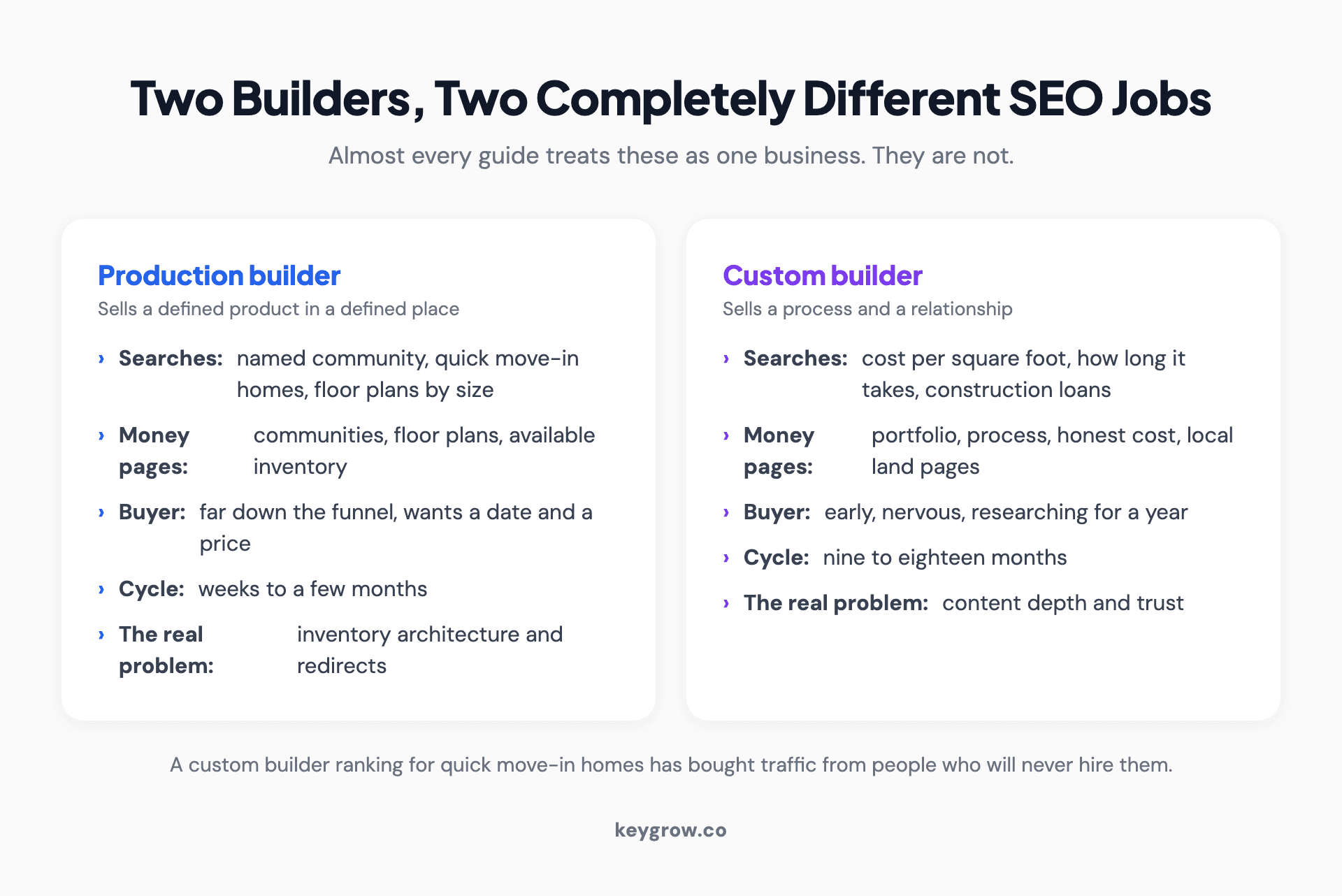
Split comparison of production builder SEO and custom builder SEO, showing different search intent, page types and sales cycles.
Semi-custom builders sit between the two and need both, weighted toward whichever half brings the margin.
If you take one thing from this article, take this: run the query set for your actual model. A custom builder ranking for quick move-in homes has bought traffic from people who will never hire them, and a production builder writing eleven thousand words on construction loan mechanics has spent a quarter on an audience buying somewhere else.
The pages that actually produce buyers
For production builders, the money sits in a three-level structure that most builder sites either flatten or bury.
Community pages come first. A named community in a named city is the highest-intent search a production builder can win, competition is thin because only builders in that community can plausibly rank, and the buyer searching it is far down the funnel. Each community deserves a substantial page: location and what is nearby, schools, price range, available plans, current inventory, HOA facts, and photos of the actual place rather than renderings.
Floor plan pages come second. People search plans by name once they have seen them, and by attribute before they have: four bedroom single story, plans with a first floor primary suite, homes under 2,000 square feet. A plan page should carry square footage, bed and bath counts, the elevations, an interactive or downloadable plan, which communities offer it, and the starting price.
Quick move-in and spec home pages come third, and they are the most valuable and most fragile pages on the site. High intent, short shelf life.
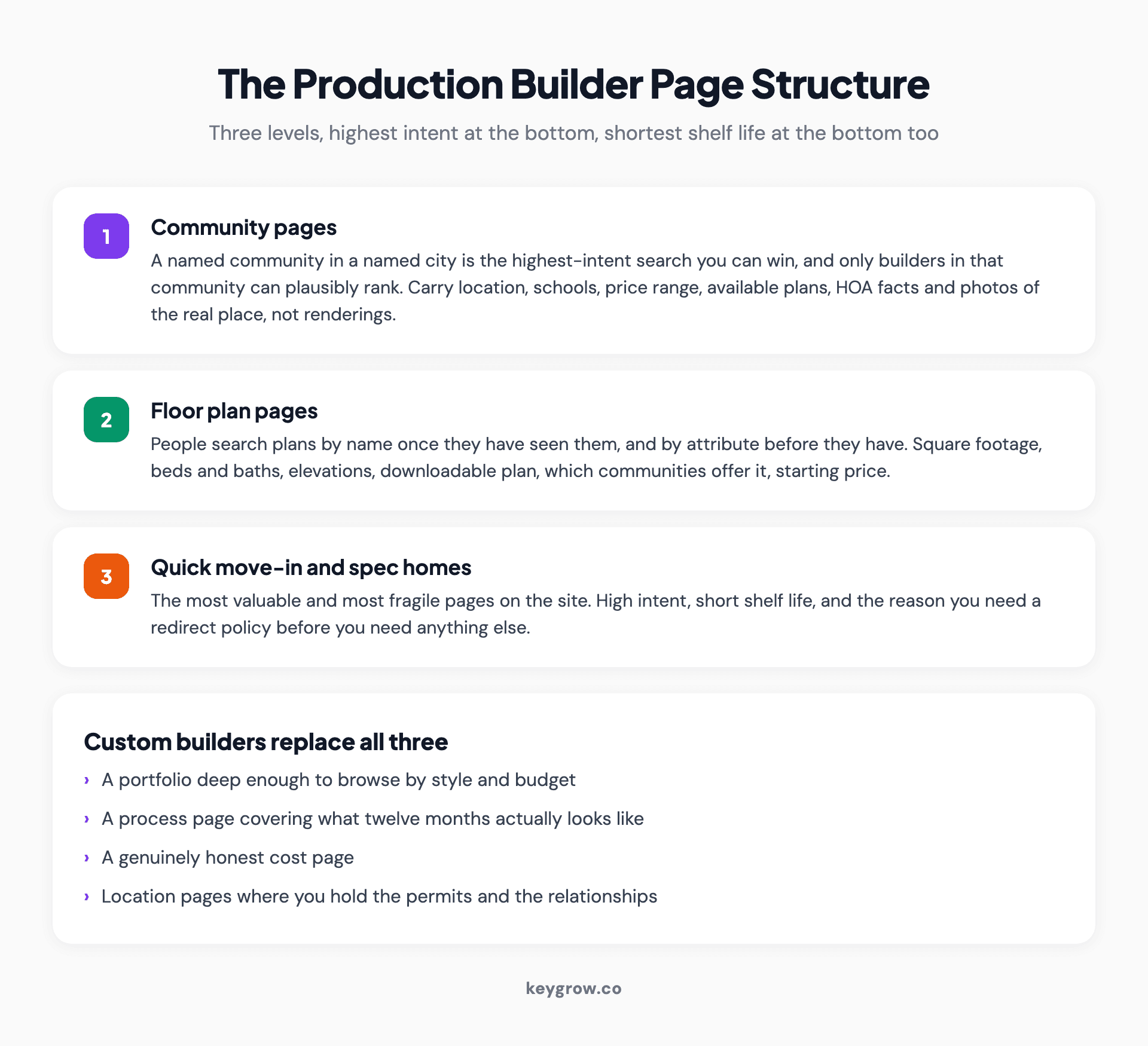
Three-level page architecture for a production home builder, from community pages down to floor plans and available inventory.
Custom builders replace all three with a different set: a project portfolio deep enough to be browsable by style and budget, a process page that explains what the twelve months actually look like, a genuinely honest cost page, and location pages for the areas where you hold the permits and the relationships.
What to do when a home sells
This is the section other builder SEO guides skip, and it is where real damage happens.
A spec home page ranks, accumulates links and gets shared. Then the house sells and somebody deletes the page. Every link pointing at it now returns a 404, the accumulated authority evaporates, and the buyer who found it through a shared link lands on an error instead of the four similar homes you have available.
Multiply that by every home you sell and you have a website that resets its own equity several times a year.
The fix is a policy, decided once and applied every time:
| Situation | What to do | Why |
|---|---|---|
| Spec home sold, similar plan available | 301 redirect to the floor plan page | Keeps the equity, lands the visitor somewhere useful |
| Spec home sold, plan retired | 301 redirect to the community page | Community is the next most relevant thing |
| Community sold out | Keep the page, mark it sold out, link to nearby communities | It still ranks and still gets searched by name |
| Floor plan retired | Keep the page, mark it unavailable, link to the closest current plan | People search retired plans by name for years |
| Whole site rebuild | Map every URL before anything is deleted | Covered properly in our redesign guide |
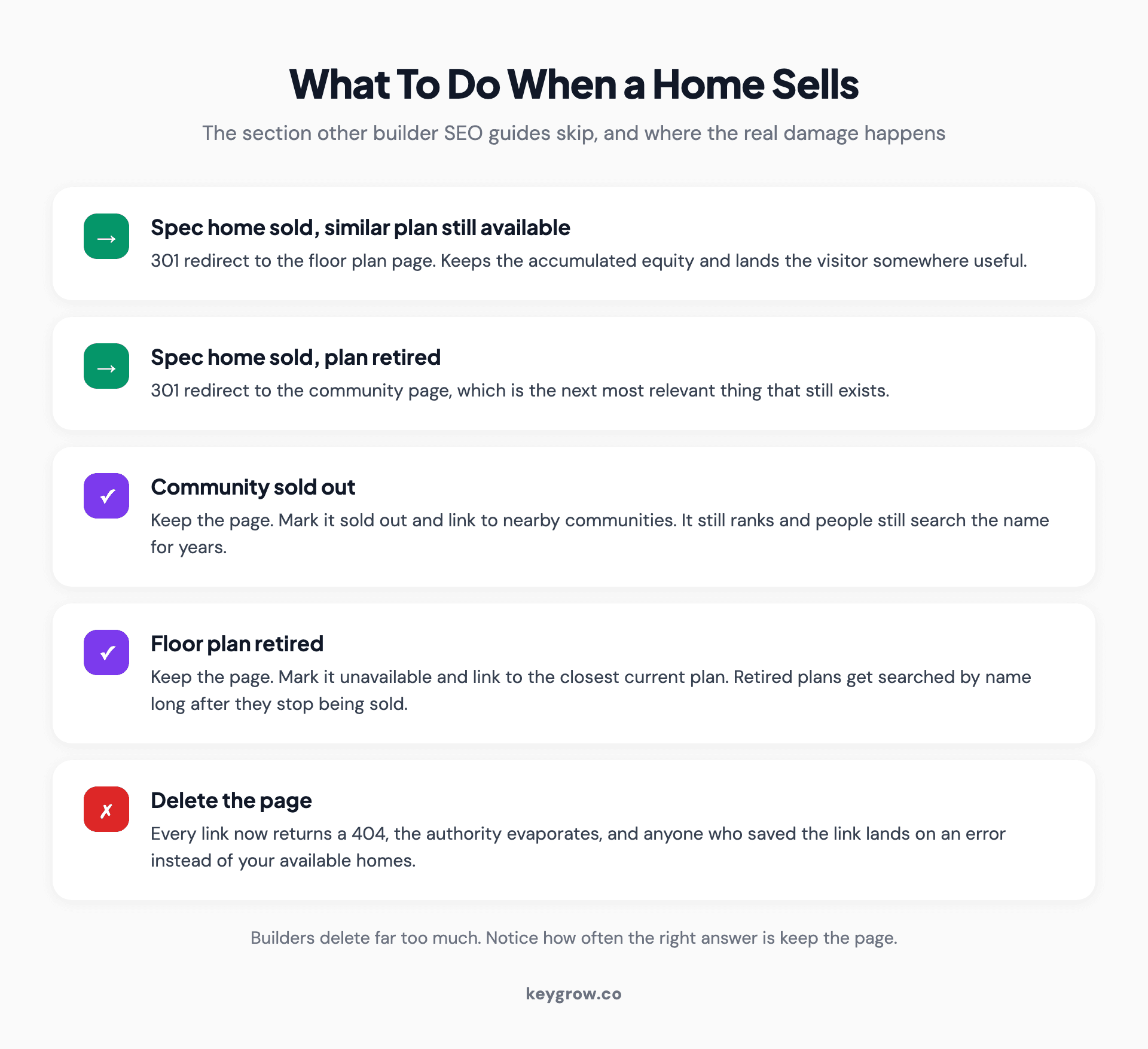
Redirect policy for home builder inventory pages when a spec home sells or a community closes out, preserving search equity.
Notice how often the answer is keep the page. Builders delete far too much. A sold-out community page that still ranks for the community name is a free lead source for the resale market and for your next phase nearby, and it costs nothing to leave up.
If you are rebuilding the site entirely, the URL mapping is the whole job. We wrote that up separately in redesigning without losing SEO, and builders are the vertical where skipping it hurts most, because there are so many URLs.

Modern newly built home with a landscaped lawn and driveway.
You cannot outrank the portals, so stop trying
Search any generic new-homes phrase and the first page belongs to the national listing sites and the biggest national builders. That is not a gap in your SEO. It is a structural fact about that query class, and no amount of content fixes it.
The winnable ground sits in three places the portals are structurally bad at.
Named specificity. Your community by name, your plans by name, the streets and school zones a local buyer actually types. A national aggregator has a thin templated page for these. You can have the real one.
Process and cost questions. What building costs per square foot in your metro this year, what the permit timeline is in your county, how a construction loan draws work locally. Portals do not write this because it does not scale nationally. It is exactly what an early buyer searches, and the national figures give you a hook to localize: NAHB's cost survey found construction costs made up 64.4 percent of the average new home price in 2024, a record for the series. Your buyer wants to know what that percentage looks like on their lot, in your county, this year. Nobody national can tell them.
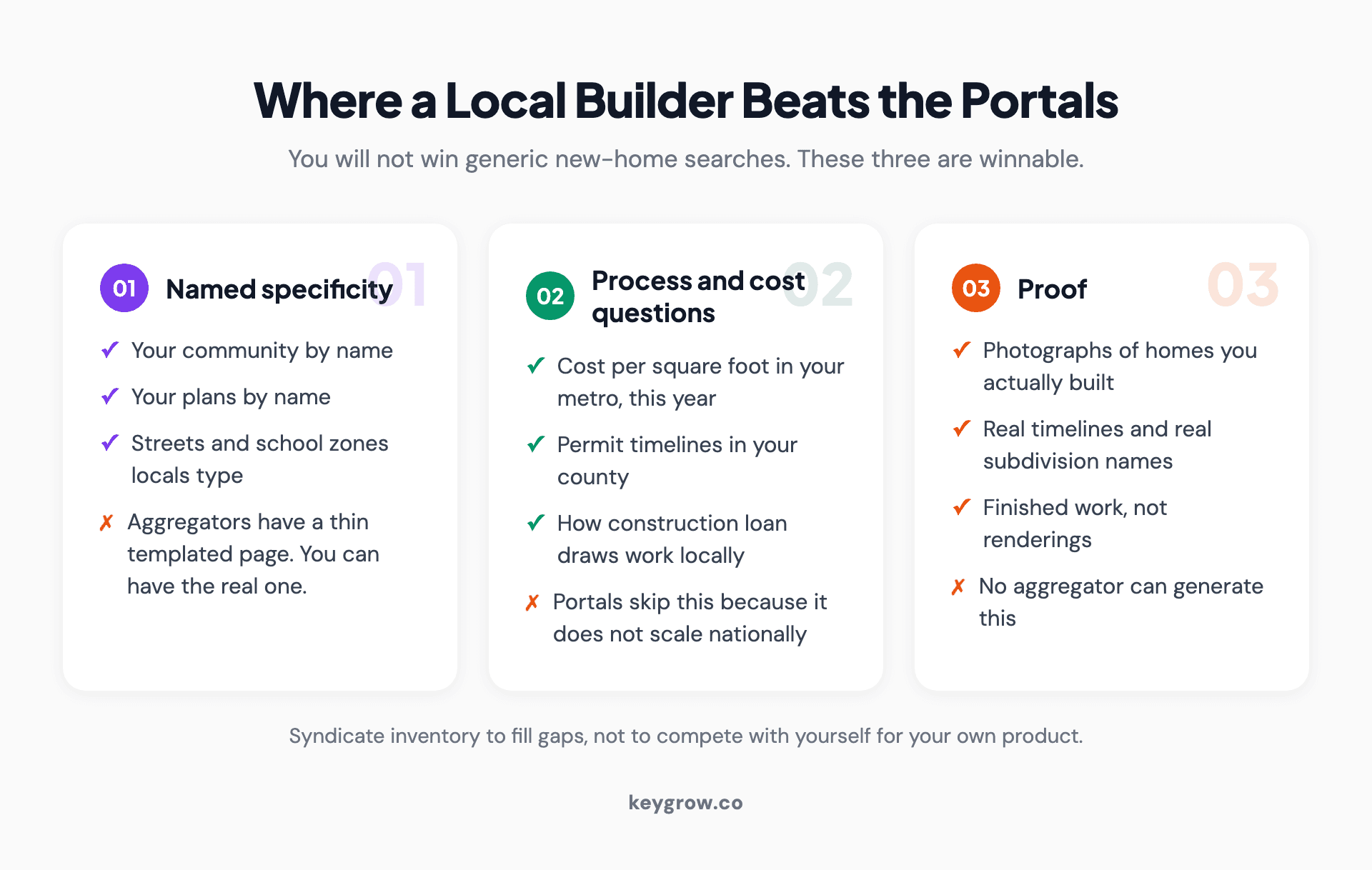
Where local home builders can win against national listing portals: named communities, local cost and permit questions, and real photography.
Proof. Real photographs of finished homes, real timelines, real names of the subdivisions. Aggregators publish renderings and stock imagery. A builder publishing a hundred photographs of homes they actually built has something no portal can generate.
That is also the reason to be selective about how much of your inventory you syndicate to third parties. Feeding everything to the aggregators makes their pages better than yours for your own product, and then you pay them for the lead. Syndicate what fills gaps, not what you can rank for yourself.
Local SEO when you build across a metro
Builders have a geography problem that most local businesses do not: the office is in one place and the homes are in twenty.
Your Google Business Profile should reflect where you actually are, with a service area covering where you build. Model home locations can be listed as separate profiles when they are genuinely staffed during posted hours, which is a real distinction rather than a technicality. Sales centers that are open by appointment only are usually not eligible, and listing them anyway is how builders lose profiles. The mechanics of getting that right are in our Google Business Profile guide.
Then build a genuine page per market you serve, not twenty near-identical pages with the city name swapped. The test is simple: if you could paste a different city name in and the page would still be true, it is a template and it will not rank. A real market page names the communities you build there, the school districts, the permit realities, the price band, and the homes you have finished nearby.
Content for a buyer who takes a year to decide
A home purchase has a research cycle measured in months, which changes what content is for. You are not closing anyone with a blog post. You are being present and useful enough, often enough, that you are on the list when the shortlist forms.
Map content to the stage rather than to a keyword list:
- Early, nine to eighteen months out. Cost per square foot in your area, buy versus build, how long building takes, financing basics, land considerations. Highest volume, lowest intent, most valuable for building the audience.
- Middle, three to nine months out. Comparing builders, what is included in a base price and what is not, allowances and upgrades, warranty terms, questions to ask on a model home tour.
- Late, under three months. Community specifics, plan comparisons, inventory, incentives, the process from contract to closing.
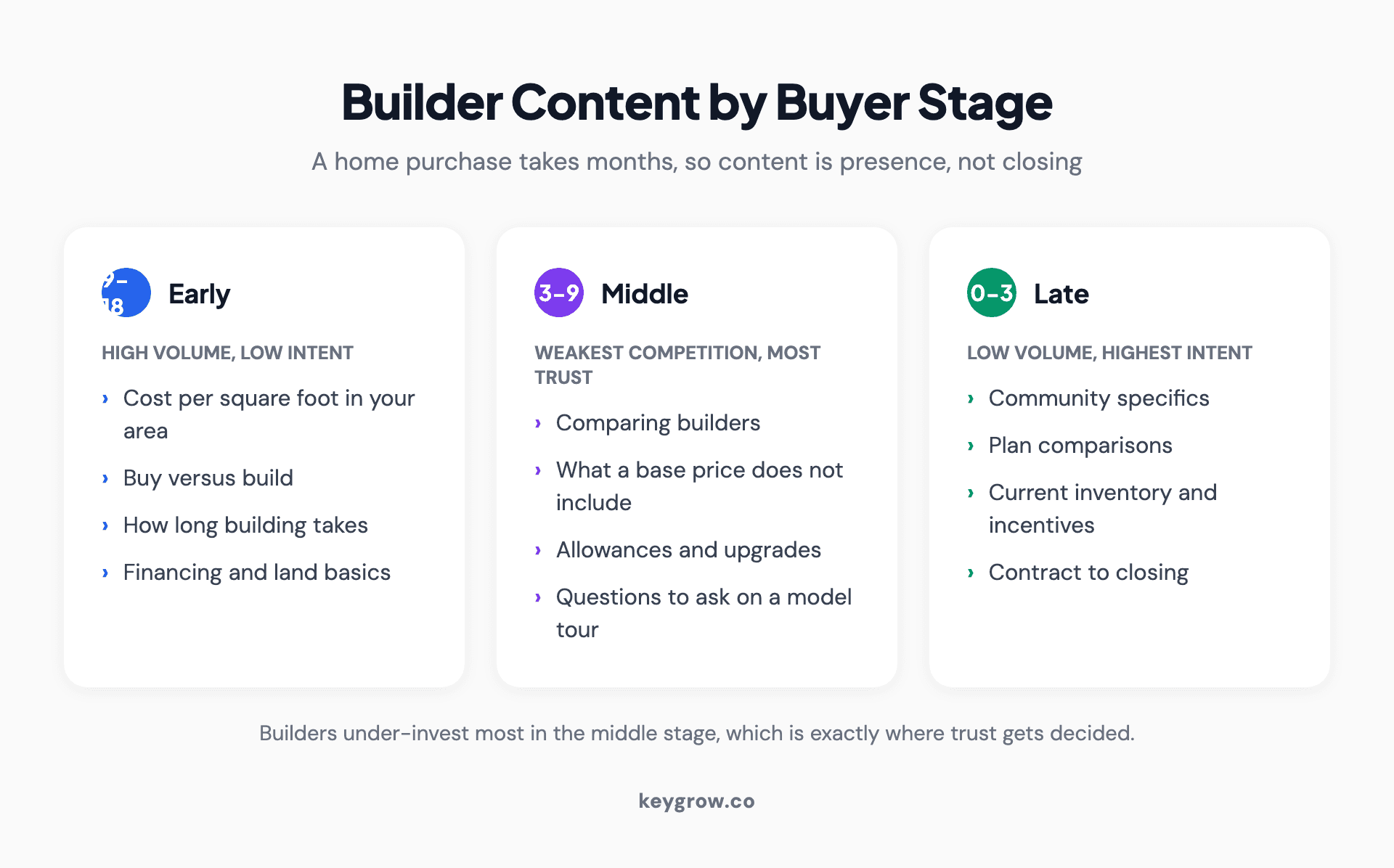
Home builder content mapped to the buyer research cycle, from early cost questions through builder comparison to community and inventory pages.
The middle stage is where builders under-invest most and where the competition is weakest, because writing honestly about what is not included in a base price feels commercially risky. It is the single most useful thing you can publish. Every buyer has been surprised by an allowance, every buyer is afraid of it happening again, and the builder who explains it plainly wins the trust that the shortlist runs on.
The lead quality problem
Home builders receive an enormous volume of unqualified enquiries, and more traffic is usually the wrong fix.
The pattern is familiar from other high-ticket categories. A cash home buyer client of ours was drowning in junk leads, and the answer was not more volume. It was filtering: tighter targeting, negative keywords, and qualifying language in the copy itself. Serious leads went up 600 percent between December and January on the same budget.
For builders, the qualifying language belongs on the page. Publish your starting price band. State the areas you build in and the ones you do not. Say what your minimum project size is if you have one. Every one of those loses you enquiries, which is the point, and the enquiries it loses were never going to close.
This is also where an agency that knows the industry earns its fee, and where a generalist quietly costs you. Someone optimizing toward cost per lead will drive your numbers toward the cheapest possible enquiry, which in home building means people who searched a price you do not build at. Ask any agency what your average sale price is and whether they know the difference between a spec home and a custom build. The answer tells you a lot.

Aerial view of a modern home with surrounding landscaping in a new development.
Technical items that matter more for builders
Three technical points that are ordinary elsewhere and load-bearing here.
Image weight. Builder sites are photograph-heavy by nature, and they are routinely the slowest sites in local search because nobody compressed a gallery of forty exterior shots. This is the highest-return technical fix on most builder websites, and it is unglamorous enough that it never gets done.
Structured data. Mark up floor plans and available homes properly so the specifications are machine readable, and use LocalBusiness for the company and the model homes. Our schema markup generator handles the JSON if you would rather not write it.
Faceted navigation. Plan filters by bedrooms, square footage and price generate enormous numbers of URL combinations. Left uncontrolled, they bury the pages you actually want ranked under thousands of near-identical filter pages. Google's guidance is blunt about the cost: crawlers work through vast numbers of filter URLs before deciding they are useless, which leaves less time for the pages that matter. Decide which combinations deserve to be indexed, and block the rest in robots.txt.
How long, and what it costs
Realistically: local profile and community pages can move in two to four months. Competitive metro terms and the early-stage content take six to twelve. The sales cycle then adds its own lag, because someone who found you through a cost article in March may not sign until the following spring.
That lag is the thing that gets builder SEO cancelled at exactly the wrong moment. The strongest organic result we have produced took a full year to reach 1,519 percent traffic growth, and the first quarter looked unremarkable. Attribution makes it worse here, because the buyer who signs today first arrived nine months ago through a page nobody is still measuring.
Set up tracking that survives that gap. Ask on the contract where they first heard of you, and compare it to what analytics claims. The two answers are rarely the same, and the difference is usually organic being undercredited.
When a builder should not buy SEO
Three cases, and we turn away work in all of them.
If you build fewer than about a dozen homes a year and you are booked out, this is not your bottleneck. Capacity is. Ranking better produces enquiries you will decline, and declining enquiries is worse for your reputation than not receiving them.
If you have no photography of finished homes, fix that first. Builder SEO runs on proof, and a site with renderings and stock images cannot compete with one showing real completed work. A photographer for two days costs less than a month of retainer and is a prerequisite rather than an enhancement.
If your website was built by the same company that sells you leads and you do not control the domain or the content, sort the ownership out before investing anything. Building search equity on a platform you do not own is paying rent on an asset you will not keep.
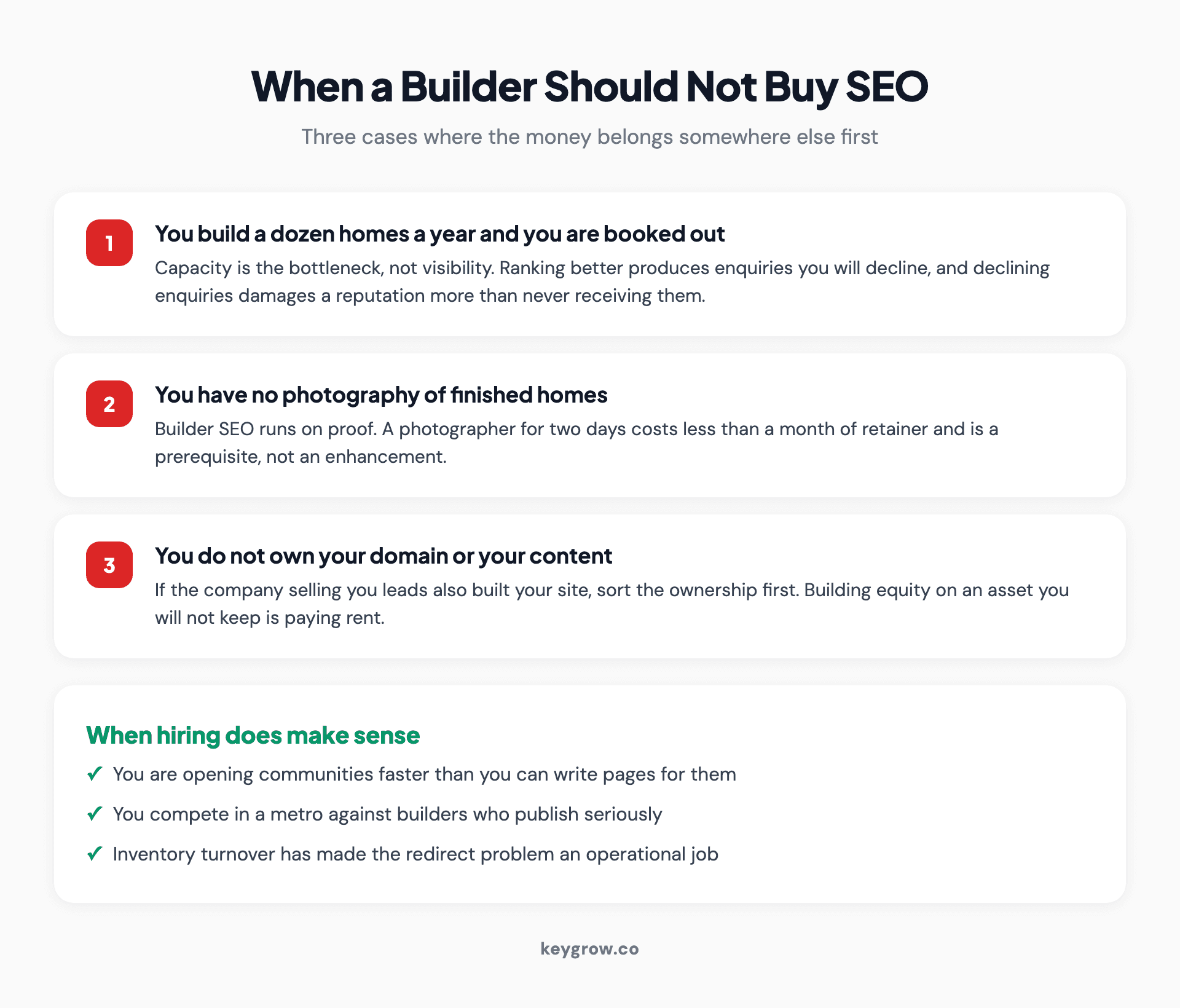
Three situations where a home builder should not buy SEO yet: limited capacity, no photography of finished homes, and a website they do not own.
Hiring makes sense when you are opening communities faster than you can write pages for them, when you compete in a metro against builders who publish seriously, or when the inventory turnover has made the redirect problem an operational job. At that point SEO services are a real purchase, and the paid side is a separate conversation we covered in Google Ads for home builders.
FAQs
What is SEO for home builders?
SEO for home builders is the work of ranking a building company for the searches its buyers actually run. It splits by business model: production builders compete on community, floor plan and inventory pages, while custom builders compete on cost, process and portfolio content aimed at buyers researching for a year before they commit.
How is custom builder SEO different from production builder SEO?
Production builders have inventory, so their SEO is architectural: community pages, floor plan pages, available homes, and a redirect policy for when things sell. Custom builders have no inventory, so their SEO is content-led: cost per square foot, timelines, financing, portfolio depth and trust building over a long research cycle.
What happens to a spec home page after the house sells?
Redirect it rather than delete it. If a similar plan is still offered, 301 the URL to that floor plan page. If the plan is retired, point it at the community page. Deleting the page destroys the links and authority it accumulated and sends anyone who saved the link to a 404.
Can a local builder outrank the national listing portals?
Not for generic new-home searches, and trying is a waste of budget. Local builders win on named communities, named floor plans, local cost and permit questions, and real photography of finished homes. Those are queries the national aggregators cover thinly because the content does not scale nationally.
How long does home builder SEO take?
Local profile and community pages typically move within two to four months. Competitive metro terms and early-stage content take six to twelve. The buying cycle then adds its own delay, since someone who finds you through a cost article may not sign a contract for another six to nine months.
Should home builders publish their prices?
Publish a starting price band at minimum. It costs you enquiries from people shopping below your range, which is the point, and it builds trust with the buyers who can afford you. Being explicit about what a base price includes, and what it does not, is the highest-trust content a builder can publish.
Do model homes need their own Google Business Profile?
Only when they are genuinely staffed during posted hours. A model home with a sales agent on site during published opening times can support its own profile. A sales center open by appointment only usually cannot, and listing one anyway risks suspension of the profiles you do have.
What is the biggest technical SEO issue on builder websites?
Image weight. Builder sites are photograph-heavy by nature and are routinely the slowest sites in local search because galleries of full-resolution exterior shots were uploaded without compression. It is the highest-return fix on most builder sites and almost never the one that gets prioritized.
Where to point the next six months
Decide which builder you are, then pick the matching first move.
Production builders: audit your inventory URLs and write the redirect policy before anything else, because every month without one is equity leaking out of the site. Then build one genuinely substantial community page and use it as the template for the rest.
Custom builders: write the cost page you have been avoiding. Cost per square foot in your market, what moves it, and what a realistic budget looks like. It is the highest-volume question your buyers have and the one your competitors answer with a contact form.
Both: get a photographer out to three finished homes. Everything else on this list works better with real pictures attached, and nothing on it works well without them.
If you want a read on which of those matters most for your specific market, our team is happy to look.