


You finished somewhere between twenty and eighty jobs last year. Each one came with photographs, a scope, a duration, a neighborhood and a budget. You published none of them.
That is the central failure in SEO for contractors, and it is not a keyword problem. It is that the single most rankable thing a construction business produces, a documented finished project, gets posted once to social and then deleted from the phone to free up storage.
Meanwhile the website has a five-item services page, a gallery of nineteen untitled photos, and a contact form.
This post is mostly about fixing that, because it is the piece almost nobody in the category does and it is the piece only you can do.
Your finished jobs are content you have already paid for
Every completed project is a page that can rank for a specific project type in a specific area. You have already done the expensive part, which was the work.

A kitchen mid-renovation, cabinets masked in plastic and paper.
Think about what a completed kitchen remodel actually contains as a document. The neighborhood. The age and style of the house. What the homeowner wanted. What you found when you opened the wall. What it took. How long. Roughly what it cost. Six photographs.
There is no national site that can write that page. There is no AI that can invent it. It is unique by construction, it is genuinely useful to the next person in that neighborhood planning the same job, and it targets a search phrase that is far less contested than anything with the word contractor in it.
Forty of those pages is a moat. Most contractors have zero.
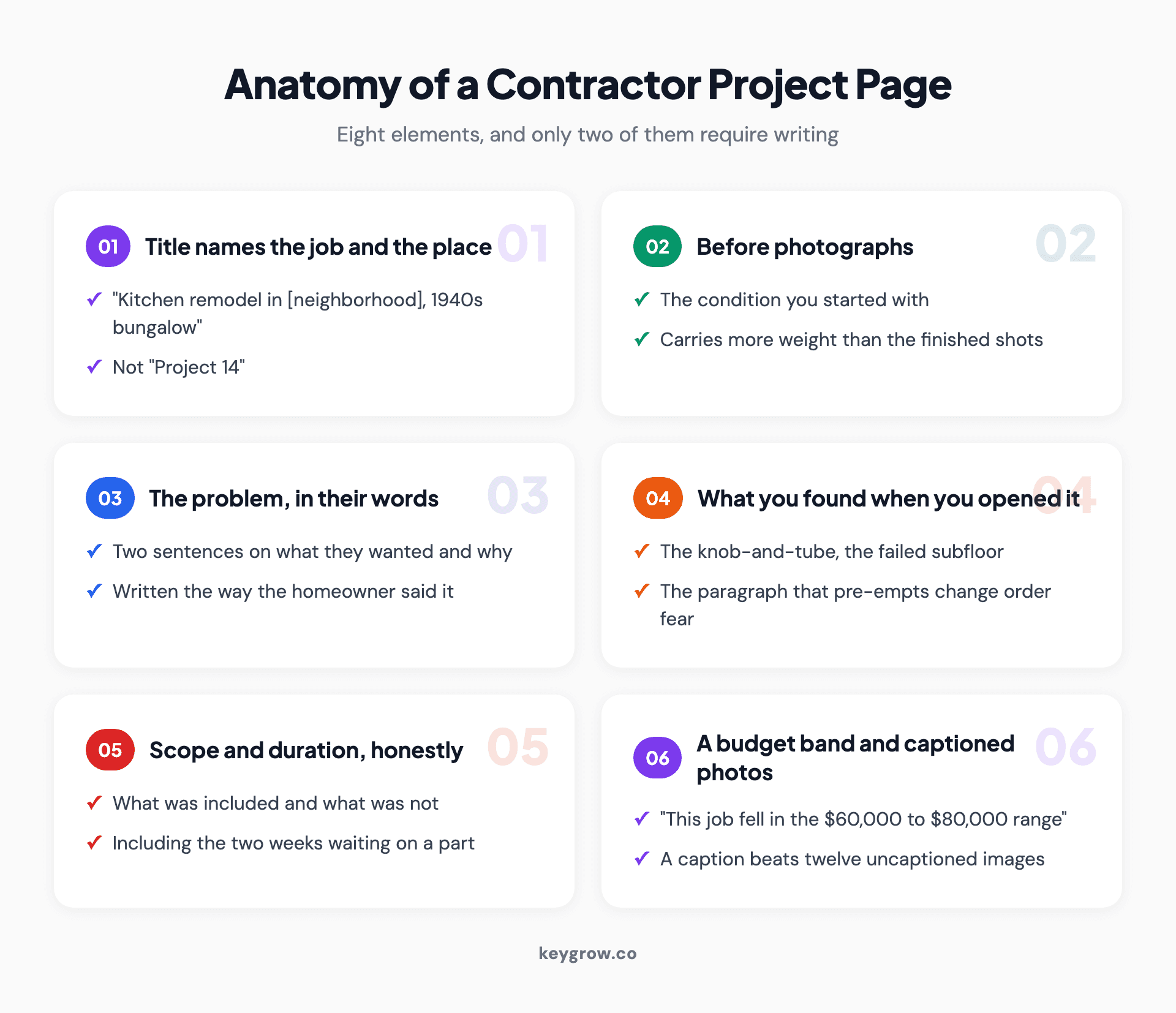
The anatomy of a contractor project page, showing the eight elements that make a finished job rank and convert.
The objection I hear is that clients would not want their project published. Some will not, and you ask. Most are pleased, and the ones who are pleased will also leave you a review while they are in the mood. Build the ask into closeout paperwork and it stops being a conversation you have to remember to have.
What a project page has to contain
Eight things, and only two of them require writing. The rest you already have on your phone.
- A title that names the job and the place. "Kitchen remodel in [neighborhood], 1940s bungalow." Not "Project 14".
- Before photographs. The condition you started with. These carry more weight than the finished shots because they establish what was actually done.
- The problem in the homeowner's words. Two sentences. What they wanted and why.
- What you found. The knob-and-tube, the failed subfloor, the joist that was never sistered. This is the paragraph that convinces the next reader you are not going to surprise them with a change order.
- Scope, in plain terms. What was included. What was not.
- Duration, honestly. Including the two weeks waiting on a part.
- A budget band. Not the exact contract value. "This job fell in the $60,000 to $80,000 range" is enough and it is the most useful line on the page.
- Finished photographs, captioned. A caption saying what you are looking at beats twelve uncaptioned images.
That is a forty-minute page. Do one a week and you will have fifty in a year, each one targeting a different project and a different part of your service area, all of them supporting each other.
The cost question you keep refusing to answer
"How much does a [project] cost in [city]" is the highest-volume search in your category and the one contractors most consistently leave to somebody else.
The reasoning is understandable. Every job is different, materials move, and you do not want to be held to a number by somebody who read a blog post. So the page does not get written, and a national content site with no idea what labor costs in your market writes it instead. Then the homeowner arrives at your estimate with a number in their head that came from a site that has never worked in your county.
You are not avoiding the price conversation by staying silent. You are outsourcing it.
The version that works is a band with the variables attached. What moves a bathroom from the bottom of the range to the top: layout changes, moving plumbing, tile selection, whether the subfloor is sound. Publish that and two things happen. You rank for a term with real volume, and the people who call have already calibrated themselves.
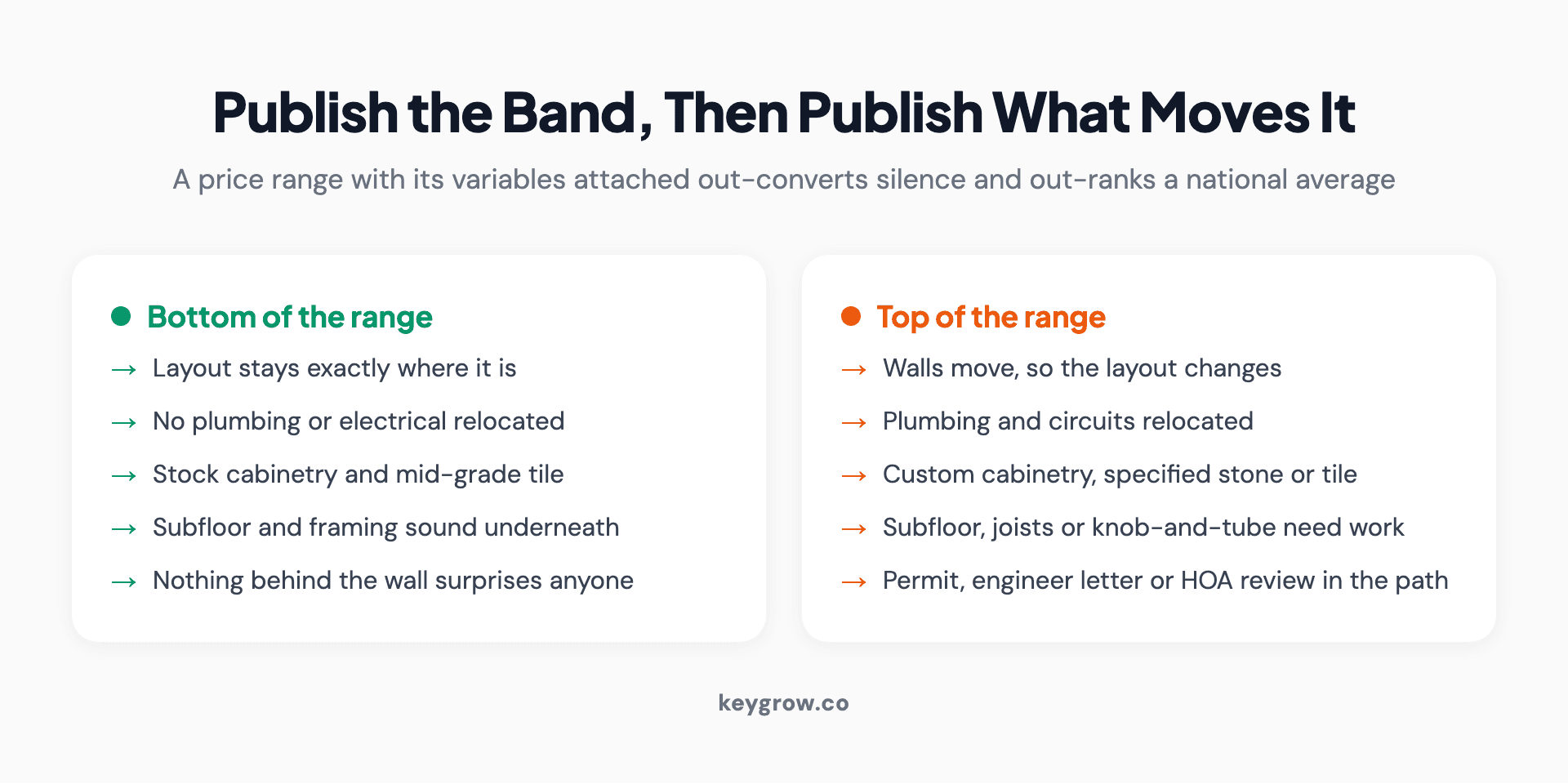
What moves a renovation from the bottom of a price range to the top, as a contractor cost page should present it.
Google's helpful content guidance is fairly direct that first-hand experience is what separates content worth ranking from content assembled from other pages. Local pricing based on jobs you actually completed is about as first-hand as it gets.
The research sequence, and where paid search cannot follow
A homeowner planning an eighty thousand dollar renovation spends three to twelve months on it. Ads can only afford the last two weeks of that. Organic can own all of it.
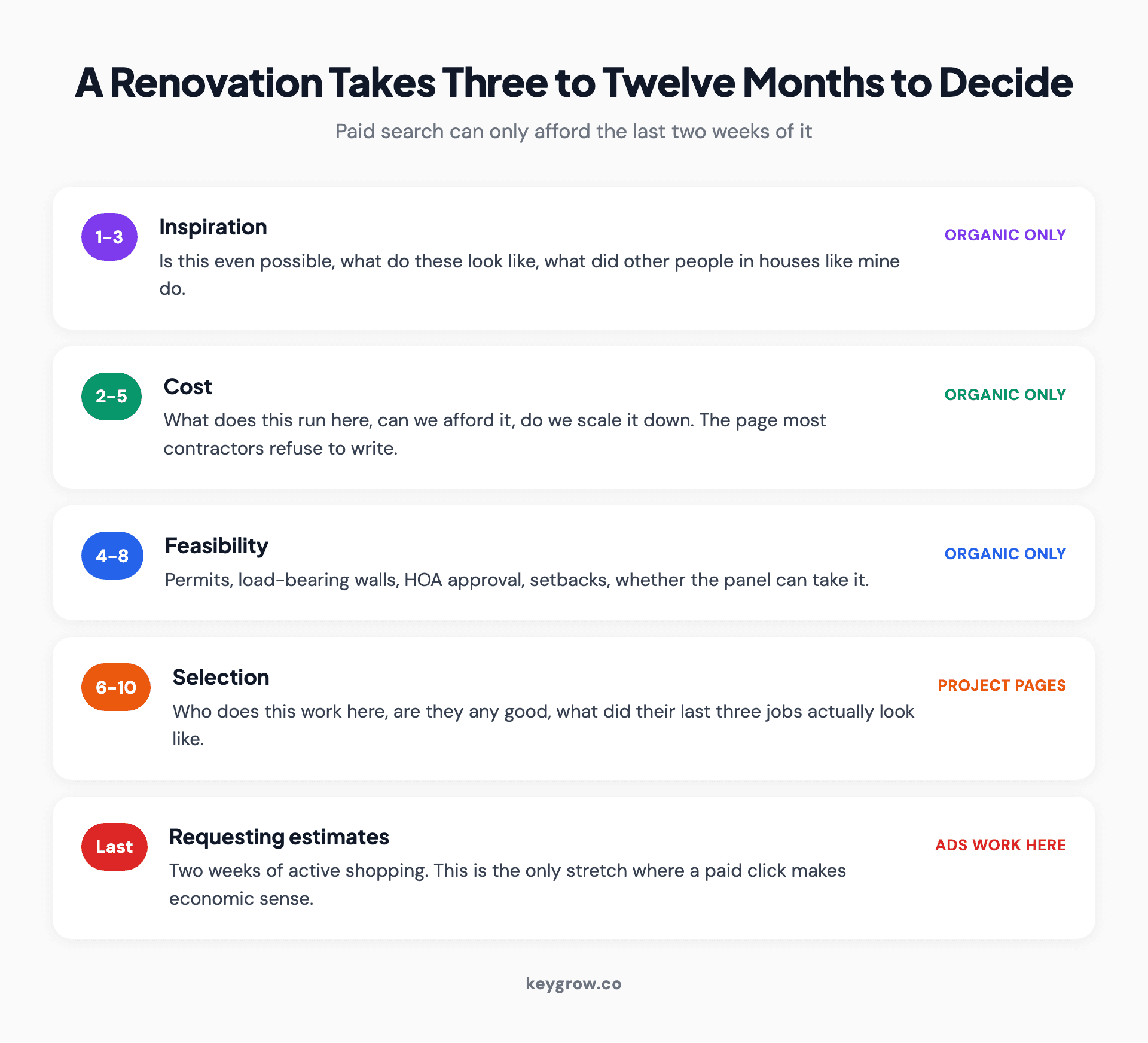
The twelve-month homeowner renovation research sequence, showing which stages organic content reaches and where paid search becomes viable.

A finished kitchen with grey cabinets, an island and pendant lighting.
Here is the sequence as it actually runs:
- Months one to three, inspiration. Is this even possible, what do these look like, what did other people do.
- Months two to five, cost. What does this run, can we afford it, do we scale it down.
- Months four to eight, feasibility. Permits, load-bearing walls, HOA approval, whether the panel can take it, what the setback rules are.
- Months six to ten, selection. Who does this work here, are they any good, what did their last three jobs look like.
- The last two weeks, action. Requesting estimates.
An ad shown in month two is paying for a click that will not convert for six months, if ever. A project page and a cost page shown in month two are still there in month eight, and by then the reader has seen your name four times. That is the entire argument for organic in this category, and it is why running Google Ads for a contracting business works best when it is aimed only at that last stretch.
Which playbook applies to you
Contractor is a routing word. What you should build depends on whether you sell projects, service calls, or something in between.
The advice diverges sharply once you get past the basics, and following the wrong version wastes a year. We have written the specific version for several trades, so use whichever fits:
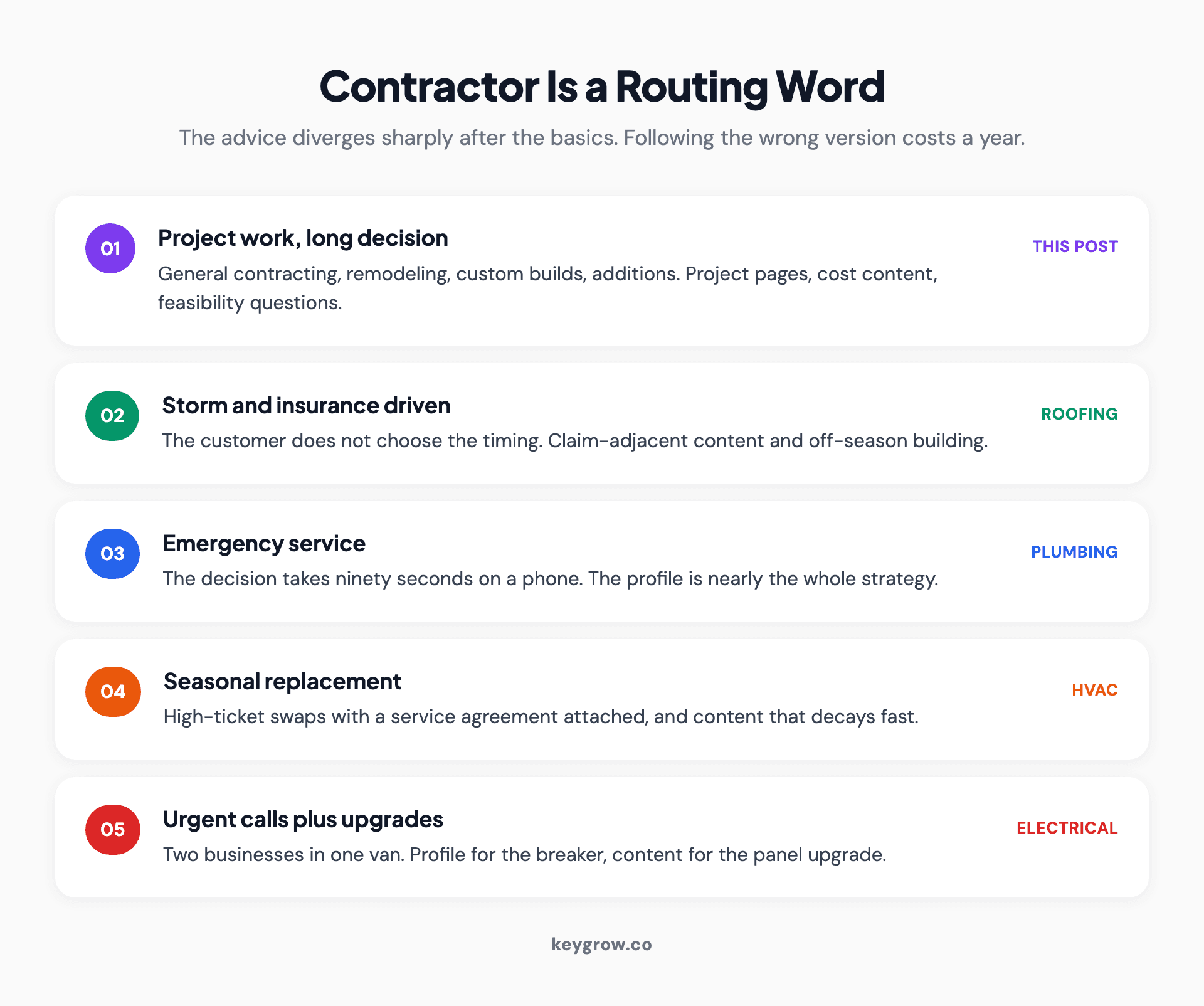
A routing chart showing which contractor SEO playbook applies based on job value, decision timeline and how customers search.
- Project work with a long decision (general contracting, remodeling, custom builds, additions). This post. Project pages, cost content, feasibility questions.
- Storm and insurance driven work, where the timing is not chosen by the customer. See SEO for roofers.
- Emergency service where the decision takes ninety seconds. See SEO for plumbers.
- Seasonal replacement with a service contract attached. See SEO for HVAC companies.
- A mix of urgent calls and high-ticket upgrades. See SEO for electricians.
If you run two of these under one company, build for the one that produces most of your gross margin and let the other live on the profile.
Permits, feasibility and the questions asked before the quote
The months-four-to-eight questions are almost entirely unwritten locally, and the person asking them has already decided to do the project.
This is the counterpart to the cost page and it is even less contested. Somebody asking whether they need a variance to build to within four feet of the property line is not shopping. They are planning. They will need a contractor and they will remember who answered.
Worth writing, for your specific jurisdiction:
- What requires a permit in your county and what does not
- How long plan review actually takes locally, in weeks
- What an HOA architectural committee typically wants and how long it sits
- Whether a wall is load-bearing, and how a homeowner can tell before calling anyone
- What a structural engineer letter costs and when one is required
- Which older housing stock in your area hides which problems
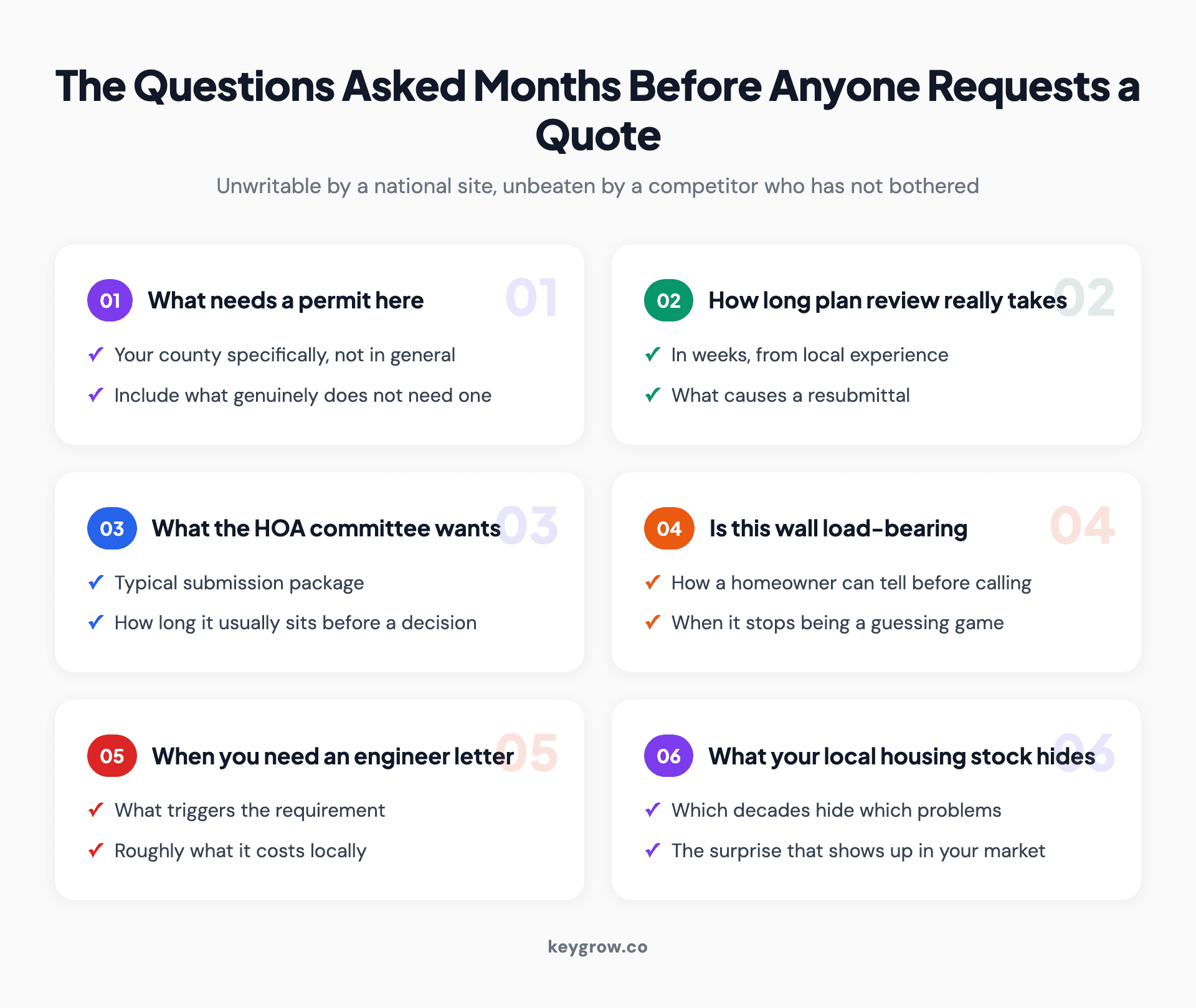
Six feasibility and permit questions homeowners search in the months before requesting a quote, none of which a national site can answer locally.
Every one of these is unwritable by a national site and unbeatable by a competitor who has not done it. That is a rare combination.
Reviews when the job took four months and one week of it was bad
Ask at the walkthrough, not at the invoice, and be ready to respond in public to the honest three-star review that mentions the delay.
Long projects generate more complicated reviews than service calls. A four month renovation has a bad fortnight in it somewhere: the tile was backordered, the inspector rescheduled, somebody's dog got out. The customer can be genuinely happy with the result and still mention all of it.
Two things follow. First, ask while you are walking the finished job with them, when the result is in front of both of you, rather than a week later when the memory has flattened into "it took a while".
Second, learn to answer the mixed review well. A response that acknowledges the delay, states what caused it, and says what you changed afterwards is worth more to the next reader than five unqualified five-star reviews. Nobody believes a wall of perfect scores on a project business. They do believe a contractor who handled a problem in public.
Links you pick up on the job site
Suppliers, architects, designers, subs, the local paper, and the manufacturers whose products you install. All of them are relationships you already have.
Contractor link building is not outreach, it is asking people you already work with:
- Supply houses and lumber yards with a contractor or installer page
- Manufacturer certified-installer directories, usually free and usually unclaimed
- Architects and designers list the builders they trust
- Subcontractors list the GCs they work under, and vice versa
- Local business associations, chambers, home builder associations
- The historical society or neighborhood association, if you do period work
- Local press, when a project is genuinely notable
Ten of these beats a hundred directory submissions, and each one comes with actual referral traffic attached, which the directories do not.
Getting off the lead marketplaces takes about a year
The maths works, but only if you start building the organic side while you are still paying for leads. Cancelling first and hoping is how contractors end up back on them at a worse rate.
Most contractors I speak to have the same relationship with lead-selling platforms: they resent the cost, they resent that the same lead went to four competitors, and they cannot switch off because it is the only pipeline they have.
The way out is boring. Keep paying while you build. Publish the project pages, the cost pages and the feasibility pages for nine to twelve months. Track what share of inquiries arrives from your own site each month. When that share is consistently covering your capacity, step the marketplace spend down in halves rather than turning it off.
The number to watch is not cost per lead, which flatters the marketplace. It is cost per signed contract, plus the estimating hours burned on leads that were never going to close.
Build the pages in the busy season, because you will not do it in the slow one
Every contractor plans to write content in the winter and then does not, because by winter the cash is tight and the motivation is gone. Write during the season, when the jobs and the photographs are in front of you.
Construction has a seasonal shape that shows up plainly in the monthly Census construction data, and every contractor feels it without needing a chart. The trap is that the content calendar gets planned around that shape backwards.
The reason is simple. Organic content published in July starts producing in roughly February. Content published in February starts producing in September, which is the back half of the season you were trying to fill. If you wait for the quiet months to write, everything you write lands late.
So the discipline is uncomfortable: photograph and publish during the busiest weeks of the year, at one page a week, when you least feel like it. Forty minutes on a Friday afternoon while the job is fresh. The slow season is for the pages that need thinking, the cost page and the feasibility pages, not for the forty project pages you should have captured as you went.
What to measure when one job is worth eighty thousand dollars
Signed contracts, estimating hours per signed contract, and average contract value by source. Leads and traffic are noise at this volume.
Here is the opinion, and it is the one contractors push back on hardest: more traffic is almost never the fix for bad lead quality. Filtering is. We had a real estate investor client drowning in junk inquiries, and the answer was not a bigger budget. It was negative keywords, tighter matching and qualifying language that told the wrong people not to bother. Serious leads went up 600 percent between December and January on the same spend.
The organic equivalent is the price band, the minimum project size, and the "who we are not right for" paragraph. Every one of them reduces inquiry count and raises signed contracts.
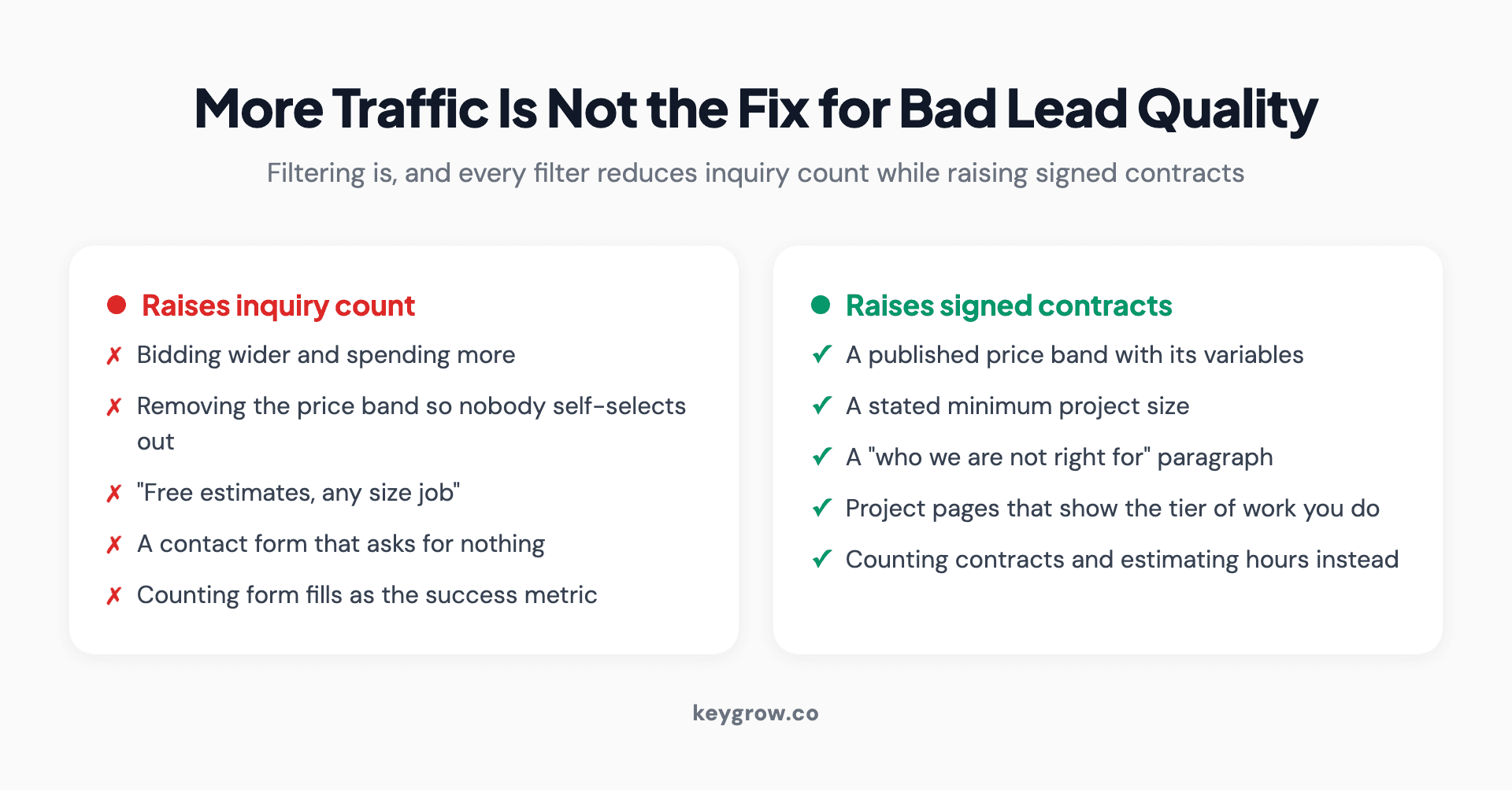
The difference between fixing lead quality with more traffic and fixing it with filtering, shown side by side.
| Track | Not | Why |
|---|---|---|
| Signed contracts per month | Form fills | The only number that becomes revenue |
| Estimating hours per signed contract | Cost per lead | Your real acquisition cost is time, not spend |
| Average contract value by source | Average across all sources | Marketplace leads and organic leads are not the same job |
| Inquiries that match your minimum | Total inquiries | Tells you whether the filtering language is working |
| Which project page they read first | Sessions | Shows which job type to go win more of |
At three to eight signed jobs a month, a traffic chart is too noisy to tell you anything. Count contracts.
Contractors who should not be buying SEO
Booked more than four months out, no photographs of finished work, or a business under two years old with no reviews yet. Fix the inputs first.
The photograph one is the real blocker. If you have no documented completed projects, the strategy in this post has nothing to run on, and no agency can conjure it. Spend one season photographing properly (before, during, after, every job) and you will start the following year with the raw material.
If you are booked into next spring, more inquiries will make your life worse, not better. Use the time to build the pages so that when the backlog clears you are not starting from nothing.
And if all your work comes from two builders or a single developer, your risk is concentration, not visibility. That is worth solving, and search is a reasonable way to solve it, but go in knowing you are buying diversification rather than volume.
FAQs
How long does SEO take for a contractor?
Profile improvements show within about two months. Project and cost pages typically take four to nine months to produce steady inquiries, and the long homeowner research cycle adds to that, because somebody who finds your page in month one may not request an estimate until month six. Judge it at twelve months, not at three.
Should a contractor build one page per service or one per project?
Both, and the project pages are the underused half. Service pages target the category term and explain what you do. Project pages target specific job types in specific areas, prove the work, and are impossible for a competitor to copy. Most contractors have the first and none of the second.
Is it a mistake to publish prices as a contractor?
Publishing a fixed price is usually a mistake. Publishing a range with the variables that move it is usually the best change you can make. It ranks for a high-volume search, it pre-qualifies the caller, and it stops a national cost estimator from setting the expectation on your behalf.
Do contractors need a separate page for every town they serve?
Only for towns where you have actually worked, and then the page should reference real projects there rather than a swapped city name. Templated town pages are the most common way a contractor site gets filtered out of results. Three towns with real project pages behind them beat twenty generated ones.
Are lead marketplaces worth it for contractors?
They work as a pipeline while you have nothing else, and they are expensive because the same inquiry goes to several companies. The mistake is treating them as permanent. Keep paying while you build the organic side, measure cost per signed contract rather than cost per lead, and step spending down once your own inquiries reliably cover capacity.
What is the single highest-return thing a contractor can do this month?
Photograph and publish your last five completed jobs as individual pages with before shots, scope, duration and a budget band. It costs a few hours, it needs no agency, and it produces the asset that everything else in contractor SEO is built on.
Do AI answers matter for construction searches?
They matter most for the cost and feasibility questions, which is exactly where contractors have published nothing. Assistants answer "what does a kitchen remodel cost in [city]" by assembling national averages, because no local contractor wrote the local answer. A page with real local numbers and a plain statement near the top is the format those systems pull from, which is the same discipline behind our answer engine optimization work.
Start with the estimate you gave last Tuesday
Pull up your last five completed jobs. If you have photographs of all five, you have five pages and a week's work ahead of you that will outperform anything else on your marketing list.
If you have photographs of none of them, that is the finding, and the fix starts on the next job rather than on the website.
The order for most contracting businesses: five project pages, one cost page for your highest-margin job type, one feasibility page for your jurisdiction, then the profile. Everything else waits. Trades whose demand arrives in a season rather than steadily have a different build window, which we go through in SEO for landscaping companies.
We work month-to-month with no lock-in, and we tell contractors who are booked out that they should call back when the backlog clears. If you want a read on whether the project-page approach fits your mix, start here or look at how we run SEO for trade businesses.