


Here is a claim that puts this post at odds with every other guide ranking for the term: your website is not going to win "emergency plumber near me", and you should stop building your strategy around the attempt.
SEO for plumbers still matters enormously. It just does two separate jobs that most plumbing companies run together and then wonder why neither pays off. Your Google Business Profile fights for the emergency work. Your website earns the planned, researched, five-figure jobs that fund a real business. Treating those as one project is the most common reason plumbing SEO underperforms.
There is a separate write-up on Google Ads for plumbers if the paid channel is what you are weighing. Everything below assumes the split above.
Look at what actually sits above the blue links
Pull out a phone and search "emergency plumber near me" in a competitive city. Count what appears before the first organic result.
Local Services Ads with the Google Guaranteed badge, usually three of them. Then paid search ads. Then the three-result map pack. On a normal phone screen, the first organic listing is several scrolls down, and the person searching has a flooded kitchen and no patience for scrolling.
That is why the emergency query is a profile fight, not a website fight. The map pack entry is your Google Business Profile, so you are still competing organically, but you are competing with a listing rather than a page. Every hour spent writing an emergency plumbing landing page for the searcher who is currently standing in water is an hour that would have paid better somewhere else.
Plumbing is also a Local Services Ads category, which is worth knowing even if you never buy them. The presence of that ad unit is precisely what compresses the organic real estate on urgent queries, and it is not going away.
None of this means emergency work is unwinnable. It means the lever is the profile, the reviews and answering the phone at two in the morning, not the copy on a service page.
What your website should be aimed at instead
The money in plumbing is not in the unblocked drain. It is in the jobs a homeowner researches for a week before calling anyone.
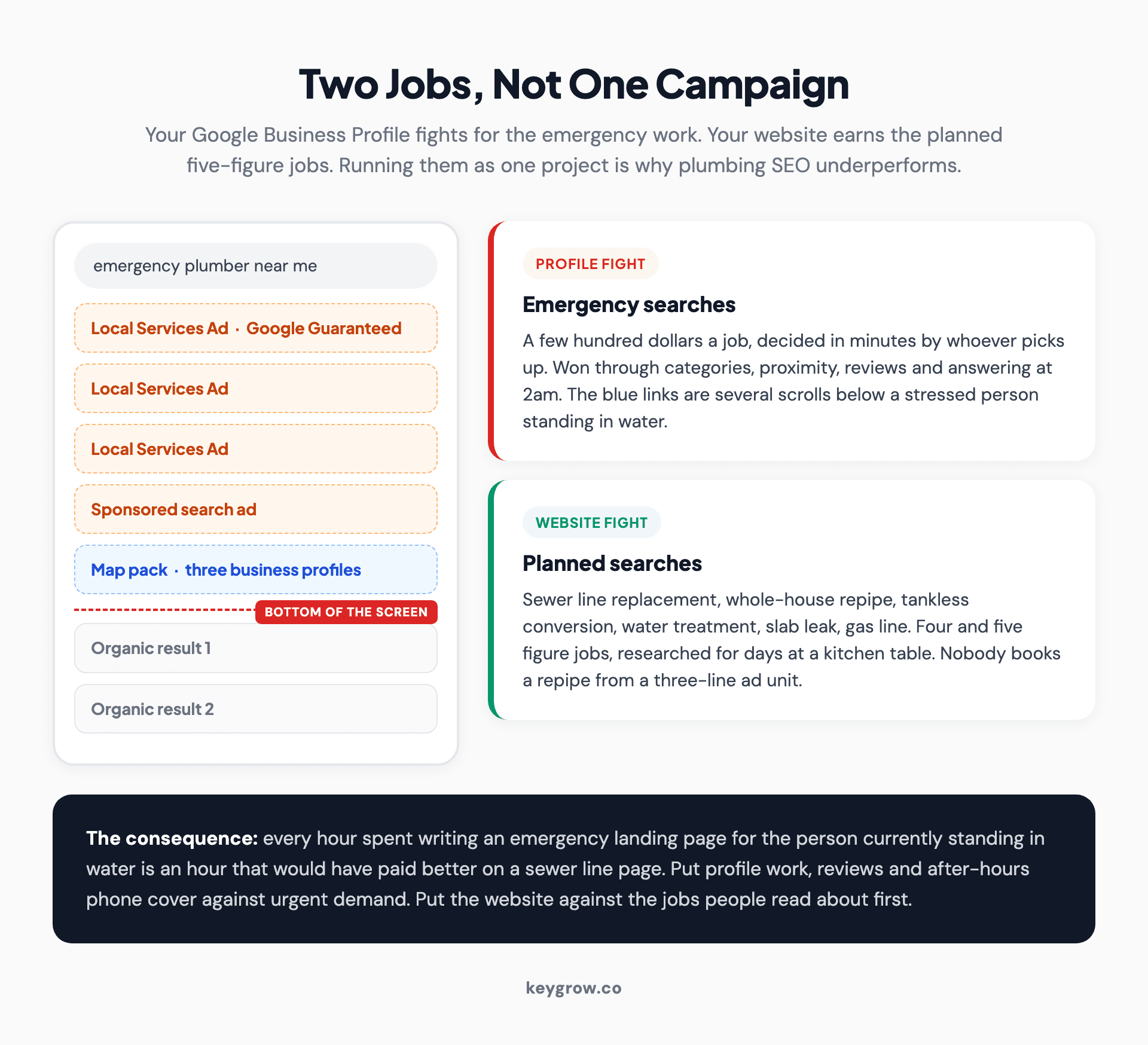
Comparison of emergency plumbing searches against planned high-value plumbing searches, showing job value, research time and where each one is won.
A sewer line replacement, a whole-house repipe, a tankless conversion, a water treatment system, a slab leak repair, a gas line run for a new range. These are four and five figure jobs, and the person buying one behaves nothing like the person with a burst pipe. They read. They compare. They look up what it costs. They visit three websites and pick the one that explained the job best.
That behavior is exactly what organic search is good at capturing, and it is the half of the market that Local Services Ads do not dominate, because nobody books a repipe from a three-line ad unit.
| Emergency work | Planned work | |
|---|---|---|
| Typical value | A few hundred dollars | Several thousand to five figures |
| Research time | Minutes | Days to weeks |
| Where it is won | Google Business Profile, reviews, answering | Website pages, cost content, proof |
| Device | Phone, standing in water | Laptop, at the kitchen table |
| What decides it | Who picks up first | Who explained it best |
The practical consequence is a service-line depth problem rather than a city-page problem. Plumbing has an unusually long tail of named, specific, expensive problems: hydro jetting, backflow testing, sump pump replacement, well pump service, water softener installation, sewer camera inspection, trenchless pipe lining, gas leak detection. Each is a distinct search with its own competition and its own margin, and most plumbing websites collapse the lot into one page called Services.
Depth in that list is worth more than a thirtieth city page, and it is a great deal easier to write honestly.

Copper and PVC pipework with shutoff valves running through a utility space.
The content trap: writing for people who want to avoid hiring you
Plumbing has a bigger do-it-yourself shadow than any other trade. In paid search that shadow is a budget problem, and we worked through the negative keyword side of it in the Google Ads guide. In organic it does something sneakier: it makes a failing blog look like a working one.
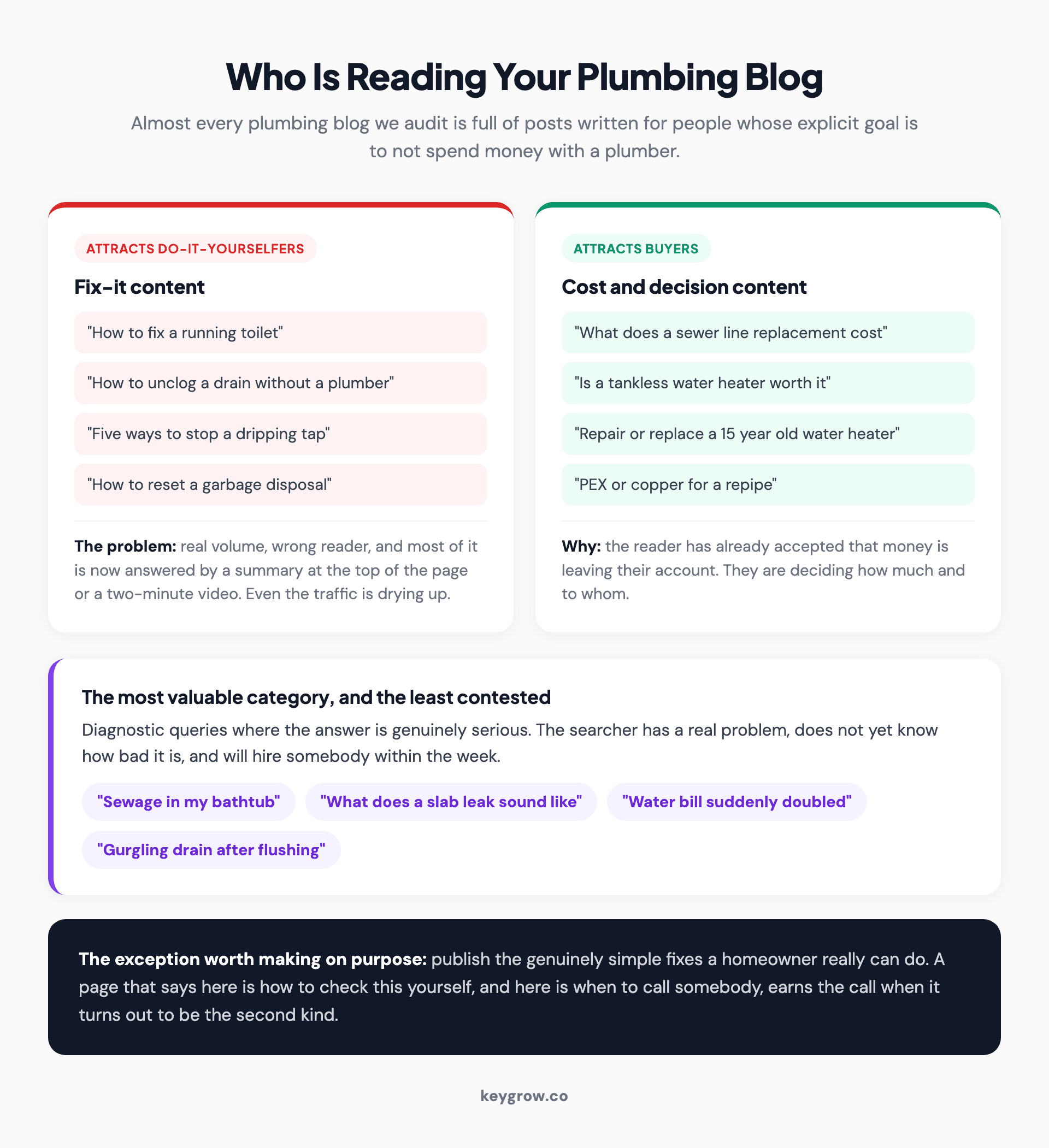
Two-column comparison of plumbing blog topics that attract do-it-yourself readers against the cost and decision topics that attract buyers.
"How to fix a running toilet." "How to unclog a drain without a plumber." "Five ways to stop a dripping tap." These have real search volume, which is why they get written, and once they rank the reports look excellent. Sessions climb. Keyword counts climb. Nobody calls. The channel gets blamed at the next budget meeting, when the actual problem is that the traffic was never buying anything. Most of those queries are also now answered by a summary at the top of the page or a two-minute video, so even the flattering number is shrinking. Not every trade works this way: pest control is the clear exception, for reasons we set out in SEO for pest control.
The queries that bring buyers look different. Cost queries: what does a sewer line replacement run, is a tankless water heater worth it, how much to repipe a house. Decision queries: repair or replace, PEX against copper, tank against tankless. Diagnostic queries where the answer is genuinely serious: why is there sewage in my bathtub, what does a slab leak sound like, why is my water bill suddenly double.
That last category is the most valuable and the least contested. Someone searching those has a real problem, does not yet know how bad it is, and is going to hire somebody within the week.
Write cost pages with actual ranges and the variables that move them. Most plumbing companies refuse, on the theory that a number scares people off. It does, and the people it scares off were never going to buy. What it also does is pre-qualify everyone else, which is why a good cost page produces fewer calls and more jobs.
There is one exception worth making deliberately. Publishing the genuinely simple fixes, the ones a homeowner really can do, builds more trust than any testimonial. The EPA's leak guidance covers the basics well, and a page that says "here is how to check for this yourself, and here is when to call somebody" earns the call when the problem turns out to be the second kind.
The profile is the whole emergency strategy
Since the profile is what competes for urgent work, treat it as a product rather than a directory listing.
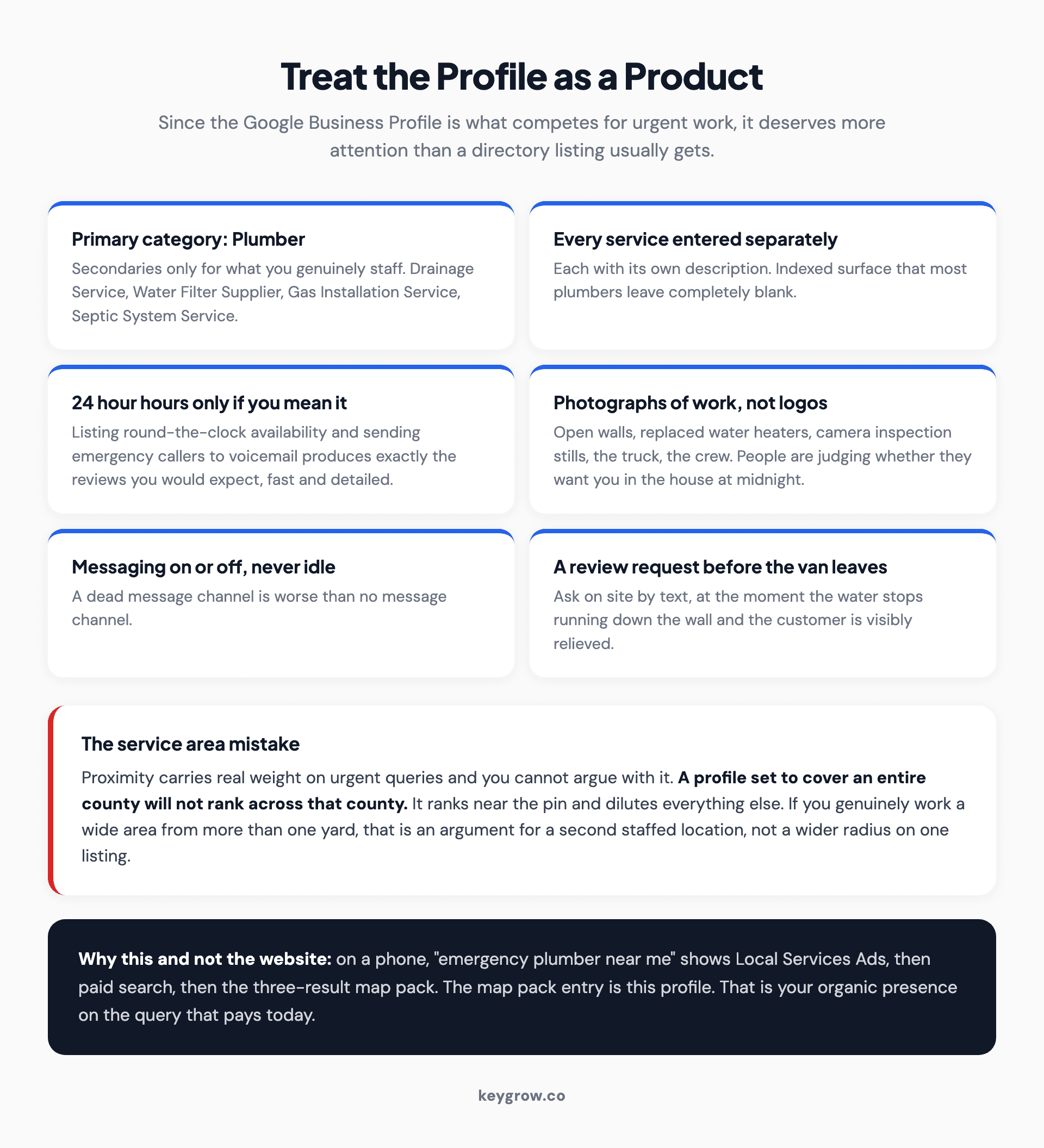
Google Business Profile checklist for a plumbing company covering category, service area, services list, hours, photos and messaging.
Primary category Plumber. Secondary categories only for what you genuinely staff: Drainage Service, Water Filter Supplier, Gas Installation Service, Septic System Service. Every service entered separately with its own description, which is indexed surface most plumbers leave blank.
Set 24 hour availability only if you genuinely answer at 3am. Listing round-the-clock hours and sending emergency callers to voicemail generates exactly the reviews you would expect, and in this trade those reviews arrive fast and detailed.
Photographs should show work rather than logos. Open walls, replaced water heaters, camera inspection footage stills, the truck, the crew. Homeowners are trying to judge whether you look like people they want in their house at midnight.
Use messaging if you turn it on, and turn it off if you will not answer it. A dead message channel is worse than none.
Service area needs more thought in plumbing than most trades, because proximity carries real weight on urgent queries and you cannot argue with it. A profile set to cover an entire county will not rank across that county; it will rank near the pin and dilute everything else. If you genuinely operate across a wide area from more than one yard, that is an argument for a second staffed location rather than a wider radius on one listing.
The review flow is the part that decides map pack position over time. Volume matters, recency matters more, and in plumbing the natural moment to ask is when the water stops running down the wall and the customer is visibly relieved. Ask on site, by text, before the van leaves.
What a plumbing service page actually has to do
Ranking a service page is the easy half. Converting the person who lands on it is where most plumbing sites give the job away.
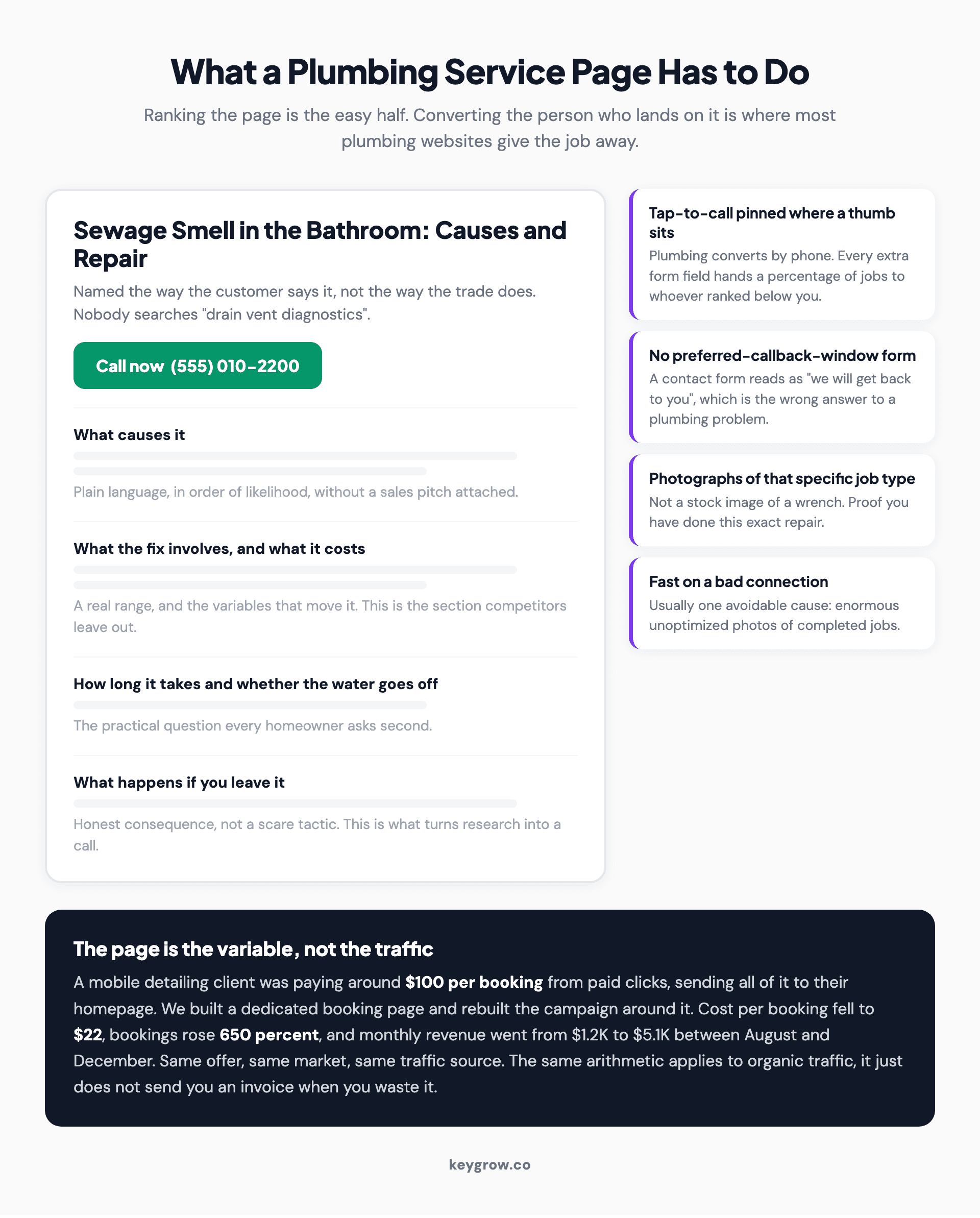
Six elements a plumbing service page needs, from the problem named in the customer's words through pricing transparency to a click-to-call button.
Name the problem the way the customer names it, not the way the trade does. People search "sewage smell in bathroom", not "drain vent diagnostics". Then explain what causes it, what the fix involves, roughly what it costs and what changes the number, how long the work takes and whether the water gets shut off, and what happens if they leave it.
Then make contacting you trivial. A tap-to-call number pinned where a thumb naturally sits, not a contact form asking for a preferred callback window. Plumbing converts by phone, and every extra field between the problem and the call is a percentage of jobs handed to whoever ranked below you.
This part is worth more than the ranking work in the short term. A mobile detailing client of ours was paying around $100 per booking from paid clicks, sending all of that traffic to their homepage. We built a dedicated booking page and rebuilt the campaign structure around it. Cost per booking fell to $22, bookings rose 650 percent and monthly revenue went from $1.2K to $5.1K between August and December. Same offer, same market, same traffic source. The page was the variable.
The same arithmetic applies to organic traffic, it just does not send you an invoice when you waste it.

Plumber in work clothes carrying tools on a residential job.
Plumbing collects more unfair reviews than most trades
Two structural reasons, and knowing them changes how you handle the replies.
The first is price shock. A homeowner who has never bought a sewer repair has no reference point, so a fair five thousand dollar quote can read as robbery. The second is blame transfer. You get called because something already failed, and a share of customers attach the damage they were already living with to the person who turned up to look at it.
The defense is written before the review, not after. Publish your pricing structure, your call-out fee, your diagnostic process and what happens if the job turns out bigger than the quote. A customer who read that page is dramatically less likely to be surprised, and a surprised customer is what a one-star review is made of.
When one does land, reply short, factual and without arguing about the technical detail. The reply is read by the next forty prospects rather than by the reviewer, and its only job is to make you look like the reasonable party. Long point-by-point rebuttals lose that job every time, regardless of who was right.
And do not buy reviews or run a gift card campaign for them. Enforcement is real, and a filtered or suspended profile takes your emergency business with it, which is the part of the business you cannot rebuild in a week.
Links a plumbing company can actually get
Ignore anything that sounds like a link building campaign and work the relationships you already have.
Supply houses and manufacturers, particularly if you are certified to install a brand of water heater or treatment system, since many publish installer locators that link out. General contractors, remodelers and builders you subcontract for. Property managers and real estate offices that keep vendor lists. Restoration companies you work alongside after a flood, which is one of the most natural reciprocal referral relationships in the trade.
Then the ordinary local ones: chamber of commerce, trade association membership pages, sponsorship of anything with a website, and the local news when the weather freezes pipes across the city and a reporter needs somebody to explain it. That last one is free, repeatable and almost nobody in the trade picks up the phone to offer it.
One more that works and almost nobody uses: municipal and utility pages. Water authorities, city public works departments and county permit offices frequently publish lists of licensed contractors, backflow testers or approved installers. Those pages carry genuine local authority, they are difficult for an out-of-area competitor to obtain, and getting listed is usually a form rather than a pitch.
Citations still need auditing, mostly because plumbing companies change phone numbers and yards more often than they update their listings. Inconsistent details across directories is the single most common technical problem we find on plumbing sites, and it undermines the profile you just spent a month improving. The same discipline runs through everything we do in SEO for home services, and plumbing is the trade where it slips fastest.
Two technical things that matter more here than elsewhere
Most technical SEO advice applies to plumbing the same way it applies to everything. Two items are genuinely weighted differently.
Speed on mobile comes first. A large share of plumbing searches happen on a phone, frequently in a situation where the person is stressed and the connection is whatever the house has. A page that takes six seconds loses to one that takes two, and Google's Core Web Vitals documentation sets out what is actually measured. Plumbing sites are commonly slow for one avoidable reason: enormous unoptimized photographs of completed jobs.
Second, click-to-call has to be genuinely one tap, sitewide, in the header, without a menu in the way. It sounds trivial. It is the single highest-impact change we make on most plumbing websites, and it usually takes an afternoon.
Structured data is worth adding while you are in there, so search engines and AI assistants can read your service area, hours and reviews without inferring them. It will not lift rankings on its own, but it makes the business legible in the places that are increasingly answering questions before anyone clicks.
One thing not to bother with: a separate mobile site, or an app. Plumbing companies get sold both regularly. Neither solves anything a fast responsive site does not already solve, and a second site splits whatever authority you have across two addresses.
What it costs, how long it takes, what to measure
Expect a range. The bottom of it, somewhere around a few hundred dollars a month, buys profile management and a slow trickle of content, which is a reasonable fit for a single truck in one suburb. The top of it, several thousand, is what a multi-location company chasing repipe and sewer work across a metro genuinely needs, because that is a content and authority project rather than a listing project.

Plumbing SEO timeline by market size, showing local pack movement first and competitive metro rankings taking up to fifteen months.
Timelines vary more by market size in plumbing than in almost any other trade, because the competition is dense everywhere and denser in cities. In a small market the local pack can rearrange itself within two or three months of the profile being fixed. Mid-size metros take most of a year. In a major metro, getting into the top three locally is realistically a nine to fifteen month project, and an agency quoting faster in a city that size is telling you what you want to hear.
On terms, we work month to month with no lock-in, and that is a considered position rather than a favor. An agency that needs a twelve month contract to keep a client is telling you the results are not doing it. The detailing account above would have fired its previous agency in month two if it had been free to, and instead it spent most of a year paying $100 a booking under a contract.
For measurement, count in this order: calls from organic, form submissions from organic, quoted jobs, and booked revenue by service line. That last split is the one that matters most in plumbing, because a hundred drain calls and four repipes are not the same month even when the lead count is identical.
Compare the result against what you currently pay per lead through Local Services Ads or paid search, not against zero. Plumbing clicks are among the most expensive in home services, so the honest comparison usually flatters organic once the first year is behind you. It just does not flatter it in month three, which is when most companies make the decision.
When a plumbing company should not buy SEO
We turn away work we cannot help, and three situations come up often enough to name.
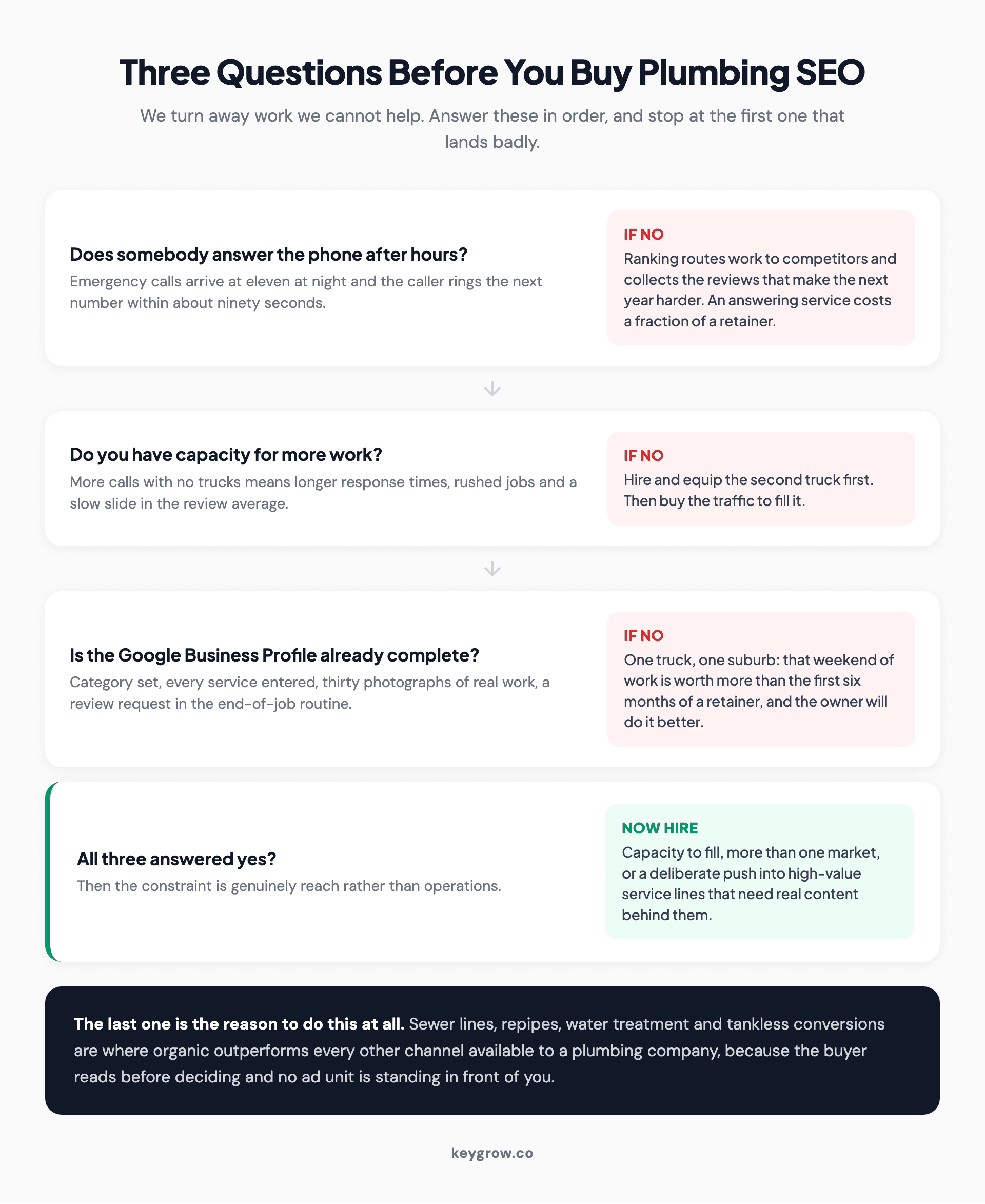
Three situations where a plumbing company should not buy SEO yet: no after-hours cover, no capacity, and an unclaimed profile.
Skip it if nobody answers after hours. Emergency plumbing calls arrive at eleven at night and the caller rings the next number within about ninety seconds. Ranking a company that cannot answer is paying to route work to competitors, and it also collects the reviews that make the next twelve months harder. An answering service costs a fraction of a retainer.
Skip it if you are already turning work away. More calls with no capacity means longer response times, rushed jobs and a slow slide in your review average. Hire and equip the second truck, then buy the traffic.
Handle it in-house if you run one truck in one suburb and the profile is still unclaimed or mostly blank. There is a weekend of work in setting the category, entering each service, uploading thirty photographs of real jobs, and putting a review request into the end-of-job routine. For an operation that size, that weekend is worth more than the first six months of a retainer, and the owner will do it better than a contractor who has never seen the trucks.
Hire when you have capacity to fill, more than one market, or a deliberate push into high-value service lines that need real content behind them. The last one is where organic genuinely outperforms everything else available to a plumbing company, and it is the reason to do this at all.
The repipe and remodel half is a different project
Emergency plumbing is won in the map pack. Repipes, bathroom remodels and sewer line replacements are not: those are four-figure to five-figure decisions a homeowner researches for weeks, and they reward documented projects and honest price bands instead. SEO for contractors covers that side of the work, which most plumbing companies underbuild.
FAQs
What is SEO for plumbers?
SEO for plumbers is the work of ranking a plumbing company in Google's local map pack and organic results for the searches homeowners use. In practice it splits into two jobs: the Google Business Profile competes for urgent emergency searches, and the website competes for planned high-value work such as repipes, sewer line replacement and water heater installation.
How long does plumbing SEO take to work?
It depends heavily on market size. Profile improvements can shift local pack position within two to three months in a small market. Mid-size metros generally take six to nine months, and major metros can take nine to fifteen months for top-three local pack placement. Website content for planned services usually needs three to six months before it holds a position.
Can a plumber rank organically for emergency plumber near me?
Rarely with a website page, because Local Services Ads, paid search ads and the map pack occupy the visible part of a mobile screen for that query. The realistic route is the map pack through your Google Business Profile, which means categories, reviews, proximity and answering the phone rather than page copy.
Which plumbing keywords are most profitable?
Planned high-value service lines rather than emergency terms. Sewer line replacement, whole-house repipe, tankless water heater conversion, water treatment installation, slab leak repair and gas line work all carry job values many times a drain clearance, and the searchers spend days researching before they call.
Should a plumbing company publish prices on its website?
Yes, as ranges with the variables explained. Cost queries are among the highest-intent searches in the trade, and most plumbing companies leave them to competitors out of a fear of scaring people off. Publishing ranges filters out pure price shoppers and pre-qualifies everyone else, which usually means fewer calls and more booked jobs.
Do plumbers need city pages for every town they serve?
Only for places you genuinely work and can describe specifically, and they matter less than service-line depth. Plumbing has a long tail of named, expensive problems, and building a real page for hydro jetting or backflow testing is generally worth more than a thirtieth thin city page.
How important are reviews for plumbing SEO?
Very. Review volume, recency and your reply rate all feed local pack position, and plumbing profiles live or die on the emergency searches that position controls. Asking on site before the van leaves collects far more reviews than any automated follow-up, because the customer is visibly relieved at that exact moment.
Is SEO or Local Services Ads better for a plumber?
They cover different ground. Local Services Ads sit above everything on urgent queries and charge per lead, which makes them effective for emergency work and expensive at volume. Organic builds the planned high-value pipeline and costs nothing per call once established. Most plumbing companies with real growth ambitions end up running both.
Where this leaves you
The reason plumbing SEO disappoints so often is that companies buy it expecting to win the search they can see, which is the frantic one, and get judged on a query the format of the results page has already decided.
Split the two jobs. Put the profile work, the review routine and the after-hours phone cover against emergency demand, because that is the only thing that moves it. Put the website effort against sewer lines, repipes, water heaters and treatment systems, where the buyer reads before deciding and no ad unit is standing in front of you.
Then measure revenue by service line rather than counting leads, because that is the only report that shows whether any of it worked.
If you want a team on it, our SEO services and plumbing SEO work covers this month to month. If the after-hours phone is the actual problem, fix that first and spend the money later.