


Google Ads for plumbers fails in a specific way, and it is not the way most guides describe. Plumbing carries one of the highest costs per lead in home services, roughly triple what a cleaning company pays for the same thing. The cause sits in the traffic rather than the ads. Most plumbing searches are not customers. They are people trying to avoid hiring you.
Once you accept that, the account you build looks different. You spend less time adding keywords and most of your time removing traffic.
Plumbing pays close to triple what cleaning pays for the same lead
Start with the numbers, because they set up everything else.
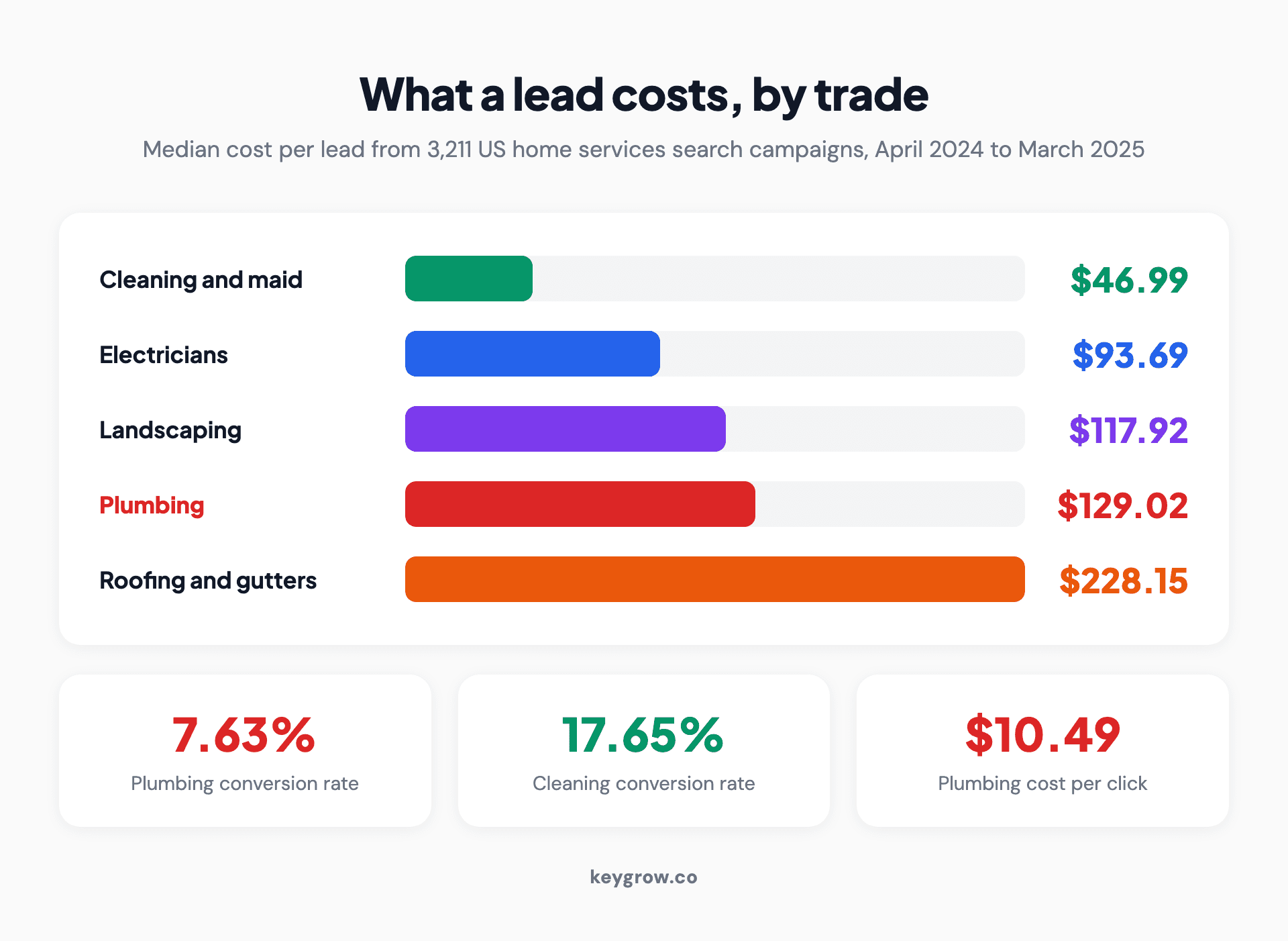
Five cards comparing search ad benchmarks by home service trade, showing click-through rate, cost per click, conversion rate and cost per lead for plumbing, cleaning, electricians, landscaping and roofing.
| Trade | Click-through rate | Cost per click | Conversion rate | Cost per lead |
|---|---|---|---|---|
| Cleaning and maid services | 9.01% | $8.50 | 17.65% | $46.99 |
| Electricians | 5.15% | $12.18 | 9.08% | $93.69 |
| Landscaping | 4.69% | $8.76 | 6.42% | $117.92 |
| Plumbing | 4.97% | $10.49 | 7.63% | $129.02 |
| Roofing and gutters | 5.66% | $10.70 | 3.70% | $228.15 |
Those come from LocaliQ's home services benchmarks, built from 3,211 US search campaigns running between April 2024 and March 2025. They are medians, not averages, so a handful of enormous accounts are not skewing them.
Put plumbing next to cleaning and the gap is uncomfortable. A cleaning company converts nearly 18 percent of its clicks. A plumber converts under 8. Both sell a local service to a homeowner, both get found the same way, and one pays $46.99 per lead while the other pays $129.02.
Urgency does not explain it. If anything, plumbing is the more urgent of the two, and urgency usually helps conversion rates. Roofing sits at the bottom of that table with $228.15 per lead, but roofing at least has the excuse of a five-figure job at the end of it. A drain unclog does not.
So something specific to plumbing search is eating the difference.
Most plumbing searches are people trying not to hire you
Here is the part almost no plumbing guide says out loud. Plumbing has a bigger do-it-yourself shadow than any other trade, and that shadow lives inside your keyword list.
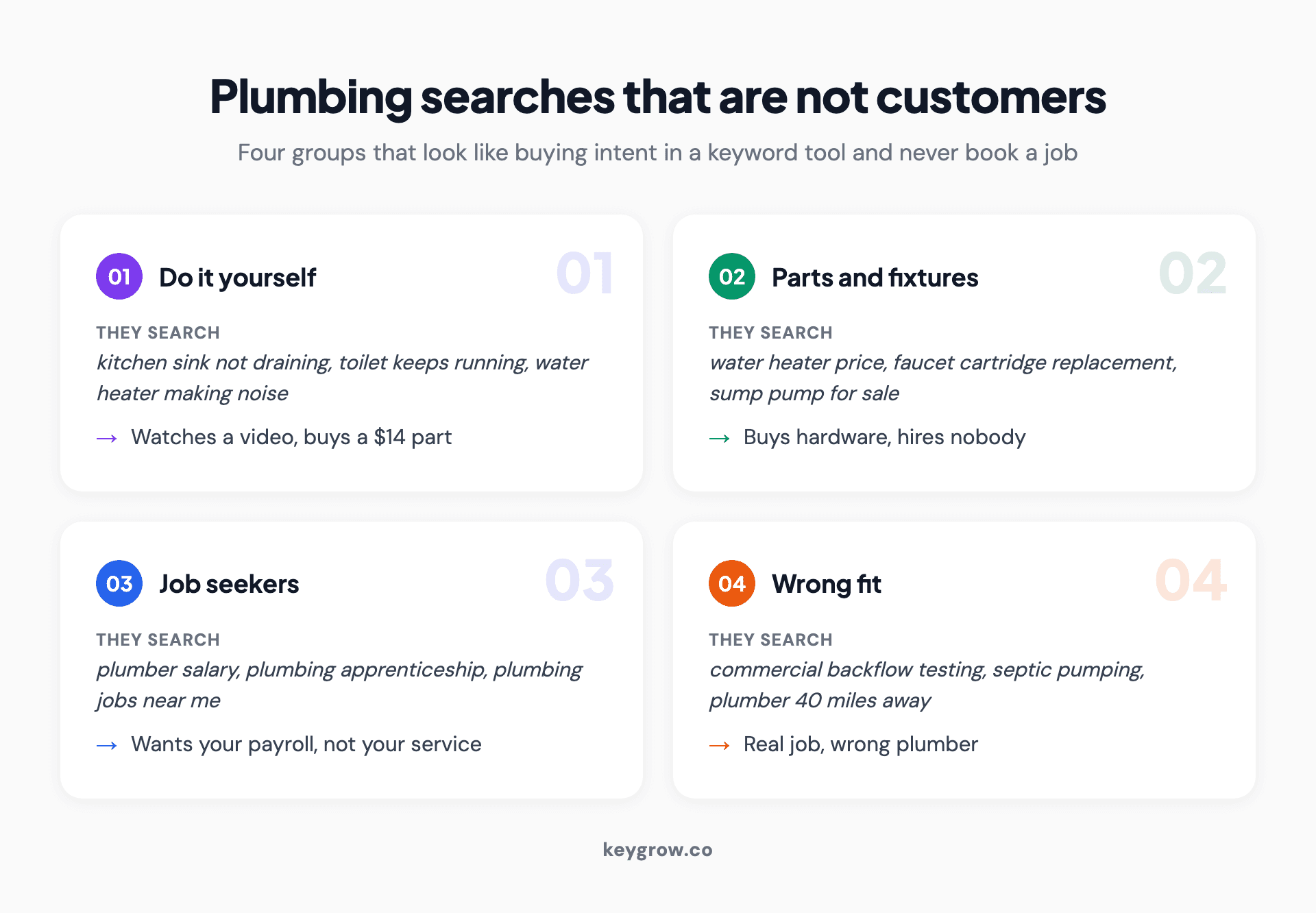
Four cards showing the search types that look like plumbing customers but are not: do-it-yourself researchers, parts and fixture buyers, job seekers, and people outside your service area or service list.
Nobody searches how to clean their own kitchen. They already know, and if they do not want to do it they hire someone. The decision fork happens before Google gets involved.
Plumbing puts the fork after the search. A blocked drain sends almost everyone to a search box first, and the search they run is identical whether they are about to buy a drain snake or about to call you. "Kitchen sink not draining" is typed by both people. So is "water heater making noise" and "toilet keeps running." One of them becomes a job. The other one watches a video and buys a $14 part.
That fork is why the conversion rate sits at 7.63 percent. It is not that your ad failed to persuade a customer. It is that most of the people clicking were never customers.
Now stack the other three groups on top. Parts and fixture shoppers searching for a specific faucet model or a water heater price. Job seekers looking for plumbing apprenticeships and plumber salaries, which spike every time a trade-school ad campaign runs in your city. And people who want a plumber, just not yours, because they are forty miles away or need commercial backflow testing and you do residential.
Every one of those looks like plumbing intent to a keyword tool. None of them pays you.
The negative keyword list is not housekeeping, it is the campaign
In most industries, negative keywords are a monthly tidy-up. In plumbing they are the primary lever, and treating them as an afterthought is the single most expensive habit in the trade.
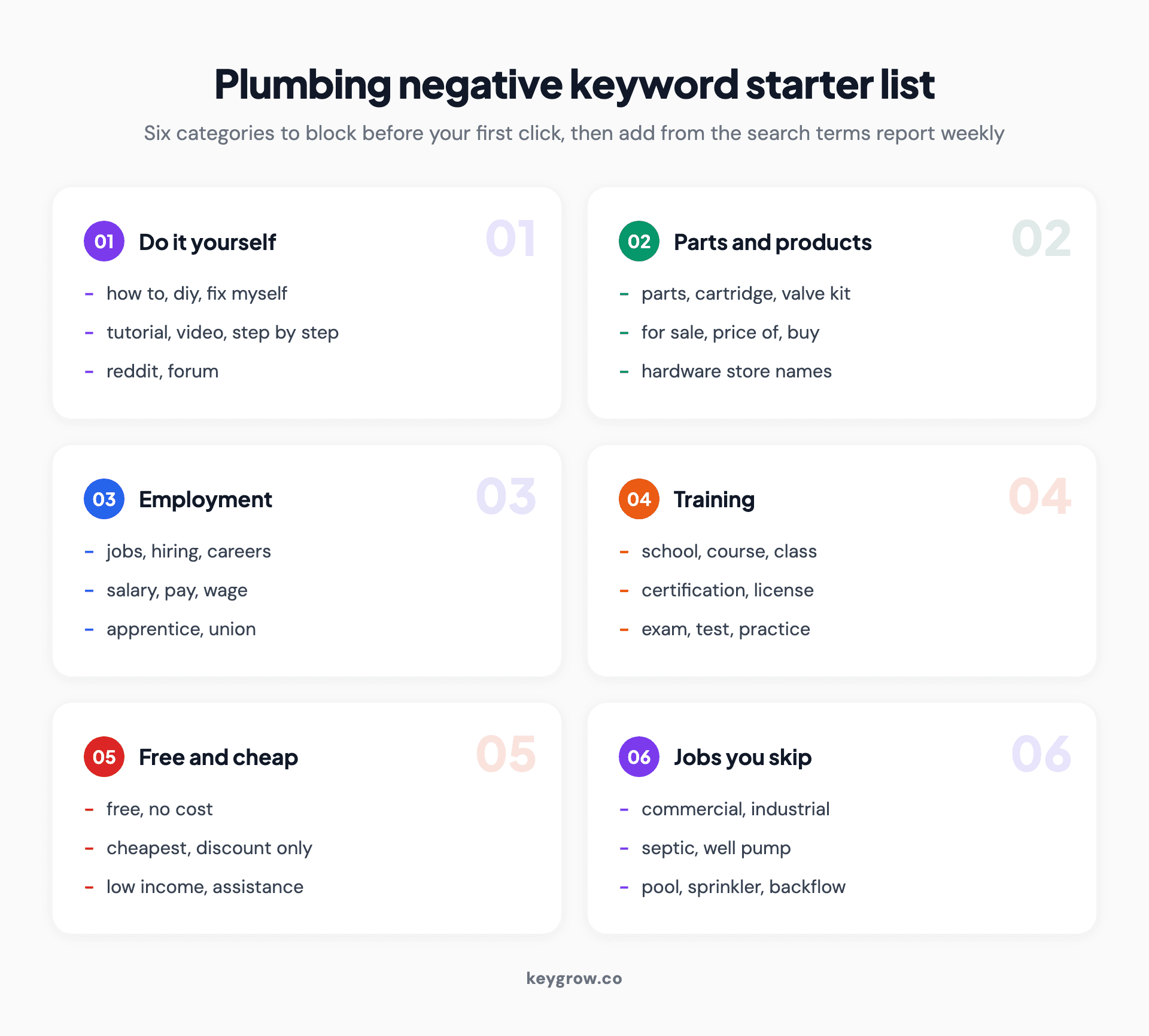
Six cards listing negative keyword categories for plumbing Google Ads campaigns: do-it-yourself terms, parts and products, employment, training, free and cheap modifiers, and services you do not offer.
Letting broad match run without negatives is a donation to Google, and plumbing is the trade where the donation is biggest. Across unmanaged accounts we typically find a fifth to a third of the budget landing on search terms the owner would never have picked, and plumbing sits at the top of that range rather than the bottom.
A cash home buyer client of ours was drowning in junk leads and wanted to spend more to find the good ones. We held the budget flat and filtered instead. Negative keywords, tighter match types, and qualifying language written into the ads themselves. Serious leads went up 600 percent between December and January on the same budget. Different industry, same lesson: more traffic is the wrong fix for bad lead quality.
Six categories worth blocking on day one:
| Category | Examples to block |
|---|---|
| Do-it-yourself intent | how to, diy, fix myself, tutorial, video, step by step |
| Parts and products | parts, replacement cartridge, for sale, price of, big box retailer names |
| Employment | jobs, hiring, salary, apprentice, career, union |
| Training | school, course, certification, license, exam |
| Free and cheap | free, cheapest, discount, coupon only, low income |
| Services you skip | commercial, septic, well pump, pool, sprinkler, backflow |
Adjust that last row to your actual service list. The point is that every service you do not sell is a negative keyword, and most plumbers have never written that list down.
Then make it a habit rather than a project. Pull the search terms report every week, read the last seven days, and add what does not belong. It takes fifteen minutes and it is the highest paid fifteen minutes in the account. Our guide to negative keywords in Google Ads covers match types for negatives, which trip up more people than the positive keyword side ever does.
Your budget is a flat line and your demand is not
Plumbing demand arrives in spikes. A cold snap, a storm, the first freeze of the season, a holiday weekend with four extra people in the house. Those days are worth several ordinary days, and most plumbers cap themselves right when the money is best.
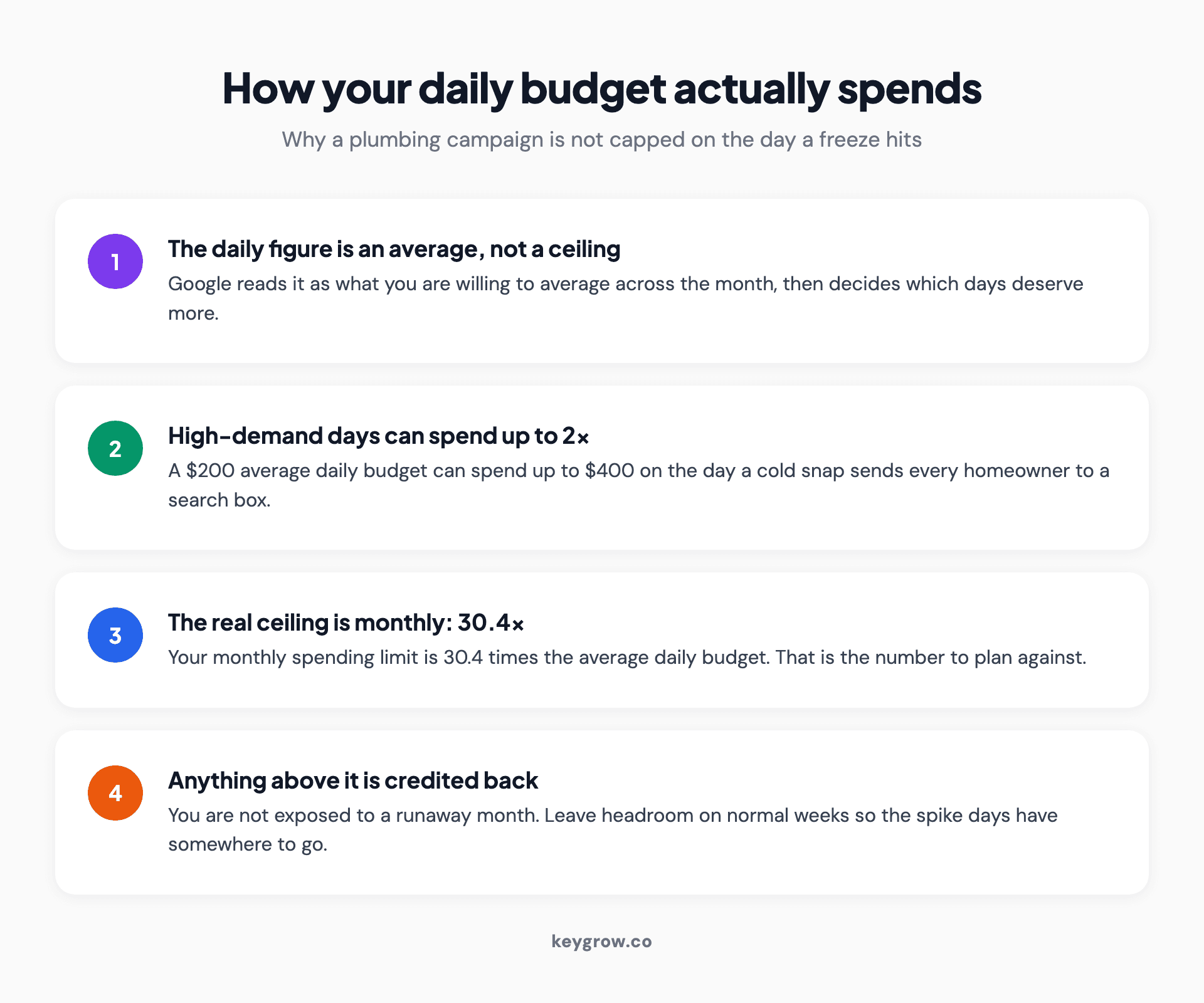
Four-step diagram explaining how Google Ads average daily budget works: the daily figure is an average, Google can spend up to twice it on high-demand days, the monthly ceiling is 30.4 times the daily budget, and overspend is credited back.
The mechanic here is worth understanding properly, because it is widely misread. Your average daily budget is not a daily ceiling. Google will spend up to twice that figure on days when it predicts better results, and it balances the month out afterwards. The real limit is monthly: 30.4 times your average daily budget, per Google's budget documentation, and anything above that gets credited back.
For a plumber that flexibility is a feature, not a risk. It means a $200 daily budget can absorb a $400 day when a freeze hits, without you touching anything, provided the campaign is not being throttled by something else.
Two things usually stop it working. The first is a bid cap set so tight that the campaign cannot compete on the day CPCs jump, which they always do during a demand spike, because every plumber in the city is bidding at once. The second is a campaign that is already limited by budget on ordinary days, so it has no headroom left when the spike arrives.
The practical version: keep a genuine buffer during normal weeks so the algorithm is not permanently against the ceiling, and raise the daily budget deliberately when the forecast tells you something is coming. Weather is one of the few demand signals in marketing you can see three days out. Very few plumbers act on it.
Also check your ad schedule. A burst pipe at 11pm is worth more than a scheduled faucet swap at 2pm, and plenty of accounts have overnight hours switched off because someone read a generic guide about not wasting budget outside business hours. That advice is written for offices, not for emergency trades.
Local Services Ads changed, and the change costs plumbers money
Plumbers are eligible for Local Services Ads, they sit above the regular search results, and unlike healthcare advertisers plumbers get the full set of lead types including bookings. That much is well covered elsewhere. What is not well covered is that the lead credit system was rebuilt, and the rebuild removed the two reasons plumbers used to claim most often.
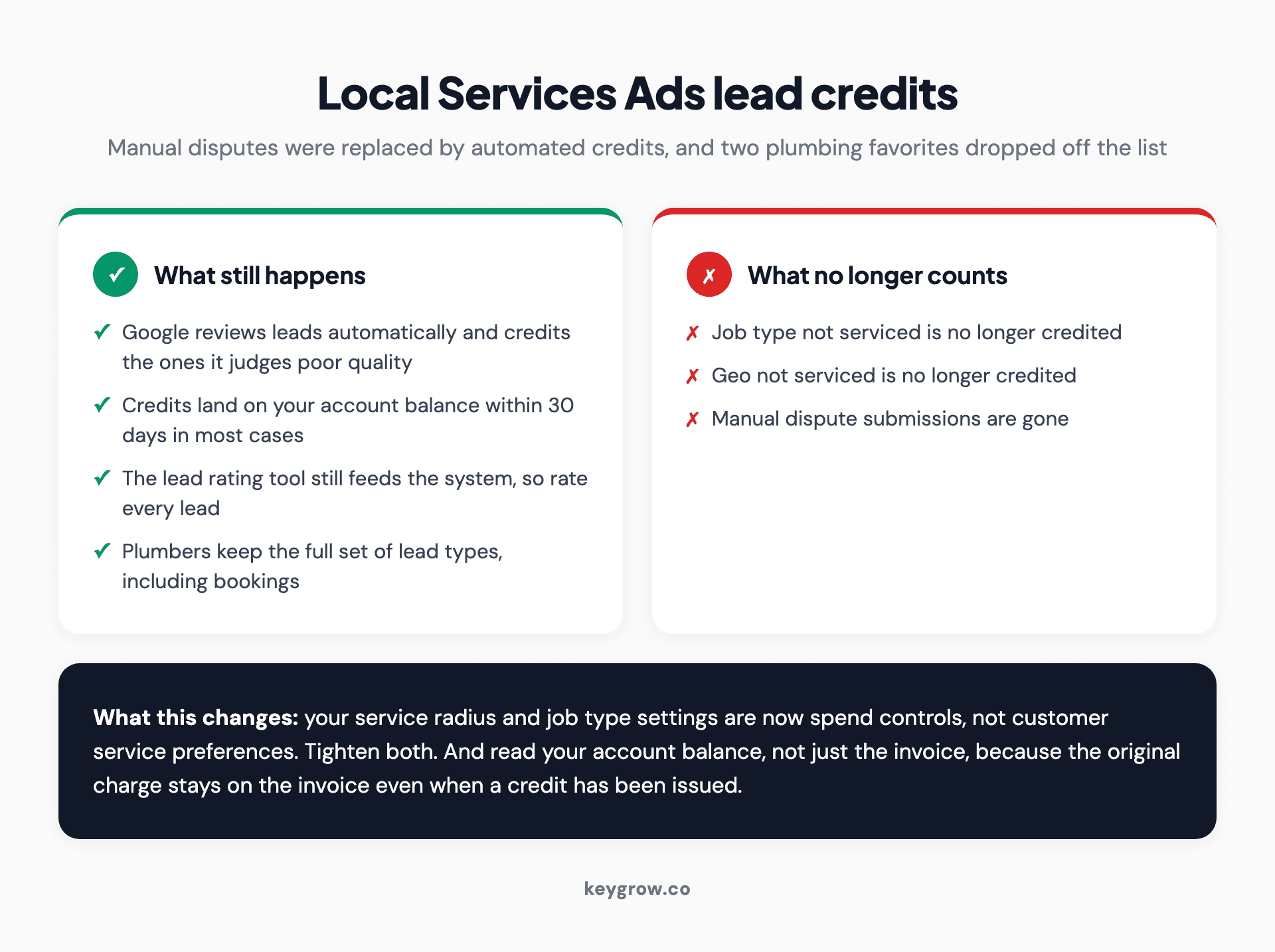
Two-column comparison of Local Services Ads lead credits, showing what the automated system still credits and what it no longer credits for plumbers.
Manual dispute submissions are gone. Google now reviews leads automatically and applies credits to accounts for leads it judges poor quality, with credits landing on the account balance within 30 days in most cases. The original charge still shows on the invoice, so a plumber reading only the invoice will conclude they were charged for a bad lead when the credit is sitting elsewhere in the account.
The important part is what dropped off the list. Google's lead credit policy states that credits are no longer supported for job type not serviced or geo not serviced. Those were the two most common plumbing disputes by a distance. Somebody outside your radius, or somebody wanting a service you do not offer, is now a lead you pay for.
Which changes what you have to do. Your service area and your job types are no longer a customer service setting, they are a spend control. Tighten the radius in your profile to where you will actually drive. Remove job types you tolerate rather than want. And use the lead rating feedback tool consistently, because the automated system is trained on it and a plumber who never rates a lead is giving the machine nothing to learn from.
If you are weighing the format against regular search ads, our post on whether Local Services Ads are worth it works through the pay-per-lead math in more detail.
Running both formats is a stack, not a decision

A plumber working on a residential water heater installation indoors.
Plumbers ask which one to run as though they are alternatives. They occupy different slots on the same results page, so the honest answer is that a healthy plumbing account usually runs both, for different reasons.
Local Services Ads charge per lead and sit at the very top, which makes them the better instrument for the emergency queries where being first matters more than anything else on the page. You are buying position and a verification badge, and the lead arrives as a phone call.
Search ads charge per click and give you control that Local Services Ads simply do not offer. Keyword-level bidding, negative keywords, ad copy, landing pages, and the ability to advertise the planned work that pays better than emergencies. Repipes, water heater replacements, sewer line work, bathroom remodels. None of that is an urgent 2am search, and none of it is well served by a format where you cannot control the message.
The mistake is running search ads on emergency terms only, competing for the scraps under the Local Services Ads block, and never advertising the planned work at all. That is where the margin is, and it is usually the quietest part of a plumbing account.
A plumbing landing page has about eight seconds
Someone standing in an inch of water is not reading your about page. Sending that click to a homepage wastes it, and plumbing punishes the mistake harder than most trades, because the visitor is stressed, on a phone, and holding a towel.
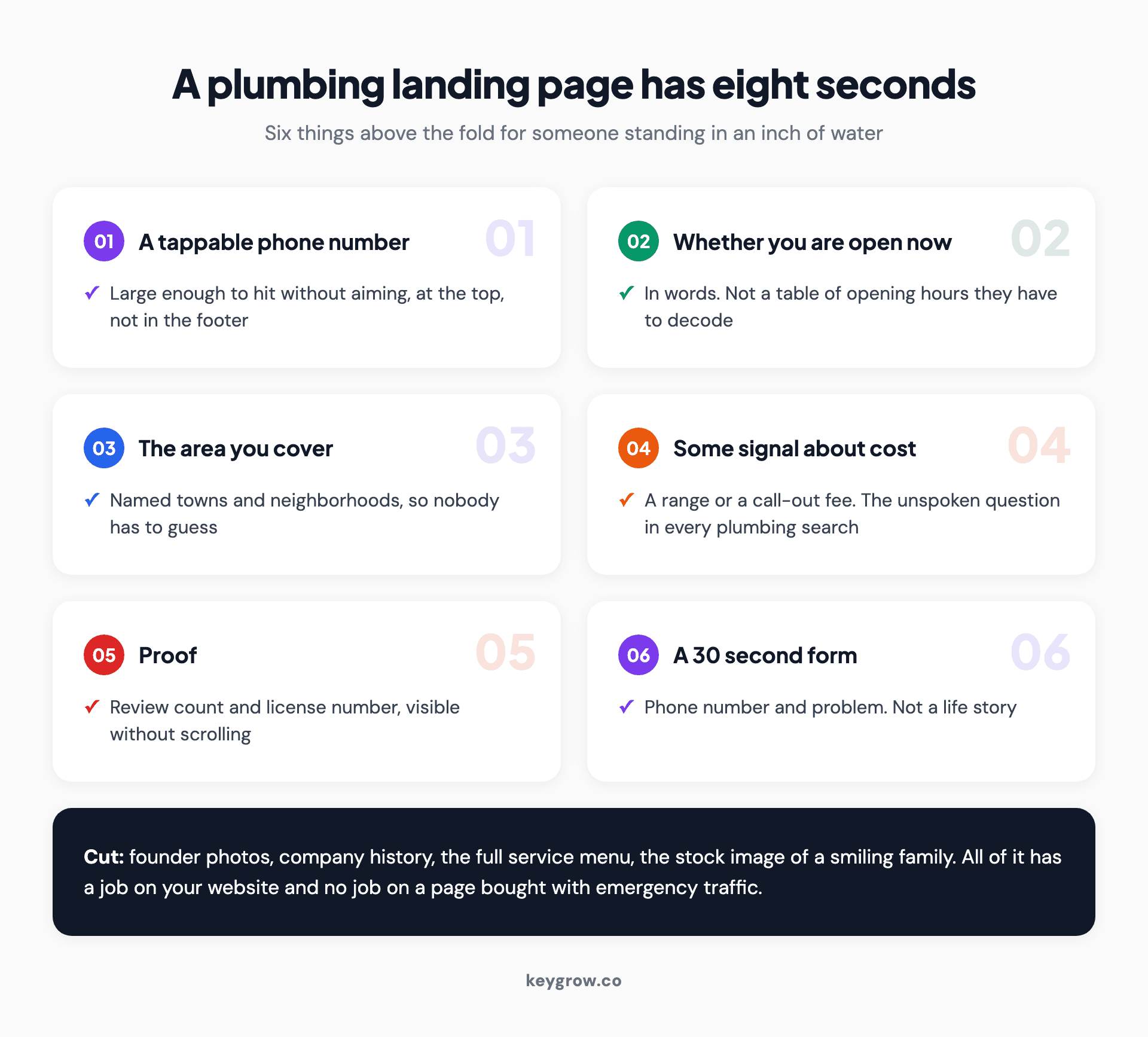
Checklist of what a plumbing Google Ads landing page must show above the fold: phone number, availability, service area, price signal, proof, and a form that takes under thirty seconds.
Above the fold, six things. A tappable phone number large enough to hit without aiming. Whether you are open right now, in words, not in a table of hours. The area you cover, named, so the visitor does not have to guess. Some signal about cost, even a range or a call-out fee, because the unspoken question in every plumbing search is how badly this is going to hurt. Proof, meaning a review count and a license number. And if you offer a form, it should take under thirty seconds and ask for a phone number rather than a life story.
Cut everything else. Founder photos, the history of the company, the full service menu, the stock image of a smiling family. That content has a job on your website and no job on a page bought with emergency traffic.
Build the planned-work pages differently. Somebody researching a repipe or a tankless water heater will read. Give them cost ranges, timelines, what the disruption looks like, financing if you offer it, and photos of finished work. Same account, completely different page.
Count booked jobs, not leads
A plumbing lead is not revenue and treating the two as interchangeable is how accounts get judged wrong in both directions.
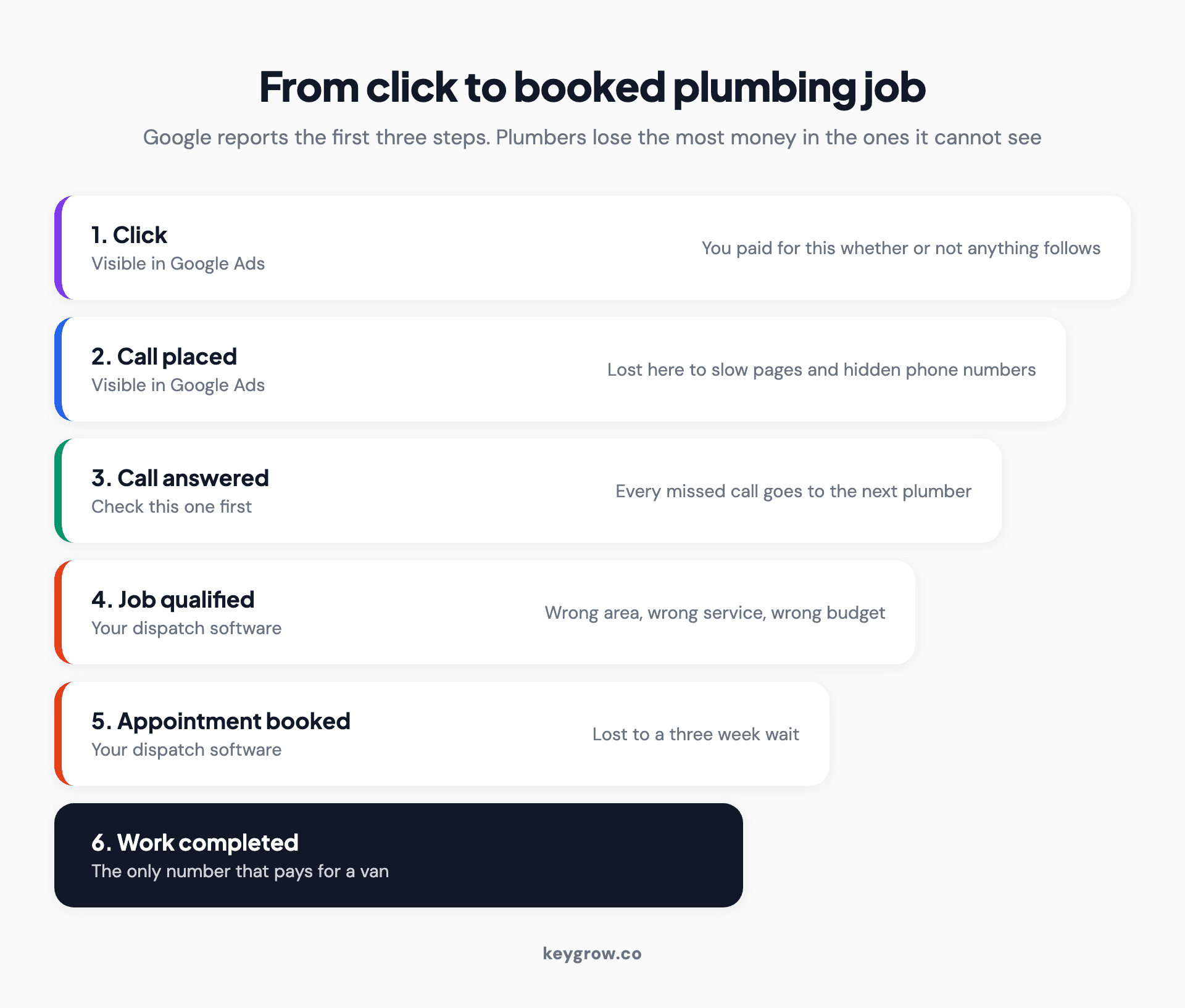
Funnel diagram from ad click to completed plumbing job showing where leads are lost: unanswered calls, unqualified jobs, unbooked estimates and unattended appointments.
The chain runs click, call, answered call, qualified job, booked appointment, completed work. Google can only report the first three. Everything past that lives in your dispatch software or your notebook, and everything past that is where plumbers lose the most.
Answer rate is the one to check first, and it is usually worse than owners believe. Every missed call during a demand spike is a lead you paid for and handed to the next plumber in the results. If two people are on jobs and the phone goes to voicemail at 3pm on a Tuesday, no amount of account optimization fixes that.
After that, look at the split between emergency and planned work in what actually got booked. Emergency jobs are smaller, faster, and rarely repeat. Planned work pays better and produces the customer who calls you again. An account that looks expensive on cost per lead can look excellent on cost per booked planned job, and you will never know unless the two are separated in your reporting.
The habit worth building is monthly rather than daily. Pull the booked jobs that came from ads, put the revenue against the spend, and ignore the click-through rate entirely. Impressions and clicks do not pay for a van.
When a plumber should not run Google Ads

A plumber's hand tools laid out on a work surface.
Three situations come up often enough that we now say them before anyone signs anything.
The first is capacity. More work than trucks means ads buy you jobs you cannot reach, and emergency traffic will not wait three weeks for a slot. Hire, or advertise only the planned work, where a wait is normal and expected.
The second is the phone. This is the answer rate point again and it earns the repetition, because it is the most common way a plumbing account fails while the account itself looks healthy. An answering service for the hours you cannot cover is cheaper than the clicks you are currently throwing away.
The third is a one-van operation with more evenings than cash. The map pack is free and a lot of plumbing work comes through it. Fill out the Google Business Profile properly, ask every finished job for a review, keep hours and service area consistent everywhere they appear. Plenty of small plumbing businesses stay busy on that alone and never buy a click. Bring in paid help once an hour of your time is worth more than the fee.
FAQs
How much should a plumber spend on Google Ads per month?
Enough to buy a meaningful number of clicks at a plumbing cost per click near $10.49. At that rate a small budget produces too few conversions for automated bidding to learn from, and the account stays stuck in a permanent testing phase. Work backwards from your average job value and your close rate rather than picking a round number.
Are Local Services Ads better than regular Google Ads for plumbers?
They do different jobs. Local Services Ads sit above search results, charge per lead, and suit emergency calls where being first matters most. Search ads charge per click and give you the keyword control, ad copy and landing pages you need to advertise planned work like repipes and water heater replacements.
Why is my plumbing cost per lead so high?
Usually because a large share of your traffic was never going to hire anyone. Do-it-yourself searchers, parts shoppers and job seekers all look like plumbing intent in a keyword tool. Check your search terms report before you touch bids, because the fix is almost always subtraction.
What negative keywords should every plumber add?
Start with do-it-yourself terms, parts and product searches, employment and training queries, free and cheap modifiers, and every service you do not offer. Then add whatever your own search terms report turns up each week, because the wasteful queries in your city will not match anyone else's list.
Can Google Ads spend more than my daily budget?
Yes. The daily figure is an average, and Google can spend up to twice it on days it expects better results. The monthly ceiling is 30.4 times your average daily budget, and anything charged above that is credited back.
Do I still get credited for bad Local Services Ads leads?
Partly. Manual disputes were replaced by an automated credit system that reviews leads and applies credits within 30 days in most cases. Credits are no longer given for job type not serviced or geo not serviced, so your service area and job type settings now control spend rather than just expectations.
How long before Google Ads produces plumbing jobs?
Emergency calls can arrive on day one, because that traffic converts within minutes of the click. Planned work takes longer, often several weeks, since a homeowner pricing a repipe collects quotes before deciding. Judge the two on different timelines or you will switch off the profitable half.
The shortest path to a working account
Open the search terms report and read the last thirty days. Not the keyword report, the search terms report, which shows what people actually typed. Most plumbers who do this for the first time find something in the top twenty that has never once produced a job.
Then check your answer rate against your call volume for the same period. Those two numbers together explain more about a plumbing account than any dashboard does, and neither of them requires new software. Answer rate matters even more if you also run Local Services Ads, which we walk through in how to get Google Guaranteed.
If you would rather hand it over, our PPC management runs month-to-month with no lock-in, and our plumbing marketing page covers how we structure accounts for the trade. If you are considering other trades, our guide to marketing a roofing company with Google Ads works through a very different set of economics on the same platform. And for the organic side of plumbing, where the profile and the website do two separate jobs, see our guide to SEO for plumbers.