

To get Google Guaranteed you sign up for Local Services Ads, pass Google's screening, and upload your license and insurance. On average it takes three to four weeks after your documents go in. There is one large complication: the badge is not called Google Guaranteed any more, and the consumer protection it was named after has been withdrawn.
That is not a technicality. It changes what you are buying, and almost every guide ranking for this question was written before it happened.
The badge changed its name, and lost the thing it was named after
Google spent years running three separate badges: Google Guaranteed for home services, Google Screened for professional services like law and finance, and License Verified by Google for a handful of licensed trades. During late 2025 those were folded into one mark called Google Verified.
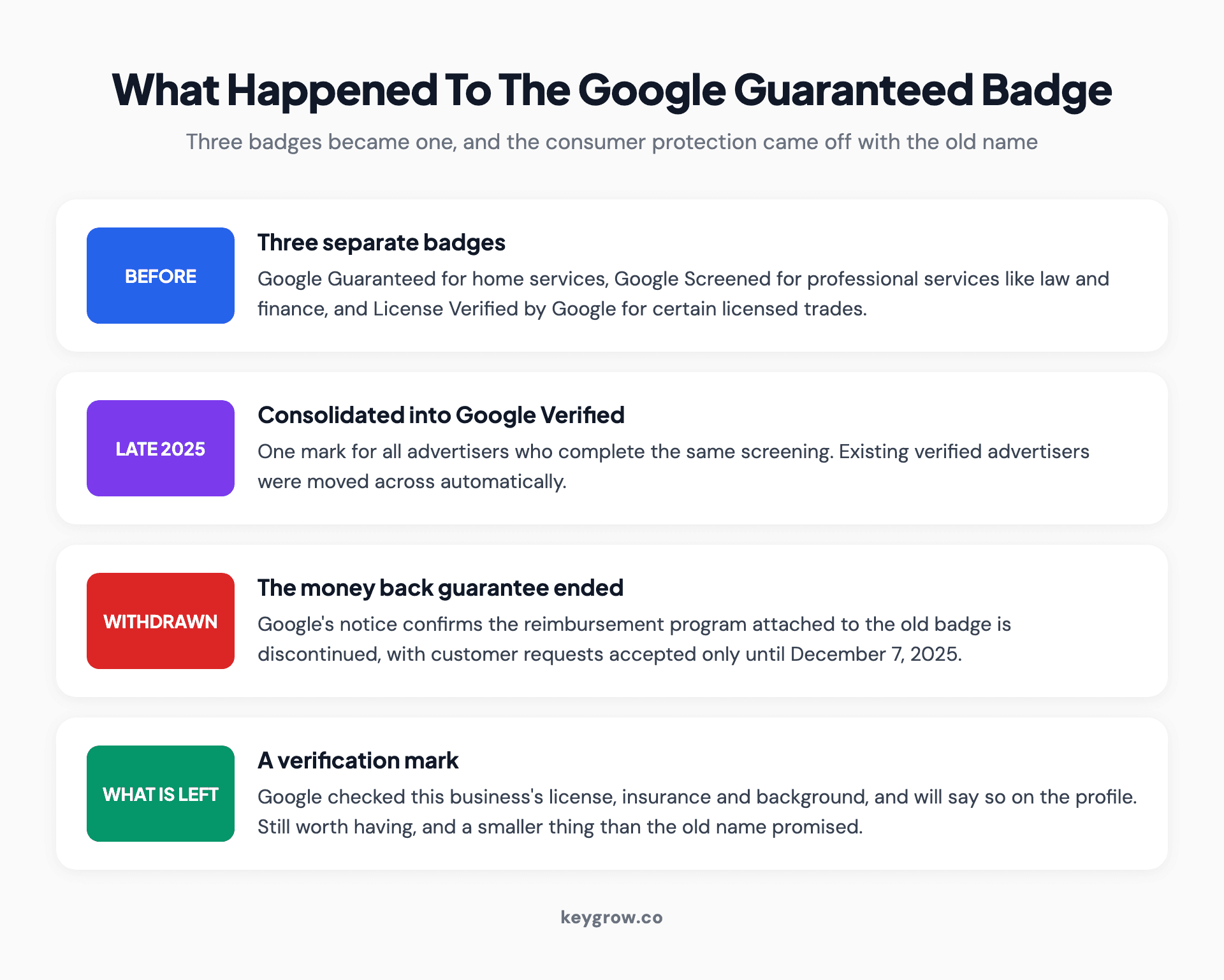
Four-stage timeline showing three Google badges consolidating into Google Verified in late 2025, the money back guarantee being withdrawn, and a verification mark remaining.
The bigger change is what came off with the old name. Google's own notice confirms the money back guarantee attached to the old badge is being discontinued, with customer reimbursement requests accepted only until December 7, 2025.
So the original pitch, that Google would reimburse a dissatisfied customer up to the job amount, is gone. What remains is a verification mark: Google checked this business's license, insurance and background, and is willing to say so on the profile.
That is still worth having. It is a different and smaller thing than what the search term promises, and you should know which one you are applying for before you spend three weeks assembling documents.
What you actually have to do
The process has not changed much, whatever the badge is called now.
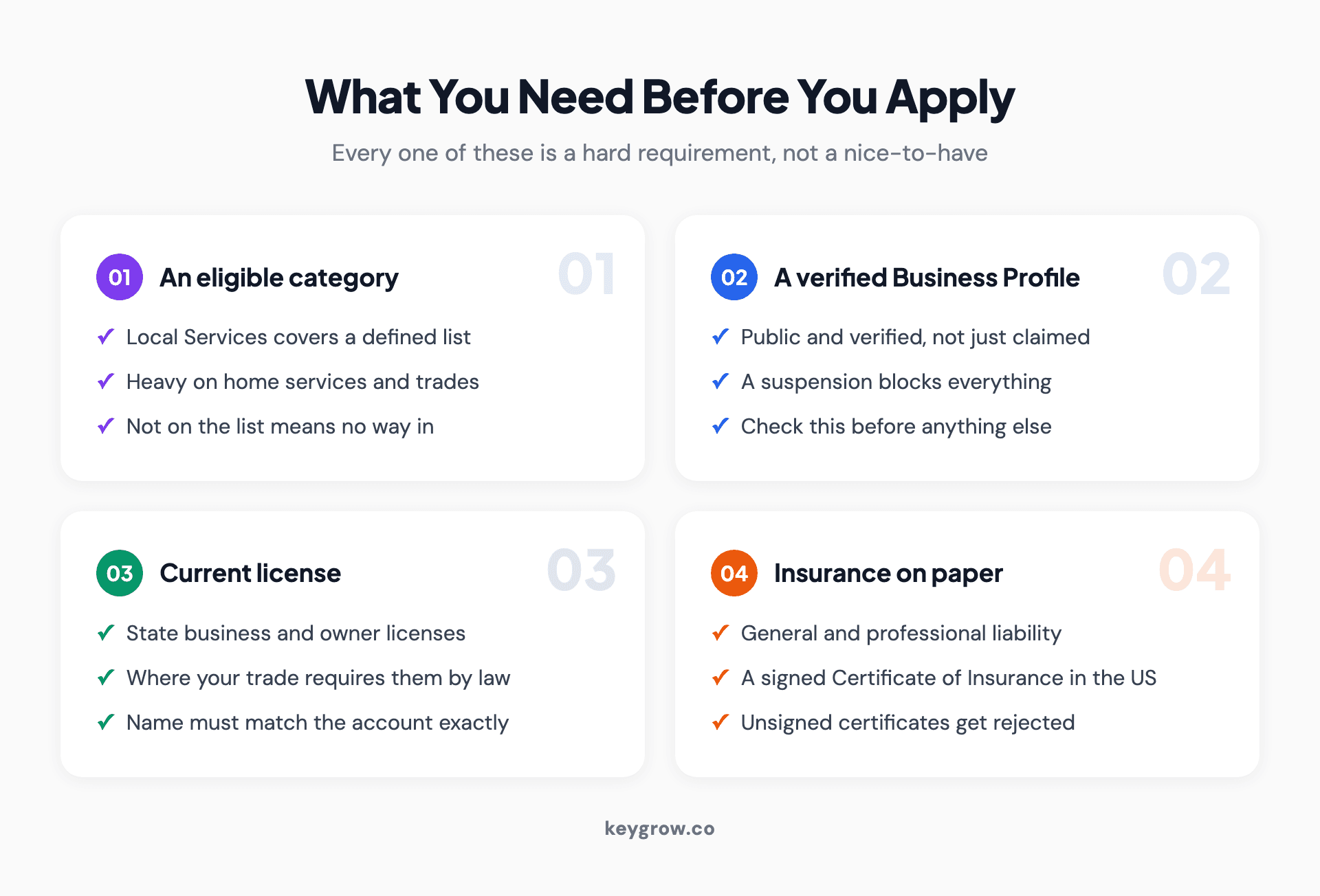
Four requirement cards for Local Services Ads: an eligible category, a verified Google Business Profile, a current license, and insurance documented on paper.
Check that your category is eligible. Local Services Ads cover a defined list, heavy on home services: plumbing, HVAC, electrical, roofing, cleaning, landscaping, pest control, garage doors, locksmiths, and a set of professional and healthcare categories. If your trade is not on the list for your country, no amount of paperwork gets you in.
Have a verified Google Business Profile. This is a hard prerequisite rather than a nice-to-have. Google's requirements state plainly that Local Services advertisers must hold a public, verified profile.
Create the Local Services account and set a budget. This is the step that surprises people, and it is covered further down.
Submit your license. State-level business and owner licenses where your trade requires them by law. The name on the license has to match the name on the account.
Submit insurance. General liability, and professional liability where the category calls for it. In the US and Canada the document Google wants is a signed Certificate of Insurance, and again the names have to match.
Pass the background checks. Business-level checks for most categories, plus owner checks and in some trades checks on the individual people who go to customers' homes.
Meet the review minimum where one applies. Some categories require a minimum number of reviews on your Business Profile before you can advertise.
What Google checks, and how it differs by trade
The screening is not uniform. Google's verification requirements set a different bar by category, and knowing which tier you are in tells you how long this will take.
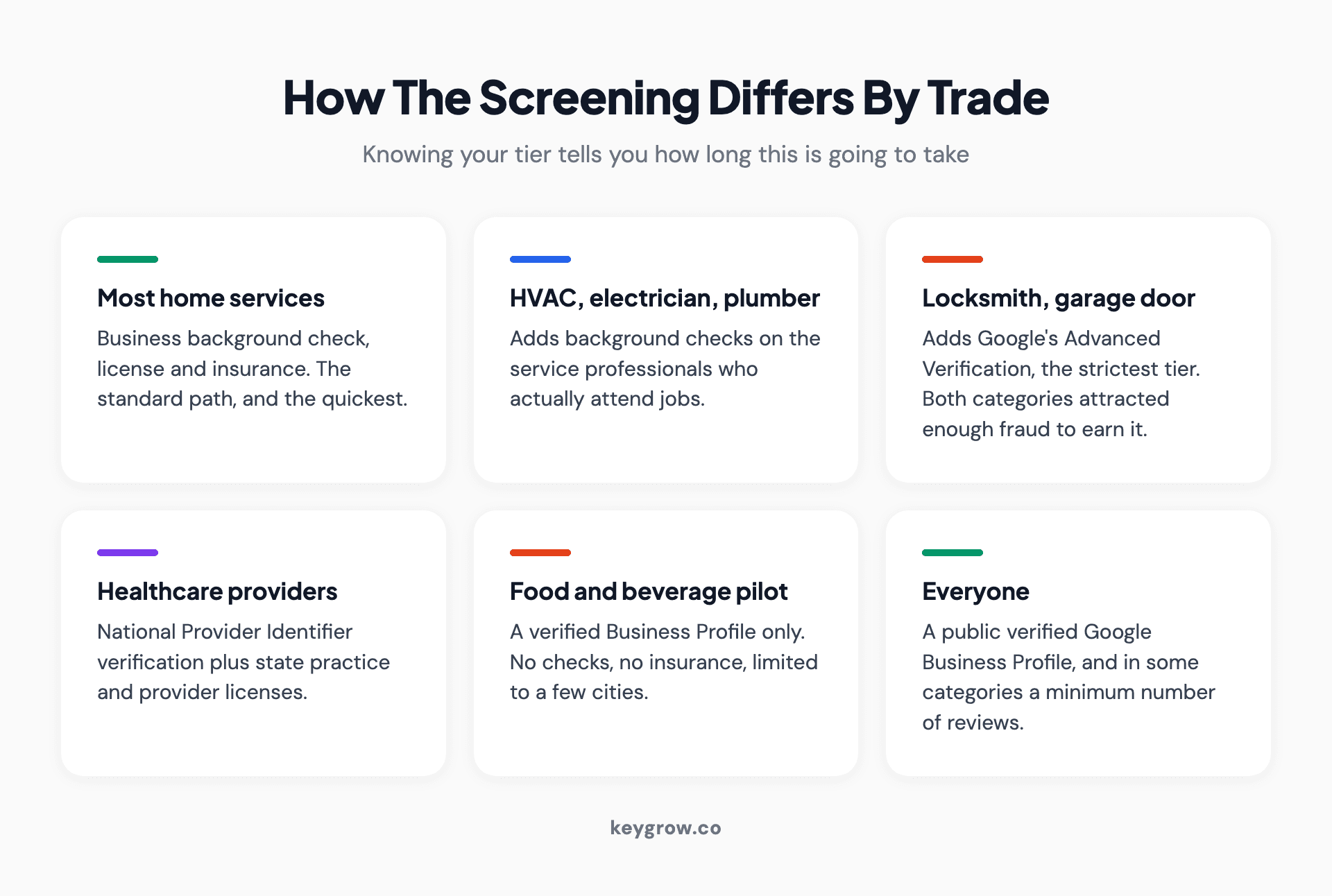
Six cards showing how Local Services screening differs by trade, from standard home services through HVAC and plumbing fieldworker checks to advanced verification for locksmiths and garage door companies.
| Category group | What is checked beyond the basics |
|---|---|
| Most home services | Business background check, license, insurance |
| HVAC, electrician, plumber | Adds background checks on the service professionals who attend jobs |
| Locksmith, garage door | Adds Google's Advanced Verification, the strictest tier |
| Healthcare providers | National Provider Identifier verification plus state practice licenses |
| Food and beverage pilot | Verified Business Profile only, in limited cities |
If you are a locksmith or a garage door company, budget for a longer and more intrusive process than a house cleaner will experience. Those two categories attracted enough fraud that Google built a separate screening tier for them, and the extra scrutiny is the reason the badge means anything in those trades.
The fieldworker checks for the urgent home trades catch people out. You are not only verifying the business, you are verifying the people you send to a stranger's house at eleven at night, and staff turnover means that job never quite finishes.
Three to four weeks, and what makes it longer
Google's published average is three to four weeks after documents are submitted. The phrase doing the work in that sentence is "after documents are submitted".
The delays are almost always paperwork rather than Google. An insurance certificate without a signature. A license under a slightly different legal entity name than the account. A DBA on the profile and the registered name on the license. An expired certificate that the broker has not reissued. Each one restarts a review cycle, and a fortnight can disappear into a name mismatch nobody noticed.
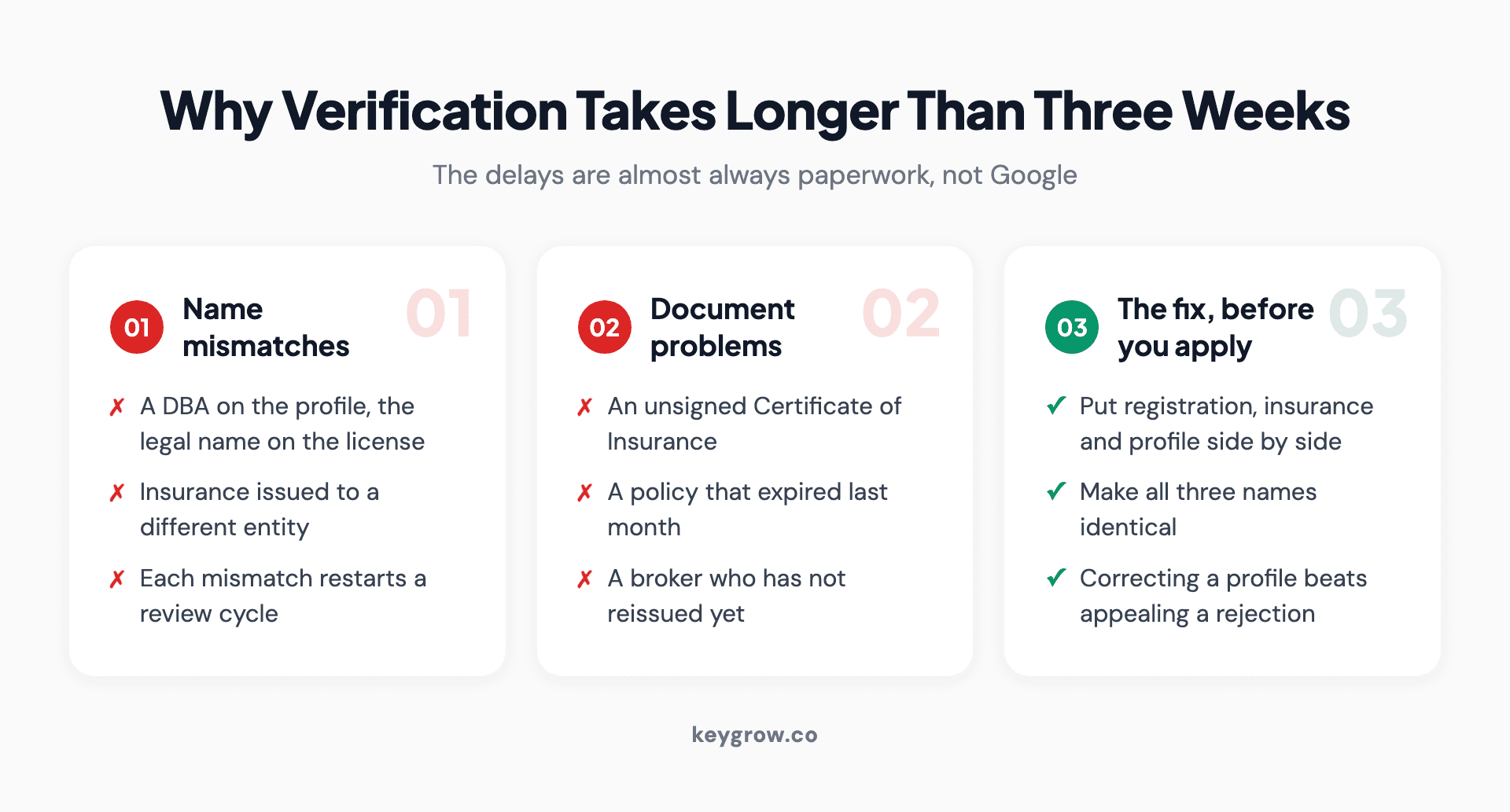
Three-column breakdown of why Local Services verification runs long: name mismatches, document problems, and the pre-application fix of aligning registration, insurance and profile.
Before you apply, put three documents side by side: your business registration, your insurance certificate, and your Business Profile. Make the names identical. If they are not, fix that first, because it is faster to correct a profile name than to argue a rejection.
You can also run ads before the badge arrives. Google allows advertising once preliminary checks pass while the rest of onboarding completes, so the waiting period is not necessarily dead time.
The part most guides skip: this is an advertising product
Here is the thing people searching for this generally do not realize. The badge is not an SEO achievement, a trust signal you earn once, or something that attaches to your organic listing.

Laptop, notepad and pen laid out on a weathered wooden desk.
It exists inside Local Services Ads. To display it you run the ads. To run the ads you set a weekly budget and pay for leads. Stop advertising and the badge stops appearing, because the thing it appears on is an ad.
It has no effect on your organic rankings and no effect on your position in the map pack. Local Services Ads sit above both, in their own unit, and they are bought rather than earned.
None of that makes it a bad idea. It does mean that "how do I get Google Guaranteed" is really the question "should I run Local Services Ads", and it should be answered with a budget conversation rather than a document checklist.
What it costs
You pay per lead rather than per click, and the price varies enormously by trade and city.
That pricing model is the genuinely interesting part. In categories where click prices are brutal, paying for a lead rather than a click can compare well. Legal terms like car accident lawyer run past $100 per click in major markets, and a click is not a case, or a call, or anything at all. A per-lead price can look cheap next to twenty clicks that produced nothing.
The flip side is lead quality, which is where this product frustrates people. You are charged for leads, and not every lead is a customer. Google allows disputes for leads that are out of area, for a service you do not offer, or that are spam, and using that dispute process properly is the difference between a workable cost per job and a bad one. Businesses that do not dispute anything pay for wrong numbers all year.
Budget is set weekly and you can pause. The lead flow responds accordingly, and in seasonal trades that control matters more than the headline price.
How you rank inside Local Services Ads
Getting the badge gets you into the auction. It does not put you at the top of it, and the levers here are unlike anything in ordinary search advertising.
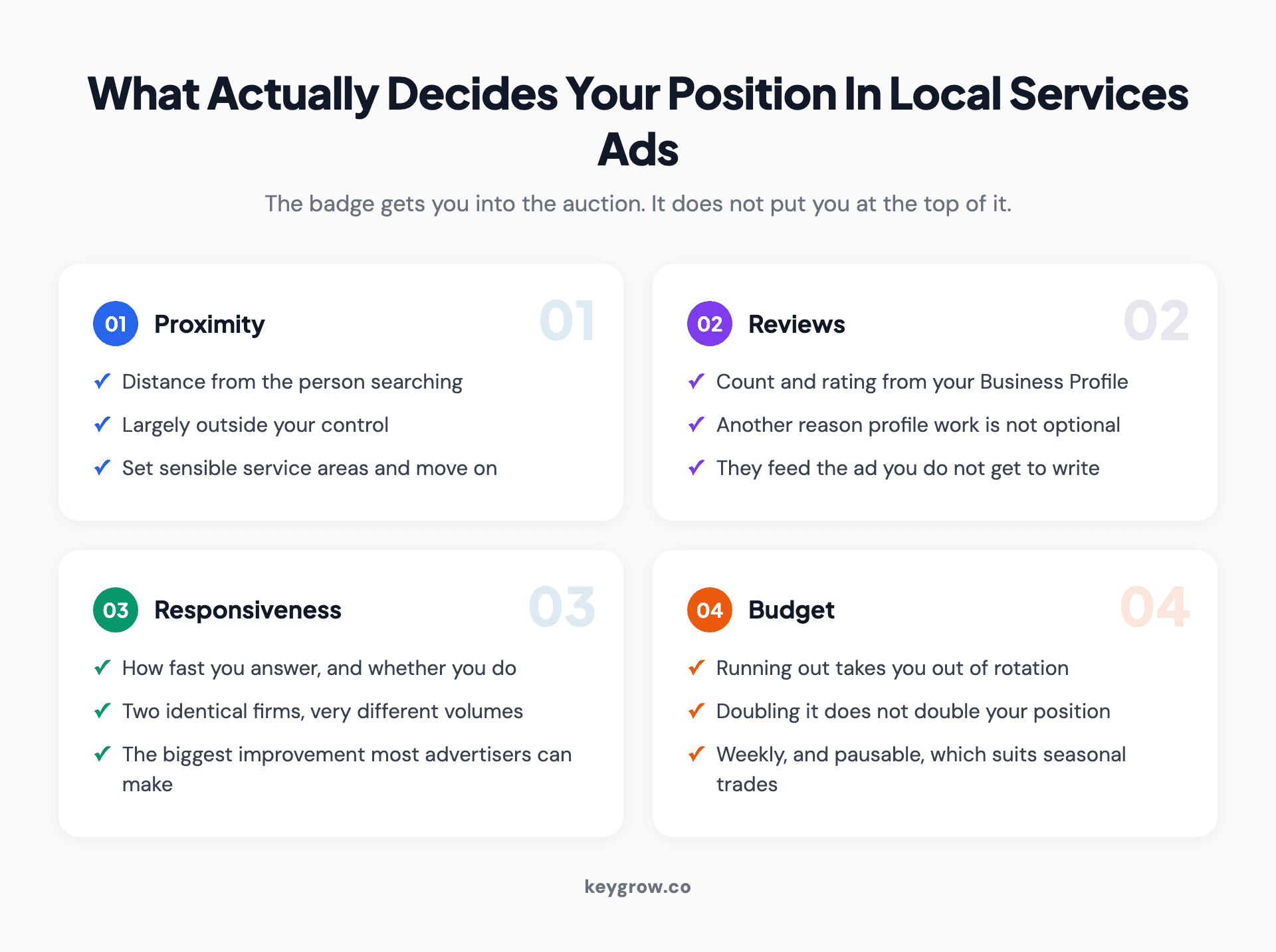
Four cards covering what decides position in Local Services Ads: proximity, reviews, responsiveness, and budget.
Proximity to the searcher matters, as it does in the map pack, and you cannot do much about it beyond setting sensible service areas.
Review count and rating matter, drawn from your Business Profile, which is another reason the profile work is not optional.
Responsiveness matters in a way that is unusual and worth taking seriously. How quickly you answer, whether you answer at all, and how promptly you deal with leads all feed into how often you are shown. Two identical businesses with different answering habits get very different volumes from this product.
Your budget matters, but less directly than in a click auction. Running out of weekly budget takes you out of rotation; doubling it does not double your position.
The practical implication is that the biggest available improvement for most advertisers here is not a settings change at all. It is answering the phone during business hours, calling back within minutes rather than hours, and marking leads as booked so the system learns you are converting them.
Where it sits next to your other options
Three channels, three different economics, and they are not substitutes for each other.
| Local Services Ads | Standard Google Ads | Organic and map pack | |
|---|---|---|---|
| Position on the page | Very top | Below LSA, above organic | Below the ads |
| What you pay for | Each lead | Each click | Nothing per visit |
| Time to first result | Weeks, after verification | Days | Months |
| Stops when you stop paying | Yes | Yes | No |
| Verification required | Yes, license and insurance | No | No |
| Control over messaging | Very little | Complete | Substantial |
That last row surprises people. Local Services Ads give you almost no creative control. You do not write the ad. Google assembles it from your profile, your reviews and your category, which means the lever you would normally pull to improve performance is simply not there.
The sensible way to read that table is not as a ranked list. Urgent trades with healthy job values usually want all three: Local Services Ads for the emergency calls, standard search ads for the terms where you need to control the message, and organic work underneath so that a paused budget does not mean a silent phone.
Is it worth applying?
Depends on three things, and they are worth answering honestly before you start.
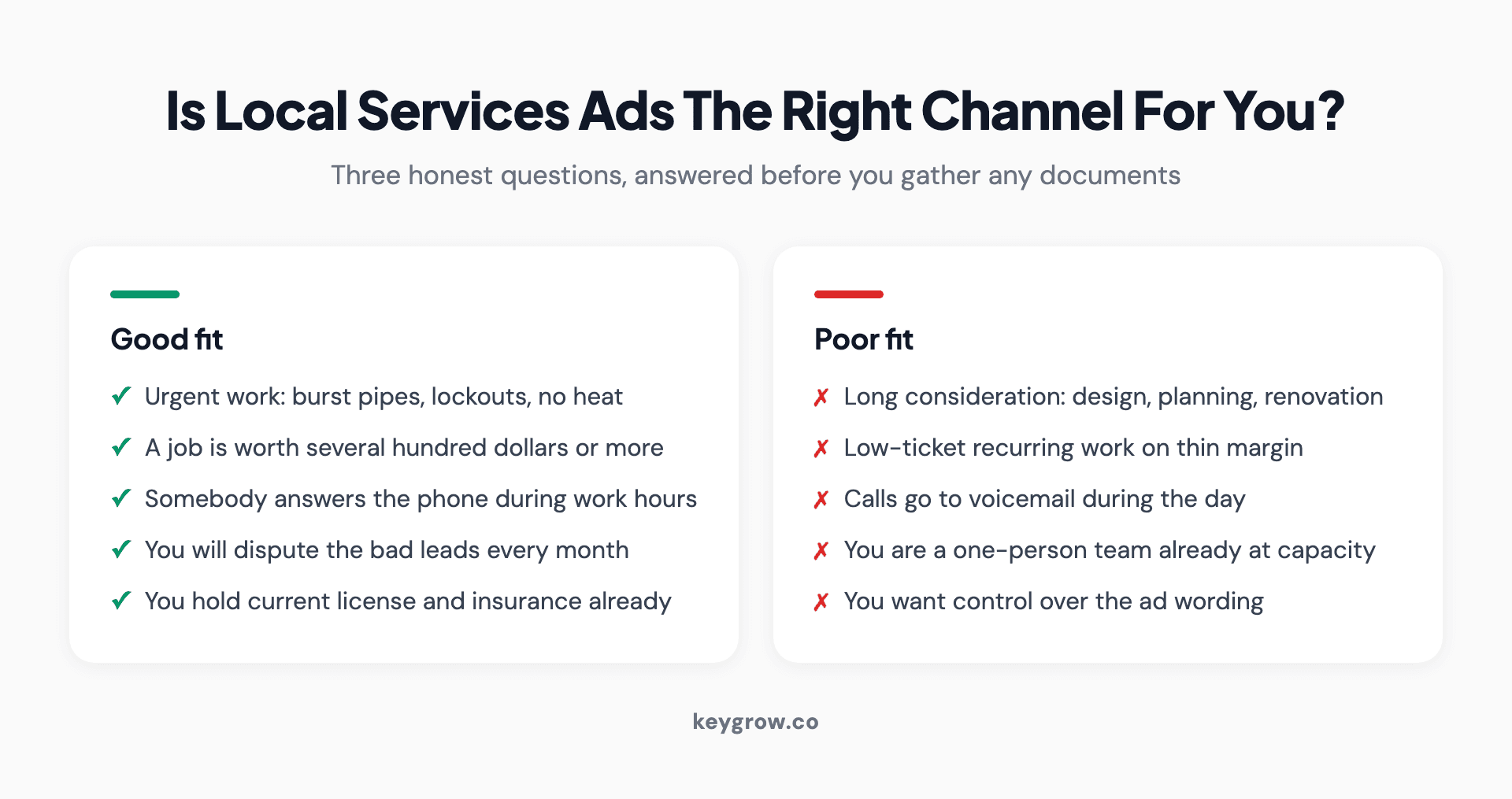
Two-column comparison of businesses that are a good fit for Local Services Ads against those that are a poor fit, covering urgency, job value, phone answering and creative control.
How urgent is your service? Local Services Ads sit at the very top of the page for emergency and same-day searches. A burst pipe at midnight is the ideal case. A landscape design project that the homeowner will think about for six weeks is not, because they will scroll, compare and research rather than tapping the first result.
What is a job worth to you? Per-lead pricing works when a job is worth several hundred dollars or more and your close rate is decent. On low-ticket recurring work the math gets tight quickly.
Can you answer the phone? This is the one that sinks people. The product routes calls, ranks you partly on responsiveness, and charges you for the lead whether or not anyone picked up. If calls go to voicemail during working hours, you will pay to miss them.
I would rather tell a business it is a poor fit than take the setup fee. If you are a design-led firm with long consideration cycles, a trade nobody searches for at 2am, or a one-person operation already at capacity, this is not your channel. Say no to it and put the same money into the organic work that compounds.
When you will not get it
Some applications fail for reasons no amount of resubmission fixes.

Close-up of a well-used canvas tool bag with hand tools in its pockets.
Your category is not eligible in your country, which is the most common one. Your license is held by a different legal entity than the business applying. You cannot obtain the insurance the category requires. The background check surfaces something disqualifying. Your Business Profile is suspended, which blocks the whole process at the prerequisite stage.
A profile suspension is worth checking before anything else, because it fails silently. If you have ever had a listing removed or reinstated, confirm the current state first.
Keeping the badge once you have it
This is not a one-time certification. Licenses and insurance expire, and the badge goes with them.
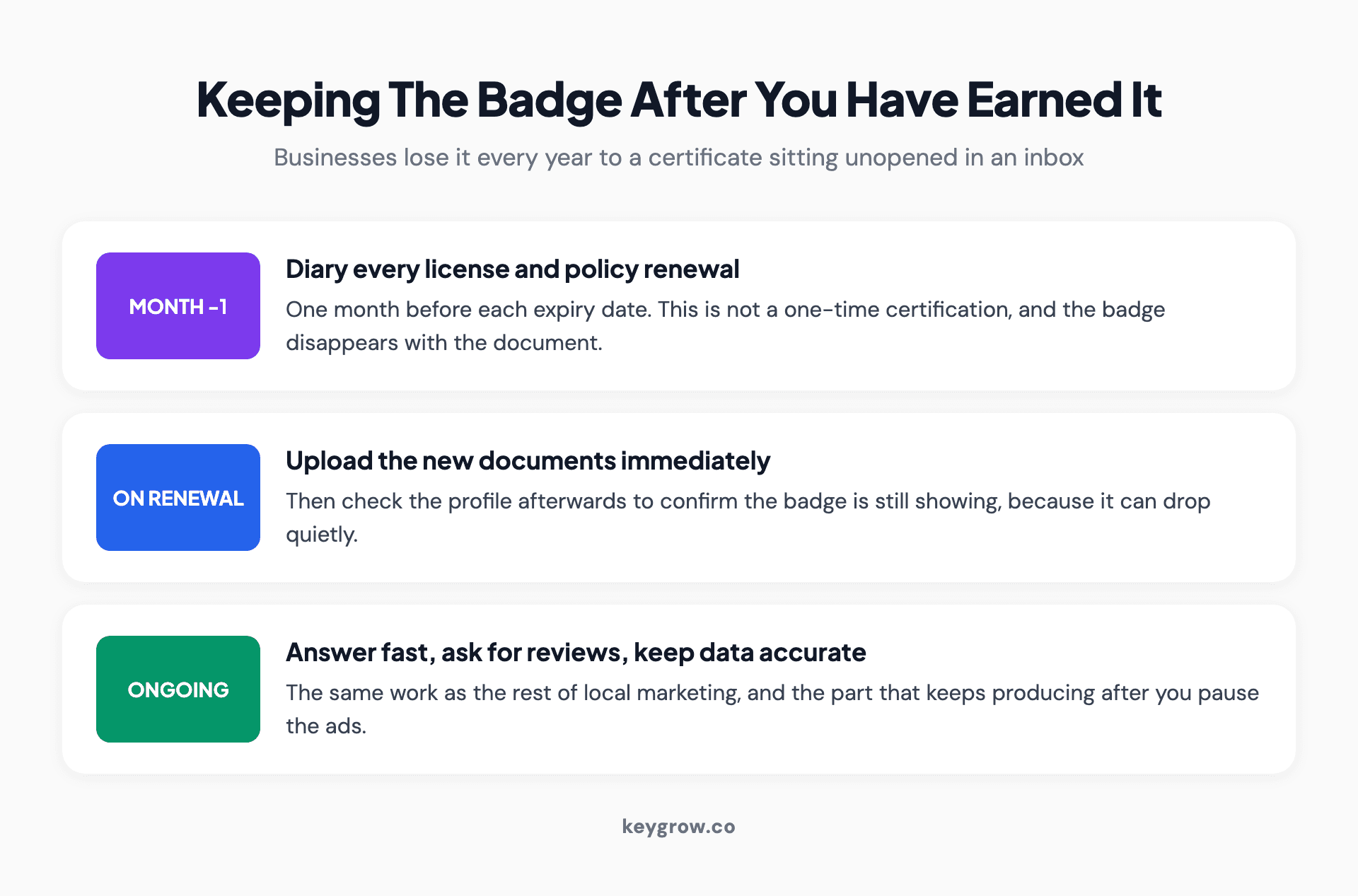
Three-step routine for keeping the Google Verified badge: diary every renewal a month ahead, upload new documents immediately, and keep answering fast and collecting reviews.
Set a calendar reminder a month before each policy and license renewal date, upload the new documents as soon as they exist, and check the profile afterwards to confirm the badge is still showing. Businesses lose it every year through nothing more than an expired certificate sitting in an inbox.
Responsiveness and reviews also matter to how often you appear, so the ongoing work is the same work as the rest of local marketing: answer quickly, ask for reviews, keep the profile accurate. Our local SEO checklist covers that side, and it is what keeps working when you pause the ads.
FAQs
Is Google Guaranteed still available?
Not under that name. Google consolidated Google Guaranteed, Google Screened and License Verified by Google into a single Google Verified badge during late 2025, and discontinued the money back guarantee that the original badge was named after. The screening and verification process behind it continues largely as before.
How long does it take to get verified?
Google's stated average is three to four weeks from the point your documents are submitted. Most delays come from mismatched names across your license, insurance certificate and Business Profile, so aligning those before you apply is the single best way to shorten it.
Does the badge help my SEO?
No. It is an advertising feature that appears on Local Services Ads, which sit above organic results and the map pack in their own unit. It does not affect organic rankings or map pack position, and it disappears if you stop advertising.
What does it cost?
You pay per lead rather than per click, at a price that varies by trade and location, with a weekly budget you set and can pause. Whether it is good value depends mostly on what one job is worth to you and how reliably you answer the phone.
Do I need a license and insurance?
For most categories, yes, and they must be current. The requirements differ by trade and country, and some categories such as locksmiths and garage door services face an additional advanced verification tier. Healthcare providers need National Provider Identifier verification as well as state licenses.
Can I be charged for a bad lead?
You can be charged, and you can dispute it. Google accepts disputes for leads outside your service area, for services you do not offer, and for spam. Disputing consistently is the difference between a reasonable cost per job and an expensive one, and it is the step most advertisers neglect.
Do I need a Google Business Profile first?
Yes. A public, verified Business Profile is a prerequisite, not an optional extra, and a suspended profile will stop the application before screening starts. Sort the profile out before you begin gathering documents.
Before you apply, do the arithmetic
Work out what one job is worth, what share of leads you typically close, and therefore the most you can pay per lead and still make money. If that number is comfortably above what your trade costs in your city, gather the documents and start.
If it is not, or if your work involves long consideration rather than urgent calls, this is not the channel and no badge will change that. The honest alternative is the slower one: profile, reviews, service pages, and the local search work that keeps producing after you stop paying.
If you want a second opinion on which side of that line you sit, that is a short conversation rather than a project. Tell us your trade and your average job value, and we will tell you whether the arithmetic works, including when it does not. Our PPC work covers Local Services Ads alongside the rest of the paid channels, and we will say so if it is the wrong one for you.


