

Most local SEO checklists have fifty items. This one has about thirty, and the honest part is that eight of them produce most of the result. The rest is maintenance, and maintenance is worth doing, but it is not what moves a business from invisible to the map pack.
So this local SEO checklist is ordered by return rather than by category. Work down it. If you stop halfway you will still have done the half that matters, which is not true of a checklist grouped by topic.
First, what local rankings are actually made of
The ingredient list is published, and it is far shorter than any checklist implies. Three things decide local results according to Google's own documentation, and everything below is downstream of them.
Relevance asks whether your listing is a sensible answer to the thing that was typed. Categories, listed services and the wording on your site are the levers.
Proximity is the one nobody can buy. The searcher's position relative to yours decides a great deal, which is worth internalizing before you spend anything: optimization does not carry a business into map results for a suburb twenty miles off.
Prominence is a measure of how established you look, assembled from reviews, links, citations and general presence. It accrues slowly, and it is the reason a business that opened in March does not displace one that opened in 2009 by May.
Every item below is really an attempt to improve relevance or prominence. Where an item does neither, it is on the list because it prevents something breaking, and where it does not do that either, it should not be on the list at all.
Before the checklist: find out where you actually stand
Twenty minutes of looking will tell you which parts of this list you can skip, and it stops you fixing things that are not broken.
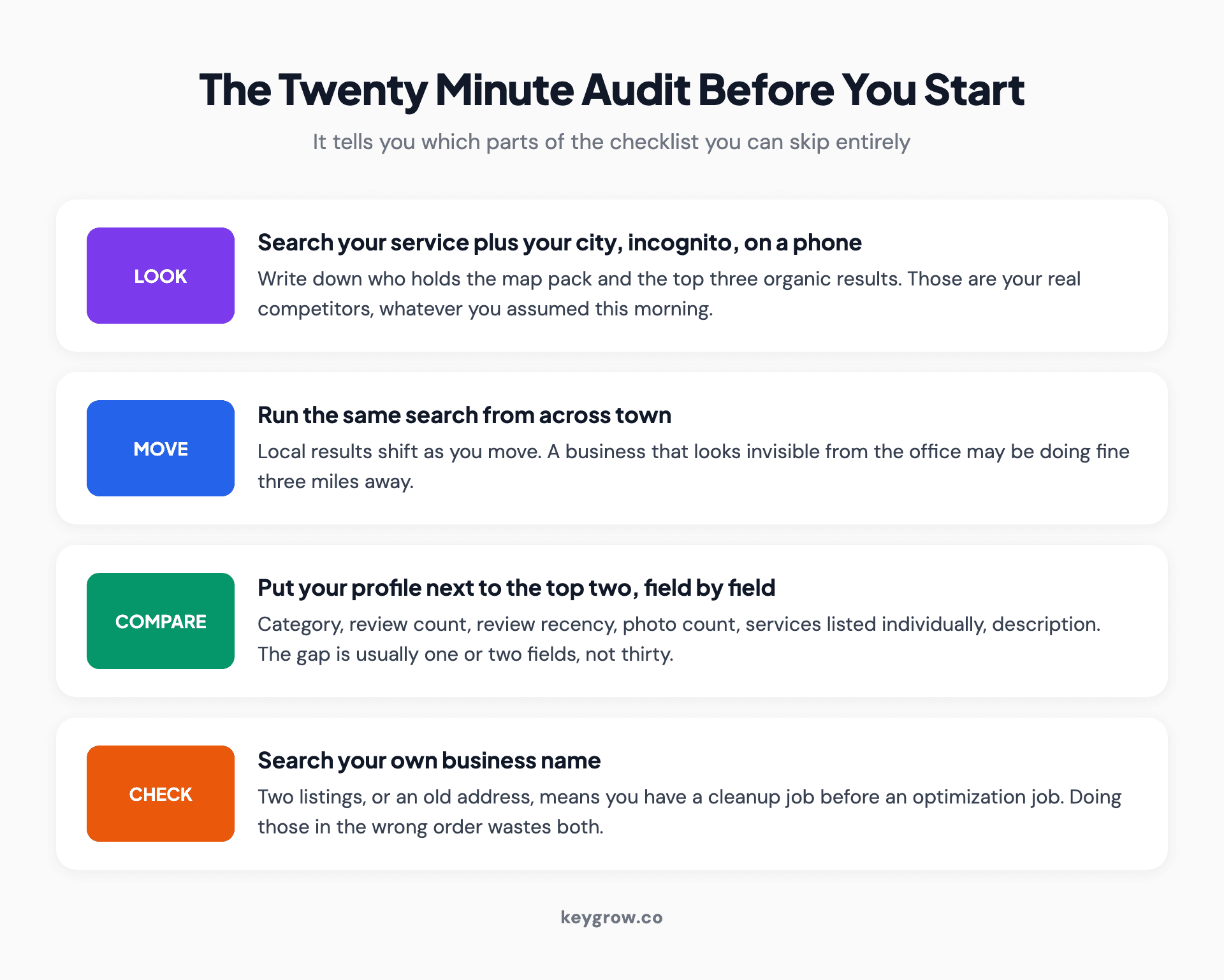
Four-step audit to run before starting a local SEO checklist: search your service and city incognito, repeat from across town, compare your profile to the top two field by field, then search your own business name.
Search your main service plus your city, in an incognito window, on a phone. Write down who is in the map pack and who is in the top three organic results. Those are your real competitors, whatever you thought before.
Then move. Search the same thing from a different part of town, or ask somebody across the city to. Local results change as you move, sometimes dramatically, and a business that looks invisible from the office may be doing fine three miles away. Knowing the shape of your visibility across the area is more useful than one ranking number.
Now open the top two map results and compare them to yours, field by field. Category, review count, review recency, number of photos, whether services are listed individually, whether the description says anything. Most of the time the gap is obvious and it is one or two fields, not thirty.
Finally, search your own business name. If two listings come back, or an old address, you have a cleanup job before an optimization job, and doing them in the wrong order wastes both.
Week one: the eight that matter most
Everything below this heading fits in a single working week, and it accounts for most of what local SEO ends up returning. The other twenty-odd items are worth doing afterwards.
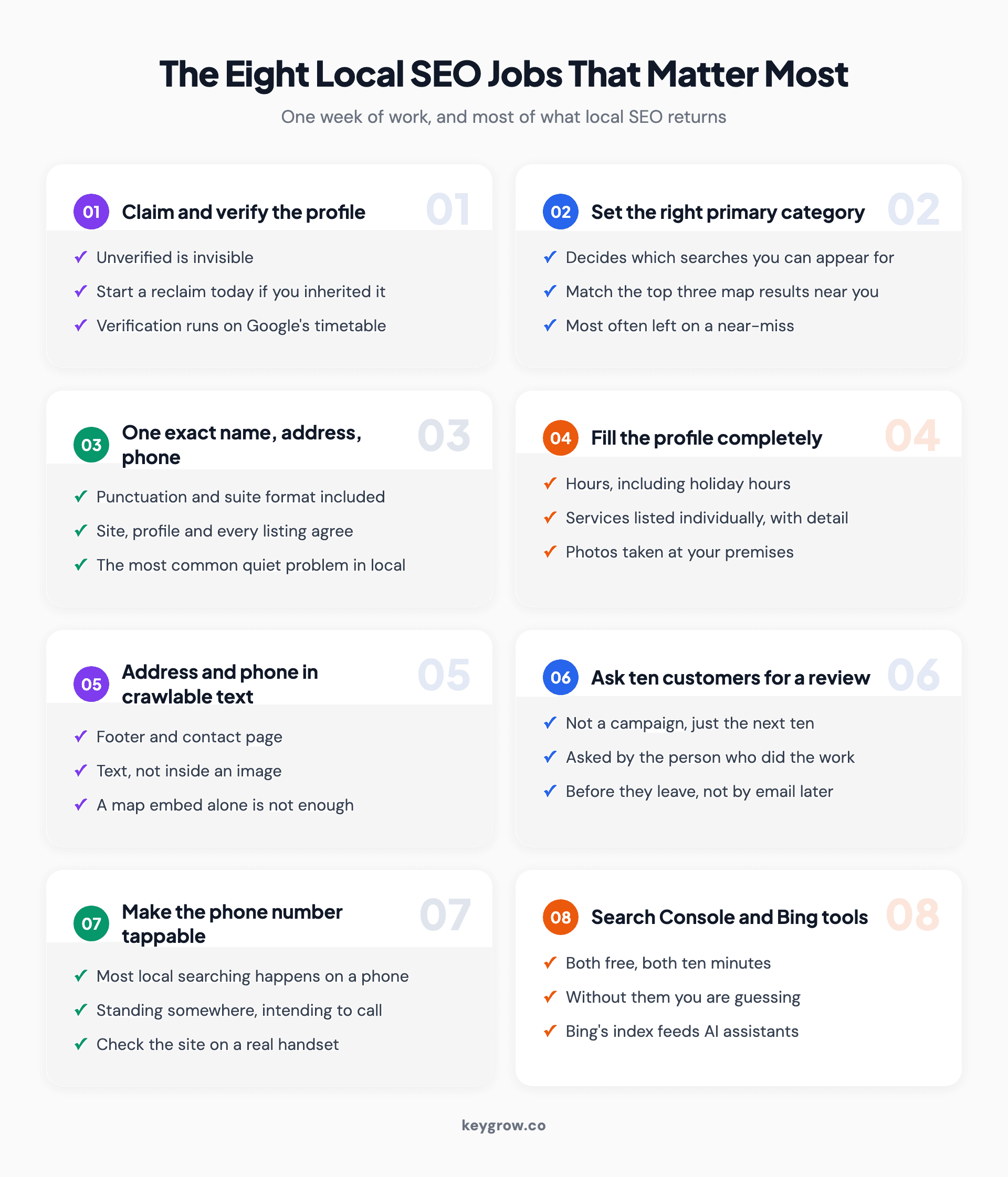
Eight numbered cards covering the highest-value local SEO jobs: claim and verify the profile, set the primary category, standardize name address and phone, complete the profile, put contact details in crawlable text, ask for reviews, make the number tappable, and set up Search Console and Bing tools.
1. Claim and verify your Google Business Profile. Unverified is invisible. If you inherited a business and cannot access the profile, start the reclaim process today, because verification runs on Google's timetable rather than yours.
2. Set the right primary category. No other field on the profile decides as much, and none is more often left on a near-miss. "Dentist" and "Cosmetic dentist" surface for different searches. Look at what the top three map results in your area use and match the one that describes your main revenue.
3. Get the name, address and phone number right and identical everywhere. Pick the exact string, punctuation included, and use it on your site, your profile, and every listing. Inconsistency here is the most common quiet problem in local search.
4. Fill the profile completely. Hours, including holiday hours. Services, individually, with descriptions. Attributes. A real description. Photos that were taken at your premises rather than pulled from a stock library.
5. Put your address and phone in crawlable text on your site. In the footer, on the contact page, as text rather than inside an image or only in a map embed.
6. Ask ten customers for a review. Not a campaign, just the next ten people you serve, asked directly by the person who did the work.
7. Make sure your site loads on a phone and the phone number is tappable. Most local searching is done on a phone, standing somewhere, with intent to call.
8. Set up Google Search Console and Bing Webmaster Tools. Both are free, and skipping them means guessing. Bing deserves the ten minutes now that its index sits underneath several AI assistants.
Month one: the website side
The profile gets you into the map pack. The website is what makes you competitive inside it, and what wins the organic results underneath.

Hands writing on a paper checklist attached to a clipboard.
| Item | Why it matters | Time |
|---|---|---|
| A page per service, not one services page | Relevance for the terms people actually search | Half a day each |
| City or area named in title tags naturally | Matching how local queries are typed | An hour |
| Location page per real location | The only page that can rank for that area | Half a day each |
| LocalBusiness schema on the contact page | Machine-readable confirmation of your NAP | An hour |
| Internal links from service pages to location pages | Tells search engines which pages relate | An hour |
| An FAQ block answering real local questions | Snippet and AI answer eligibility | Two hours |
| Fix broken links and 404s | Prevents slow leakage of authority | An hour |
| Embed a map on the contact page | Small signal, useful for humans | Ten minutes |
The one to take seriously is the first. A single page listing eight services will not rank for any of them. Eight pages, each answering the question somebody types when they need that service, will.
The title tag guidance deserves a caution. Naming your city is sensible. Stuffing three suburbs and two services into a 60 character title is the thing that makes a listing look spammy to a human, and humans are the ones clicking.
Months two and three: prominence, which is the slow part
Prominence is where local SEO stops being a checklist and starts being a habit.
Citations. Get listed on the major aggregators and the directories that matter in your industry, with your exact NAP string. Then stop. There is a long tail of directories that exist only to be sold to people building citations, and being in 200 of them is not eight times better than being in 25. Our citations guide covers which ones earn the time.
Reviews, continuously. Not a burst. See the next section for why the date on the review matters as much as the star.
Local links. Sponsor something, join the trade body, get on the supplier's installer list, help with a school event. These are the links that actually correlate with local prominence, and none of them come from an outreach template.
Content that has a local reason to exist. Not "Top 10 things to do in Springfield" written by somebody who has never been. A page about the permit process in your county, or what a job costs in your market, or the problem specific to houses built in your area in the 1970s.
If your team drives to customers
Service area businesses run the same list with three differences, and getting them wrong is how accounts end up suspended.
Hide your address if customers do not come to you. A profile showing a residential address you operate from looks like a violation even when it is not, and it invites edits from strangers. Set the service areas instead, as the regions you genuinely cover rather than every place you would drive for enough money.
Resist opening a profile per city you cover. One profile carries a list of areas; twenty profiles carry a suspension. Among trades this is the mistake that ends accounts more often than any other.
And be more careful than a storefront would be about proof of location on your site. Without a visitable address, the evidence that you work in an area is your content: jobs you have done there, neighborhoods named the way locals name them, photos with recognizable surroundings. A storefront proves its location by existing. You have to show yours.
Reviews have a shelf life, and that changes the job
One statistic reframes the whole review job. In BrightLocal's 2026 survey, 97 percent of consumers read reviews for local businesses, which is the figure everyone quotes. The useful one is further down: 74 percent look for reviews written in the last three months, and 44 percent care that there is one from the last month.
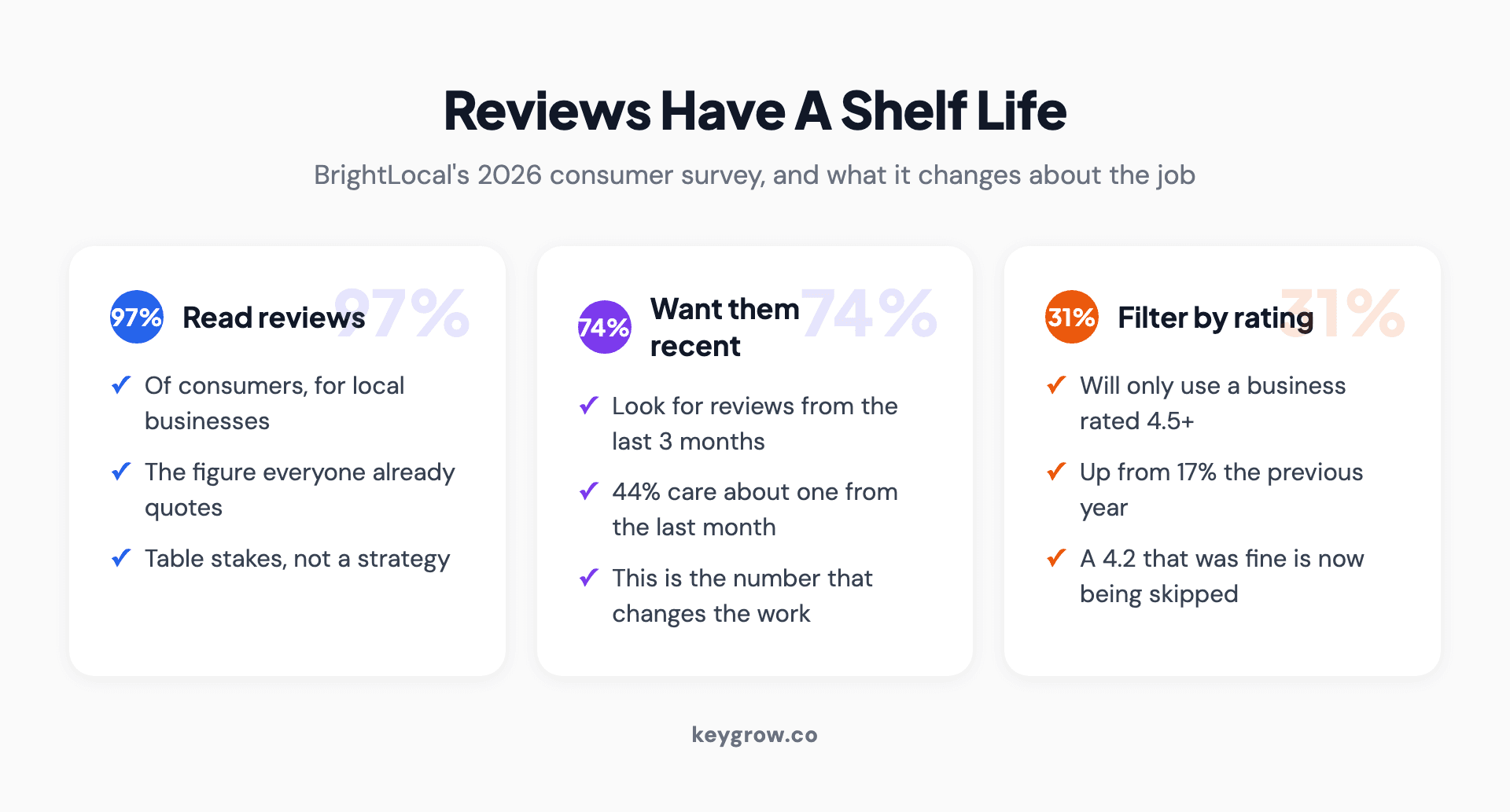
Three statistics from BrightLocal's 2026 consumer survey: 97 percent read reviews, 74 percent look for reviews from the last three months, and 31 percent will only use a business rated 4.5 stars or higher.
Picture two listings side by side. One carries 180 reviews and the most recent is from last spring. The other has 40, three of which landed this week. The larger number reads as a business that used to be busy.
That turns review generation from a project into a standing process. A steady handful every month beats forty in a burst and then silence, and it is easier to do, because the ask happens at the end of a job rather than in a campaign.
The same survey found 89 percent expect owners to respond, and 31 percent will now only use businesses rated 4.5 or higher, up from 17 percent the year before. That last shift is the one to watch. The bar is moving, and a 4.2 that was fine two years ago is now being filtered out by a third of the people looking.
What to measure, and what to ignore
Rank tracking for local is misleading in a specific way, and it is worth understanding before you pay for a report built on it.
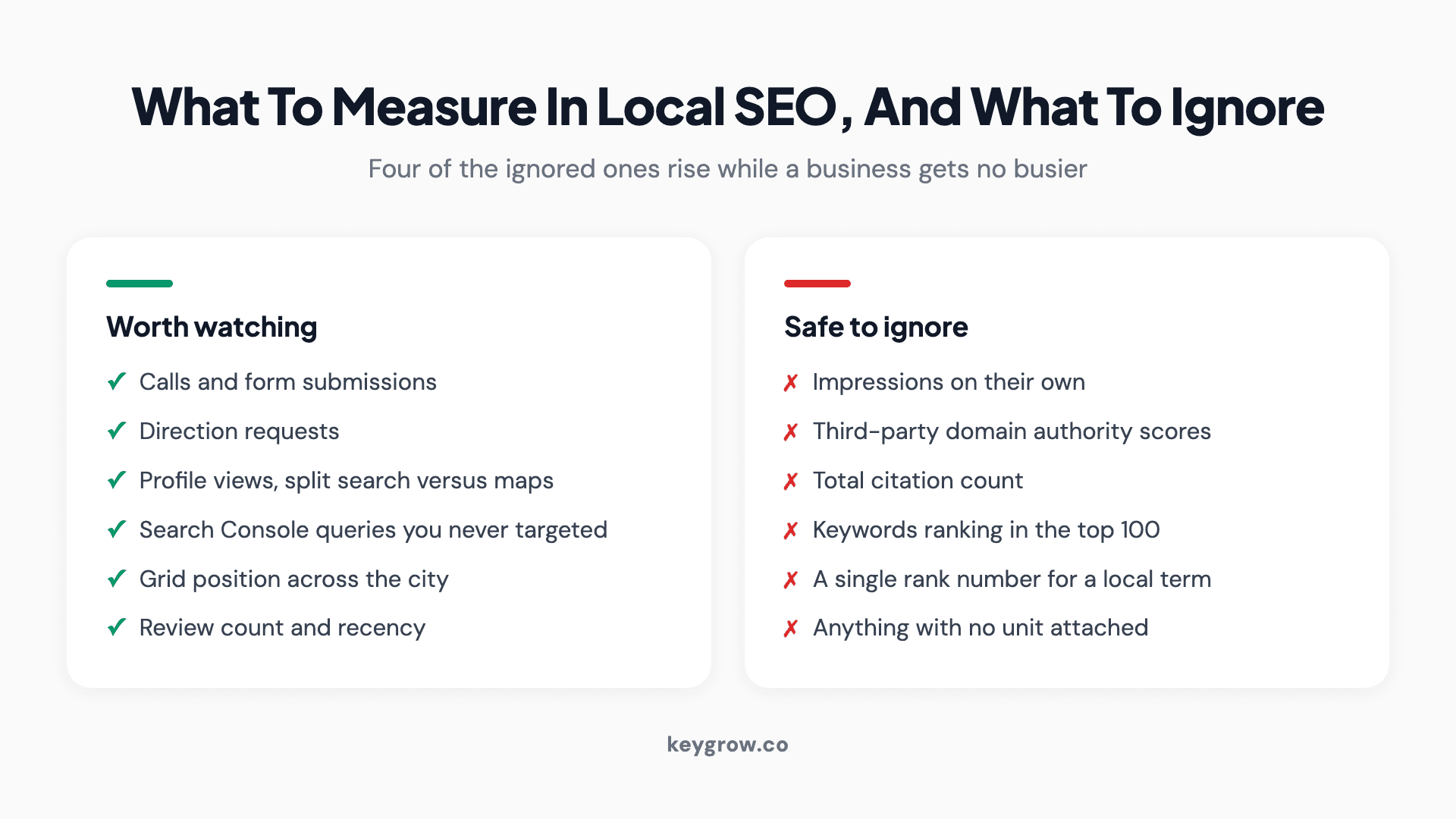
Two-column comparison of local SEO metrics worth watching, such as calls and direction requests, against metrics safe to ignore, such as impressions and total citation count.
A single position number for a local term is close to meaningless, because there is no single position. Your placement changes with the searcher's location, so a report saying "position 3" is really saying "position 3 from wherever the tool checked". Grid-based tracking, which samples your position across a matrix of points around the city, is the honest version, and we went through how to read one in our Google Maps SEO guide.
What to actually watch, in order of usefulness: calls and form submissions, because they are the thing you sell. Direction requests, which are the closest thing to intent a profile reports. Profile views broken down by search versus maps. The queries in Search Console that you rank for but never targeted, which is the cheapest keyword research available. Then rankings, last, as a diagnostic rather than a scoreboard.
What to ignore: impressions on their own, domain authority scores, total citation count, and the number of keywords you rank for in the top 100. All four go up while a business gets no busier, which is precisely why they appear in so many reports.
Set a baseline before you start. Screenshot the profile insights, record this month's calls, note where you appear from three points around the city. In three months that baseline is the only thing that will tell you whether any of this worked, and nobody ever regrets having taken it.
The checklist items that do almost nothing
Every local SEO checklist is padded, because a fifty item list looks more thorough than a twelve item list. Here is what I would cut.
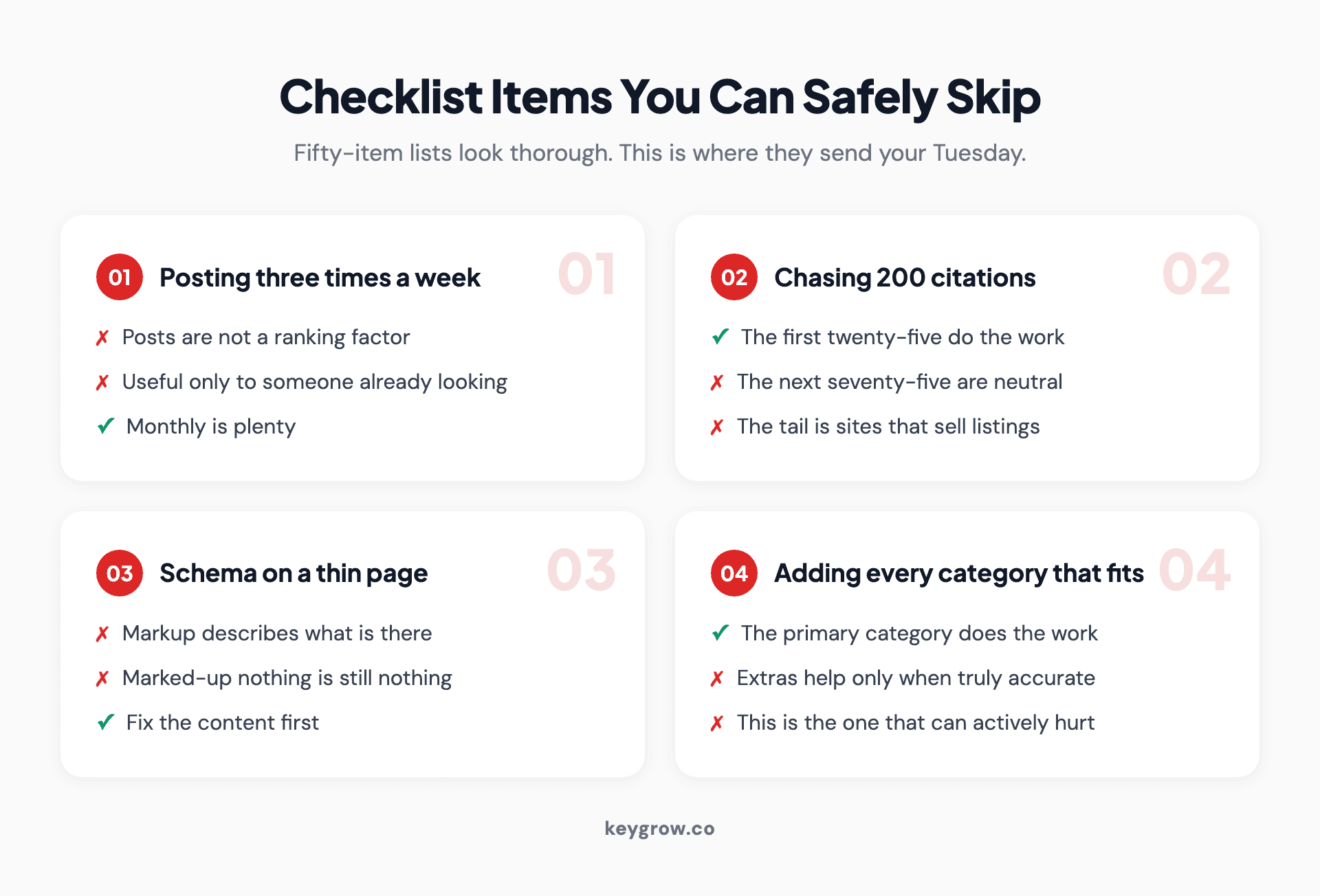
Four cards listing local SEO checklist items that can be skipped: posting three times a week, chasing 200 citations, adding schema to a thin page, and adding every category that fits.
Posting to your Business Profile three times a week. Posts are not a ranking factor. They are useful for the person already looking at your listing, and a monthly post is plenty. Weekly posting is a job somebody invented to have something to report.
Chasing 200 citations. Diminishing returns set in fast. The first twenty-five matter, the next seventy-five are neutral, and the tail is often on sites that exist purely to sell listings.
Schema on a thin page. Structured data describes what is on the page. If the page says nothing, marked-up nothing is still nothing. Get the content right first.
Adding every category that fits. Your primary category does the heavy lifting. Secondary categories help when they are genuinely accurate and hurt when they dilute what you are.
Local blog posts about events you are not part of. The community-calendar post is the most common filler in local content. Nobody searches it, nobody links to it, and it makes the site look like it publishes for search engines.
Social media links on the profile. Fine to add, takes a minute, changes nothing about your ranking. Add it and move on rather than building a strategy around it.
None of these are harmful, except the category dilution. They are just where checklists send your Tuesday.
What to do every month, in about an hour
Once the setup is done the ongoing list is genuinely short.
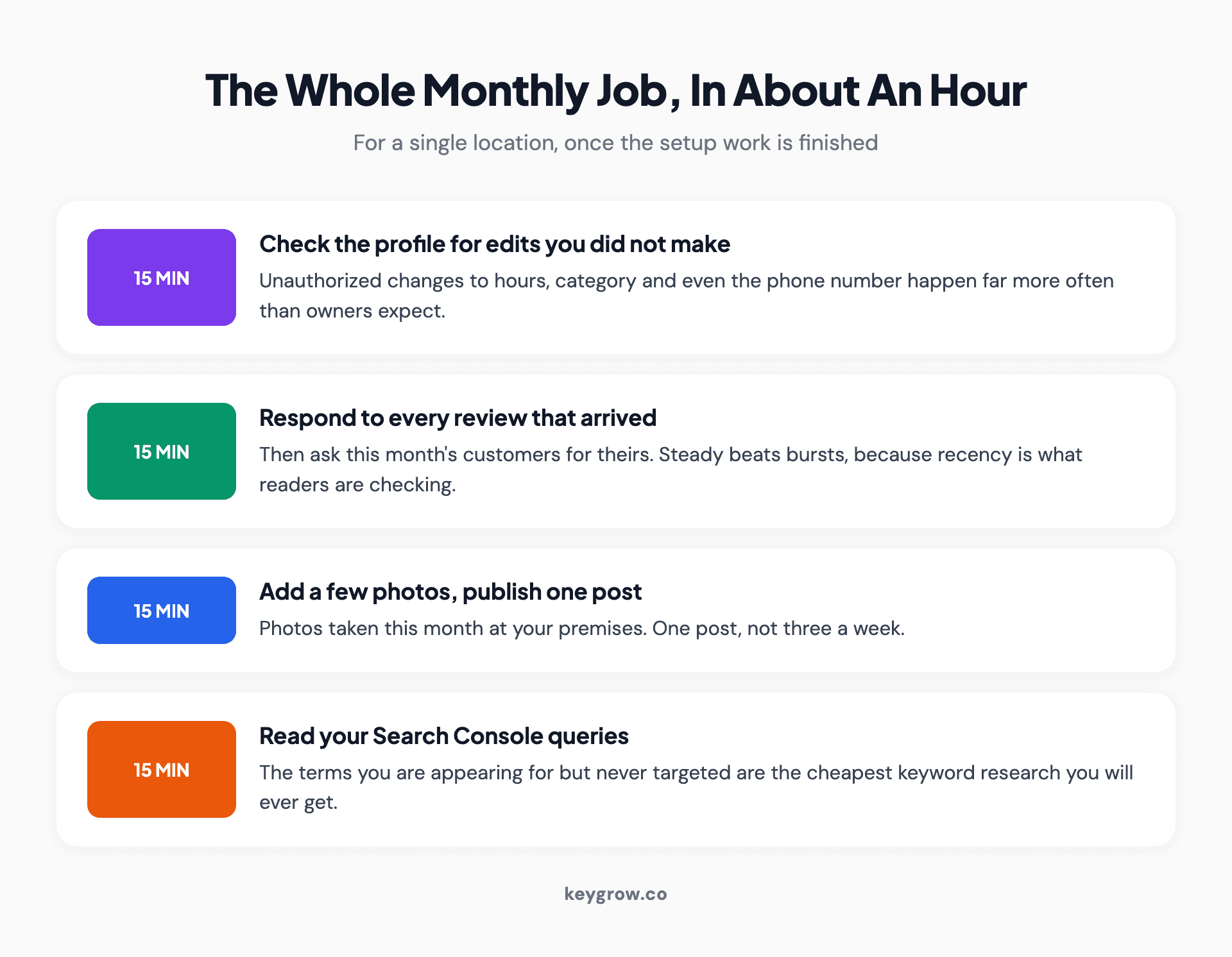
Four fifteen-minute blocks making up the monthly local SEO job: check the profile for unauthorized edits, respond to reviews and ask for more, add photos and one post, and read Search Console queries.
Check the profile for unauthorized edits, which happen more than people expect. Add a few photos. Respond to every review that arrived. Ask the month's customers for reviews. Look at your Search Console queries for the terms you are starting to show for and were not targeting, because that is free keyword research. Once a quarter, run your NAP check across the main directories.
That is the entire ongoing job for a single-location business. If someone is charging for forty hours a month against this list, ask what the other thirty-five hours are.
How long before any of this shows up
Longer than you want, and the shape of the curve is the thing to understand rather than the number.
A doctor's practice in Dubai gave us a full twelve months. For the first quarter there was very little to show anyone, and the temptation to change approach was real. The twelve month figures were 1,519 percent organic traffic growth and 130+ patient calls arriving monthly. Nothing clever happened in between, just the dull list, repeated.
That curve is the argument for treating local SEO as an asset that compounds rather than a campaign that concludes. Early on it reads as money going out for nothing. Later, the identical work returns at a rate that makes those first months look like the price of admission. The cruel part is that the people who stop in month three have already paid for the expensive stretch and walk away immediately before it starts returning anything.
Take a thirty-day page-one promise as a description of the terms being targeted. Either nobody searches them, or the method behind the speed is one your domain settles the bill for in a year or so.
You have done the list and you still are not showing up
This happens, and there are only a handful of causes worth checking before concluding the market is just hard.
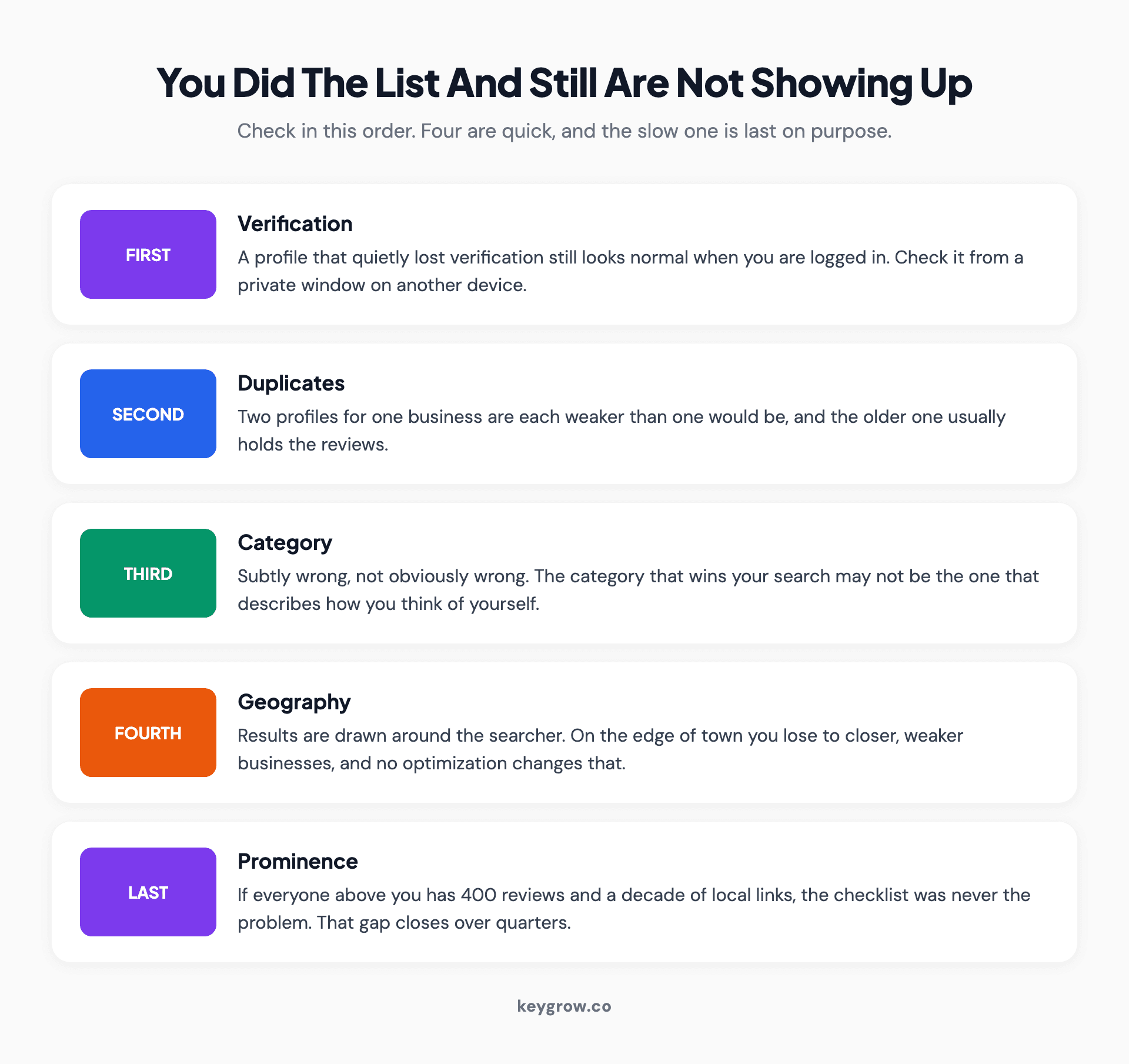
Five-step diagnostic order for a local business that is still not ranking: verification, duplicate listings, category, geography, then prominence.
You are outside the radius. Google draws its map results around the searcher. If your premises sit on the edge of the city and everyone searching is downtown, you will lose to worse businesses that are closer. There is no fix through optimization, only a different target: rank organically for the terms underneath the map, and win the neighborhoods you are genuinely nearest.
Your category is wrong in a way that is hard to see. Not obviously wrong, subtly wrong. Ranking for the search you care about may require a category you have never considered because it does not describe how you think of yourself. Check what the businesses beating you have chosen.
There is a duplicate listing splitting your signals. Two profiles for one business will each be weaker than one would be, and the older one is often the one with the reviews.
You are suspended or soft-suspended and did not notice. A profile that has quietly lost its verification still looks normal to you when logged in. Check whether it appears in a logged-out search, in a private window, from a different device.
The market genuinely requires prominence you have not built. If the three businesses above you each have four hundred reviews and a decade of local links, the list is not the problem. That gap closes over quarters, not weeks, and it closes fastest through reviews and real local relationships rather than anything technical.
The order matters when you check: verification, then duplicates, then category, then geography, then prominence. Four of those five are quick, and the slow one is last for a reason.
When you should just do this yourself
One shop, one town, a diary with gaps in it and a bank balance without any: that combination does not need an agency this year.
The week one list is not technical. It is a day of careful data entry and a habit of asking for reviews. The month one list is harder but still within reach of anyone who can write clearly about their own trade, which is most owners. You will do a better job on the service pages than a writer who has never done the work, because you know what customers actually ask.
Hire when the opportunity cost of your time exceeds the fee, when you have several locations, when the market is competitive enough that prominence needs real link work, or when you have tried the list above and are still not appearing. Those are real reasons. "We should probably do SEO" is not one, and any agency that takes that brief without asking more is selling.
FAQs
How long does a local SEO checklist take to work through?
The eight highest-value items take about a week of part-time effort. The website work is a few weeks after that, depending on how many services and locations you have. Citations and reviews are continuous rather than finishable, and results typically start showing in three to six months.
What is the single most important item on the list?
The primary category on your Google Business Profile, followed immediately by having your name, address and phone number identical everywhere. The category decides which searches you are eligible for at all, and nothing else on the profile carries that much weight.
Do I need a website for local SEO?
Yes, in practice. A Google Business Profile alone can rank in the map pack, but the website is what makes you competitive for the terms underneath, gives you somewhere to prove relevance for each service, and gives customers somewhere to check you out. A profile with no site looks less established to both Google and the person reading it.
How many reviews do I need?
Enough to look credible next to whoever appears beside you in the map pack, which varies by market. The more useful target is recency: most consumers look for reviews written in the last three months, so a steady few every month beats a large total that has gone quiet.
Is local SEO different from regular SEO?
They overlap, and the difference is the map pack. Local SEO adds the Google Business Profile, citations, and proximity, which regular SEO has no equivalent of. Everything about content quality, site health and links applies to both.
Should I pay for citation building services?
For a small number of major aggregators and industry directories, the service can save you a tedious afternoon. Beyond that, the packages that promise hundreds of listings are selling volume that stopped helping a long way before listing number 200, and some of them use sites you would not choose yourself.
What should I check every month?
Unauthorized profile edits, new reviews to respond to, a few fresh photos, this month's review asks, and your Search Console query list. About an hour for a single location. NAP consistency is a quarterly check rather than a monthly one.
If you only do five of these
Claim and verify the profile. Get the primary category right. Make the name, address and phone identical everywhere. Build one real page per service. Ask for reviews every month, forever.
That is five things and it will put most single-location businesses ahead of most of their local competition, because most of their local competition has not done all five either. The rest of the list is worth working through, and it is what you do after those are true, not instead.
If you have done those five and still are not showing up, something specific is wrong rather than something general, and that is the diagnosis our SEO work starts with. Send us the business name and city and we will tell you which of relevance, distance or prominence is the one holding you back.


