


Is SEO worth your agency's time, or should you keep living on referrals and renewals? For most local agents the answer is yes, but only a narrow version of it. SEO for insurance agents is mostly local SEO: a correctly named Google Business Profile, one page per line of business you actually write, license details a buyer can check, and a steady flow of recent reviews. Ranking nationally for "car insurance" is not on the list, and it never was.
Which version applies to you depends on one question most guides skip. Are you captive or independent? A captive agent often cannot touch the website, and the carrier decides what the profile is called. An independent agent controls everything and has to build it all from nothing.
This post is a checklist, in the order the work pays off. Work down it and stop where your time runs out.
Three questions before you start
Answer these first. They decide whether SEO is worth doing this year, and which half of this checklist is yours.
1. Can you edit your own website? If your site is a carrier-provided agent page with a fixed template, your SEO is your Google Business Profile, your reviews and your citations. That is still plenty. If you own the domain, the page work below applies too.
2. Where does your premium come from? Write down your top three lines by commission. Personal auto and home bundles, small commercial, life, Medicare. Each one is a page and a search family. If 60 percent of your book is commercial, start there, because that is where national advertising budgets thin out.
3. Do you have four hours a week? The first two checklists below are owner work, not technical work. If you have the hours, you probably do not need an agency for the first six months. More on that in the cost section.
There is also a short list of agents who should skip SEO for now. A book that is 90 percent referral and fully booked does not need more inbound. An agent in a town of 4,000 people where everyone already knows the office gets more from a phone that gets answered. And an agent leaving a captive contract in the next year should wait, because the profile and the domain may not come with them.
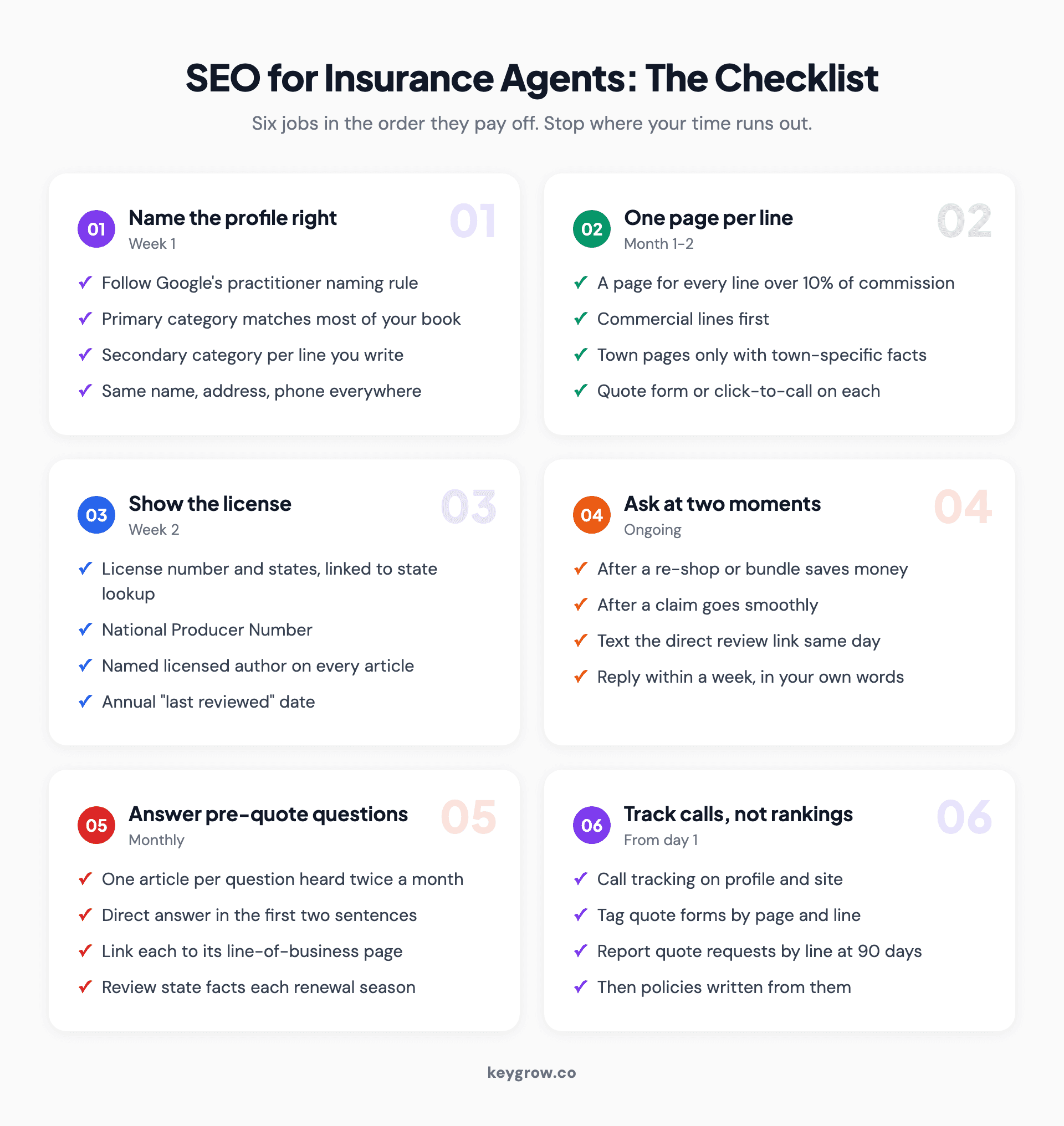
Checklist grid of SEO for insurance agents in priority order: name and categorize the Google Business Profile, build one page per line of business and town, publish license and author details, ask for reviews at renewal and claim, answer pre-quote questions, and track calls and quote starts by line.
Captive or independent: which checklist are you on?
The work is the same in principle. What changes is who controls the website, the profile name and the approval process.
| Captive agent | Independent agent | |
|---|---|---|
| Website | Often a carrier template you can only partly edit | Yours, built and hosted however you like |
| Profile name | Google's format is "Brand: Your Name" if you are the only agent at the office | Your registered agency name |
| Lines you can write about | The carrier's products | Every line and carrier you place |
| Marketing approval | Usually needs carrier compliance sign-off, check your agreement | Your own call, within state rules |
| Biggest SEO lever | Profile, reviews, citations | Line-of-business pages plus everything a captive agent does |
| Biggest search advantage | The brand name people already search | "Independent agent" and multi-carrier comparison searches |
That profile name rule is specific, and plenty of agents get it wrong. Google's profile guidelines list insurance agents as individual practitioners. When you are the only public-facing agent at a branded office, the agent and the brand share one profile named "[brand]: [your name]". When several agents work out of one office, the office gets its own profile and each agent's profile carries only their own name. The same page says sales associates and lead-generation agents for corporations are not eligible for a profile at all.
Get it wrong and you risk a suspended profile. That costs you far more than a weak ranking ever will.

Insurance agent taking notes on a clipboard while a client explains his coverage needs across an office desk
Checklist 1: the profile (week one)
The Google Business Profile is the one SEO asset every agent has, captive or not. It decides whether you show in the map results for "insurance agent near me", which is where most local quote calls start.
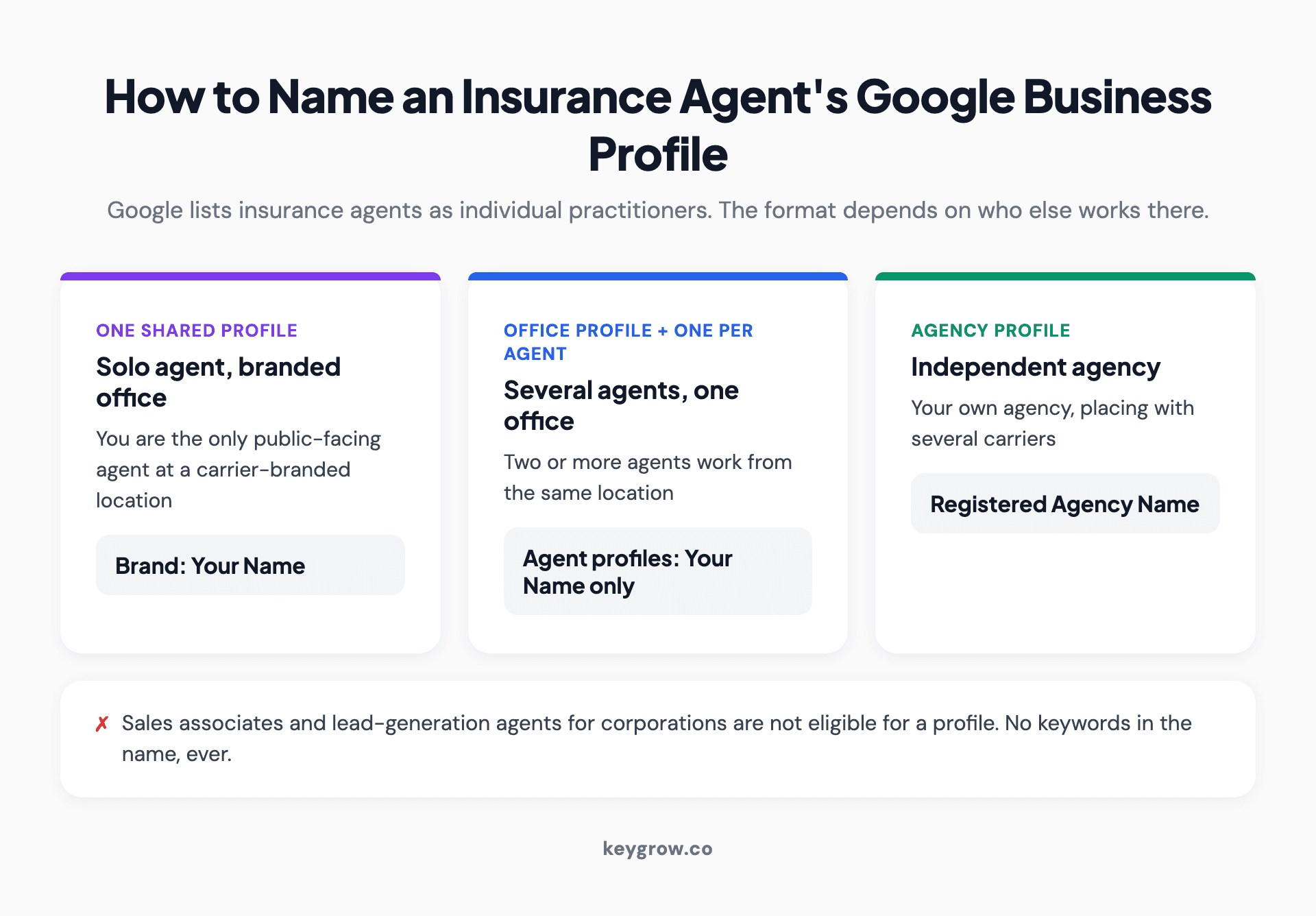
Three cards showing how Google wants insurance agent Business Profiles named: a solo agent at a branded office uses Brand: Agent Name on one shared profile, an office with several agents gets one office profile plus a name-only profile per agent, and an independent agency uses its registered agency name.
- Profile named exactly per the practitioner rules above, with no keywords stuffed in
- Primary category set to the one that matches most of your book (Insurance agency is the usual default)
- Secondary categories for the lines you actually write, such as auto, home, life or business insurance agency
- Hours, phone and address matching your website character for character
- Services list filled in, one entry per line, each with a two-line description
- Ten or more real photos: the office exterior, the sign, the team
- The same name, address and phone on Bing Places and the two or three directories your state association runs
Categories do more work than most agents expect. An agent who writes auto, home and life but lists one category is less likely to show for the other two. We cover the mechanics in our guide to choosing Google Business Profile categories.
Plan on three to five hours for all of this, once, plus a monthly check.
Checklist 2: one page per line, and per town
The single biggest website fix for an independent agency is replacing the one "Products" page with a page per line of business. A generic products page ranks for nothing in particular.
Here is how the searches map to pages:
| What the buyer types | Page that should answer it | What the page has to show |
|---|---|---|
| home insurance agent [town] | Home insurance, [town] | Carriers you place, what drives the rate locally, a quote form |
| commercial auto insurance [town] | Commercial auto | Fleet sizes you handle, industries, documents needed |
| general liability insurance for contractors | Contractor insurance | Trades you write, typical limits clients ask for |
| independent insurance agent near me | Home page or About | "Independent", carriers represented, license, office photo |
| life insurance agent [town] | Life insurance | Term vs permanent in plain words, who you are a fit for |
Commercial lines deserve the first build. Business owners tend to want a local agent they can call, and most of the national insurance advertising you see on TV and in search is for personal auto and home. A page about insurance for roofers in your county has a short list of competitors.
Town pages are where agents go wrong next. If you serve four towns, a page for each one only helps when the page says something true about that town: the flood zone map, the main employers you write group benefits for, the office you drive to. Four pages with the town name swapped are doorway pages, and Google treats them that way.
- One page per line that makes up at least 10 percent of your commission
- One page per town only where you can write something specific to it
- A quote form or click-to-call on every one of those pages
- Every page linked from the main navigation, not buried in a footer
Checklist 3: the trust signals Google and buyers both check
Insurance is a "Your Money or Your Life" topic. Google holds it to a higher quality bar, and buyers are already nervous about who they hand their policy to.
Most of what satisfies both is simple to publish:
- Each agent's license number and states on the About page, linked to the state's public license lookup
- The National Producer Number (NPN) alongside it
- A named, licensed author on every article, not "Agency Staff"
- A visible "last reviewed" date on coverage articles, updated every year
- Carrier appointments named in text, not only as logos
- Professional association memberships and local chamber membership
- The physical office address in the footer
Some of this is the law as well as good SEO. California requires producers to print their license number on business cards, written price quotes and print ads, and since January 2023 on emails too, as the Department of Insurance notice explains. Other states have their own advertising rules. If your license number is already on every email signature, putting it on the website costs nothing.
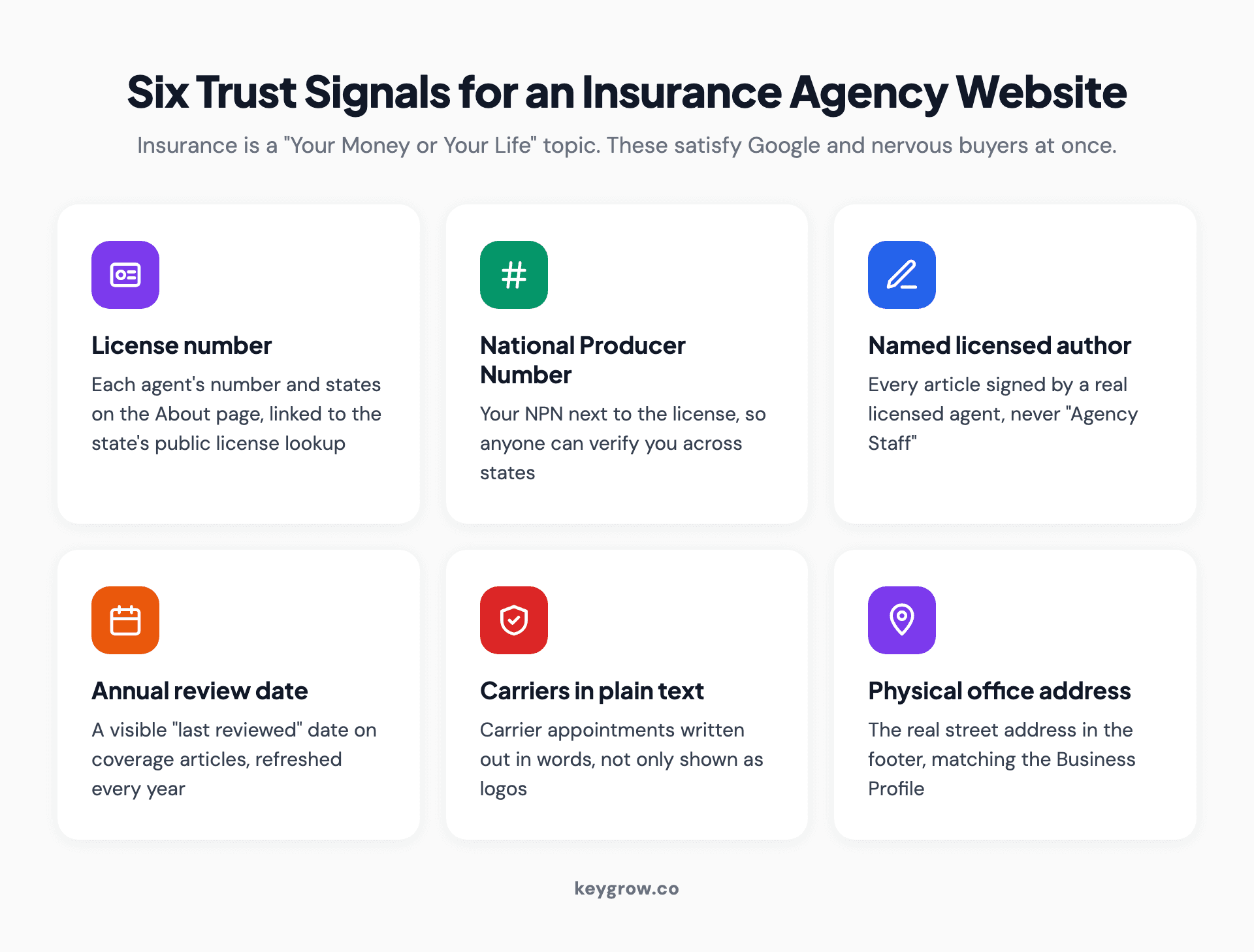
Icon grid of six trust signals for an insurance agency website: license number with lookup link, National Producer Number, named licensed author, annual review date, carriers named in text, and the physical office address.
Checklist 4: reviews at the two moments that produce them
Recent reviews matter more than a big total. In BrightLocal's 2026 survey, 74 percent of consumers said they only care about reviews from the last three months, and 31 percent will only use a business rated 4.5 stars or higher.
An agency with 140 reviews and nothing since last spring looks closed to a lot of buyers.
Insurance clients have two natural review moments. The first is when you saved them money on a re-shop or a bundle. The second is when a claim went smoothly and you were the one who picked up the phone. Ask at both, by text, with the direct review link, the same day.
- A review request built into your renewal and claim follow-up, not left to memory
- The direct review link saved as a text shortcut for every agent
- Every review answered within a week, in your own words
- No gating (asking only happy clients) and no incentives, both against Google's rules
On replies: the same survey found 50 percent of consumers are put off by templated or generic responses. The copy-paste "We're thrilled you had a great experience" reply that half the guides on this topic hand you is exactly what reads as templated. Mention the line, the situation, the agent. Our notes on responding to Google reviews go further.
Checklist 5: answer the questions buyers ask before they call
Agency content works when it is the six questions you answer on the phone every week, written down once. A blog posted to because someone said you need a blog mostly sits there.
Good candidates, all from real quote calls:
- What does a typical homeowners policy in [state] not cover, and do I need flood?
- How much does commercial auto cost for a three-truck contractor?
- Independent agent or buying direct: what's the difference for me?
- Do I need an umbrella policy, and at what net worth?
- What happens to my premium after an at-fault accident?
Each answer should open with the direct answer in one or two sentences, then the detail. That structure also matters for AI search. The same BrightLocal survey found 45 percent of consumers now use ChatGPT and similar tools for local recommendations, up from 6 percent a year earlier. Those tools quote pages that answer plainly near the top, which is the core of answer engine optimization.
- One article per question you hear more than twice a month
- Each one links to the line-of-business page it relates to
- State-specific facts reviewed every renewal season
Skip the general explainers ("what is a deductible") that national carriers have already covered with bigger budgets. Write what they can't: your state's rules, your town's flood map, the trades you insure.
What to measure instead of rankings
Measure calls and quote starts by line of business. Rankings are a leading signal at best, and a "top 3 for 40 keywords" report pays nobody's rent.
Set up call tracking on the profile and the website, and tag each quote form by the page it came from. After 90 days you should be able to say how many commercial auto quote requests came from search, not just how many visits.
That is how we report for local clients in every niche. A phone repair shop reaching 115+ monthly calls in 7 months is a result the owner can check against the phone bill. Rankings never are. For an agency the equivalent is quote calls by line, and then policies written from them, which is the number your producer reports already track.
If you are comparing SEO against buying leads, our guide to insurance lead generation works through cost per policy across channels.
What it costs, and when to do it yourself
Most of this checklist is DIY work, and we would rather say so up front. A single-location agent with a few hours a week can do Checklists 1, 3 and 4 alone, and probably should, before paying anyone.
When we read the published prices of SEO providers for our SEO pricing study, finance and insurance plans started at a median of $799 a month, with the middle half between $250 and $1,500. That is $9,588 a year at the median. For an agent who has not yet fixed the profile name or asked for a review this quarter, that money buys work you could have done in an afternoon.

Calculator and printed charts on a desk, the kind of numbers an agency owner weighs before paying for SEO
Hiring help makes sense when:
| Situation | DIY or hire |
|---|---|
| One office, profile not set up properly | DIY, this week |
| Reviews stalled, no request process | DIY, build it into renewals |
| You own the site but have no line-of-business pages | Hire for the build, or a writer plus a developer |
| Three or more offices or several agents with profiles | Hire, the profile rules get easy to break |
| Commercial-heavy book competing in a metro | Hire, content and links take sustained time |
| Captive agent on a carrier template | DIY, there is not enough to hand off |
If you do hire, ask whether the provider has worked under carrier compliance review and how they handle licensed authorship. An agency that has only done generic local work will learn on your account. Our financial services SEO work starts from those constraints.
Expect three to six months before line-of-business pages bring steady quote requests, sooner for profile and review fixes. Anyone promising page one in 30 days is either targeting searches nobody makes or about to cause you a problem.
FAQs
What is SEO for insurance agents?
SEO for insurance agents is the work of getting an agency found in Google's local results and organic search for the lines it writes. In practice that means a correctly named and categorized Google Business Profile, one page per line of business, visible license details and a steady flow of recent reviews.
Can a captive agent do SEO on a carrier-provided website?
Partly. Carrier templates usually limit what you can change, so the main levers are your Google Business Profile, your reviews and consistent listings on other directories. Check your agent agreement before building a separate site, because many carriers require approval for any marketing.
How long does SEO take for an insurance agency?
Profile and review fixes can move map visibility within a few weeks. Line-of-business pages usually take three to six months to produce steady quote requests, and competitive metro markets take longer.
How much does SEO cost for an insurance agency?
In our review of published SEO prices, finance and insurance plans started at a median of $799 a month, with most between $250 and $1,500. A single-location agent can do much of the early work without paying anyone.
What keywords should an insurance agent target?
Target the line of business plus the town, such as "home insurance agent" with your city, and commercial searches for the industries you insure. Skip generic national terms like "car insurance", which belong to national carriers and comparison sites.
Does an insurance agency need a blog?
Not a blog for its own sake. It needs answers to the questions prospects ask before they call, such as what a homeowners policy excludes in your state, each written by a named licensed agent and reviewed every year.
This month's three jobs
Fix the profile name and categories. Put a review request into your renewal and claim follow-ups. Build the page for the line that pays you the most.
That is about a month of evenings, and none of it needs a retainer. If you have done all three and want help with the pages and content after that, talk to us about SEO management on month-to-month terms.