


Buying leads is the most expensive way to start lead generation for insurance. It feels cheapest, because a shared lead at $30 looks like a bargain next to a $74 search lead. Then you do the math per bound policy and the bargain falls apart.
Here is the short answer. Lead generation for insurance works when you own one channel first (your own book, referrals, local search, or search ads to your own landing page), measure what each bound policy costs you, and only then buy leads from someone else to test against it. The rest of this post is the playbook in order, with a worked cost-per-policy example you can copy with your own numbers.
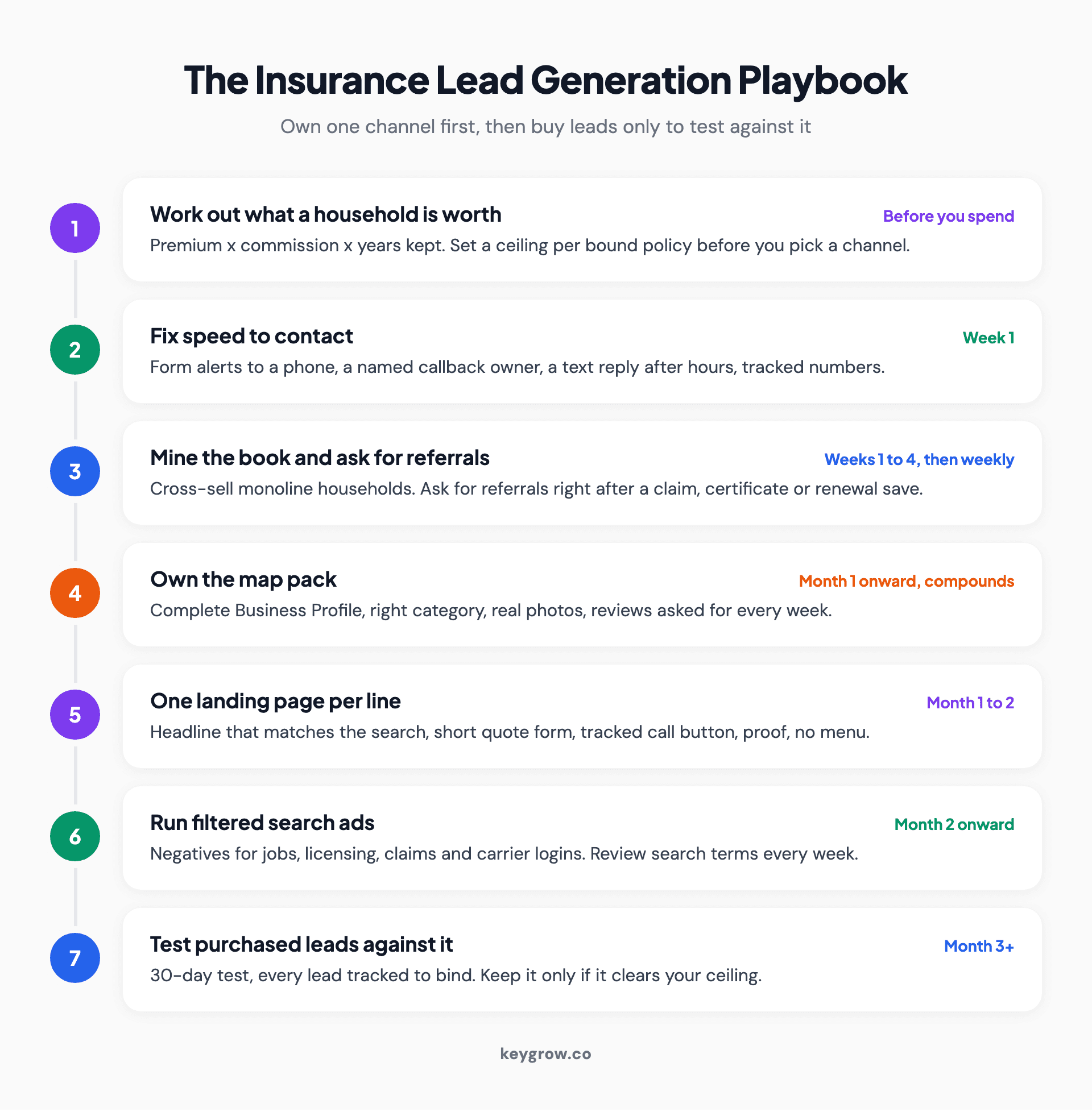
Seven-step timeline for insurance lead generation: work out what a bound household is worth, fix speed to contact, mine the book and referrals, own local search, build one landing page per line, run filtered search ads, then test purchased leads against your own channel.
Step 1: Work out what a bound household is worth
Before you pick a channel, set a ceiling. The ceiling is how much you can spend to win one household and still make money on it.
You need three inputs from your own agency: average annual premium, your blended commission rate, and how many years a typical household stays. Here is a worked example with illustrative numbers (swap in yours):
- A home and auto bundle at $4,200 a year in premium
- A blended commission of 12%, so $504 a year to you
- An average stay of 5 years, so $2,520 in commission over the life of the household
- If you are willing to spend 30% of that to acquire it, your ceiling is $756 per bound household
Now run the same math on a monoline auto policy at $1,800 a year. That is $216 a year, $1,080 over five years, and a ceiling of $324. That is a hard number for any paid channel to hit.
This one calculation changes the plan. Paid lead generation usually pays for bundles, commercial lines and life policies with real first-year commission. Monoline auto is mostly a cross-sell and referral game.
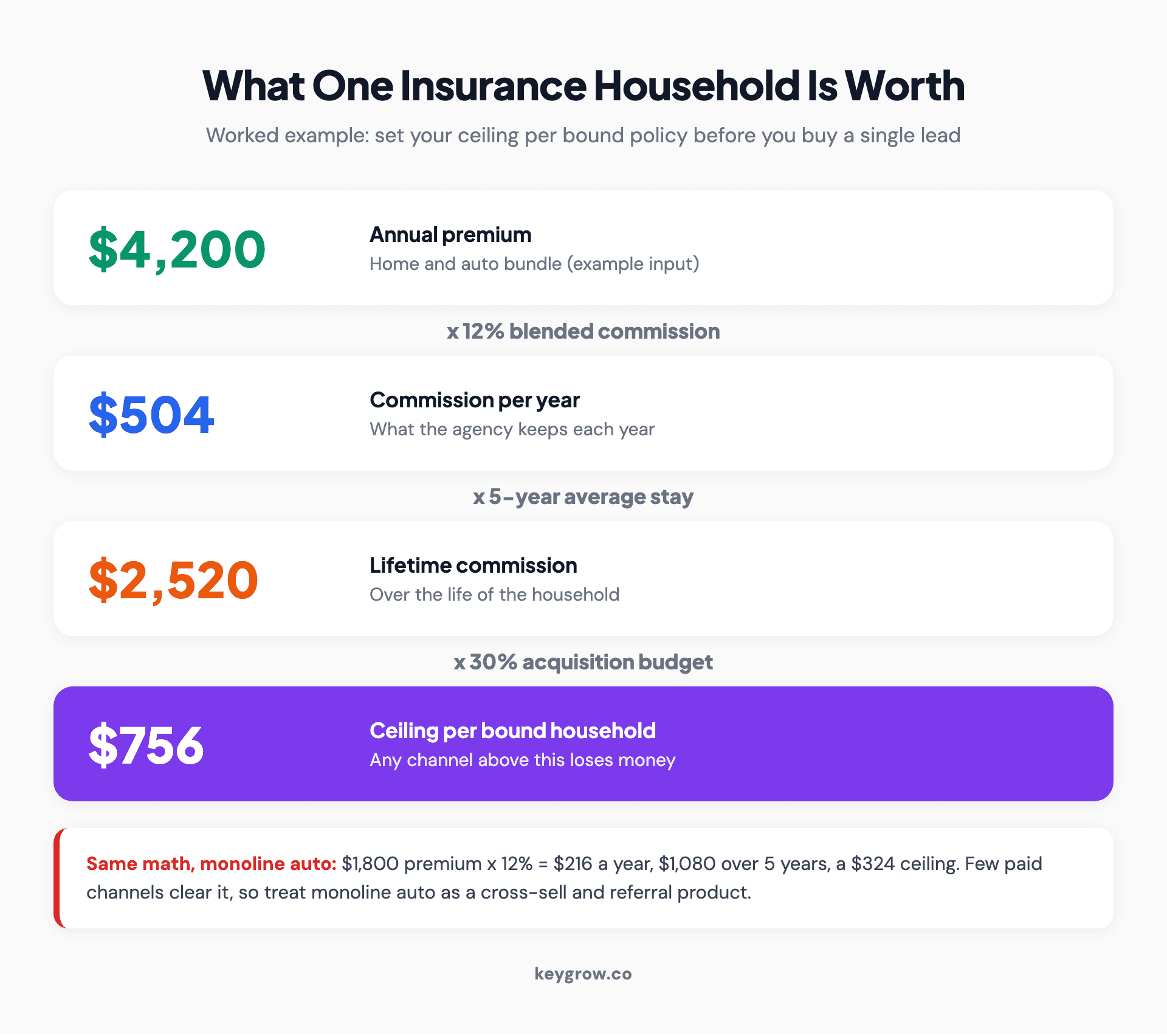
Flow diagram of the break-even math for an insurance household: $4,200 annual premium times 12% commission equals $504 a year, times a 5-year stay equals $2,520 lifetime commission, and 30% of that sets a $756 ceiling per bound household.
Step 2: Fix speed to contact before you spend a dollar
Quote shoppers compare several agencies at once, so the first agency to reach them usually gets the conversation. Fix response time before you buy any traffic.
The shopping data backs this up. J.D. Power's 2026 Insurance Shopping Study found that 53% of auto insurance customers shopped in the past year, the average shopper collected about three and a half quotes before deciding, and 48% of new auto policies were bought digitally, up from 36% five years earlier. The full findings are summarized in Repairer Driven News.
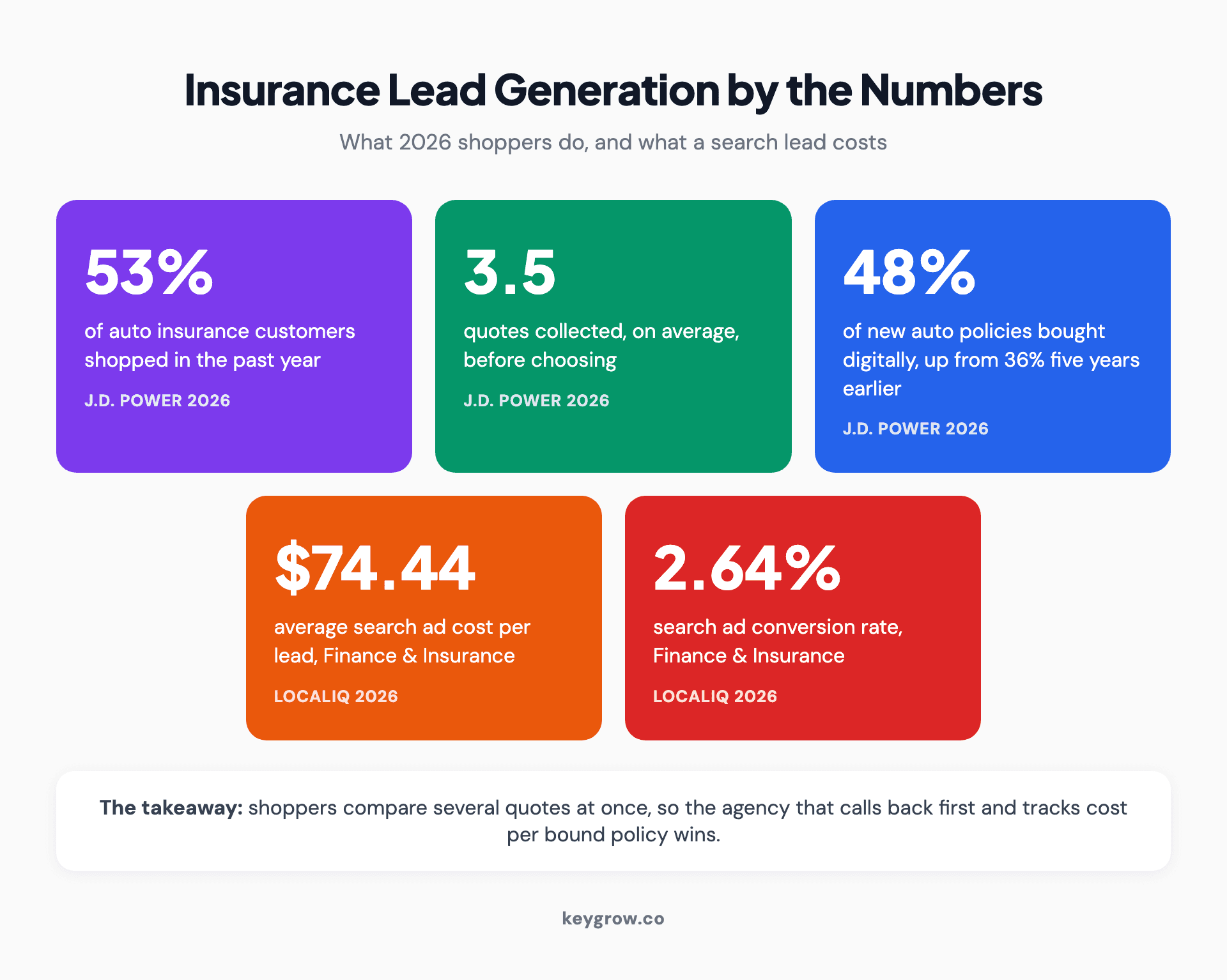
Stat strip of 2026 insurance lead generation numbers: 53% of auto insurance customers shopped in the past year, shoppers collected about 3.5 quotes, 48% of new auto policies were bought digitally, and the Finance and Insurance search ad benchmark is a $74.44 cost per lead at a 2.64% conversion rate.
Three and a half quotes means you are one of several tabs open in someone's browser. If your form alert lands in an inbox nobody checks until tomorrow, you paid for a lead someone else will write.
What to set up first:
- A form alert that goes to a phone, not only to email
- A named person who calls back within minutes during business hours, and a text reply after hours
- A tracked phone number on every ad and landing page, so you can see which calls came from where. Our guide to call tracking for PPC covers the setup.

A man taking a call at his desk with a laptop open, the moment an insurance agency either calls a new quote request back in minutes or loses it to the next agency.
If you cannot answer leads quickly, do not pay anyone to generate them yet. That includes us.
Step 3: Mine your own book and ask for referrals on a schedule
Your existing clients are the cheapest leads you will ever get. Cross-sell the monoline households, and ask for referrals right after you have helped someone.
Pull every auto-only household that owns a home, every homeowner without an umbrella policy, and every business owner without the coverage their industry usually needs. Those are warm conversations with people who already pay you.
Referrals work the same way, if you treat them as a process instead of a hope. Ask after a smooth claim, a quick certificate, or a renewal where you saved them money. Make the ask specific ("who do you know who just bought a house?"), log every referral, and thank the referrer within a couple of days.
You do not need a marketing budget for any of this. You need a weekly calendar block and someone who will keep it.
Step 4: Own the map pack for "insurance agent near me"
Local searches for an insurance agent are won in the Google map results, and a complete Business Profile plus a steady flow of reviews does most of the work there.
Fill in every field on your Google Business Profile, pick the right primary category, list each line you write, and post real photos of your office and team. Then ask every happy client for a review, every week, not in a burst once a year.
After that comes the website side: a page for each line of business and each town you serve, answering the questions people type in. Our post on SEO for insurance agents goes through that in detail.
This channel is slow. Expect months, not weeks, before it carries real volume. It is also the one that keeps producing after you stop spending, which is why we put it ahead of paid search in the order.
Step 5: Build one landing page per line of business
Sending ad clicks to your homepage is the most common money leak we see in insurance accounts. A homepage talks about everything. Someone who searched "commercial auto insurance for contractors" wants one thing.
Build a separate page for each line you advertise. Each one needs:
- A headline that repeats what they searched
- A short quote form (name, phone, ZIP, line of business, and very little else)
- A click-to-call number that is tracked
- Proof: reviews, carriers you represent, years in business
- No main navigation pulling them away
If you would rather not build these yourself, that is what our landing page design work covers. One page per line also keeps your tracking honest about which line produces bound policies.
Step 6: Run search ads to that page, and filter hard
Paid search puts you in front of people who want a quote today. It only pays when you block the searches that will never buy.
The benchmark to beat is real. LocaliQ's 2026 search advertising benchmarks put the Finance & Insurance category at an average cost per lead of $74.44 and a conversion rate of 2.64%, one of the lowest of any industry in the LocaliQ benchmark report. A low conversion rate means a lot of your clicks are not shoppers at all.
Insurance search terms attract a specific kind of junk: people looking for agent jobs, licensing courses and claims phone numbers. Then there are the people searching for their current carrier's login page, who are not shopping no matter what you paid for the click. Add those as negatives before launch, then review the search terms report every week. Our guide to negative keywords in Google Ads lists the patterns to block.
Filtering beats volume. A cash home buyer we worked with was drowning in junk leads, and the fix was negative keywords, tighter match types and qualifying language in the ads, not a bigger budget. Serious leads rose 600% between December and January on the same spend. Insurance accounts respond to the same treatment. This is the core of how we run financial services PPC.
Step 7: Test purchased leads against your own channel
Now you have a baseline. Buy leads as a 30-day test, track every one through to bind, and compare cost per bound policy, not cost per lead.
Here is the worked example, per 100 leads, using the $756 ceiling from Step 1. Every number is an illustrative input except the $74.44, which is the LocaliQ benchmark.
| Channel | Cost per lead | Contacted | Quoted | Bound | Cost per bound policy | Clears $756? |
|---|---|---|---|---|---|---|
| Shared purchased leads | $30 | 30% | 50% of contacted | 15% of quoted | $1,333 | No |
| Exclusive purchased leads | $80 | 60% | 60% | 25% | $889 | No |
| Your own search ads + landing page | $74.44 | 80% | 70% | 25% | $532 | Yes |
| Referrals (with a $25 thank-you) | $25 | 90% | 80% | 40% | $87 | Yes |
The math on the first row: 100 leads cost $3,000. Thirty people pick up, fifteen get a quote, and 2.25 bind. $3,000 divided by 2.25 is $1,333 per policy. The cheapest lead on the invoice is the most expensive policy on the list.
Your own search ads cost more per lead and still win, because the person filled in your form and expects your call. Add any management fee to the media cost before you compare. Referrals win by a mile, but you cannot buy more of them, which is why you need a second channel you control.
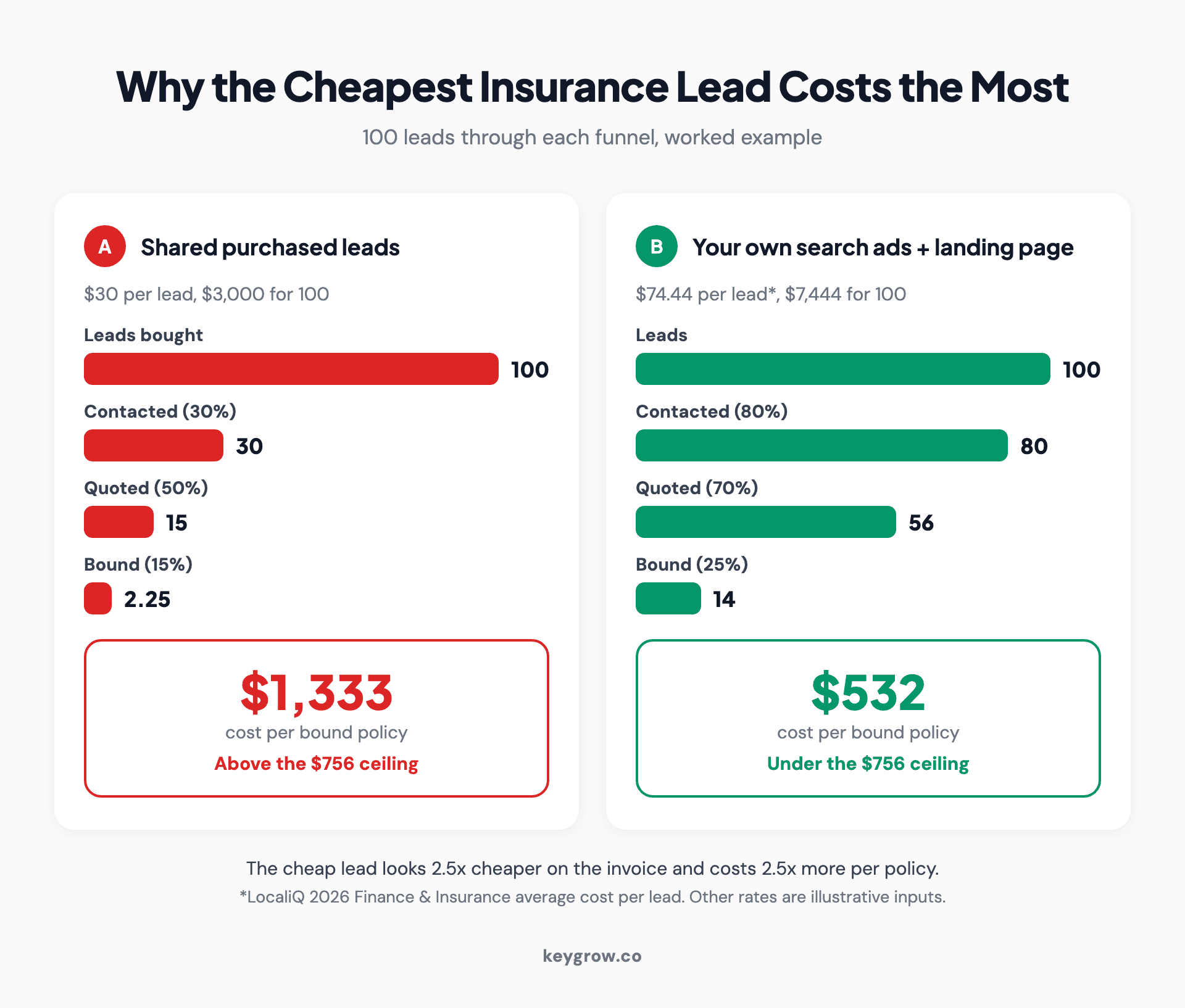
Two lead funnels side by side for 100 insurance leads: shared purchased leads drop from 100 to 30 contacted, 15 quoted and 2.25 bound at $1,333 per policy, while leads from your own search ads drop from 100 to 80, 56 and 14 bound at $532 per policy.
Measure cost per bound policy, every month
If your marketing report opens with impressions or cost per lead, ask why. In the table above, the $30 lead looks two and a half times cheaper than the $74.44 lead, and it costs two and a half times more per policy. Cost per lead is the number that makes bad channels look good.
Track these, by channel, every month:
- Contact rate (if it is under about a third on purchased leads, your follow-up is the problem, not the source)
- Quote-to-bind rate
- Cost per bound policy against your ceiling
- Retention at 12 months, because a cheap policy that leaves at renewal was not cheap
For the longer view, our guide on lifetime value of PPC leads shows how to tie spend to commission over years instead of weeks.
When you do not need an agency for this
Plenty of agents should not hire anyone yet. If you are a captive agent whose carrier supplies leads, or a newer agent with a few hundred households and more time than budget, Steps 1 through 4 are free and you can run them yourself. Mine the book, build the referral habit, finish your Business Profile, and collect reviews every week.
Hire help when the math says paid search can clear your ceiling and your time is worth more than the fee. Usually that means bundles or commercial lines to sell, someone to answer leads in minutes, and a few thousand dollars a month to test with. Until then, the best lead generation for insurance is the client you already have.

A hand holding a small model house, a reminder that an insurance agency's cheapest new policy usually comes from a household it already protects.
FAQs
What is the best lead source for insurance agents?
Referrals and cross-selling your own book have the lowest cost per bound policy, because the trust is already there. The best paid source is usually search ads sent to your own landing page. Purchased leads work only if you answer them within minutes and track them to bind.
How much do insurance leads cost?
LocaliQ's 2026 benchmark puts the average search ad cost per lead for Finance & Insurance at $74.44, and shared purchased leads usually cost less per lead. The number that matters is cost per bound policy, which is often higher on cheap leads because so few of them close.
Are exclusive insurance leads worth it?
They can be, if your contact and bind rates are strong and the line has enough commission to cover them. In our worked example, an $80 exclusive lead still came out at $889 per policy, above a $756 ceiling. Run a 30-day test and compare cost per bound policy before committing.
How do new insurance agents get leads without buying them?
Start with your warm market and your agency's existing book, and ask for referrals right after you help someone. Then complete your Google Business Profile and ask for reviews every week. These cost time, not money.
How fast should you follow up on an insurance lead?
Within minutes during business hours. Auto shoppers collected about three and a half quotes on average in J.D. Power's 2026 study, so the first agency to call usually gets the conversation. After hours, an automatic text holds the lead until morning.
Does Google Ads work for insurance agents?
Yes, when clicks go to a dedicated page per line of business and negative keywords block job seekers, licensing searches and claims traffic. It works best for bundles, commercial lines and life insurance, where the commission covers the cost per bound policy. Monoline auto rarely pays on its own.
Own one channel before you buy one
Pick the one channel you can control this quarter: your book, your referral habit, your map listing, or search ads to your own page. Set your ceiling per bound household and get your callback time down to minutes. Then trace every policy back to the channel it came from. Once your own channel clears the ceiling, a batch of purchased leads is just a test with a clear pass mark.
If paid search is the channel you want to own and you would like a second opinion on the math, our PPC management team works month-to-month, and you can get a quote any time.