


To market a roofing company with Google Ads, run Local Services Ads and Search Ads together, bid on high-intent terms like "roof replacement" and "emergency roof repair," fence your budget with a long negative keyword list, and send every click to a page built to make one phone call happen. Roofing is close to the ideal Google Ads category: the searches are urgent, the jobs are worth thousands, and people rarely shop roofers for fun. It is also one of the most expensive categories to advertise in, which is exactly why the discipline below matters.
Here is the number that sets the stakes. Roofing and gutters carries the highest cost per lead of any home-services category, about $228.15, at a $10.70 average cost per click, according to LocaliQ benchmarks. At those prices, a sloppy account does not just underperform. It bleeds.
Why Google Ads fits roofing, and the honest catch
Roofing demand is intent-rich. Almost nobody searches "roof replacement near me" out of curiosity; they have a problem, often an urgent and expensive one, and they are looking for someone to solve it today. That is the kind of demand paid search is built to capture.

The peaked roofline of a house against a blue sky, the kind of replacement job roofing search ads compete for.
The catch is the price of that demand. High job values pull in aggressive competition, and competition pushes clicks past $10 each in most markets, higher for storm and insurance terms. So the goal is never just "get clicks." It is to win the right clicks and refuse the wrong ones, because at $10 a click, wasted traffic is the fastest way to a bad month. Everything that follows is a way to spend that expensive click on someone who might actually book a roof.
Search Ads, Local Services Ads, or Performance Max
Roofers have three main ways to show up, and they are not equal. Run the first two together and treat the third with caution.
| Ad type | How you pay | Best for |
|---|---|---|
| Local Services Ads | Per lead, not per click | Top-of-page calls with the Google Guaranteed badge |
| Search Ads | Per click | Control over keywords, landing pages, and message |
| Performance Max | Per outcome, automated | Scaling once you have conversion data, with a close eye |
Local Services Ads sit at the very top, charge per lead instead of per click, and come with the Google Guaranteed badge, which buys trust for a business a homeowner has never heard of. Not every trade gets these ads, so check whether asphalt paving qualifies for Local Services Ads. You can dispute leads that are clearly not real jobs. Search Ads sit just below and give you the control LSAs do not: exact keywords, your own landing pages, and message you write. Most roofers should run both, because they catch different people at the top of the page.
Performance Max is the one to be careful with. It automates placement across Google's whole network, which can work once you have solid conversion data to feed it, but handed a fresh account with no data it tends to spend on cheap, low-intent clicks. Earn the data on Search first, then consider it.
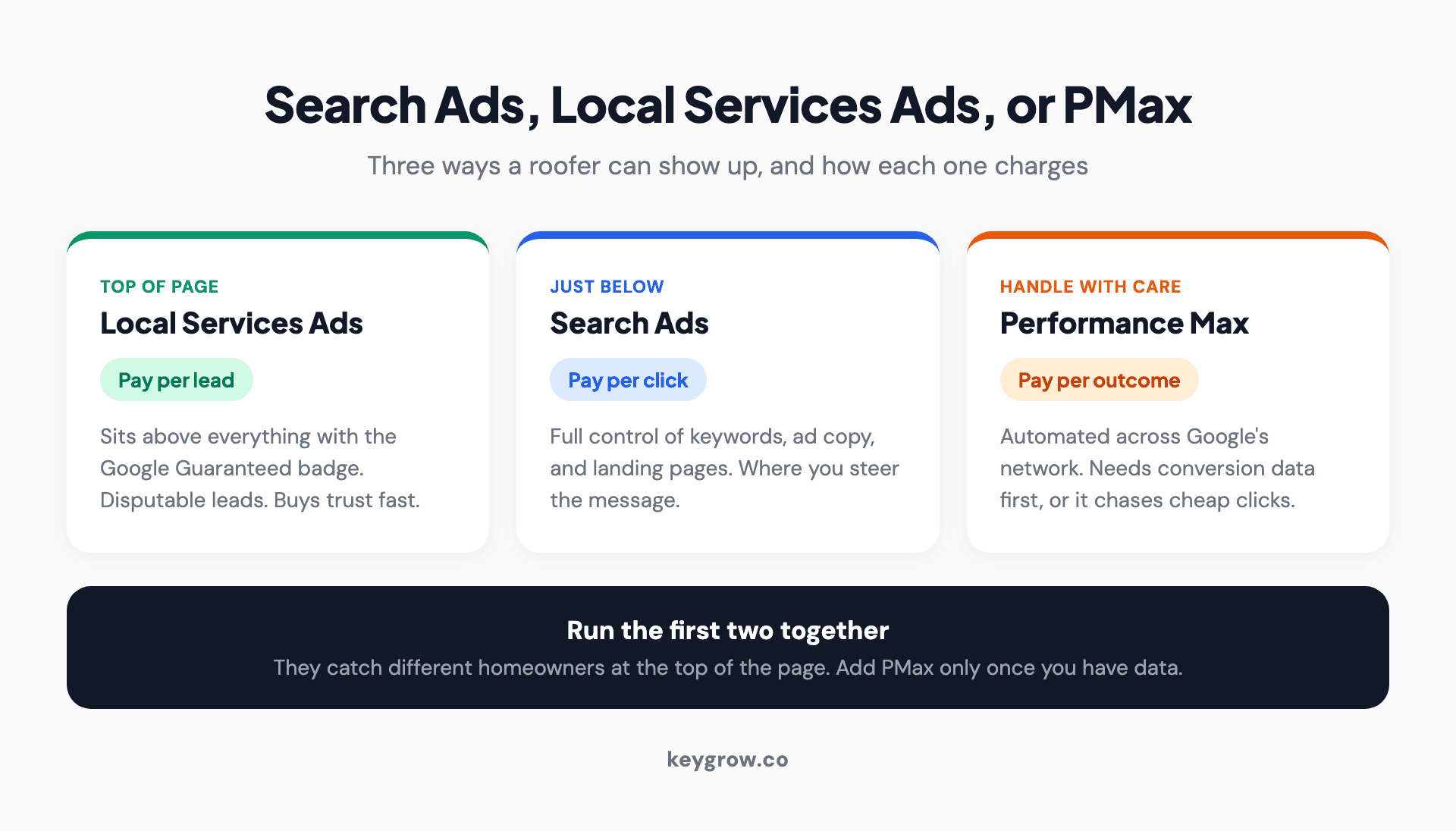
Three cards comparing Local Services Ads, Search Ads, and Performance Max for roofers, showing how each one charges and where it sits on the page.
The keyword strategy: buy intent, not eyeballs
Not all roofing searches are worth the same, and grouping them by intent is how you spend smart.
The high-value tiers are emergency ("emergency roof repair," "roof leak repair today"), replacement ("roof replacement," "new roof cost"), and storm or insurance ("hail damage roof," "storm damage roof insurance"). These are people ready to spend, and they justify the top bids. Lower-intent, research-style searches ("how long does a roof last," "types of shingles") can wait until the money terms are handled, if you touch them at all.
Lean on specific, longer phrases over broad head terms. "Roofer" fights the whole city for a click. "Metal roof replacement" plus your town is cheaper and converts better because the intent is unmistakable. If your click costs feel high across the board, our guide on lowering cost per click walks through the levers that actually move it.
Write ads a homeowner with a leak would click
A roofing ad has one second to say "these are the pros, and they can help right now." Generic copy about "quality workmanship" says nothing a competitor is not also saying.
Put the search back in the headline. If someone typed "emergency roof repair," an ad that opens with "Emergency Roof Repair, Same-Day" beats "Welcome to Our Roofing Company" every time, because it mirrors what they asked for and lifts both click-through and Quality Score. Then earn the click with the things a nervous homeowner actually wants to know: that you are licensed and insured, that you offer free inspections or estimates, that financing is available on a replacement they were not planning to buy, and how long you have worked in their town. Use the ad assets too. Callout extensions for "Licensed and Insured" and "24/7 Storm Response," sitelinks to your reviews and your service area, and a call button on mobile all take up more of the page and give the homeowner more reasons to pick you, at no extra cost per click.
Keep the tone calm and specific. A roof is a scary, expensive purchase, and the roofer who sounds competent and reachable wins over the one shouting about being number one.
The negative keywords that protect a roofing budget
This is the section most roofing guides skip, and it is where the budget is won or lost. A roofing account with no negative keyword list quietly pays $10 a click for searches that will never become a job. Block them before they cost you.
Start with these categories:
- Jobs and careers: jobs, salary, hiring, apprentice, resume, "roofer wanted"
- DIY and research: how to, DIY, tutorial, video, "fix my own roof"
- Education and licensing: school, course, certification, license, exam
- Price-shoppers and materials-only: free, cheap, wholesale, supply, shingles for sale, big-box hardware store names
- Adjacent work you do not do: solar, gutters only, siding, if those are not your services
Build this as a shared negative keyword list and apply it across every campaign, then add to it weekly from the search terms report. Our full guide on negative keywords covers how to do this without accidentally blocking good traffic, which is a real risk if you get careless with broad terms.
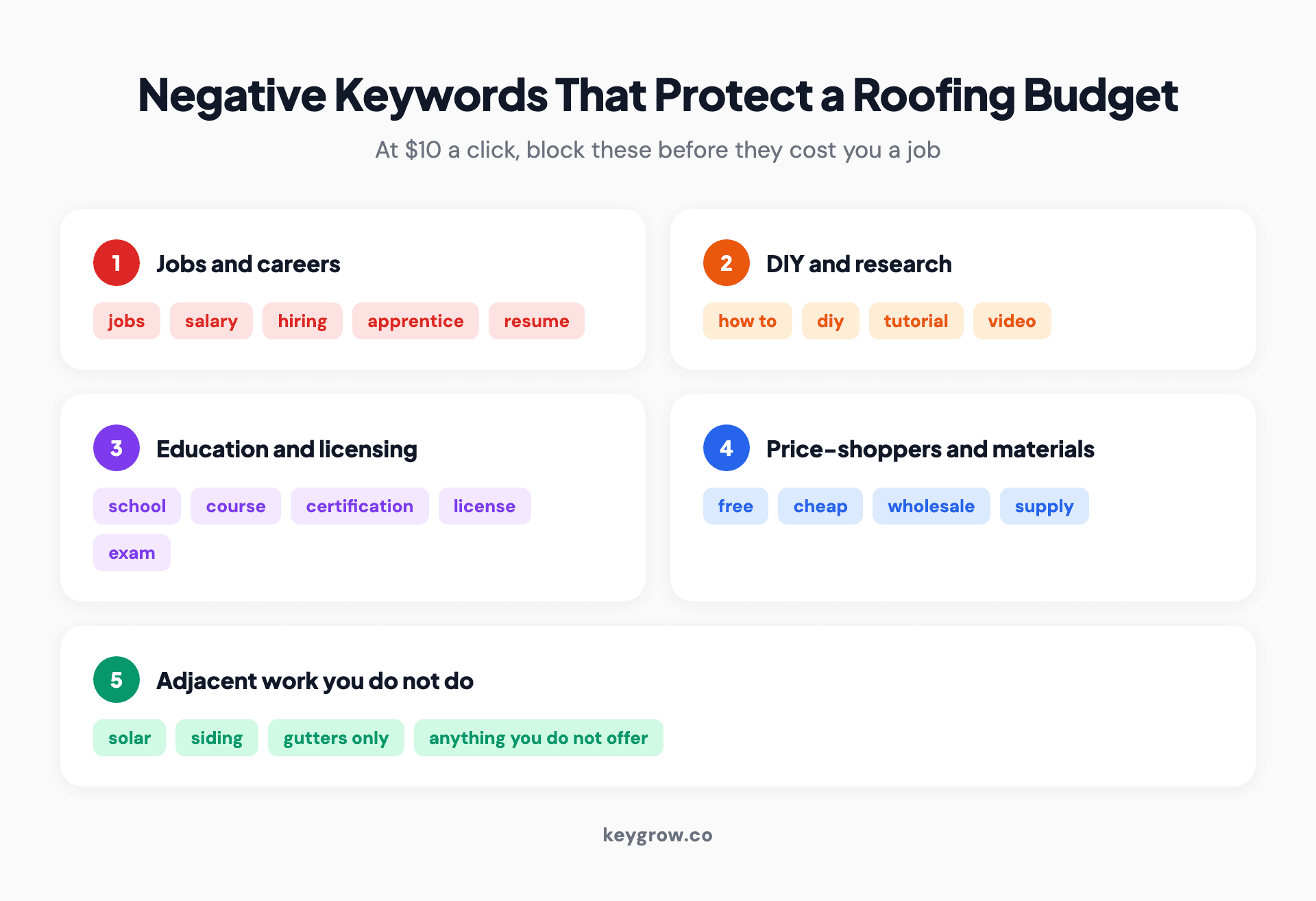
Five categories of negative keywords that protect a roofing Google Ads budget: jobs and careers, DIY and research, education and licensing, price-shoppers and materials, and adjacent work you do not do.
Target the radius you actually serve
Roofing is a local business, so your geography settings do heavy lifting. Set your targeting to the service radius you truly cover, whether that is a set of ZIP codes or a mile radius around your yard, and exclude the areas you will not drive to.
One setting to check: make sure you are targeting "presence," people actually in your area, not "presence or interest," which can show your ads to someone across the country reading about roofs. It is a small toggle that stops you paying for clicks from people who could never hire you.
Send the click somewhere built to convert
Winning the click is half the job. The page it lands on is the other half, and it is the half most roofers get wrong.
A roofing client who sends every ad click to their homepage is paying premium prices to drop urgent buyers onto a page full of navigation and no clear next step. We saw this pattern with a mobile detailing account paying about $100 per booking by sending clicks to its homepage. We pointed the ads at a single dedicated landing page built around one action, and the cost per booking dropped to $22 while bookings grew 650 percent between August and December. Different trade, same lesson: sending paid traffic to your homepage is the most expensive default in PPC.
For roofing, that landing page needs a phone number that is impossible to miss, proof you are licensed and insured, real photos of your work, and one obvious action. And answer the phone. Speed to lead decides roofing jobs; the homeowner with a leak calls three roofers and hires the first one who picks up. A perfect campaign feeding a phone nobody answers is money set on fire.
Track the calls, not just the clicks
You cannot improve what you cannot see, and roofing leads come mostly by phone, which the default reports miss. Set up tracking before you scale spend, not after.
At minimum, turn on call conversion tracking so a phone call from an ad counts as a conversion, and use call reporting to hear which keywords drive real jobs versus wrong numbers and price-shoppers. Track form submissions as separate conversion actions. This is the wiring that lets Google optimize toward the clicks that book work instead of the clicks that just show up, and if any of it feels fiddly, our guide on finding your conversion ID covers the piece people most often get wrong. Once the tracking is honest, you can finally answer the only question that matters: what did a booked roof cost you, and which campaigns delivered it.
Seasonality and storm response
Roofing demand is not flat across the year, and a budget that ignores the calendar leaves money on the table. This is the roofing-specific edge most accounts miss.
Planned replacement searches climb in spring and early summer as homeowners tackle projects in good weather. Storm and emergency intent spikes after hail and wind events, often heaviest from midsummer into fall. Winter is quieter, and clicks are frequently cheaper because fewer competitors are bidding, which can make it a smart season to capture replacement research at a discount.
The move that pays: when a hailstorm hits your area, raise budgets hard for the two to four weeks that follow, because that is when a flood of high-intent, insurance-backed searches appears and the roofers who show up win the work. Have a storm-response plan ready so you are not scrambling to adjust budgets while your competitors capture the demand.
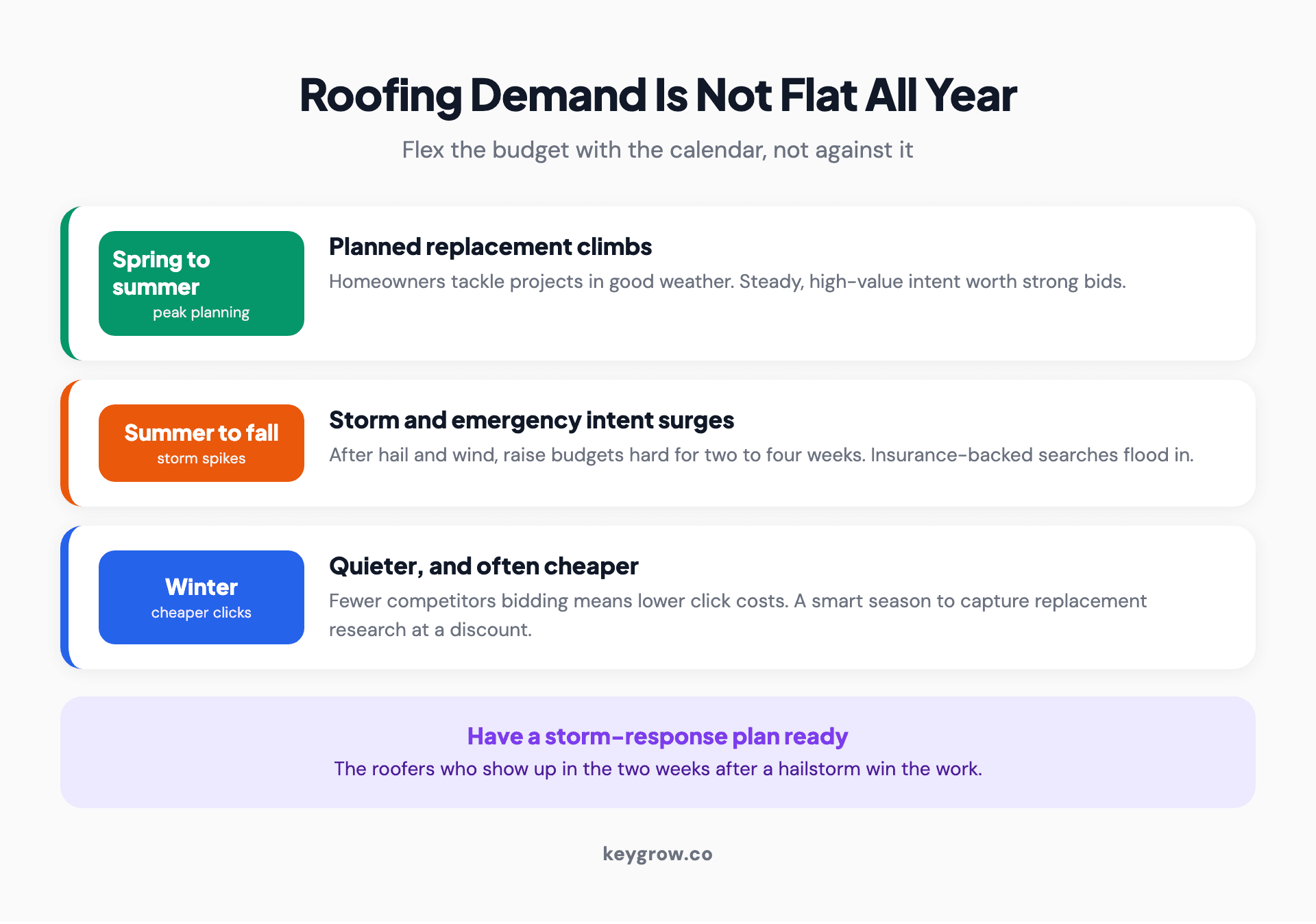
Roofing ad seasonality: planned replacement peaks spring to summer, storm and emergency intent surges summer to fall, and winter clicks are often cheaper.
Budget and bidding without lighting money on fire
Roofing is not a category you can test with lunch money. At $10 or more per click, a $500 monthly budget buys you a few dozen clicks, not enough to learn anything, so you pay for the experiment and get no answer. Fund one focused campaign properly rather than scattering a small budget across many.
On bidding, do not hand a brand-new account to full automation. Google's automated strategies like Maximize Conversions need conversion data to work, and a fresh roofing account has none, so early on they tend to chase cheap, low-intent clicks. Start with manual bidding or a clicks-focused strategy while you gather conversions, keep a close eye on the search terms report, and switch to conversion-based bidding once the account has a month or two of clean data telling the algorithm what a real lead looks like. The same logic applies to Local Services Ads: the pay-per-lead model is forgiving, but you still need to dispute junk leads promptly, because the leads you let slide are the budget you never get back. Set a budget you can sustain for at least three months, because roofing accounts get more efficient with data, and pulling the plug at week three means paying for the learning without collecting the payoff.
What good results look like
Set expectations with real numbers so you can tell a working account from a broken one. Home and home improvement advertisers average around a $8.33 cost per click and an 8.05 percent conversion rate, per WordStream, while roofing specifically runs pricier because of the competition. A cost per lead well over $100 is normal for this category, so judge the account on cost per booked job and close rate, not on the click price alone.
Give it time, too. The first few weeks are for gathering data and cutting waste, not for judging the whole channel. Track calls and booked jobs from day one, watch your click-through rate as an early signal that your ads match the search, and expect the account to get more efficient as you feed it negatives and conversion data. For the broader home-services picture, our home services marketing work covers how the pieces fit together.
FAQs
How much should a roofing company spend on Google Ads?
Enough to compete at roofing's high click prices, which usually means a few thousand dollars a month at minimum to gather real data. Because roofing carries one of the highest costs per lead in home services, around $228 on average, a thin budget spread across many campaigns tends to starve them all. Fund one or two focused campaigns well before expanding.
What is the difference between Local Services Ads and Search Ads for roofers?
Local Services Ads charge per lead, sit at the very top of the page, and carry the Google Guaranteed badge, which builds trust with homeowners who do not know you. Search Ads charge per click and give you control over keywords, ad copy, and landing pages. Most roofers benefit from running both, since they capture different people in different ways.
How long before Google Ads works for a roofing company?
You can get calls within days of launching, but the first few weeks are mostly for gathering data and cutting wasted spend. Expect the account to get more efficient over the first one to three months as you add negative keywords and feed it conversion data. Judge it on booked jobs over that window, not on the first week.
What is a good cost per lead for roofing Google Ads?
Roofing runs high. The home-services average sits around $90, but roofing and gutters specifically averages about $228 per lead, one of the priciest categories. What counts as good depends on your close rate and job value, so track cost per booked job and the revenue behind it rather than fixating on the lead price alone.
Should roofers run ads year-round or seasonally?
Run them year-round, but flex the budget with demand. Planned replacement searches peak in spring and summer, storm and emergency intent spikes after severe weather, and winter clicks are often cheaper. Raising budgets hard in the two to four weeks after a hailstorm captures a surge of high-intent, insurance-backed searches your competitors are also chasing.
Are Google Ads worth it for a small roofing company?
They can be, if you have the budget to compete and a system to catch the leads. Roofing's high job values mean even expensive clicks pay off when they convert, but the high cost per lead punishes sloppy accounts. A small roofer with a tight budget, a strong landing page, and someone to answer the phone can do well; one that skips those will lose money quickly.
The bottom line
Roofing is a category Google Ads was made for, urgent, high-value, high-intent, and also one of the most expensive to get wrong. It also pairs badly with nothing and well with organic: the paid side answers a storm in hours, and SEO for roofers builds the map pack position that keeps taking calls after the budget stops. Win it by running Local Services Ads and Search together, buying intent instead of eyeballs, fencing the budget with negatives, flexing with the weather, and sending every click to a page and a phone that convert. Do that and the high cost per lead becomes a price worth paying. Skip it and you are just funding Google.
If you would rather hand this to a team that runs roofing and home-services accounts every day and reports on booked jobs, not clicks, our paid search service does exactly that, month to month. Tell us your market and your numbers on the get started page and we will tell you honestly what to expect.