


A hailstorm goes through a suburb on a Tuesday afternoon. By Wednesday morning, four hundred homeowners are typing "roof repair near me" into their phones, and the three roofers who already rank for that phrase in that town take the calls. Everyone else buys clicks at forty dollars each, or knocks doors.
SEO for roofers is the work of being one of those three. It means owning the map pack in the towns you actually serve, having a real page for every service and every town, and collecting enough reviews and local signals that Google trusts you over the company two suburbs away. Done properly it takes six to twelve months to mature, and then it keeps producing after you stop paying for it, which is the part paid search never does.
This is the organic side. If you want the paid side, we wrote about Google Ads for roofing companies separately, and the two channels work better together than either does alone.
The $40 click is the whole argument for organic
Roofing keywords are among the most expensive in home services. The average cost per click on roofing terms sits around forty dollars in competitive markets, and that is before anyone fills in a form.
Run the arithmetic on what that means per job. Roofing lead costs land between $60 and $120 in smaller metros and $120 to $220 in competitive cities, according to Biddable's benchmarks. Close a quarter of them and your real cost per signed job is four times the lead price. That is a permanent line item. Stop paying and it stops the same afternoon.
Organic behaves differently. The page you rank in March is still ranking in November, and the fourth call it produces costs the same as the first, which is nothing. That does not make it better than paid. It makes it a different kind of purchase: paid is rented volume you can switch on in an hour, organic is an asset that takes two quarters to build and then sits on your balance sheet.
Most roofing companies that do well run both. Paid covers the gap while the organic work matures, then the budget shifts toward whichever is producing cheaper jobs that quarter.

Aerial view of a suburban neighborhood of rooftops, the service area a local roofing company competes across in search.
Start with the map pack, not the website
For a local trade, the three-result map pack above the organic listings takes most of the clicks. Your Google Business Profile is the thing that ranks there, not your website, so it gets fixed first.
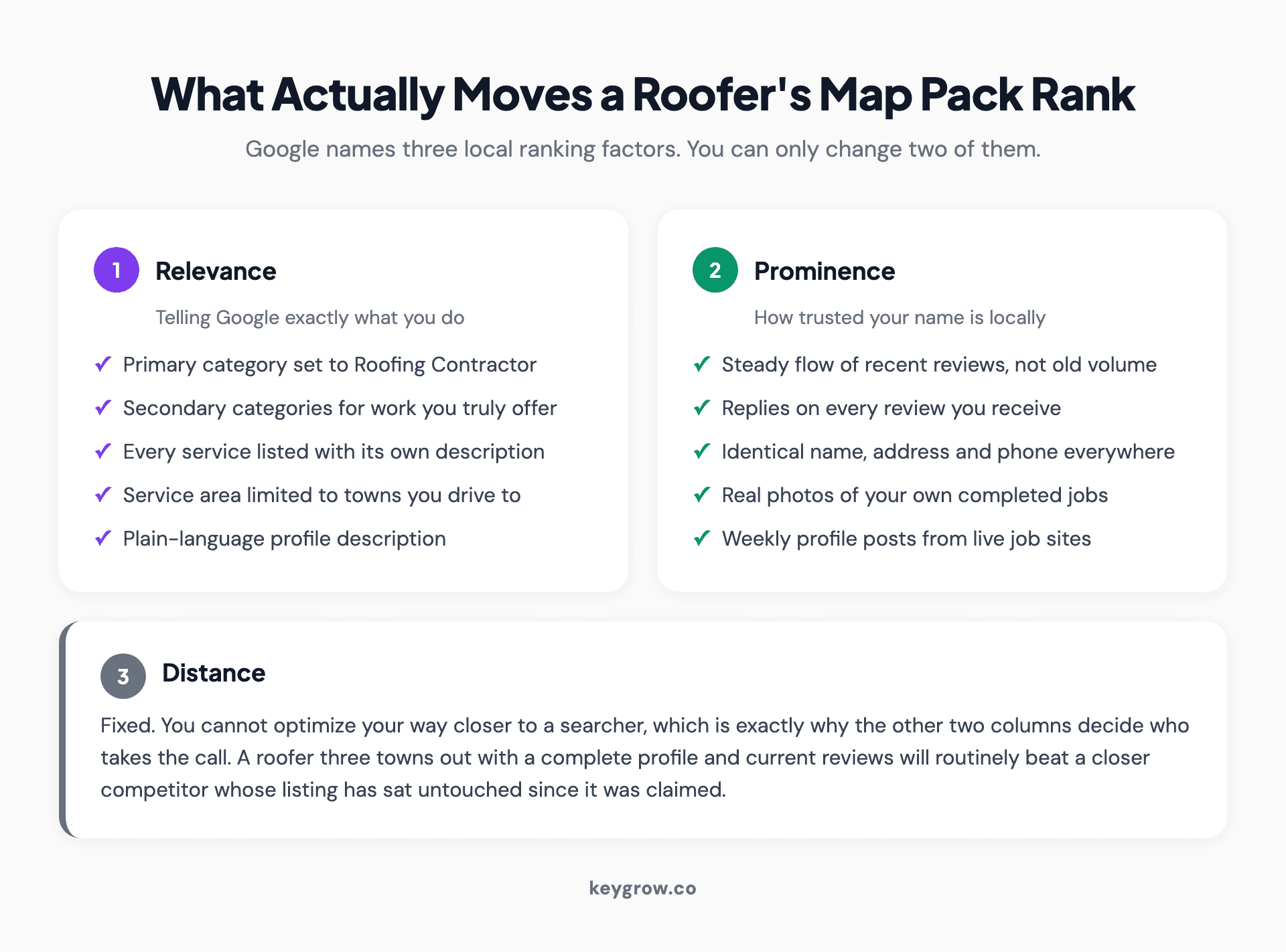
Two-column breakdown of Google's local ranking factors for roofers: relevance and prominence checklists, with distance fixed.
Google is unusually open about what drives local rankings. Google's own guidance names three factors: relevance, distance, and prominence. Distance you cannot change. Relevance and prominence you can, and most roofers leave both half-finished.
Relevance is about telling Google precisely what you do. The primary category should be Roofing Contractor, with secondary categories for the work you genuinely offer: Gutter Cleaning Service, Siding Contractor, Metal Roofing Contractor. Every service you sell should be listed in the services section with its own short description. The profile description should say what you do and where, in plain words.
Prominence is reviews, citations, and how often your name appears alongside your town in places Google trusts. It is the slow part and the part that separates the top three from the rest.
Two things worth doing in the first week: add real photos of your own completed jobs, geotagged and dated, rather than stock roof images, and set your service area to the towns you will actually drive to. A service area padded out to thirty towns you have never worked in dilutes the signal for the five that matter.
The services section is the part most roofers skip, and it is free ranking surface. Each service you add can carry its own description, and those descriptions are indexed. A profile listing eleven specific services with a sentence each will out-rank a profile listing "roofing" for most of the searches that matter.
Posts are worth ten minutes a week. A short update with a photo from a job you finished that week keeps the profile active, and activity is one of the few prominence signals you control directly and immediately.
Which roofing searches are actually worth ranking for?
Not all roofing traffic is worth the same, and volume is a poor way to choose. Rank your target searches by what the job behind them is worth.
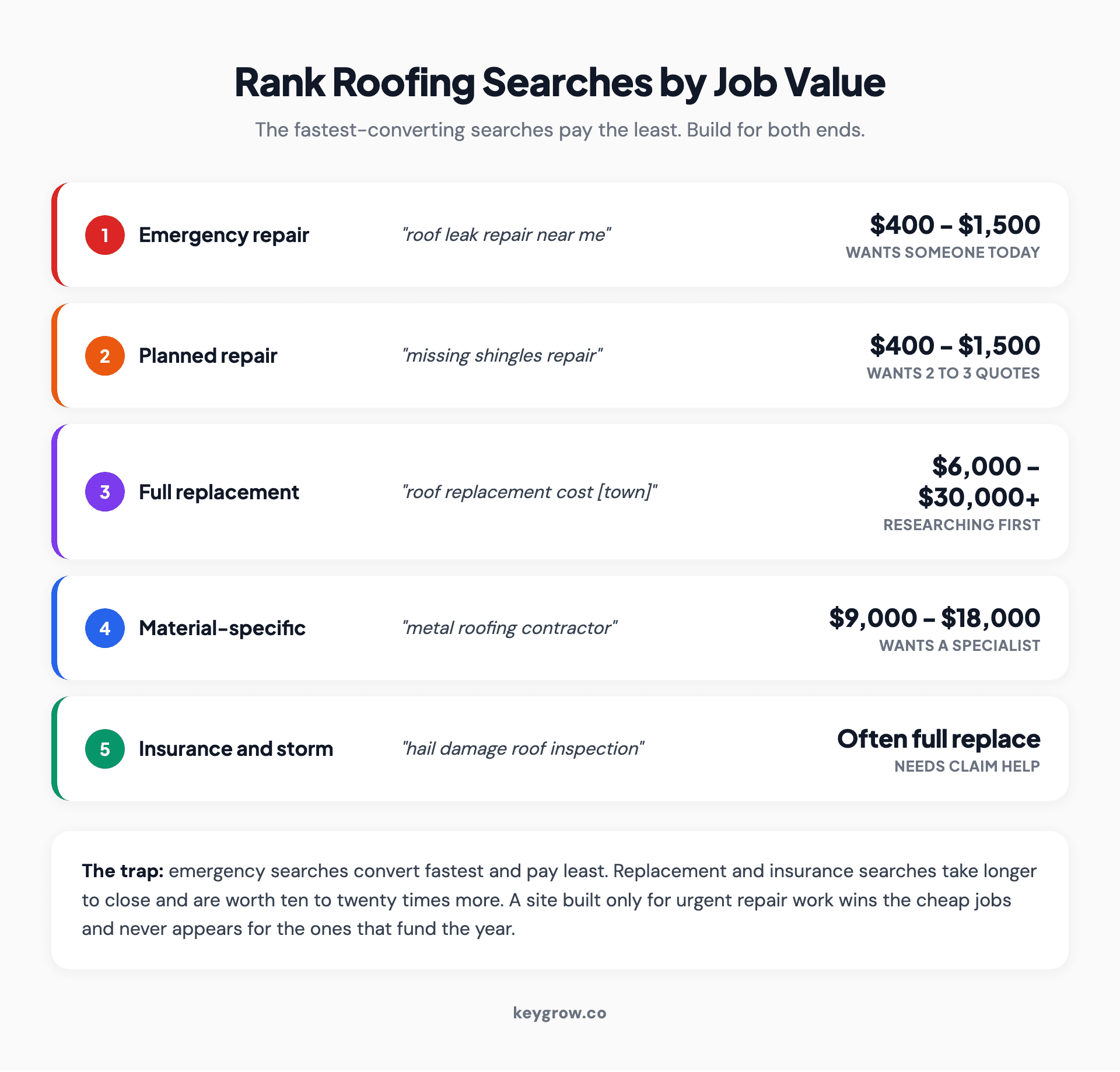
Five roofing search families ranked by job value, from emergency repair at $400 to full replacement at $30,000 and up.
A roof repair runs between $400 and $1,500. A full asphalt replacement runs $6,000 to $12,000, metal $9,000 to $18,000, and tile or slate $15,000 to $30,000 or more, per Housecall Pro's pricing data. Those are not variations of one job. They are different businesses with different margins, different sales cycles, and different searchers.
| Search family | Example | Typical job | What the searcher wants |
|---|---|---|---|
| Emergency repair | roof leak repair [town] | $400 to $1,500 | Someone today |
| Planned repair | missing shingles repair | $400 to $1,500 | Two or three quotes |
| Replacement | roof replacement cost [town] | $6,000 to $30,000+ | Research, then quotes |
| Material-specific | metal roofing contractor | $9,000 to $18,000 | A specialist |
| Insurance and storm | hail damage roof inspection | Varies, often full replacement | Help with a claim |
The pattern most roofers miss: emergency repair searches convert fastest and pay least, while replacement and insurance searches take longer and pay ten to twenty times more. If you only build pages for the urgent stuff, you win the cheap work and never appear for the jobs that fund your year.
Build for both, but do not pretend they are the same page.
The insurance claim searches nobody is writing for
Here is the gap in almost every roofing site we audit. Homeowners with storm damage do not start by searching for a contractor. They start by searching about their insurance.
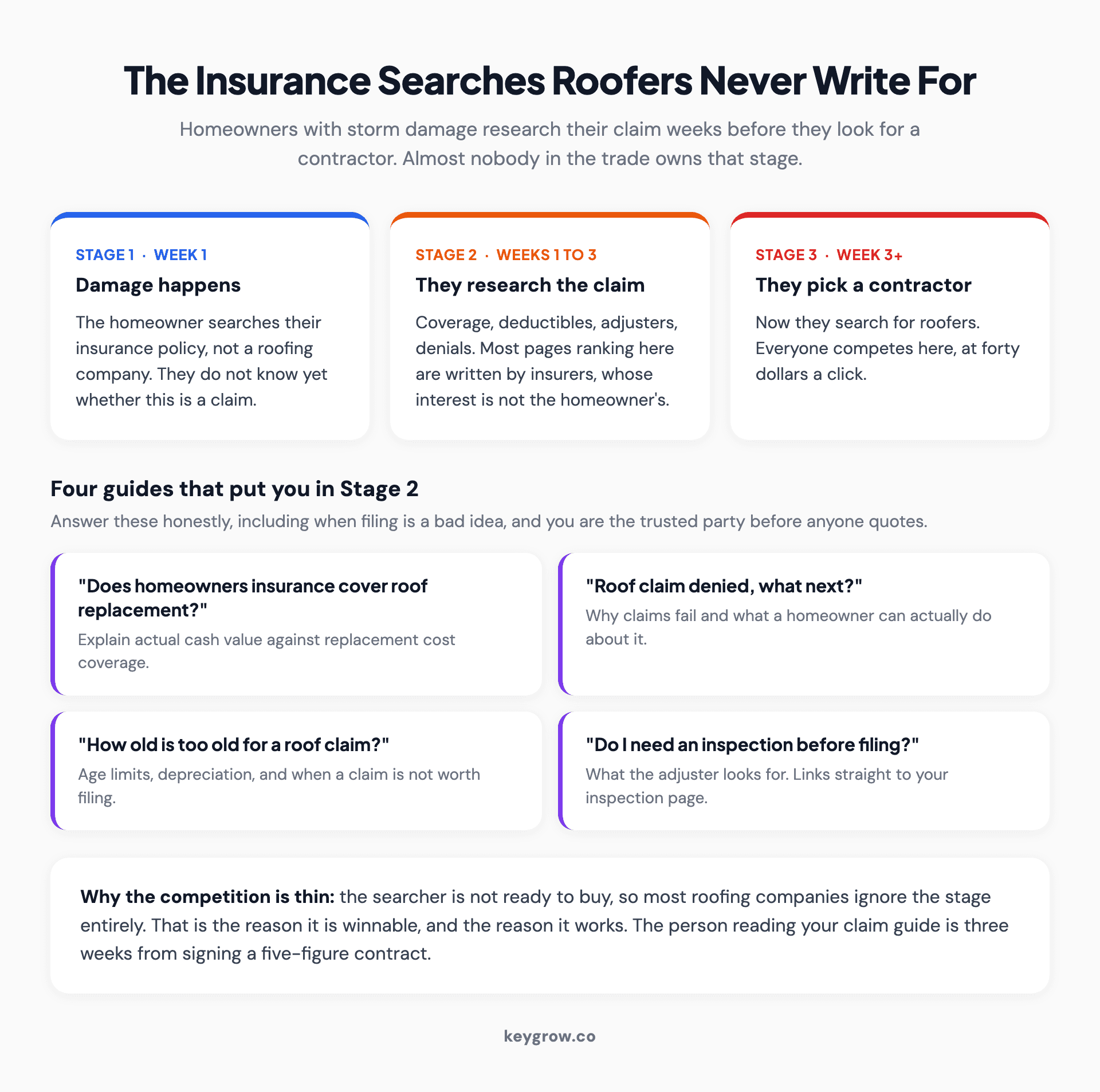
Three-stage timeline showing homeowners researching an insurance claim for weeks before they search for a roofing contractor.
"Does homeowners insurance cover roof replacement." "Roof claim denied what next." "How old is too old for a roof claim." "Do I need a roof inspection before filing." These are high-volume informational searches from people who are three weeks away from signing a five-figure contract, and the pages ranking for them are mostly written by insurance companies, whose interest is not the same as the homeowner's.
A roofer who answers those questions honestly, including the times when filing a claim is a bad idea, becomes the trusted party before anyone gets a quote. That is a defensible position that no amount of ad budget buys.
Write them as plain guides. What the adjuster looks for. Why a claim gets denied and what to do about it. What the difference between actual cash value and replacement cost coverage means for the homeowner's out-of-pocket. Link each one to your inspection page. The searcher is not ready to buy yet, and that is exactly why the competition is thin.
Build one page per service and one per town
The structural mistake we see most often is a single Services page listing eight services, and a single Areas We Serve page listing twenty towns. That is one page competing for a hundred and sixty different searches, which means it ranks for none of them.
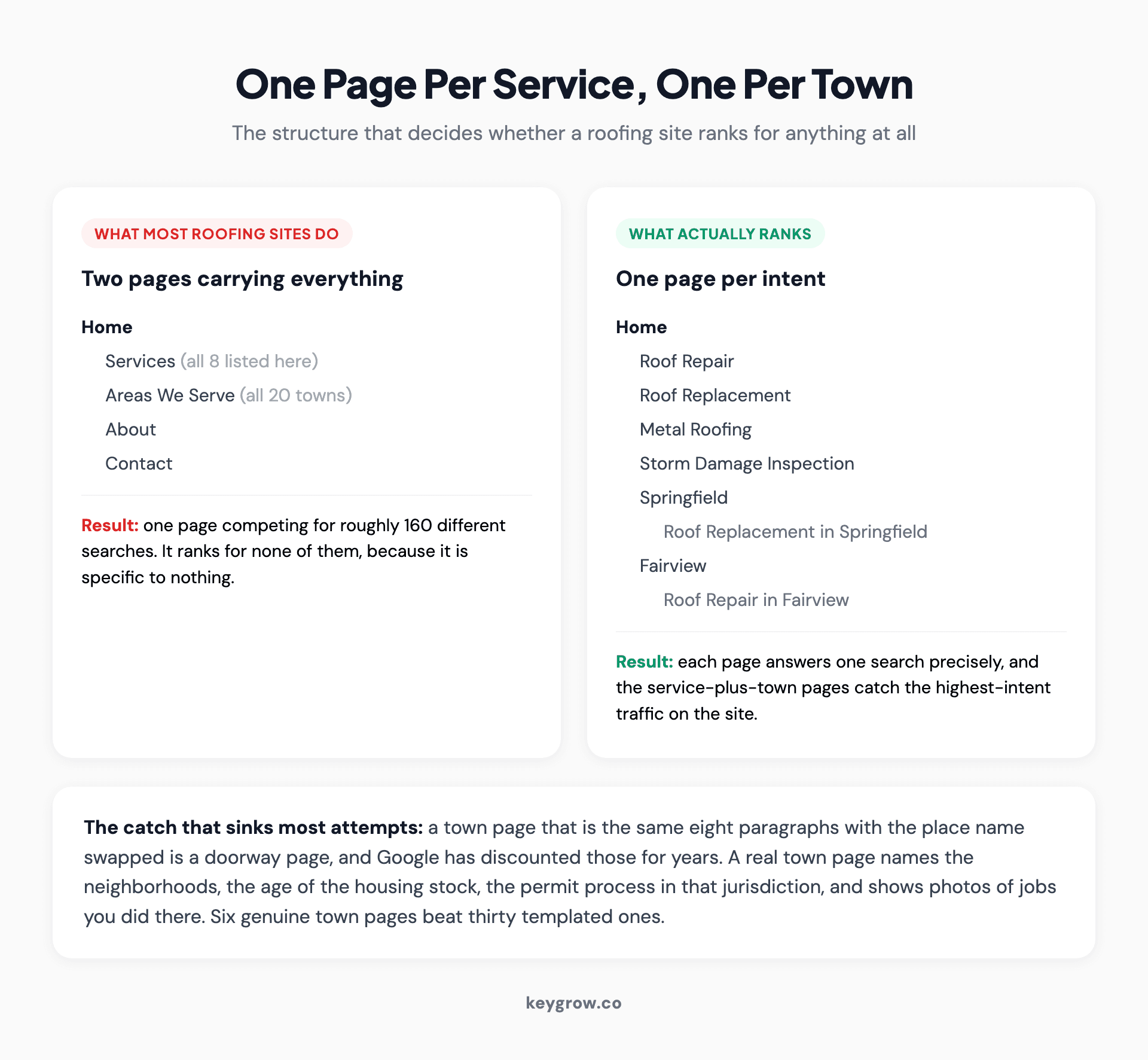
Side-by-side site structure comparison: two catch-all pages against one page per service and one per town.
The fix is unglamorous. One page per service. One page per town you genuinely work in. Then a page for each service and town combination that carries real volume, which is usually your top three or four towns crossed with your top two or three services.
The catch, and the reason most attempts at this fail, is that those pages have to be different from each other. A town page that is the same eight paragraphs with the place name swapped is a doorway page, and Google has been discounting those for years. A real town page mentions the neighborhoods, the housing stock and its age, the permit process in that jurisdiction, the storms that hit it, and photos of jobs you did there.
If you cannot write something genuinely specific about a town, you probably should not have a page for it yet. Six real town pages beat thirty templated ones. One of our junk removal clients ranked with six service pages built over six weeks, not sixty.
Storm season is won in the quiet months
This is the timing problem that makes roofing different from every other trade, and almost no roofing SEO guide addresses it.
Demand arrives in bursts. A hail event or a windstorm creates weeks of searches inside forty-eight hours. Organic rankings take three to six months to establish. Those two timelines do not meet, which means the storm you are going to win is not the next one, it is the one after that.

Roofer stripping damaged shingles from a residential roof during a repair job.
So the sequence runs backwards from your weather, not forward from today. If your region takes hail in spring, the storm content and the inspection pages go live in autumn. They sit there quietly, accumulate a little authority through the winter, and are already ranking when the sky opens.
What to have in place before the season, not during it:
- A storm damage inspection page that ranks in the quiet months
- Town pages for the areas most exposed to your local weather
- The insurance claim guides above, indexed and holding position
- A Google Business Profile with recent photos and a steady review flow
- Enough site speed headroom that a traffic spike does not take you down
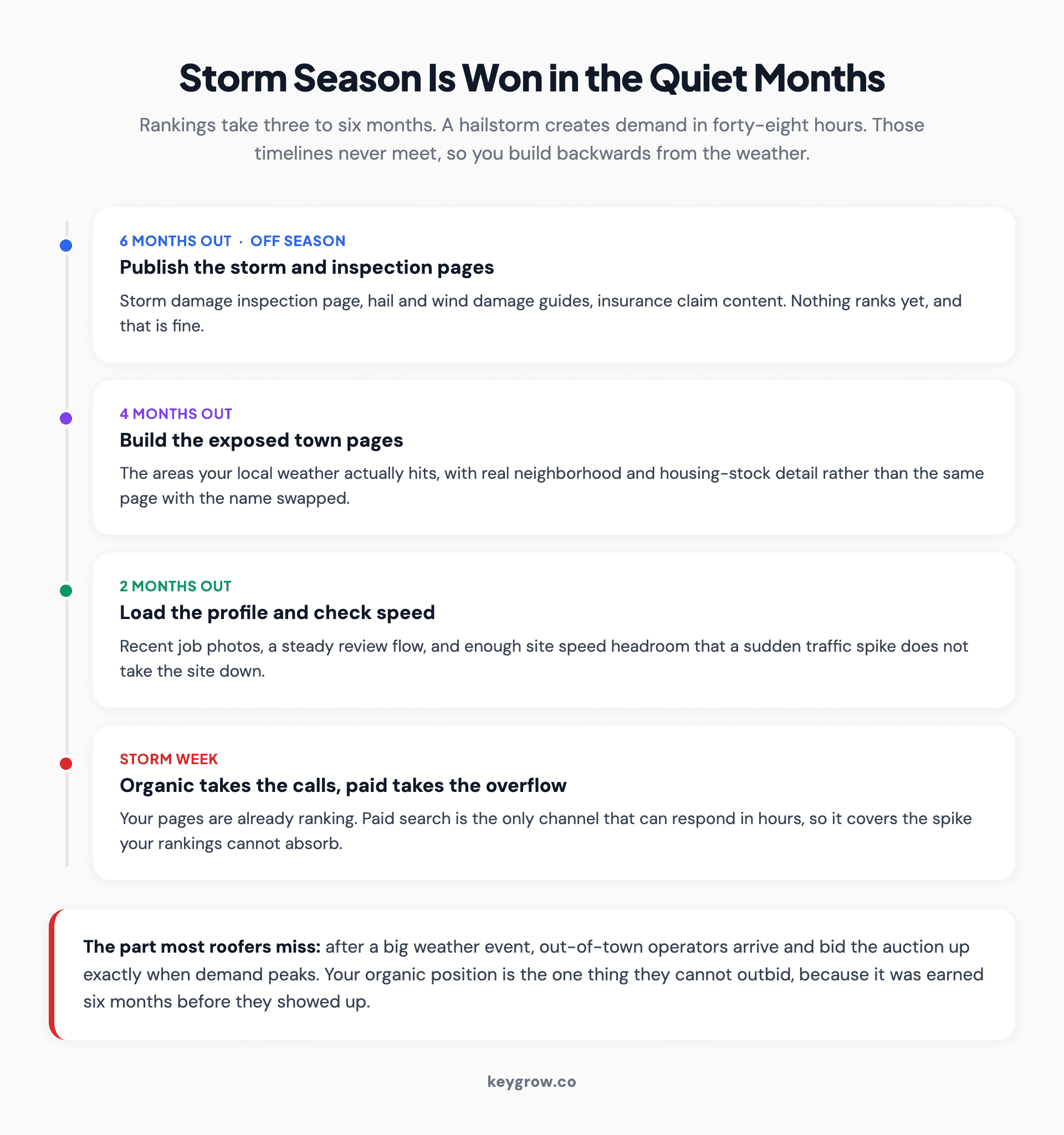
Timeline counting backwards from storm season, showing when to publish inspection pages, town pages and profile updates.
During the storm itself, paid search is the only channel that can respond in hours. That is the honest division of labor between the two, and it is why the roofers who do best treat them as one plan rather than competing budgets.
There is a second reason the quiet months matter. After a significant weather event, out-of-town operators arrive and start advertising heavily, which pushes paid costs up exactly when demand peaks. Your organic position is the thing they cannot outbid, because it was earned six months before they showed up. Local roofers who hold the map pack through a storm season keep taking calls at zero marginal cost while everyone else fights over a suddenly more expensive auction.
What should a roofing website publish between storms?
Publish proof. For a trade, that means photographs, specifics, and numbers, because the thing you are trying to demonstrate is that you have actually been on roofs.

Two roofers working on a residential roof, the kind of job photography that makes project pages persuasive.
Project pages do the heaviest lifting: one per notable job, naming the town, the problem, the material, roughly what it cost, with before and after photos. They pick up long-tail searches nobody else is targeting, and they are the most persuasive pages on any roofing site because they are the only ones a competitor cannot copy.
Material comparisons catch people earlier. Asphalt against metal in your particular climate, or what a slate roof really costs to maintain over thirty years. Someone reading that is nine months from a five-figure decision and has not spoken to anyone yet.
Then there are cost pages, which almost every roofer refuses to build. Publishing ranges with the variables explained captures the very large "roof replacement cost" search volume and screens the caller before they dial. You will lose some time-wasters, which is the point.
Seasonal maintenance guides round it out. Low commercial intent, but they build authority and give you somewhere natural to link from into the pages that do convert.
What not to publish: a generic "5 tips for choosing a roofer" post. Every roofing site has one. They rank for nothing and they say nothing.
Reviews do the work that links do in other industries
In most sectors, backlinks are the main authority signal. In local trades, reviews carry more of the load, and they are the single highest-return activity available to a roofing company.
The variables that matter are volume, recency, and whether you reply. A profile with two hundred reviews where the last one is from eighteen months ago reads worse than one with sixty where the last is from Tuesday. Ask every completed job, by text, the same day the crew leaves. That is it. Most roofers ask nobody and then wonder why the company down the road outranks them.
Citations still matter, though less than they did. Your name, address, and phone number should be identical everywhere they appear, including on the trade directories, the supplier listings, and the local chamber. Inconsistency here is the most common technical problem we find on roofing sites, and it is usually caused by an old address nobody remembered to update.
For links, the realistic sources are local: suppliers, manufacturers whose products you are certified to install, local news coverage after a storm, sponsorship of anything with a website. Manufacturer certification directories in particular are the most underused link source in this trade. If you hold a certification, check whether the manufacturer publishes a contractor locator, then check whether your listing there actually links back to you. Many do and most roofers never claim the entry.
Worth adding: mark up your business details with LocalBusiness structured data so search engines and AI assistants can read your service area, hours, and reviews without guessing. Our schema markup generator will produce it if you do not want to hand-write the JSON.
How do you know any of this is working?
Not by rankings. A number one position that produces no calls is a vanity metric, and rank tracking is where bad agencies hide.
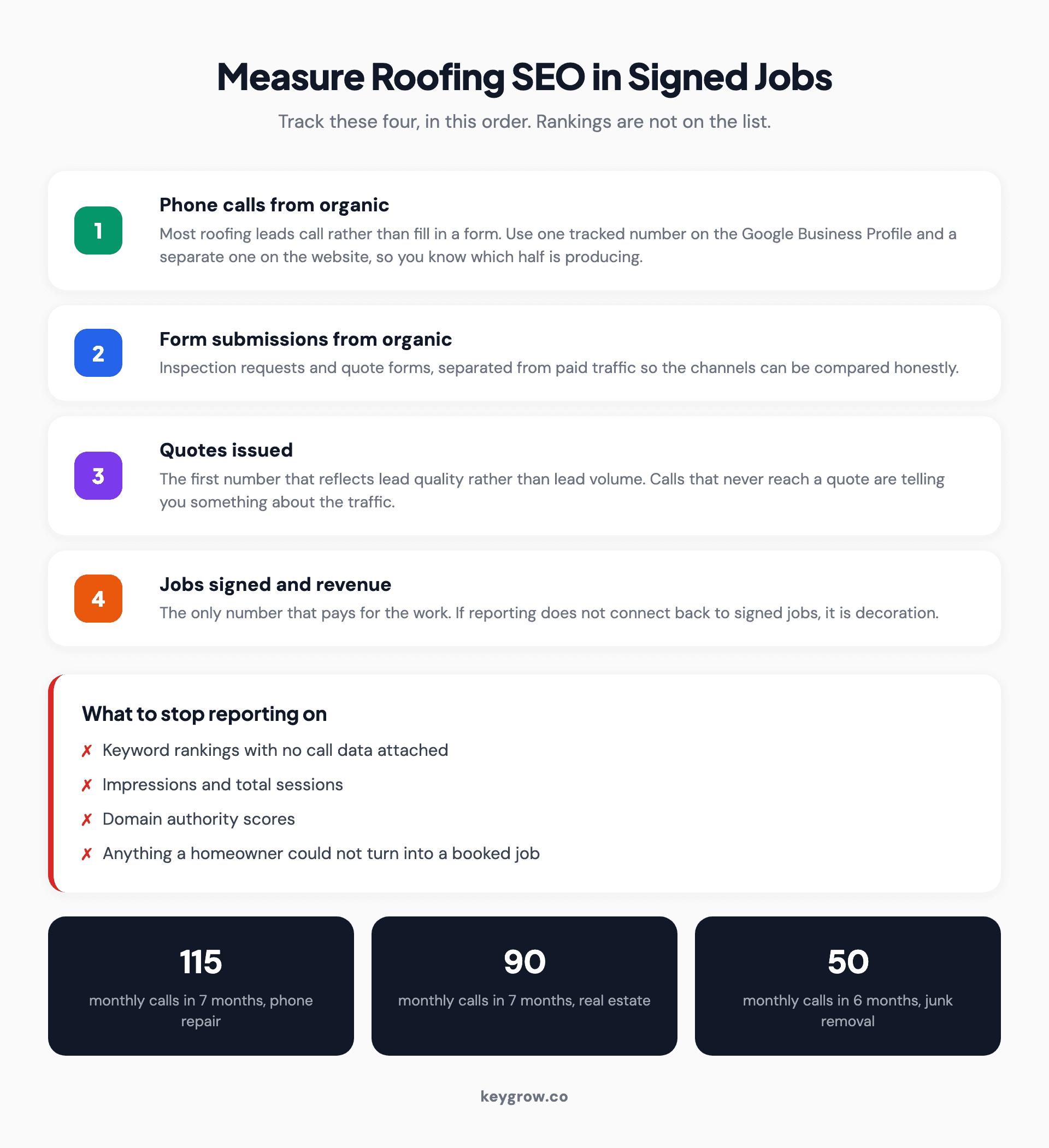
Four roofing SEO metrics ranked in order: calls, form submissions, quotes issued and jobs signed, plus what to stop reporting.
Track these instead, in this order: phone calls from organic, form submissions from organic, quotes issued, and jobs signed. If your reporting does not connect back to signed work, it is not reporting, it is decoration.
Call tracking is worth the setup cost in this trade specifically, because most roofing leads phone rather than fill in a form. The same measurement discipline applies across SEO for home services generally, though roofing skews harder toward the phone than almost any other trade. A separate tracked number for your Google Business Profile and another for the website will tell you which half of your local presence is producing, which is information most roofers have never had.
Three local service clients we work with hit 115 monthly phone calls in seven months, 90 in seven months, and 50 in six months. None of them had meaningful inbound calls before the work started. Nobody involved was watching a rank tracker.
What roofing SEO costs, and how long before it pays
Market rates for local SEO run roughly $500 to $5,000 a month depending on scope and market competitiveness, with most single-market roofing companies landing somewhere in the middle of that band. An in-house specialist costs considerably more once you add salary and tools.
Here is the opinion that matters, and it costs us business to say it: SEO is a compounding asset, not a campaign, and the first quarter looks like nothing. Our strongest organic case took 12 months to reach 1,519% traffic growth. Companies that quit at month three have paid for the hard part and left before the payout.
| Period | What is actually happening | What you will see |
|---|---|---|
| Months 1 to 2 | Technical fixes, profile rebuild, page structure | Very little |
| Months 3 to 4 | Service and town pages indexed, reviews accumulating | Map pack movement, first calls |
| Months 5 to 8 | Rankings establish on mid-tail terms | Steady call volume |
| Months 9 to 12 | Authority compounds, competitive terms move | Cost per job drops below paid |
Anyone promising page one in thirty days is either targeting phrases nobody searches or about to do something to your domain you will regret.
The roofers who should not hire anyone yet
Plenty of roofing companies are not ready to pay an agency, and an agency that will not tell you that is selling rather than advising.
Do it yourself if you are a single crew working one town, you have time in the off-season, and your Google Business Profile is still unclaimed or half-filled. Claiming the profile, loading it with real job photos, setting the categories properly, and texting every customer for a review will move you further in three months than a retainer will, and it costs you evenings rather than money.
Wait if you cannot answer the phone. Ranking creates calls. If those calls go to voicemail because the crew is on a roof and nobody is in the office, more traffic just means more missed calls and a worse reputation. Fix the intake first.
The same applies if your website cannot take a booking. Sending organic traffic to a site with no phone number above the fold and no way to request an inspection is paying to send people somewhere they cannot act.
Hire when the opportunity cost of your own time exceeds the fee, when you have more than one town to cover, or when you have plateaued and cannot work out why. That last one is the most common reason roofers come to us, and it is usually a structural problem rather than an effort problem.
If roofing is only part of what you do
Plenty of roofing companies also sell siding, windows, gutters and the occasional full exterior. Once a meaningful share of revenue comes from project work rather than storm work, the playbook shifts toward documented finished jobs and published cost bands. That version is in SEO for contractors, which covers the long-decision side of the trade.
FAQs
What is SEO for roofing companies?
SEO for roofing companies is the work of ranking in Google's map pack and organic results for the searches homeowners use when they need a roof repaired, replaced, or inspected. It combines Google Business Profile optimization, service and location pages on your website, review generation, and local authority building. Unlike paid ads, the results persist after you stop paying.
How long does roofing SEO take to work?
Expect three to six months before meaningful movement and six to twelve months before it becomes a primary lead source. Map pack improvements often show first because Google Business Profile changes are indexed faster than website content. Anyone promising first-page rankings in thirty days is either targeting keywords with no search volume or using tactics that will cost you later.
How much does roofing SEO cost?
Market rates run roughly $500 to $5,000 per month depending on how many towns you target and how competitive your market is. Single-crew operators in one town sit at the lower end, multi-location companies in major metros at the upper. Compare the monthly fee against your cost per job from paid channels, not against zero.
Is SEO better than Google Ads for roofers?
Neither is better, they solve different problems. Paid search goes live in hours and is the only way to respond to a storm in real time. Organic takes months to build but then produces calls at no incremental cost. Most successful roofing companies run both, using paid to cover the gap while organic matures.
How do roofers rank in the Google map pack?
Google ranks local results on relevance, distance, and prominence. You cannot change distance, so the work is in the other two: complete category and service selection on your Google Business Profile, real photos of your own jobs, consistent business information across the web, and a steady flow of recent reviews. Reviews with recency matter more than a large old review count.
What content should a roofing website publish?
Project pages documenting real jobs with photos and locations, material comparison guides, honest cost pages with ranges and explanations, and insurance claim guidance. Avoid generic tip listicles. The pages that rank and convert for roofers are the ones that prove work has actually been done and answer money questions other roofers avoid.
Do reviews affect roofing SEO rankings?
Yes, significantly, and more than in most industries. Review volume, recency, and your response rate all feed the prominence signal that decides map pack position. Asking every customer for a review the day the job finishes is the highest-return SEO activity available to most roofing companies, and it costs nothing.
Should a roofing company build separate pages for each town?
Yes, but only for towns you genuinely serve and can write specifically about. A town page needs local detail: neighborhoods, housing stock, permit requirements, local weather, and photos of jobs completed there. Six substantial town pages outperform thirty templated ones, and templated location pages risk being treated as doorway pages.
What to do in the next 90 days
If you take nothing else from this, take the order. Roofers who get organic working tend to do the same things in the same sequence.
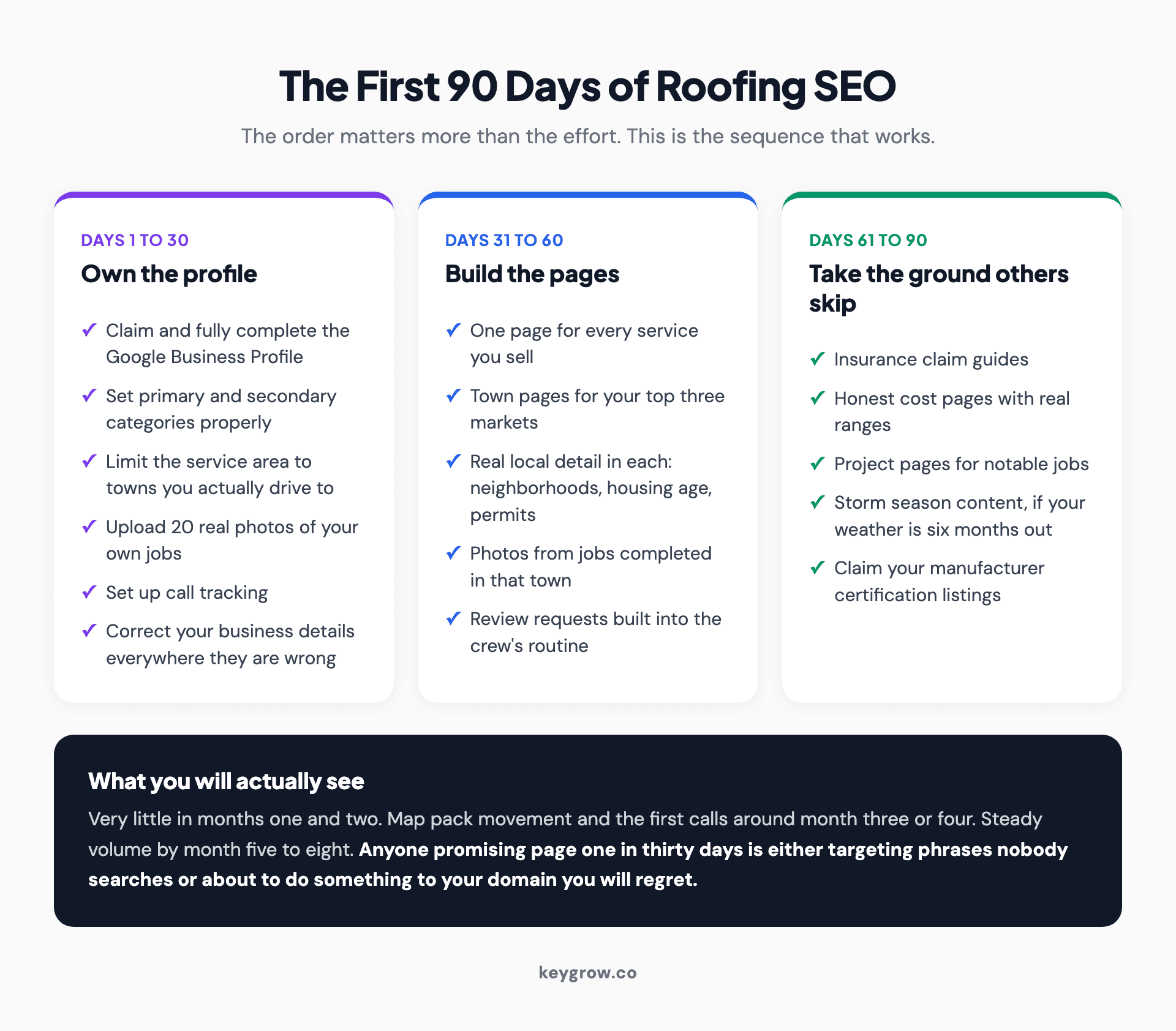
Three-column 90-day roofing SEO plan covering profile setup, page building and the insurance and cost content competitors skip.
Days 1 to 30. Claim and fully complete your Google Business Profile: categories, services, service area limited to towns you actually serve, twenty real job photos. Set up call tracking. Fix your business information anywhere it appears wrong.
Days 31 to 60. Build one page per service. Build town pages for your top three markets, with genuine local detail in each. Get your review request into the crew's routine so it happens without anyone remembering.
Days 61 to 90. Publish the insurance and cost content, the pages competitors avoid. Start the storm-season material now if your weather is six months out.
None of this is complicated. It is just consistent, and consistency is the part that beats most companies, which is exactly why it works.
If you would rather have someone run it, our SEO services and home services marketing teams do this work for trades every day, month to month with no lock-in. And if you read the section above and recognized yourself in the do-it-yourself list, do that instead and come back when the phone problem is a good problem.