


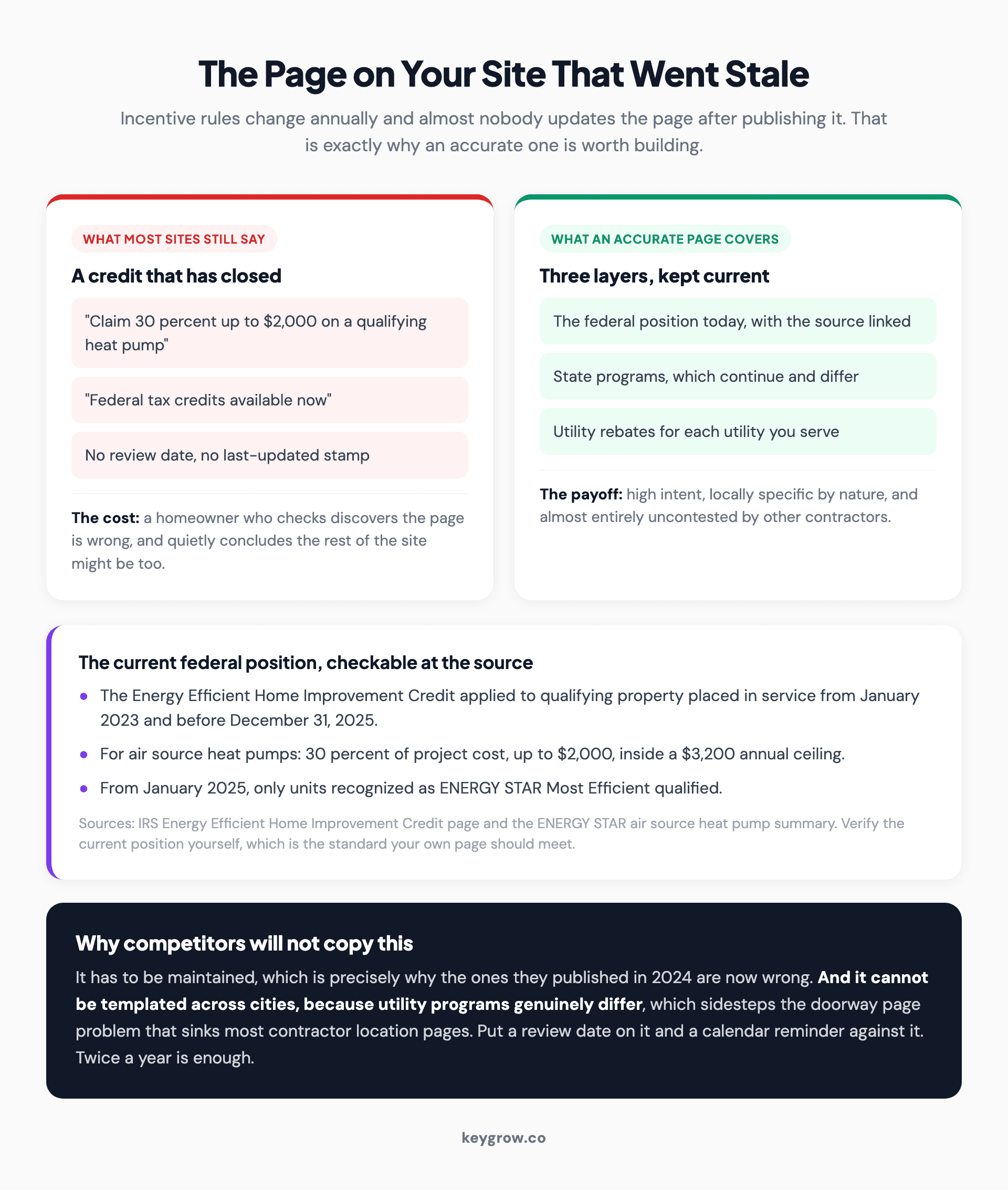
Open your own website and search it for the words "tax credit". If a page tells homeowners they can claim 30 percent up to $2,000 on a qualifying heat pump, that page is out of date, and it has been since the first of January.
That one stale paragraph is a small thing on its own. It is also a fair summary of why SEO for HVAC companies underperforms for so many contractors: the search behavior around heating and cooling has moved faster in the last three years than most contractor websites have, and the pages that would capture the highest-value jobs in the trade are either missing or wrong.
Below is what we would fix, in order, and what we would not bother with. The paid side is a separate discussion, and we wrote it up in HVAC Google Ads.
Why is this the fastest-decaying content on your website?
Because incentive rules change annually, and almost nobody updates the page after publishing it.
Timeline of federal heat pump incentive changes and the questions homeowners search at each stage, showing where contractor pages go stale.
Here is the current position, and check it yourself rather than taking our word for it, which is exactly the standard your own page should meet. The federal Energy Efficient Home Improvement Credit covered qualifying property placed in service from January 2023, and the IRS credit page states it applies to property placed in service before December 31, 2025. ENERGY STAR's summary describes the same window for air source heat pumps, at 30 percent of project cost up to $2,000, inside a $3,200 annual ceiling, and notes that from January 2025 only units recognized as ENERGY STAR Most Efficient qualified.
So a homeowner searching for the federal credit today is looking for something that is no longer there in the form your website describes. Meanwhile state programs, utility rebates and local weatherization schemes continue, they differ enormously by zip code, and they are genuinely hard to assemble in one place.
That is the opportunity. A contractor who maintains one accurate page covering the federal position, their state's programs, and the specific rebates offered by the utilities in their service area owns a query set that is high intent, locally specific by nature, and almost entirely uncontested by other contractors.
Two things make it defensible. It has to be updated, which is precisely why competitors abandon theirs. And it cannot be templated across cities, because the utility programs genuinely differ, which sidesteps the doorway page problem that sinks most contractor location pages.
Put a review date on the page and a calendar reminder against it. Twice a year is enough.
What are HVAC customers actually searching for now?
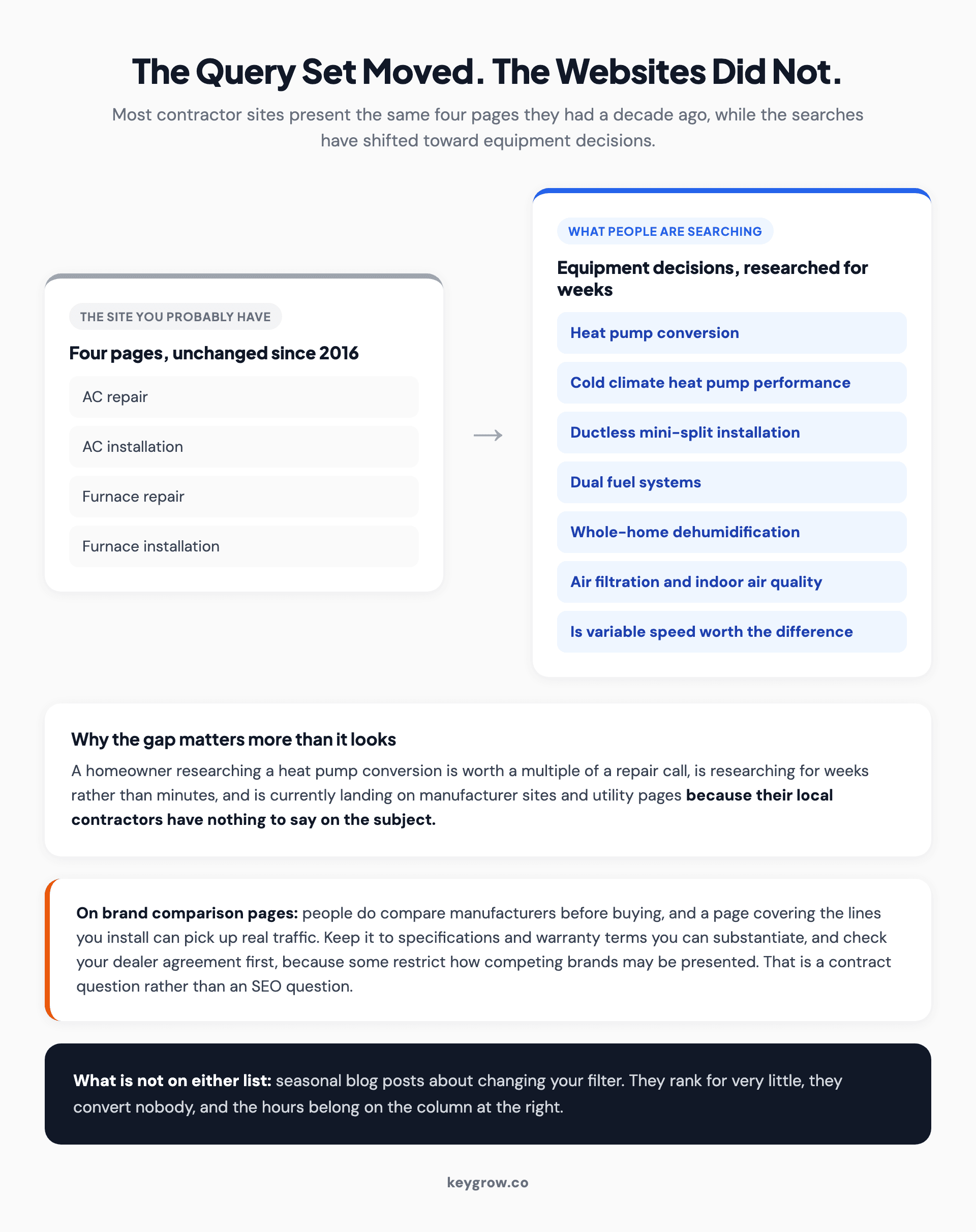
Not what most HVAC websites are built to answer. The query set has shifted toward equipment decisions and away from repair.
Comparison of the traditional HVAC page set against the searches homeowners now run about heat pumps, mini-splits, indoor air quality and system sizing.
Most contractor sites still present the same four pages they had a decade ago: AC repair, AC installation, furnace repair, furnace installation. Meanwhile homeowners are searching about heat pumps, cold climate performance, ductless mini-split conversions, dual fuel systems, whole-home dehumidification, air filtration, and whether a variable speed system is worth the difference.
Some of that is electrification policy, some is manufacturers marketing directly to homeowners, and some is that the equipment genuinely changed. The cause does not matter much. What matters is that a homeowner researching a heat pump conversion is worth a multiple of a repair call, is researching for weeks, and is landing on manufacturer sites and utility pages because their local contractors have nothing to say on the subject.
Brand comparison queries deserve a mention here, and a caution. People do search for one manufacturer against another before they buy, and a contractor page comparing the lines they install can pick up real traffic. Keep it factual, keep it about specifications and warranty terms you can substantiate, and be aware that manufacturer agreements sometimes restrict how you may present competing brands. That is a contract question rather than an SEO question, and it is worth asking before publishing.

Modern home exterior with an outdoor heat pump unit installed against the wall.
Which pages make the money?
HVAC has the widest gap between its cheapest job and its most expensive job of any home service, and the pages have to be built around that spread rather than around the calendar.
A diagnostic visit is a few hundred dollars. A full system replacement is five figures. Both arrive through the same website, and one of them pays for the year. Organic effort should follow the second number.
| Page type | Job value | Competition | Research time |
|---|---|---|---|
| Emergency AC or heat repair | Low | Very high | Minutes |
| Maintenance and tune-up | Low, but recurring | High | Days |
| System replacement and sizing | High | Moderate | Weeks |
| Heat pump conversion | High | Low to moderate | Weeks to months |
| Ductless mini-split installation | High | Low | Weeks |
| Indoor air quality systems | Moderate to high | Low | Days to weeks |
| Rebates and incentives | Indirect, feeds replacement | Very low | Ongoing |
The maintenance row is easy to underrate. Plan members are the people you sell replacements to, so the tune-up page is not really selling a tune-up. It is the entry point to a relationship that produces the five figure job in three years. Write it that way, and publish what the plan actually includes rather than a price and a phone number.
Notice what is missing from the list: seasonal blog posts about changing your filter. They rank for very little, they convert nobody, and the effort belongs on the rows above.
Does the Google Business Profile really decide it?
For the urgent half of the business, largely yes. For the replacement half, no, and confusing the two wastes a lot of effort.
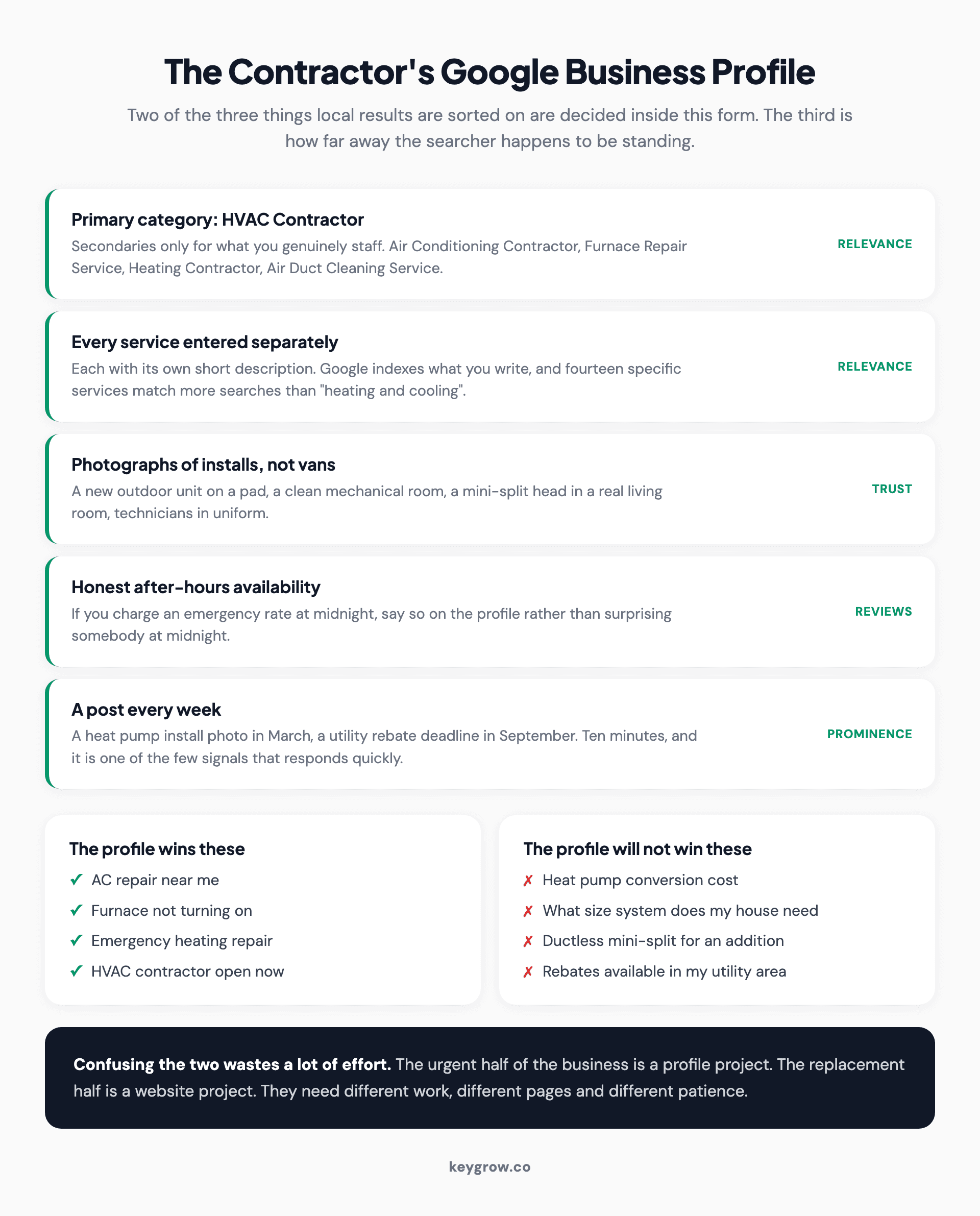
Google's local ranking guidance sets out what the local results are sorted on, and only one of the three inputs is out of your hands: how far the searcher is from your yard. The other two, how well your listing matches the search and how established the business looks across the web, are decided almost entirely inside the profile.
Google Business Profile setup for an HVAC contractor, covering categories, services, hours, photographs and the seasonal posting routine.
Set the primary category to HVAC Contractor, then add secondaries only for what you genuinely staff: Air Conditioning Contractor, Furnace Repair Service, Heating Contractor, Air Duct Cleaning Service. Then work through the services list properly. Each entry takes its own short description, Google indexes what you write there, and a contractor listing fourteen specific services will match more searches than one listing "heating and cooling".
Photographs should show installs and equipment rather than a van with a logo. A new outdoor unit on a pad, a clean mechanical room, a mini-split head in a real living room, technicians in uniform. Homeowners spending twelve thousand dollars are looking for evidence of care.
Keep hours honest about after-hours availability. If you charge an emergency rate at midnight, say so on the profile rather than surprising somebody at midnight.
Post weekly, and let the posts follow the season without turning into a seasonal content strategy. A heat pump install photo in March, a note about a utility rebate deadline in September. Ten minutes, and it is one of the few prominence signals that responds quickly.
What should an HVAC service page say?
Answer the question the searcher has, in the order they have it, and stop selling long enough to do that.
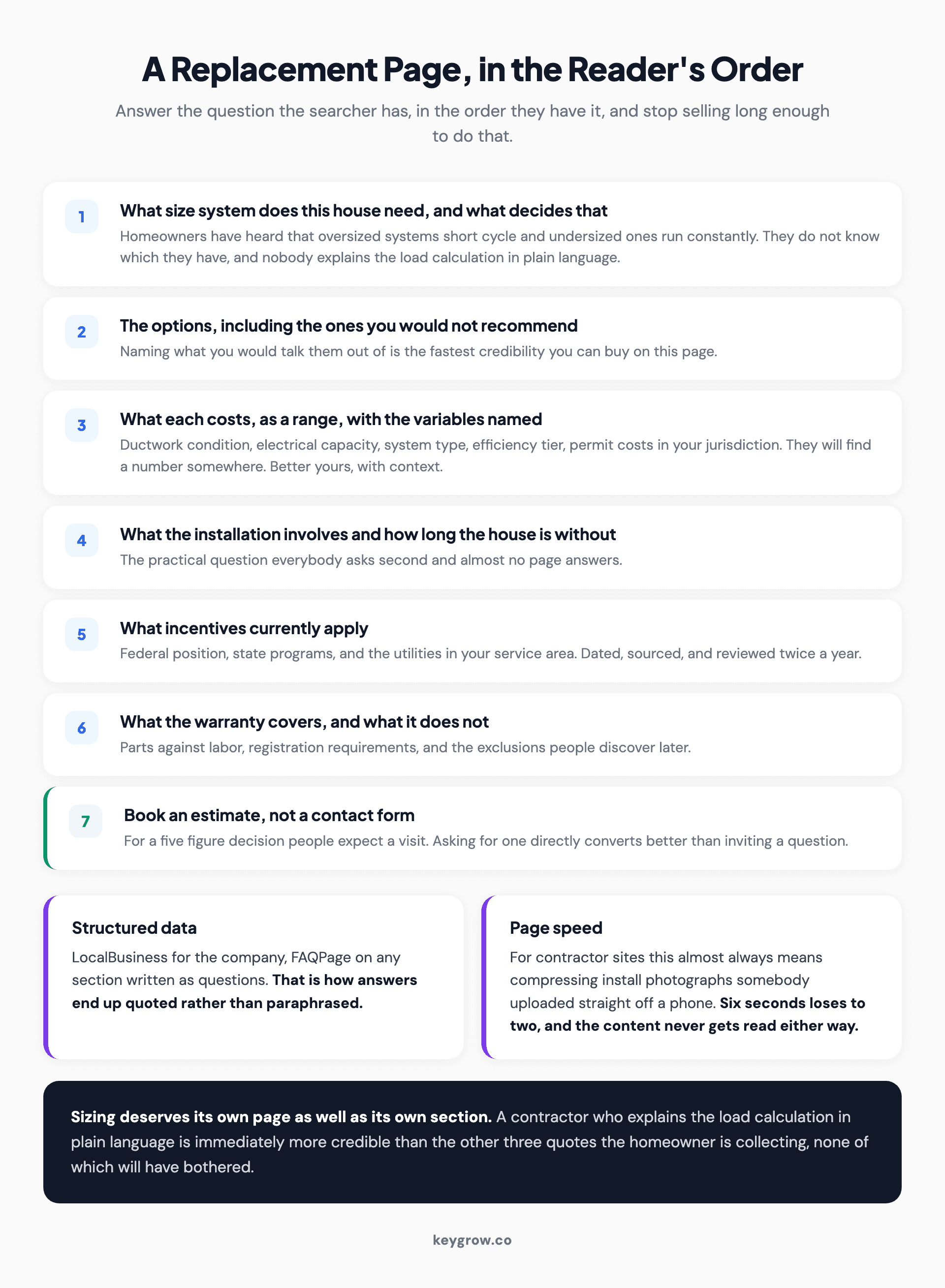
For a replacement page, that order is fairly predictable. What size system does this house need and what determines that. What the options are, including the ones you would not recommend and why. What each costs, as a range, with the variables named. What the installation involves and how long the house is without heating or cooling. What incentives currently apply. What the warranty covers and what it does not.
Structure of a high-value HVAC replacement page, from sizing through cost ranges and incentives to the estimate booking step.
Sizing deserves its own paragraph on that page and probably its own page as well. Homeowners have heard that oversized systems short cycle and undersized ones run constantly, they do not know which they have, and nobody explains the load calculation in plain language. A contractor who does is immediately more credible than the three quotes the homeowner is collecting.
Cost ranges are the section contractors fight hardest against publishing. Publish them anyway, with the variables that move them: ductwork condition, electrical capacity, system type, efficiency tier, permit costs in your jurisdiction. The homeowner is going to find a number somewhere, and it is better that they find yours with context attached than a national average with none.
End on booking an estimate rather than a contact form. For a five figure decision people expect a visit, and asking for one directly converts better than inviting a question.
Two technical items belong on these pages while you are building them. Structured data comes first: LocalBusiness for the company and FAQPage on any section written as questions, which is how the answers end up quoted rather than paraphrased. Our schema markup generator will produce the JSON if you would rather not write it. And keep the pages fast, which for contractor sites almost always means compressing the install photographs somebody uploaded straight off a phone. A replacement page that takes six seconds to load on a suburban connection loses to one that takes two, and the content on it never gets read either way.

Two HVAC technicians working on rooftop equipment during an installation.
How do you get reviews when nobody enjoys paying for this?
Every HVAC transaction happens on a bad day. The system failed, the house is uncomfortable, and the bill is unwelcome. Review collection has to work around that rather than pretend otherwise.
The moment that works is not when you present the invoice. It is a day or two later, once the house is comfortable again and the memory has softened. A short text with a direct link, sent by the office rather than the technician, collects better than anything handed over on site.
Replacement customers are a separate ask entirely. That job took a day, cost a great deal, and the customer made a considered decision they would like to feel good about. Ask them a week after commissioning, when the first comfortable evening has happened, and mention the specific system so the review has detail in it. Reviews naming equipment and outcomes carry more weight with the next reader than five-star reviews saying "great service".
For negative reviews, the pattern in HVAC is nearly always price or a diagnosis the customer disagreed with. Do not litigate either in the reply. Acknowledge, decline to discuss the specifics of their job publicly, offer a number. The audience is the next forty prospects, not the reviewer.
Recency does more work than volume, and it is the one thing a smaller contractor can genuinely beat a large one at, because a large one usually has a lapsed process and a lot of old reviews.
One more habit worth building: ask maintenance plan members annually rather than only after a problem. Those customers are the least stressed people you deal with, they have the longest relationship with the company, and their reviews tend to mention the things prospects actually want reassurance about, which is reliability and turning up when they said they would.
Where do HVAC links come from?

Utility meters capped with snow and icicles on a brick wall, a nod to local utilities, one of the strongest sources of HVAC links.
The realistic sources are local, industry and utility, in roughly that order of effort.
Utility and municipal pages are the strongest and the most overlooked. Utilities running rebate programs frequently publish lists of participating or qualified contractors, and those listings are close to unobtainable for anyone outside the service territory. The barrier is paperwork rather than persuasion, which is unusual and worth exploiting. This is the same relationship that makes the incentives page worth building, and the two reinforce each other.
Manufacturer dealer locators are next, if you hold a dealer or certified installer status. Many publish a locator that links out to the contractor's site, and a surprising number of contractors have never checked whether their entry actually links or just lists a phone number.
Then the ordinary local ones: trade association membership pages, chamber of commerce, sponsorship of anything with a website, and home builder or remodeler partners who list their subcontractors. Local news is available every time the weather goes extreme and a reporter needs somebody to explain heat pump performance in a cold snap or what to do when a system freezes.
Supplier and distributor relationships are worth a look as well. Regional HVAC distributors sometimes publish contractor directories or case studies, and a supplier you buy from every week has more reason to feature you than a stranger has to link to you.
Skip anything that sounds like a package of links. HVAC is a competitive enough vertical that manipulative link building gets attention, and the recovery costs more than the links ever produced. The same discipline runs through our wider SEO for home services work, and HVAC is the trade where shortcuts get noticed fastest, because the money in it attracts them.
How long does HVAC SEO take, and what does it cost?
Longer than the emergency half of the business would suggest, because the pages that matter are the researched ones.
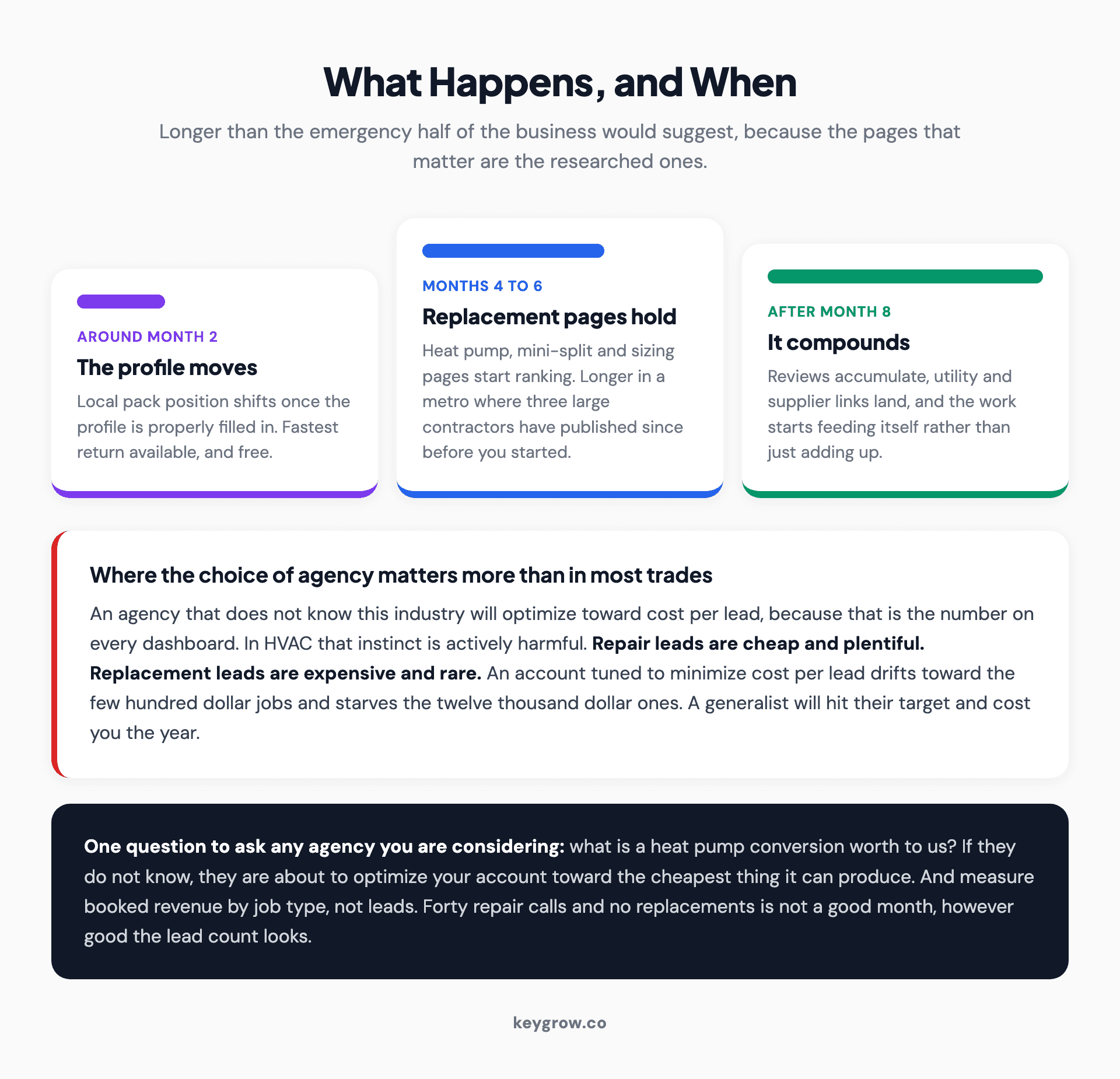
Timeline for HVAC SEO results, showing profile movement first, replacement and heat pump pages from month four, and compounding after month eight.
The profile moves fastest. Two months is a fair expectation for local pack movement once it is properly filled in. Replacement, heat pump and mini-split pages want four to six months before they hold anything, and longer again in a metro where three large contractors have been publishing since before you started. The point where the work compounds rather than accumulates tends to arrive after month eight.
On budget, the spread is wide and the two ends buy different things. A few hundred a month keeps a profile healthy and adds a page occasionally, which suits one location in one suburb. Several thousand funds a genuine content and authority program, which is what a multi-location contractor chasing replacement work across a metro actually requires.
Here is where the choice of agency matters more than in most trades, and it is our strongest opinion on the subject. An agency that does not know this industry will optimize toward cost per lead, because that is the number on every dashboard. In HVAC that instinct is actively harmful: repair leads are cheap and plentiful, replacement leads are expensive and rare, and an account tuned to minimize cost per lead will drift toward the few hundred dollar jobs and starve the twelve thousand dollar ones. A generalist will hit their target and cost you the year. Ask any agency you are considering what a heat pump conversion is worth to you, and see whether they know.
Measure booked revenue by job type, not leads. A month with forty repair calls and no replacements is not a good month, however good the lead count looks.
Should you spend on SEO or ads?
Both, and the honest split is not fifty fifty in either direction.
Paid search is the only channel that responds in hours, which matters when a heat wave arrives and the phones go quiet the week after. It also lets you buy replacement demand you have not yet earned organically. We went through when that spending is genuinely incremental, and when it is not, in the HVAC Google Ads guide, and the short version is that the calendar matters more than most accounts allow for.
Organic is where the replacement and heat pump pipeline gets built, because those buyers read for weeks and no ad unit holds attention that long. It is also the only part of the marketing that keeps producing when you pause spending, which in a trade with a seasonal cash flow is worth more than it sounds.
The stack that works for most contractors: profile and reviews first because they are free and they move fastest, then organic pages against the high-value services, then paid to cover gaps in demand and to test offers faster than content can. Local Services Ads sit alongside all of that where available, priced per lead, and they are worth running for the urgent half.
Who should not buy HVAC SEO?
Three situations come up often enough to name, and we turn away work in all three.
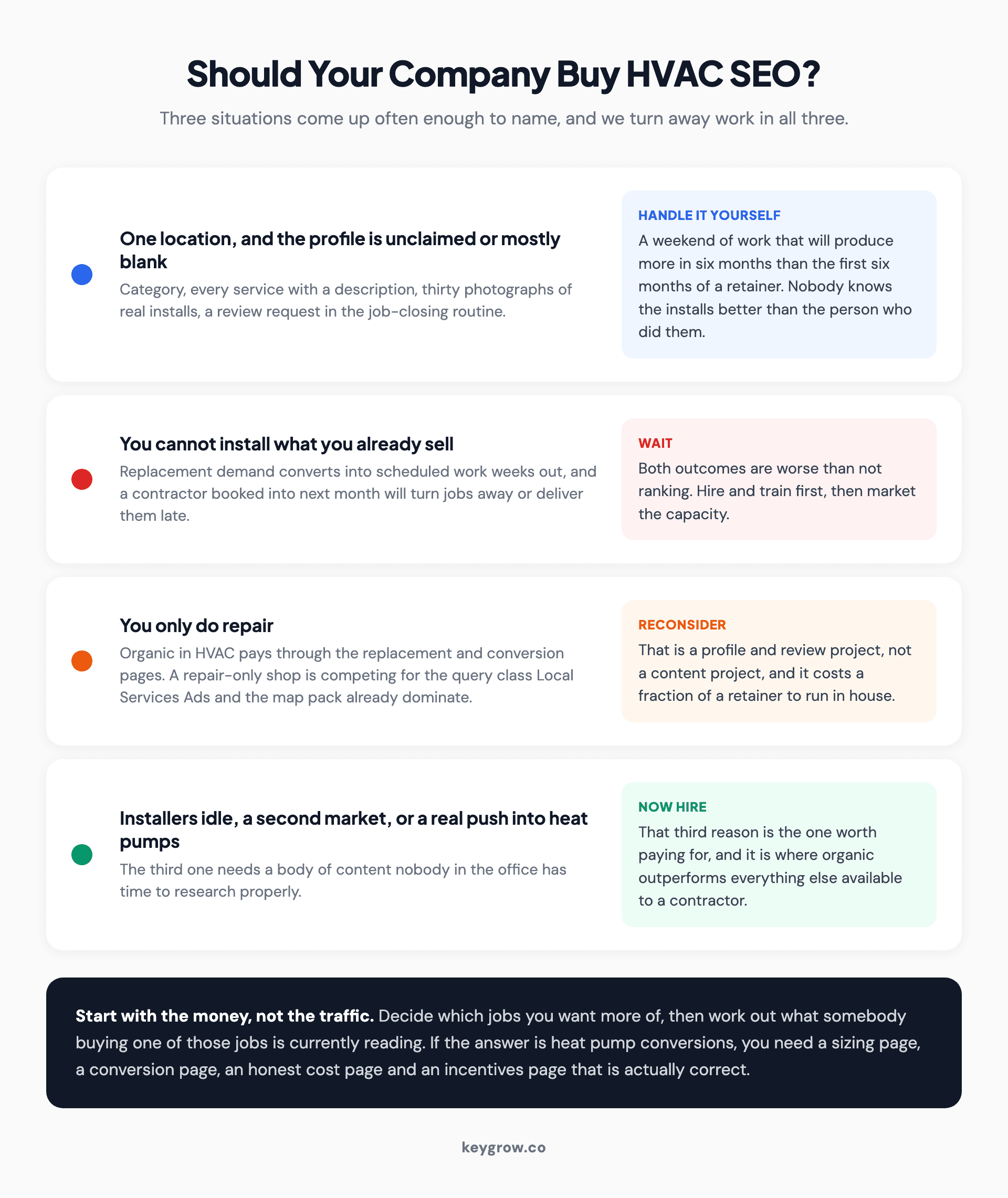
Three situations where an HVAC contractor should not buy SEO yet, covering unclaimed profiles, installer capacity and single-service operations.
Handle it yourself if the Google Business Profile is unclaimed or mostly blank and you run one location. Setting the category, entering each service with a description, uploading thirty photographs of real installs and building a review request into the job-closing routine is a weekend of work. For a contractor that size it will produce more in six months than the first six months of a retainer, and nobody knows the installs better than the person who did them.
Wait if you cannot install what you sell. Replacement demand converts into scheduled work weeks out, and a contractor already booked into next month will either turn the jobs away or deliver them late. Both are worse than not ranking. Hire and train first.
Reconsider if you only do repair. Organic in HVAC pays through the replacement and conversion pages, and a repair-only shop is competing for the query class that Local Services Ads and the map pack already dominate. That is a profile and review project, not a content project, and it costs a fraction of a retainer to run yourself.
The case for hiring is narrower than most agencies imply. It comes down to installers sitting idle, a second market you cannot cover from one office, or a decision to go after heat pump and high-efficiency replacement work seriously, which needs a body of content nobody in the office has time to research. That third reason is the one worth paying for.
Replacements behave like projects, not service calls
A tune-up is a service call. A full system replacement is a planned purchase with a research window, financing questions and a homeowner comparing three quotes, which is the pattern SEO for contractors is built around. If replacements carry your margin, that post is the closer fit for how you should be building pages.
FAQs
What is SEO for HVAC companies?
SEO for HVAC companies is the work of ranking a heating and cooling contractor in Google's local map pack and organic results. In practice it splits in two: the Google Business Profile competes for urgent repair searches, and the website competes for the researched high-value work such as system replacement, heat pump conversion and ductless installation.
How long does HVAC SEO take to show results?
Expect the profile to move first, roughly within two months of being completed properly. Replacement and heat pump pages need four to six months, and longer where entrenched competitors already rank. The compounding effect generally appears after month eight, which is why a judgment made at the end of the first quarter is almost always the wrong one.
Which HVAC keywords are worth targeting?
Target the equipment decisions rather than the breakdowns. System replacement and sizing, heat pump conversion, ductless mini-split installation, indoor air quality systems and local rebate queries all sit in front of jobs worth many times a diagnostic call, and the people running them are deciding over weeks rather than minutes.
Should an HVAC website publish prices?
Yes, as ranges with the variables explained: ductwork condition, electrical capacity, system type, efficiency tier and local permit costs. Homeowners will find a number somewhere, and a national average with no context serves them worse than your range with the reasoning attached. Published ranges also filter out the people who were never going to buy.
Do HVAC tax credits and rebates still exist?
Federal, state and utility programs all change, and they change on different schedules. The federal Energy Efficient Home Improvement Credit applied to property placed in service before the end of December 2025 according to the IRS, while state and utility programs continue and vary widely by location. Check the current position directly rather than relying on any contractor page, including this one.
Is a Google Business Profile more important than an HVAC website?
For emergency repair searches, yes, because the map pack sits above organic results and the profile is what competes there. For replacement and heat pump work, no. Those buyers research for weeks, read full pages, and compare contractors on what the pages explain. Most contractors need both, aimed at different halves of the business.
How much does HVAC SEO cost?
Retainers commonly run from roughly $500 a month for a single-location contractor to $5,000 or more for multi-location companies competing on replacement work across a metro. Compare the figure against your current cost per booked replacement rather than against zero, since that is the job organic is actually being bought to produce.
Should HVAC contractors write seasonal blog content?
Sparingly. Filter-changing reminders and seasonal checklists rank for very little and convert almost nobody. The effort is better spent on replacement, sizing, heat pump and incentive pages, which hold their value year round and attract buyers rather than readers.
Start with the money, not the traffic
Most HVAC contractors approach this from the wrong end. They ask how to get more traffic, when the useful question is which jobs they want more of and what somebody buying one of those jobs is currently reading.
Answer that and the plan writes itself. If the answer is heat pump conversions, then you need a sizing page, a conversion page, an honest cost page and an incentives page that is actually correct, and you need the utility relationships that come with the last one. If the answer is replacement volume, the same list applies with different emphasis. If the answer is repair calls, you do not need a content program at all, you need a better profile and more recent reviews.
Then measure booked revenue by job type. It is the only report that distinguishes a busy month from a profitable one, and in this trade those are frequently not the same month.
Our SEO services team takes this on for contractors, and there is more detail on the trade at HVAC SEO. Engagements run month to month.
Whichever way you go, fix the incentives page this afternoon. It costs nothing, it takes twenty minutes, and right now it is quietly telling every visitor that your information is a year out of date.