


Most HVAC Google Ads advice tells you to raise your budget in July. We think that is close to backwards.
The first week of a heat wave is when clicks cost the most, when every competitor within forty miles is bidding, and when a large share of the calls you pay for would have found you anyway or will be booked nine days out and cancelled. It is the least incremental traffic you will buy all year, at the highest price you will pay all year.
The cheap, genuinely incremental month is April. Your calendar has gaps, your competitors have pulled back, and the customer you sign is not a one-off repair. They are a maintenance agreement, which is the thing that makes next July profitable without an auction.
So run the year the other way round. Buy the shoulder, harvest the peak.
Why a peak lead is worth less than it costs
Incrementality is the word nobody uses in home services advertising and it decides everything here.
A lead is incremental if you would not have got that job without paying for it. In the middle of a July heat wave, three things reduce incrementality at once:
- You were going to get called anyway. Your existing customers, your Business Profile, your referrals and your van signage all produce more calls in a heat wave, and paid search sits on top of that demand rather than creating it.
- You cannot service what you book. A call answered on Tuesday and scheduled for the following Thursday is a call the homeowner keeps shopping. Some of those bookings evaporate, and you paid a peak price for every one of them.
- The auction knows it is July too. Every competitor raised their budget on the same forecast, so you are paying more for a smaller share of a pool that was already coming to somebody.
None of that means switch off in summer. Emergency demand is real and margins on a same-day repair are good. It means stop treating peak spend as your growth lever, because it mostly is not one.
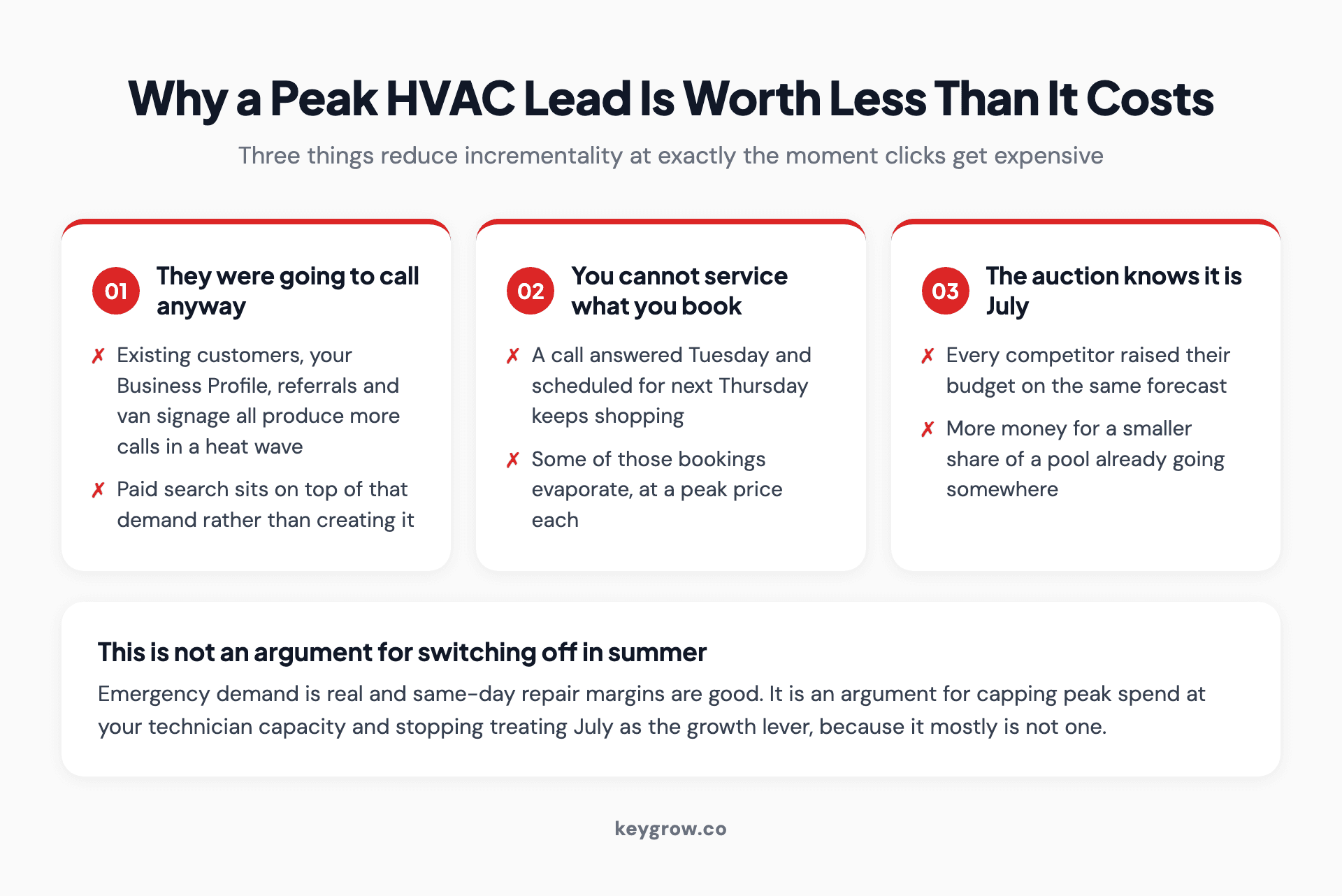
Three cards explaining why an HVAC lead bought during a heat wave is less incremental: existing demand you would have captured anyway, jobs you cannot service in time, and every competitor bidding on the same forecast.
Price a peak lead against your actual capacity
Do this with your own figures. It usually changes what the summer budget is for.
Illustrative, so substitute yours:
| Line | April | July |
|---|---|---|
| Cost per click | $12 | $19 |
| Calls per 100 clicks | 9 | 11 |
| Cost per call | $133 | $173 |
| Share you can book within 48 hours | 95 percent | 55 percent |
| Share that would have called you anyway | 20 percent | 45 percent |
| **Cost per incremental booked job** | **$175** | **$571** |
The last row is the one nobody calculates. In April, $133 buys a call you can serve, from somebody who did not otherwise know you existed. In July, $173 buys a call you might not be able to serve, from somebody who may well have found you through the map pack twenty seconds later.
More than three times the price for the same job. And the July version arrives when your technicians are already at capacity, which means the true cost includes the overtime or the lost install you displaced.
The budget calculator will run the forward version of this if you want to test a few splits across the year.
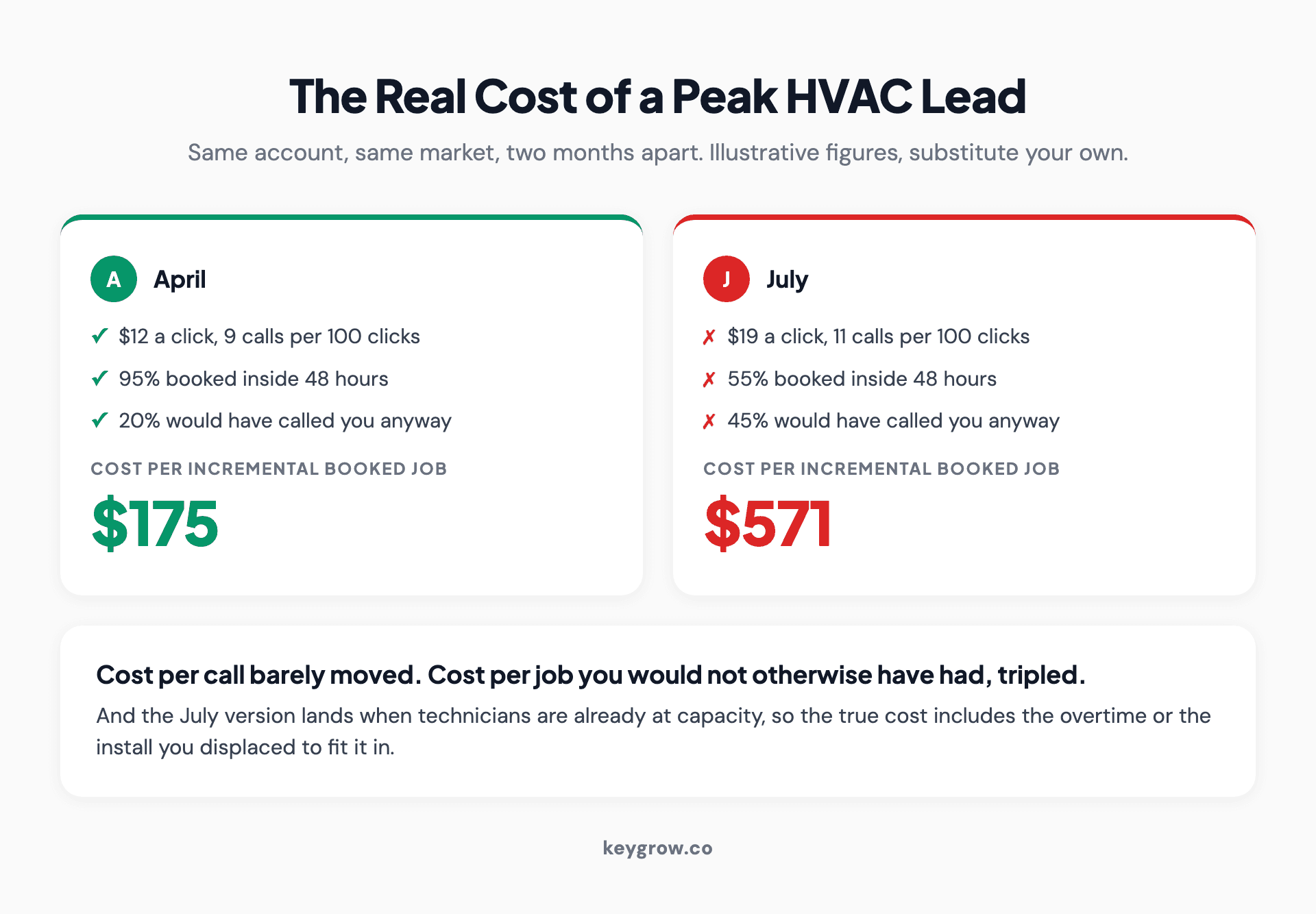
A side by side comparison of an April and a July HVAC lead, showing $133 versus $173 per call but $175 versus $571 per incremental booked job once capacity and existing demand are accounted for.
Run the year backwards
Here is the calendar we would build for a residential HVAC company in a market with a real summer and a real winter.
| Season | What you buy | What you measure | Budget posture |
|---|---|---|---|
| March to May | Tune-ups, maintenance plans, install quotes | Plan signups, quotes issued | Highest of the year |
| June to August | Emergency repair, same-day service | Cost per booked job, booking lead time | Steady, capped, watched daily |
| September to October | Furnace tune-ups, plan renewals, financing offers | Plan signups, install deposits | Second highest |
| November to February | Heating emergency, plus install for the patient buyer | Cost per booked job, install pipeline | Lower, and shifted to installs |
Two things about that table that will look wrong at first.
Your biggest spending months are the shoulders, not the peaks. That is deliberate. Shoulder clicks cost less, your calendar can absorb the work, and the lead you buy converts into a recurring relationship rather than a single invoice.
And your peak budget is capped rather than uncapped. In a heat wave the constraint is technician hours, not demand, so an uncapped budget just buys you a longer list of people you will disappoint.
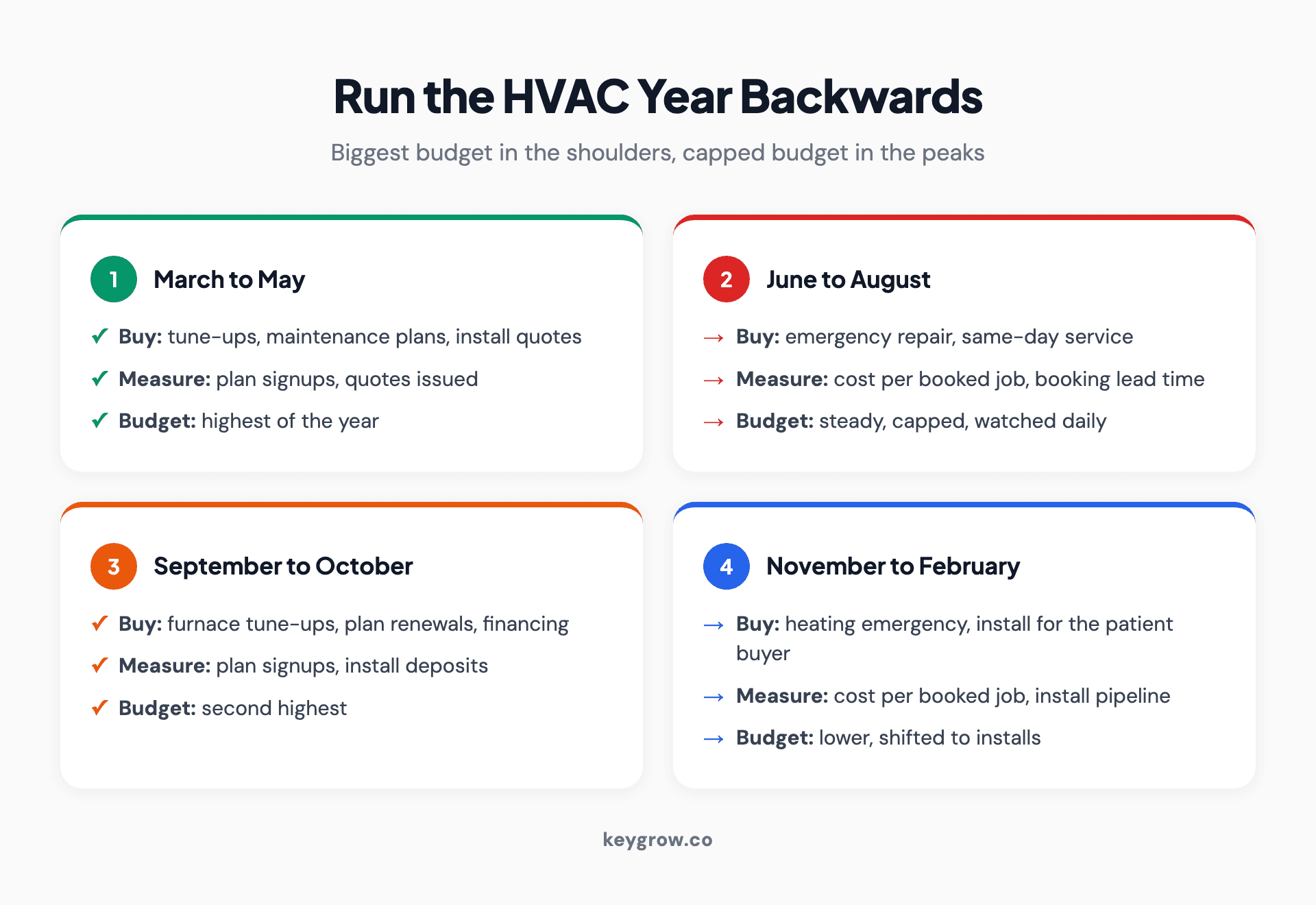
A four-season calendar for an HVAC Google Ads account showing what to buy, what to measure and what budget posture to hold from March through February.
What you are really buying in April is the agreement
A tune-up at $89 is not a profitable job. It is a customer acquisition cost with a service van attached, and the return is the maintenance agreement.
The arithmetic is not subtle. A plan customer calls you first when the unit fails, which means you get the July emergency without entering the July auction. They stay on the books for years. They are dramatically more likely to buy the replacement system from you when the unit finally dies, and the replacement is where the real money in this trade sits.
So in the shoulder season, judge the account on plan signups rather than on the revenue of the jobs it produced. If April's ads look unprofitable on same-month revenue and produced 40 new plan customers, April was your best month.
This is also why an agency that has never run HVAC will underbid you into irrelevance. A generalist looks at an $89 tune-up and caps the cost per lead at $40. Somebody who knows the plan retains for four years and carries a replacement quote at the end of it will pay four times that and be right. Industry context is a bidding advantage, not a nice-to-have.
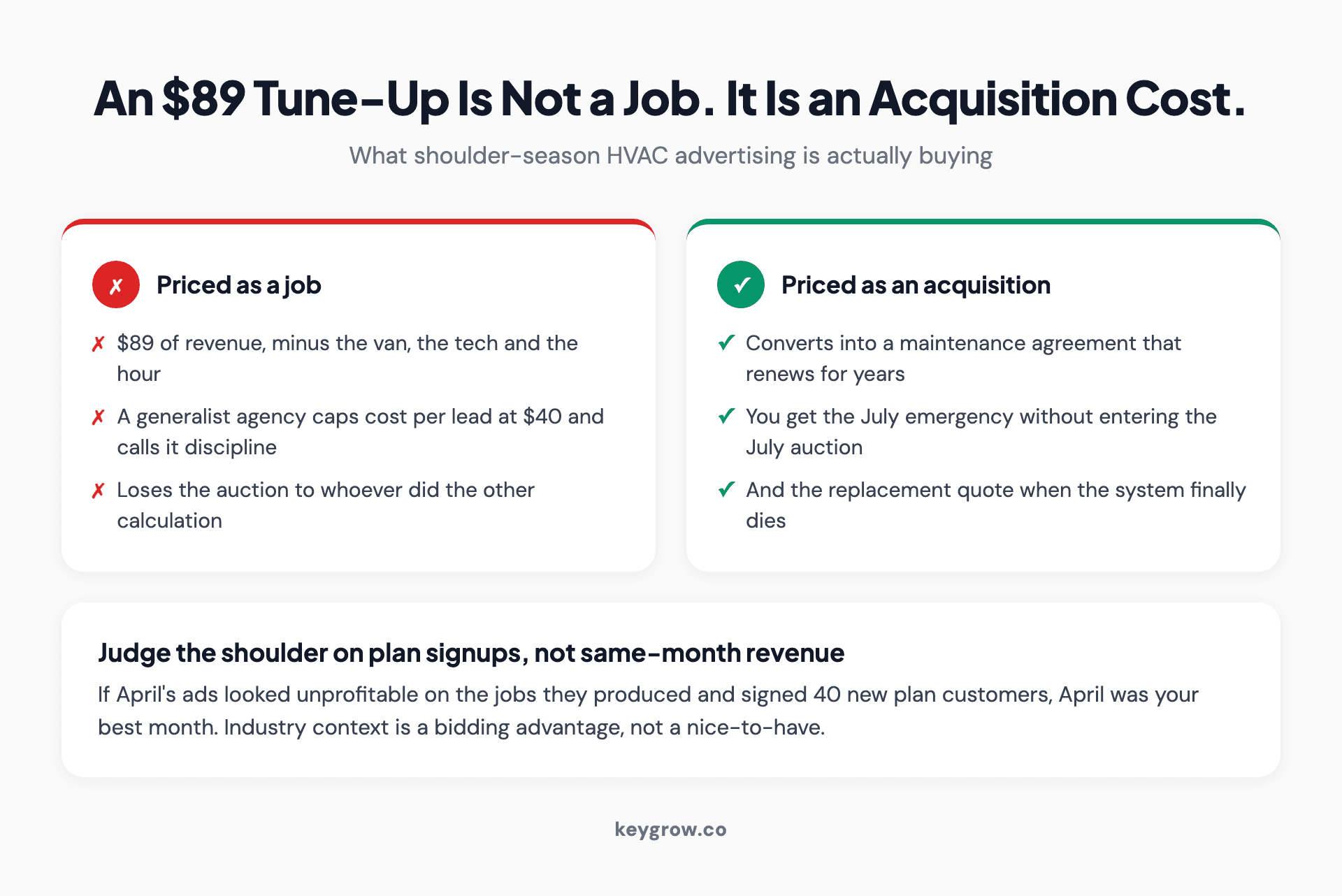
Two cards contrasting an $89 tune-up treated as a job against the same tune-up treated as the acquisition cost of a maintenance agreement, with the plan renewal and system replacement that follow.
Do not use seasonality adjustments for your season
This one is a straight correction to advice you will read everywhere, including from people who should know better.
Seasonality adjustments look like the obvious tool for a seasonal trade. They are not. Google describes them as an advanced tool for informing Smart Bidding of expected conversion rate changes for future events like promotions or sales, says in Google's seasonality guidance that they are best used for short events of one to seven days, warns they may not work as well over more than 14 days at a time, and states plainly that Smart Bidding already manages seasonal events.
Your cooling season is not an event. It is three months, and the bidding already knows about it from your own conversion history.
Where the tool genuinely fits in this trade is much narrower:
- A three-day heat emergency forecast where you expect conversion rates well above normal
- A weekend promotion on system replacements
- The first cold snap of the season, for the four or five days it lasts
Everything else should be handled with budget, targets and campaign structure. If your summer plan is a permanent plus 30 percent seasonality adjustment, you are using an event tool as a settings tool and telling the algorithm something it already knew.
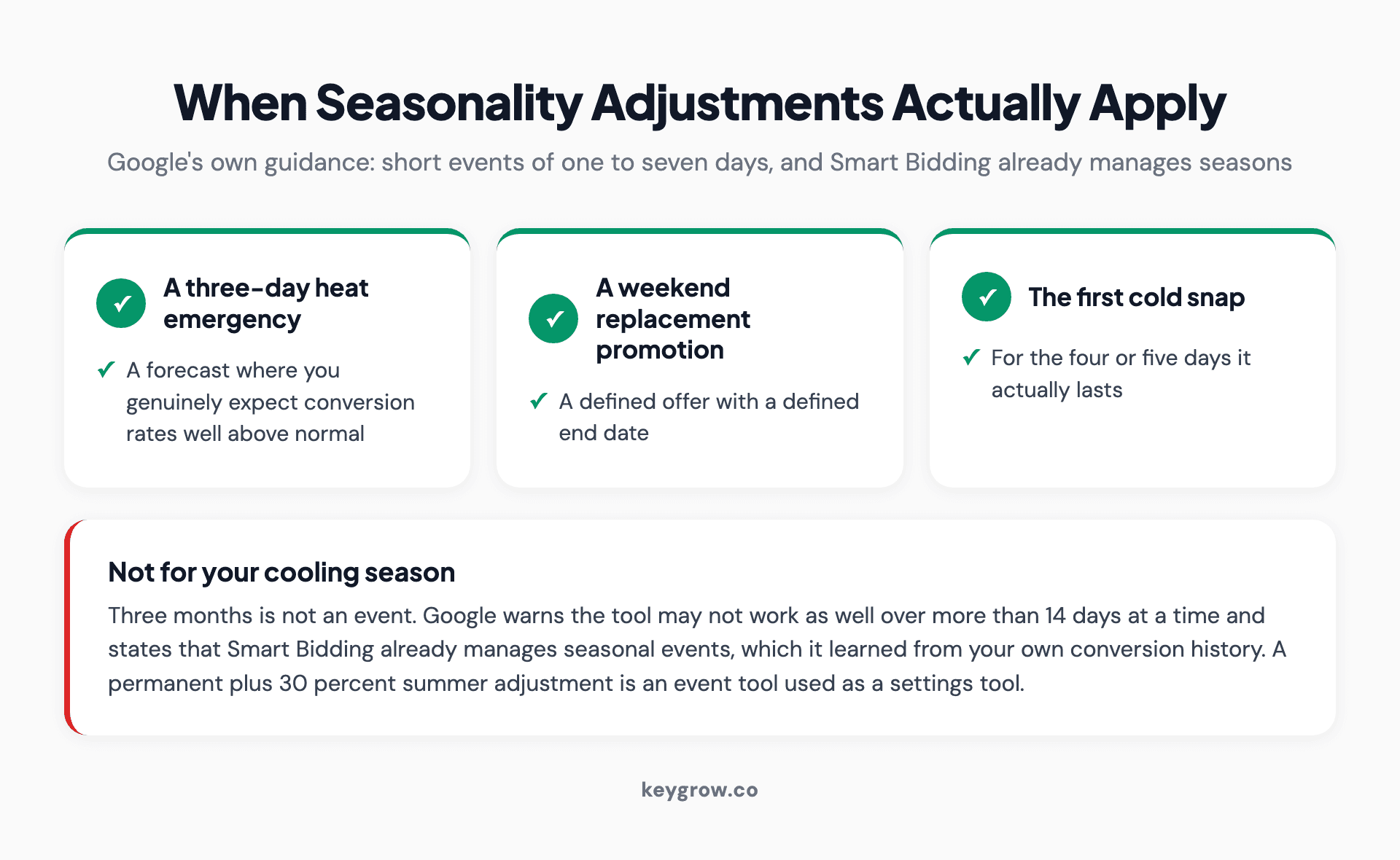
Three cards showing the narrow cases where Google Ads seasonality adjustments genuinely apply to an HVAC account: a three day heat emergency, a weekend replacement promotion, and the first cold snap.
What to do when you are booked solid
Every HVAC company hits the week where the schedule is full and the phone is still ringing. Most either keep spending and annoy people, or switch everything off. There is a better third option.
Shift spend from repair to replacement. A homeowner whose fifteen year old system just failed in a heat wave is the most motivated replacement buyer you will ever meet. That job is worth many times a repair, it books further out without complaint, and it is exactly the demand your competitors are too busy to chase.
Use ad scheduling rather than pausing. Run during the hours you can actually answer. An unanswered call in this trade is not neutral, it is negative, and if you are running Local Services Ads it is worse than that: Google states that if you regularly fail to answer calls or respond to messages, your ad ranking may be affected, per the Local Services Ads guide.
Raise your price before you cut your budget. If demand exceeds capacity, that is a pricing signal. Most owners will pause ads for a week before they will add ten percent to a diagnostic fee, which is the wrong order.
Never let the emergency campaign go to voicemail. If nobody is answering after 6pm, schedule the campaign to stop at 6pm. Paying peak prices to reach an answering machine is the single most expensive habit in seasonal home services.
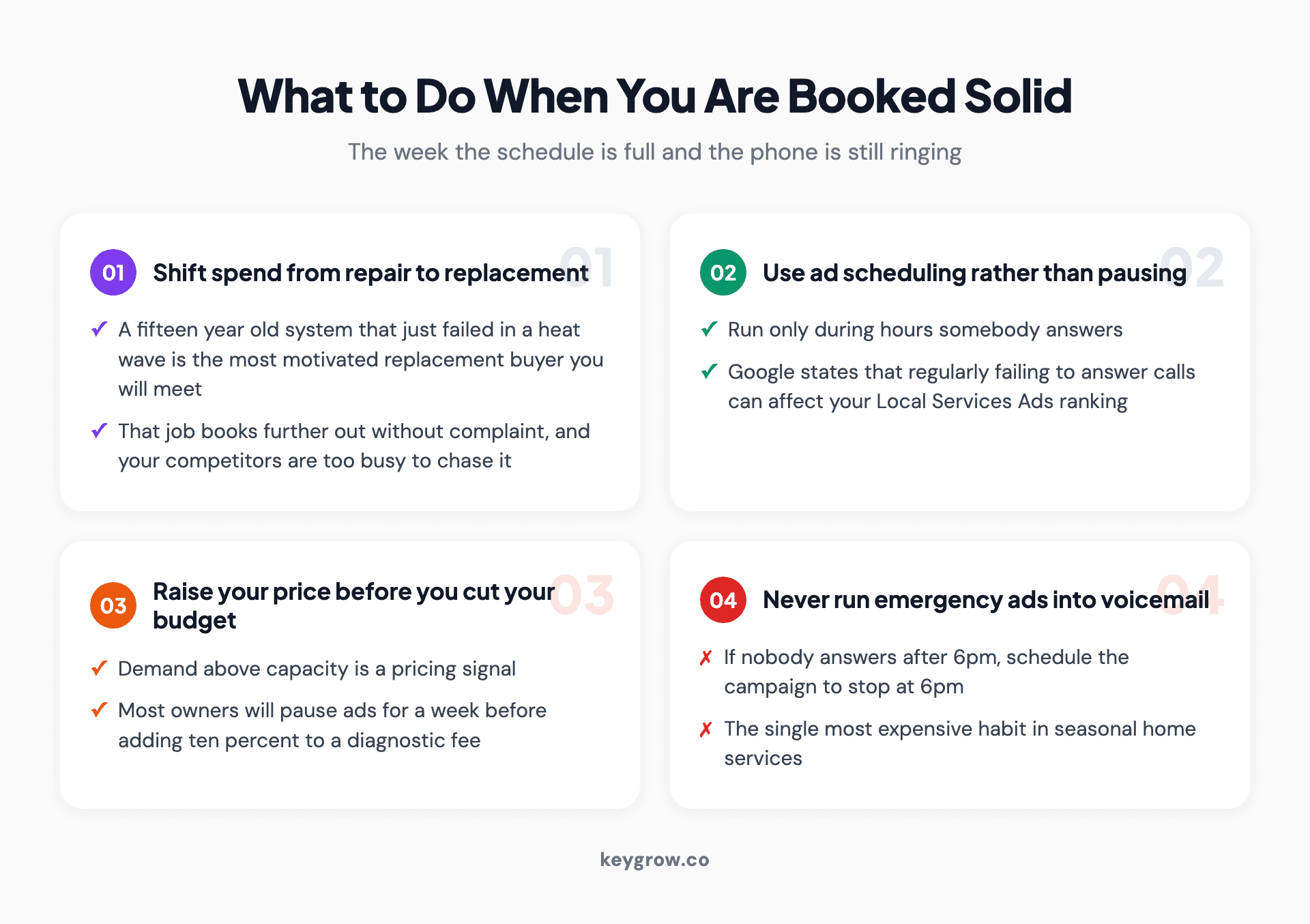
Four numbered cards on what to do when an HVAC company is booked solid: shift spend to replacement, use ad scheduling instead of pausing, raise price before cutting budget, and never run emergency ads into voicemail.
Measure calls and booked jobs, not clicks
The reporting that matters in this trade is short. Cost per booked job, booking lead time, and plan signups. Everything else is context.
Booking lead time is the underrated one. If the gap between call and appointment stretches past three days, your conversion from call to completed job is falling whether or not the ads account shows it, and more budget makes it worse rather than better.
We have run this pattern with several local service clients and the shape repeats: a phone repair shop reaching 115+ monthly phone calls in seven months, a real estate office 90+ in seven, a junk removal company 50+ in six. None had meaningful inbound calls before the work started. In every case the number that told us it was working was calls answered and jobs booked, not impressions or click-through rate.
If you want the keyword-level version of this, including what your competitors are actually bidding on, that is covered in HVAC competitor keywords. And Local Services Ads are worth running alongside search in this category rather than instead of it, because the pay-per-lead model and the verified badge behave differently in an emergency search.

An HVAC technician in uniform working outside a building.
When an HVAC company should not run Google Ads
Three honest situations, and we turn away work in all of them.
Nobody answers the phone after hours during the season. In emergency HVAC the caller is trying three companies in eight minutes. If you are not answering, you are funding your competitors' close rate. Fix the answering before the advertising.
You are already at capacity year round. Some established companies genuinely are. If your problem is technicians rather than customers, the marketing budget is better spent on recruiting, and the ads will only inflate a waiting list you are already apologizing for.
You have no maintenance plan to sell. Without a recurring product, shoulder-season advertising has nothing to convert into and you are left buying only peak emergency traffic, which is the expensive half of the year. Build the plan first, then advertise into it.

A wall-mounted air conditioning unit displaying a set temperature.
FAQs
How much do Google Ads cost for HVAC companies?
Costs swing hard with the season and the keyword. Maintenance and tune-up terms sit at the low end, while emergency and same-day repair terms in competitive metros run several times higher, and cooling season pushes the whole curve up. The number worth tracking is not cost per click but cost per booked job, calculated separately for shoulder and peak months, because the same account can look twice as efficient in April as it does in July.
Should HVAC companies increase their Google Ads budget in summer?
Usually less than they think. Peak clicks cost more, a larger share of peak callers would have found you anyway, and your capacity limits how many of those bookings you can actually serve. Cap the peak budget at what your technicians can absorb and move the extra money into March through May, where clicks are cheaper and the customer converts into a maintenance agreement.
Should I use seasonality adjustments for cooling season?
No. Google describes seasonality adjustments as best suited to short events of one to seven days, warns against periods longer than 14 days, and states that Smart Bidding already manages seasonal events. A three-month cooling season is not an event. Use the tool for a three-day heat emergency or a weekend replacement promotion, and handle the season itself with budget, targets and campaign structure.
What HVAC keywords are worth bidding on?
Emergency and same-day repair terms convert best but cost the most, and they are worth running in peak. Tune-up, maintenance plan and system replacement terms are where shoulder-season budget belongs. Block the searches that look right and are not: HVAC jobs, HVAC certification, DIY repair guides, parts and filter shopping, and manufacturer manual lookups all carry volume and no buying intent.
Are Local Services Ads better than Google Ads for HVAC?
They do different jobs and most established companies run both. Local Services Ads charge per lead and carry a verified badge, which matters in an emergency search where trust decides a fast decision. Search ads give you control over specific keywords and landing pages, which is what makes shoulder-season maintenance and replacement campaigns possible. Note that failing to answer calls can affect your Local Services Ads ranking.
How do I stop paying for HVAC leads I cannot service?
Cap the peak budget at your real capacity rather than at your appetite, use ad scheduling so campaigns only run when somebody answers, and watch booking lead time as a stop signal. When the gap between call and appointment passes three days, more spend produces more cancellations rather than more revenue.
How long before Google Ads work for an HVAC business?
Emergency campaigns produce calls in the first week because the intent is immediate. The part that takes time is the shoulder-season program, where you are buying maintenance agreements whose value shows up over the following one to three years. Judge emergency campaigns monthly and judge the whole account across a full year, since a single season tells you almost nothing about a business this seasonal.
Buy the shoulder, harvest the peak
If you take one idea from this: your ads are most valuable when your calendar has gaps and your competitors have gone quiet, which is exactly when most HVAC companies cut their budget.
So put your biggest spend in March through May and September through October, sell maintenance agreements with it, and judge those months on plan signups rather than same-month revenue. Then cap the summer at what your technicians can genuinely absorb, run emergency campaigns only when somebody answers the phone, and leave the seasonality adjustments alone.
The July auction will still be there. You just will not need as much of it.
If you want this built and run against booked jobs rather than clicks, our HVAC marketing team does this work, and our PPC management is month to month with no lock-in. For the organic half, including the incentives page most contractors have let go stale, see our guide to SEO for HVAC companies.