

The top Google Ads keywords your HVAC competitors bid on fall into five clusters: emergency repair, standard repair, system replacement, maintenance plans, and commercial service. Emergency and replacement carry the margin. They also carry the highest click costs, which is not a coincidence.
Here is the part most guides leave out. Almost every article listing HVAC keywords hands you the words with no prices attached, which is a menu with the costs cut off. A keyword list without cost data tells you what to say, not what you can afford to buy.
So this covers both halves of the question. What the keywords are, what they actually cost according to published benchmark data, and how to see the real list the company down the road is bidding on rather than a generic list assembled for search traffic.
The keywords HVAC competitors are actually bidding on
Five clusters, and they behave completely differently. Emergency terms convert fastest and cost most, maintenance terms cost least and rarely pay for themselves alone.
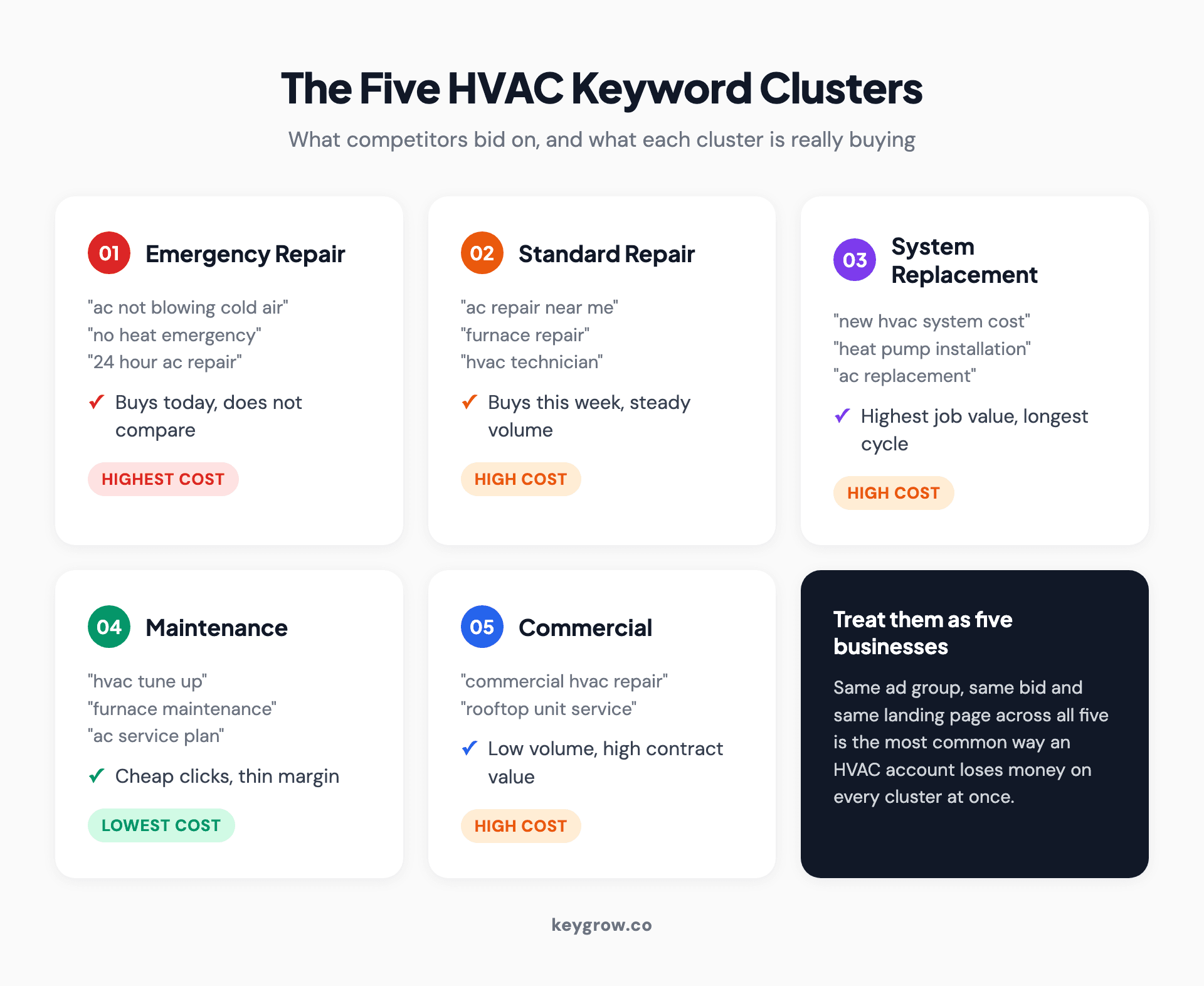
Five HVAC keyword clusters used in Google Ads: emergency repair, standard repair, system replacement, maintenance plans, and commercial service, with the intent and relative cost of each.
| Cluster | Example searches | Intent | Relative click cost |
|---|---|---|---|
| Emergency repair | ac not blowing cold air, no heat emergency, 24 hour ac repair | Buy now, today | Highest |
| Standard repair | ac repair near me, furnace repair, hvac technician | Buy this week | High |
| System replacement | new hvac system cost, heat pump installation, ac replacement | Research, then buy | High, long cycle |
| Maintenance | hvac tune up, furnace maintenance, ac service plan | Low urgency | Lowest |
| Commercial | commercial hvac repair, rooftop unit service | Long cycle, high value | High, low volume |
The mistake most HVAC accounts make is treating these as one list. They are five different businesses. Somebody typing "no heat emergency" at 11pm in January is not the same customer as somebody typing "hvac tune up" on a Sunday afternoon, and running them through the same ad group with the same bid and the same landing page wastes money on both.
Maintenance keywords deserve a specific warning. They are cheap, they generate volume, and they make a report look healthy. A tune-up is worth perhaps a hundred dollars. If your cost per lead on those terms is fifty, you are working for very little, and the argument for bidding on them at all is that a tune-up sometimes turns into a replacement quote later. That is a real argument. It is also the argument every underperforming HVAC account uses to justify keeping a losing campaign running.
What an HVAC click really costs
Home services search campaigns averaged $5.31 per click and $45.27 per lead in the most recent large-sample benchmark. Emergency HVAC terms in competitive metros run well above that.
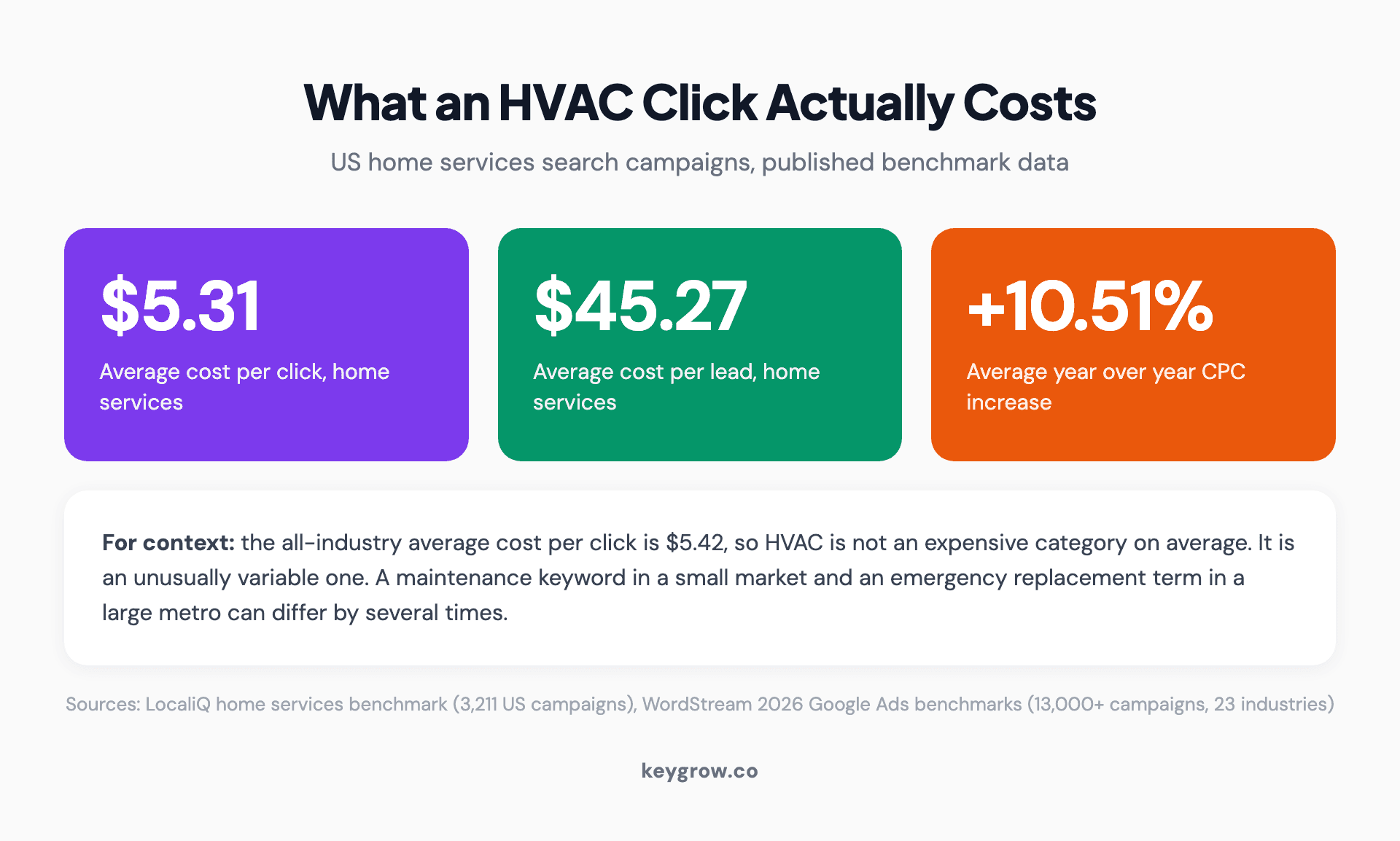
Benchmark costs for HVAC Google Ads: average cost per click, average cost per lead, and the year over year increase, with the all-industry average shown for comparison.
Those figures come from LocaliQ's benchmark data, drawn from 3,211 US home service search campaigns. For context, WordStream's 2026 benchmarks put the all-industry average cost per click at $5.42 across more than 13,000 campaigns and 23 industries, which tells you something useful: HVAC is not an unusually expensive category on average. It is an unusually variable one.
The variance is the thing to plan around. An average of $5.31 hides a range where a maintenance keyword in a small market costs a dollar and an emergency replacement term in a large metro costs several times the average. Anyone quoting you a single HVAC cost per click is describing their own account, not the category.
Costs are also moving. The same benchmark research found cost per click rose for roughly 75 percent of advertisers year over year, with an average increase of 10.51 percent. If you built your budget on numbers from two years ago, your budget is wrong by about a fifth.
There is a second number that matters more than either of these and almost nobody tracks it: what a job is worth to you. A replacement at four figures justifies a cost per lead that would be lunacy for a tune-up. Until you know your average job value by service line, cost per click is a number without a denominator.
How to see a competitor's real keyword list
You cannot see their account. You can see most of what it does, from four sources, none of which require a subscription.
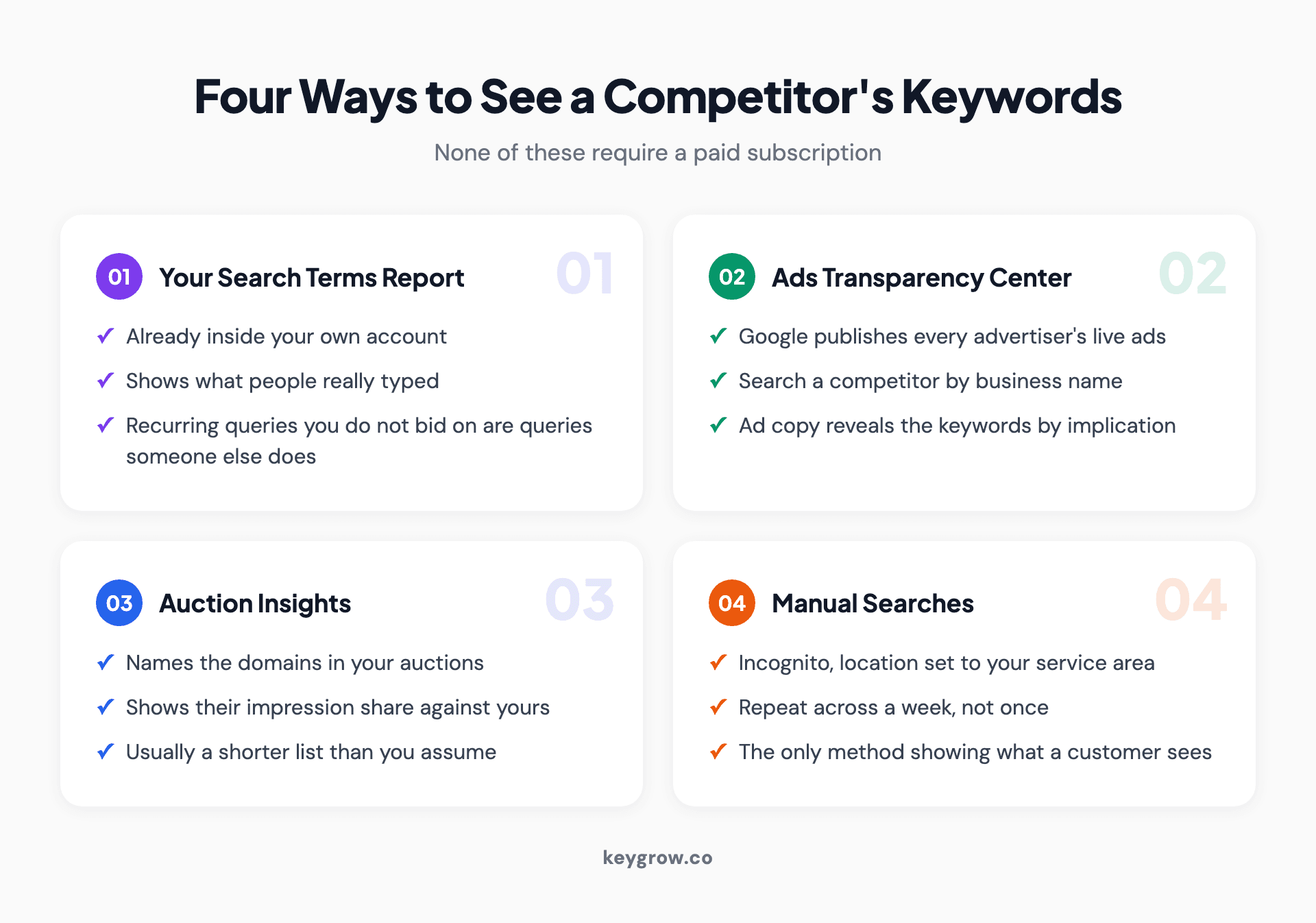
Four ways to find out which keywords a competitor is bidding on: your own search terms report, the Google Ads Transparency Center, auction insights, and manual searches from the right location.
Your own search terms report. The most underused competitive research tool in the business, and it is already in your account. It shows what people actually typed before your ad appeared, which is a direct readout of the demand in your market. If a query keeps appearing and you are not bidding on it deliberately, your competitors probably are.
The Ads Transparency Center. Google publishes the ads any advertiser is running. Search a competitor's business name in Google's Ads Transparency Center and you can see their live ad copy, which tells you what they are bidding on by implication. Ad copy is written to match keywords, so an ad headlined around emergency service is running on emergency terms.
Auction insights. Inside your own account, this report names the domains competing in the same auctions and shows their impression share against yours. It will not give you their keywords, but it tells you who is actually in the fight, which is often a shorter list than you assume.
Manual searches, from the right place. Search your money terms while your location is set to your service area. Incognito, and repeat it a few times across a week. This is crude and it is the only method that shows you exactly what a customer sees, including who is running Local Services Ads above everything else.
Paid tools like Semrush or SpyFu estimate competitor keyword lists and are genuinely useful for scale, but treat their output as a hypothesis. They infer from scraped SERP data, which means the list is directionally right and specifically wrong. We wrote a longer walkthrough of the whole process in our guide to checking competitor Google Ads.
Emergency intent is where HVAC money is made
Emergency terms convert at multiples of everything else because the decision is already made. The customer is not comparing, they are calling whoever answers. They also cost the most, and there is a case for spending less on them than instinct suggests, set out in HVAC Google Ads.

A residential air conditioning vent, the kind of system behind most emergency HVAC searches.
An HVAC business is one of the few categories where the customer's problem has a deadline attached. A failed air conditioner in July and a dead furnace in January are both emergencies with a clock running, and the search behavior reflects it. These searches happen on phones, they happen outside business hours, and the caller usually stops at the first company that picks up.
That has three consequences for how you bid.
Run emergency keywords on a separate campaign with its own budget, so a busy Tuesday on maintenance terms cannot starve them. Bid harder on them than the blended average suggests you should, because their conversion rate carries a higher cost per click comfortably. And make sure someone actually answers the phone, since an emergency campaign pointing at a voicemail is the most expensive way to fund a competitor's afternoon.
Ad scheduling matters here in a way it does not for most industries. If you take calls at 2am, bid at 2am, and say so in the ad. If you do not, either turn the emergency campaign off overnight or send it somewhere that captures the lead. Paying premium prices for after-hours emergency clicks that ring out is a common and quietly enormous leak.
Your negative keyword list will beat your keyword list
Most HVAC accounts do not have a keyword problem. They have a search terms problem, and the fix costs nothing but attention.
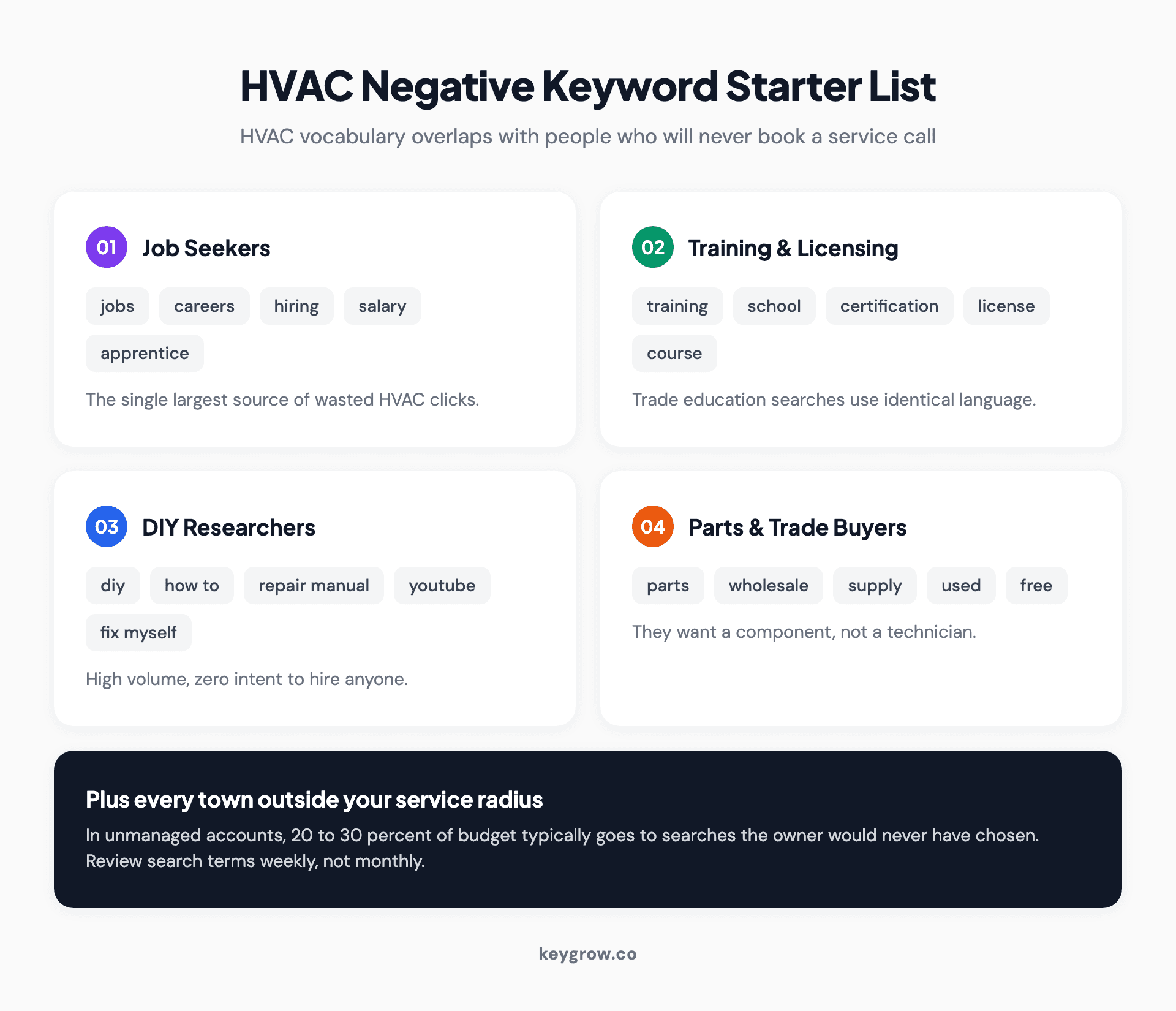
A starter negative keyword list for HVAC Google Ads grouped by type: job seekers, DIY researchers, parts buyers, training queries, and out-of-area searches.
Broad match without a negative keyword list is a donation to Google. In unmanaged accounts we typically find 20 to 30 percent of budget going to searches the owner would never have chosen, and HVAC is worse than most because the vocabulary overlaps so heavily with things that are not customers. "HVAC" appears in job listings, trade school searches, DIY repair videos, parts catalogs and licensing questions. Every one of those is a person who will never book a service call.
The starter negatives for almost any HVAC account: jobs, careers, hiring, salary, training, school, certification, license, diy, how to, repair manual, parts, wholesale, supply, used, free, and the names of any towns outside your service radius.
The mechanism transfers across industries. A real estate investor client of ours was drowning in unusable leads, and the fix was not more traffic. It was negative keywords, tighter match types, and qualifying language in the ad copy itself. Serious leads went up 600 percent between December and January on the same budget. Nothing was added. Things were removed.
Do the search terms review weekly, not monthly. Monthly means you find the waste after you have paid for four weeks of it. Our negative keywords guide covers the mechanics if you want the longer version.
Match types and structure, kept deliberately simple
Phrase and exact for your money terms, broad only where you have a mature negative list and the discipline to check it weekly.
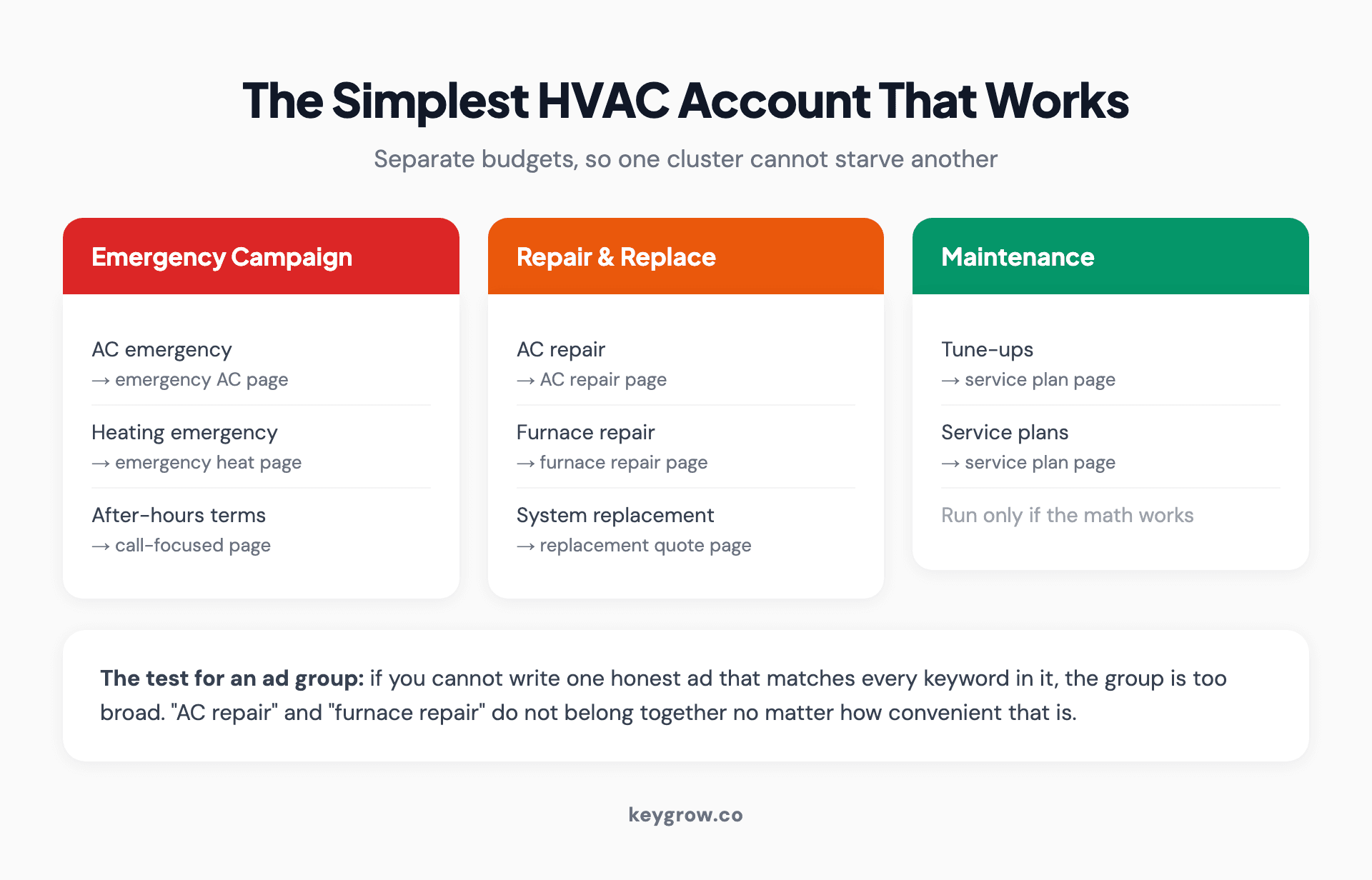
A simple three-campaign HVAC Google Ads structure: separate emergency, repair and replacement, and maintenance campaigns, each with its own ad groups and dedicated landing pages.
The structure that works for most HVAC companies is smaller than people expect. One campaign for emergency, one for standard repair and replacement, one for maintenance if the math justifies it, and commercial separated out entirely if you serve it. Inside each, ad groups tight enough that every keyword in the group could share one ad and one landing page without either feeling generic.
That last test is the useful one. If you cannot write a single ad that honestly matches every keyword in an ad group, the group is too broad. "AC repair" and "furnace repair" do not belong together, no matter how convenient it is to file them both under "repair".
Seasonality then sits on top of all of it. The same keyword is worth different money in July and January, and demand for the two halves of your business runs on opposite calendars. Most HVAC accounts should shift budget between the AC and heating campaigns twice a year rather than running both flat all year, which quietly overpays for furnace clicks in August.
When copying your competitor is the wrong move
If your competitor is bigger, their keyword list is a description of their budget, not a plan you can execute.
This is the part competitive research articles skip. A regional HVAC company with twelve trucks and a call center can profitably bid on broad replacement terms and absorb a long sales cycle. A two-van operation copying that list will spend its monthly budget in nine days on research traffic and conclude that Google Ads does not work.
If you are smaller, the list you want is deliberately narrower than theirs: your tightest emergency terms, your highest-margin service, and your immediate radius. You win on relevance and response time, not coverage. Being the only advertiser who genuinely answers at 9pm within six miles beats being the eleventh advertiser on "hvac installation".
And some HVAC businesses should not be running this at all yet. If you have one van, a full schedule from referrals, and no way to answer the phone during a service call, paid search will generate leads you cannot service and reviews you will not enjoy. Claim your Google Business Profile, collect reviews, get the basics of your site working, and come back to paid search when you have capacity to sell. We turn away that conversation regularly, and it is usually the right answer.
When you do have capacity, the honest threshold for handing it over is when the time you spend on the account costs more than management would. Below that, a careful owner can run a decent HVAC account. Above it, the search terms report stops getting opened, which is where the money goes. Our PPC management work is month to month for that reason, and the same logic runs through our other home services accounts.
FAQs
What are the best Google Ads keywords for an HVAC company?
Emergency repair terms convert best, including phrases like "ac not blowing cold air", "no heat emergency" and "24 hour ac repair". Standard repair terms such as "ac repair near me" carry the most consistent volume. Replacement terms have the highest job value but a longer decision cycle, and maintenance terms are cheapest but rarely profitable on their own.
How much do HVAC Google Ads keywords cost per click?
Home services search campaigns averaged $5.31 per click and $45.27 per lead in LocaliQ's benchmark of 3,211 US campaigns. HVAC sits close to the all-industry average of $5.42, but the range is wide. Emergency and replacement terms in large metros cost several times a maintenance keyword in a small market.
How can I find out what keywords my competitors are bidding on?
Four sources cover most of it. Your own search terms report shows real demand in your market, the Google Ads Transparency Center shows a competitor's live ad copy, auction insights names who is competing against you, and manual incognito searches from your service area show exactly what a customer sees. Paid tools estimate the rest.
Should HVAC companies bid on competitor brand names?
It is allowed, and it can work, but it is rarely the first thing a smaller HVAC company should spend on. Brand terms convert well for the brand owner and poorly for everyone else, and Quality Score economics mean you usually pay more per click than they do. Prioritize emergency and repair terms first.
What negative keywords should every HVAC account have?
Start with jobs, careers, hiring, salary, training, school, certification, license, diy, how to, repair manual, parts, wholesale, supply, used and free, plus the names of towns outside your service area. HVAC vocabulary overlaps heavily with job hunting, trade education and DIY research, so these terms leak budget faster than in most industries.
How much should an HVAC company budget for Google Ads?
Enough to buy meaningful data in your market, which at typical home services costs means a few hundred clicks a month before you can judge anything. Work backwards from your average job value and target cost per lead rather than picking a round number. A budget too small to produce conversions produces no learning either.
Do seasonal keywords need separate campaigns?
Yes, in most markets. Air conditioning and heating demand run on opposite calendars, and keeping them in one campaign means overpaying for furnace clicks in summer and cooling clicks in winter. Separate campaigns let you move budget between them twice a year instead of funding both at full rate year round.
What to do this week
Open your search terms report and read the last thirty days before you touch a keyword list. Most HVAC accounts have their answer sitting in that report already, in the form of job seekers, DIY researchers and towns three counties away.
Then pick your five highest-margin terms, separate emergency from everything else, and check that somebody answers the phone at the hours you are bidding. Those three moves will do more than any competitor keyword list you can assemble.
If you want the same thinking applied to a neighboring trade, we covered Google Ads for roofing companies in more depth, and you can see whether our approach fits at get started.


