


A patient with a stiff neck opens their phone, types "chiropractor near me", and taps one of three results. Your website was never part of that decision.
SEO for chiropractors is mostly the work of winning those three map results in a radius small enough that a patient will drive it twice a week, and then giving the ones who do click a reason to book rather than keep scrolling. The website matters, but it matters second, and most practices spend their money in the wrong order.
We covered the paid side in Google Ads for chiropractors. This post is the organic half, and it is the half that keeps working after the budget stops.
The map pack decides this before your website is involved
For any search with local intent, Google shows three business profiles above the organic results. Most of the clicks go there, and the thing competing for those slots is your Google Business Profile rather than your site.
That single fact reorders everything. A practice with a beautiful website and a half-finished profile loses to a practice with a plain website and a complete one. It happens constantly, and the owner of the beautiful website usually concludes that SEO does not work.
Local ranking comes down to how close you are, how precisely your listing matches what somebody typed, and how well known the practice is elsewhere on the web. You cannot move the clinic. The other two are both decided on the profile: the categories and services you fill in, and the reviews and mentions accumulating around your name. That is two thirds of the ranking equation sitting in a form most practices filled in once and never reopened.
The website still earns its place. It handles condition searches, it converts the people who do click through, and it is what AI assistants read when they are deciding who to mention. It is just not what wins "chiropractor near me".
Your real service area is smaller than you think
Here is the constraint that makes chiropractic different from every other local service, and almost no chiropractic SEO guide accounts for it.
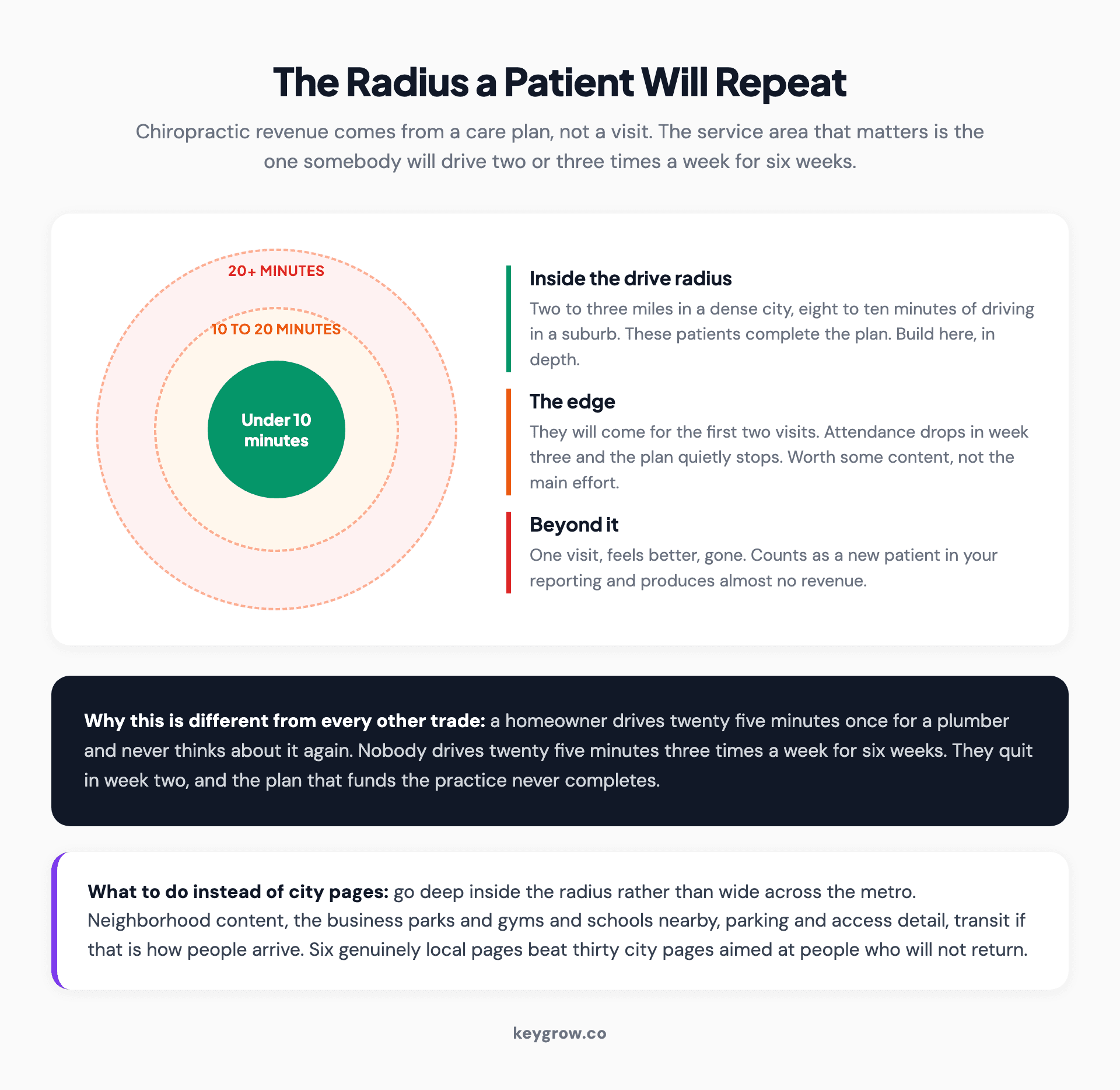
Diagram of a chiropractic drive-time radius showing why patients three miles away sustain a care plan and patients twenty minutes away do not.
Chiropractic revenue does not come from a visit. It comes from a care plan, which means the same person returning two or three times a week for several weeks. A homeowner will drive twenty five minutes once for a plumber and never think about it again. Nobody drives twenty five minutes three times a week for six weeks. They quit in week two, and the plan that funds your practice never completes.
So the radius that matters is not the radius you can technically serve. It is the radius a patient will repeat. In dense urban areas that can be two or three miles. In suburbs, maybe eight or ten minutes of driving. Outside that, you are attracting people who will book once, feel better, and disappear.
The strategic consequence is the opposite of what most practices do. Rather than building thin pages for every town in the metro, go deep inside the drive radius. Neighborhood-level content, the specific business parks and gyms and schools near you, parking and access detail, transit if that is how people arrive. Six genuinely local pages inside your radius will outperform thirty city pages covering places nobody will return from.
It also changes how you read your own reporting. A campaign pulling patients from twenty minutes out looks healthy on new patient count and quietly fails on plan completion, which is the number that pays your rent.

Physical therapist assessing a patient's leg during a clinical evaluation.
Step one: make the profile do the work
Most chiropractic profiles are two thirds empty, which is convenient, because filling them in is free.
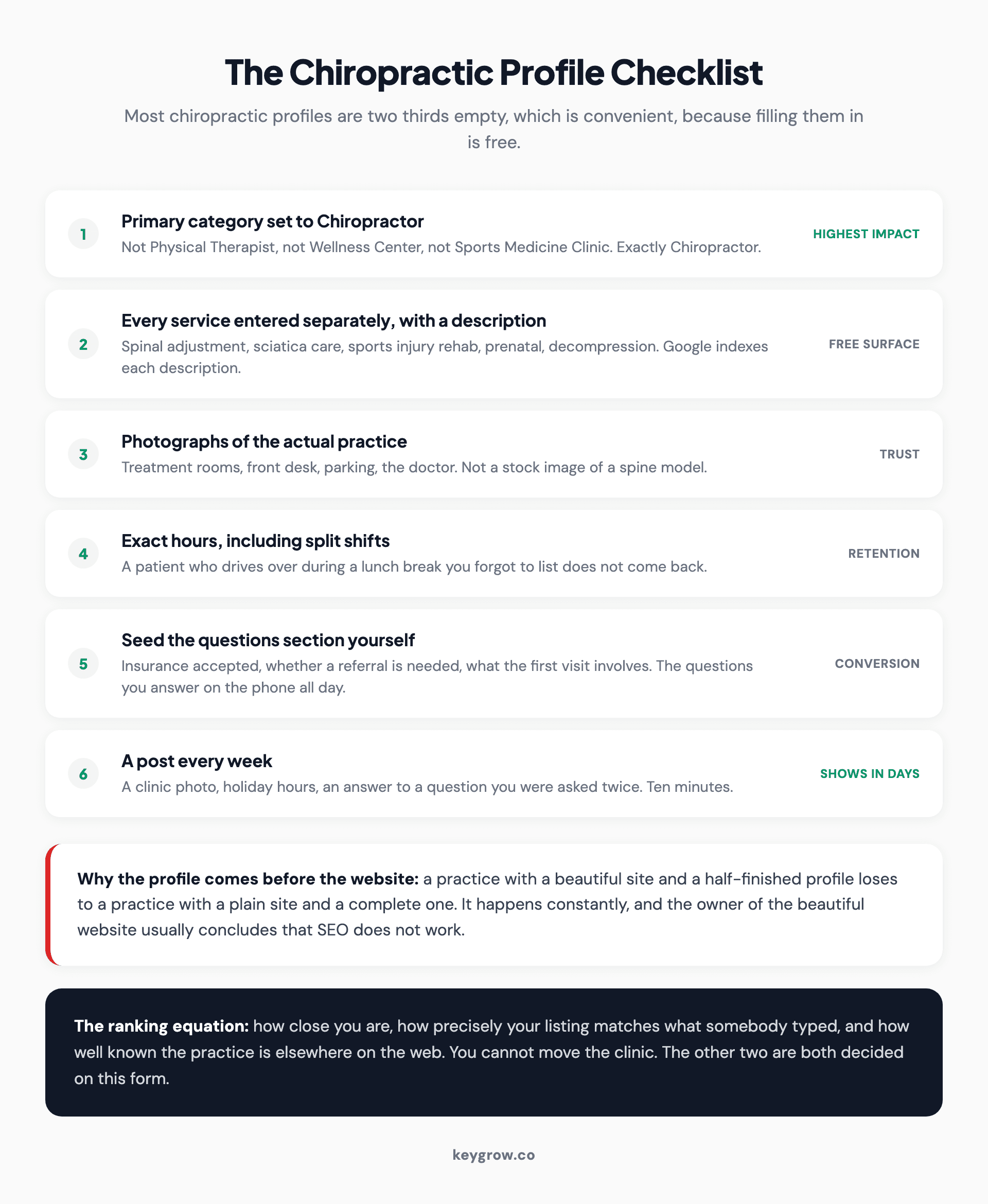
Google Business Profile checklist for a chiropractic clinic covering category, services, photos, hours, questions and posts.
The primary category should be Chiropractor. Not Physical Therapist, not Wellness Center, not Sports Medicine Clinic. Exactly Chiropractor, because the category is the strongest relevance signal you control and Google matches it against what people type. Add secondary categories only for services you genuinely provide with the equipment and training to back them.
Next, the services list. Enter each one separately with its own short description rather than lumping everything under a general heading: spinal adjustment, sciatica care, sports injury rehabilitation, prenatal chiropractic, decompression therapy, whatever the practice genuinely provides. Google indexes those descriptions, and a clinic listing eleven specific services will match more searches than one listing "chiropractic care".
Photographs need to show the practice, not stock imagery of a spine model. The treatment rooms, the front desk, the parking, the doctor. Patients are trying to work out whether the place looks clean and whether they will feel comfortable there, and a real photograph answers both questions faster than any paragraph.
Two details that quietly matter. Hours must be exact, including the split shifts many practices run, because a patient who drives over during a lunch break you forgot to list does not come back. And the questions and answers section is public, so seed it yourself with the questions you get on the phone all day: whether you take a particular insurance, whether a referral is needed, what the first visit involves.
Then post something every week. A photo from the clinic, a note about holiday hours, an answer to a question you were asked twice that week. Ten minutes, and it is one of the very few things on this list that shows an effect within days rather than months.
Step two: one page per condition, not a services list
The website's job is condition searches, and the structure that works is one page per condition rather than a single page listing everything.
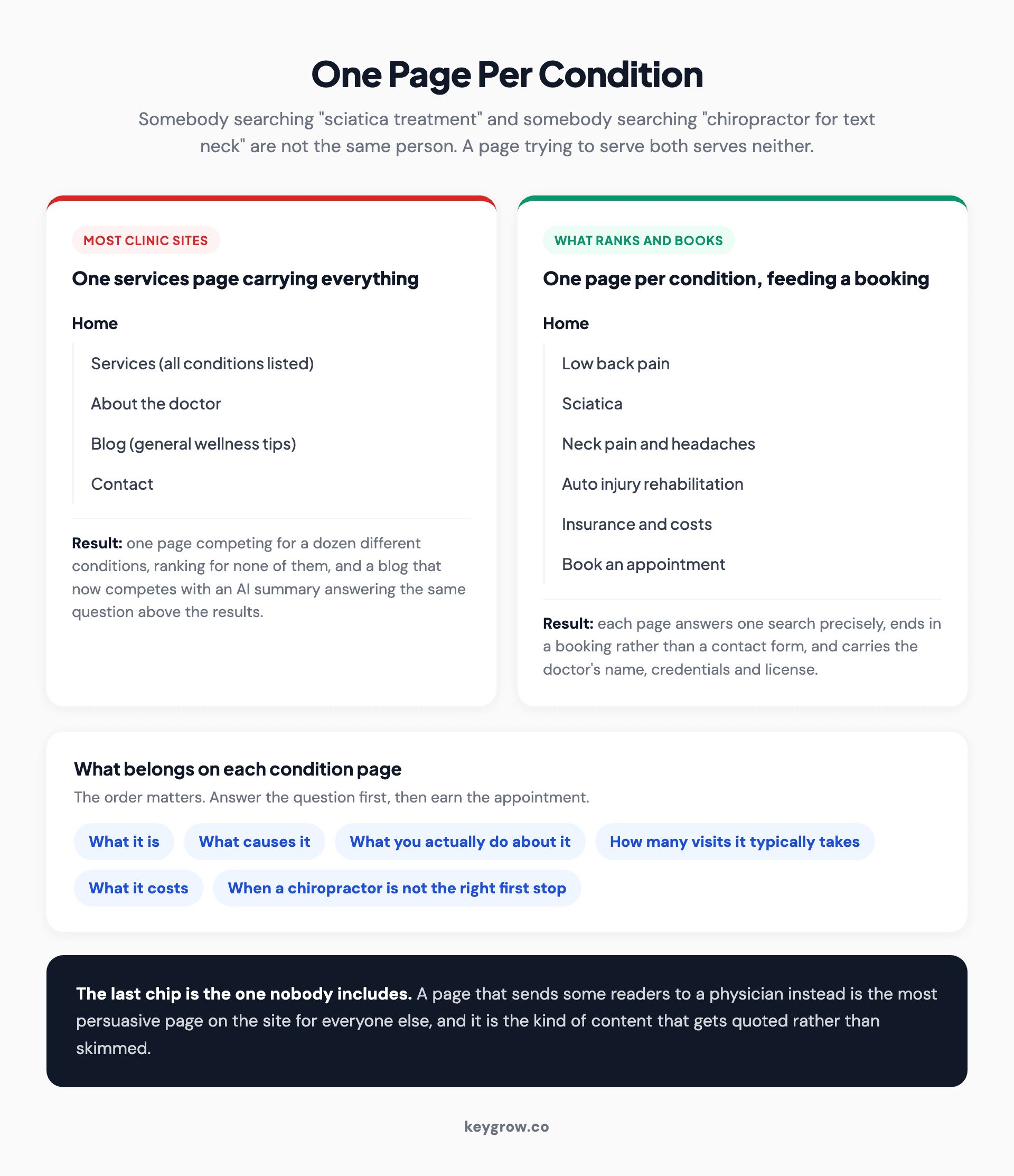
Site structure for a chiropractic practice showing one page per condition feeding into a booking page, against a single catch-all services page.
Somebody searching "sciatica treatment" and somebody searching "chiropractor for text neck" are not the same person, and a page trying to serve both serves neither. Give each condition its own page: what it is, what causes it, what you actually do about it, how many visits it typically takes, what it costs, and when the honest answer is that a chiropractor is not the right first stop.
The conditions worth building first are the ones with real local search volume and a genuine care plan behind them. Low back pain, sciatica, neck pain, headaches and migraine, shoulder impingement, sports injuries, auto injury rehabilitation, work injury. Prenatal and pediatric care if that is genuinely part of your practice.
Each page should end where the patient wants to go next, which is a booking, not a contact form. And each should carry a byline with the doctor's name, credentials and license, because health content without a named clinician behind it is treated as less trustworthy by both search engines and readers.
What not to build: a blog full of general wellness posts. Ten tips for better posture is a page every chiropractic site has, it ranks for nothing, and it now competes directly with an AI summary that answers the same question above the results.
Symptom searches are getting answered without a click
This is the shift that has changed health content more than any other category, and pretending otherwise wastes a year of effort.
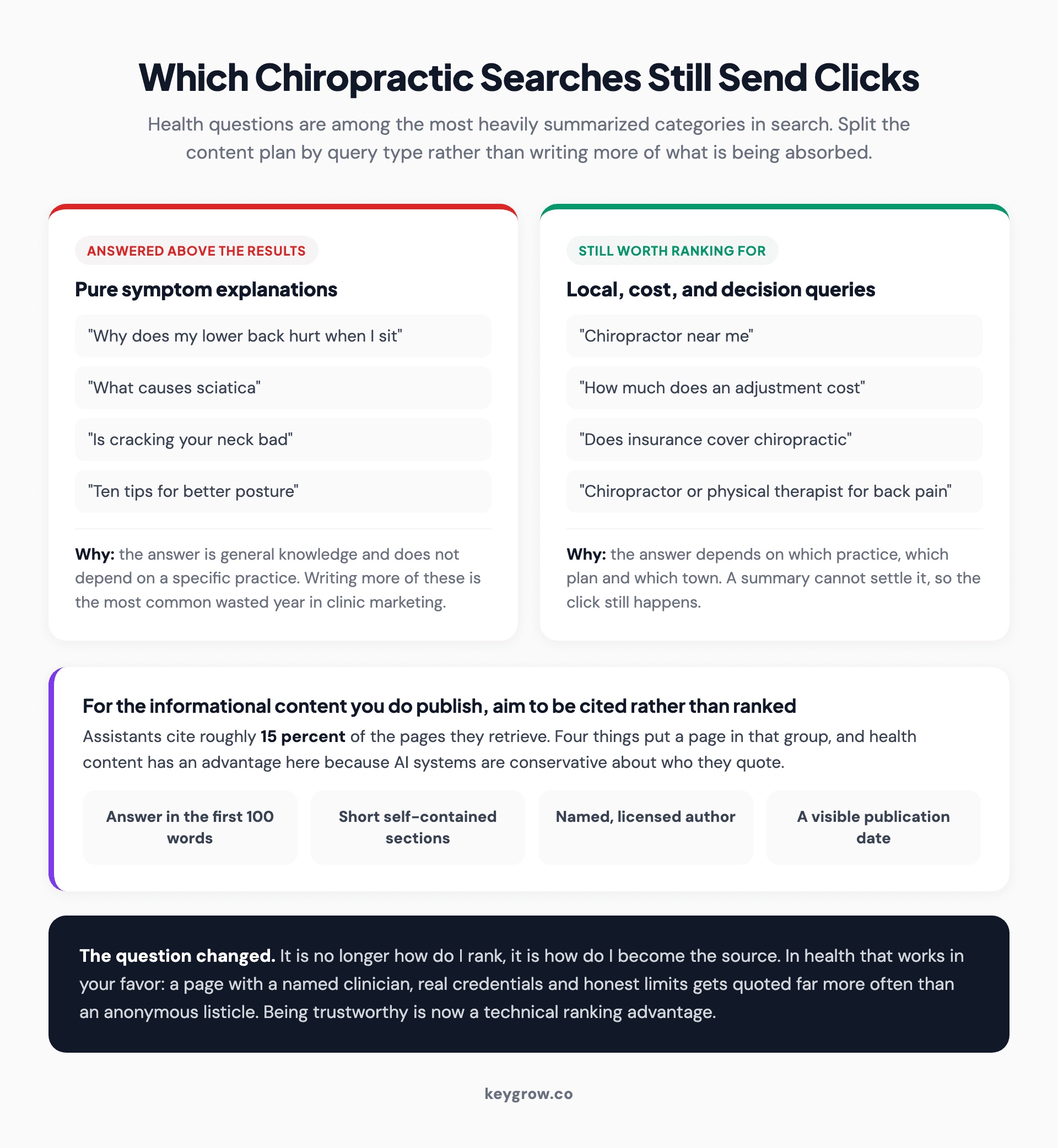
Two-column comparison of chiropractic search queries that AI now answers directly against the local and decision queries that still send clicks.
Someone typing "why does my lower back hurt when I sit" used to land on a clinic blog post. Now they get a generated answer at the top of the page, and often that is where the session ends. Google's AI features documentation describes these summaries as a standard part of results, and health questions are among the most heavily summarized categories there is.
The instinct is to write more of that content. The better response is to split your effort by query type. Pure symptom explanations are getting absorbed. Local queries, comparison queries, cost queries, insurance queries, and "should I see a chiropractor or a physical therapist" style decision queries still send clicks, because the answer depends on a specific practice rather than on general knowledge.
For the informational content you do publish, the goal changes from ranking to being cited. Our strongest position on this is that the question is no longer how do I rank, it is how do I become the source, and the numbers support it: assistants cite roughly 15 percent of the pages they retrieve. Getting into that 15 percent means answering in the first hundred words, keeping sections short and self-contained, naming the clinician who wrote it, and dating the page. It is the same discipline as our answer engine optimization work, applied to a field where the questions are personal and the stakes feel high.
The compensating advantage in health is that AI systems are conservative about who they quote. A page with a named, licensed author, real credentials and honest limits is far more likely to be cited than an anonymous listicle. Being trustworthy is now a technical ranking advantage.
The claims problem is also a ranking problem
Chiropractic marketing has a long habit of claiming more than the evidence supports, and search engines have become unusually good at noticing.
Health content sits in the category Google treats most carefully, because a wrong answer can hurt someone. Pages making broad claims that adjustments treat conditions well outside musculoskeletal care are a compliance risk with your state board and a ranking liability at the same time. It is one of the few situations where doing the careful thing and doing the profitable thing are the same decision.
The version that works is specific and sourced. Say what the evidence supports for low back pain and neck pain, link the research when you cite it, and be plain about where the evidence is thinner. The NIH's spinal manipulation overview is a reasonable place to check what can be stated confidently.
Then do the thing almost no clinic website does: tell people when to go elsewhere. Red flag symptoms that need a physician or an emergency department. Cases where physical therapy is the better first option. When imaging is genuinely warranted. A page that sends some readers away is the most persuasive page on the site for everyone else, and it is the kind of content that gets quoted rather than skimmed.
Reviews, and the line you cannot cross when replying
Reviews carry more weight for a clinic than almost any other signal you control, and healthcare adds a constraint no other local business has to think about.
The collection part is ordinary. Ask at the end of a visit where the patient is visibly better, make it a single tap on a card at the desk, and build it into the routine so it happens without anyone remembering. Recency does more work than total volume: sixty reviews with a new one most weeks reads better than three hundred that stopped two years ago.
The reply part is where practices get into trouble. Responding to a review in a way that confirms the reviewer was your patient, or that references their condition, treatment or visits, can be a disclosure of protected health information. Practices have been penalized for exactly that, usually while defending themselves against an unfair review. The safe reply thanks the person for the feedback, says nothing about whether they were seen at the practice, and offers a phone number to discuss it privately. Every time, without exception, however wrong the review is. If in doubt, have your compliance advisor write the template once and use it forever.
Google's review policies also prohibit incentivized and solicited-in-bulk reviews, and enforcement in healthcare categories is active. A gift card campaign is not worth the profile.

Chiropractor performing a spinal adjustment on a patient during a treatment session.
Getting the booking, not just the visit
Ranking produces sessions. Sessions are not patients, and the gap between the two is usually the website rather than the traffic.
Three things decide it. Online booking that works on a phone in under a minute, with actual times shown rather than a request form that gets answered tomorrow. Insurance information stated plainly, because it is the first question almost every new patient has and most sites bury it. And a first-visit explanation, because a meaningful share of people have never been adjusted and are quietly nervous about it.
This is worth more than people expect. Across our own landing page rebuilds, a security company went up 95 percent on conversion rate in four weeks and a services client 120 percent in five, and in neither case did the traffic change at all. Only the page did. If your site takes a hundred visitors a month and books four of them, doubling the traffic is a much more expensive way to get to eight patients than fixing the page. Our web development team does this work, though a competent practice manager with a good booking tool can get most of the way alone.
Timeline, cost, and the number to actually watch
Profile work moves first. Fill in a neglected Google Business Profile properly and map pack position can shift within four to eight weeks, which makes it the highest-return work available to most practices.
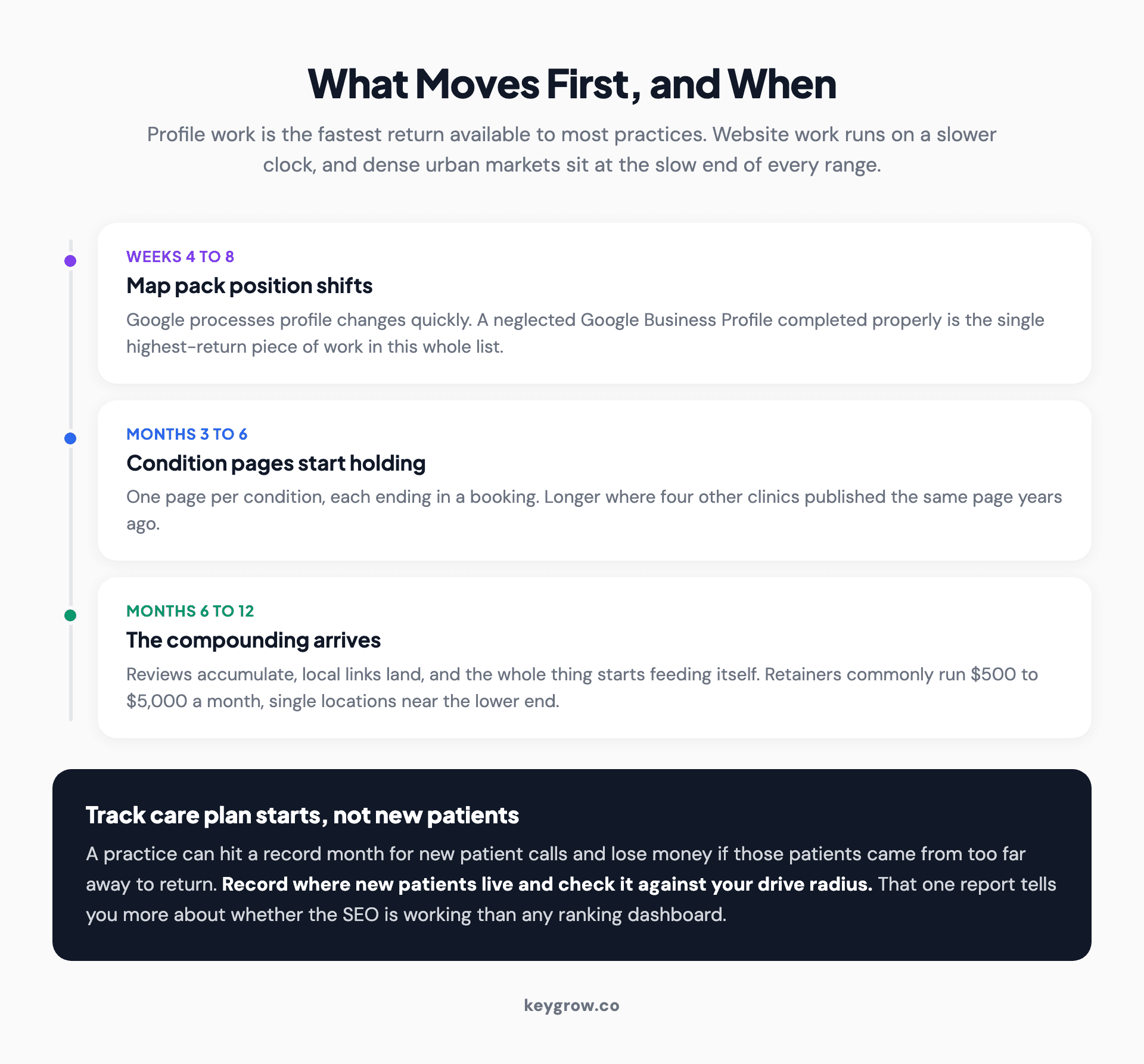
Timeline of chiropractic SEO results by month, showing profile movement first, condition pages from month three, and compounding from month six.
Website work runs on a different clock. A condition page usually needs a quarter or two before it holds anything, longer in a dense urban market where four other clinics published the same page years ago. The point where the whole thing starts feeding itself tends to arrive somewhere in the second half of year one.
Market rates for local SEO run roughly $500 to $5,000 a month. A single-location practice in one neighborhood sits at the lower end of that. Multi-location groups sit higher, mostly because each location needs its own profile, its own reviews and its own local content.
The number to watch is not new patients. It is care plan starts, and then plan completion. A practice can hit a record month for new patient calls and lose money if those patients came from too far away to return, or arrived expecting something the practice does not do. Track where new patients live, and check it against the drive radius you decided on earlier. That one report tells you more about whether your SEO is working than any ranking dashboard.
When a chiropractic practice should not hire an SEO agency
There is a version of this conversation where we take the retainer and everyone regrets it in four months. Here is how to tell whether your practice is in that group.
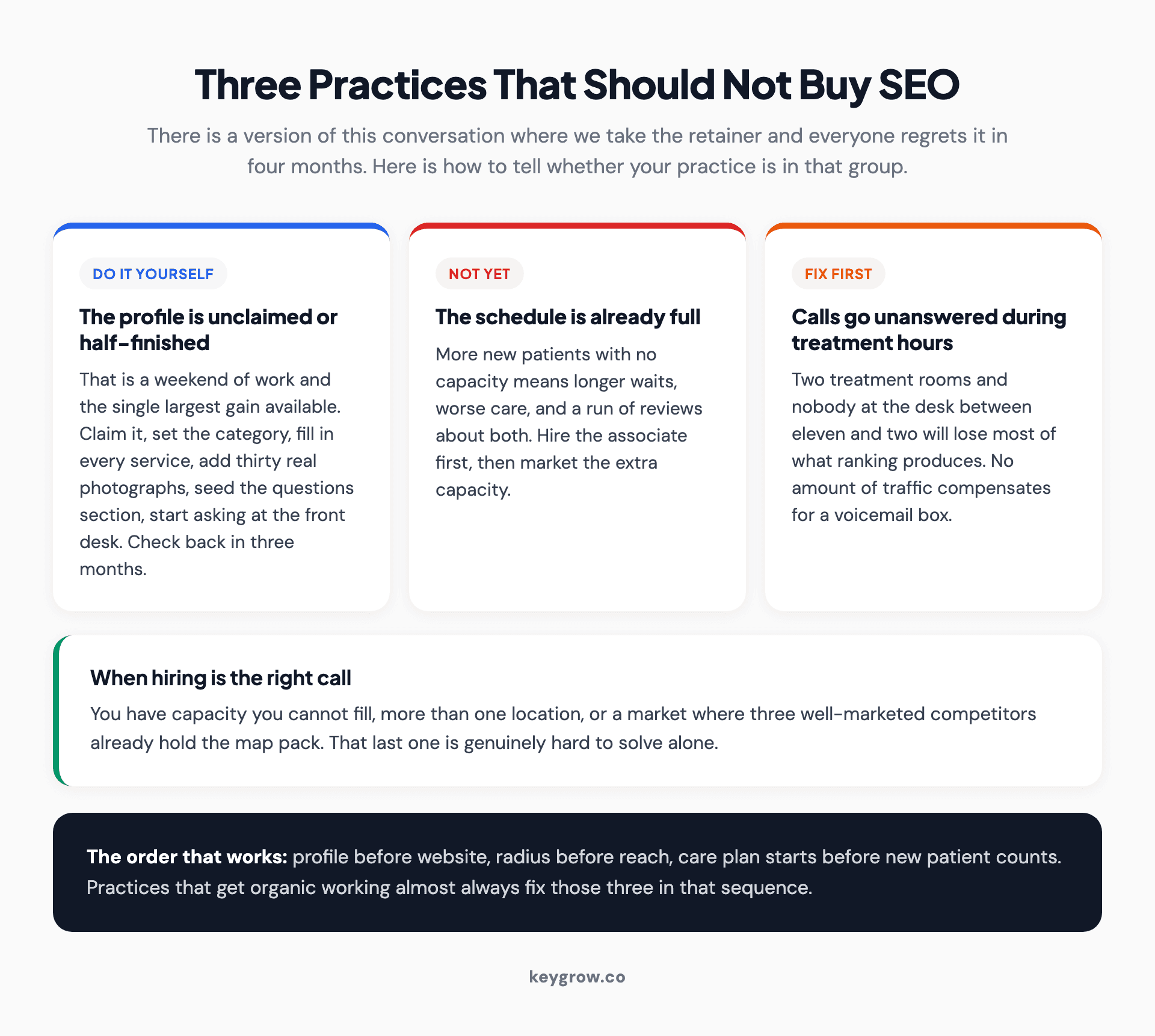
Three situations where a chiropractic practice should not buy SEO yet, covering unclaimed profiles, full schedules and associate hiring.
Do it yourself if your Google Business Profile is unclaimed or half-finished. That is a weekend of work and it is the single largest available gain. Claim it, set the category, fill in every service, add thirty real photographs, seed the questions section, and start asking for a review at the front desk. Come back in three months and see where you are. Most single-location practices will find the answer is "further than a small retainer would have taken us".
Wait if your schedule is already full. More new patients when you have no capacity means longer waits, worse care and a run of reviews about it. Hire the associate first, then market the extra capacity.
Fix the intake first if calls go unanswered during treatment hours. A practice with two treatment rooms and nobody at the desk between eleven and two will lose most of what ranking produces, and no amount of traffic compensates for a voicemail box.
Hire when you have capacity you cannot fill, more than one location, or a market with three well-marketed competitors already holding the map pack. That last one is genuinely hard to solve alone, and it is the most common reason practices come to us.
FAQs
What is SEO for chiropractors?
SEO for chiropractors is the work of ranking a practice in Google's local map pack and organic results for searches such as "chiropractor near me", "sciatica treatment" and city or neighborhood queries. It combines Google Business Profile optimization, condition-specific website pages, review generation and local content, and it targets patients who live close enough to complete a course of care.
How long does chiropractic SEO take to work?
Profile changes are processed quickly, so a neglected Google Business Profile filled in properly can shift map pack position inside four to eight weeks. Condition pages on the website need a quarter or two before they hold a position, and the compounding effect usually arrives in the second half of the first year. Dense urban markets sit at the slow end of all of those ranges.
How much does SEO cost for a chiropractic clinic?
Local SEO retainers commonly run from roughly $500 to $5,000 a month depending on scope. A single-location practice targeting one neighborhood sits toward the lower end. Multi-location groups cost more because each site needs its own profile, review flow and local content rather than a shared campaign.
Is Google Business Profile more important than a chiropractic website?
For the searches that produce most new patients, yes. The map pack sits above organic results and the profile is what competes for those three positions. The website still matters for condition searches, for converting visitors into bookings, and for being cited by AI assistants, but it does not win "chiropractor near me" on its own.
Should a chiropractor build a page for every nearby city?
Usually not. Chiropractic care requires repeat visits, so patients outside a realistic drive radius rarely complete a plan. Depth inside your radius beats breadth across the metro: neighborhood-level pages with genuine local detail outperform a large set of thin city pages aimed at people who will book once and not return.
Do AI Overviews hurt chiropractic websites?
They reduce clicks on general symptom explanations, which were a large share of chiropractic blog traffic. Local, cost, insurance and comparison queries still send clicks because the answer depends on the specific practice. The practical response is to shift effort toward those queries and to structure informational content so AI systems cite the practice as a source.
How should a clinic respond to a negative online review?
Reply without confirming the person was a patient and without referencing any treatment or visit detail, since doing so can disclose protected health information. Thank them for the feedback, offer a phone number, and move the conversation offline. Have a compliance-approved template written once and use it every time, including when the review is unfair.
What content should a chiropractic website publish?
One page per condition you treat, with what you do about it, how many visits it typically takes, what it costs and when a chiropractor is not the right first option. Add insurance information, a first-visit explanation and neighborhood pages inside your drive radius. Skip generic wellness listicles, which rank for nothing and are now answered above the results.
Our take
Most chiropractic practices are one weekend of profile work and one honest condition page away from a materially better position, and they are spending money on neither.
Fix the Google Business Profile first, completely, before anything else gets bought. Decide the radius a patient will actually drive twice a week and build inside it rather than across the metro. Put a named, licensed clinician on every page that says anything about health, and be specific about what the evidence supports. Then measure care plan starts instead of new patient calls, because those are the ones that pay for the practice.
If that list describes work you do not have time for, our SEO services team and our chiropractic SEO work cover exactly this, month to month. And if you read the do-it-yourself section and recognized your own practice, start there. It costs nothing and it is the part that moves first.