


Google Ads for chiropractors works, and it gets judged wrong almost every time. The ad sells a first visit. The practice runs on care plans. Those two things have completely different economics, and an account measured on new patients rather than plan starts will reward exactly the offers that produce the fewest of them.
That gap is where most chiropractic ad budgets quietly go.
Before anything else, one honest admission that no other guide on this topic seems willing to make.
Nobody has a chiropractic benchmark, including us
You will see a cost per click quoted for chiropractic Google Ads in most articles on this subject. Check the source and it is usually a healthcare-wide average from a report several years old, or a single agency's own account data.
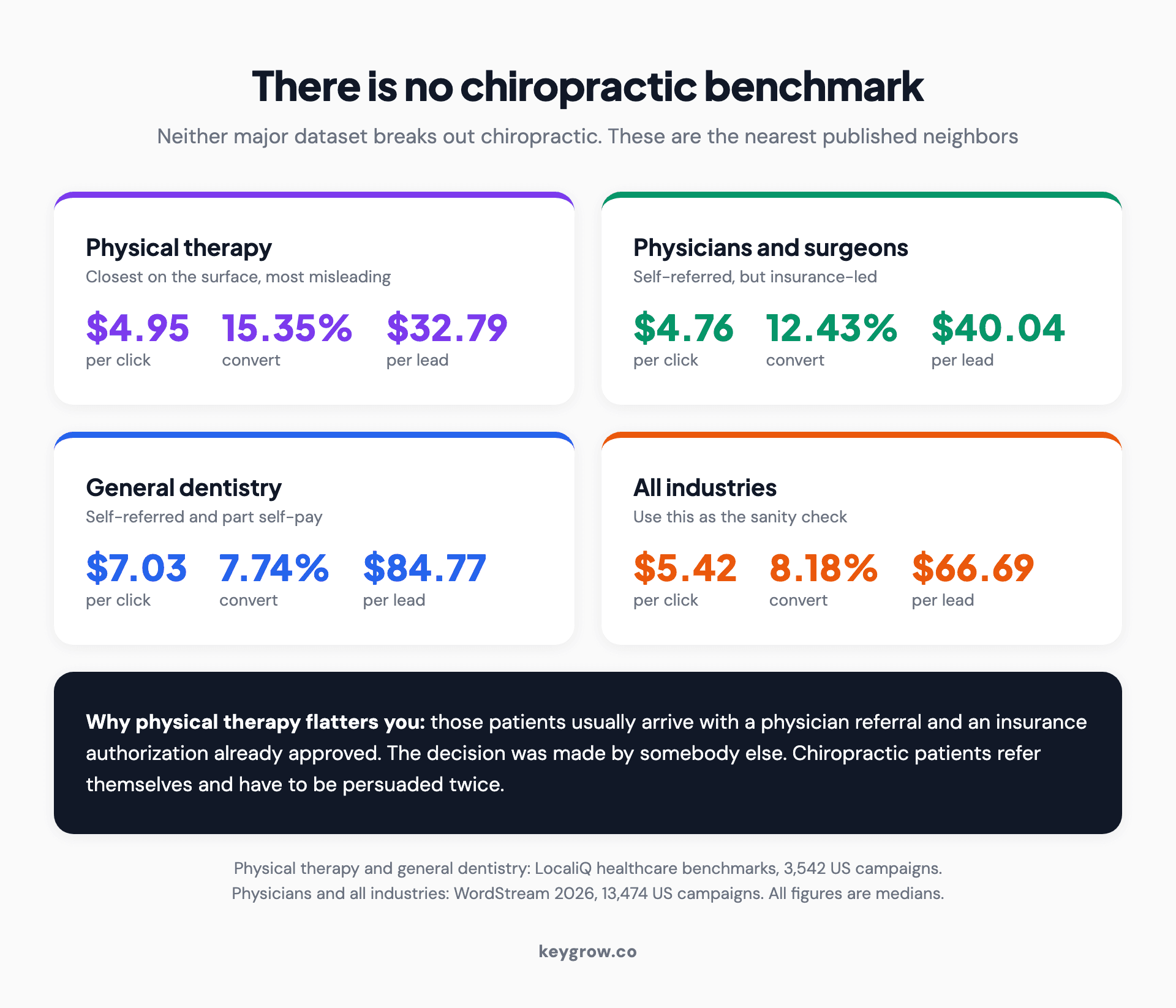
Benchmark cards showing the nearest published comparisons for chiropractic Google Ads: physical therapy, general dentistry, physicians and surgeons, and the all-industry average.
The two large published datasets do not break out chiropractic at all. LocaliQ's healthcare benchmarks cover 16 specialties across 3,542 US campaigns and chiropractic is not one of them. WordStream's 2026 benchmarks cover 13,474 campaigns across every major industry and there is no chiropractic row there either.
So here are the nearest neighbors, with the caveat attached.
| Category | Click-through rate | Cost per click | Conversion rate | Cost per lead |
|---|---|---|---|---|
| Physical therapy | 6.61% | $4.95 | 15.35% | $32.79 |
| General dentistry | 5.06% | $7.03 | 7.74% | $84.77 |
| Physicians and surgeons | 6.61% | $4.76 | 12.43% | $40.04 |
| All industries | 6.64% | $5.42 | 8.18% | $66.69 |
Physical therapy is the closest analogue on the surface, and it is the most misleading one. A physical therapy patient usually arrives with a physician referral and an insurance authorization already in hand. The decision was made by somebody else. That is why the conversion rate is 15.35 percent, which is nearly double the all-industry figure.
A chiropractic patient typically refers themselves, pays out of pocket for at least part of the care, and has to be persuaded twice. Once to book, and again to commit to a course of treatment. Borrow physical therapy's numbers and you will set a cost per lead target you cannot hit and conclude the channel is broken.
Use the all-industry row as your sanity check instead. It is less flattering and closer to what chiropractic practices actually report.
Your ad sells a visit and your practice sells a plan
This is the structural problem, and once you see it you cannot unsee it.
Almost nothing in a chiropractic practice is paid for by a first visit. The economics live in the treatment plan that follows, whether that is a twelve visit course, a maintenance arrangement, or an ongoing wellness membership. The first appointment is the audition.
Google Ads cannot see any of that. It sees a form submission or a phone call and reports a conversion, then optimizes hard toward whatever produces more of them. Left alone, the system will find the cheapest possible route to a booked first visit, and the cheapest route to a booked first visit is almost never the route to a started care plan.
That is not a flaw in the platform. It is doing precisely what it was told. The problem is what it was told.
The new patient special is an auction you win by losing
Walk through the chiropractic ads in any competitive city and you will find the same shape of offer repeated down the page. A dollar figure, an exam, an X-ray, sometimes an adjustment thrown in.
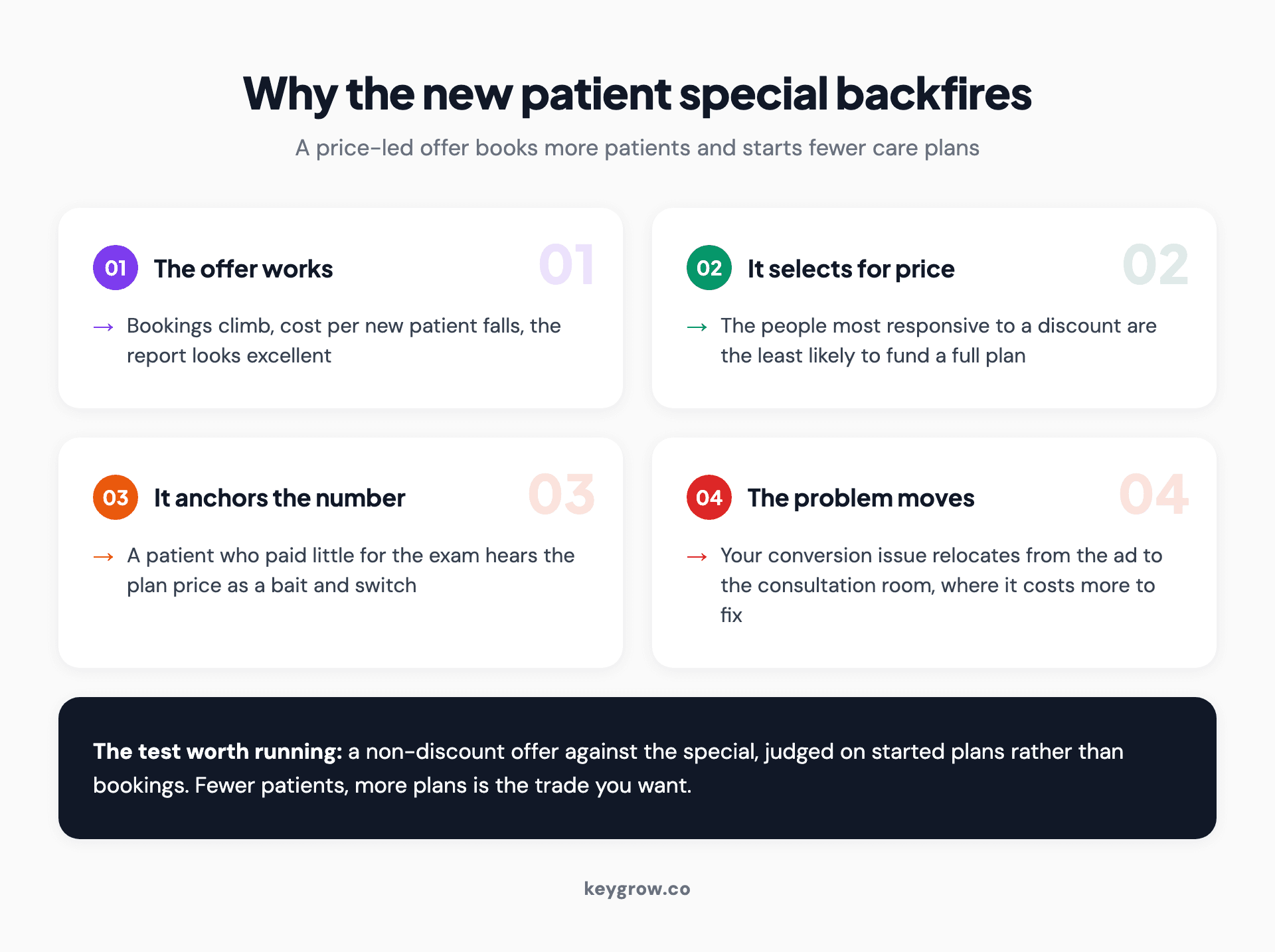
Four cards explaining why discounted new patient offers in chiropractic Google Ads produce more bookings and fewer care plan starts.
The offer works. That is the trap. Drop the price of a first visit far enough and your booking rate climbs, your cost per new patient falls, and the report looks excellent.
Now look at who took the offer. A price-led offer selects for the people most responsive to price, which is a polite way of saying it selects for the patients least likely to commit to a plan they will pay for in full. You have not bought new patients. You have bought a discounted first visit, and a share of those people were always going to take the discount and go.
There is a second effect that compounds it. The deeper the discount, the harder the conversation on the day. A patient who came in for a cheap exam has anchored on a low number, and the plan you present at the end of it now looks like a bait and switch to them even when it is not. Your conversion problem has moved from the ad to the consultation room, where it costs more to fix.
None of this means never run an offer. It means measure the offer on plan starts rather than on bookings, and be willing to run a higher-priced or non-price offer against it. A free consultation with no exam attached, a specific problem framing like a spinal assessment for people with a named complaint, or simply a normal-priced first visit with strong credentials behind it. In competitive markets we have seen the non-discount version book fewer patients and start more plans, which is the trade you want.
Cost per care plan is the number, and it is easy to work out
Most chiropractors we speak to know their cost per new patient and have never calculated the number underneath it.
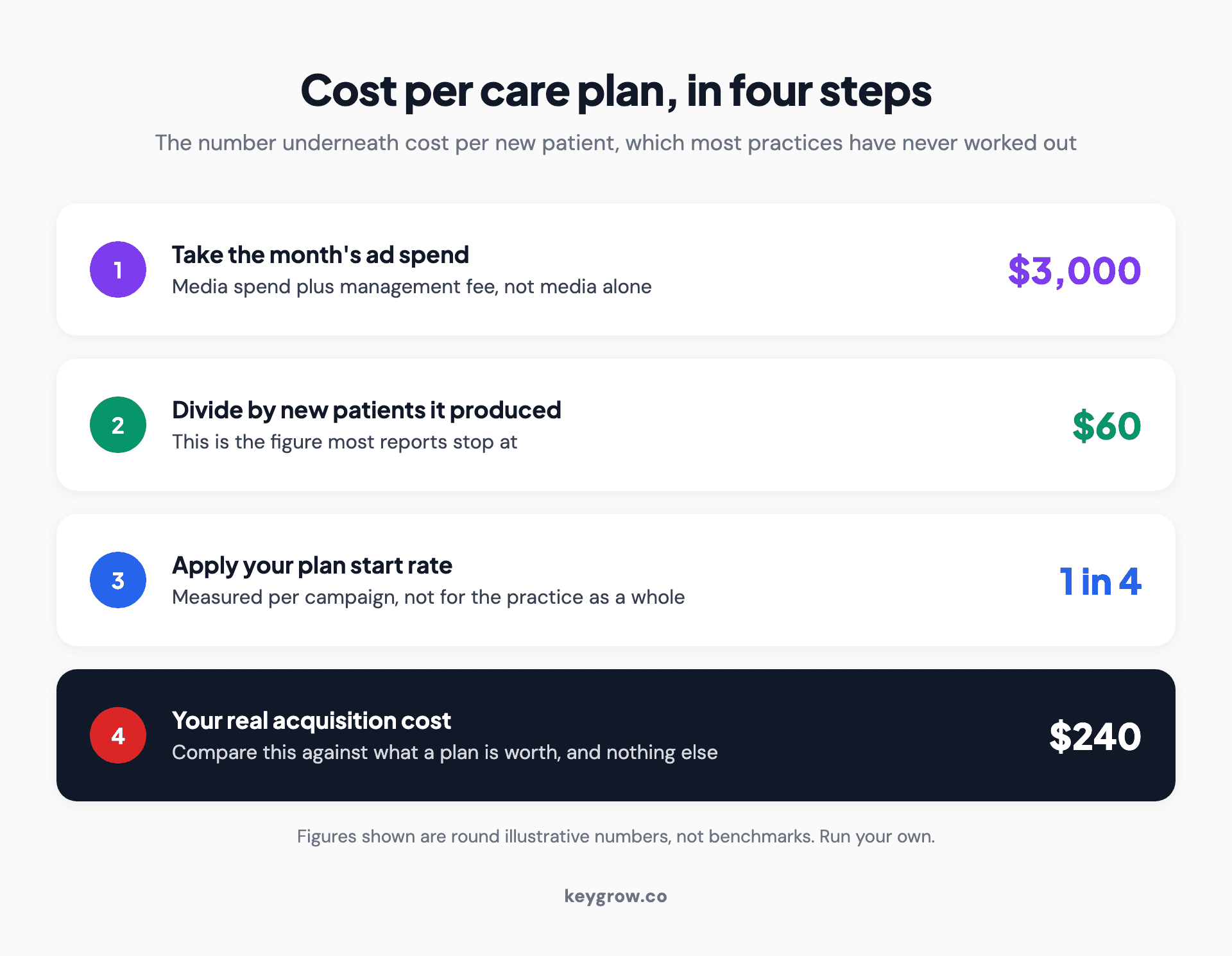
Four-step calculation showing how to convert cost per new patient into cost per started care plan for a chiropractic practice.
Four inputs, all of which you already have.
Take your ad spend for the month. Divide by the number of new patients it produced to get cost per new patient. Then divide that by the share of those patients who started a care plan. That last number is your cost per plan, and it is the only one worth comparing against what a plan is worth.
An example with round figures, which are illustrative rather than benchmarks. Spend $3,000, get 50 new patients, and your cost per new patient is $60. That reads well against almost any industry figure. Now suppose one in four of them starts a plan. Your real acquisition cost is $240 per plan, and whether that is good depends entirely on what a plan is worth in your practice.
Run the same arithmetic on the campaign or offer level and the picture usually rearranges itself. The discount campaign that produced the cheapest new patients frequently produces the most expensive plans, and no report that stops at cost per new patient will ever tell you that.
Reports that lead with cost per new patient are vanity-metric reporting with a clinical accent. Impressions and clicks do not pay for a treatment room, and neither does a booked first visit that never came back.
Two practical notes. Track plan start rate by campaign, not just at the practice level, or the averaging hides everything useful. And give the number a lag, because a patient who books on the 28th has not decided anything by the 31st.
Accident keywords put you in a lawyer's auction
Chiropractic has a query class that most healthcare verticals do not, and it is priced by somebody else entirely.
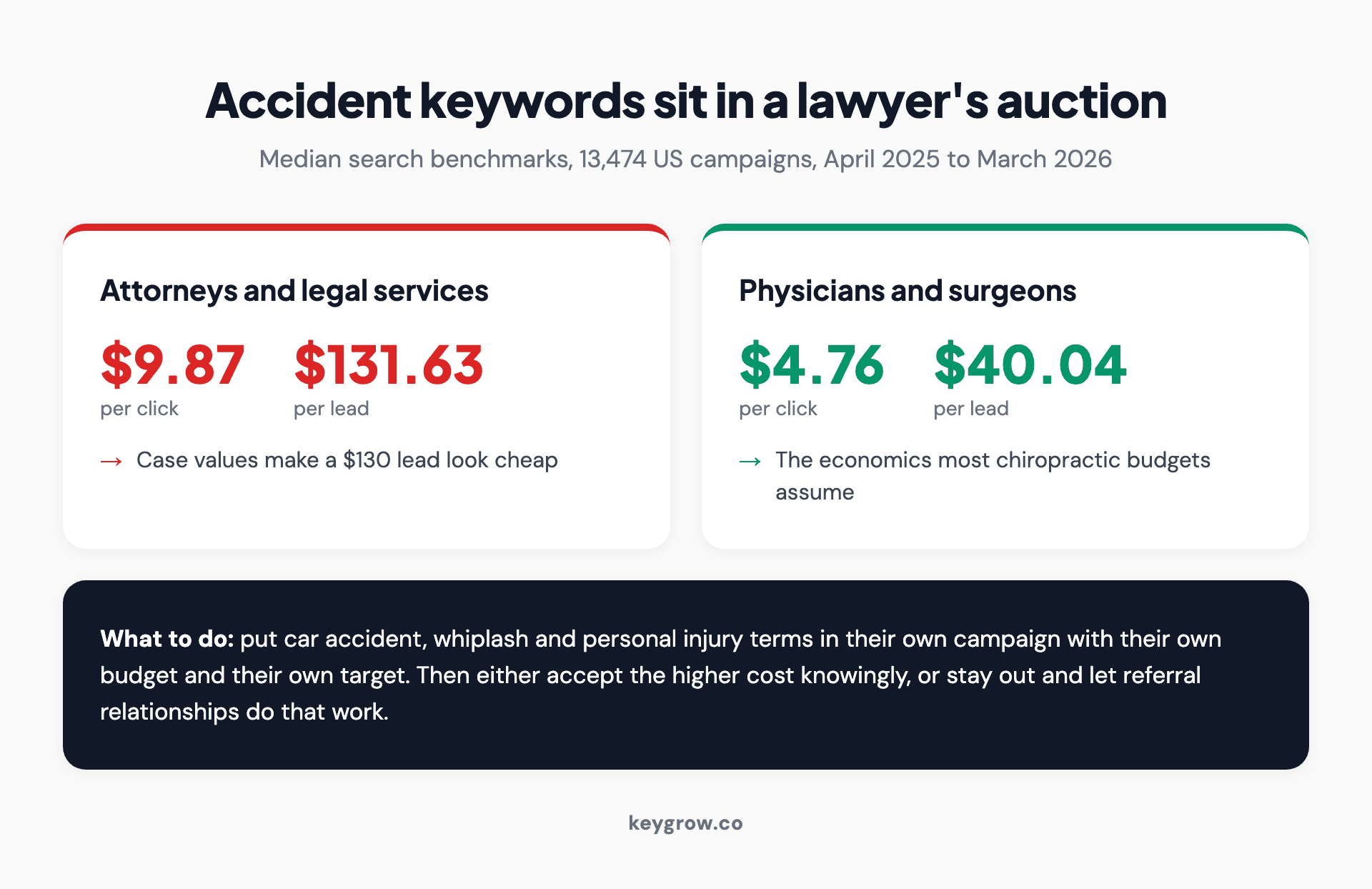
Comparison cards showing that attorneys and legal services pay a median $9.87 per click and $131.63 per lead, against $4.76 and $40.04 for physicians and surgeons.
Searches around car accidents, whiplash and personal injury sit in a neighborhood where the other advertisers are law firms. WordStream's data puts attorneys and legal services at a median $9.87 per click with a tolerable cost per lead of $131.63, against $4.76 and $40.04 for physicians and surgeons. Legal advertisers are working with case values that make a $130 lead look cheap, and their willingness to pay sets the price expectation for everything adjacent to it.
That does not make accident work a bad idea. For plenty of practices it is the highest value patient they see, and the treatment course is longer than a typical back pain case. It does mean you should not fund it out of the same budget as your general chiropractic campaign, and you should not judge it on the same cost per lead.
Split it into its own campaign so the arithmetic stays honest. Then either accept the higher acquisition cost knowingly, because the case supports it, or stay out of the auction and let the referral relationships with attorneys and urgent care clinics do that work instead. Both are defensible. Drifting into it by accident, because a broad match keyword wandered there, is not.
While you are separating things, keep the general searches apart too. Someone typing a symptom is at a different point than someone typing your treatment name, and lumping back pain relief in with chiropractic adjustment gives you one bid and one ad for two different people.
You cannot remarket to your website visitors
This one surprises people, including some of the guides currently ranking for this keyword, several of which recommend building a remarketing campaign as a standard part of a chiropractic account.
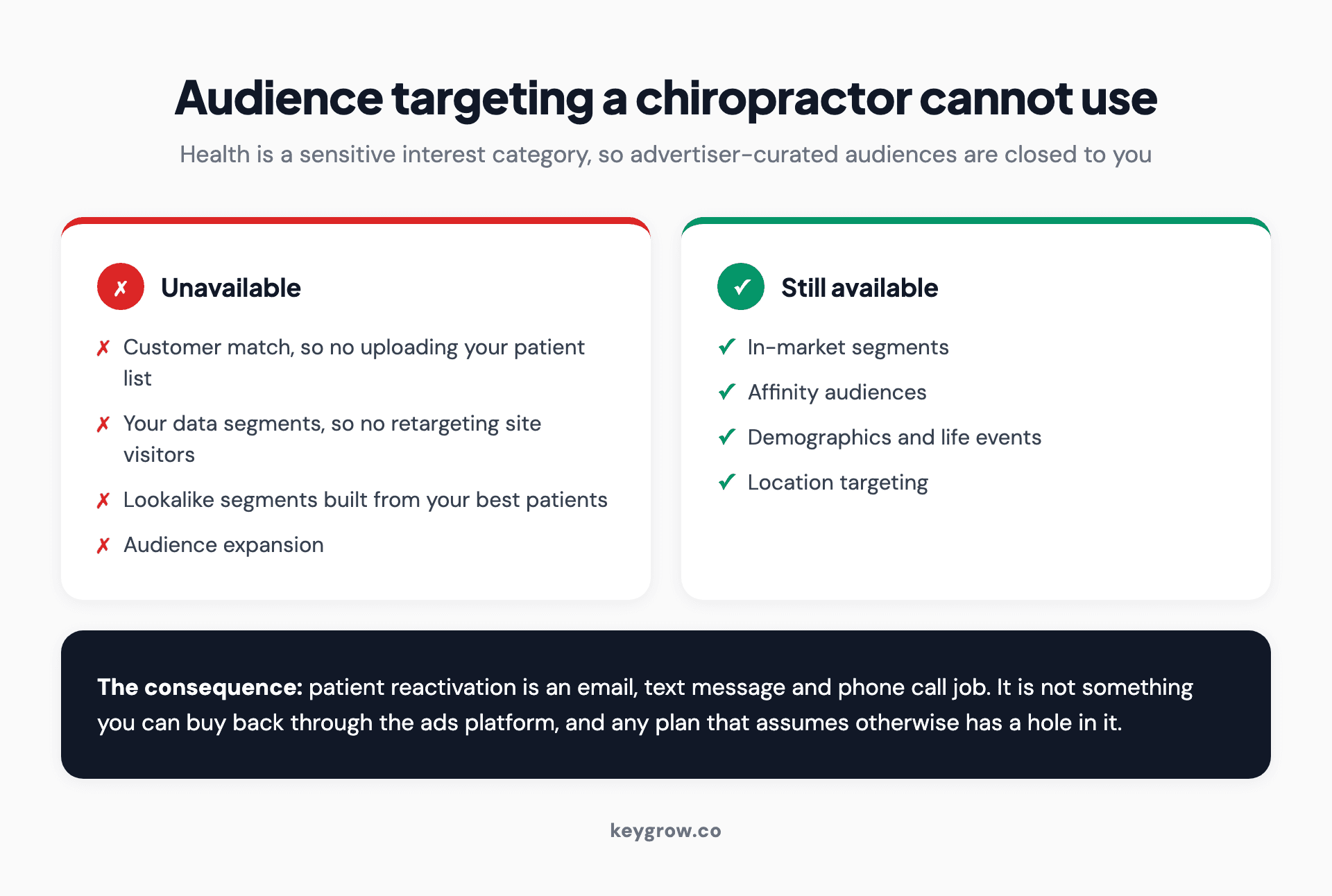
Two-column comparison of the audience targeting options unavailable to chiropractic advertisers, such as customer match and lookalike segments, against the Google-defined audiences that remain available.
Health falls under sensitive interest categories in Google's personalized advertising policy, and advertisers in sensitive categories cannot use advertiser-curated audiences. In practice that rules out customer match, your own data segments, lookalike segments and audience expansion.
So the obvious plays are unavailable. You cannot upload your patient list to win back people who dropped out of a plan. You cannot build a lookalike from your best long-term patients. And the standard advice to retarget everyone who visited your site and did not book does not survive contact with the policy.
What remains are Google's own predefined audiences. In-market segments, affinity audiences, demographics, life events and location targeting are all built to exclude sensitive signals, so they stay open to you.
The consequence is worth stating plainly, because it changes the plan. Patient reactivation in a chiropractic practice is an email, text message and phone call job. It is not something you can buy your way back into through the ads platform, and any strategy that assumes otherwise has a hole in it.
What your landing page has to settle before anyone books
The page carries more weight in chiropractic than in most healthcare categories, because you cannot follow up with an ad if it fails.
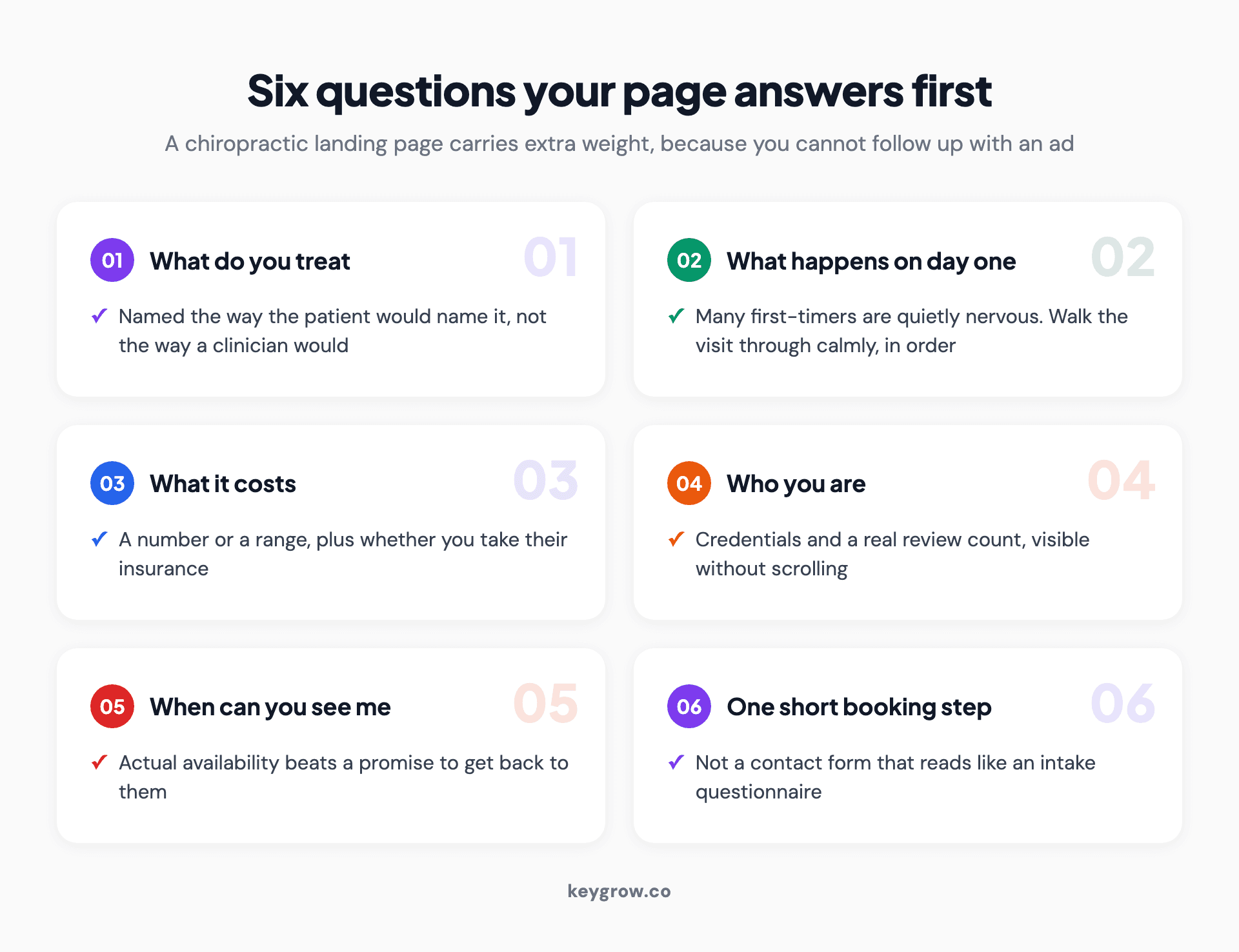
Six cards listing what a chiropractic landing page must answer above the fold: the specific problem treated, what the first visit involves, cost and insurance, credentials, availability, and a short booking step.
An eviction law firm came to us already running ads to an already-built landing page and getting almost nothing back. One conversion a week from 22 clicks, at $240 each. Visitors arrived, could not work out what to do next, and left. We rebuilt the page around a single clear action and restructured the campaigns. Within a week it was 21 conversions from 189 clicks at $31.79. Different field, same failure: the traffic was never the problem.
Six questions your page should answer without the visitor scrolling to find them. What specific problem do you treat, named the way they would name it. What actually happens at a first visit, because a meaningful share of people have never seen a chiropractor and are quietly nervous about it. What it costs and whether you take their insurance. Who you are, with credentials and a real review count. When you can see them. And then one short booking step rather than a contact form that reads like an intake questionnaire.
The nervousness point deserves more space than it usually gets. First-time chiropractic patients often have a vague and slightly alarming idea of what an adjustment involves. A page that walks through the first visit calmly, in order, converts better than one that leads with a discount, and it also pre-sells the plan conversation rather than ambushing people with it.
Track the second visit, not the first
If your conversion action fires on a booked appointment, you are optimizing toward bookings, and Google will get you more of the cheap kind.

A clinician examining a patient's leg during an assessment in a treatment room.
Push the conversion further down wherever your systems allow it. If your practice management software can signal that a patient attended, use attendance rather than booking. Chiropractic no-show rates on discounted first visits are high enough that the difference between the two numbers is often the whole story.
Better still, import an offline conversion when a care plan starts. That is a weekly export and a file upload rather than an engineering job, and it changes what the bidding system is chasing. Once plan starts are the conversion, the algorithm stops hunting for the cheapest booking and starts finding the patients who look like the ones who stayed.
Give it enough volume to work with. A practice generating a handful of plan starts a month does not have enough signal for that to drive automated bidding on its own, so use it as a reporting layer and keep attended visits as the optimization target until the numbers grow.
Phones matter here as well, since a lot of chiropractic booking still happens by voice. If your call tracking records duration, set a minimum length before a call counts as a conversion. Anything shorter is usually a wrong number or an insurance query, and counting those trains the bidding system to go and find more of them.
When a chiropractor should not run Google Ads
Paid search amplifies whatever a practice already does. Sometimes what it amplifies is a problem the ads did not create and cannot solve.
A practice without a working consultation process is the clearest example. If people book, attend, and leave without a clear recommendation, advertising fills a schedule and changes nothing financially. That is a room problem, and no amount of bidding reaches into the room.
A new practice with no reviews is the second. Chiropractic is a trust purchase, and a paid click sends someone to look you up within about ten seconds of landing. A profile with four reviews loses to one with two hundred regardless of how good the ad was. Building the review base costs time rather than money, and the identical clicks convert far better six months later.
A small market with more hours than budget is the last one. Organic local search and the map pack cover a lot of chiropractic demand, and the Google Business Profile costs nothing. Fill it out properly, post to it, ask every patient for a review, and see where that lands you. Advertising is what you add when that ceiling is reached, not what you start with because a competitor did.
FAQs
How much do Google Ads cost for chiropractors?
There is no published chiropractic benchmark in the major datasets. The nearest published figures are physical therapy at $4.95 per click and $32.79 per lead, and the all-industry average at $5.42 and $66.69. Treat the all-industry row as the more realistic reference, because physical therapy patients arrive pre-qualified by a physician referral in a way chiropractic patients do not.
Do Google Ads work for chiropractors?
Yes, when the account is measured on care plan starts rather than booked first visits. The channel reaches people actively searching for relief, which is high intent. The common failure is optimizing toward cheap bookings, which tends to select for patients who take a discounted first visit and never begin a plan.
Should I run a new patient special in my ads?
Test it against a non-discount alternative rather than assuming it wins. Price-led offers reliably increase bookings and often decrease plan starts, and a deep discount anchors the patient on a low number before the plan conversation. Judge both versions on cost per started plan, not cost per new patient.
Can chiropractors use remarketing in Google Ads?
No. Health is a sensitive interest category under Google's personalized advertising policy, so advertiser-curated audiences including customer match, your data segments, lookalike segments and audience expansion are unavailable. Google's own predefined audiences such as in-market segments and life events remain available.
Are car accident keywords worth bidding on?
Sometimes, but budget them separately. Accident-related searches sit next to legal advertisers, who pay a median $9.87 per click and tolerate $131.63 per lead. If your practice treats personal injury cases and the case value supports it, the higher acquisition cost can make sense. Judged against a general chiropractic cost per lead, it never will.
What should my conversion action be?
Something further down the funnel than a booked appointment. Attended visits are better than bookings, and an offline import of care plan starts is better still. Optimizing toward bookings tells the bidding system to find the cheapest possible booking, which is rarely the patient you want.
How long before Google Ads brings in new patients?
Bookings can start within the first week or two, since the search intent is immediate. The number that matters takes longer, because a plan start is a decision made at or after the first visit. Give any judgment about profitability at least a couple of months so the plan starts have time to appear against the spend that produced them.
Do the arithmetic before the ads
Work out one number before you change anything in the account. Take last quarter's new patients from ads, count how many started a plan, and divide your spend by that second figure. Most practices doing this for the first time find their real acquisition cost is three or four times the number they had been quoting.
The second job is smaller. Check whether accident-related searches are sitting in the same campaign as your general terms, because splitting them is what makes either set of numbers readable.
If you would rather hand it over, our PPC management is month to month, and our chiropractic marketing page covers how we approach practices in this field. For the wider compliance picture across healthcare advertising, our guide on whether healthcare businesses should use PPC goes through the policy side in more detail. And for the organic side, including the map pack and the drive radius that decides which patients complete a plan, see our guide to SEO for chiropractors.