

Google Ads for dentists usually fails for a structural reason, not a creative one. A dental practice is not one advertiser. It is three or four, sharing a single account. Someone searching at 11pm with a cracked molar and someone pricing a full-arch implant case have nothing in common except the word dental, and a campaign built to serve both serves neither well.
Split the account by procedure economics and most of the familiar problems go away on their own.
The benchmark data makes that case for us.
Your practice is three advertisers wearing one coat
Emergency, routine and elective dentistry are separate markets. They differ in urgency and in what a case is worth, and the conversion data backs that up. Each one needs its own campaign, funded and measured on its own terms.
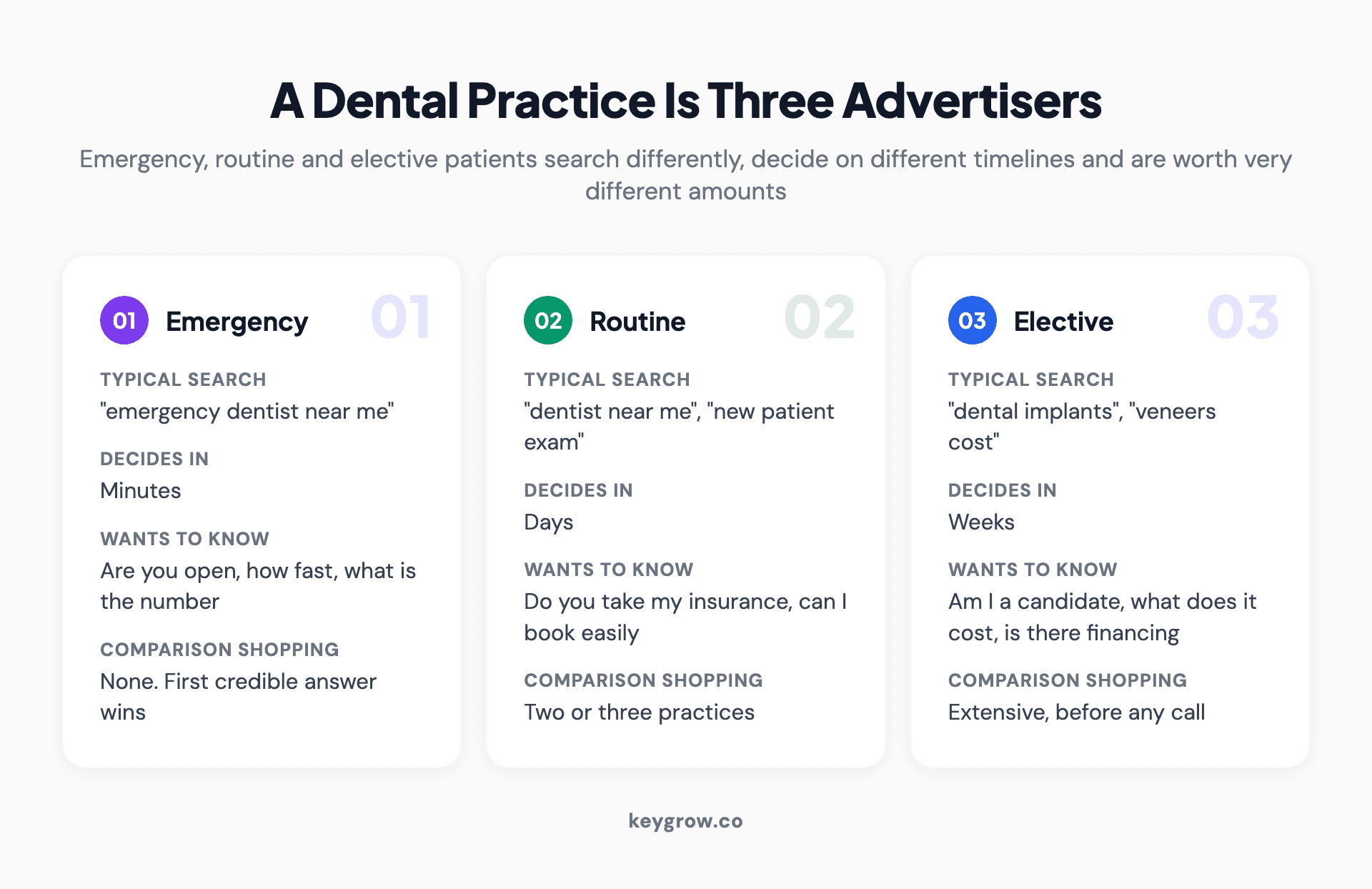
Three-card comparison of emergency, routine and elective dental patients showing what each one searches for, how fast they decide and what they want to know.
Think about what each patient is actually doing at the moment they search.
The emergency patient is in pain and has already decided to pay someone. They are not comparing. They want the first practice that answers the phone and can see them today. Their search happens on a phone, often outside business hours, and the decision takes minutes.
Routine patients arrive for duller reasons. A house move, a new insurance plan, a checkup postponed twice already. They compare two or three practices, check whether you take their plan, and book inside a week.
Then there is the elective patient, weighing aligners, veneers or implants. That is a four-figure to five-figure decision. They research for weeks, ask about financing, and want to know whether they are even a candidate before they pick up the phone.
Same account. Three completely different sales processes.
The benchmark data says these are not one market
Dental search splits cleanly across segments, and the numbers move in directions that surprise most practice owners.
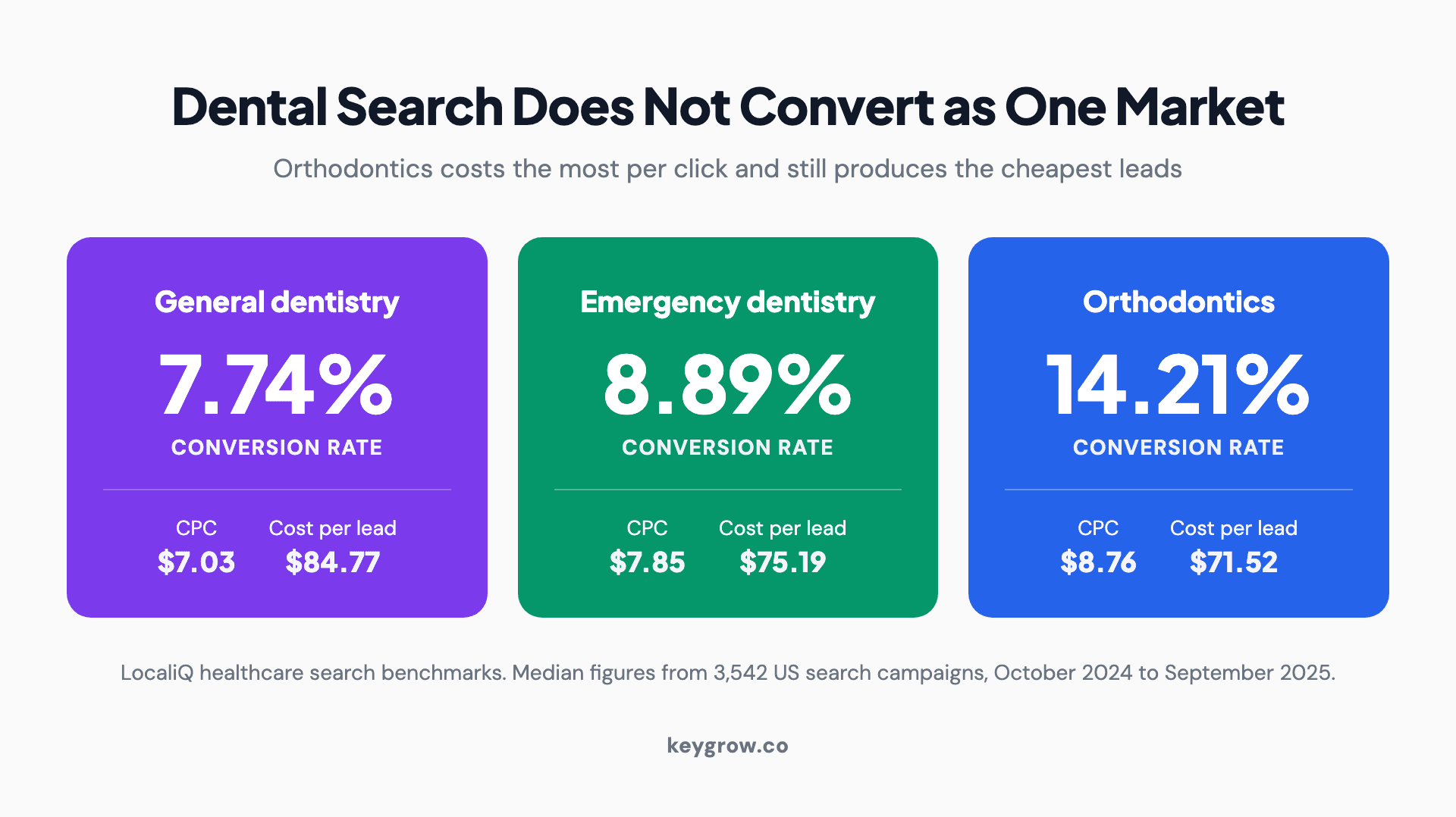
Benchmark cards comparing general dentistry, emergency dentistry and orthodontics on conversion rate, cost per click and cost per lead.
| Segment | Click-through rate | Cost per click | Conversion rate | Cost per lead |
|---|---|---|---|---|
| General dentistry | 5.06% | $7.03 | 7.74% | $84.77 |
| Emergency dentistry | 6.40% | $7.85 | 8.89% | $75.19 |
| Orthodontics | 4.35% | $8.76 | 14.21% | $71.52 |
Those figures come from LocaliQ's healthcare benchmarks, drawn from 3,542 US search campaigns running between October 2024 and September 2025. They are medians rather than averages, so outlier accounts are not dragging them around.
Read the orthodontics row again. It has the worst click-through rate of the three and the highest cost per click, and it still produces the cheapest leads, because it converts at 14.21% against general dentistry's 7.74%. Nearly double.
Emergency runs the other way. It has the highest click-through rate of the three, because people in pain click the first credible result rather than opening six tabs.
Now consider what happens when these share one campaign. General dentistry has the most search volume, so it dominates. Its lower conversion rate sets the account average, its bids get applied to everything, and the segment converting at 14.21% quietly gets under-funded by the segment converting at 7.74%.
Split by procedure economics, not by "dental services"
Build the account around what a case is worth and how fast the patient decides. Those two variables should drive every structural choice you make.
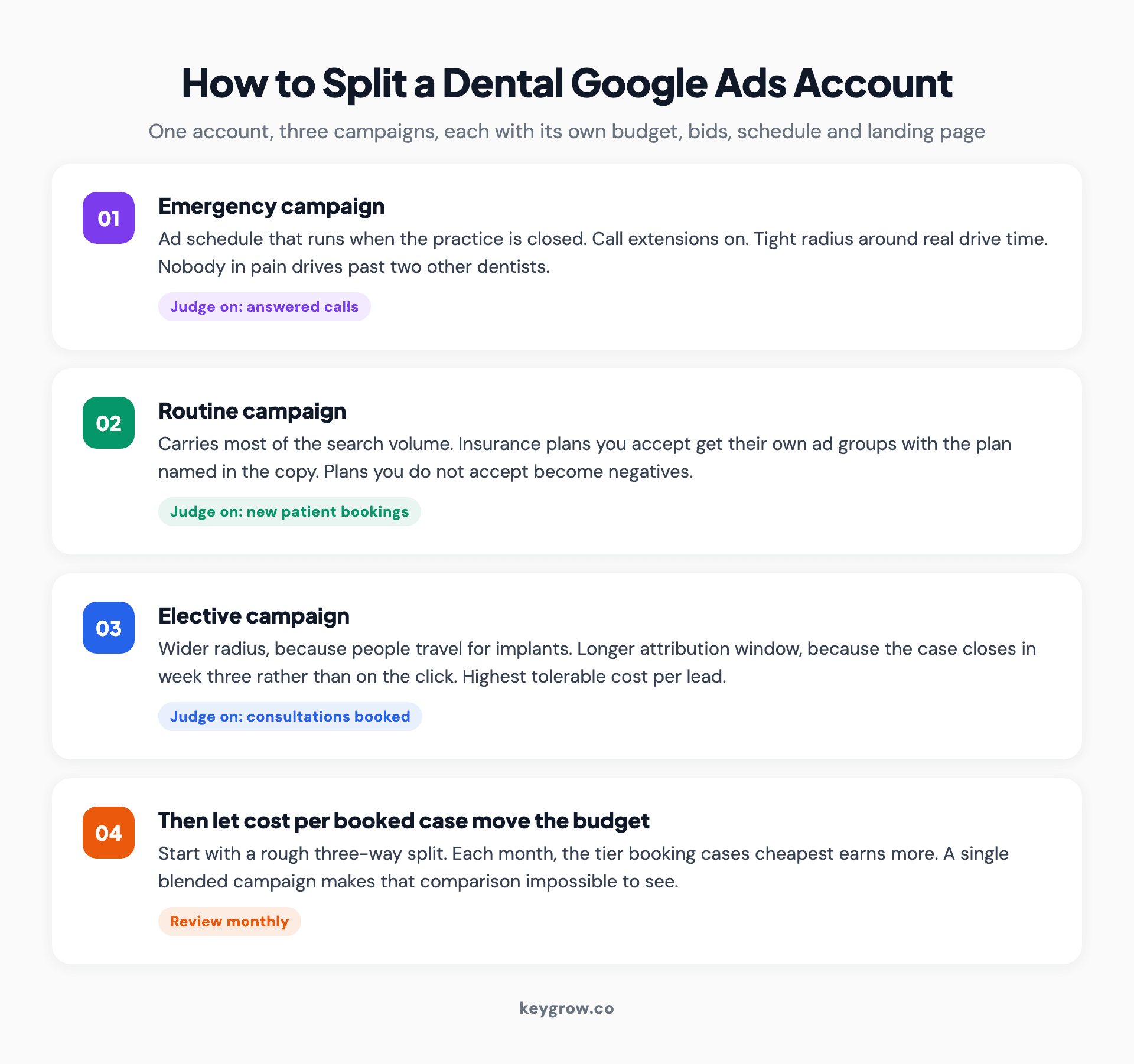
Four-step diagram showing how to split a dental Google Ads account into emergency, routine and elective campaigns and then move budget by cost per booked case.
| Tier | What they search | Decision speed | What the ad must promise |
|---|---|---|---|
| Emergency | emergency dentist near me, tooth pain, broken tooth | Minutes | Open now, same-day appointment, phone number |
| Routine | dentist near me, new patient exam, teeth cleaning | Days | Accepting new patients, insurance accepted, easy booking |
| Elective | dental implants, clear aligners, veneers cost | Weeks | Case examples, financing, free consult, candidacy |
Once the tiers are separate, the settings can finally disagree with each other, which is the whole point.
Emergency campaigns want ad schedules that run when practices are closed, call extensions turned on, and location targeting drawn tight around your actual drive time. Nobody in pain drives forty minutes past two other dentists.
Elective campaigns need almost none of that. Wider radius, because people travel for implants. Longer attribution windows, because the case closes in week three, not on the click. And bid strategies that are not being judged on a seven-day conversion lag.
Routine campaigns sit in the middle and carry most of the volume, which is exactly why they should not be allowed to set the pace for everything else.
Budget follows the same logic. Most practices we audit have it backwards, with the majority of spend sitting in general dentistry because that is where the impressions are. Impressions are not the constraint. Chair value is. If your elective tier converts at nearly double the rate and each case is worth twenty times a hygiene visit, it can carry a lot more budget than its search volume suggests, right up until you saturate the available demand.
Start with a rough three-way split, then let cost per booked case move it. The tier that books cases cheapest gets more next month. That sounds obvious written down, and almost nobody does it, because a single blended campaign makes the comparison impossible to see.
Each tier needs its own page, and this is where the money leaks
Sending all three tiers to your homepage is the most expensive default in dental PPC. The homepage has to introduce the practice, list every service, show the team and handle three patient types at once, so it does none of them well.
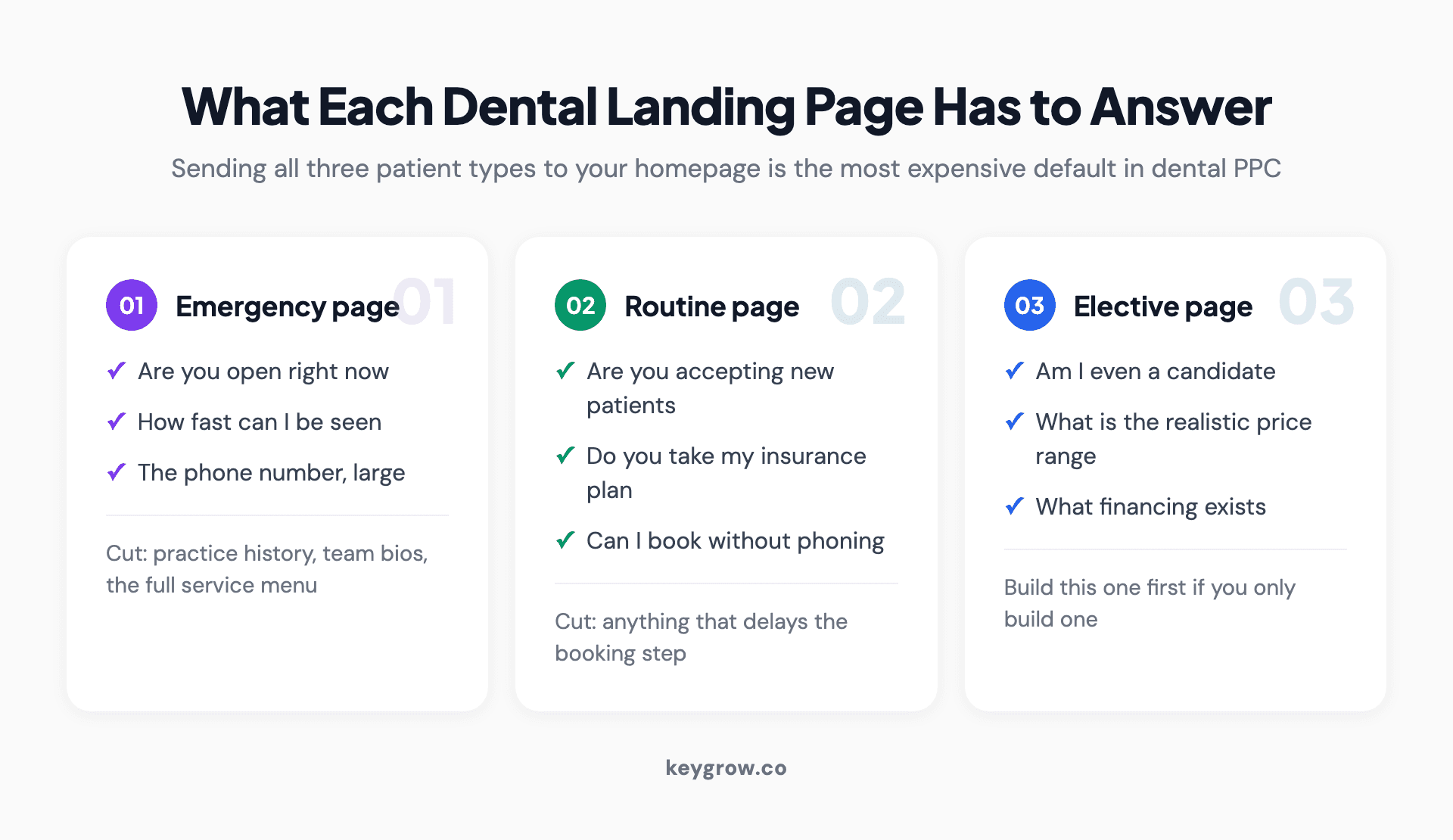
Three cards setting out what an emergency, routine and elective dental landing page each has to answer, and what to cut from each.
We had a mobile detailing client paying around $100 per booking, sending every click to their homepage. Different industry, identical mistake. We rebuilt the campaign structure and pointed the traffic at a dedicated booking page. Cost per conversion went to $22 and bookings grew 650% between August and December.
An emergency page should be almost aggressive in its simplicity: are you open, how fast can you see me, what is the number. No practice history, no team bios, no service menu.
An implant page has the opposite job. It has to answer whether the patient is a candidate, what the range costs, what the timeline looks like and what financing exists, because a five-figure decision does not get made from a form with three fields.
If you only have budget to build one dedicated page, build the elective one. It carries the highest case value and the longest consideration window, so it has the most to gain from doing the persuasion work properly.
Insurance searches are quietly draining your general campaign
Dental has a query class that most industries do not: people searching for a practice that takes their specific plan. Handled well, those are qualified patients telling you their insurance before they call. Handled badly, they are the single biggest source of wasted spend in a general dentistry campaign.
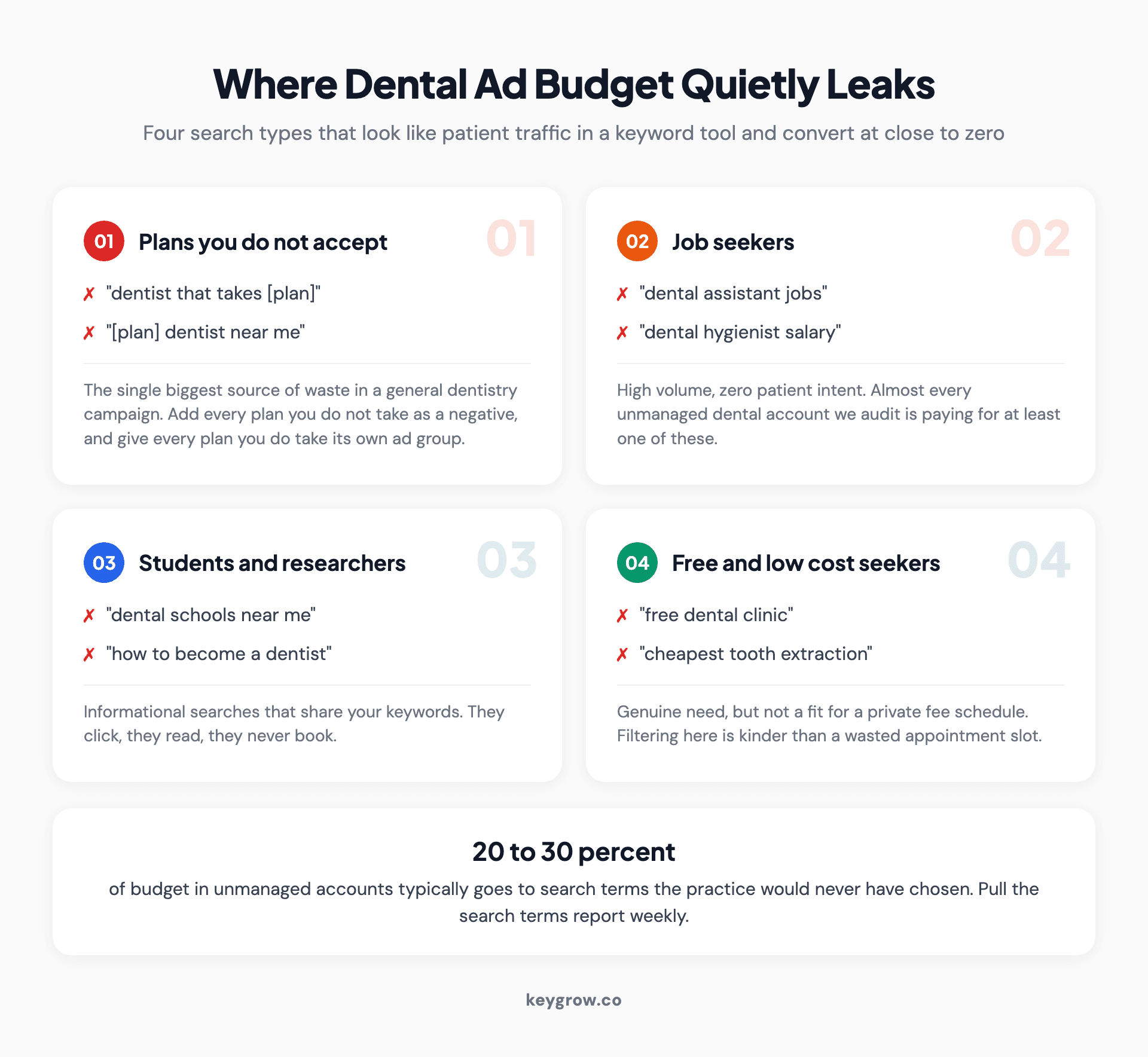
Four cards showing where dental ad budget leaks: insurance plans you do not accept, job seekers, students and free clinic searches.
Broad match without negative keywords is a donation to Google. In unmanaged accounts we typically find 20 to 30 percent of budget going to search terms the practice would never have chosen, and in dental a large share of that is insurance traffic for plans the practice does not accept.
The fix is not complicated, it is just unglamorous. Pull the search terms report weekly. Add every plan you do not take as a negative. Add every plan you do take as its own tightly matched ad group, with the plan named in the ad copy, because that ad will out-convert a generic one every time.
While you are in there, negative out the queries that look like patients and are not: dental assistant jobs, dental schools, free dental clinic, dentist salary. Every account we audit has at least two of those running live.
Write ads that turn the wrong patients away
The instinct in a competitive auction is to write the broadest, friendliest ad possible so nobody is put off. That instinct costs dental practices a lot of money, because you pay for every click regardless of whether the person was ever going to book.

A dental treatment room with the chair and equipment ready for the next patient.
Qualifying copy does the filtering before the click, which is the only place filtering is free.
Name the insurance plans you accept, in the ad. A patient on a plan you take is more likely to click, and a patient on a plan you do not take is less likely to, which is exactly the trade you want. Name your price floor on elective work if you have one. "Implant consultations from" with a real number will cost you clicks from people shopping on price alone, and those were never going to become cases.
For emergency, state the availability plainly. "Same-day appointments" and "open until 8pm" both qualify and reassure at once. A patient in pain reading "quality dental care since 1998" is already back on the results page.
The counter-argument is that qualifying copy lowers click-through rate, and it does. That is the point. Click-through rate is not a business outcome. Watch what happens to cost per booked case instead, which is usually the only number that moves in the right direction.
One caution. Do not put claims in ad copy that your landing page does not immediately back up. If the ad promises same-day and the page says "request an appointment and we will get back to you within two business days", you have bought a click and broken the promise in the same breath.
Local Services Ads behave differently for a dental practice
Dentists and orthodontists are both eligible for Local Services Ads, and the format is worth having, but it does not work the way it does for a plumber.
Google lists dentist and orthodontist among the eligible categories, so you can run the Google Guaranteed badge above the regular search results. What you cannot do is take bookings inside the ad. Booking leads are not available for healthcare verticals, so the format delivers calls and messages only.
That matters more than it sounds. The entire pitch of Local Services Ads elsewhere is that the customer books without ever reaching your website. For a dental practice, the ad still hands the patient to your front desk, which means your phone answering process is the conversion mechanism whether you planned for that or not.
Practices that run Local Services Ads well treat it as a call channel and staff it accordingly. Practices that treat it as a set-and-forget listing pay for calls that ring out at lunchtime.
Your patient list cannot become a remarketing audience
This one catches practices out constantly, usually after they have already built the list.
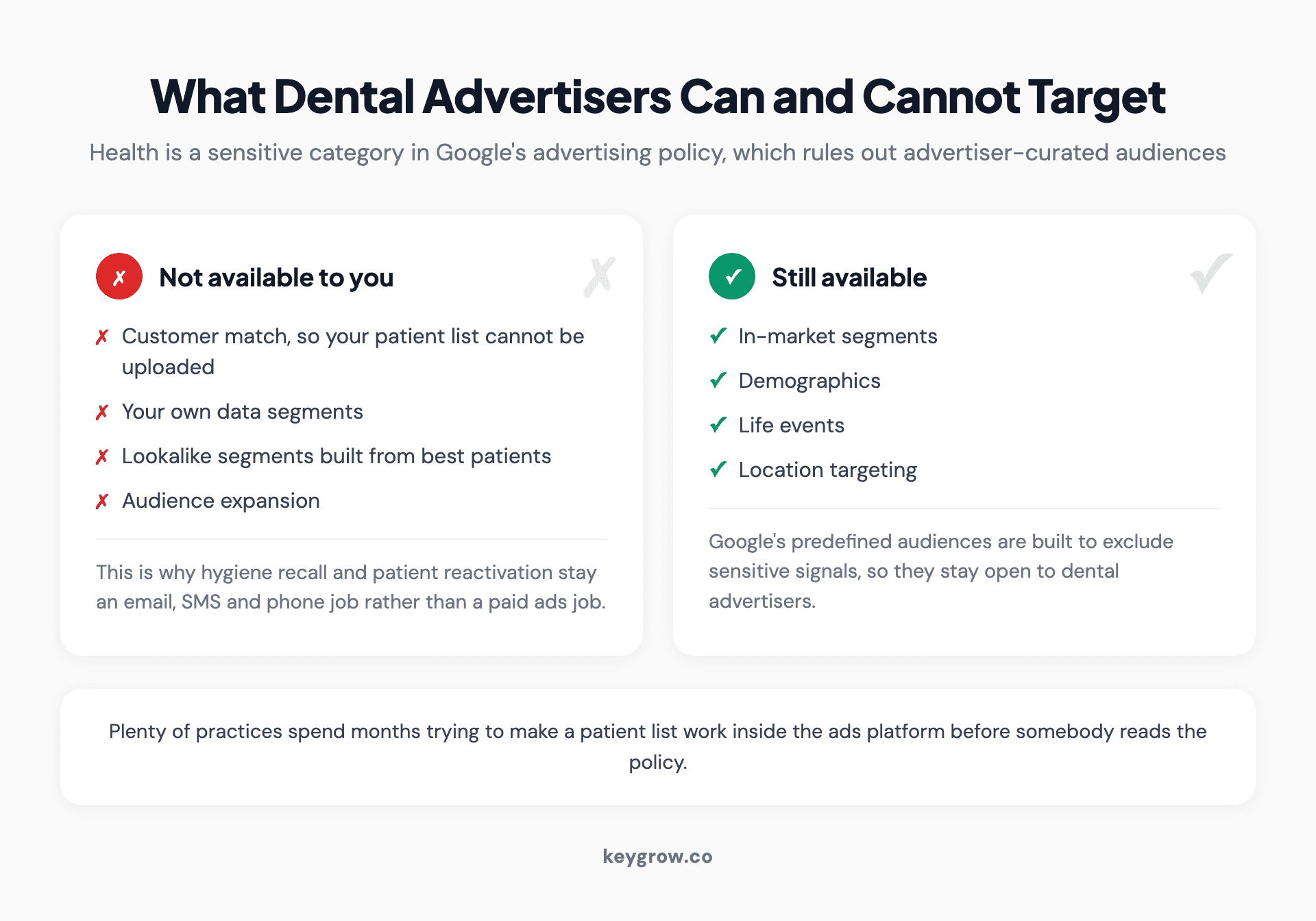
Two-column comparison of the audience types dental advertisers cannot use, such as customer match and lookalikes, against the predefined Google audiences that remain available.
Health is a sensitive category under Google's advertising rules, and advertisers in sensitive categories cannot use advertiser-curated audiences. In practice that means customer match, your own data segments, lookalike segments and audience expansion are all unavailable. Google's personalized advertising policy sets this out directly.
So the obvious recall play, uploading your patient list to re-engage everyone overdue for a hygiene visit, is not something Google Ads will let you do. Neither is building a lookalike from your highest-value implant patients.
What you can still use are Google's own predefined audiences: in-market segments, demographics, life events and location targeting. Those are built to exclude sensitive signals by design, so they stay available.
The practical consequence is that patient reactivation is an email, SMS and phone job for a dental practice, not a paid ads job. Plenty of practices spend months trying to make it work in the ads platform before somebody reads the policy.
Each tier needs its own definition of a good month
A single account-wide cost per lead is close to meaningless in dental, because the three tiers cannot be compared on it. An $80 lead is expensive for a hygiene appointment and almost free for an implant consultation.
Set a separate target for each tier, worked backwards from case value and your realistic close rate.
Take the elective tier. If a case is worth several thousand dollars and your treatment coordinator closes roughly one consultation in three, you can afford a cost per consultation many times higher than the general dentistry benchmark and still be comfortably ahead. Practices that judge that campaign against the account average switch it off in month two, which is the most common self-inflicted wound we see in dental accounts.
Routine runs on different arithmetic. Volume is high, margins per visit are thin, and lifetime value is the whole argument. A new routine patient is worth the recall visits that follow, so the tolerable acquisition cost is higher than a single cleaning suggests, but only if the practice actually runs recall properly.
Emergency sits somewhere in between, with the added wrinkle that a meaningful share of those patients never return. Price it as a one-off unless you have evidence otherwise in your own records.
None of this requires new software. It requires the campaigns to be separate enough that the report can tell you which one earned its money.
When a practice should not run Google Ads
We turn this work away more often than you would expect, and there are three clear cases.
If your schedule is already full six weeks out, ads will buy you patients you cannot see. Fix capacity first, or use the budget on the elective tier only, where a longer wait is normal and the case value justifies it.
If nobody answers the phone reliably, do not start. Emergency and routine dental traffic converts by phone. An unanswered call is a patient who is already dialling the next practice, and you paid for that click. Sort out call coverage, then advertise.
And if you are a single-location practice with more time than money, claim your Google Business Profile, get your review count up and fix your site basics before paying anyone, including us. All of that matters for local dental search and costs nothing but your time. Hire help when the value of your time beats the fee. Our SEO vs Google Ads comparison for dentists walks through which channel to start with if you are genuinely choosing one.
FAQs
How much should a dental practice spend on Google Ads per month?
Enough to buy a meaningful number of clicks in your most valuable tier, which usually means at least a few hundred clicks a month. At a general dentistry cost per click near $7.03 and a conversion rate near 7.74%, small budgets produce too few conversions for the bidding to learn anything. We break the numbers down properly in our guide to Google Ads cost for dentists.
Should I run one campaign or several?
Several. At minimum, separate emergency, routine and elective into their own campaigns. They convert at different rates and on different timelines, and a shared campaign forces one bid strategy to cover all of it.
Do Google Ads work for dentists?
Yes, and dental converts better than most industries. Orthodontics converts at 14.21% and emergency dentistry at 8.89% in LocaliQ's benchmark data, against a cross-industry search average well below that. The failure cases are usually structural, not a sign the channel does not work.
Can I use my patient list for remarketing?
No. Health is a sensitive category in Google's advertising policy, so customer match, lookalike segments and audience expansion are unavailable to dental advertisers. Patient reactivation has to run through email, SMS or phone instead.
Are Local Services Ads worth it for a dental practice?
Often yes, but treat it as a call channel. Dentists and orthodontists are eligible categories, though booking leads are disabled for healthcare, so patients reach your front desk rather than booking inside the ad.
What keywords waste the most dental ad budget?
Insurance plans you do not accept, job seekers searching for dental assistant or hygienist roles, students looking for dental schools, and people searching for free or low-cost clinics. All four look like patient traffic in a keyword tool and convert at close to zero.
How long before Google Ads produces new patients?
Emergency and routine traffic can produce calls in the first week. Elective cases take longer, often three to six weeks from click to consultation, because the patient is researching a four-figure or five-figure decision. Judge the elective tier on a longer window or you will switch it off before it reports.
What to fix first
Open your search terms report and read the last thirty days. That single exercise usually explains the account better than any dashboard, and it is where the insurance and job-seeker waste is hiding.
Then check whether emergency, routine and elective are sharing a campaign. If they are, separating them is the highest-return structural change available to a dental account, and it costs nothing but an afternoon.
If you would rather have someone run it, our PPC management team works month-to-month, and our dental marketing page covers how we approach practices specifically. If you are still deciding whether to bring in help at all, our guide on choosing a dental Google Ads agency lists the questions worth asking first.