

Yes, healthcare businesses should use PPC when they offer urgent or high-value services, patients actively search for what they provide, and their tracking is set up to stay compliant. For a dentist, dermatologist, urgent care clinic, or physical therapist, paid search puts you in front of someone deciding right now who to call. It is a poor fit for low-margin, low-search-volume, or heavily restricted services, and it carries HIPAA and Google policy risks the hype articles gloss over.
Most guides on this question are written by agencies and answer with an unbroken yes. This one gives you the real decision framework: what it costs, where the compliance landmines are, which niches it suits, and when to skip it. Healthcare is the one industry where the ad platform's own rules can sink you, so the honest version matters more here than anywhere.
Why patients make this worth considering
Patients research providers online before they ever call, and reviews and search now outrank word of mouth for many of them. That is demand you can capture the moment it appears.
The behavior shift is real and measured. In a 2025 survey of just over a thousand US adults, rater8 found that 84 percent of patients check online reviews before choosing a new provider, 61 percent said a personal recommendation would not necessarily sway them if they saw bad reviews for a provider, and more than a quarter said they are considering changing providers this year. People are actively shopping for care on search engines, and a well-placed ad meets them at the exact moment of intent.
That intent is the whole argument for healthcare PPC. Someone searching "emergency dentist open now" or "physical therapy for rotator cuff near me" has a problem and a wallet out. You are not creating demand, you are capturing it.

A doctor typing at a computer in a bright modern medical office.
What healthcare PPC actually costs
Medical clicks are not cheap, but healthcare conversion rates are among the highest anywhere, so the cost per lead often lands lower than you would expect.
Real 2026 numbers from WordStream's benchmarks, drawn from thousands of US campaigns:
| Specialty | Avg cost per click | Conversion rate | Cost per lead |
|---|---|---|---|
| Physicians and surgeons | $4.76 | 12.43% | $40.04 |
| Dentists and dental | $8.00 | 10.67% | $72.97 |
| Health and fitness | $6.17 | 6.94% | $67.36 |
Notice the conversion rates. Physicians convert search clicks at 12.43 percent, roughly one and a half times the 8.18 percent cross-industry average, because health searches carry urgent intent. That high conversion rate is what keeps the cost per lead reasonable even when clicks are expensive.
But a cost per lead only means something next to what a patient is worth. A $73 dental lead looks steep beside a $6 e-commerce lead, until you remember a single implant case or a family that stays with the practice for a decade. Healthcare PPC pencils out not despite high costs but because patient lifetime value is so large. Run that comparison, not the raw click price, when you judge whether it is worth it.
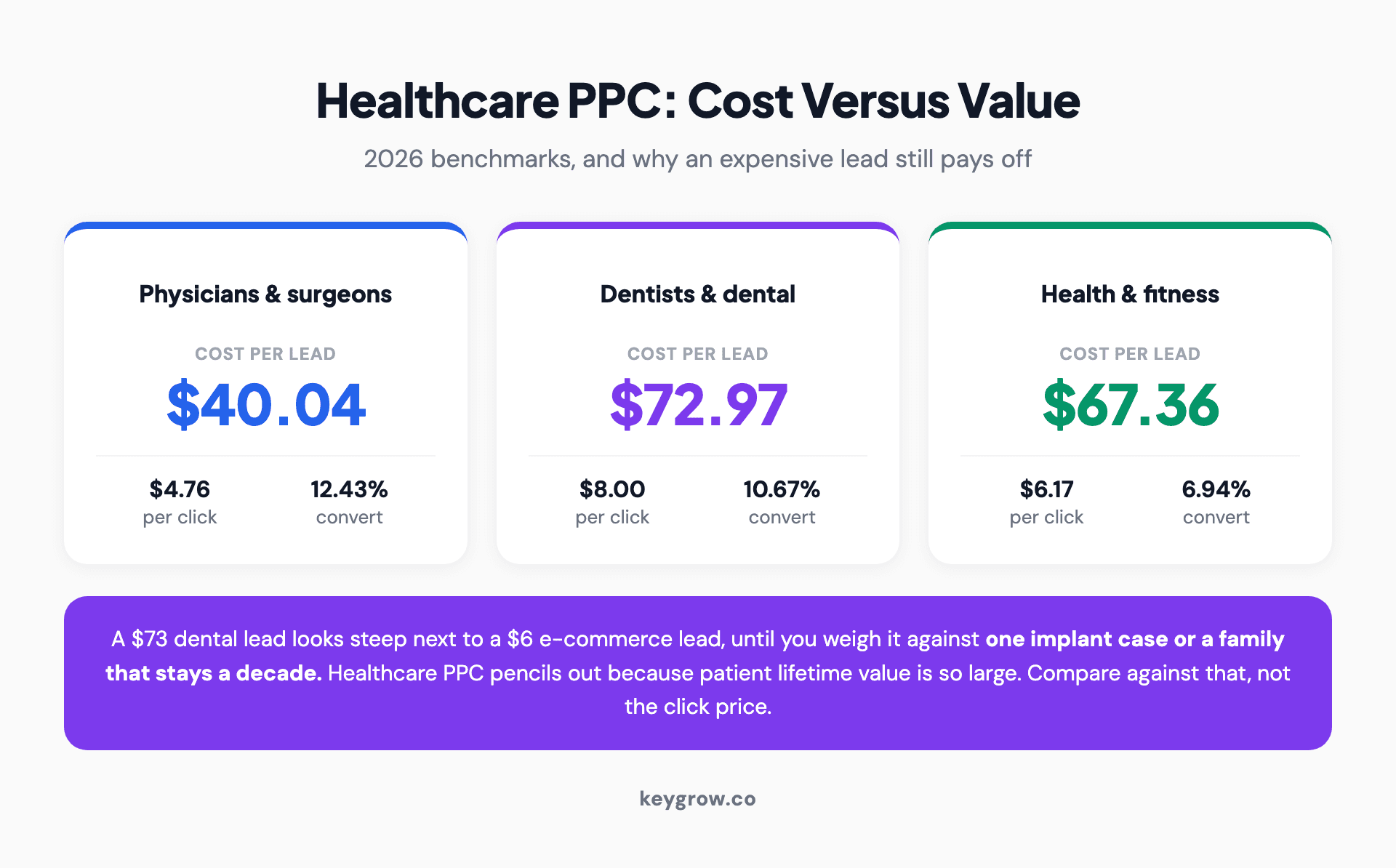
Comparison showing healthcare PPC benchmarks by specialty alongside the point that a high patient lifetime value makes a seemingly expensive cost per lead worthwhile.
The compliance reality nobody explains clearly
Google treats health as a sensitive category, which blocks the audience targeting other advertisers rely on, and Google will not sign a HIPAA agreement for its ad tools. The risk sits on your website, not in the ad.
This is the section the sales-pitch guides skip, and it is the one that can actually get you in trouble.
Google restricts health targeting. Under Google's health advertising policy, you cannot use remarketing, Customer Match, similar audiences, or lookalike targeting to promote sensitive health content, because those tools could infer someone's medical condition. A May 2025 update actually eased one corner of this, clarifying that you may use Customer Match and remarketing to reach licensed healthcare professionals in their professional capacity, but the core prohibition on targeting patients by sensitive health condition stands. So the common advice to "remarket to past visitors" is, for many patient-facing health services, against the rules. You compete on keywords and location, not on audience data.
Google does not make its ad tools HIPAA compliant. Google does not sign a Business Associate Agreement for Google Analytics or Google Ads, and it states plainly that no protected health information should be passed to it. The compliance burden is yours, and it lives at the website level: a tracking pixel or a conversion tag that captures a form field, a URL parameter, or an appointment detail can leak protected information to Google without you realizing. The fix is server-side tracking and careful configuration so that nothing identifiable ever reaches the ad platform. This is a real project, not a checkbox, and it is the single biggest reason to bring in help who has done it before.
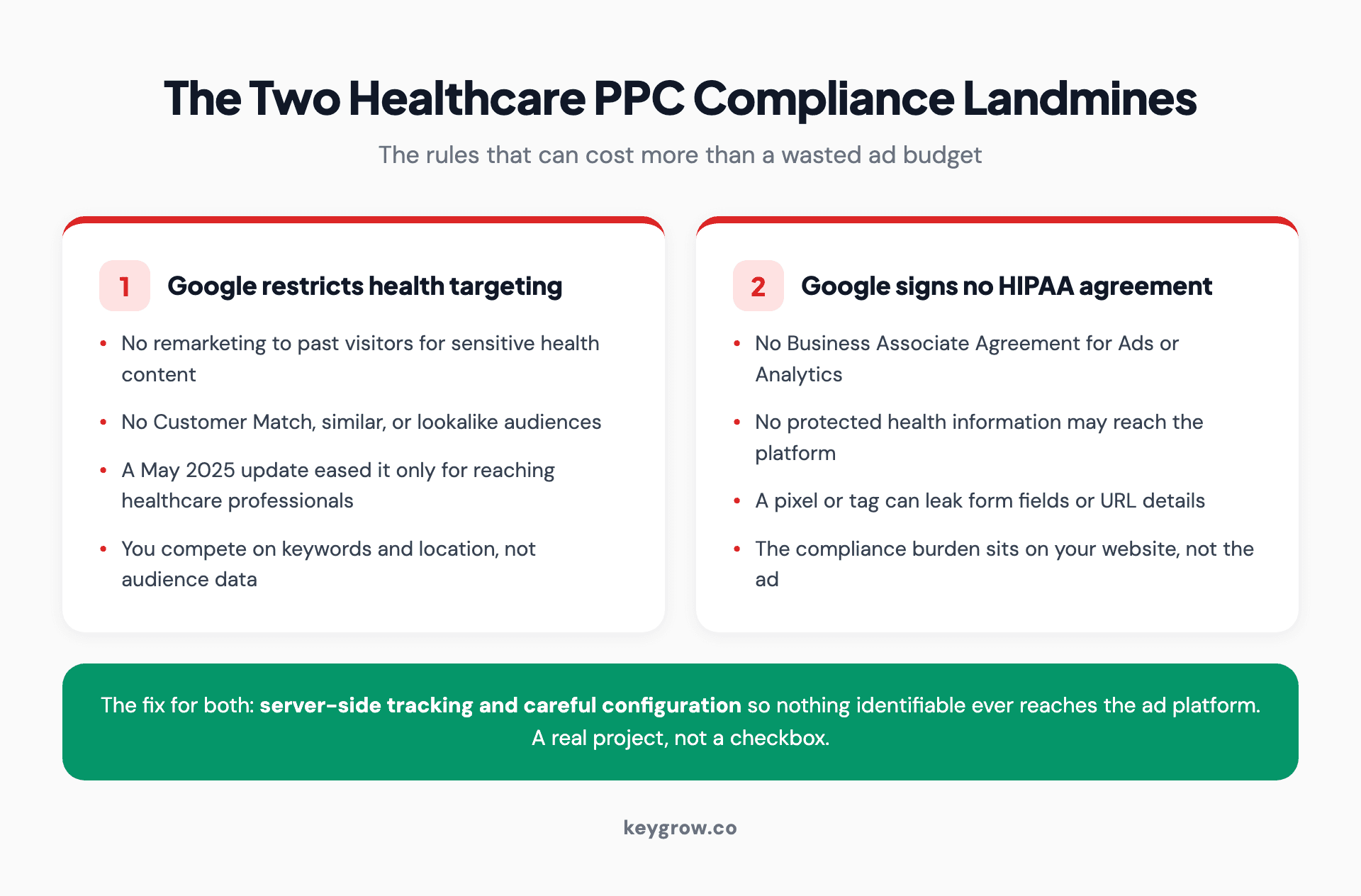
Two-part explainer of healthcare PPC compliance: Google blocks audience targeting for sensitive health content, and Google signs no HIPAA agreement, so protected information must be kept off the ad platform through server-side tracking.
Restricted and certification-gated services
Some health verticals cannot advertise on Google without a formal certification, and a few cannot advertise at all. Know which bucket you are in before you plan a budget.
Online pharmacies, telemedicine, and addiction-treatment providers must earn certification, usually through LegitScript, before Google will run their ads. That certification is not cheap or fast: it commonly runs several thousand dollars up front plus an annual monitoring fee, and typically clears in about four to six weeks when documentation is complete, longer if there are gaps. Google also prohibits ads outright for certain medical products and services in some regions. If you are in one of these categories, factor the certification cost and timeline into your decision, or the plan stalls before launch.
For most everyday practices, dental, derm, PT, primary care, med spa, you are not in the gated group and can advertise normally, within the targeting limits above.
PPC, Local Services Ads, or SEO: which lever fits
Search ads buy speed, Local Services Ads offer pay-per-lead simplicity for eligible verticals, and SEO compounds over time. Most practices should not treat these as either-or.
Three levers, three jobs:
- Search PPC is best for urgent, high-intent, high-value services where being at the top the moment someone searches wins the patient. You pay per click and control the message tightly.
- Local Services Ads are worth checking first for eligible verticals, which now include dentists, dermatologists, optometrists, orthodontists, physical therapists, chiropractors, and primary care, among others. You pay per lead rather than per click and appear above the regular ads with a Google Verified badge, the unified badge that replaced Google Screened and Google Guaranteed in October 2025. For many local practices this is cheaper and simpler than standard search.
- SEO compounds. It is slower to start but keeps producing without a per-click fee once it holds. We took a doctor's practice in Dubai from a standing start to 1,519 percent organic traffic growth and 130-plus patient calls a month over twelve months, all organic. Paid buys you patients today; organic builds the asset that lowers your blended cost over years. The strongest practices run paid for speed and organic for durability.
Which healthcare niches PPC suits, and which it does not
PPC works best for urgent, high-value, freely-advertisable services with real search demand. It struggles for restricted categories, ultra-low-margin services, and anything patients do not search for.
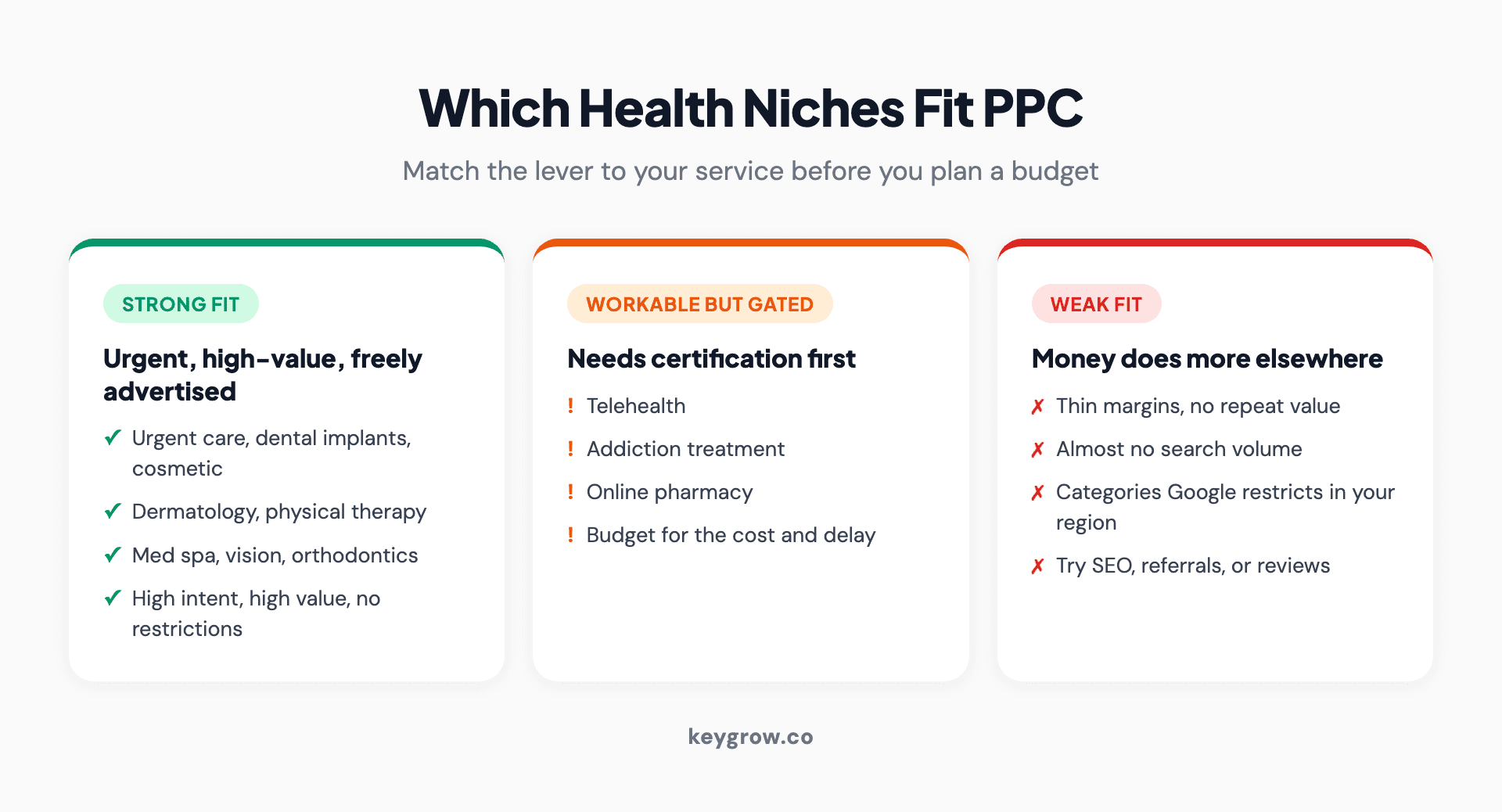
Decision matrix of which health niches fit PPC: strong fit for urgent high-value services, workable but gated for telehealth and addiction treatment, weak fit for thin-margin or low-search-volume services.
A quick decision matrix:
- Strong fit: urgent care, dental (especially implants and cosmetic), dermatology, physical therapy, med spa, vision, orthodontics. High intent, high value, no advertising restrictions.
- Workable but gated: telehealth, addiction treatment, online pharmacy. PPC can perform, but only after certification, so budget for the cost and delay.
- Weak fit: services with thin margins and no repeat value, niches with almost no search volume, or anything Google restricts in your region. Here your money usually does more in SEO, referrals, or reputation building.
If you land in the strong-fit group with compliant tracking in place, PPC is very likely worth it. If you are gated or a weak fit, the honest move is to fix the blocker or pick a different channel.
FAQs
Should healthcare businesses use PPC?
Yes, if you offer urgent or high-value services that patients actively search for and your tracking is set up to stay compliant. It is a poor fit for restricted categories, ultra-low-margin services, or niches with little search demand, where SEO or Local Services Ads often work better.
Is Google Ads HIPAA compliant?
Google does not sign a Business Associate Agreement for Google Ads or Google Analytics and states that no protected health information should be sent to it. Compliance is your responsibility and lives at the website level, which usually means server-side tracking so that no identifiable patient data ever reaches the ad platform.
How much does healthcare PPC cost?
Clicks run roughly $4.76 for physicians, $6.17 for health and fitness, and $8.00 for dentists in 2026 benchmarks, with cost per lead between about $40 and $73. High patient conversion rates keep the cost per lead lower than the click prices suggest, and patient lifetime value is what makes the math work.
Can medical practices use remarketing on Google Ads?
Usually no, for sensitive health services. Google's health advertising policy blocks remarketing, Customer Match, and similar-audience targeting when the content could reveal a medical condition, because those tools might infer sensitive information. You generally compete on keywords and location instead of audience data.
What health services cannot be advertised on Google?
Online pharmacies, telemedicine, and addiction treatment require certification, typically through LegitScript, before ads can run. Google also prohibits ads for certain products and services outright in some regions, such as some reproductive and at-home testing categories. Everyday practices like dental, derm, and PT can advertise normally within the targeting limits.
Does PPC or SEO work better for healthcare?
They do different jobs. PPC captures patients searching right now and works from day one, while SEO compounds over months into durable, lower-cost traffic. Most practices are best served running both, using paid for immediate appointments and organic to build a lasting presence that reduces overall acquisition cost.
The honest verdict
Healthcare PPC is worth it for the many practices that offer services patients urgently search for, can absorb a lead cost that looks high until you weigh it against patient value, and are willing to set up compliant tracking. It is not a fit for restricted categories without certification, for services nobody searches for, or for anyone who treats the compliance side as an afterthought.
The compliance piece is what separates healthcare from every other industry here, and it is where a wrong setup can cost far more than a wasted ad budget. If you want a team that has run healthcare accounts inside these rules, our team will map your niche, your numbers, and your tracking before you spend, month-to-month. Speed from paid, durability from organic, and not a dollar spent until the compliance groundwork is right.