

Google Ads for doctors is cheaper than the average business pays, not more expensive. Physicians and surgeons average $4.76 per click and $40.04 per lead, against an all-industry average of $5.42 and $66.69. That is a lower click price and a cost per lead about 40 percent below the norm.
This surprises almost everyone, including a lot of doctors who have been told medical advertising is a money pit.
The reason is not that clicks are cheap. It is that the people clicking are unusually ready to book. Physician campaigns convert at 12.43 percent against an all-industry 8.18 percent, and a conversion rate half again as high drags the cost per patient down with it.
Where medical advertising does get expensive is at the specialty level, and the gap between specialties is far wider than the gap between medicine and any other industry. That distinction is the whole planning problem, and most guides skip it.
Doctors pay less per lead than the average advertiser
Four benchmark numbers, and physicians beat the all-industry figure on three of them.
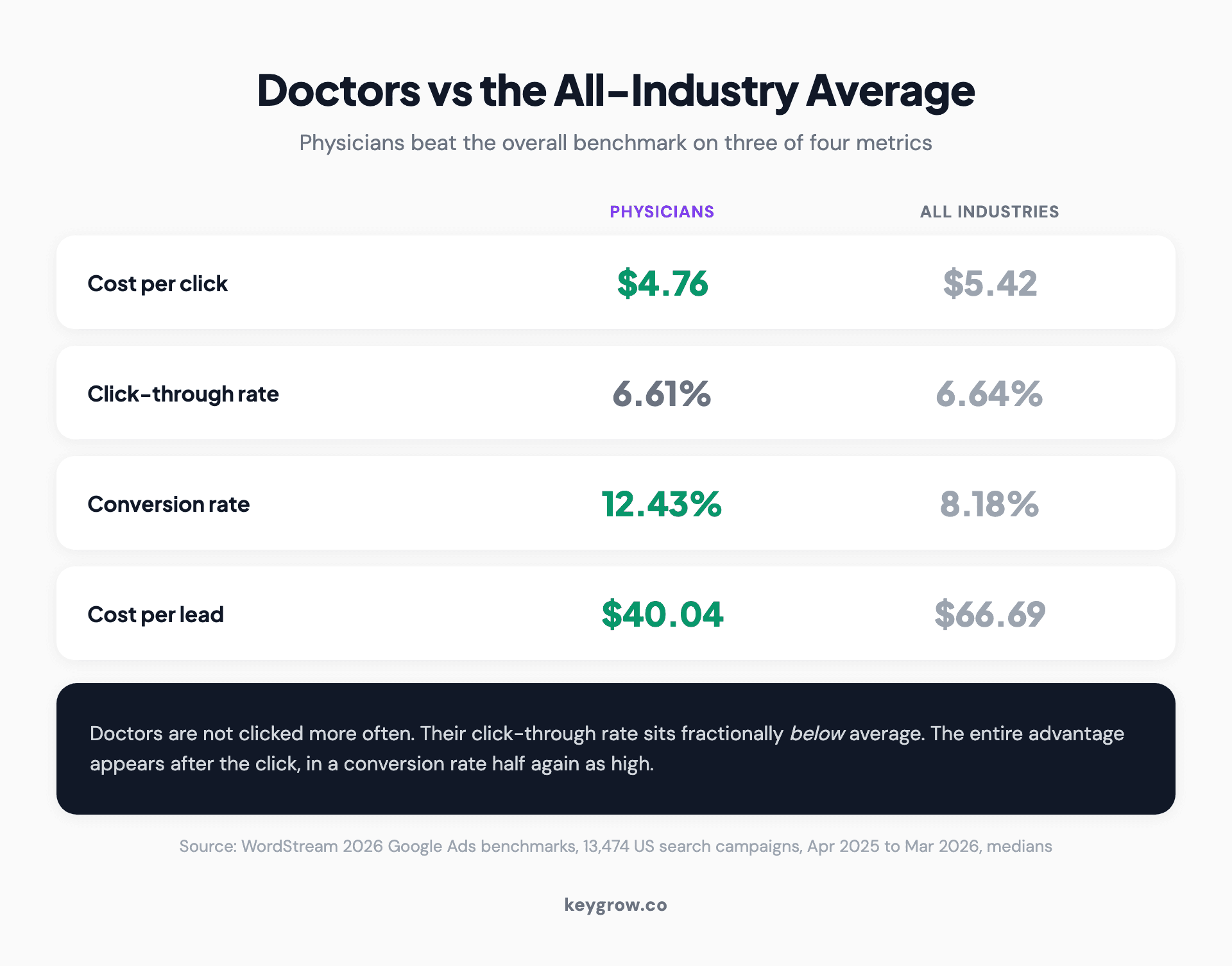
Google Ads benchmarks for physicians and surgeons compared with the all-industry average: cost per click, click-through rate, conversion rate and cost per lead.
| Metric | Physicians & surgeons | All industries |
|---|---|---|
| Average cost per click | $4.76 | $5.42 |
| Click-through rate | 6.61% | 6.64% |
| Conversion rate | 12.43% | 8.18% |
| Cost per lead | $40.04 | $66.69 |
Those come from WordStream's 2026 benchmarks, built on 13,474 US search campaigns running between April 2025 and March 2026, with a minimum of 52 active campaigns per subcategory and medians used rather than means so a few large spenders cannot distort the picture.
Worth knowing that a competing set of figures circulates widely, putting physician conversion at 11.6 percent and cost per lead at $56.83. Both stories point the same direction, and the numbers above are the ones with a published dataset size and methodology attached, which is why we use them.
The click-through rate is the interesting outlier. At 6.61 percent, doctors sit fractionally below the all-industry 6.64 percent, which tells you something real: medical ads are not unusually compelling. People do not click a doctor's ad more readily than anyone else's. They just book at a much higher rate once they do.
Where medical advertising genuinely does get expensive
The category average hides an enormous spread. A primary care click and a cosmetic surgery click are not the same product.
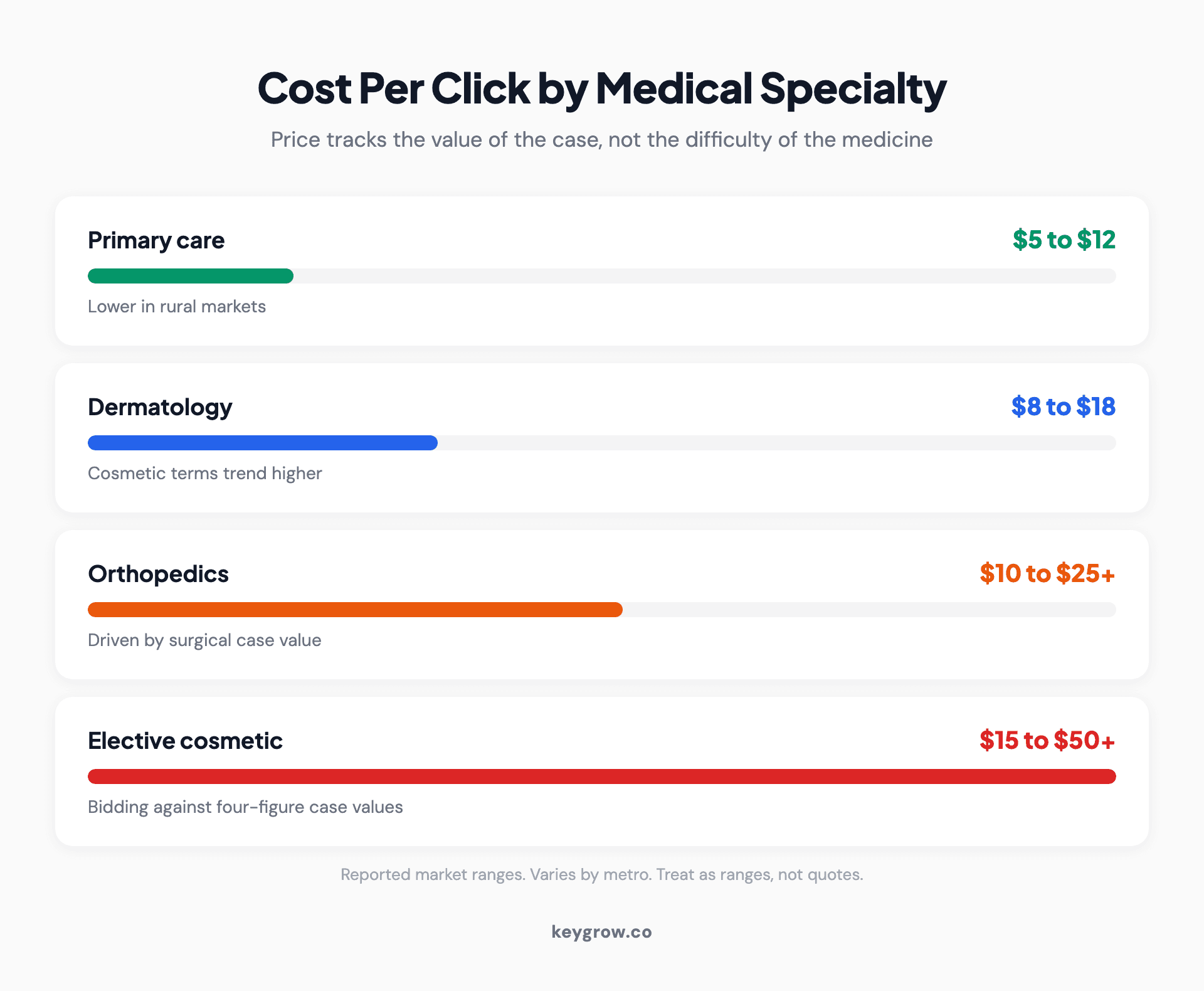
Typical Google Ads cost per click ranges across medical specialties, from primary care at the low end through dermatology and orthopedics to elective cosmetic procedures at the high end.
Reported market ranges, which vary by metro and should be treated as ranges rather than quotes:
| Specialty | Typical cost per click range |
|---|---|
| Primary care | $5 to $12, lower in rural markets |
| Dermatology | $8 to $18, cosmetic terms higher |
| Orthopedics | $10 to $25 and up |
| Elective cosmetic procedures | $15 to $50 and up |
The pattern is straightforward once you see it. Price tracks the value of the case, not the difficulty of the medicine. A practice competing for elective procedures with four-figure or five-figure case values is bidding against others who can also afford four-figure acquisition costs. A primary care practice is not in that auction and should stop reading advice written for people who are.
This is where a generalist agency loses money for a medical client. An agency that knows what a joint replacement consultation is worth to an orthopedic practice will out-bid and out-structure one that treats it as a lead like any other. Industry context is a targeting advantage rather than a nicety, and in specialties where a single case pays for a quarter of advertising, it is most of the job.
Why the conversion rate is so high
Somebody searching for a doctor usually has a symptom, a referral, or a deadline. There is no browsing phase.

A doctor showing a patient a medical scan on a tablet during a consultation.
Compare it with almost any other category. Somebody searching for a contractor may be six months from a project. Somebody searching for software may be researching for a colleague. Somebody searching "dermatologist near me" has a thing on their skin they are worried about, and a strong preference for resolving it this week.
That urgency produces the 12.43 percent conversion rate, and it also changes what the campaign has to do. You are not building interest. You are removing friction between an already-decided person and an appointment.
Which means the boring operational things carry disproportionate weight. Whether your phone is answered. Whether online booking works on a phone. Whether the page states which insurance you accept, because for a large share of patients that is the actual qualifying question and its absence is why they went back to the results page.
Practices routinely spend on campaign optimization while leaving the insurance question unanswered on the landing page. The second one is worth more.
The three constraints that make medical different
You cannot retarget site visitors, you cannot pass health data to Google, and you cannot make outcome claims. Plan around all three from the start.
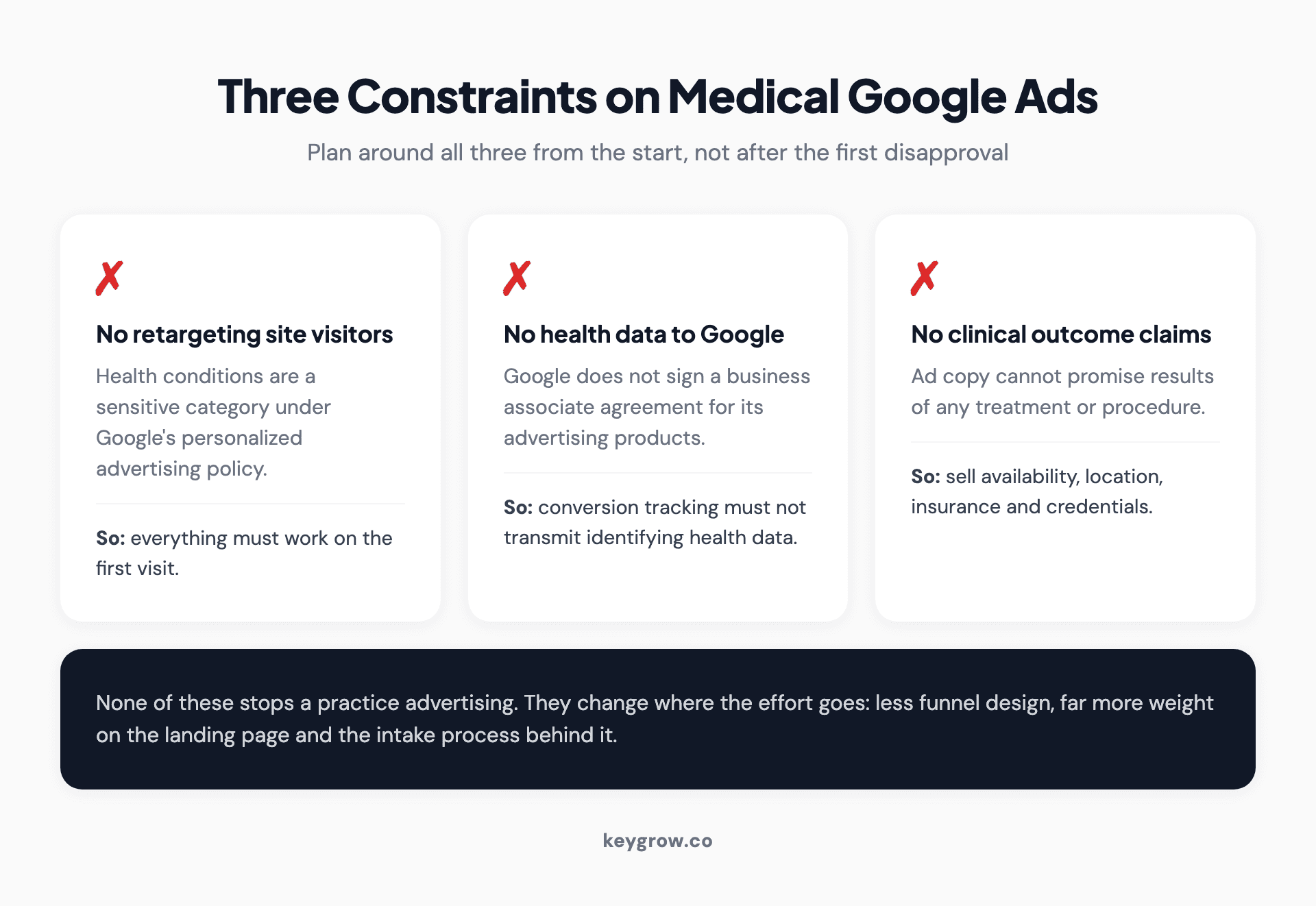
The three constraints on medical Google Ads: no retargeting of site visitors, no protected health information in conversion data, and no clinical outcome claims in ad copy.
No retargeting of your site visitors. Google's personalized advertising policy treats health and medical conditions as a sensitive category, so the remarketing that props up most accounts is off the table. Everything has to work on the first visit, which raises the value of the landing page and lowers the value of clever multi-touch funnel design.
No protected health information reaching Google. Google does not sign a business associate agreement for its advertising products. Compliant campaigns are entirely possible, and they require conversion tracking that does not transmit identifying health data, which is a technical setup decision rather than a copywriting one.
No clinical outcome claims. Ad copy cannot promise results. This is less restrictive than it sounds, because the things that actually persuade a worried patient are availability, location, insurance and credentials, none of which are outcome claims.
We covered the policy and compliance side properly in a separate piece on whether healthcare businesses should use PPC, including which niches face additional certification requirements. This post assumes you have decided to advertise and want to know how to structure it.
What a practice campaign should actually look like
One campaign per service line, tight ad groups, and a page per service. Smaller than most practices expect.
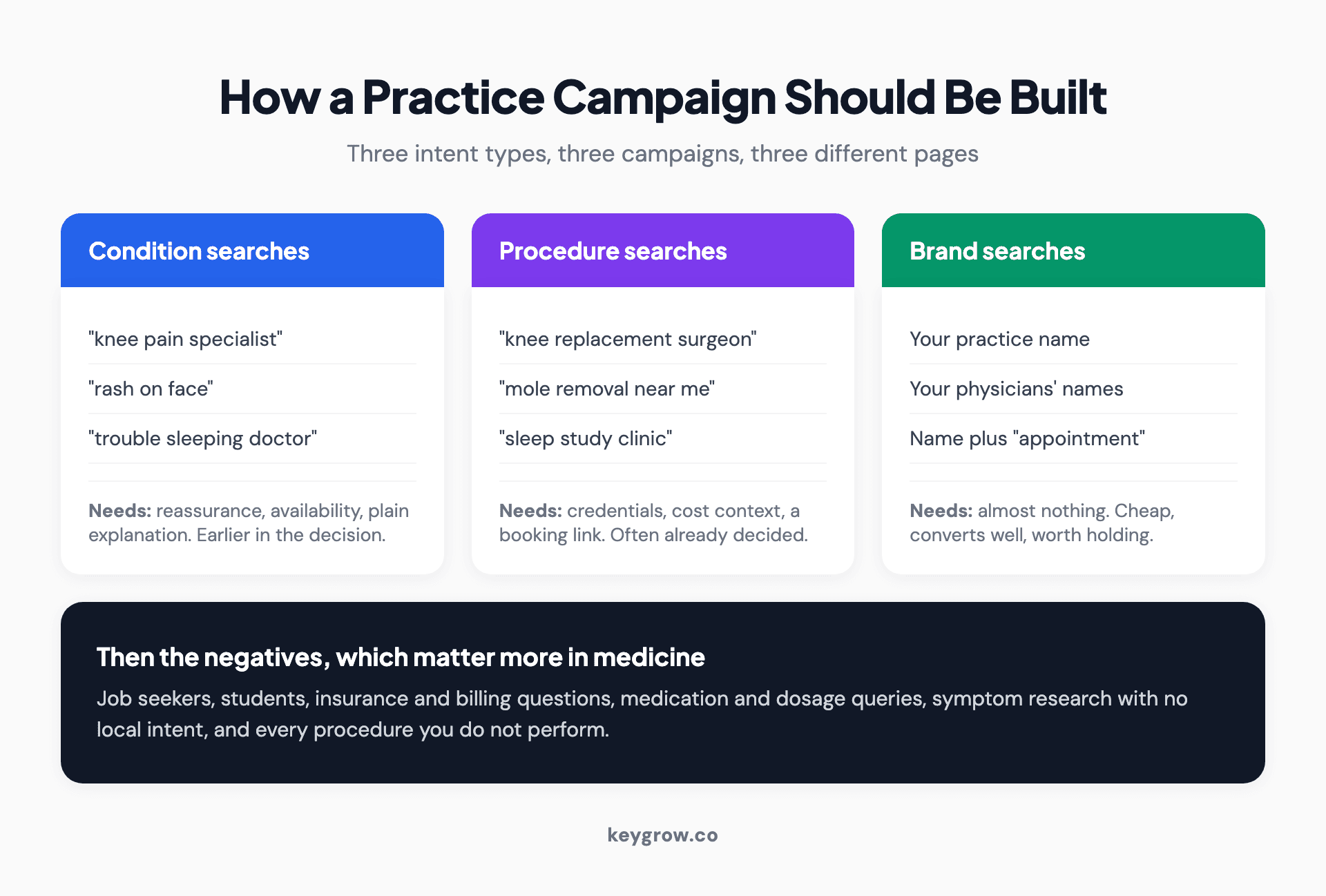
A Google Ads structure for a medical practice: separate campaigns for condition-led searches, procedure-led searches and branded searches, each with tightly themed ad groups and its own landing page.
Three campaign types cover most practices. Condition searches, where someone describes a symptom or problem. Procedure searches, where someone names the thing they want. And your own brand, which is cheap, converts extremely well, and is worth holding even though it feels like paying for traffic you would have received anyway.
Keep condition and procedure separate. Somebody typing a symptom is earlier in the decision and needs reassurance and availability. Somebody typing a procedure name has often already decided and needs credentials, cost context and a booking link. Running them through one ad group with one page underserves both.
Then the negatives, which in medicine are unusually important. Strip out job seekers, students, insurance and billing questions, medication and dosage queries, "is it covered", symptom research with no local intent, and any procedure you do not perform. Medical vocabulary overlaps heavily with people who will never become patients, and the search terms report is where you find them.
Location settings deserve a second look too. A practice with one location serves a drive-time radius, not a metro, and the default targeting option reaches people who have merely shown interest in your area rather than only those in it.
Count booked appointments, not form fills
A form submission is not a patient. If your conversion tracking stops at the form, you are optimizing toward the wrong thing and the bidding system will faithfully chase it.
This matters more in medicine than in most categories because the gap between an inquiry and a booked appointment is unusually wide. People contact three practices, check insurance, discover the first availability is five weeks out, and book elsewhere. All three practices record a conversion. One of them gets a patient.
The fix is to define your conversion as far down the funnel as your systems allow. If the booking platform can fire a conversion when an appointment is actually scheduled, use that. If it cannot, an offline conversion import from your practice management system once a week is not a difficult project and it changes what the algorithm optimizes toward.
Two numbers are worth tracking separately by service line: cost per inquiry and cost per booked appointment. When those two diverge sharply for one service, the problem is almost never the ads. It is availability, insurance, or intake.
The same logic applies to phone calls, which in medicine are still the dominant channel. Call tracking that records duration lets you filter out the twenty-second wrong numbers and billing questions that would otherwise inflate your conversion count and quietly teach the bidding system to buy more of them.
When a practice should not run Google Ads
Three situations where the honest answer is not yet, and we say so regularly.
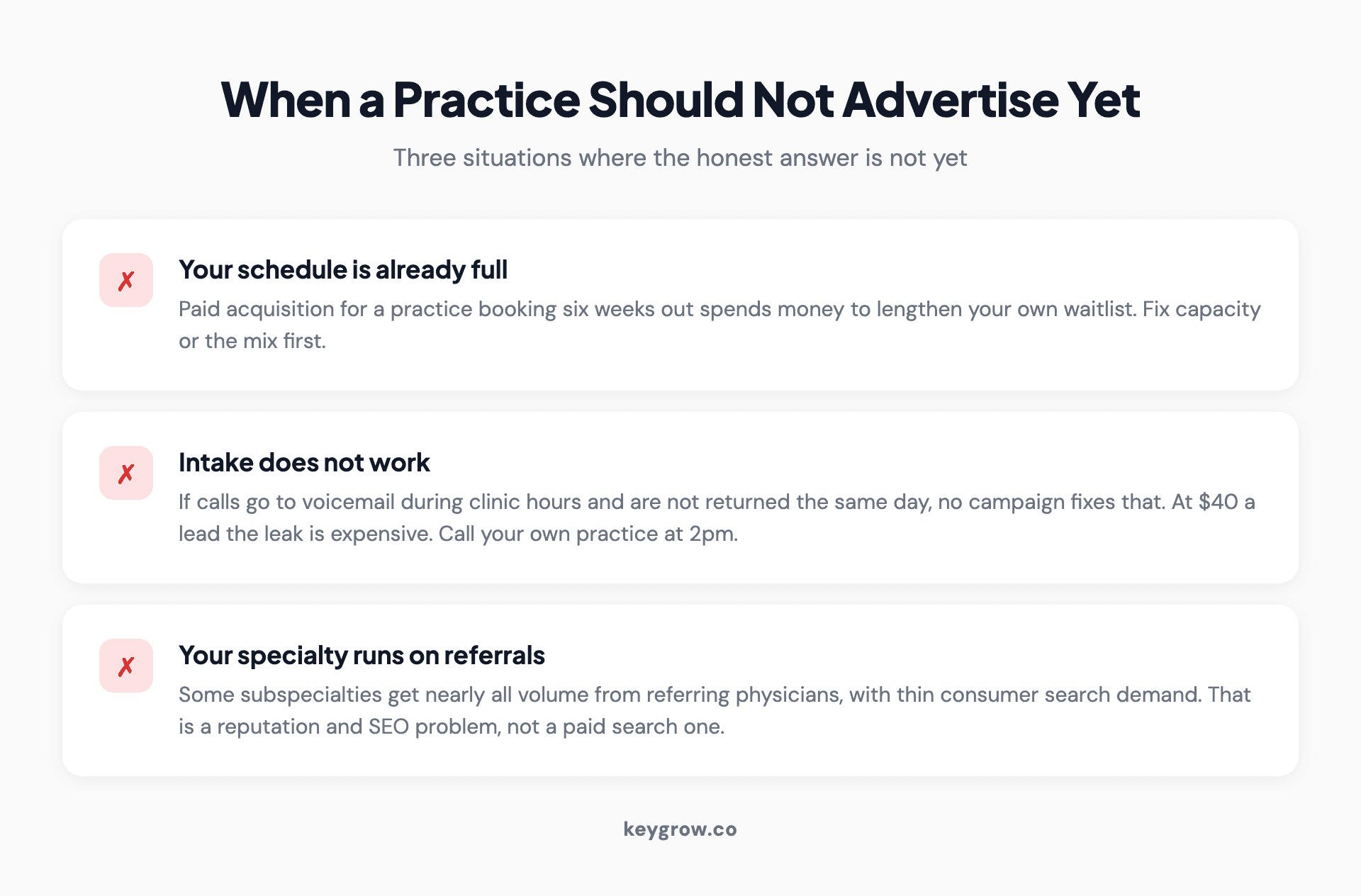
Three situations where a medical practice should not run Google Ads yet: no capacity for new patients, no working intake process, and a referral-driven specialty with no consumer search demand.
If your schedule is already full. Paid acquisition for a practice booking six weeks out generates frustration rather than revenue. Fix capacity, add a provider, or work on the mix of what you are booking. Advertising into a full schedule is spending money to lengthen your own waitlist.
If intake does not work. If calls go to voicemail during clinic hours and nobody returns them the same day, no campaign will fix that, and at $40 a lead the leak is expensive. Test your own intake before spending anything. Call your own practice at 2pm and see what happens.
If your specialty runs on physician referrals. Some subspecialties get almost all their volume from referring physicians, and consumer search demand is thin to nonexistent. Money there is better spent on referral relationships and on being findable when a referred patient looks you up, which is an SEO and reputation problem rather than a paid search one.
For practices that do fit, the case is reasonably strong on the numbers: below-average click costs, well above-average conversion, and a cost per lead 40 percent under the all-industry figure. Our PPC management work is month to month, and we run it alongside SEO for most medical clients, since organic and paid answer different parts of the same patient search.
FAQs
How much does Google Ads cost for doctors?
Physicians and surgeons average $4.76 per click and $40.04 per lead according to WordStream's 2026 benchmarks, which is below the all-industry averages of $5.42 and $66.69. Specialty matters far more than the category average, with primary care clicks commonly in the $5 to $12 range and elective cosmetic procedures running $15 to $50 and above.
Are Google Ads worth it for a medical practice?
On the benchmark numbers, generally yes. Physician campaigns convert at 12.43 percent against an all-industry 8.18 percent, and cost per lead sits roughly 40 percent below average. The exceptions are practices without capacity for new patients, practices whose intake process does not reliably answer calls, and referral-driven subspecialties with little consumer search demand.
Is Google Ads HIPAA compliant for doctors?
Google does not sign a business associate agreement for its advertising products, so compliance depends on how you configure things. Campaigns can be run compliantly by ensuring no protected health information reaches Google through conversion tracking. You also cannot retarget site visitors, because health conditions fall under Google's sensitive category rules.
Why do doctors convert better than other advertisers?
Because there is no browsing phase. Someone searching for a physician typically has a symptom, a referral or a deadline, and intends to resolve it quickly. Notably, doctors do not get clicked more often. Their click-through rate of 6.61 percent is fractionally below the all-industry 6.64 percent. The advantage appears entirely after the click.
What keywords should a medical practice bid on?
Split them into condition searches, where someone describes a symptom, and procedure searches, where someone names what they want, and keep your own brand terms running separately. The two intent types need different ad copy and different landing pages, and combining them into one ad group tends to underperform on both.
How much should a practice budget per month?
Work backwards from case value rather than picking a round figure. At roughly $40 per lead and a realistic consultation-to-patient rate, you can estimate what a new patient costs and compare it against what one is worth over their time with the practice. Specialties with higher case values can justify considerably more spend per lead.
Should a practice do SEO or Google Ads first?
Most benefit from both, because they capture different moments. Paid search reaches somebody deciding this week, while organic and local visibility reach the much larger group researching and the referred patients who look you up before their appointment. If budget forces a choice, paid tends to answer the immediate capacity question faster.
Our take
The expensive-medical-advertising story is largely a specialty story wearing a category costume. Take the average and doctors advertise for less per patient than most businesses do per customer, on the strength of a conversion rate half again as high as the norm.
What that means practically is that the money in a medical account is not usually in bidding cleverness. It is in whether the phone gets answered, whether the page says which insurance you take, and whether you are bidding in the right specialty auction for the case values you actually earn.
If you are weighing this up, the healthcare PPC decision guide covers the compliance side, and the first 2-4 weeks of a campaign launch covers what to do once you commit.


