

A sensible Google Ads campaign launch schedule for the first 2-4 weeks looks like this: days 1 to 3 you check that things are working and change nothing, days 4 to 7 you add negative keywords and nothing else, days 8 to 14 you make your first real decisions, and days 15 to 30 you scale what is working and cut what is not.
The hard part is not the schedule. It is the doing nothing.
Almost every account that fails in month one fails because somebody got nervous on day four and started adjusting. The campaign never gets a clean run at the data, so it never produces the data that would tell you what to adjust. That loop is the single most common way a launch budget disappears.
Before you launch: five things that must already be true
If any of these is missing on day one, the first two weeks of spend buys you nothing you can use.
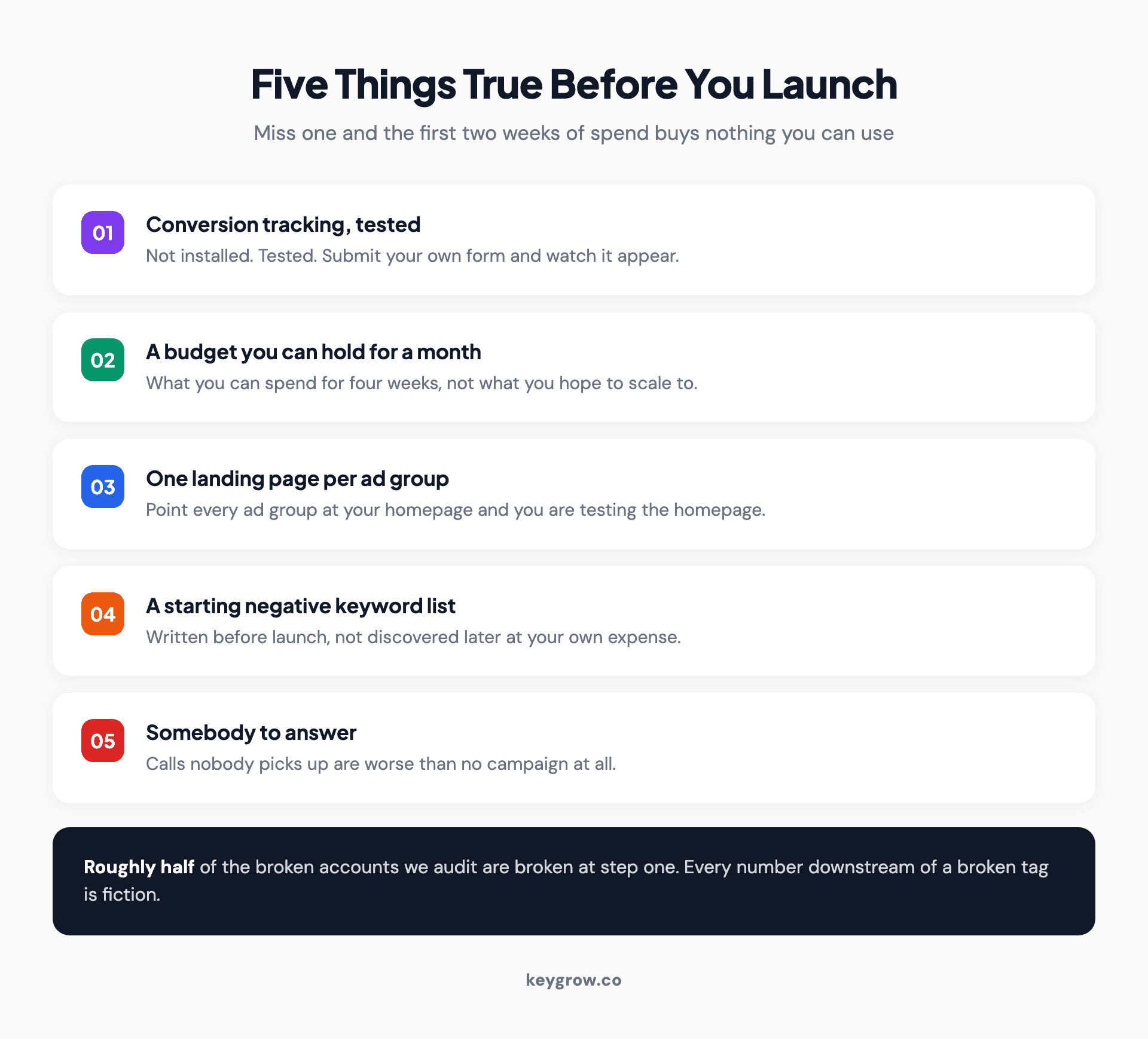
Pre-launch checklist for a new Google Ads campaign: verified conversion tracking, a budget you can sustain for a month, one landing page per ad group, a starting negative keyword list, and a way to answer inquiries.
Conversion tracking, tested with a real submission. Not installed. Tested. Fill in your own form, place your own call, and watch the conversion appear in the interface, following Google's conversion tracking setup if you are starting from scratch. Roughly half the broken accounts we audit were broken here, and every number downstream of a broken tag is fiction.
A budget you can hold for a month. Set it to what you can spend for four weeks, not what you hope to spend once it works. Cutting the budget mid-learning is one of the changes that hurts most.
One landing page per ad group. The ad is half the job. If every ad group points at your homepage, you are testing your homepage, not your campaign.
A starting negative keyword list. Write it before launch rather than discovering it in the search terms report at your own expense. Jobs, careers, salary, free, diy, cheap, and any service you do not offer. Our negative keywords guide has a fuller starter list.
Somebody to answer. An account generating calls nobody picks up is worse than no account, because you are paying for the privilege of annoying people.
That last group is where an eviction law firm was stuck when they came to us. They were already running ads at an existing landing page and getting one conversion a week from 22 clicks, at $240 each. Visitors arrived and could not tell what to do next. We rebuilt the page around a single action and restructured the campaigns. Within a week: 21 conversions from 189 clicks, at $31.79. Nothing about that was a bidding problem.
Days 1 to 3: launch and leave it alone
Check that ads are approved and money is moving. Change nothing else. Underspend in the first few days is normal, not a fault to correct.
Your entire job in the first 72 hours is confirming the plumbing works. Are the ads approved and serving, or sitting in review. Is spend registering at all. Is the conversion tag still firing now that real traffic is hitting it rather than your test submission.
What you should not do is read performance. There is no performance yet. A cost per conversion calculated on three clicks is a number with no meaning, and the temptation to act on it is precisely the trap.
Expect the budget to underspend. New campaigns commonly run below their daily cap while the system works out where to place you, and advertisers routinely misread that as a targeting problem and start widening things. Widening is a change. Changes have costs, which the next section covers.
Days 4 to 7: the only safe lever is negatives
Pull the search terms report. Add obvious junk as negative keywords. Leave bids, budgets, targeting and ad copy completely alone.

Two colleagues reviewing a printed report together during the first week of a new campaign.
By the end of week one you will have enough search terms to see the shape of what you are actually buying. This is where the money is, and it is also the only intervention most practitioners consider safe this early, because it removes waste without touching the bidding system.
Worth an honest caveat, though. Google's own documentation lists composition changes, meaning keywords added or removed, among the things that can put a bid strategy back into learning. It does not explicitly say where negative keywords sit on that list. The conservative approach, and the one we use, is to batch negatives into two or three sittings across the first two weeks rather than editing daily. You get the waste out without poking the system every morning.
What to watch, and what to ignore: click-through rate tells you whether the ad matches the query, and impression volume tells you whether the targeting is too narrow. Cost per conversion tells you nothing yet. Neither does return on ad spend. Both need a sample you do not have.
Days 8 to 14: your first real decisions
Now you can look at conversions rather than clicks. Two weeks is the earliest point at which a pattern means anything, and even then it means less than you would like.
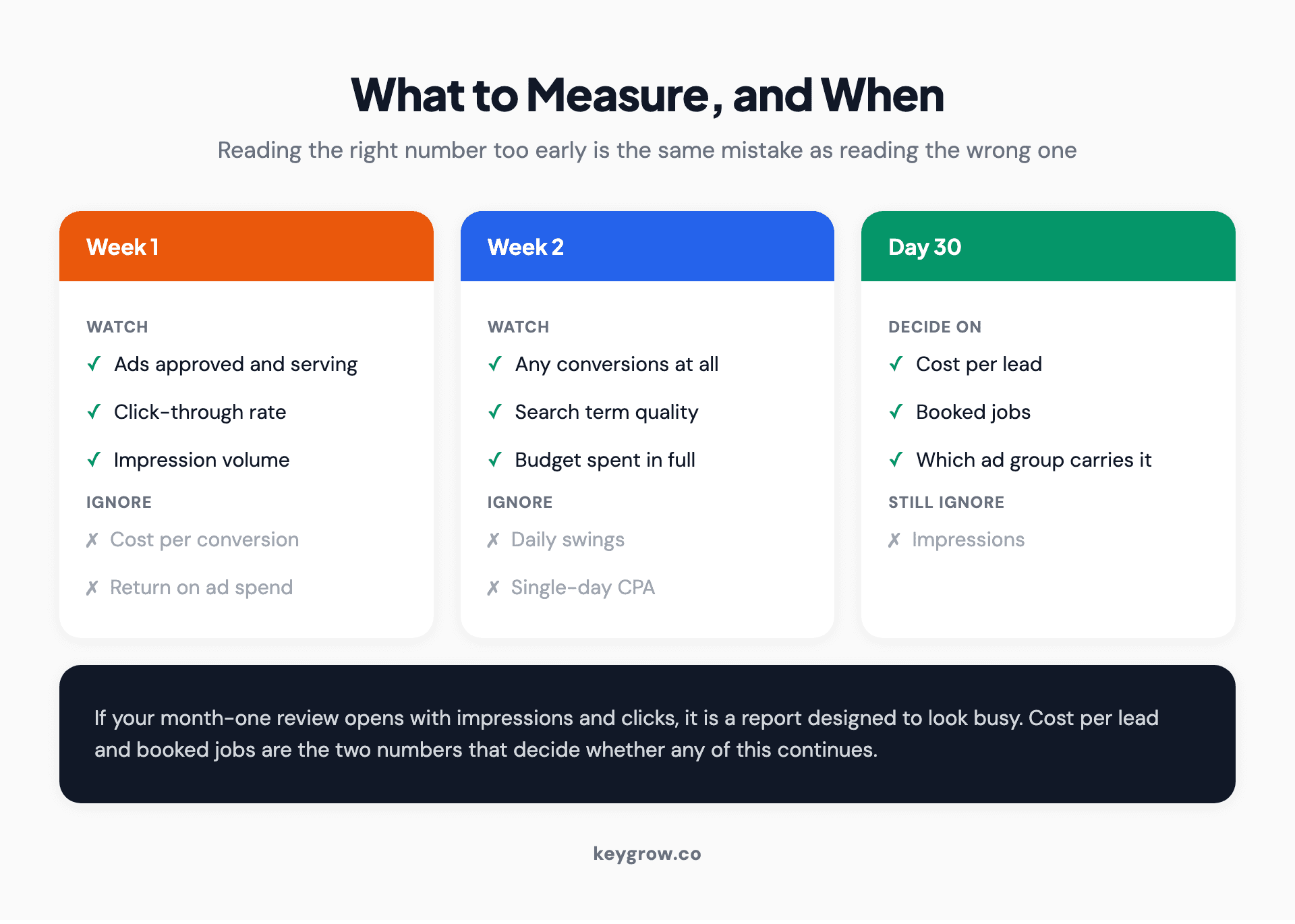
What to measure in each phase of a Google Ads launch: click-through rate and impression volume in week one, conversions and search term quality in week two, and cost per lead and booked jobs by day thirty.
The questions worth asking in week two are narrow. Is any ad group producing conversions at all. Are the search terms improving as negatives accumulate. Is the daily budget now being spent in full, or is the campaign still limited.
If one ad group is clearly carrying the account and another has spent real money with nothing to show, that is a signal. Act on it once, deliberately, rather than making four small adjustments across the week. Every change costs you some measurement clarity, so spend that cost on the decision most likely to matter.
This is also the point to start testing a second ad. Not rewriting the first one, which throws away what it learned, but adding an alternative so the system has something to compare.
Days 15 to 30: scale the winners, cut the rest
Segment by ad group, device and match type. Increase budget on what converts, in increments, and pause what has spent enough to have proven itself and did not.
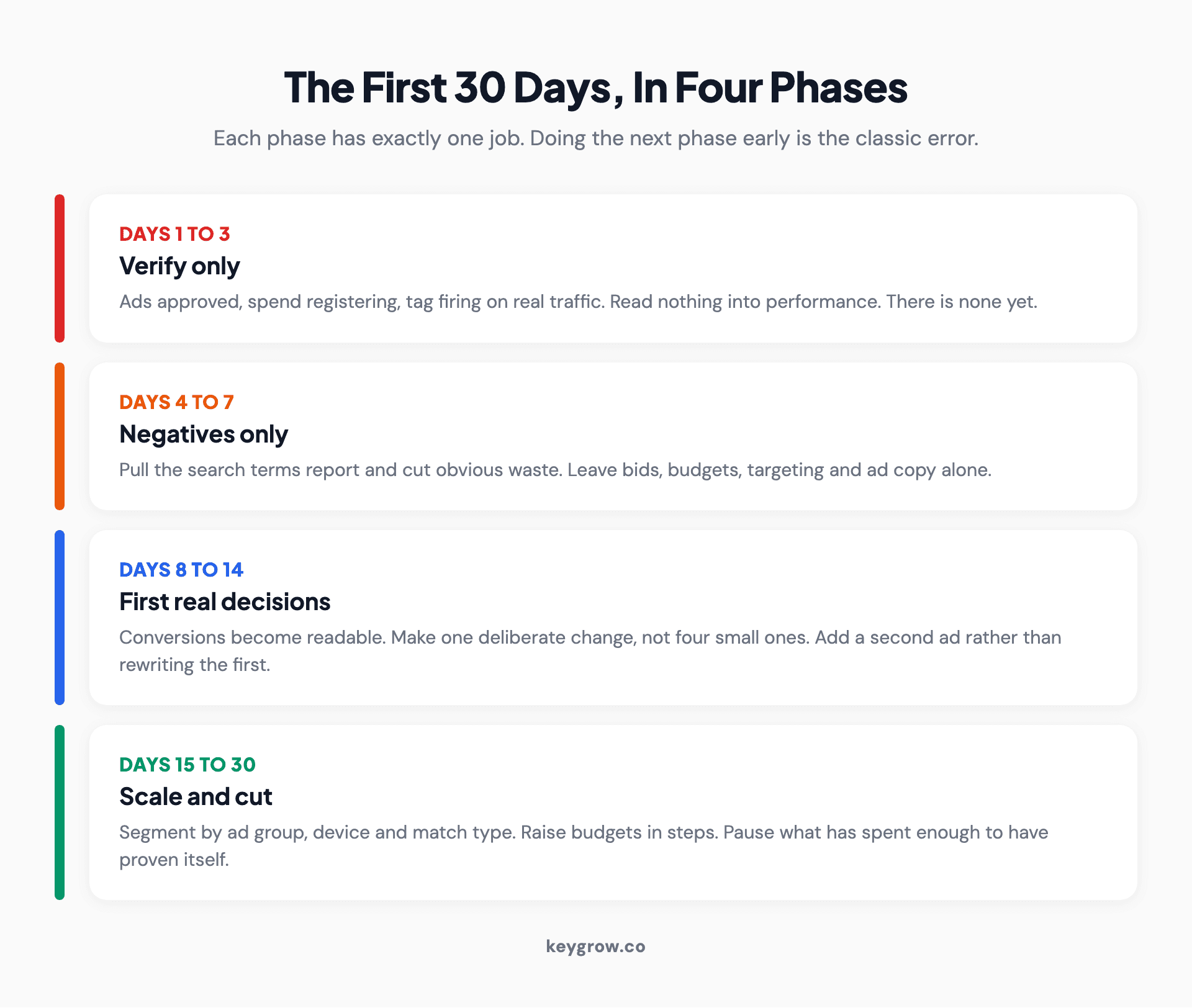
The first thirty days of a Google Ads campaign as four phases: days 1 to 3 verification only, days 4 to 7 negative keywords only, days 8 to 14 first decisions, and days 15 to 30 scaling and cutting.
The word doing the work there is "enough". An ad group that has spent a fifth of what a conversion is worth to you has not failed, it has barely been tested. An ad group that has spent three times your target cost per lead with nothing back has told you something real.
Increase budgets in steps rather than doubling. A large jump changes the conditions the bid strategy has been calibrating against, and you can find yourself back at the start of a learning period you had already paid for once.
By day 30 you should be able to answer three things: which ad group produces leads, what a lead costs, and whether that number is survivable against what a job is worth. If you cannot answer those, the problem is almost always tracking rather than performance.
What actually restarts the learning period
Google names four triggers, and the list is more specific than the folklore around it.
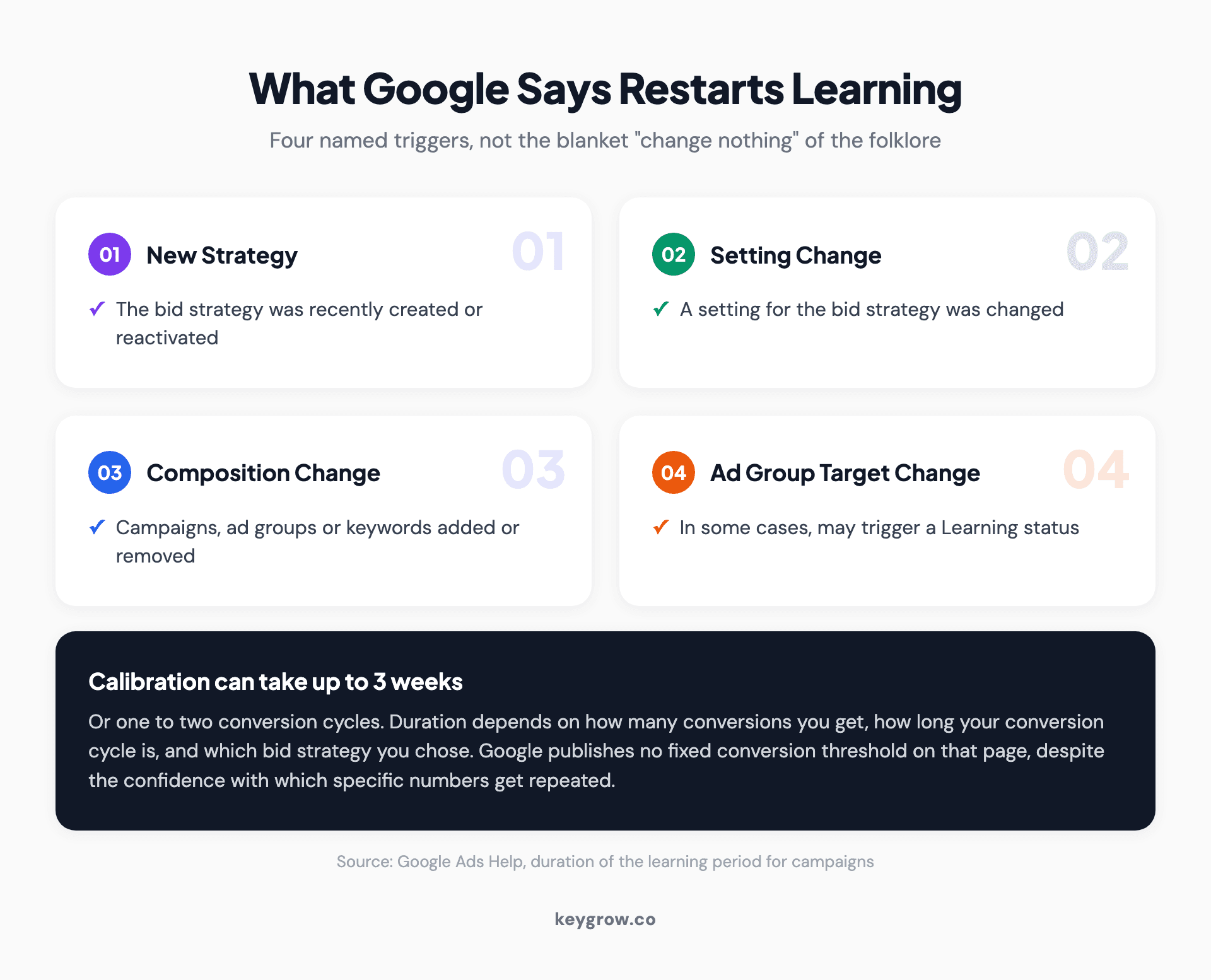
The four changes Google names as triggers for a new learning period: a new or reactivated bid strategy, a bid strategy setting change, a composition change to campaigns, ad groups or keywords, and in some cases an ad group target change.
According to Google's learning period documentation, a bid strategy enters Learning status when it is newly created or reactivated, when one of its settings is changed, when campaigns, ad groups or keywords are added or removed, and in some cases when an ad group target changes.
The same page says calibration can take up to three weeks, or one to two conversion cycles, and that duration depends on three things: how many conversions you are getting, how long your conversion cycle is, and which bid strategy you chose.
Two things are worth noticing here. Google does not publish a fixed conversion threshold on that page, despite the confidence with which specific numbers get repeated across the industry. And "leave everything alone" is not quite the rule people state, because the list is specific rather than universal. Knowing which four things carry the cost is more useful than a blanket instruction to freeze.
The practical version: batch your changes. If you are going to adjust something, adjust several things in one sitting and then leave it for a week, rather than making a small change every day and never giving the system a stable run at anything.
The mistakes that cost the most in month one
Most of them come from impatience, and one comes from the opposite problem.
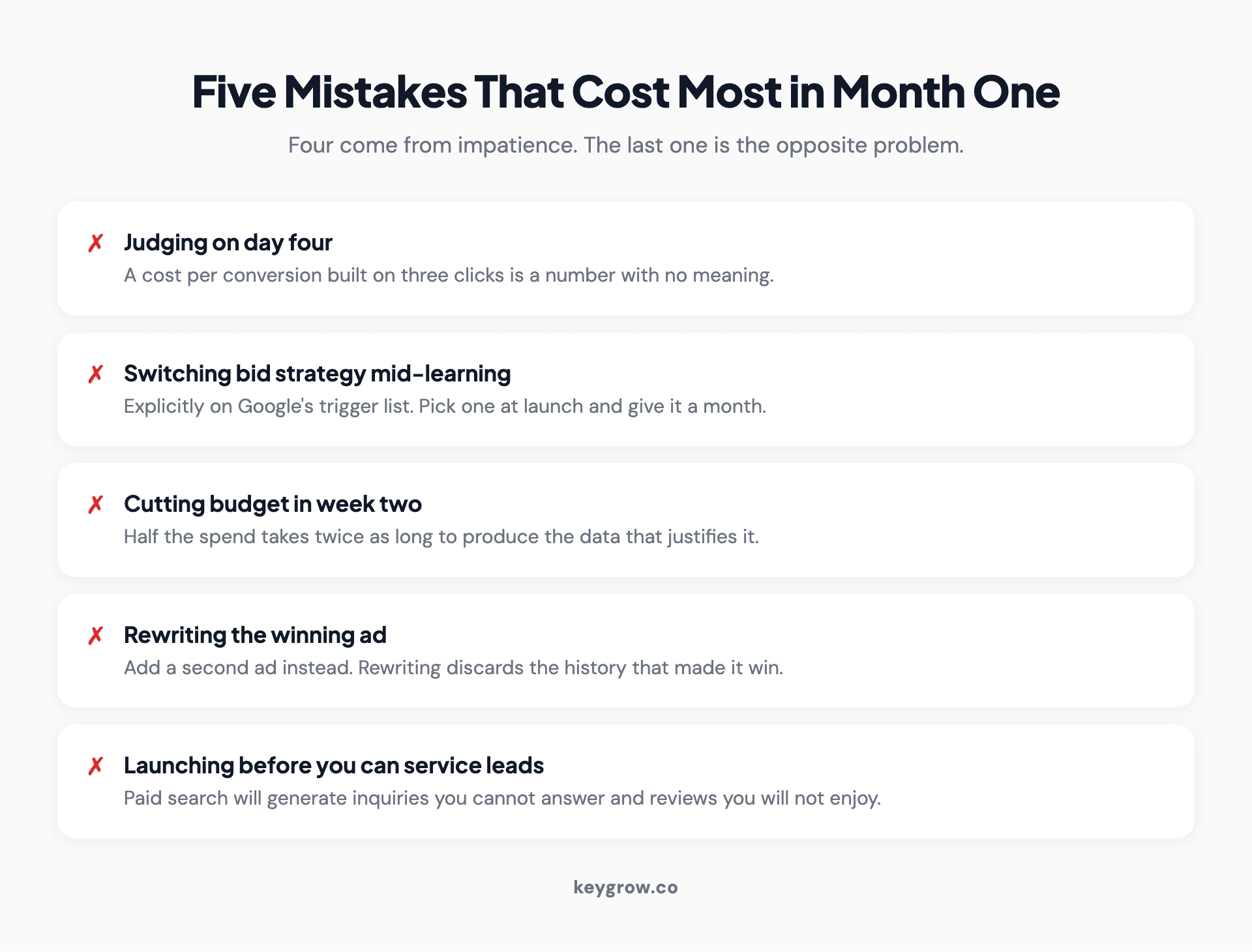
Five costly mistakes in the first month of a Google Ads campaign: judging results too early, changing bid strategy mid-learning, cutting budget in week two, rewriting winning ads, and reporting on clicks instead of leads.
Judging on day four. Covered above, and still the most expensive habit in paid search.
Switching bid strategy mid-learning. This is explicitly on Google's trigger list. Pick a strategy at launch and give it a month, and if the sheer number of options is the blocker, we unpacked why the platform feels this complicated separately. If you have no conversion history at all, starting on maximize clicks with a cap and moving to a conversion strategy later is defensible. Switching twice in three weeks is not.
Cutting the budget in week two. Understandable and counterproductive. A campaign spending half of what it needs takes twice as long to produce the data that would justify the spend.
Rewriting the ad that was working. Add a second ad instead. Rewriting discards the performance history that made it the winner.
Reporting on the wrong things. Impressions, clicks and click-through rate do not pay wages. If your month-one review opens with impressions, it is a report designed to look busy. Cost per lead and booked jobs are the two numbers that decide whether any of this continues.
And the opposite failure, which is rarer and real: launching before you can service the leads. If you are a single operator with a full schedule, paid search will generate inquiries you cannot answer and reviews you will not enjoy. Fix capacity first. We turn that conversation away regularly and it is usually the right call.
FAQs
How long does the Google Ads learning period last?
Google's documentation says calibration can take up to three weeks, or one to two conversion cycles. The duration depends on how many conversions your campaign gets, how long your conversion cycle is, and which bid strategy you selected. Campaigns with more conversion data settle faster than low-volume ones.
What should I do in the first week of a new Google Ads campaign?
Confirm ads are approved, spend is registering and conversion tracking fires on real traffic. Then pull the search terms report and add obvious junk as negative keywords. Leave bids, budgets, targeting and ad copy alone. There is no performance to read in week one, only plumbing to verify.
When can I judge whether a new campaign is working?
Not before day 14, and properly not before day 30. Two weeks is the earliest a pattern means anything, and even then the sample is thin. By day 30 you should be able to say which ad group produces leads, what a lead costs, and whether that cost works against your job value.
Does changing anything reset the Google Ads learning period?
No, the list is specific. Google names four triggers: a newly created or reactivated bid strategy, a change to a bid strategy setting, adding or removing campaigns, ad groups or keywords, and in some cases an ad group target change. Other edits do not carry the same cost, though batching changes is still the safer habit.
Why is my new campaign underspending its daily budget?
This is normal early behavior. New campaigns often run below their daily cap while the system works out where to place your ads. It is usually not a targeting fault, and widening targeting to fix it is a change that can extend the learning period you are trying to get through.
Should I add negative keywords during the learning period?
Yes, but batch them. Negatives are the one intervention most practitioners consider safe early, because they remove waste without touching bidding. Google lists keyword composition changes among its learning triggers without specifying where negatives sit, so two or three sittings across the two weeks is more prudent than daily edits.
How much budget do I need for the first 30 days?
Enough to buy a readable sample, which depends entirely on what a click costs in your category. Work backwards: if clicks cost several dollars and you need a few hundred to see a pattern, that sets your floor. A budget too small to produce conversions produces no learning either, and stopping early wastes everything spent so far.
The bottom line
The first 2-4 weeks are not where you make a campaign profitable. They are where you buy the information that makes profitability possible later, and almost every way to waste that money involves acting too early on too little.
Verify in the first three days. Add negatives in the first week. Make your first real decision in week two. Scale and cut in weeks three and four. Then judge it at day 30 against cost per lead, not clicks.
If you want the longer view on timelines beyond the first month, we covered how long PPC takes separately, along with a full PPC audit walkthrough for accounts already running. Our PPC management work is month to month, which tends to concentrate the mind on getting the first thirty days right.


