
SEO for medical practices is local SEO with three complications bolted on: a higher content quality bar because Google treats health information as high stakes, a listing structure where individual providers can hold their own profiles, and a privacy problem in your analytics that almost no marketing guide mentions.
Get those three right and the rest is ordinary local SEO. Get them wrong and you can do everything else correctly and still lose to the practice down the road with two fewer providers and a better-organized website.
This is written for independent practices and small groups: primary care, specialty clinics, multi-provider practices with one or a few locations. Not hospital systems, which have a different problem entirely.
The demand is real and it is not new. Tebra's patient survey puts the share of patients who often or sometimes search online for a doctor at 79 percent. The question was never whether patients look. It is whether what they find is your site, a directory, or a competitor who organized their pages better.

Clinic waiting room with padded armchairs and natural light.
Three things that make this different from ranking a plumber
Most medical SEO advice is generic local SEO with the word patient swapped in for customer. These three differences are the ones that actually change what you build.
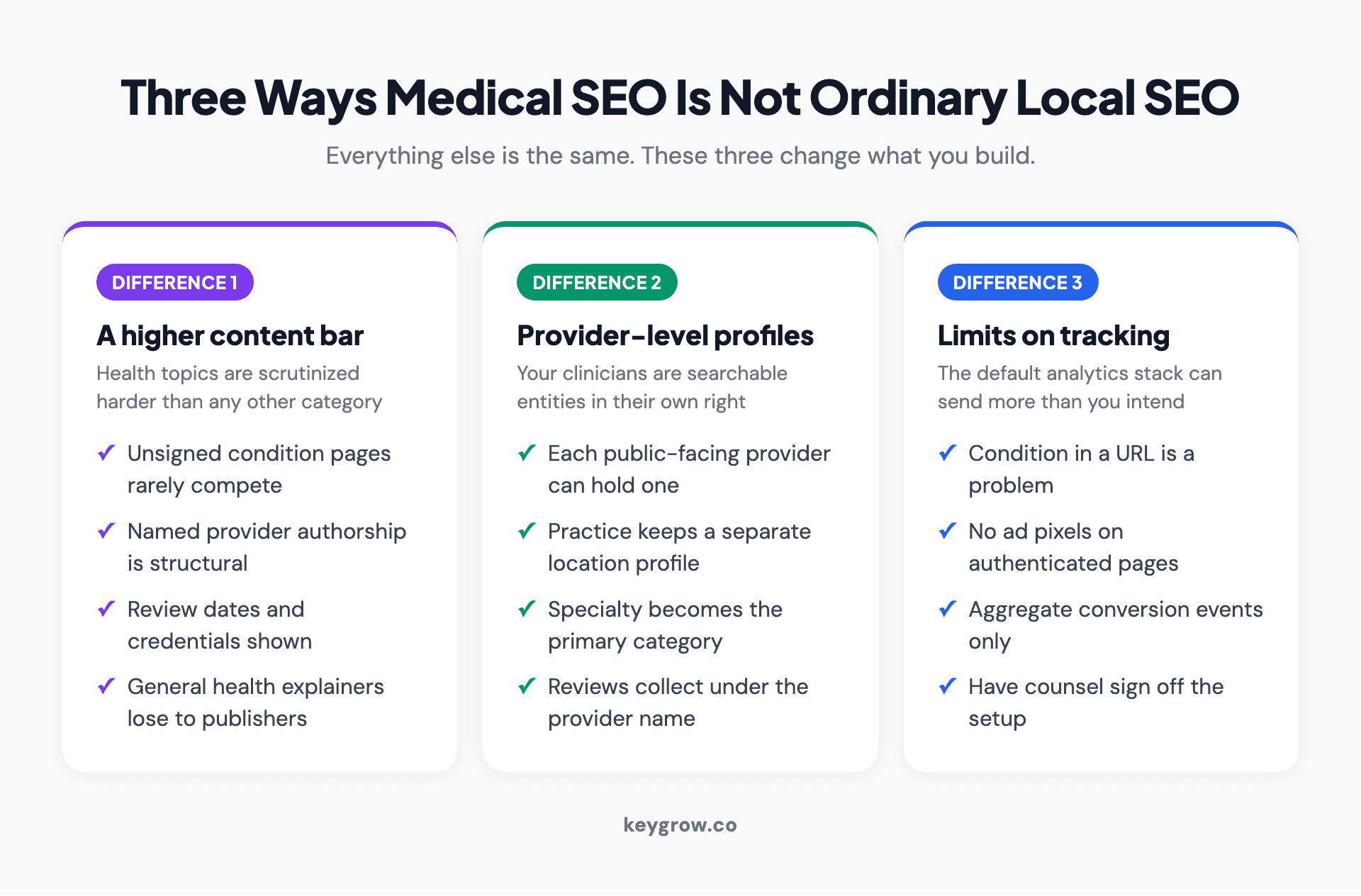
Three-column layout of what makes medical practice SEO different: a higher content quality bar, provider-level Google profiles, and privacy limits on tracking.
The first is the quality bar. Health content sits in the category Google scrutinizes hardest, which means an unsigned 600-word page about a condition is close to worthless. The second is structural: your providers are searchable entities in their own right, and Google has a specific rule set for them that most practices never use. The third is that the ordinary tracking setup a marketing agency installs by default can create a privacy exposure in a healthcare context.
None of the three is difficult. All three are commonly skipped.
Each provider should have their own profile, and most do not
This is the highest-return unclaimed thing in medical local SEO. Patients search provider names constantly, and a practice-only profile leaves every one of those searches to directories.
Google's profile guidelines allow an individual practitioner to hold their own Business Profile when that person works in a public-facing role and can be contacted directly at the verified location during stated hours. Support staff cannot. When several providers work at one site, the practice holds a profile for the location and each provider holds a separate one carrying only their own name.
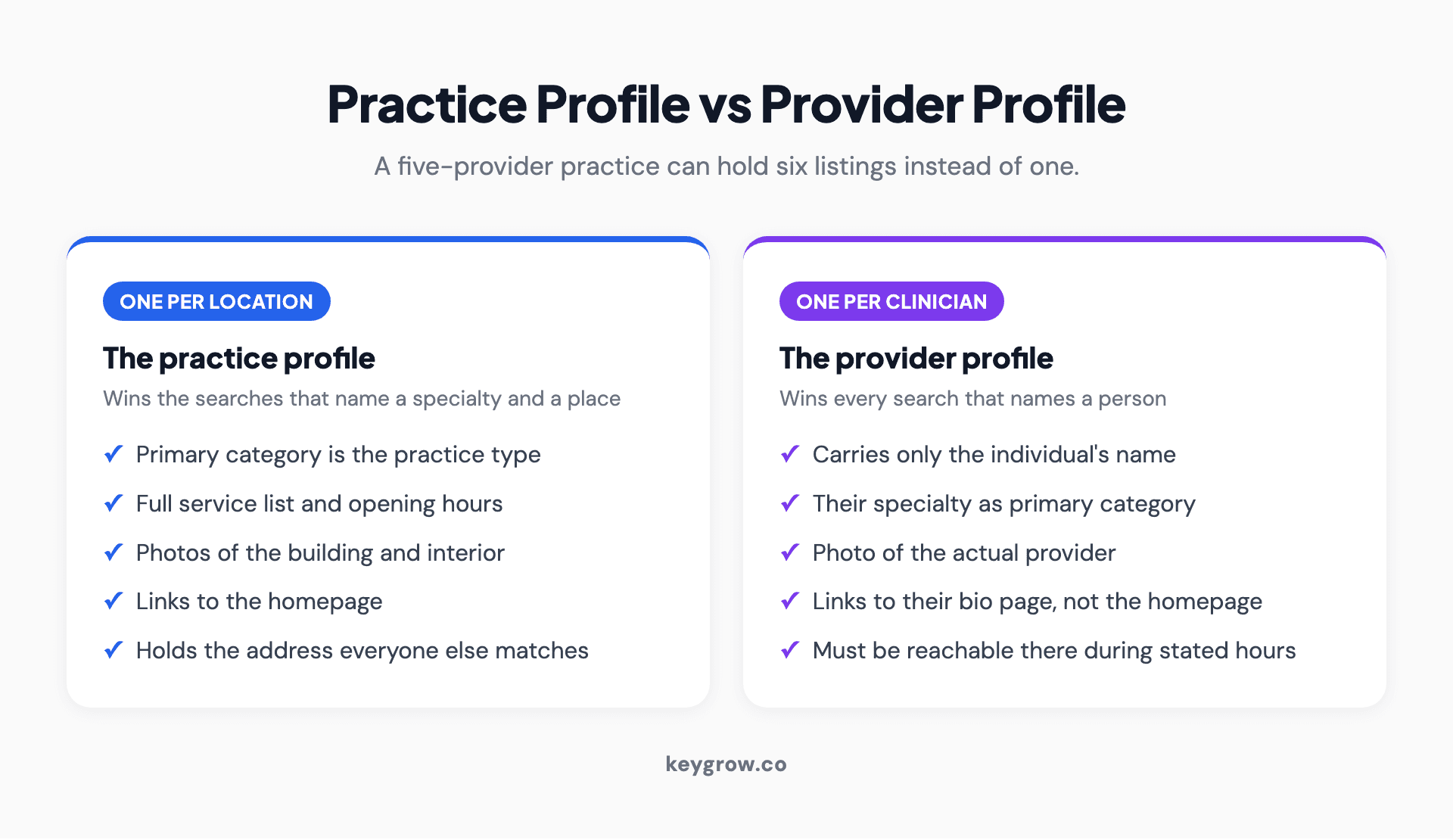
Two-column comparison of the practice Business Profile and an individual provider profile, showing what each one should contain and which searches each one wins.
The practical effect is that a five-provider practice can hold six profiles rather than one. Each provider profile takes their specialty as its primary category, links to their own bio page rather than the homepage, and collects reviews under their own name.
Two rules to respect, because ignoring them gets profiles merged or suspended. A provider profile carries the person's name, not the practice name stacked on it. And the provider genuinely has to be reachable at that address during the hours listed, so a surgeon who operates at three hospitals and consults at one clinic lists the clinic.
What goes on a provider profile is narrower than a practice profile and that is the point. Their specialty as the primary category, the conditions they treat as services, a photograph of the actual person rather than a stock portrait, the same address and phone as the practice, and a website link pointing at their bio page. Do not duplicate the practice description across all of them, because near-identical profiles at one address is exactly the pattern that triggers a merge.
Then keep them alive. A provider profile that is created and abandoned sits at three reviews forever and does nothing. Route review requests to the provider the patient actually saw, which is more natural to ask for anyway, and which builds the entity Google associates with that name.
Departments follow a similar logic. Google allows departments within larger organizations to hold separate profiles when they have distinct names, categories and usually their own entrance, which is how an imaging suite or a physical therapy wing inside a larger practice can appear on its own.
Build pages the way patients search, not the way you bill
Practice websites are usually organized around the practice. Patients search around their problem. The gap between those two structures is where most of the missed traffic sits.
| Page type | What the patient typed | What the page has to do |
|---|---|---|
| Condition | "plantar fasciitis treatment [city]" | Explain the condition, then who treats it here |
| Procedure | "cortisone injection cost" | Describe the procedure, recovery, and price shape |
| Provider bio | "dr [name] [city]" | Credentials, what they treat, how to book with them |
| Insurance | "podiatrist that takes [plan]" | Name the plans, state the verification process |
| New patient | "new patient appointment [specialty]" | What to bring, wait time, first visit length |
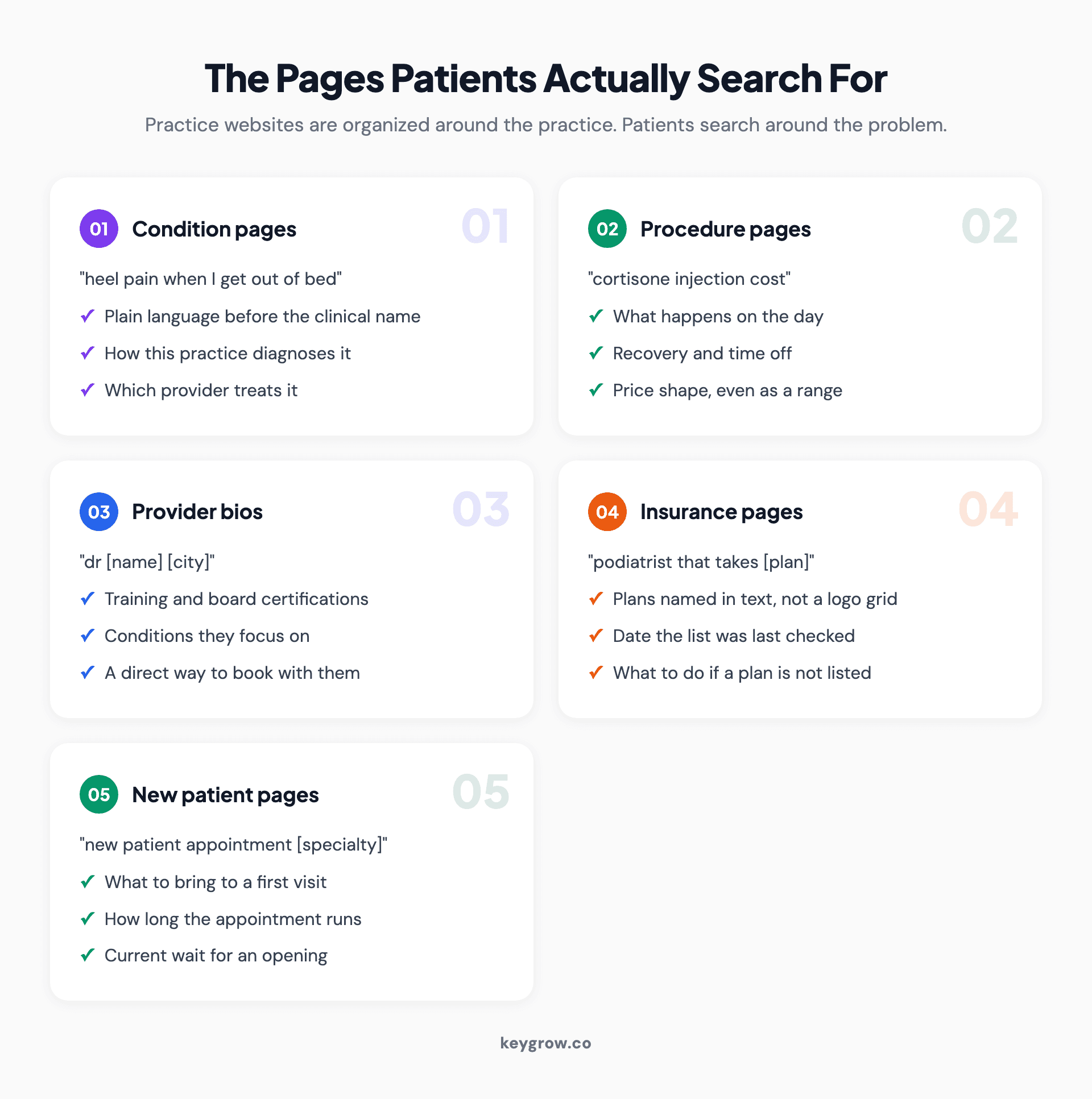
Card grid of the page types a medical practice website needs: condition pages, procedure pages, provider bios, insurance pages and new patient information.
The condition page is the workhorse, and it is where practices most often publish something that cannot rank. A page that explains a condition in general terms competes against major health publishers with vastly more authority, and it loses. A page that explains the condition briefly and then covers how this practice diagnoses it, what the first appointment involves, which providers handle it and what the typical treatment path costs is competing in a much smaller field.
Write the second kind. The first kind is already on the internet a thousand times.
There is a vocabulary decision underneath this too. Patients search symptoms, not diagnoses. Nobody types "plantar fasciitis" before a clinician has said the words; they type "heel pain when I get out of bed". A condition page that leads with the clinical name and never uses the plain description misses the searches that happen before diagnosis, which are the earliest and least contested ones available to you. Use both, with the plain language first.
The insurance question your site probably ignores
"Doctors who take [plan name] near me" is one of the highest-intent searches in healthcare and one of the least answered. Most practice sites either say nothing or list plan logos in an image.
Put it in text. A page that names the plans you accept, states when the list was last checked, and explains what a patient should do if their plan is not listed will pick up a steady stream of searches your competitors are ignoring. Add the practical detail patients actually want: whether you verify benefits before the visit, whether you are in-network or out-of-network with a given plan, and what self-pay costs if the answer is no.
One caution. Insurance participation changes, and a stale list is worse than no list because it creates a patient who arrives expecting coverage they do not have. Date the page, put a review reminder in the calendar, and say plainly that patients should confirm with their plan.
If most of your revenue is cash-pay rather than insurance-billed, this section inverts: price becomes the page and insurance becomes a footnote. Our guide to SEO for elective and cash-pay clinics covers that version of the problem.
Who signs the content decides whether it ranks
In this category, authorship is not a nice-to-have detail at the bottom of the page. It is part of whether the page competes at all.

Clinician writing notes on a patient chart.
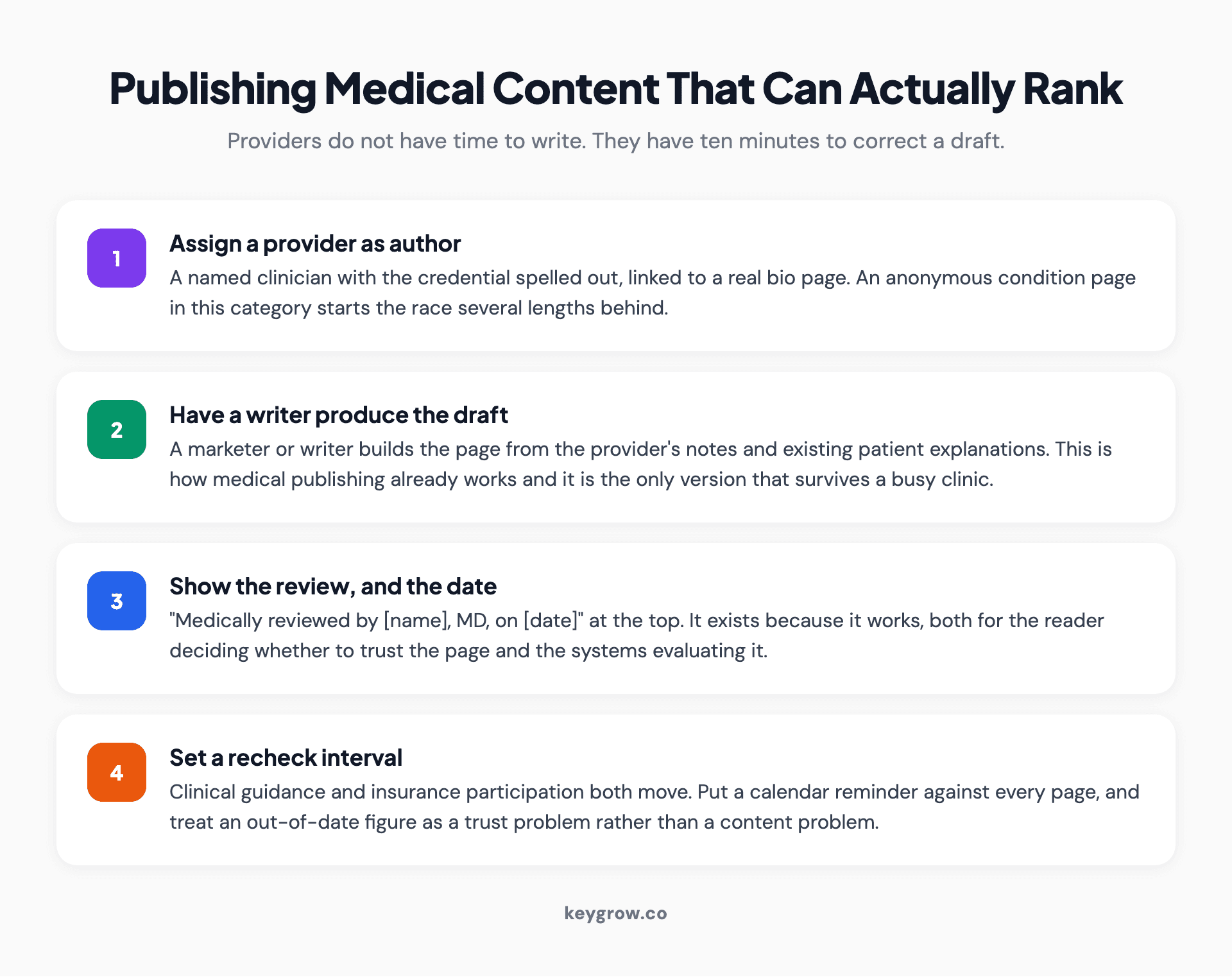
Four-step process for publishing medical content that can rank: assign a provider author, add a clinical reviewer, show credentials and review date, and set a recheck interval.
Every clinical page needs a named provider as author or reviewer, with the credential spelled out and linked to a real bio page. "Medically reviewed by [name], MD, on [date]" at the top of the page is the standard convention and it exists because it works, both for readers deciding whether to trust the page and for the systems evaluating it.
The bio page matters as much as the byline. It should carry the provider's training, board certifications, hospital affiliations, years in practice and the conditions they focus on. This is the page that makes a name into an entity that search engines and AI systems can recognize and attribute to.
A practical note on workflow, because this is where practices stall. Providers do not have time to write. They do have ten minutes to correct a draft. Have a writer produce the page, have the provider mark it up, and publish under the provider's name once they have genuinely reviewed it. That is honest, it is how medical publishing works, and it produces a page nobody else in your market can copy.
Reviews when you cannot discuss the patient
Every practice knows to ask for reviews. Fewer know how to handle the reply, which is where the actual risk sits.
You cannot confirm that someone was a patient. Responding to a negative review with "we are sorry your procedure on the 14th did not go as planned" discloses a treatment relationship, and that is a disclosure you are not permitted to make. The safe response acknowledges nothing specific: thank the reviewer for the feedback, state your general commitment to patient experience, and give a phone number and a name for the conversation to move offline.
Write those templates once, train whoever monitors reviews, and never let a well-meaning office manager improvise. On the asking side, the reliable moment is checkout rather than a delayed email, and the request has to avoid anything that ties the review to a specific condition. Our guide to asking for Google reviews covers the mechanics of the ask; the healthcare-specific part is entirely in what you do not say.
The tracking problem medical SEO guides skip
Here is the part your marketing agency probably has not raised. The standard analytics and ad-platform tracking stack, dropped onto a practice website without thought, can send more than you intend.
The concern is the combination of an identifier with a health context: an IP address or advertising ID paired with a visit to a page about a specific condition, or an appointment booking that carries the specialty in the URL. Regulators took an expansive view of this, as the AHA reported when the guidance was updated, and a federal court later vacated part of that position. The regulatory picture narrowed. The private litigation did not go away.
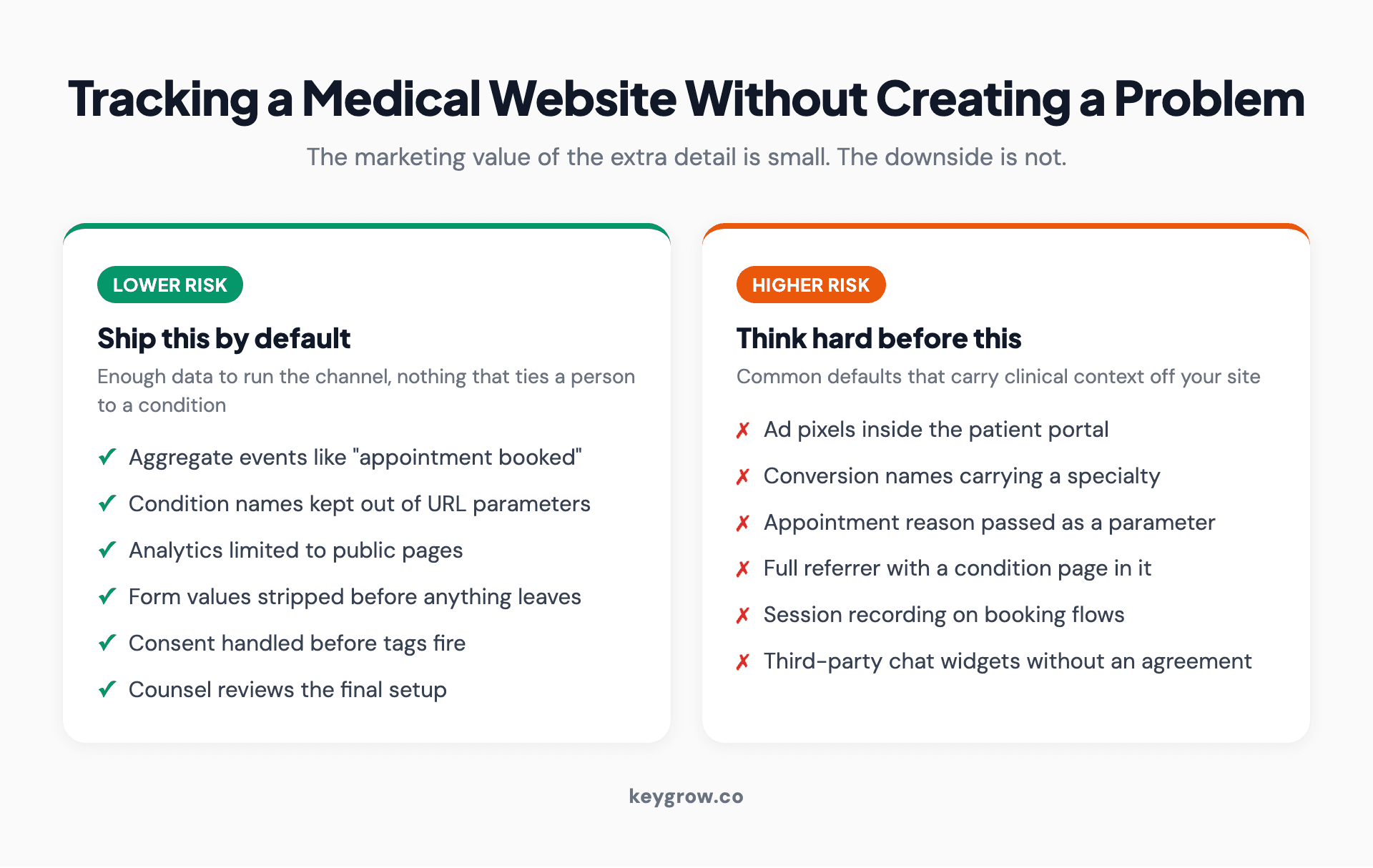
Two-column checklist of lower-risk and higher-risk tracking practices for a medical practice website, covering page URLs, form fields, ad pixels and patient portals.
The practical version, which costs nothing to implement and removes most of the argument:
Keep condition names and specialty identifiers out of URLs and page titles that get passed to analytics as parameters. Do not fire advertising pixels inside the patient portal or on any authenticated page. Strip form field values from anything sent to a third party, and never send the appointment reason. Use aggregate conversion events rather than ones that carry a clinical detail, so "appointment booked" rather than "dermatology consult booked".
This is not legal advice and your counsel should sign off on the final setup. It is the configuration we would ship by default for a practice, because the marketing value of the extra detail is small and the downside is not.
More than one location, or more than one specialty
Multi-site practices lose ranking for boringly structural reasons, usually a single location page with a dropdown, or five near-identical pages built from one template.

Empty clinic corridor with benches outside treatment rooms.
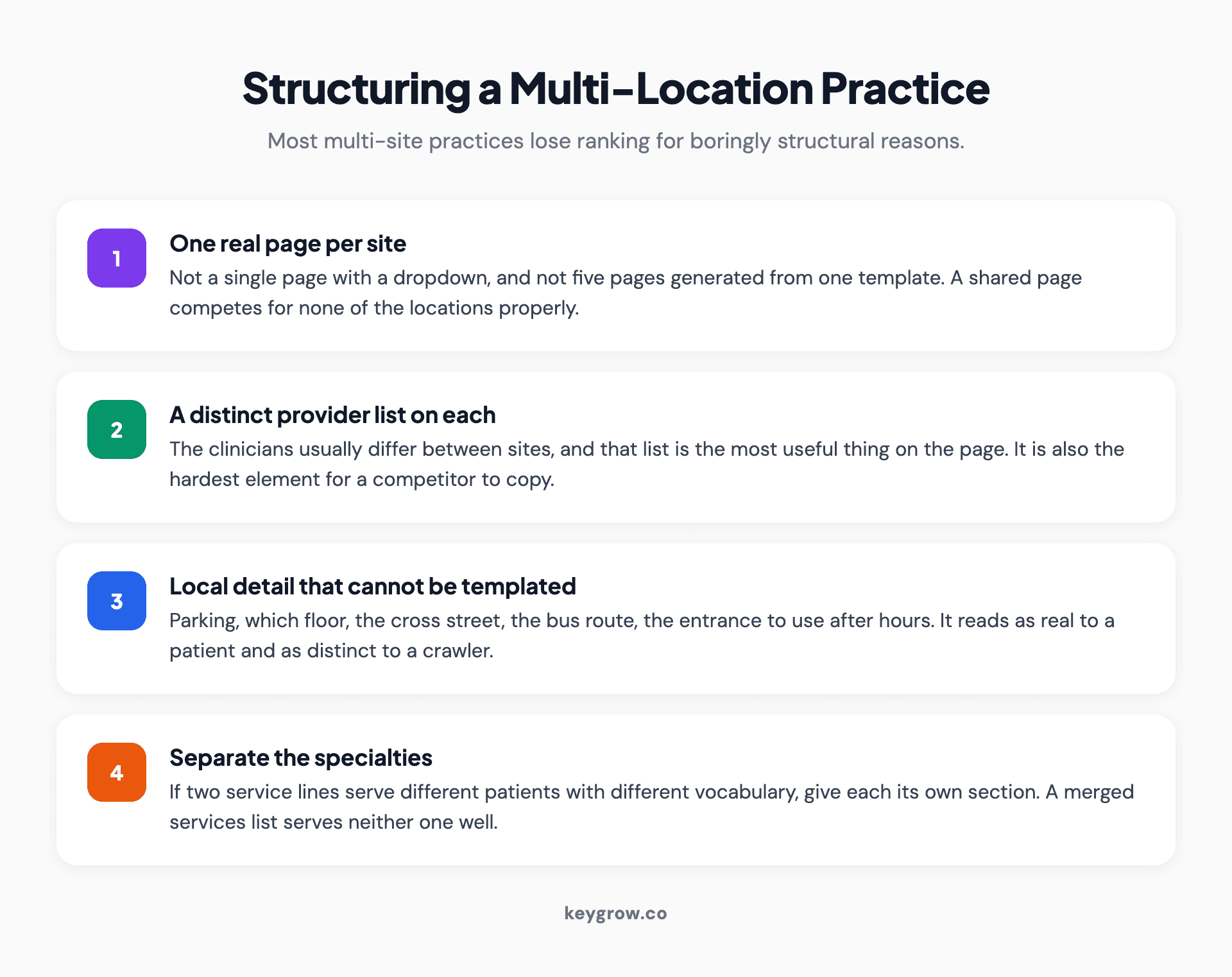
Four-part structure for a multi-location medical practice: one page and profile per site, a distinct provider list on each, local detail that cannot be templated, and specialty sections kept separate.
Each site needs its own page, its own profile, its own photographs and its own provider list, because the providers usually differ and that is the most useful thing on the page. Local detail helps: parking, which floor, the cross street, which bus route. It reads as real to a patient and it reads as distinct to a crawler.
Multi-specialty groups have a second decision to make. If your specialties serve genuinely different patients, give each one its own section with its own condition and procedure pages rather than flattening everything into one services list. An orthopedic group and its physical therapy arm are searched for by different people with different vocabulary, and one merged page serves neither.
What patients ask an assistant instead of a search box
A growing share of health questions never reach a search box. Someone describes a symptom to an assistant, gets an explanation, and then asks who nearby treats it.
The second question is the one you can do something about. The answer is assembled from profiles, reviews and text that states plainly what a practice treats and who works there. A site whose specialties live inside a navigation menu and whose provider list is an image gallery has almost nothing for that process to work with.
The fix is the same work as everything above, stated more plainly: conditions named in text, providers named with credentials, insurance listed in words, hours and locations consistent everywhere. Our answer engine optimization service is largely this, and healthcare is one of the categories where the shift is moving fastest, because people ask assistants the questions they are embarrassed to ask a person.
Practices that should not hire an SEO agency
A single-provider practice with a full schedule and a six-week wait does not need an SEO agency. It needs a claimed profile, an accurate insurance page and a phone that gets answered, and then it needs to think about pricing rather than marketing.
A practice about to change its patient mix should wait. If you are moving from insurance-heavy to cash-pay, or adding a service line that will become half the revenue, the content you build now will be aimed at the patients you are trying to stop attracting.
A practice whose front desk does not return calls should fix that first. We have watched practices generate a genuine increase in inbound and convert almost none of it because voicemail was full by Tuesday. Marketing makes a demand problem better and a capacity problem worse.
Hire help when you have the capacity to see more patients, more than one provider or location to coordinate, and a competitor who has clearly invested. Our SEO service works on a month-to-month basis for exactly this reason: a practice that fills up should be able to stop without an argument, and our healthcare marketing work is priced on the assumption that some practices will.
FAQs
When does a medical practice start seeing results?
Profile work, including provider profiles and category fixes, can move map pack visibility within 4 to 8 weeks. Condition and procedure pages generally take 3 to 6 months to rank, and a full year before organic contributes a predictable share of new patients. Practices in competitive metros should assume the longer end.
Can each doctor in a practice have a separate Google Business Profile?
Yes, when the provider is public-facing and can be reached at the verified address during the hours listed. The practice keeps a profile for the location and each qualifying provider holds one carrying only their own name. Support staff cannot have profiles, and a provider who is never actually at that address should not be listed there.
Does a medical practice website need a blog?
It needs condition and procedure pages far more than it needs a blog. Generic health articles compete against major publishers and rarely rank for a local practice. Content tied to what your practice treats, who treats it, what it costs and what the first visit involves is where the return is.
Is Google Analytics HIPAA compliant for a medical website?
Standard analytics is not designed for protected health information and most providers of it will not sign a business associate agreement. The usual approach is to configure tracking so that nothing identifying or clinically specific reaches it, keep it off authenticated pages entirely, and have counsel review the setup before launch.
What is the most common SEO mistake medical practices make?
Publishing general health content instead of practice-specific content. A page explaining a condition in the abstract competes with national health publishers and loses. The same page becomes competitive when it covers how this practice evaluates and treats that condition, who does it, and what a patient can expect.
How do I get patient reviews without breaking privacy rules?
Ask at checkout rather than by an email that names a procedure, keep the request free of any clinical detail, and never respond publicly in a way that confirms someone was a patient. Prepared response templates that acknowledge feedback without acknowledging treatment are the part most practices are missing.
Should a medical practice list its prices online?
For cash-pay services and common procedures, yes, at least as a range. Price is a real search and patients are increasingly asking for it before they call. For insurance-billed care, explaining how billing works and what affects a patient's share is more useful than a number you cannot promise.
The order to work through this
Start with the profiles, because a five-provider practice can go from one listing to six in an afternoon and every one of them will be found by name. Then fix the insurance page, which is the highest-intent search nobody in your market has answered properly. Then build condition pages one at a time, each signed by the provider who treats it.
Leave the tracking review until you have something worth tracking, but do not leave it out. If you want a look at how your practice is currently structured across profiles, pages and providers, tell us about the practice and we will tell you which of the three is costing you the most.


