
Here is the uncomfortable place to start. SEO for accountants does not work the way it works for a plumber, because most of your future clients are not going to find you by typing a service into Google. They are going to be told your name by someone they trust, and then look you up.
A survey of 350 US businesses reported by CPA Practice Advisor found 57 percent chose their current accountant through a peer referral. Three percent came from advertising.
That number kills a lot of bad marketing advice, and it does not kill SEO. It changes the job. Search has to win the verification that happens after the referral, and it has to win the narrow slice of cold search where somebody is looking for exactly the kind of firm you are.

Accountants working at wooden desks in a sunlit office lined with filing cabinets.
The two jobs search actually does for a firm
Your website has two audiences and they behave nothing alike. Building for one and ignoring the other is the most common reason accounting firm SEO produces traffic and no clients.
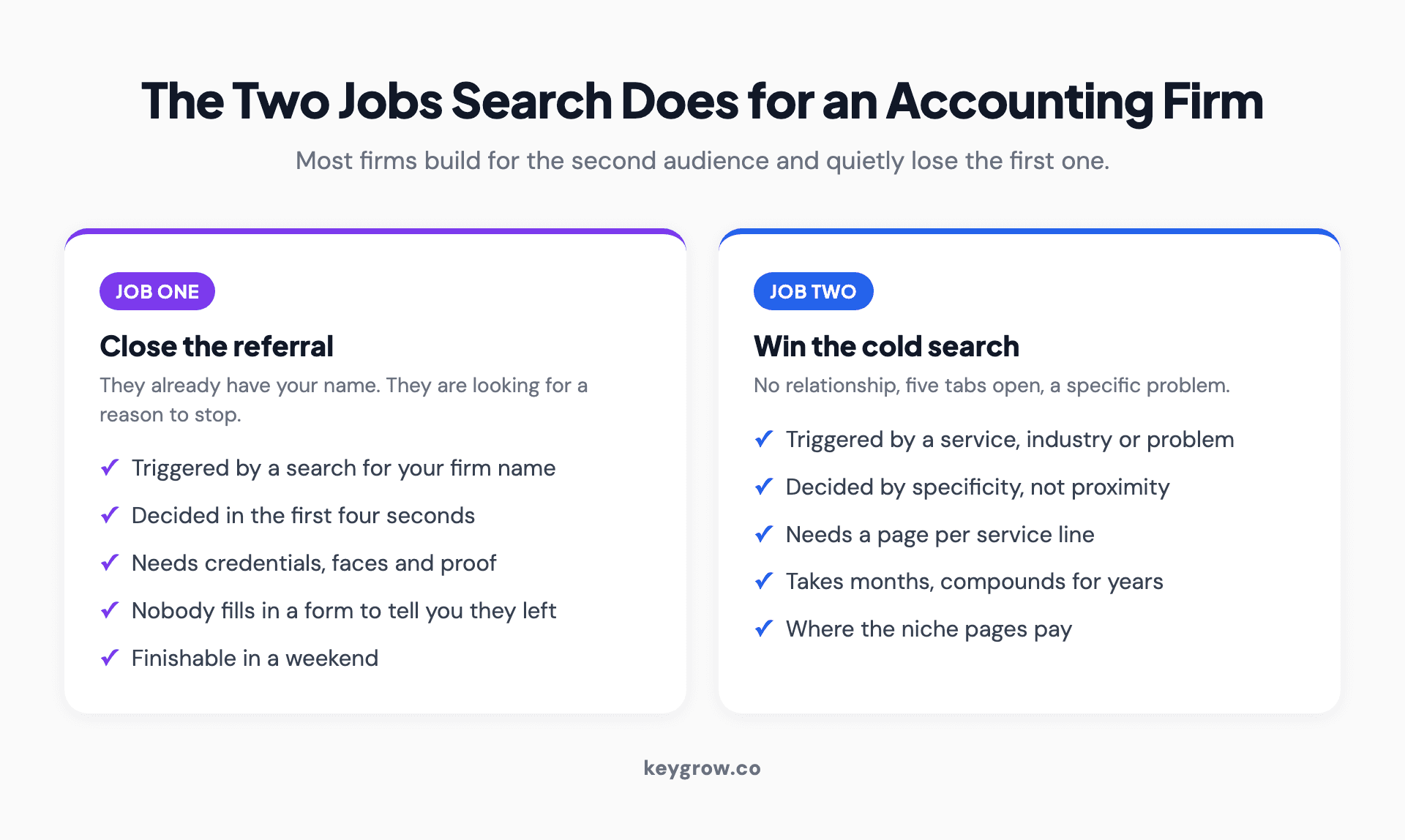
Two-column layout showing the two jobs SEO does for an accounting firm: closing the referral that already has your name, and winning the narrow cold searches where intent is specific.
The referred prospect searches your firm name. They land on your site already half-sold, and they are looking for reasons to stop. Missing credentials, a 2019 copyright line, no partner photos, no indication you have ever handled a business like theirs. Most firms lose referrals here without ever knowing it happened, because nobody fills in a form to tell you they left.
The cold searcher types a problem. "S corp election deadline", "accountant for Shopify sellers", "IRS letter CP2000 what to do". They have no relationship with you and they are comparing five tabs. You win these by being specific, not by being nearby.
Almost every guide to this topic optimizes for the second audience and forgets the first. Do the reverse for a month and watch what happens to your close rate.
The referral-closing job is a short list and you can finish it in a weekend. Partner photos that are actually of the partners. Credentials and license numbers on the page, not in a PDF. Two or three client situations described in enough detail that a reader recognizes their own business. A phone number that a person answers during filing season. None of that needs a keyword and all of it decides referrals.
The keyword nearly every firm chases first
"Accountant near me" and "CPA in [city]" feel like the obvious targets. They are the worst starting point for most firms, for four reasons.
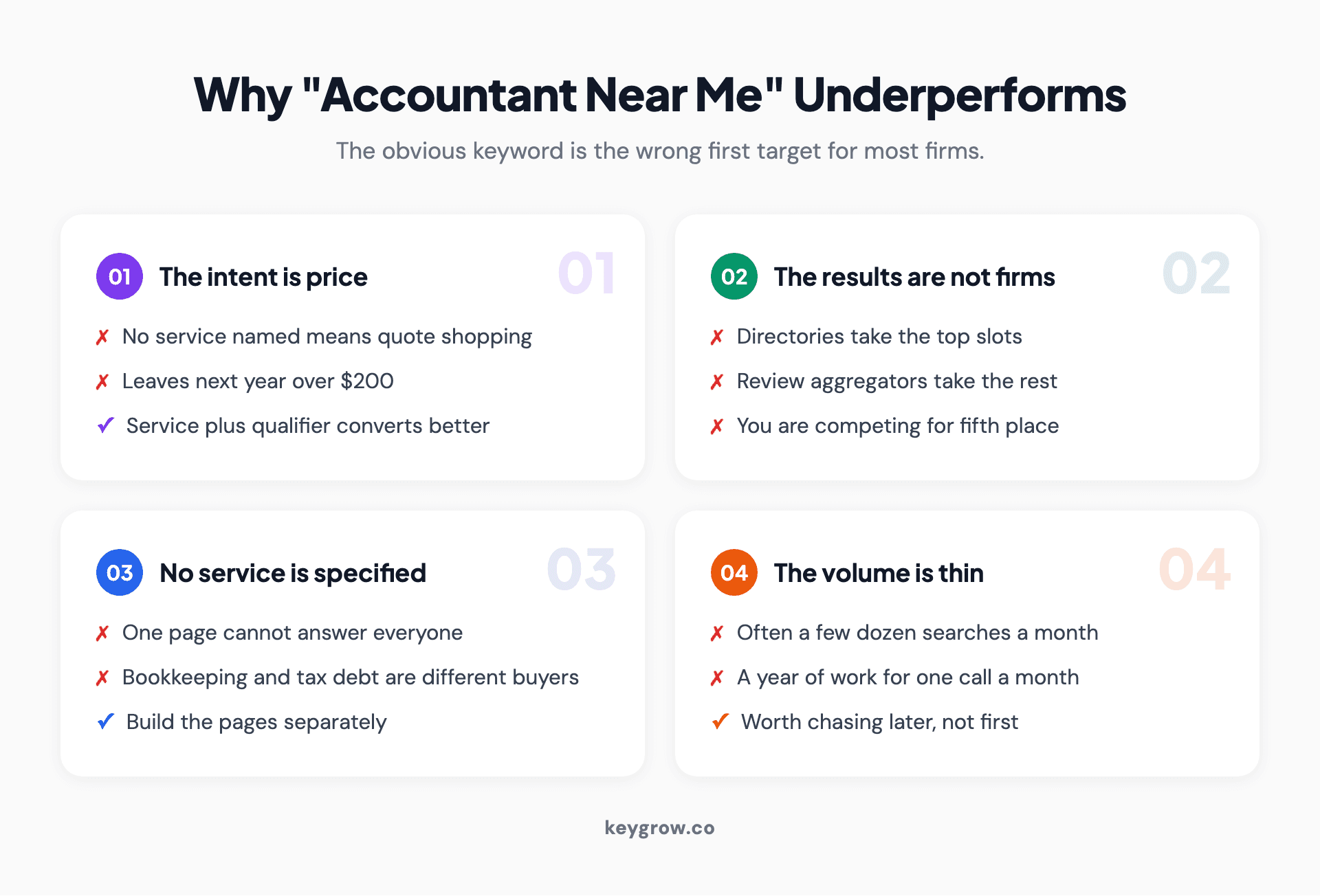
Four-card grid explaining why the keyword accountant near me underperforms for most firms: price shopping intent, directory-dominated results, no service specificity, and low volume relative to effort.
The intent is price. Someone searching a generic term with no service attached is usually gathering quotes. That is the client who leaves next year over a $200 difference.
The results are not firms. Generic local accounting searches are dominated by directories, review aggregators and the map pack. You are fighting for the fourth or fifth position on a page where the first four are not even competitors.
No service is specified. A search that does not name a service cannot be answered with a page that converts. Your bookkeeping buyer and your tax resolution buyer are different people with different urgency.
The volume is thin. Outside major metros, the city-plus-profession term often gets a few dozen searches a month. Firms spend a year fighting for it and win something that produces one call a month.
Chase it eventually, by all means. Just do not make it the first thing you build, and do not let an agency sell you a twelve-month engagement whose only measurable goal is that phrase.
Rank for the client you want, not the city you sit in
This is the highest-return move available to an accounting firm and almost nobody in the SERP for this topic mentions it. Specialize the pages by industry, not just by geography.
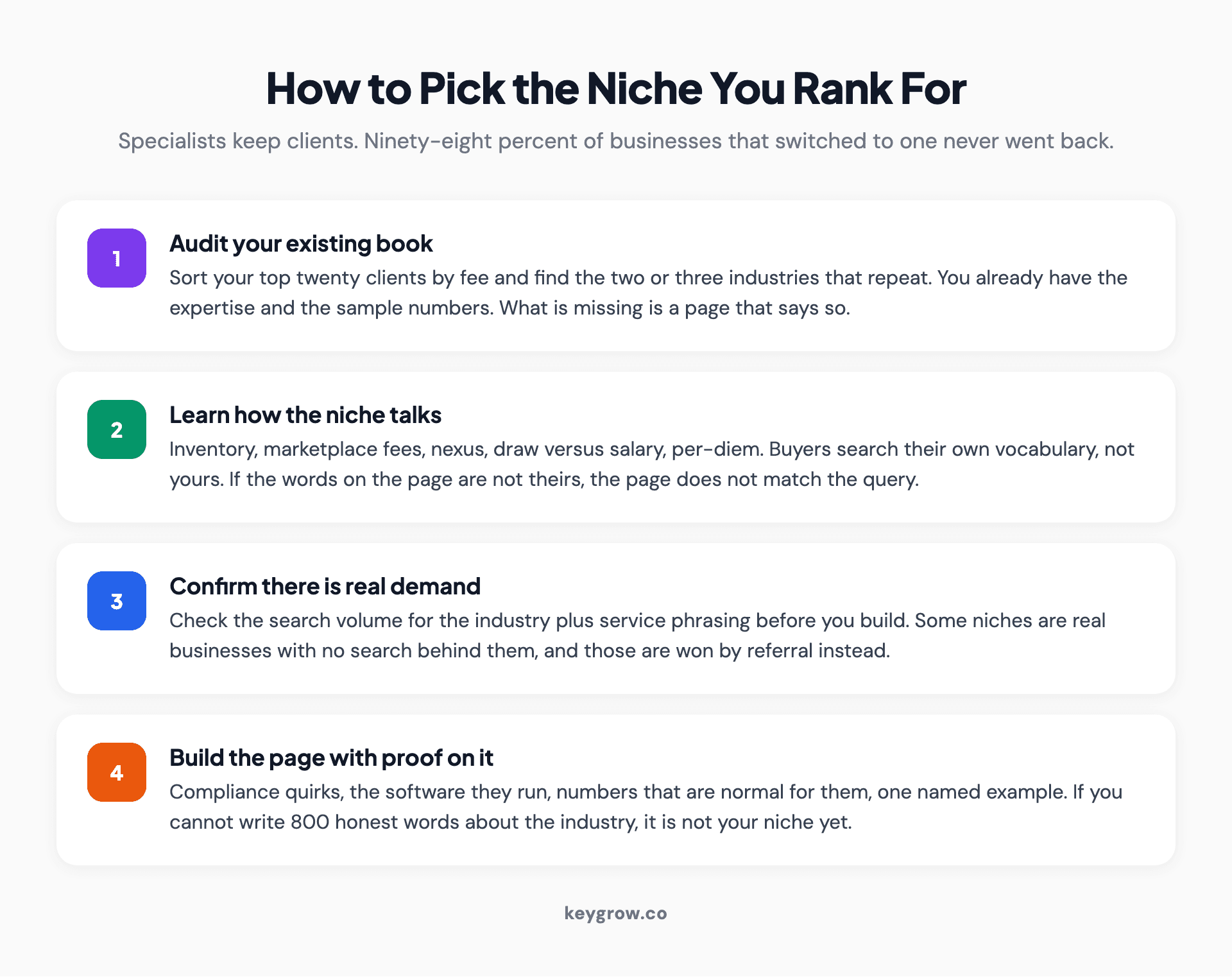
Four-step process for choosing an accounting niche to rank for: audit your existing book, check the language the niche uses, confirm the search demand, then build the niche page and proof.
The same survey found that 98 percent of businesses that moved from a generalist to a specialist accountant stayed with specialists, and firms over $1 million in revenue were twice as likely to hire a niche specialist in the first place. Specialization is not just a positioning exercise. It is what your better clients are shopping for.
Practically, that means a page for "accountant for dental practices" rather than a line on your services page saying you serve healthcare. It means "bookkeeping for e-commerce sellers" with the words inventory, marketplace fees and sales tax nexus on it, because that is how the buyer describes their own problem.
Start with your existing book. Look at your top twenty clients by fee and find the two or three industries that repeat. You already have the expertise, the sample numbers and the language. What you are missing is a page that says so.
The bonus is competitive. Every firm in your city is fighting over the city term. Roughly nobody is fighting over "CPA for short term rental owners", and the person searching it is worth ten of the price-shoppers.
One warning, because this is where firms fake it. A niche page has to carry proof: the compliance quirks specific to that industry, the software those businesses run on, the numbers that are normal for them, and at least one named example. A page that swaps the industry word into generic copy ranks for nothing and reads as a mail merge to anyone who actually works in that field. If you cannot write 800 honest words about an industry, it is not your niche yet.
Your service lines are separate businesses to Google
Bundling everything onto one services page is the second most common structural mistake. Each line has its own buyer, its own urgency and its own search behavior.
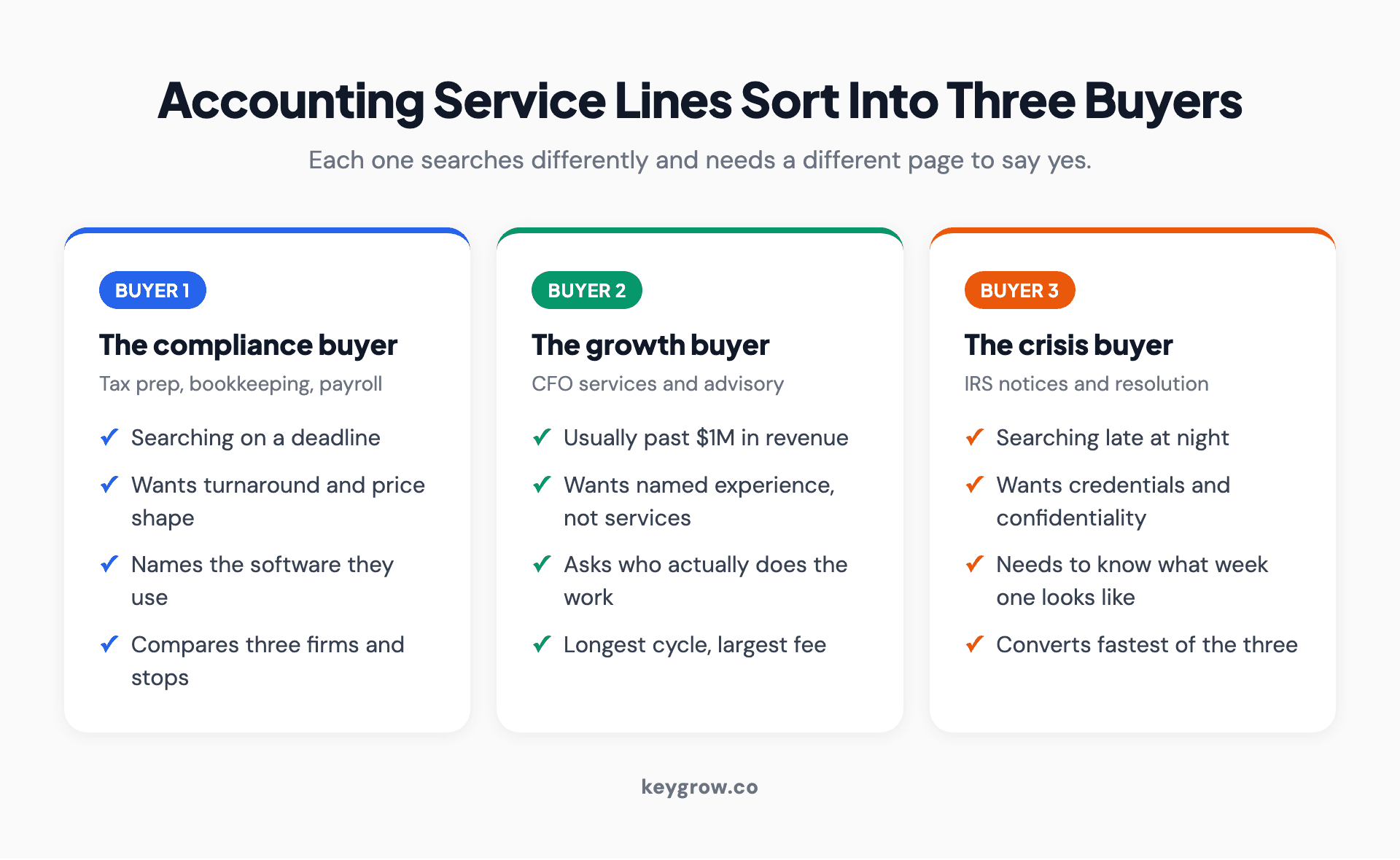
Three-column layout grouping accounting service lines by buyer type: the compliance buyer, the growth buyer, and the crisis buyer, with what each one searches and what the page must prove.
| Service line | Who is searching | What the page must settle |
|---|---|---|
| Tax preparation | Individuals and businesses on a deadline | Turnaround time, what you need from them, price shape |
| Bookkeeping | Owners who fell behind or fired a bookkeeper | Software you work in, catch-up capability, monthly cost |
| Payroll | Businesses hiring their first employees | Multi-state handling, filing responsibility, onboarding time |
| CFO and advisory | Owners past $1M looking to grow or sell | Named experience, outcomes, who exactly does the work |
| Tax resolution | People with an IRS letter, searching at 11pm | Credentials, confidentiality, what happens in week one |
Look at that last row. Someone searching about an IRS notice is in a different emotional state than someone comparing bookkeeping quotes, and a shared services page cannot speak to both. Build the pages separately and the difference in conversion rate shows up faster than the ranking does.
Accounting sits in a category Google treats differently
Financial advice falls into what Google calls "Your Money or Your Life" content, which means the quality bar is higher than it is for a landscaping site. Thin, unsigned, generic pages do not just rank badly. They struggle to rank at all.

Person at an office desk reviewing documents on screen and on paper.
Google's helpful content guidance is explicit that it wants content with evident expertise behind it, and that the question "who wrote this and why should anyone trust them" needs a visible answer on the page.
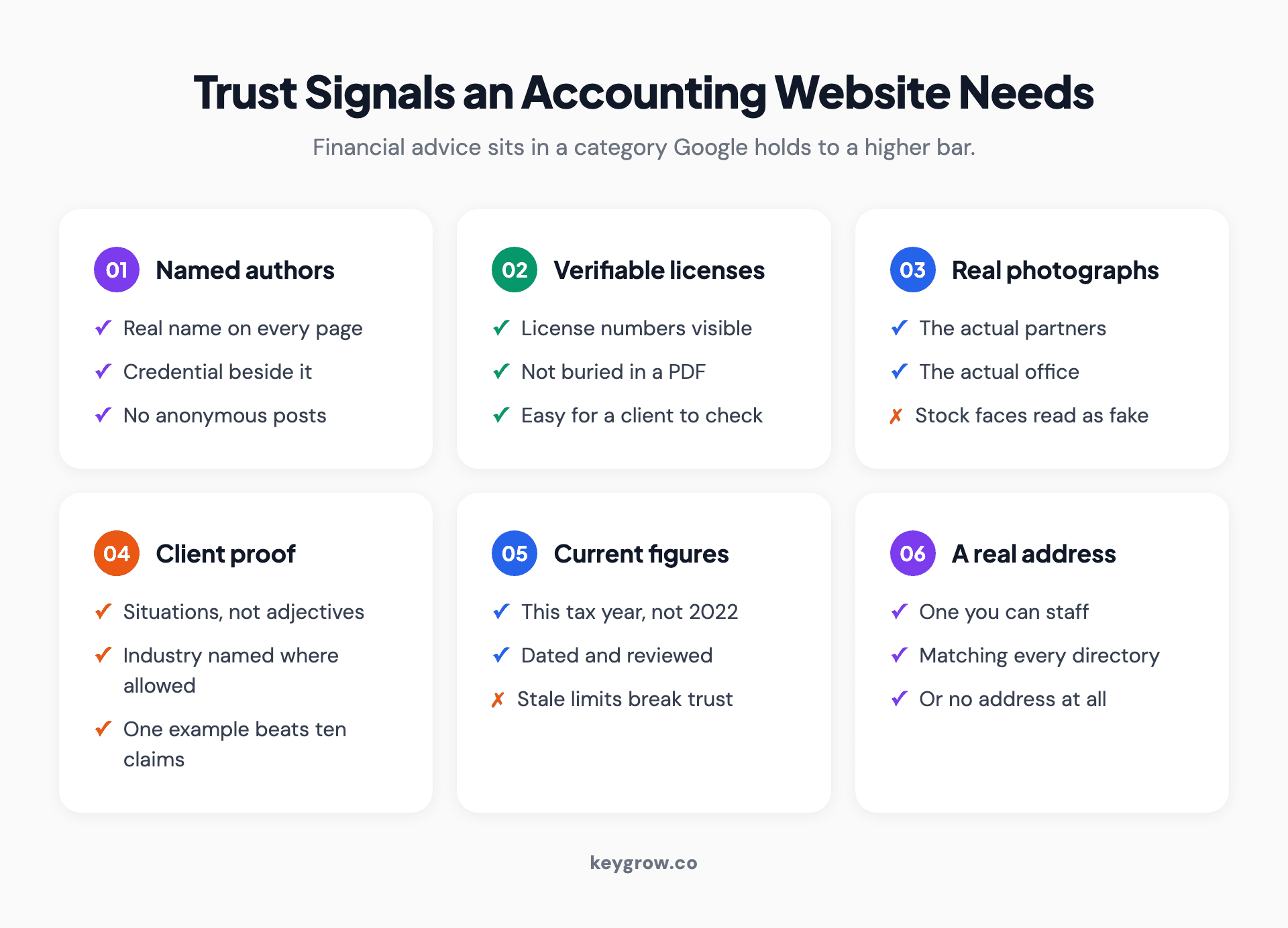
Six-card grid of the trust signals an accounting firm website needs: named authors with credentials, license verification, real partner photos, client proof, current tax year content, and a physical address.
In practice that means a byline with a real name and a real credential on every substantive page, a bio page for each professional, and license details a reader can check. The IRS guidance on preparers tells taxpayers to verify credentials, so make yours easy to verify rather than making a visitor hunt.
It also means keeping dated content current. A page about deduction limits that still quotes a three-year-old figure is a trust problem before it is an SEO problem, and in this category the two are the same thing.
Publish something about price
Very few accounting firms publish pricing, and the ones that do tend to get a disproportionate share of the search traffic for it. This is the trade-off worth making deliberately.
Nobody is asking you to publish a rate card. Publish a shape: what a typical monthly bookkeeping engagement runs for a business of a given size, what drives a tax return above the base, what an advisory retainer starts at. Frame it as ranges with the variables named.
The argument against is that price-led buyers will call. That is the point. They will call, and you will qualify them out in four minutes instead of a forty minute meeting. The argument for is that the buyer who was never going to negotiate now trusts you slightly more than the firm that hid the number.
If you genuinely cannot publish ranges, publish the process instead: how you scope, what changes the fee, how long a quote takes. Pricing intent is real search demand, and right now it mostly goes to directories and threads full of guesswork.
The local half, kept short
Local search still matters, especially for tax preparation and for firms whose clients want to sit across a desk. It just is not the whole strategy the way it is for a restaurant.
The essentials: claim the profile, set the primary category to match your main revenue line, list every service separately, keep hours accurate through tax season including any extended Saturday hours, and gather reviews steadily rather than in one burst. Our full walkthrough of Google Business Profile optimization covers the mechanics.
One accounting-specific note. If you work from home or a serviced office, think hard before listing a physical address you cannot staff. Profiles at addresses that do not check out get suspended, and recovering one during filing season is a genuinely bad week.
Reviews need their own handling here. Clients are often reluctant to publicly confirm who does their taxes, so the volume a restaurant gets easily will take you years. Ask at the two moments when gratitude runs highest, the week a return is filed and the month a messy catch-up job is finished, and accept that ten detailed reviews from named business owners will do more for you than fifty one-line ones.
The free-calculator trap
Accounting firms get pushed toward high-traffic informational content: tax calculators, "what is a 1099" explainers, deduction checklists. Some of it is worth building. Most of it is a trap.
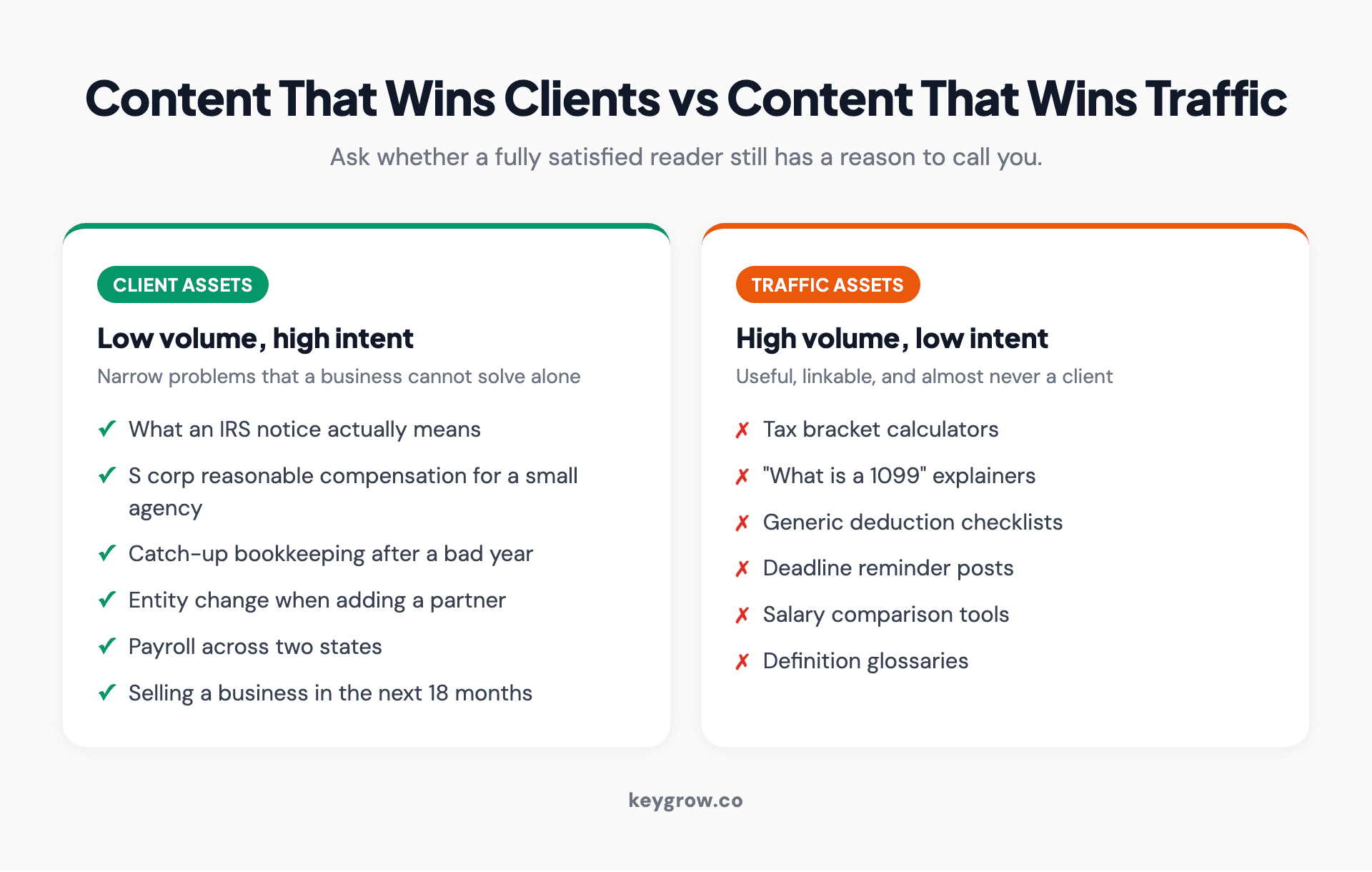
Two-column comparison of accounting content that wins clients versus content that only wins traffic, with examples of each.
A tax bracket calculator will bring thousands of visitors, of whom approximately none want to hire a firm. They wanted a number and they got it. Meanwhile a 900-word page on how S corp reasonable compensation is calculated for a two-owner agency brings forty visitors a month, and three of them have a real problem you charge for.
The test is simple. For any piece of content, ask whether someone who reads it and is completely satisfied still has a reason to call you. If the content fully solves the problem for free and the problem was small, it is a traffic asset, not a client asset. Build a few for the links they attract, then get back to work.
Where informational content does earn its keep is the anxious end: IRS notices, audit letters, missed deadlines, entity changes. High emotion, low volume, and the reader is looking for someone to take it off their hands.
What assistants do with a tax question
A growing share of "what does this IRS letter mean" and "do I need an accountant for an LLC" now gets asked to an AI assistant instead of a search box. The firms being named in those answers are not the ones with the best homepage.

Pen resting on printed tax forms and a mileage log.
Assistants favor pages that answer plainly and attribute clearly: a specific question as a heading, a direct answer in the first two sentences, a named author with a credential, and a date. They also favor pages that say who the advice does not apply to, because that reads as expertise rather than marketing.
The niche pages pay off twice here as well. When someone asks an assistant for an accountant who understands restaurant payroll, the model has to find a page that connects those two ideas in text. A generic services page never surfaces. Our answer engine optimization work is mostly this: making the specific true things about a business legible to a machine that is summarizing rather than ranking.
Measuring this when the sales cycle is a year
Accounting has an attribution problem that most industries do not. Someone reads your S corp article in March, does nothing, gets a referral to you in November, and signs in January. Last-click reporting gives all the credit to the direct visit and none to the page that built the trust.
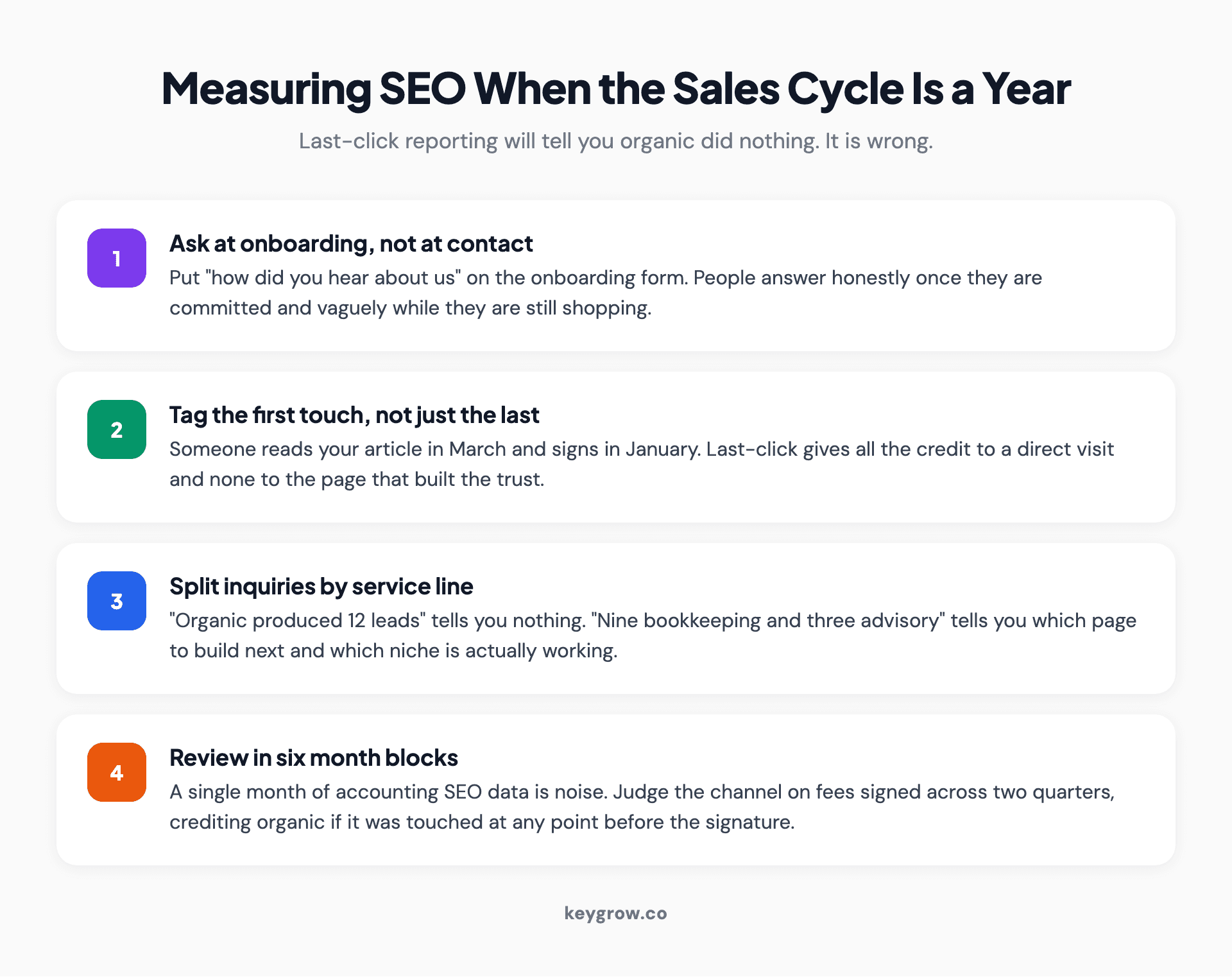
Four-step approach to measuring accounting firm SEO across a long sales cycle: ask how they heard about you, tag the first touch, track service-line inquiries separately, and review by cohort rather than by month.
Three practical fixes. Put a "how did you hear about us" field on the onboarding form, not the contact form, so you capture it when someone is committed rather than when they are guarded. Track inquiries by service line, because "organic produced 12 leads" tells you nothing while "organic produced 9 bookkeeping inquiries and 3 advisory inquiries" tells you what to build next. And judge the channel in six month blocks, because a month of accounting SEO data is noise.
The number that matters at the end of it is fees signed, attributed generously rather than narrowly. If a client touched an organic page at any point before signing, organic did work, even if the last click was your brand name.
The firms that should leave this alone for now
If your firm is at capacity, do not start. You will spend nine months and a fee building demand you have to turn away, and the goodwill you burn is worth more than the traffic.
If you are a sole practitioner whose entire book comes from one referral network and you have no intention of changing what you sell, a good profile, a current site with your credentials on it and a handful of reviews is genuinely enough. Anything more is a hobby.
If you have not decided what kind of firm you are, fix that first. SEO is a commitment device: it makes you publish what you do and who you do it for. A firm that takes any client with a pulse will produce pages that say nothing, rank for nothing and convert nobody. The strategy work has to come before the keyword work.
And if you need clients this quarter, search is the wrong instrument. Paid gets you in front of people this week, which is why we wrote a separate guide to running Google Ads for an accounting practice. Organic is the thing you start now so that next tax season is easier than this one. Our SEO work assumes that longer horizon, and we say so before anyone signs.
FAQs
When will an accounting firm see results from SEO?
Expect three to six months before rankings move meaningfully on service-line pages, and closer to twelve months before organic reliably contributes signed clients. Niche pages with low competition can rank faster, sometimes inside eight weeks, which is another argument for starting there rather than with the city term.
Is SEO worth it if most of my clients come from referrals?
Yes, but for a different reason than most firms assume. The referred prospect almost always searches your firm before calling, so your site is part of closing referrals whether you invest in it or not. Treat that as the first job and cold-search traffic as a second, slower benefit.
Which keywords are worth targeting first?
Start with service plus qualifier terms rather than the generic city term. Combinations of a service, an industry and a problem work best: bookkeeping for e-commerce sellers, S corp tax preparation, IRS notice help. They are less competitive, they signal what you actually sell, and the people searching them are further along.
Do accountants need to blog to rank?
Not in the way most firms blog. Generic tax explainers rarely produce clients. Content that answers a narrow, high-anxiety question for a specific type of business does, and a handful of those pages will outperform a weekly post about deadline reminders.
Does Google treat accounting websites differently from other local businesses?
Yes. Financial and tax advice falls under Your Money or Your Life topics, where quality standards are stricter. Pages need visible authorship, real credentials, current figures and clear sourcing to compete, which is why anonymous outsourced content underperforms so badly in this category.
Should an accounting firm publish its prices online?
Publishing ranges usually helps more than it hurts. It filters out buyers who would have wasted a meeting and builds trust with the ones who would not. If exact figures are impossible, publish the variables that move the fee and how long a quote takes.
Can a small firm outrank the national accounting brands?
For local and niche terms, regularly. National brands compete on broad informational keywords and rarely build convincing pages for a single industry in a single region. A three-person firm with a real page about restaurant payroll in its own metro is very hard for a national site to beat on that phrase.
Pick the niche before you pick the keywords
The order matters more than the tactics. Decide which two industries you want more of, write the pages that prove you understand them, put your credentials where a referred prospect can see them in four seconds, and let the city-level terms come later.
That sequence is unglamorous and it is why most firms never do it. If you want a second opinion on which niche your existing book is already pointing at, send us your situation and we will tell you what we would target, including whether we think you need an agency at all.


