


Google Ads for accountants has a structural problem that no amount of bid tuning will fix. Google bills you every month. A tax return pays you once.
That is the whole difficulty in one line. A firm can run a technically clean campaign, hit a respectable cost per lead, sign the client, file the return, and still lose money on the acquisition. The account only works when the ads are pointed at the services that renew, and when it is built to survive the eight months a year when almost nobody is searching for an accountant.
Most guides on this keyword skip both problems. They tell you to raise your budget in tax season and hand you a keyword list. This one starts with the arithmetic, then deals with the calendar, because for an accounting firm the calendar is the campaign.
A return pays once, a retainer pays for years
Work out the lifetime value of each service you sell before you write a single keyword. If a service cannot clear your cost per signed client on the first engagement, it has to earn its place through renewal, and the ads should say so.
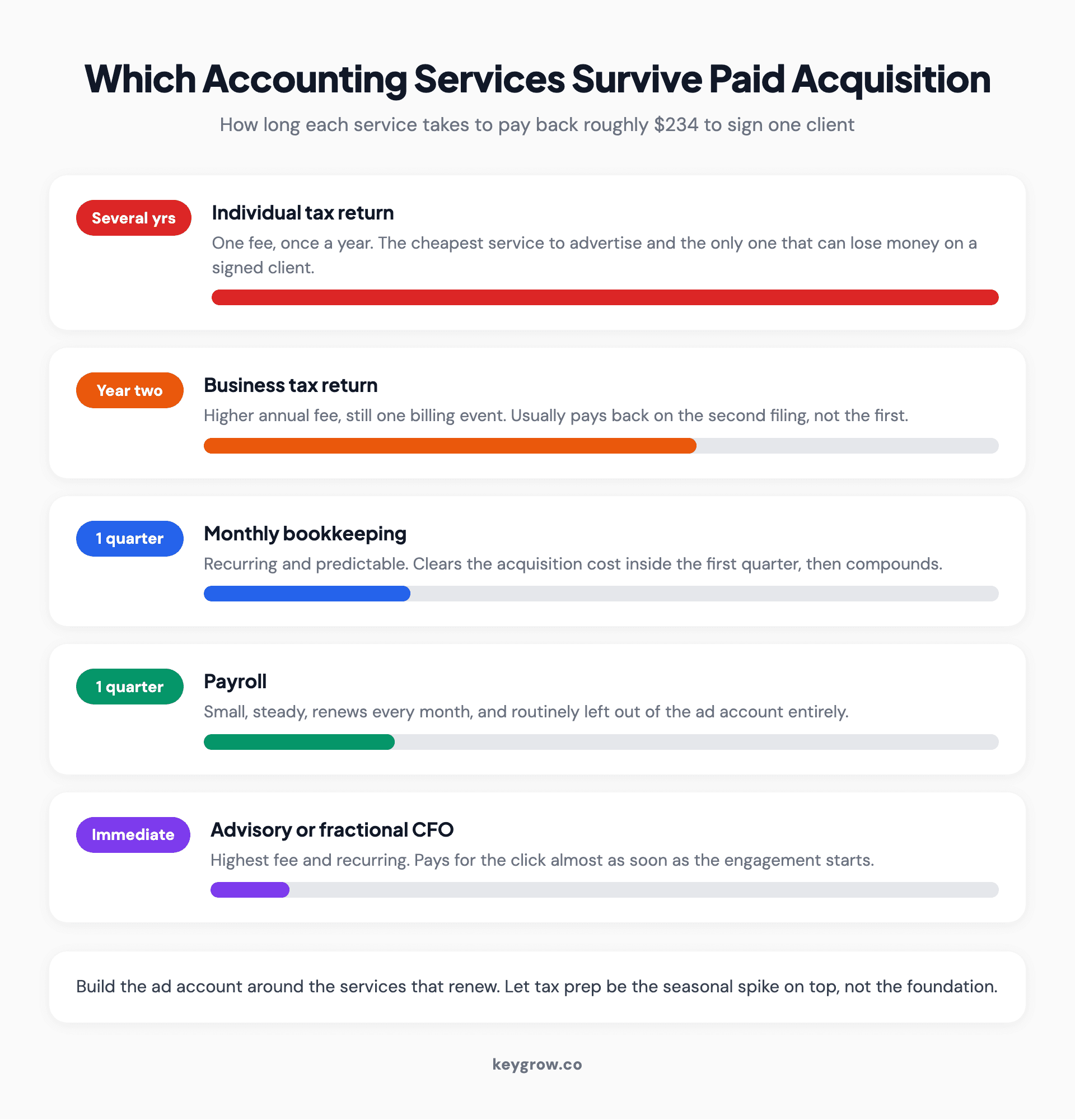
Horizontal bar chart comparing how long five accounting services take to pay back roughly $234 in client acquisition cost, from individual tax returns taking several years to advisory work paying back immediately.
Here is the number to start from. In LocaliQ's 2026 benchmarks, built from thousands of Google Ads and Microsoft Ads campaigns, Business Services runs an average cost per lead of $93.69 at a 4.85 percent conversion rate.
A lead is not a client. Say you sign 40 percent of the leads that come in, which is an assumption you should replace with your own number as soon as you have one. That puts you around $234 to sign a client.
Now put your services against that figure:
| Service sold | Typical billing shape | Clears $234 acquisition? |
|---|---|---|
| Individual return | One fee, once a year | Only after several returns |
| Business return | One fee, annual, higher | Usually by year two |
| Monthly bookkeeping | Recurring, monthly | Inside the first quarter |
| Payroll | Recurring, monthly | Inside the first quarter |
| Advisory or fractional CFO | Recurring, higher | Almost immediately |
The individual return line is the one that catches firms out. It is the cheapest service to advertise and the easiest to sell, so it is where the budget drifts. It is also the only one on that list that can lose money on a signed client.
None of this means you should refuse individual returns. It means you should not build the account around them.
The benchmark most accountant guides quote is the wrong one
Accounting is not consumer finance. Guides that quote you a three dollar click are quoting lending and insurance, where clicks are cheap and conversion is dismal.
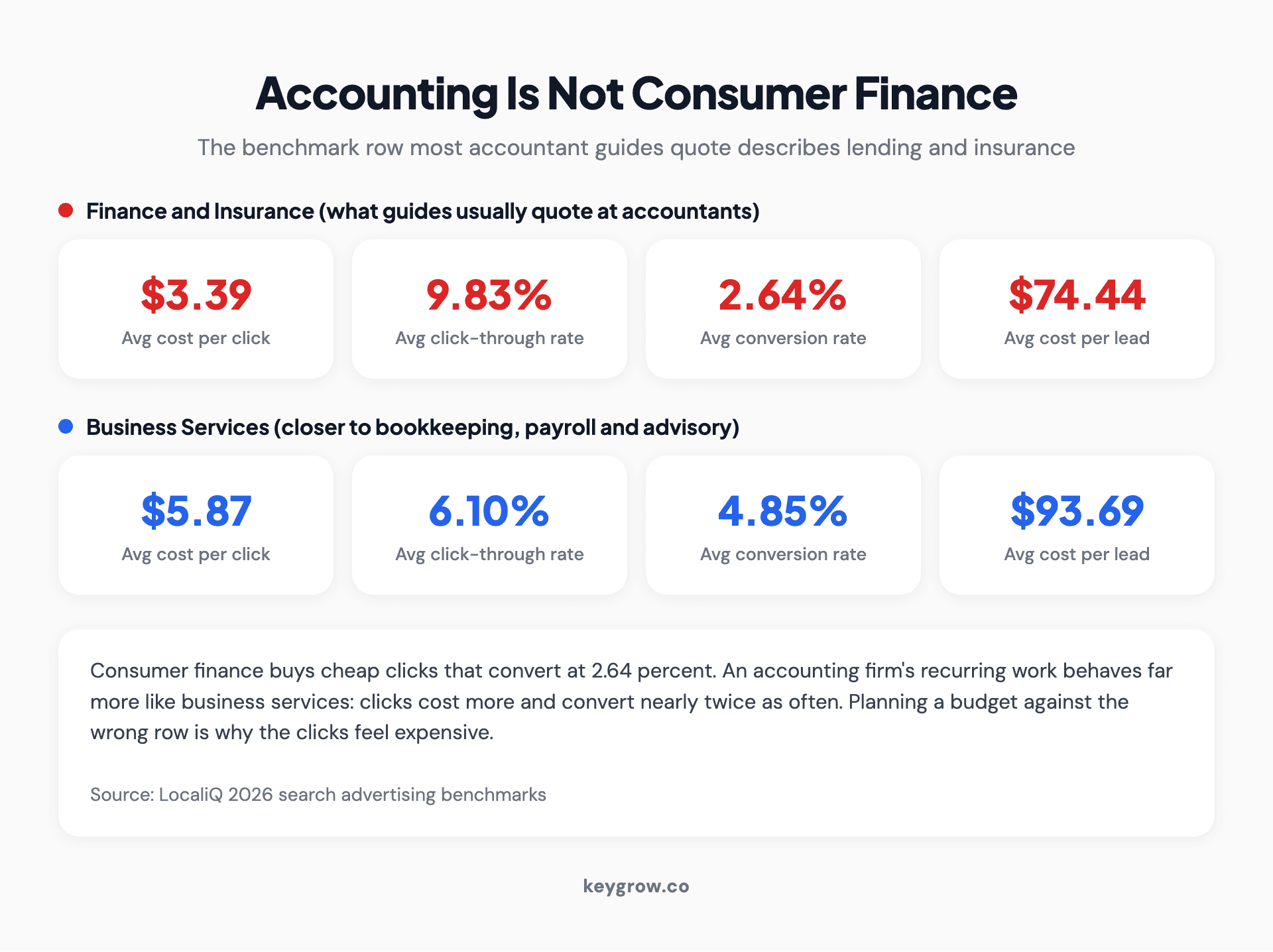
Stat comparison of Finance and Insurance versus Business Services Google Ads benchmarks: $3.39 versus $5.87 cost per click and 2.64% versus 4.85% conversion rate.
| Category | Avg CPC | Avg CTR | Avg conversion rate | Avg cost per lead |
|---|---|---|---|---|
| Finance and Insurance | $3.39 | 9.83% | 2.64% | $74.44 |
| Business Services | $5.87 | 6.10% | 4.85% | $93.69 |
Both rows are from the same LocaliQ dataset. The Finance and Insurance row is the one accountant articles keep reaching for, and it describes a completely different business: mass-market lending and insurance, where a cheap click is followed by a 2.64 percent conversion rate.
Your bookkeeping and advisory work behaves much more like Business Services. Consumer tax prep sits somewhere between the two. Neither row is your firm exactly, and that is fine. The point is to stop planning a budget against the insurance industry's cost per click and then wondering why your clicks cost double.
We wrote a companion piece on Google Ads for financial advisors that sits in the Finance and Insurance row properly, and the two professions end up needing almost opposite accounts.
Build the account around the service that renews
Give each service its own campaign, its own budget and its own target cost per acquisition. One campaign covering everything an accounting firm does will spend most of its money on the cheapest, least valuable search.
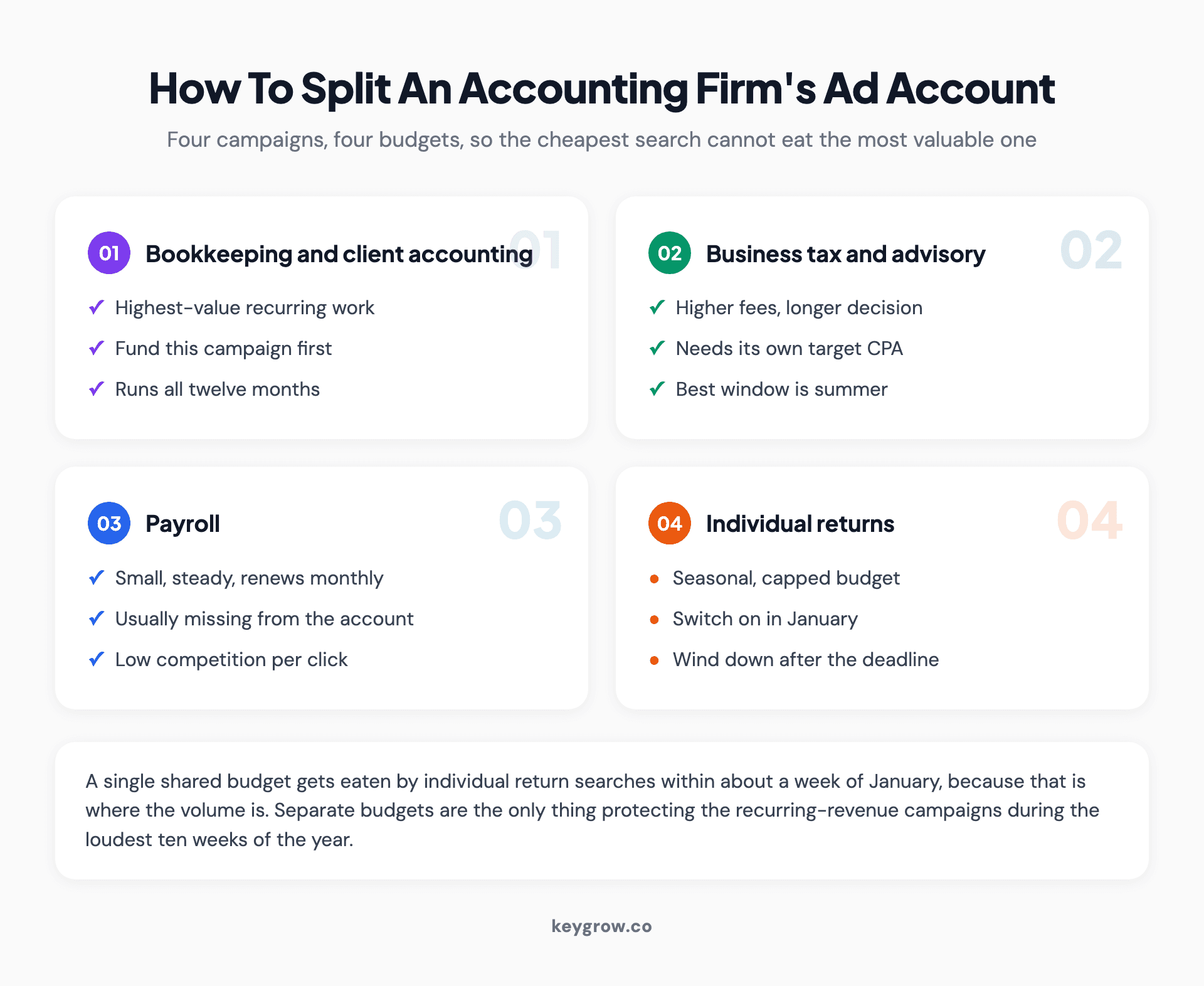
Four-card diagram of an accounting firm's Google Ads account split: bookkeeping, business tax and advisory, payroll, and seasonal individual returns, each with its own budget.
A structure that holds up:
- Bookkeeping and client accounting. Your highest-value recurring work. Fund it first and keep it running all year.
- Business tax and advisory. Higher fees, longer decision, worth a separate target CPA.
- Payroll. Small, steady, often overlooked, and it renews.
- Individual returns. Seasonal, capped budget, switched on in January and wound down after the deadline.
The reason to split them is not tidiness. It is that a shared budget in January will be eaten by individual return searches within about a week, because that is where the volume is. Separate budgets are the only thing that protects your bookkeeping spend during the loudest ten weeks of the year.
If you want to sanity check the split before you commit, our Google Ads budget calculator will get you to a starting figure per campaign.
Tax services can run Local Services Ads, bookkeeping cannot
Google's Local Services Ads list includes "Tax services" as an eligible category. It does not include accountant, bookkeeper or payroll. That split is worth knowing before you plan a channel mix.

A calculator and laptop on a desk with financial paperwork, the daily tooling of a small accounting practice.
These sit in the block above the paid search results, carry the Google Verified badge, and bill you per lead instead of per click. For the tax preparation side of a firm, that is a second route to the top of the page during the only weeks when consumer search volume is high.
It is also slightly awkward, because the eligible service is the one with the weakest economics. The recurring work that actually pays for itself, bookkeeping and payroll and advisory, has no category and has to be won in ordinary search ads.
Two practical consequences. If you do a meaningful volume of individual returns, get verified before December so the badge is live when the season starts, since approval is not instant. And do not let the tax-services lead flow convince you the whole firm is well marketed, because it only covers one service line for one quarter.
If you are weighing it up, we went through the lead credit process and the channel's limits in a separate piece on Local Services Ads.
Google's seasonality tool is not built for your season
Seasonality adjustments are designed for events lasting a few days. Tax season runs about thirteen weeks, so the tool that sounds like it was made for you is the wrong instrument.
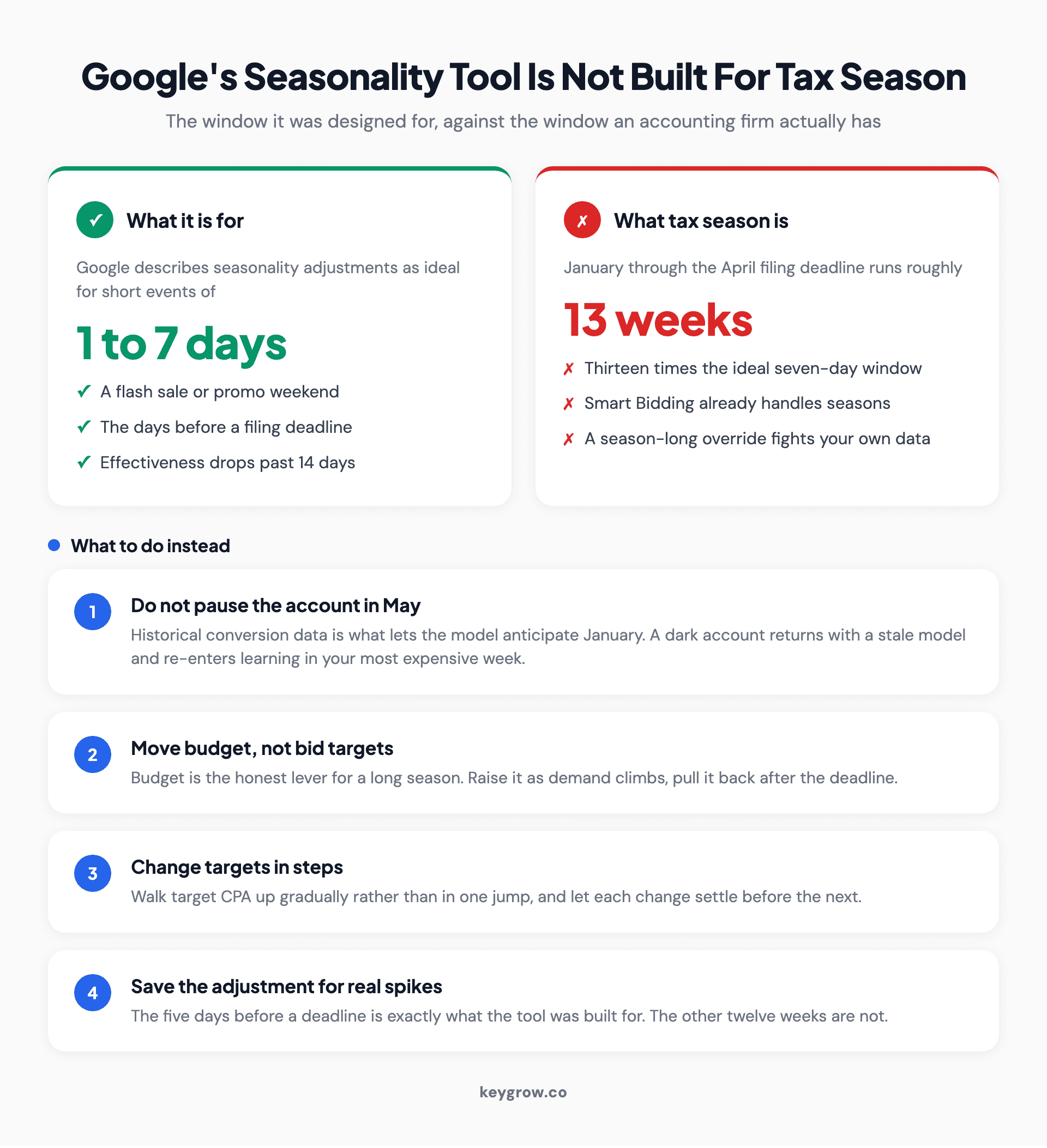
Comparison showing Google's seasonality adjustments are designed for events of 1 to 7 days while tax season runs about 13 weeks, plus four alternative tactics for a seasonal account.
This one matters, because it is the piece of advice every competing article gets wrong by omission. A seasonality adjustment tells Smart Bidding to expect a conversion rate change over a defined window. In Google's own documentation, they are described as ideal for short events of one to seven days, they may not work as well over periods longer than fourteen days, and Smart Bidding already manages seasonal events on its own.
Filing season is not a flash sale. Applying a season-long adjustment tells the bidding model to distrust the data it already has.
What actually works for a seasonal account:
- Do not pause the account in May. Historical conversion data is what lets the model anticipate January. An account that goes dark for eight months comes back with a stale model and re-enters the learning period in your most expensive week.
- Move budget, not bid targets. Budget is the honest lever for a longer season. Raise it as demand climbs and pull it back after the deadline.
- Change targets in steps. If you do want more volume at a higher cost, walk your target CPA up gradually rather than in one jump, and give each change time to settle.
- Save the seasonality adjustment for real short spikes. The five days before a filing deadline is exactly what the tool was built for.
The off-season budget is not there to generate leads at tax-season efficiency. It is buying two things: recurring-revenue clients, who are available all year, and a bidding model that still knows what your account looks like when January arrives.
The accounting year, quarter by quarter
| Period | What buyers are searching for | What the account should be doing |
|---|---|---|
| January to mid-April | Individual and business returns, deadline help, last-minute filing | Peak budget, individual return campaign live, tightest negatives, phones staffed |
| Mid-April to June | Extensions, amended returns, "I need a better accountant" | Budget down, switch messaging to switching firms, individual campaign paused or minimal |
| July to September | Bookkeeping cleanup, payroll, quarterly estimates, entity setup | Recurring services carry the account, advisory campaigns get their best window |
| October to December | Year-end planning, entity elections, next-year prep | Warm up individual returns late December, rebuild remarketing lists, fix the landing page |
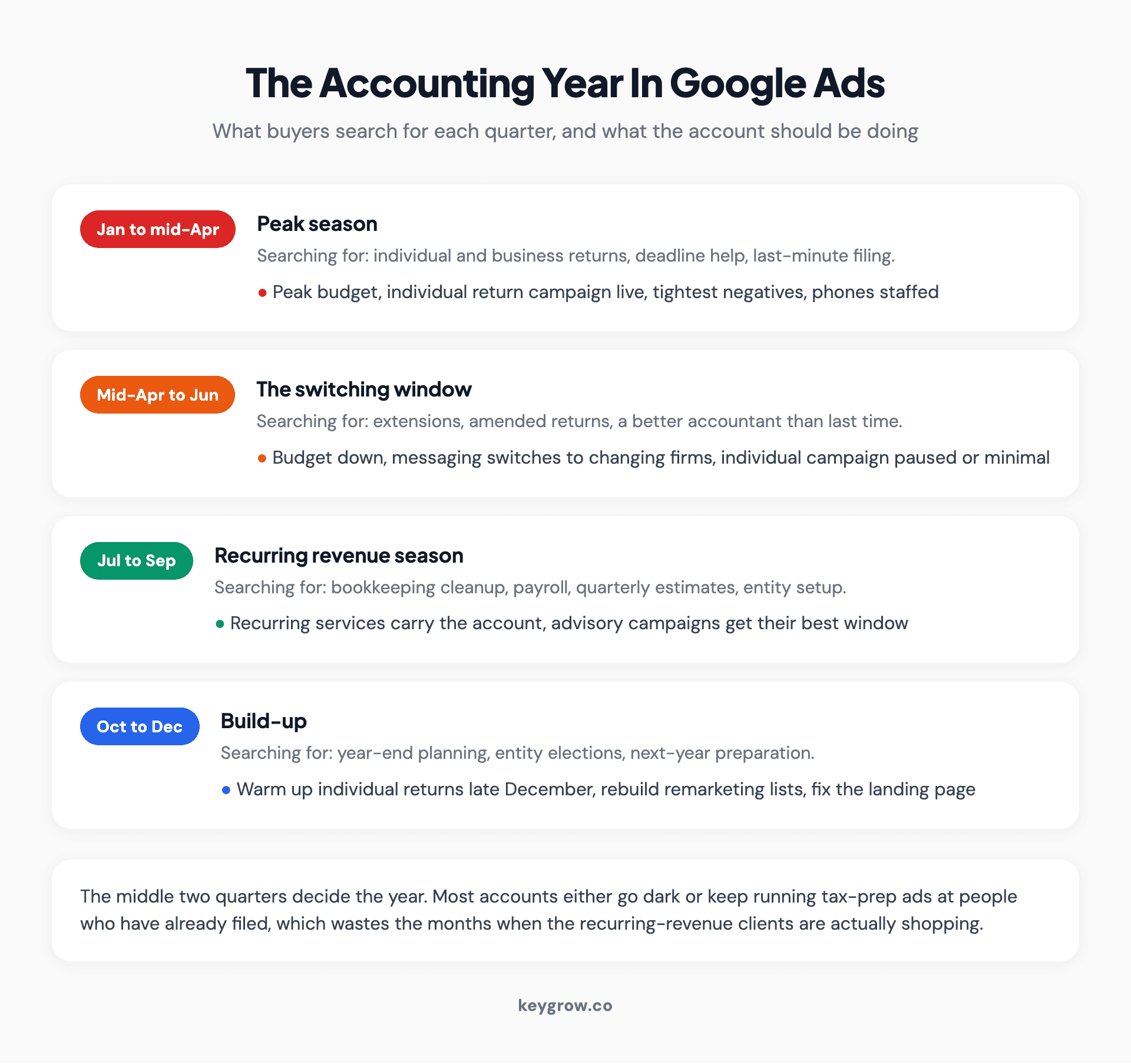
Four-quarter calendar of an accounting firm's Google Ads year, showing what buyers search for and what the account should be doing from January through December.
The two quarters in the middle are where the difference between firms shows up. Most accounts either go dark or keep running the same tax-prep ads to an audience that has already filed. Both waste the part of the year when your best clients are actually shoppable.
Mid-April to June is the single most underrated window in this business. Anyone searching for an accountant a week after the deadline just had a bad experience with their last one. That is the cheapest switching intent you will see all year, and almost nobody is bidding on it.
Keywords worth buying, and the ones that look right
Buy by service and by client type, not by profession. "Accountant near me" is the most expensive way to reach someone who might want a $300 return.
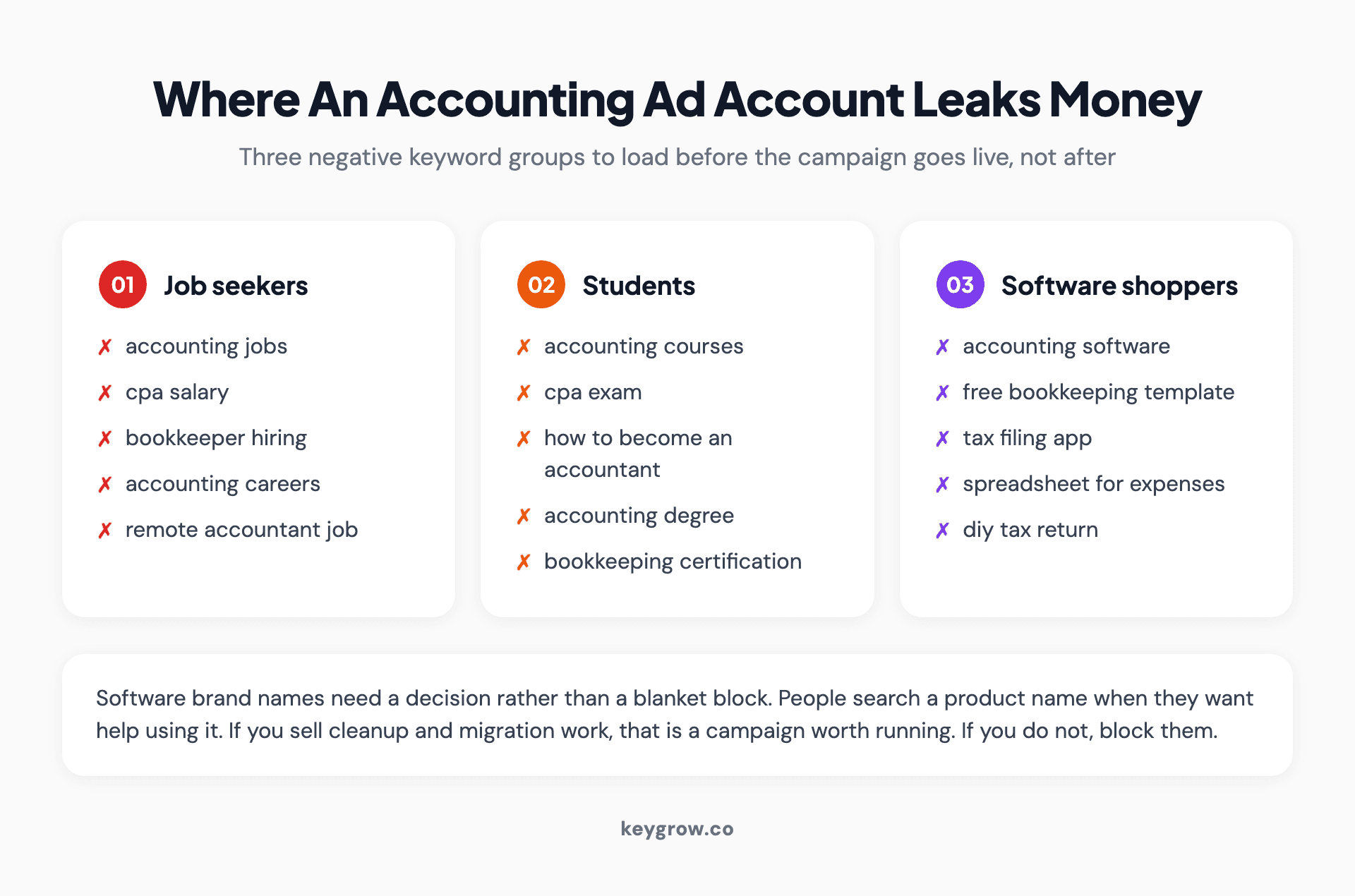
Three cards of negative keyword groups that drain an accounting ad account: job seekers, students, and software shoppers, with example search terms for each.
| Keyword group | Example intent | Worth buying? |
|---|---|---|
| Service plus business type | bookkeeping for contractors, cpa for ecommerce business | Yes, highest value |
| Recurring service plus city | payroll services phoenix, monthly bookkeeping austin | Yes |
| Switching intent | new accountant for small business, change accountants | Yes, underpriced |
| Entity and event driven | cpa for llc, s corp election help, quickbooks cleanup | Yes |
| Generic profession | accountant near me, local cpa | Cap it, low value per click |
| Consumer tax prep | file my taxes, cheap tax return | Seasonal only, small budget |
Three audiences will quietly spend your budget without ever intending to hire anybody. Job seekers ("accounting jobs", "cpa salary", "hiring"), students ("accounting courses", "cpa exam", "how to become"), and people looking for software rather than a person ("accounting software", "free bookkeeping template", "tax filing app"). Add all three before you turn anything on rather than after.
Software brand names deserve special attention. People search a software name when they want help using it, not when they want to hire a firm, unless you actually offer cleanup and migration work. If you do, that is a good campaign. If you do not, block them.
If your negative list is thin, our guide to negative keywords in Google Ads covers the match-type behavior that trips most accounts up.
The policy rule that catches firms advertising tax debt help
Ordinary tax prep, bookkeeping and advisory need no special approval. Advertising debt settlement or debt management does, and some firms cross that line without noticing.
Under Google's financial services policy, ads for debt settlement services and debt management services require certification, an application to advertise debt services, and a location that is eligible for that ad type. The policy also requires financial services ads to prominently disclose the advertiser's physical address and all associated fees.
If your firm markets IRS debt resolution, offers in compromise, or penalty abatement as a headline service, read the definitions before you write the ad. A disapproval in the second week of February is not an inconvenience, it is a lost season.
This is worth flagging because it is genuinely different from the neighboring professions. Financial advisors deal with a verification requirement as a matter of course. An accounting firm doing normal accounting work does not, right up until it advertises debt relief.
What the landing page has to settle for someone switching firms
Most people searching for an accountant already have one. The page is not selling accounting, it is answering whether changing is going to be painful.
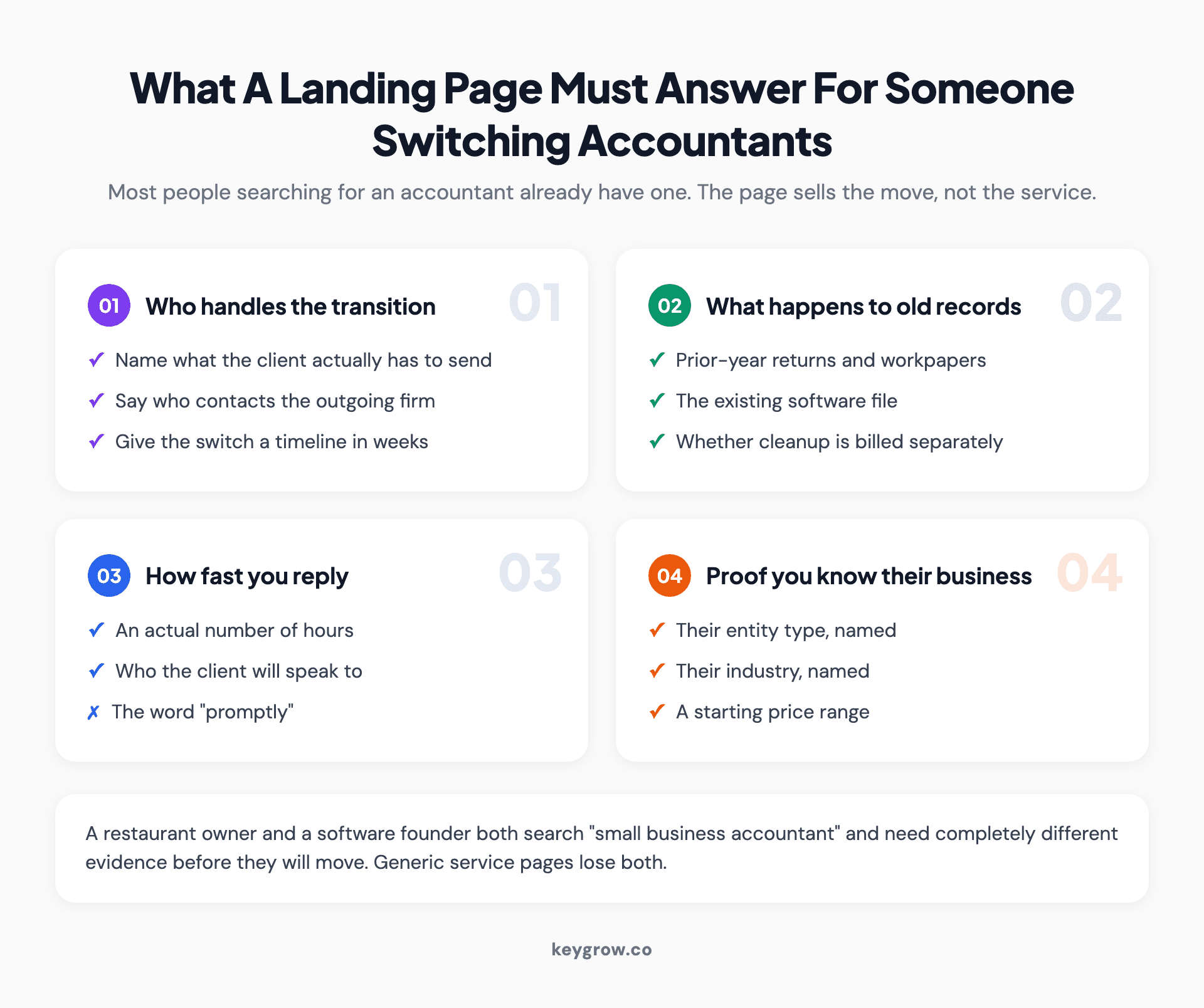
Four-card checklist of what an accounting landing page must answer for someone switching firms: who handles the transition, what happens to old records, reply speed, and industry proof.
That changes what belongs on it. A generic services page lists what you do. A page built for a switcher answers the questions that stop someone from moving:
- Who handles the transition, and what does the client actually have to send you
- What happens to prior-year records and the existing software file
- How quickly someone replies, in hours, not "promptly"
- What it costs, at least as a starting range
- Whether you have worked with their entity type and industry before
The last one carries more weight than most firms expect. A restaurant owner and a software founder both search "small business accountant" and want completely different evidence.
A professional services client of ours had a page that did none of this. Rebuilding it so a single next step was obvious took their conversion rate up 120 percent over five weeks, on the same traffic and the same offer. Same traffic, same spend, same firm. Professional services buyers are not hard to convert, they are just easy to lose to an unanswered question.
When an accounting firm should skip Google Ads
There are firms that should not be here, and any agency that will not say so is selling.
Skip it if referrals already fill your capacity. Paid acquisition solves a demand problem. If your problem is that you are booked solid and underpricing, ads will make it worse and cost you money on the way. If the goal is steadier demand over a longer horizon rather than volume this quarter, organic search for an accounting firm is the cheaper instrument.
Skip it if you only sell individual returns. Re-read the first table. The economics do not work, and no amount of campaign skill changes them.
Skip it if nobody answers the phone in January. A missed call during filing season is a client who called the next firm on the page.
Skip it, for now, if you have no tracking and no landing page. Spend the first month building those instead. You will get better data from a small campaign with clean conversion tracking than from a large one with none.
And be careful about what you sign. A twelve month agreement signed in January commits a seasonal business to paying management fees through two quiet quarters at full rate. We work month to month, cancel anytime, partly because a seasonal client should be able to change their mind in May without a penalty. If an agency needs a year-long contract to keep you, ask what happens in month three.
FAQs
How much do Google Ads cost for an accounting firm?
Plan against a cost per lead rather than a cost per click. LocaliQ's 2026 benchmark for Business Services is $93.69 per lead at a $5.87 average cost per click. Competitive metros and high-value terms like advisory or fractional CFO work run well above that, while off-season bookkeeping searches often run below it.
When should an accounting firm start running ads for tax season?
Start in late December or the first week of January. Bid competition climbs through January and peaks close to the deadline, so an account that launches in February pays more for the same click and spends part of the season in a learning period.
Should I pause my Google Ads after April 15?
Reduce the budget rather than pausing entirely. Pausing loses the historical conversion data that Smart Bidding uses to anticipate next season, and it means re-entering the learning period at the most expensive time of year. Keep the recurring-service campaigns running through the quiet months.
Do accountants need special approval to advertise on Google?
No, not for ordinary tax preparation, bookkeeping, payroll or advisory work. Certification is required for debt settlement and debt management services, which can apply to firms that advertise IRS debt resolution as a headline offer. Financial services ads also have to disclose a physical address and all associated fees.
Can an accounting firm run Google Local Services Ads?
Partly. "Tax services" is an eligible Local Services Ads category, so the tax preparation side of a firm can run them and carry the Google Verified badge. Accountant, bookkeeper and payroll are not listed categories, so recurring services still have to be won through ordinary search ads.
What is a good conversion rate for accounting Google Ads?
The Business Services benchmark sits at 4.85 percent, and Finance and Insurance at 2.64 percent. Accounting firms usually land between the two. Anything above 6 percent on service-specific keywords with a dedicated landing page is a strong result.
Are Google Ads better than SEO for an accounting firm?
They solve different problems on different timelines. Ads can be live in a few days and are the only realistic way to buy visibility for a specific tax season. Organic search compounds and costs nothing per click once it ranks, but it takes months. Most firms that can afford both run ads through filing season and build organic content in the quiet quarters.
Which is more profitable to advertise, tax prep or bookkeeping?
Bookkeeping, in almost every case. It bills monthly and renews, so it clears the acquisition cost within a quarter, while a single annual return may take several years of repeat business to pay back the same lead. Tax prep still earns a place in the account as a seasonal entry point into the recurring services.
What to do before tax season starts
If you take one thing from this: build the account around bookkeeping, payroll and advisory, and let tax prep be the seasonal spike on top rather than the foundation.
Then get three things done before January. Split your campaigns by service so the individual return budget cannot eat the rest. Load the negative keywords for jobs, courses and software. And leave the account running through the quiet months so the bidding model still recognizes your business when the season starts.
If you want a second opinion on an account you are already running, or you are weighing whether paid search fits your firm at all, our accounting marketing team will tell you honestly if the numbers do not work. That conversation is free and occasionally ends with us saying no. If you would rather read first, our PPC management page explains how the engagements work.