


To optimize Google Ads for a family law practice, split your campaigns by case type, front-load a long negative-keyword list that blocks price-shoppers and legal-aid seekers, write ads that meet a scared person with calm competence, and track leads all the way to signed retainers instead of clicks. Family law has expensive clicks and emotional searchers, so the money is made in what you exclude and how fast you answer the phone, not in bidding higher than everyone else.
Someone searching "emergency custody lawyer near me" at 11pm is not comparison shopping. They are frightened and they want to talk to a person now. Everything below is built around that reality.
Do Google Ads even work for family law?
Yes, and family law has some of the best ad economics in the legal field. It draws high-intent searchers at a lower cost per click than most legal niches, with strong conversion rates, so the leads are there if you manage the waste.
Family law clicks are expensive because all legal clicks are. Legal made up 19.4 percent of the 5,000 most expensive Google Ads keywords, according to Fraud Blocker's analysis, and legal carried the highest average cost per click of any industry in WordStream's benchmarks. The good news is that within legal, family law is one of the more affordable areas to advertise in. LocalIQ's legal data puts family law at a $7.69 average cost per click, an 8.52 percent conversion rate, and a $103.54 cost per lead. That is the lowest cost per click of the major legal practice areas, below personal injury and criminal defense. Google Ads also turn on faster than SEO, which makes them the right tool when you need cases this quarter, not next year.
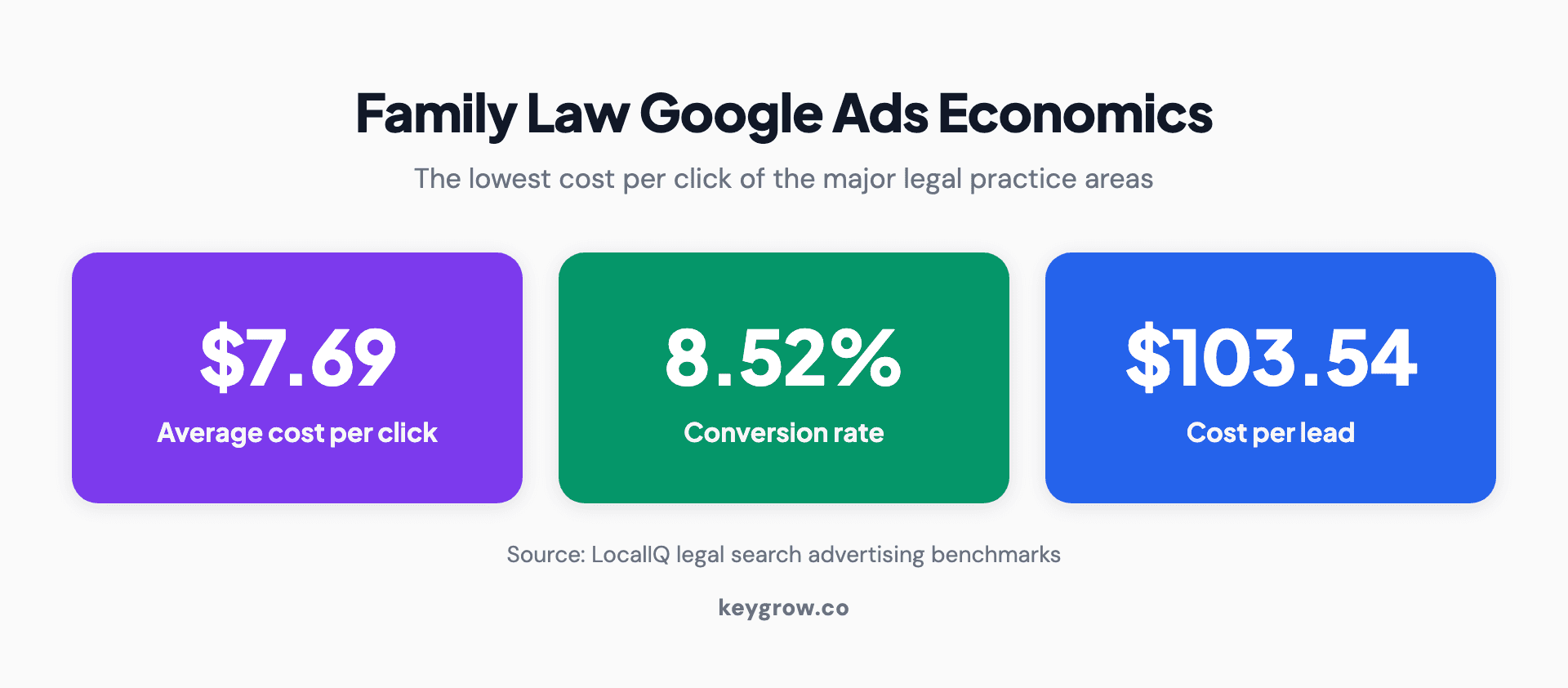
Family law Google Ads economics from LocalIQ benchmarks: a 7.69 dollar average cost per click, an 8.52 percent conversion rate, and a 103.54 dollar cost per lead, among the best unit economics in legal.
Segment campaigns by case type
Do not run one "family law" campaign. Divorce, custody, child support, alimony, and high-net-worth cases have different searchers, different values, and different urgency, so they need separate campaigns, budgets, and landing pages.
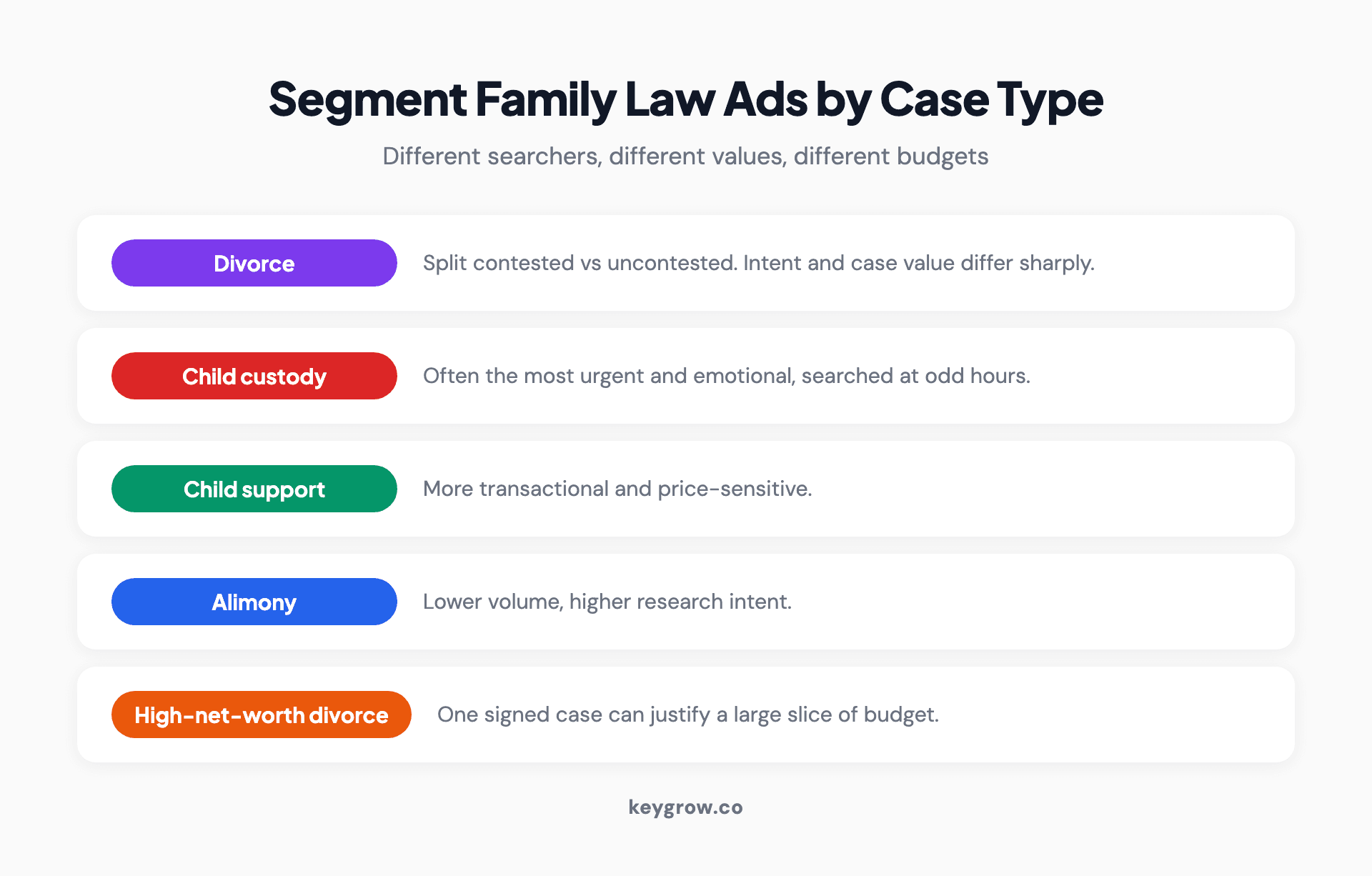
Family law Google Ads campaigns segmented by case type: divorce, child custody, child support, alimony, and high-net-worth divorce, each with its own keywords, budget, and landing page.
A custody searcher and a high-net-worth divorce searcher are not the same customer, and lumping them together means one message and one budget serving both badly. Separate them:
- Divorce, split further by contested versus uncontested, since intent and case value differ sharply.
- Child custody, often the most urgent and emotional, frequently searched at odd hours.
- Child support, more transactional and price-sensitive.
- Alimony and spousal support, lower volume, higher research intent.
- High-net-worth divorce, where a single signed case can justify a large slice of budget on its own.
Segmenting lets you bid what each case is actually worth, match the landing page to the exact worry, and see which case types pay. Knowing that a contested divorce retainer dwarfs a support consult is a targeting advantage a generalist account never captures.
Build the negative-keyword list first
The fastest way to cut wasted family-law spend is a heavy negative-keyword list. Block price-shoppers, do-it-yourself searchers, job seekers, and legal-aid traffic before they ever cost you a click.
More traffic is the wrong fix for a family-law account that is leaking money; filtering is. At a $103 cost per lead, every unqualified click you block is real money back in the budget, and this vertical attracts a lot of them: people looking for free help, forms, jobs, or a definition, none of whom will ever retain you.
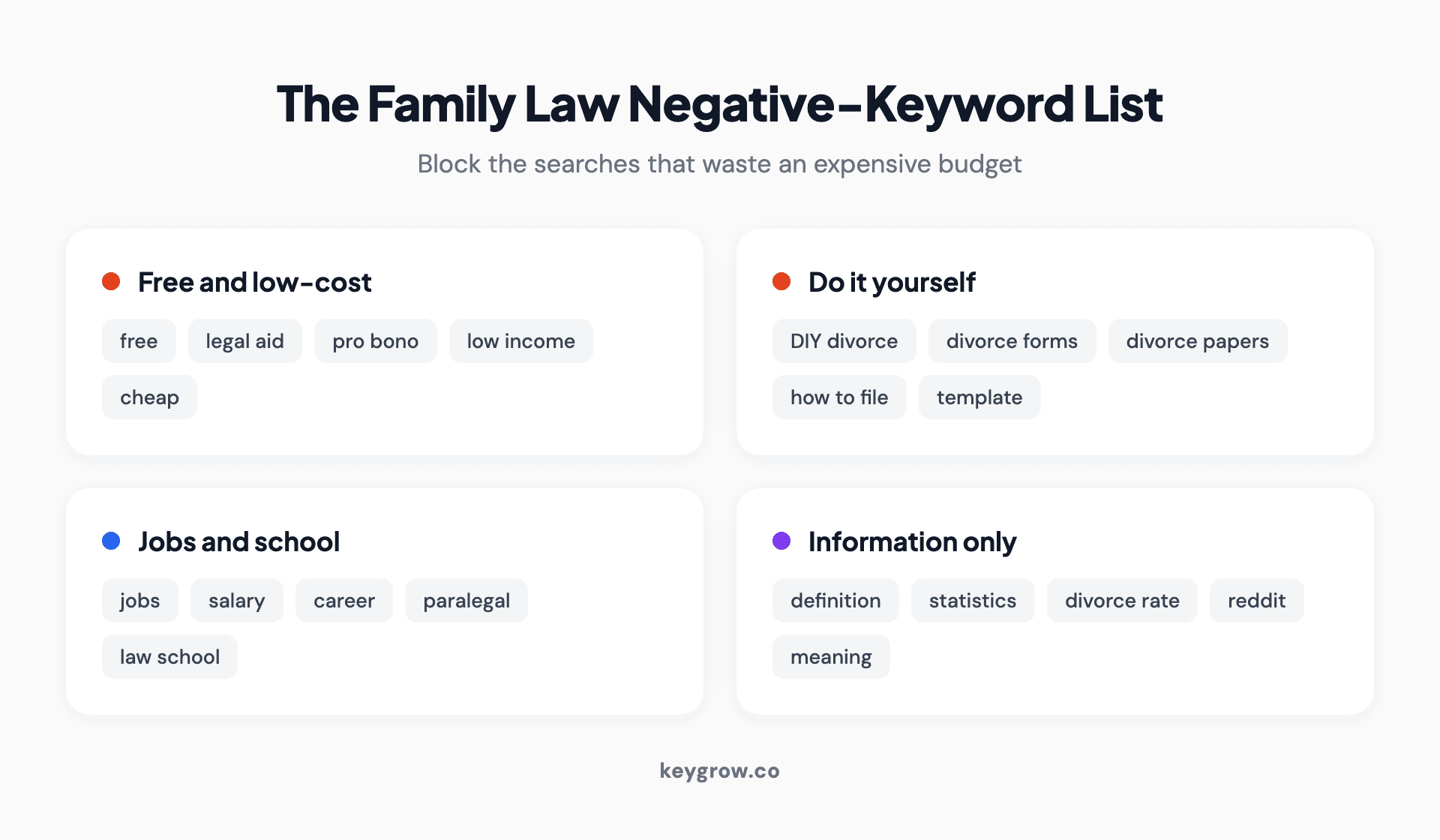
A family law negative-keyword list grouped into four buckets: free and low-cost seekers, do-it-yourself searchers, jobs and education, and information-only queries.
A starting negative list, grouped by what it blocks:
- Free and low-cost: free, free consultation (unless you offer one), legal aid, legal aid society, pro bono, low income, cheap.
- Do it yourself: DIY divorce, divorce forms, divorce papers, how to file, self representation, template, do it yourself.
- Jobs and school: jobs, salary, career, paralegal, law school, how to become.
- Information only: definition, meaning, statistics, divorce rate, reddit, and the names of any TV shows or public divorces that spike random searches.
Then review your search terms report weekly and keep adding. Unmanaged broad-match keywords quietly hand 20 to 30 percent of a budget to searches you never wanted. Our guide on using negative keywords in Google Ads covers the match-type details.
Write ads that fit the moment
Family-law ad copy has to signal competence without sounding combative. Acknowledge the fear, promise a real conversation with an attorney, and lead with reassurance, not aggression.
The wrong tone loses the click. "Crush your ex in court" reads as reckless to someone terrified of losing time with their kids. "Worried about custody? Talk to an experienced family attorney today" meets the actual emotion. Write for the person, not the case:
- Lead with the worry the searcher has, not your firm's awards.
- Name the specific case type in the headline so the ad matches the search.
- Make the next step a phone call, and say a real attorney will take it.
- Keep claims honest. Legal advertising is governed by your state bar's rules, so avoid guarantees about outcomes.
Match the landing page to the ad. A custody ad should land on a custody page that opens with the same reassurance and one clear way to call, not on a generic homepage. Sending high-cost legal clicks to a homepage is the most expensive default in this niche.
Target tight on geography and timing
Keep the radius small and the schedule smart. Family law clients hire locally, so a wide target area burns budget on people who will never drive to your office, and odd-hour searches often carry the most urgency.
Set a tight radius around your office and the courthouses you serve rather than a whole state, and layer in bid adjustments for the moments that convert. Custody and emergency searches spike at night and on weekends, so do not switch ads off after business hours if your intake can catch the call or the lead. Adjust bids by device too, since most family-law searches happen on a phone and the click is worth more when it can become an immediate call. The aim is simple: spend where your actual future clients are, at the hours they are actually looking.
Stay inside the advertising rules
Family-law ads have to follow both your state bar's advertising rules and Google's policies. Avoid promising outcomes, keep claims substantiated, and know that Google limits some audience targeting on sensitive personal topics.
Two rule sets apply at once. Your state bar governs attorney advertising, which generally means no guarantees about results and no misleading claims, so keep ad copy confident but honest. Google adds its own layer: personal hardships and relationship status fall under its sensitive categories, which restrict how narrowly you can target audiences on those topics. That mostly affects audience targeting, not your ability to bid on high-intent keywords, but it is worth knowing before you build audience segments. When in doubt, lead with your expertise and the next step, not with a promise, and you stay clear of both rule sets.
Local Services Ads vs Search for family law
Run both if you qualify. Local Services Ads, the "Google Screened" slots, sit at the very top and charge per lead; Search ads sit below with full control over keywords and messaging.
Legal is one of the professional categories Google Screened covers, so a family law firm can often earn that badge after a background and license check. It buys the top position and a trust mark, and you pay per lead rather than per click.
| Local Services Ads (Google Screened) | Search ads | |
|---|---|---|
| Position | Very top of the page | Below Local Services |
| You pay for | Each lead | Each click |
| Setup | Background check, bar license, screening | No screening needed |
| Control | Limited | Full keyword and copy control |
| Best for | Trust and top-of-page calls | Targeting specific case types |
Local Services Ads win on trust and placement. Search wins on precision, letting you separate a high-value contested-divorce campaign from a price-sensitive support campaign. Most firms with budget run both and let intake sort the leads.
Track leads to signed cases, not clicks
Measure family-law ads by cost per signed case, not cost per click. Use call tracking, record which campaigns produce consultations and retainers, and feed that back into bidding.

A lawyer and client shaking hands across a desk with a document and laptop, representing a family law consultation that turned into a retained case.
This is a phone-driven business. More than a form fill, a booked consultation and a signed retainer are the numbers that matter, so put dynamic call tracking on your ads, tag which case types close, and watch response time. Leads that reach a real person quickly convert far better than the ones that hit voicemail. Then feed conversions back into Google so smart bidding optimizes toward cases, not clicks.
We saw the pattern with a law firm that was already running ads to a landing page and getting almost nothing: one conversion a week from 22 clicks at $240 each. The traffic was fine; the page and the structure were not. After we rebuilt the page around a single clear call, restructured the campaigns, and tested small side campaigns, it went to 21 conversions from 189 clicks at $31.79 each within a week. Same firm, same budget, better plumbing.
Where DIY ends and help begins
A solo or small family-law firm can absolutely start Google Ads themselves, especially the profile and a simple search campaign. Bring in help when the cost of your time and the waste in the account outgrow the fee.
The basics are learnable: one tightly themed campaign, a real negative list, honest ad copy, and call tracking will beat most self-run accounts already out there. Where firms lose money is the ongoing management, the weekly search-term pruning, the bid tuning across case types, the landing-page testing, that a busy attorney never gets to. When you are paying $100-plus per lead, a mismanaged account wastes real money fast. Hire when the opportunity cost of doing it yourself beats the management fee, which for a growing firm comes quickly. Our legal marketing work is built around exactly this math.
FAQs
How much do Google Ads cost for family law firms?
Family law runs around a $7.69 average cost per click and a $103.54 cost per lead, per LocalIQ's legal benchmarks, which is the lowest cost per click among the major legal practice areas. Monthly budgets vary widely by market, but plan for a few thousand dollars to gather real data in a competitive area. High-net-worth divorce keywords cost more per click than routine support terms.
Do Google Ads actually work for divorce and custody lawyers?
Yes. Family law has high-intent searchers and a solid conversion rate around 8.52 percent, so qualified leads are available. The results depend on tight case-type targeting, a heavy negative-keyword list, and fast phone intake. Ads that send clicks to a generic homepage or skip negatives waste the budget regardless of the niche.
Should family lawyers use Local Services Ads or regular Search ads?
Use both if you qualify. Local Services Ads, shown as Google Screened, sit above everything and charge per lead, which suits trust-driven legal searches. Search ads give you full control to target specific case types and craft the message. Running both captures the top slot and the precise targeting, then your intake team sorts the leads.
What negative keywords should a family law firm use?
Block free and low-cost seekers (free, legal aid, pro bono, low income), do-it-yourself searches (DIY divorce, divorce forms, how to file), jobs and education terms (jobs, salary, paralegal, law school), and information-only queries (definition, statistics, divorce rate). Then review the search terms report weekly and keep adding, since new wasteful queries appear constantly.
What is a realistic cost per signed case in family law?
It depends on your close rate and case mix, but work backward from the lead economics. At roughly $103 per lead, if one in four consultations retains, your cost per signed case lands in the few-hundred-dollar range, which most family-law case values comfortably support. Track it directly rather than guessing, since intake speed and quality move the number a lot.
How long until Google Ads bring in family law cases?
Ads can produce calls within days, which is the main advantage over SEO, but give a new campaign 30 to 60 days to gather enough conversion data to optimize. Early weeks run less efficiently while you prune search terms and tune bids. Judge it on cost per signed case over a couple of months, not on the first week's clicks.
What to do first
Split your account by case type, load the negative-keyword list before you turn anything on, point each ad at a matching page with one clear call, and put call tracking on everything so you can see cost per signed case. Those four moves fix most family-law accounts before you touch a bid.
If you would rather have a team that knows what a retained divorce case is worth run it for you, that is what our paid search management does for law firms. Bring your case types and your average retainer to the get started page and we will size the opportunity honestly.