


In some metros, a single click on "car accident lawyer" costs more than a month of car insurance. Firms pay it anyway, because the case behind the click is worth five figures in fees.
Personal injury lawyer SEO is the work of ranking a firm's website and Google Business Profile for the searches injured people run in the days after an accident, so the case arrives without a $250 click attached to it. It is slower than paid search and harder than almost any other local niche. It is also the only channel in legal marketing where your cost per signed case falls over time instead of climbing every year.
This is the organic side of the problem. We wrote about Google Ads for local law firms separately, and the honest answer for most firms is that they need both, in a specific order.
Personal injury is the most expensive auction in local search
Legal already has the highest average cost per click of any industry. Personal injury sits far above the rest of legal.
The blended attorney and legal services average reached $9.87 per click in 2026, up 15 percent year over year. Personal injury does not live anywhere near that average. According to Custom Legal Marketing, competitive metro personal injury terms run $150 to $500 per click, the most contested phrases in the largest cities reach $250 to $1,000, and even mid-size regional markets sit at $40 to $80.
Those numbers are not irrational. A signed case can be worth tens of thousands in contingency fees, so a firm that converts one click in fifty is still comfortably ahead. That is exactly why the auction never gets cheaper. Every firm in your city has run the same arithmetic, and the price only moves in one direction.
Organic has no meter running. Once a case-type page holds its position, the consultations it books this quarter cost the firm nothing beyond the work already done, and the page does not care how many competitors entered the auction last month. The trade is upfront: two or three quarters of investment before it produces anything at all, against a paid campaign that produces on day one and keeps charging forever.
The honest caveat, which most agency pages skip: personal injury organic is also the most contested local search vertical in the country. National firms with in-house content teams are competing for the same phrases in your city. This is not a channel where you show up and win in a quarter.
Not every case type is worth ranking for
Difficulty and case value are not correlated in personal injury, and that mismatch is the single biggest strategic advantage available to a small firm.
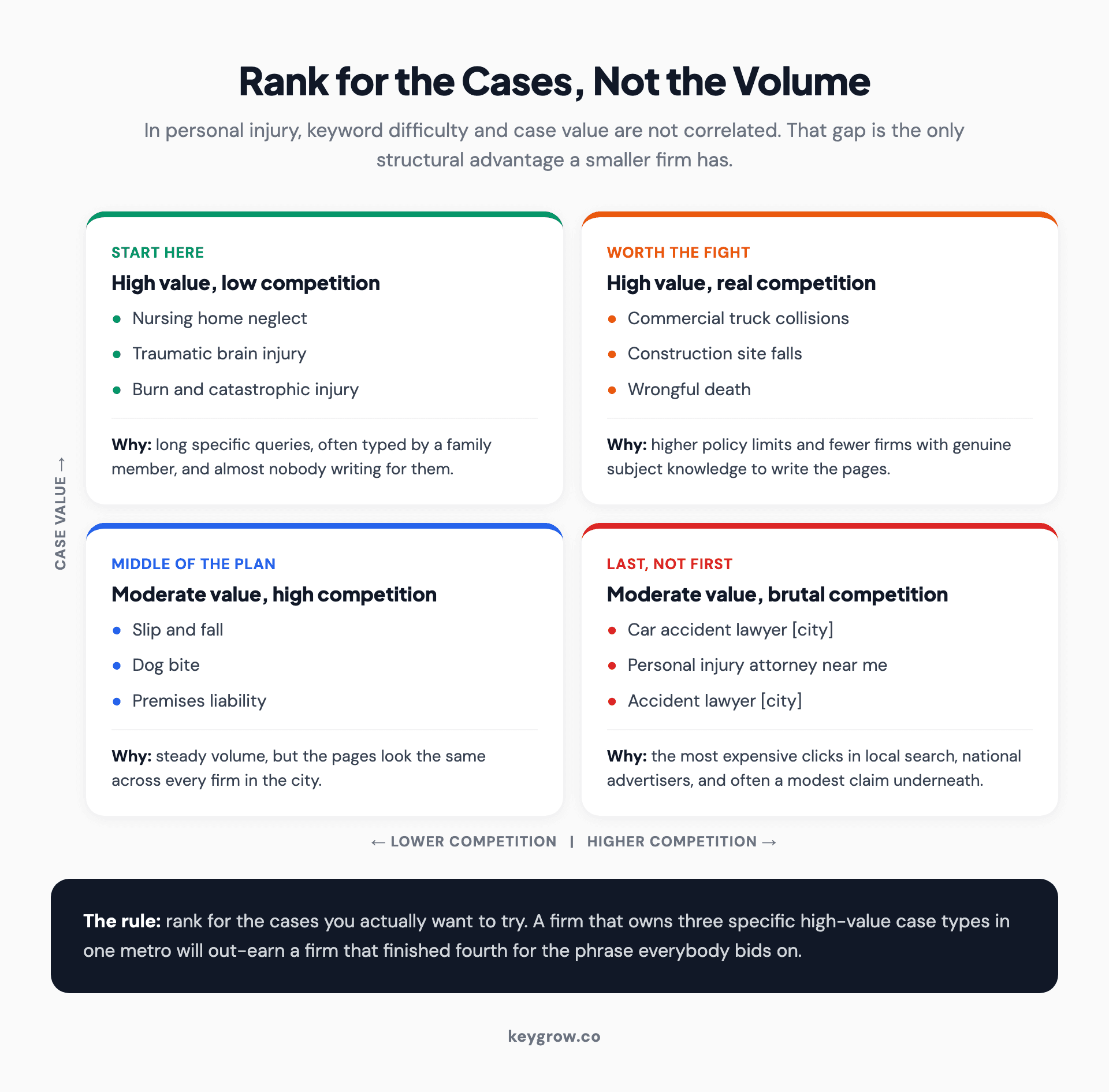
Matrix of personal injury case types plotted by keyword difficulty against case value, showing where small firms should compete.
Every firm in your market is fighting over "car accident lawyer" plus the city name. It has the highest volume, the highest ad prices, and the deepest bench of national competitors. The case underneath it is frequently a modest soft tissue claim with a policy limit that caps what anyone can recover.
Now look at what almost nobody optimizes for. Commercial truck collisions. Nursing home neglect. Burn injuries. Traumatic brain injury. Construction site falls. Each has a fraction of the search volume, a fraction of the competition, and a case value that can be an order of magnitude higher. The searcher is often a family member doing research on someone else's behalf, which means longer, more specific queries and far less competition for them.
| Search family | Competition | Typical case value | Worth chasing first? |
|---|---|---|---|
| Car accident lawyer [city] | Brutal | Low to moderate | Only once you have authority |
| Slip and fall attorney [city] | High | Low to moderate | Middle of the plan |
| Truck accident lawyer [city] | Moderate | High | Yes |
| Nursing home neglect attorney | Low to moderate | High | Yes |
| Traumatic brain injury lawyer | Low | Very high | Yes |
| Workers compensation attorney | High | Moderate, high volume | Depends on your fee model |
The practical rule: rank for the cases you actually want to try, not the ones with the biggest search volume. A firm that owns three specific high-value case types in its metro will out-earn a firm that finished fourth for the generic phrase.
There is a second benefit that is easy to miss. Specific case-type pages are the ones that earn links and citations, because a page about proving liability in a commercial trucking case has something to say. A generic car accident page does not.
Build the architecture before you write a word
The structure of a personal injury site decides what it can rank for. Get it wrong and no amount of content fixes it.
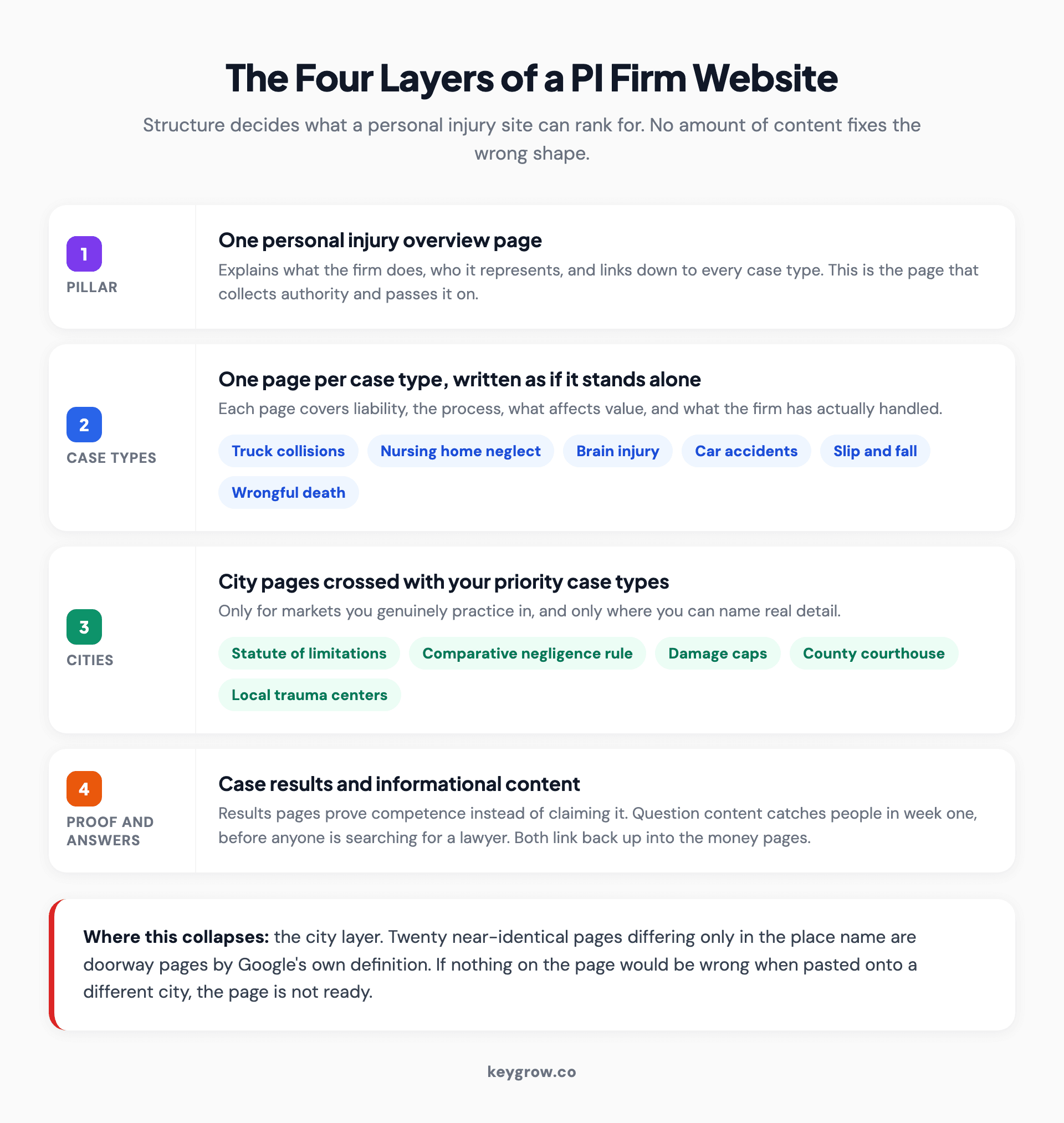
Site architecture diagram for a personal injury firm: pillar page, case type pages, city pages, case results and informational content.
The shape that works has four layers. A pillar personal injury page that explains what the firm does and links down. One page per case type, each written as though it is the only page on the subject. City pages for the markets you genuinely practice in, crossed with your priority case types. Then case results and informational content feeding links back up into the money pages.
The city layer is where this collapses. Twenty near-identical pages differing only in the place name are doorway pages by Google's own definition, and firms still generate them by the hundred because a tool made it easy.
Personal injury has an unusual advantage here, and almost nobody uses it. Legal detail is local by nature. Your state's statute of limitations, its comparative negligence rule, its damage caps, the county courthouse the case gets filed in, the specific intersections and highway interchanges where collisions cluster, the trauma centers injured people are taken to. Every one of those is a genuine, verifiable, locally specific fact that no template can produce. A city page built around real jurisdictional detail is not a doorway page, it is a resource.
The test is simple. If nothing on the page would be wrong when pasted onto a different city's page, the page is not ready. Four researched city pages carry a domain further than thirty generated ones, and the generated thirty can pull the whole site down with them.

Two people reviewing legal paperwork at a desk during a client meeting.
Case results pages do work no other page can
A results page is the only page on a law firm site that proves competence rather than claiming it. It is also the most neglected page type in the practice area.
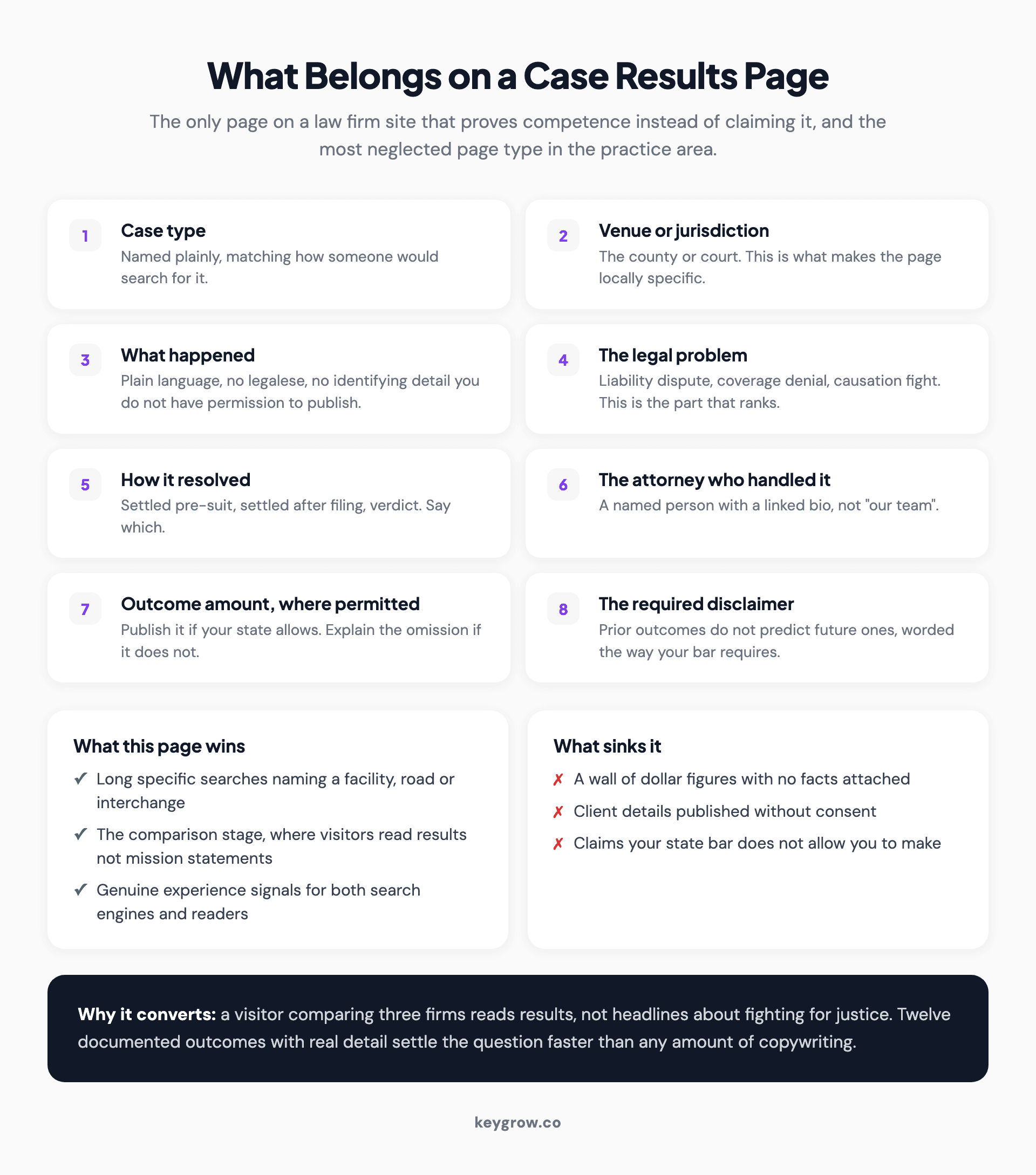
Checklist of the eight elements a personal injury case results page needs, from case type and venue to the required disclaimer.
Each one should carry the case type, the venue or jurisdiction, what happened in plain language, what the legal problem was, how it was resolved, and the attorney who handled it. Where your state permits publishing outcome amounts, publish them with the required disclaimer that prior outcomes do not predict future ones. Where it does not, describe the resolution qualitatively and say why the number is not shown.
These pages rank for searches nobody else targets. Someone whose parent was injured at a specific facility, or who was hit at a specific interchange, is running a long, specific query. A results page that names the circumstance is often the only page on the internet that matches it.
They also do something for conversion that no amount of copywriting achieves. A visitor comparing three firms reads results pages, not mission statements. Twelve documented outcomes with real detail settle the question faster than any headline about fighting for justice.
How do you win the map pack when directories sit above you?
Google's local three-pack takes most of the clicks on any query with local intent, and the profile that ranks there is your Google Business Profile, not your website.
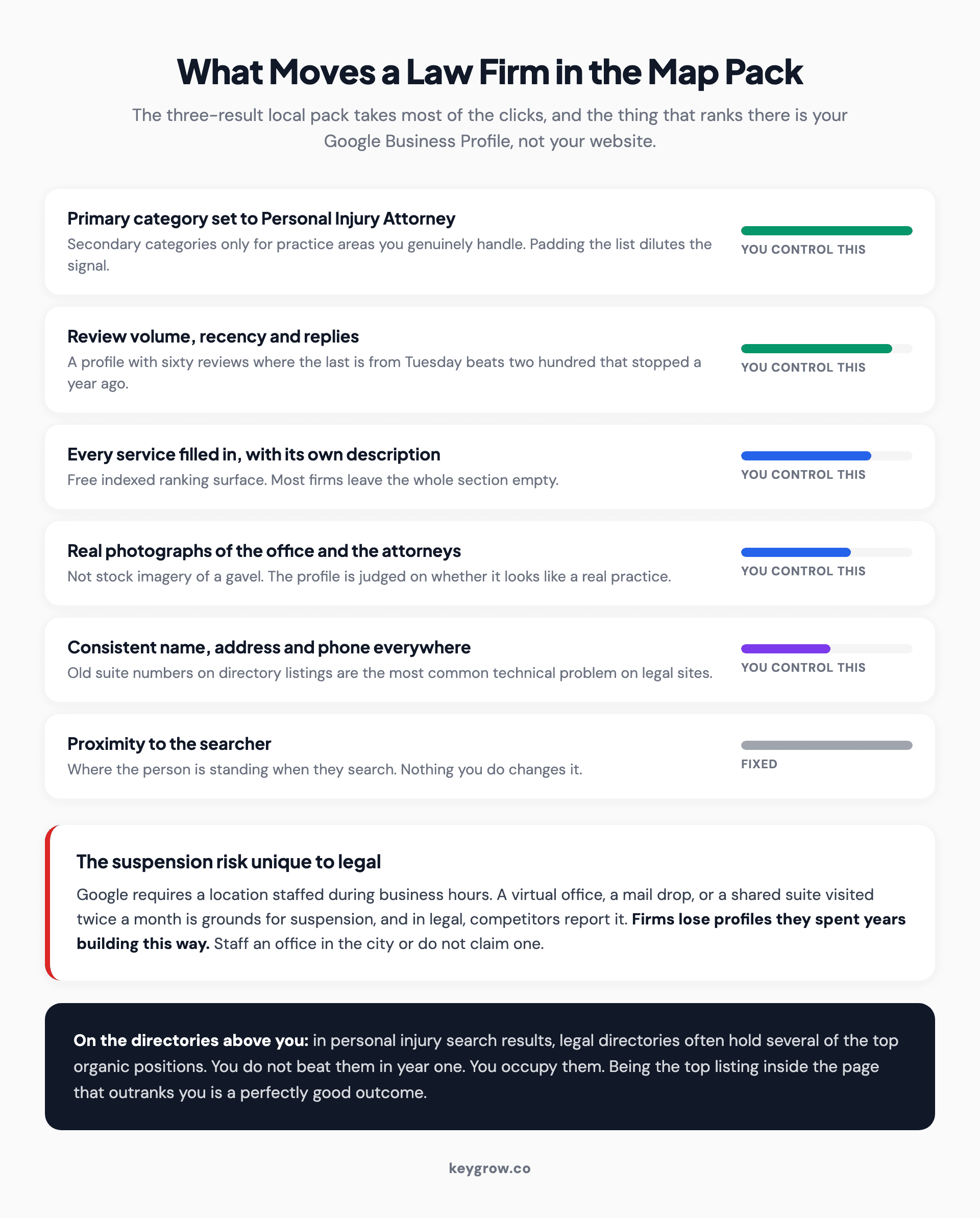
Local ranking signals for a personal injury law firm: profile completeness, categories, address compliance, reviews and proximity.
Three fundamentals get most firms most of the way. Set the primary category to Personal Injury Attorney and add secondary categories only for practice areas you genuinely handle. Fill in every service with its own description, because those descriptions are indexed and most firms leave the section empty. Add real photographs of the actual office and the actual attorneys.
Then there is the address problem, which is more common in legal than in any other local vertical. Google's profile guidelines require a location staffed during business hours. A virtual office, a mail drop, or a shared suite you visit twice a month is grounds for suspension, and suspensions in legal get reported by competitors quickly. Firms lose profiles they spent years building this way. If you want a presence in a city, staff an office there or do not claim one.

Empty law firm conference room with a wooden table, the kind of staffed office a Google Business Profile listing requires.
The other reality of personal injury search results is that legal directories frequently occupy the organic positions above you. That is not a problem you solve by outranking them, at least not in year one. It is a problem you solve by occupying them. Claim and fully build every directory profile that ranks in your market, treat each as a landing page rather than a listing, and take the referral traffic and the link. Being the top result inside the page that outranks you is a perfectly good outcome.
The searches that happen before anyone hires a lawyer
Most injured people do not search for an attorney first. They search to work out whether they need one.
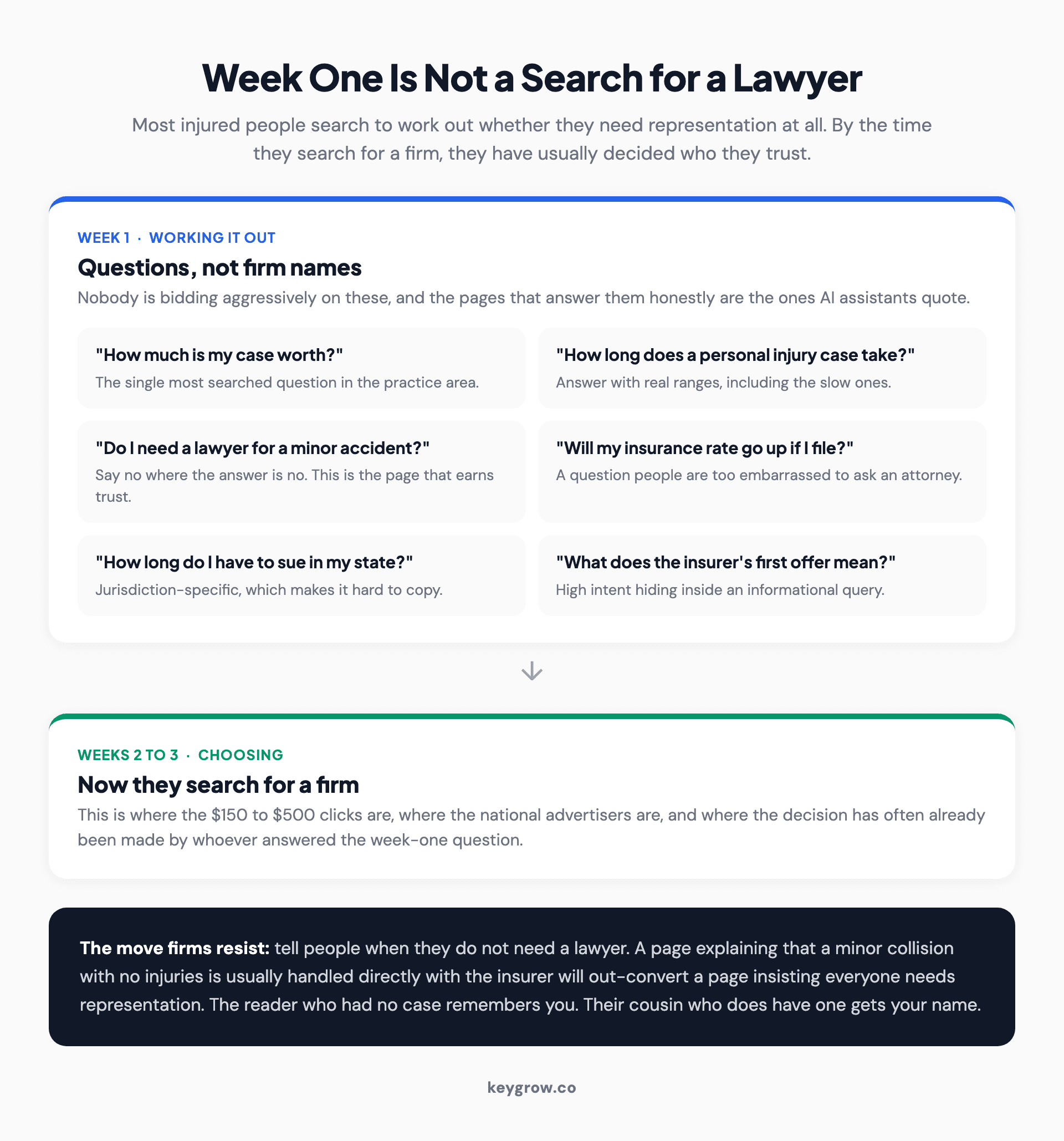
Timeline of the questions injured people search in week one, before the search for a lawyer happens in week two or three.
"How much is my case worth." "How long does a personal injury case take." "Do I need a lawyer for a minor accident." "Will my insurance rate go up if I file." "How long do I have to sue in my state." These run in the first week. The hiring search runs in week two or three, and by then most people have already decided who they trust.
Answer these properly and something useful happens. You get the click before the competition is bidding, you get the brand recall that makes your firm the one they search by name later, and you get the informational pages that AI assistants actually cite.
The move that works best here is the one firms resist. Tell people when they do not need a lawyer. A page explaining that a minor fender bender with no injuries is usually handled directly with the insurer, and here is how to do it, will out-convert a page insisting everyone needs representation. The reader who did not have a case remembers you. Their cousin who does have one gets your name.
Reviews, links, and the ethics trap in between
Reviews carry more weight in local legal search than almost anything else you control, and personal injury makes them awkward to collect.
Clients in active litigation often will not post publicly. The window that works is at resolution, when the case has closed and the outcome is good. Build the request into your file-closing checklist so it happens without anyone remembering to do it, and ask by text rather than email.
There is a trap in the response side that costs firms more than the reviews are worth. Replying to a negative review by explaining what really happened in the case is a confidentiality problem, and bar associations have disciplined lawyers for exactly that. The safe reply acknowledges the feedback, declines to discuss any specifics, and offers to talk offline. Every time. No exceptions, however unfair the review is.
For links, the sources that work in legal are unglamorous. Bar association member profiles. Law school alumni pages. Local sponsorship of anything with a website. Genuine commentary for reporters covering a case type you know. Community organizations you actually support.
The things to avoid are more important. Legal is the most aggressively policed niche in search, because it has the most money chasing manipulation. Bought links, private blog networks, and the scholarship link schemes that circulated for years are all either burnt out or actively dangerous. A firm that buys links is renting a ranking against a penalty it cannot predict the timing of.
What bar advertising rules mean for your SEO
Compliance and ranking pull in the same direction more often than lawyers expect, which makes this cheaper than it sounds.
State bar advertising rules generally restrict claims you cannot substantiate, control how testimonials and past results can be presented, and limit who may describe themselves as a specialist or expert. Requirements vary by state, and the state where you practice is the one that governs. Check your own rules rather than copying what a firm two states over does.
Here is the overlap. Google's helpful content guidance asks who produced the content, whether they have real experience, and whether the page demonstrates it. Bar rules push you toward named attorneys, verifiable credentials, accurate claims, and disclosed limitations. Those are the same page elements.
So build the parts both want. Attorney bios with real names, bar admissions, jurisdictions, and photographs. A named author on every substantive page, not "the team". Physical office addresses. Clear disclaimers where your state requires them. Firms that treat compliance as an obstacle end up with anonymous content that fails both tests at once. We go through the specific collisions, including the states where "expert" is restricted outright, in our broader guide to SEO for lawyers.
Getting cited when the answer is an AI summary
AI Overviews and assistants appear on the informational half of personal injury search, not the hiring half. That split tells you where to spend the effort.
Nobody asks a chatbot to pick their trial lawyer. Plenty of people ask one how long they have to file, what their state's negligence rule means, or whether a settlement offer sounds reasonable. Those are the pages that get retrieved and quoted, and being the quoted source is how a firm ends up in the consideration set before the hiring search happens.
The structure that gets cited is answer-first. Put a self-contained twenty to twenty-five word answer immediately under each heading, then expand. Keep sections tight. Cite your sources, name your author, and date the page, because AI systems consistently favor fresher, attributed material.
Add the structured data while you are there. Attorney and LegalService markup tells search engines and assistants what the firm is, where it practices, and what it handles, without anyone having to infer it. Our schema markup generator will produce it if you would rather not hand-write JSON, and our answer engine optimization work goes deeper on the citation side.
The 18-month problem nobody warns firms about
Here is the measurement trap that ends more legal SEO engagements than bad rankings do.
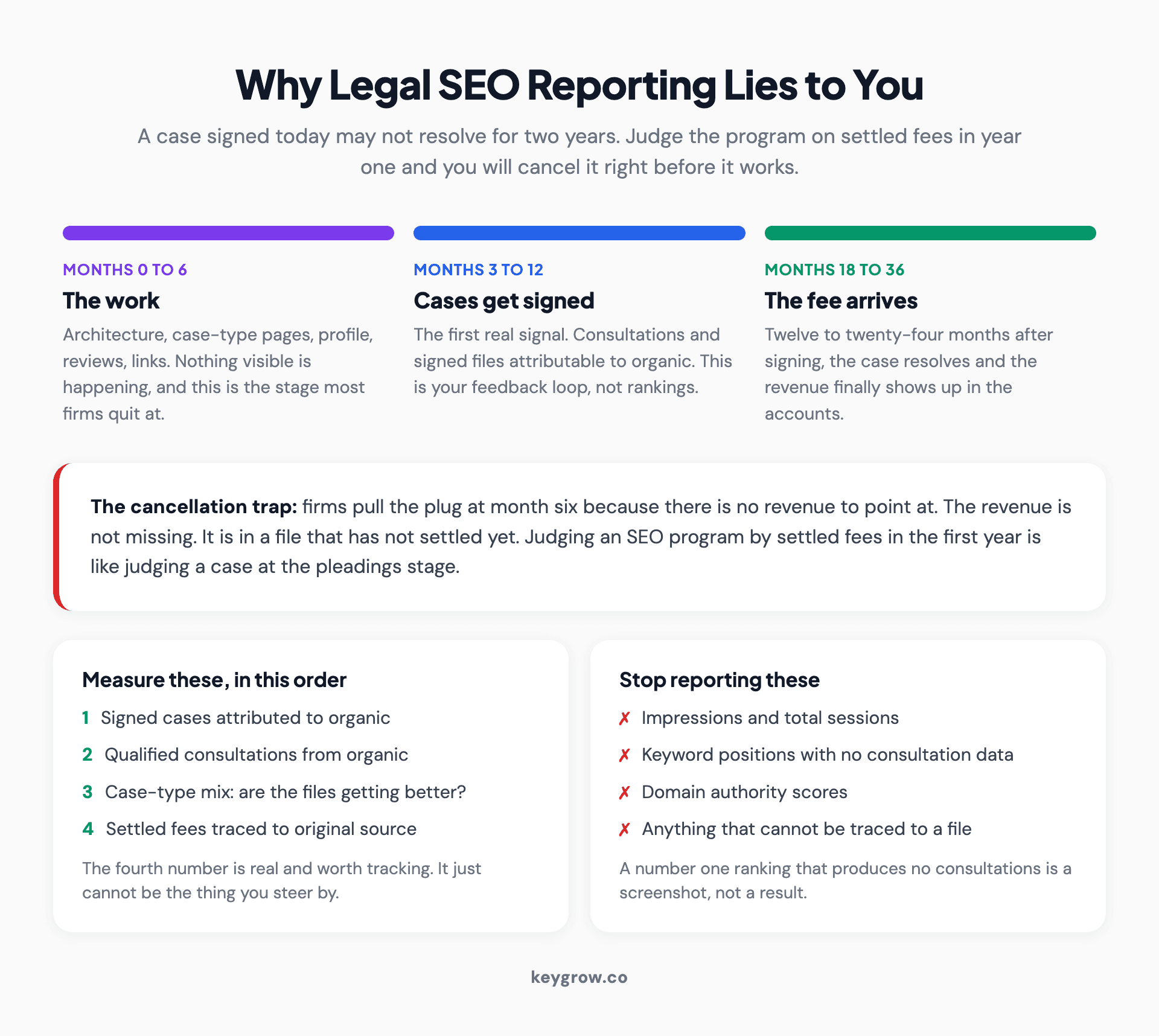
Timeline showing the gap between signing a personal injury case from organic search and the fee arriving 12 to 24 months later.
A personal injury case signed today may not resolve for twelve to twenty-four months. Add the three to six months organic takes to produce that signing, and the revenue from your first month of SEO work lands somewhere between eighteen months and three years out.
Firms cancel at month six because there is no revenue to point at. The revenue is not missing. It is in a file that has not settled yet. Judging an SEO program by settled fees in the first year is like judging a case by how it looks at the pleadings stage.
So measure the leading indicators and be disciplined about it. In order: signed cases attributed to organic, qualified consultations from organic, the case-type mix of what you are signing, and only then settled fees traced back to original source. That last number is real and worth tracking, it just cannot be your feedback loop.
This is also where most agency reporting quietly falls apart, and it is the industry's biggest running scam. If the monthly report opens with impressions, keyword positions, and domain authority, ask what any of it did for the case list. A number one ranking that produces no consultations is a screenshot, not a result. Our own strongest organic engagement took twelve months to reach 1,519 percent traffic growth and 130 or more patient calls a month for a doctor's practice in Dubai. Months one through three looked like nothing was happening. Anyone reading that report at month three and pulling the plug would have paid for the entire hard part and left before it produced anything.
Attribution in this practice area is mostly a phone problem. Injured people dial rather than type, frequently at night, and a firm that cannot tell a profile call from a website call is guessing at which half of its local presence is doing the work. Two tracked numbers solve it for the price of a coffee subscription.

A desk phone in an office, the line most injury clients use first, which is why call tracking matters for attribution.
Should a firm run SEO or paid search first?
Both, but not in equal measure and not at the same stage. They solve different problems on different clocks.
| Paid search | Organic | |
|---|---|---|
| Time to first case | Days | Three to six months |
| Cost per case | Fixed or rising | Falls over time |
| Stops when you stop paying | Yes | No |
| Works for a brand new domain | Yes | Slowly |
| Defensible against a bigger budget | No | Yes |
A newer firm that needs cases this quarter runs paid, accepts the cost per case, and funds the organic build out of it. An established firm with a domain that already has some authority pushes harder on organic, because the compounding is available to it and is not available to the newcomer.
Local Services Ads are worth a separate look in legal. Where they are available they sit above everything, they are priced per lead rather than per click, and the screening process itself is a trust signal. They are not a substitute for either channel, but they are frequently the cheapest legal lead in the market and many firms have still not set them up.
When a personal injury firm should not hire an SEO agency
An agency that will not tell you who should not buy is selling rather than advising, so here is our list.

Readiness checklist for a personal injury firm considering SEO, covering intake, practice geography, domain age and DIY capacity.
Fix intake first if calls go to voicemail. Injured people call at eleven at night from a hospital waiting room and they call the next firm on the list within four minutes. Ranking a firm that cannot answer the phone just pays to hand cases to a competitor. Answering service, after-hours coverage, or a real intake team comes before any of this.
Do it yourself if you are a solo or two-attorney firm in one city with more time than budget. Claim and complete the Google Business Profile, write your own case-type pages, and collect reviews at file closing. You write for a living, which puts you ahead of most businesses attempting this. Six months of that will move you further than a small retainer will.
Run paid instead if the domain is brand new and the firm needs cases this quarter. Organic cannot deliver on that timeline and any agency saying otherwise is selling you something. Come back to organic once paid is funding the practice.
Hire when the bottleneck stops being budget and starts being your calendar, when you are competing in more than one market, or when growth has flattened for reasons nobody in the firm can name. The flattening is what brings most firms to us, and nine times out of ten the diagnosis is site architecture rather than effort.
FAQs
What is personal injury lawyer SEO?
Personal injury lawyer SEO is the practice of ranking a law firm's website and Google Business Profile for the searches injured people run when looking for representation. It combines case-type and city page architecture, local profile optimization, review generation, links from legitimate legal sources, and content answering the questions people ask before they hire anyone.
How long does SEO take for a personal injury law firm?
Plan on three to six months for early movement and twelve to eighteen before organic carries a meaningful share of the case list in a competitive metro. Personal injury runs longer than other practice areas because it is the most contested local vertical in search. Google Business Profile work usually shows up first, since profile changes are processed faster than new site content.
How much does personal injury SEO cost?
Market rates for law firm SEO commonly run from a low four-figure monthly retainer for a single-market firm to five figures for multi-market campaigns in major metros. Compare the fee against your current cost per signed case from paid search rather than against zero. In markets where clicks run $150 to $500, the comparison usually favors building organic.
Which keywords should a personal injury firm target first?
Start with high-value, lower-competition case types rather than the generic city-plus-car-accident phrase. Truck collisions, nursing home neglect, traumatic brain injury, and construction accidents have less competition and far higher case values. Add the generic high-volume terms once the domain has enough authority to compete for them.
Do legal directories hurt a firm's SEO?
They compete for the same positions, but they are not something to fight. Directories often occupy several of the top organic results in personal injury searches. The practical response is to claim and fully build those profiles so you appear inside the results that outrank you, take the referral traffic, and keep the link.
Can a small firm compete with large personal injury firms in search?
Yes, by narrowing rather than broadening. A two-attorney firm will not outrank a national advertiser for the widest terms, but it can own specific case types in specific cities where the national firm has generic content and no local detail. Specificity is the only structural advantage a small firm has, and it is a real one.
What schema markup does a personal injury law firm need?
Attorney or LegalService markup for the firm, LocalBusiness details for each staffed office, Person markup for attorney bios, and FAQPage markup on pages with genuine question and answer sections. Structured data does not lift rankings on its own, but it makes the firm legible to search engines and AI assistants that would otherwise infer things incorrectly.
Is SEO or Google Ads better for personal injury lawyers?
They answer different questions. Paid search signs cases within days, at a price per click that has risen every year and will rise again. Organic is slow to start and then cheap to run, and a competitor cannot take your position away by raising a bid. Newer firms typically begin with paid and use the fee income to fund the organic build.
If you only fix three things
Most personal injury firms do not need a bigger plan. They need three specific problems solved, and the rest follows.
Fix intake before traffic. Every case that reaches voicemail at eleven at night is a case a competitor signed instead, and no ranking improvement survives that leak.
Pick the case types you actually want and build real pages for them, with jurisdictional detail no template can produce. Three specific high-value case types beat a generic push at the most expensive phrase in your city.
Measure signed cases, not rankings. If your reporting cannot tell you how many files came from organic last month, it is not measuring anything that pays a salary.
We handle this work through our SEO services team, and there is more detail on the practice area at personal injury SEO. Engagements are month to month with no lock-in, because a firm that wants to leave in April should be able to. If the do-it-yourself section described your firm, start there instead.