


Every guide to SEO for lawyers tells you to prove your expertise. Put credentials on the page. Show results. Collect testimonials. Say what you are good at.
Then you read your state's advertising rules and find out that in New York, a firm cannot even put the word "expert" in its domain name.
That collision is the part nobody writes about, and it is the reason law firm SEO is genuinely harder than SEO for a plumber or a dentist. Google's quality signals and your bar's advertising rules were written by different people for different reasons, and they overlap awkwardly. You can build a page that ranks and gets you a grievance, or a page that is bulletproof and invisible. The work is finding the pages that are neither.
Here is the short version before the long one. SEO for lawyers works the same way it works anywhere else, with three changes: your keyword priorities are set by case value rather than search volume, your trust signals have to survive a compliance read before they go live, and your timeline is longer because legal is one of the hardest verticals Google grades.
The two rulebooks your website has to satisfy
A law firm website answers to Google's quality guidelines and to your jurisdiction's rules of professional conduct. Neither one knows the other exists.
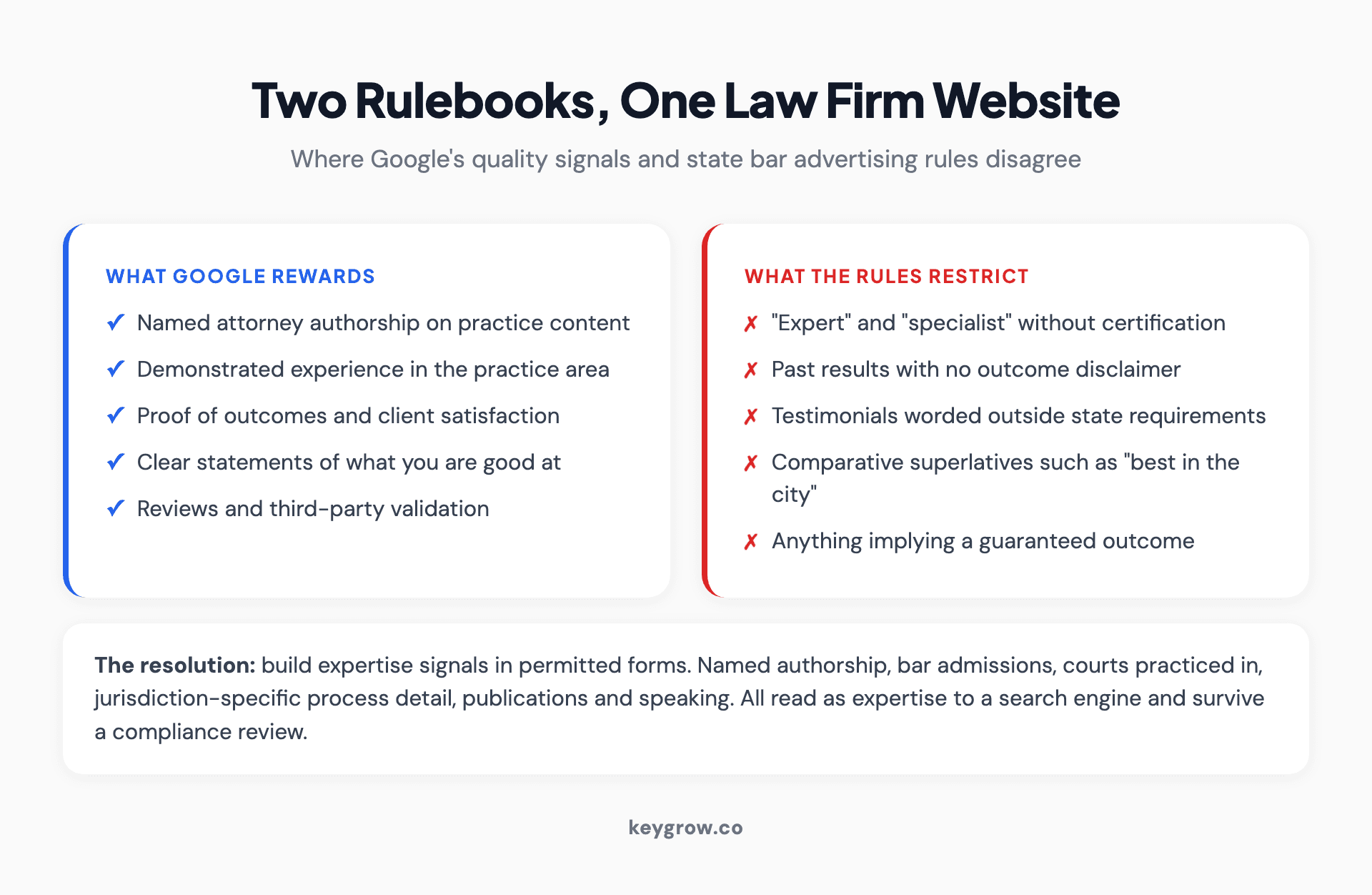
Paired cards showing what Google rewards on a law firm website against what state bar advertising rules restrict, including expertise claims, testimonials, case results and specialist language.
Google puts legal content in the category it grades hardest. Money or Your Life topics, the ones that affect somebody's finances, safety, or legal rights, get held to a higher standard for demonstrated experience and trustworthiness than a recipe blog ever will. Google's own helpful content guidance asks whether the content was produced by someone with real expertise and whether a reader would trust it. For a law firm, that means named attorney authorship, real bios, real case experience, and pages that read like a practitioner wrote them.
Your bar rules push the other direction. Under ABA Model Rule 7.1 a lawyer cannot make a false or misleading communication about their services, and the commentary treats a truthful past result as misleading when it sets an expectation that the same outcome is available to the next person. States adopt that unevenly and some go further. Ethics Opinion 1021 in New York held that "expert" in a domain name is a comparative claim no disclaimer can fix.
So the answer is not to pick a side. It is to build the expertise signals in forms the rules permit: authored content under a named attorney, factual experience statements, jurisdiction and court admissions, published writing and speaking, and outcomes presented with whatever disclaimer your state requires. All of that reads as expertise to Google and survives a compliance review.
Rank for what a case is worth, not what it gets searched
Start keyword research from the value of a signed case, then filter by volume. Doing it the other way around is how firms end up ranking for terms that never produce a client.
This is the single biggest structural difference between legal SEO and everything else. A pest control company can chase volume because every job is worth roughly the same. A firm handling both traffic tickets and wrongful death cannot.
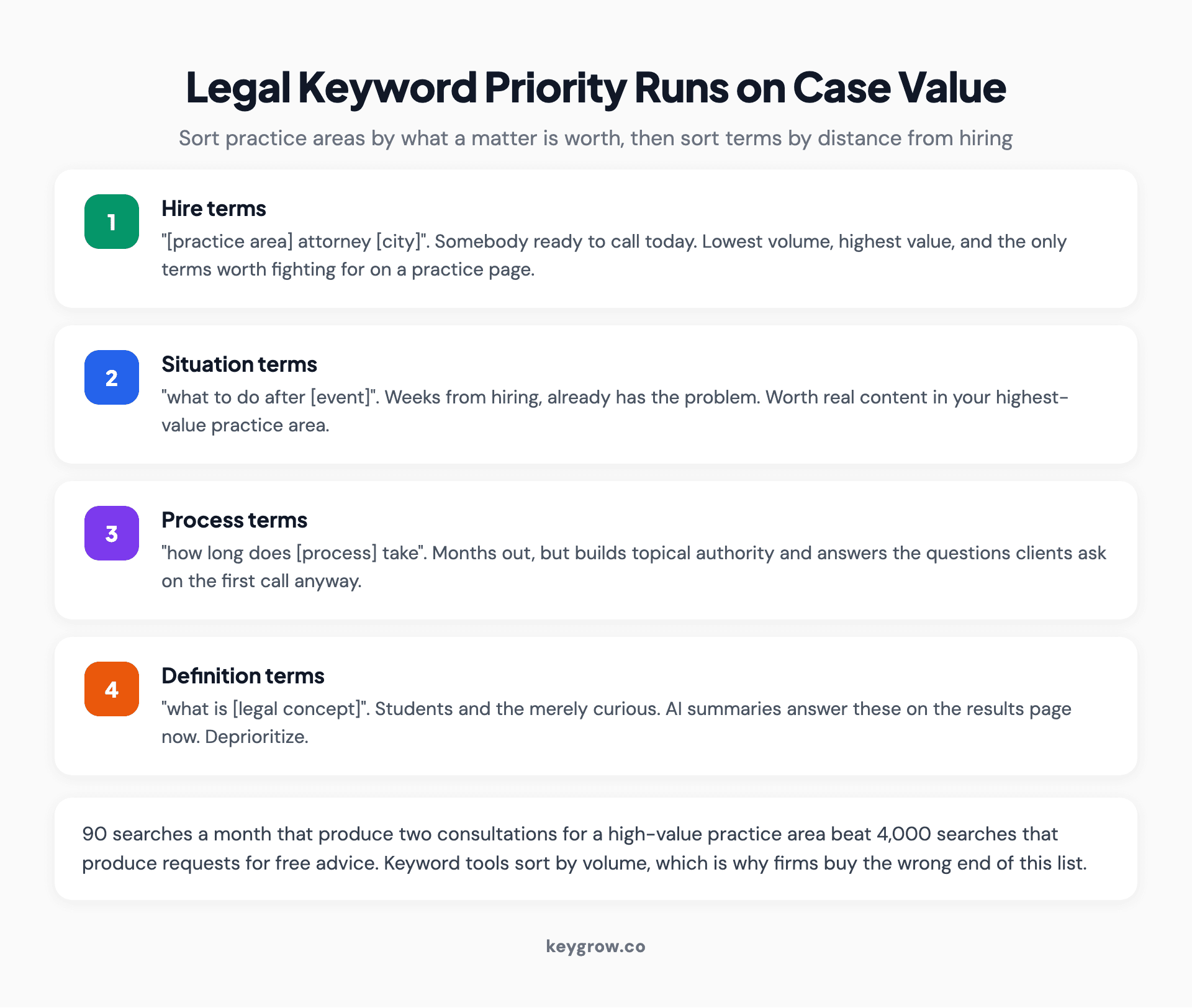
Priority ladder for legal keyword research ordered by case value, showing high-intent hire terms above informational research terms and above general legal questions.
Sort your practice areas by average matter value first. Then, inside each one, sort search terms by how close they sit to hiring somebody:
| Term type | Example shape | Intent | Priority |
|---|---|---|---|
| Hire terms | "[practice area] attorney [city]" | Ready to call | Highest, always |
| Situation terms | "what to do after [event]" | Researching, weeks out | High for the top practice area |
| Process terms | "how long does [process] take" | Researching, months out | Medium, good for authority |
| Definition terms | "what is [legal concept]" | Studying, maybe not a client | Low, and AI answers took most of it |
A term with 90 searches a month in one metro that produces two consultations for a practice worth five figures a matter beats a term with 4,000 searches that fills your inbox with people looking for free advice. That trade is obvious when written down and gets ignored constantly, because keyword tools sort by volume and firms buy what the tool shows them first.
The related caution: search volume for legal terms is heavily seasonal and event driven. Estate planning spikes around tax season and after public health scares. Employment law tracks layoffs. Do not judge a keyword on one month of data.
Practice area pages first, blog posts second
Build one strong page per practice area and per city you actually serve, and only then start writing articles. The order matters more here than in most industries because law firm sites cannibalize themselves faster than almost anything else.
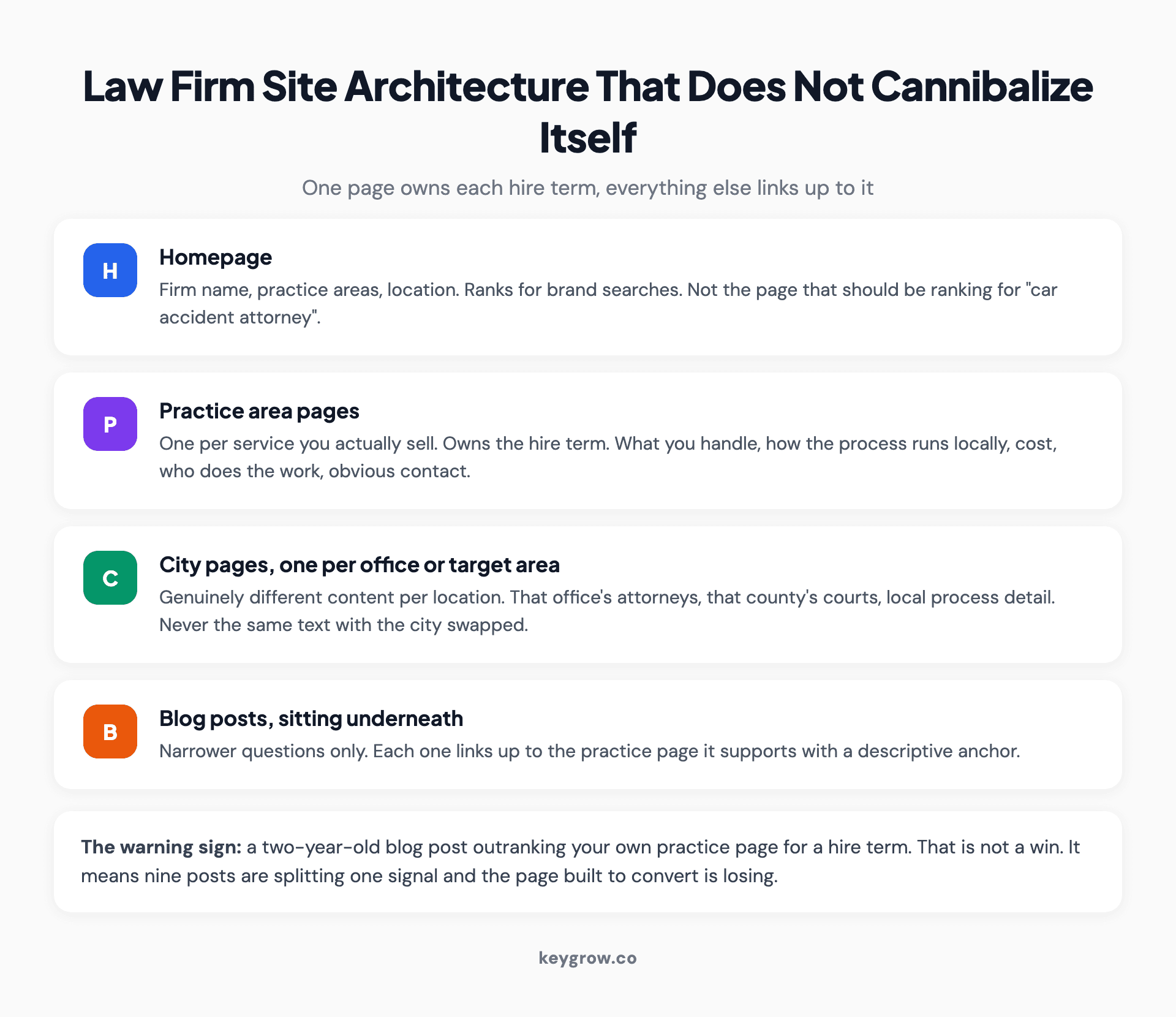
Site architecture diagram for a law firm showing the homepage above practice area hub pages, city pages beneath them, and supporting blog articles linking upward.
Here is the failure I see on maybe half the firm sites I audit. There is a car accident practice page. There are also nine blog posts with "car accident" in the title, written over three years by three different vendors, each of them targeting some version of the same query. Google has to guess which one is the answer. It usually picks a two-year-old blog post with no phone number above the fold instead of the practice page built to convert.
The fix is boring and effective. One page owns each hire term. That page is the practice area page, and it is a real page: what you handle, how the process runs in your jurisdiction, what it costs, who at the firm does the work, and a way to contact you that does not require scrolling. Blog posts sit underneath it, answer narrower questions, and link up to it with descriptive anchors. If a blog post starts outranking its own practice page for a hire term, that is not a win, that is a structural problem to fix.
For multi-location firms, each office gets a page with genuinely different content: that office's attorneys, that county's courts, local process details. Copying the same 700 words and swapping the city name is the most common way firms build a hundred pages that all rank for nothing.
What Google reads as expertise on a legal site
Google cannot verify that you are a good lawyer. It reads proxies. The useful thing about the proxies is that they are all things a legitimate firm can produce honestly.
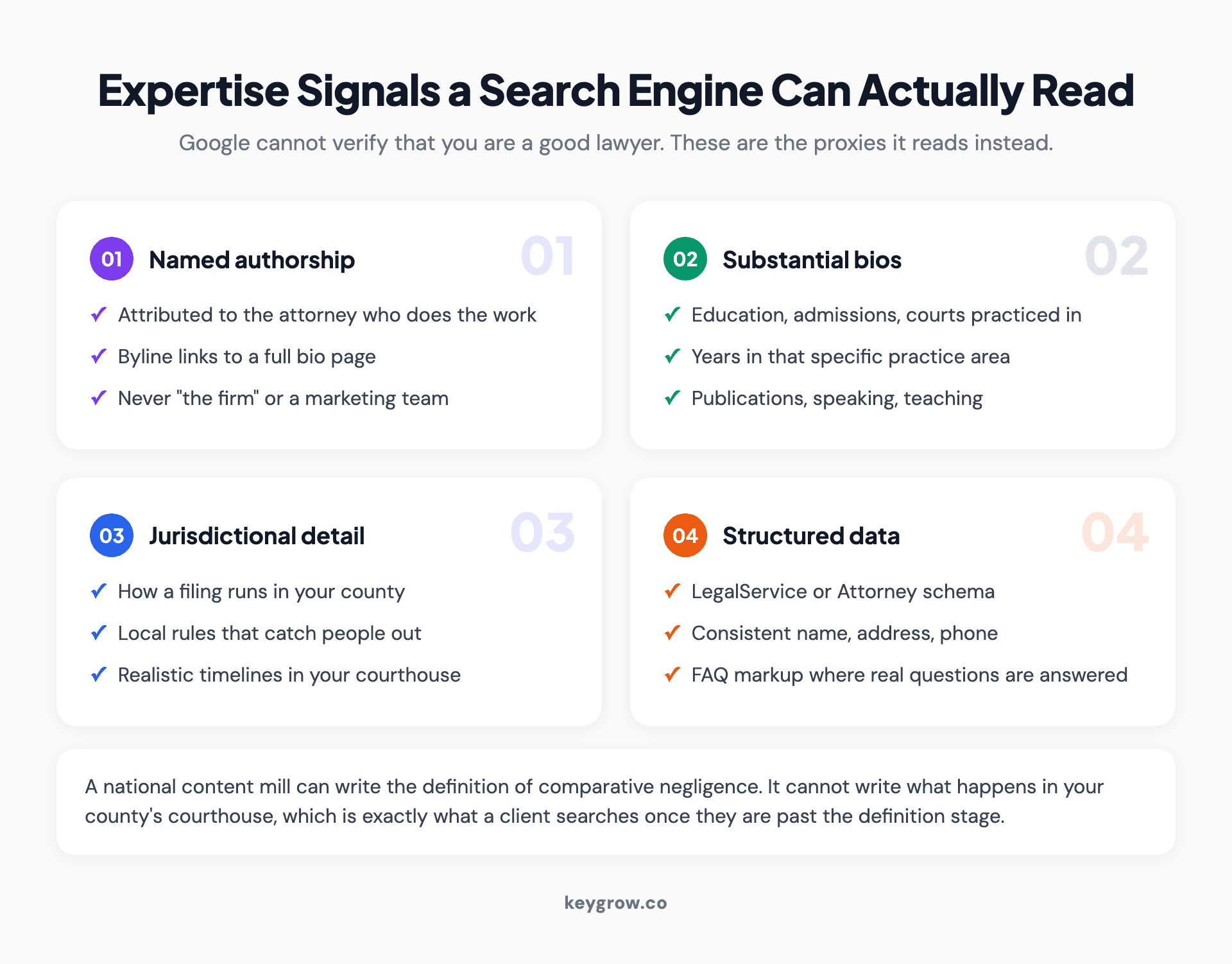
Annotated law firm page anatomy marking the expertise signals search engines read, including named attorney byline, bar admissions, court experience, jurisdiction detail and structured contact information.
Named authorship that resolves to a real person. Content attributed to "the firm" or to a marketing team carries almost nothing. Attribute practice content to the attorney who actually handles that work, link the byline to a full bio, and make the bio real: education, admissions, courts, years in the practice area, publications, speaking. Thin bios are the most common gap on otherwise decent firm sites.
Then there is the jurisdictional layer. Generic legal content is the most duplicated material on the internet. What a national content mill cannot write is the part that makes you useful: how a filing actually runs in your county, which local rule catches people out, what the realistic timeline is in your courthouse. That is also the part clients search for once they get past the definition stage.
Structured data that describes the firm accurately. LegalService or Attorney schema, consistent name, address and phone, practice areas, and FAQ markup on pages with real question and answer sections. Our schema markup generator will build the base object if you do not want to hand-write JSON-LD.
Depth should match the query rather than a word count target. A page about a narrow procedural question does not need 3,000 words. A practice area page that has to serve someone deciding whether to hire anyone at all usually does need real length. Write to the question.
The bar rules that quietly rewrite your SEO checklist
Before anything goes live, run it past the advertising rules in every state where you are admitted and where you advertise. This is not legal advice and I am not your compliance counsel, but these are the recurring places where a standard SEO recommendation runs into a rule.
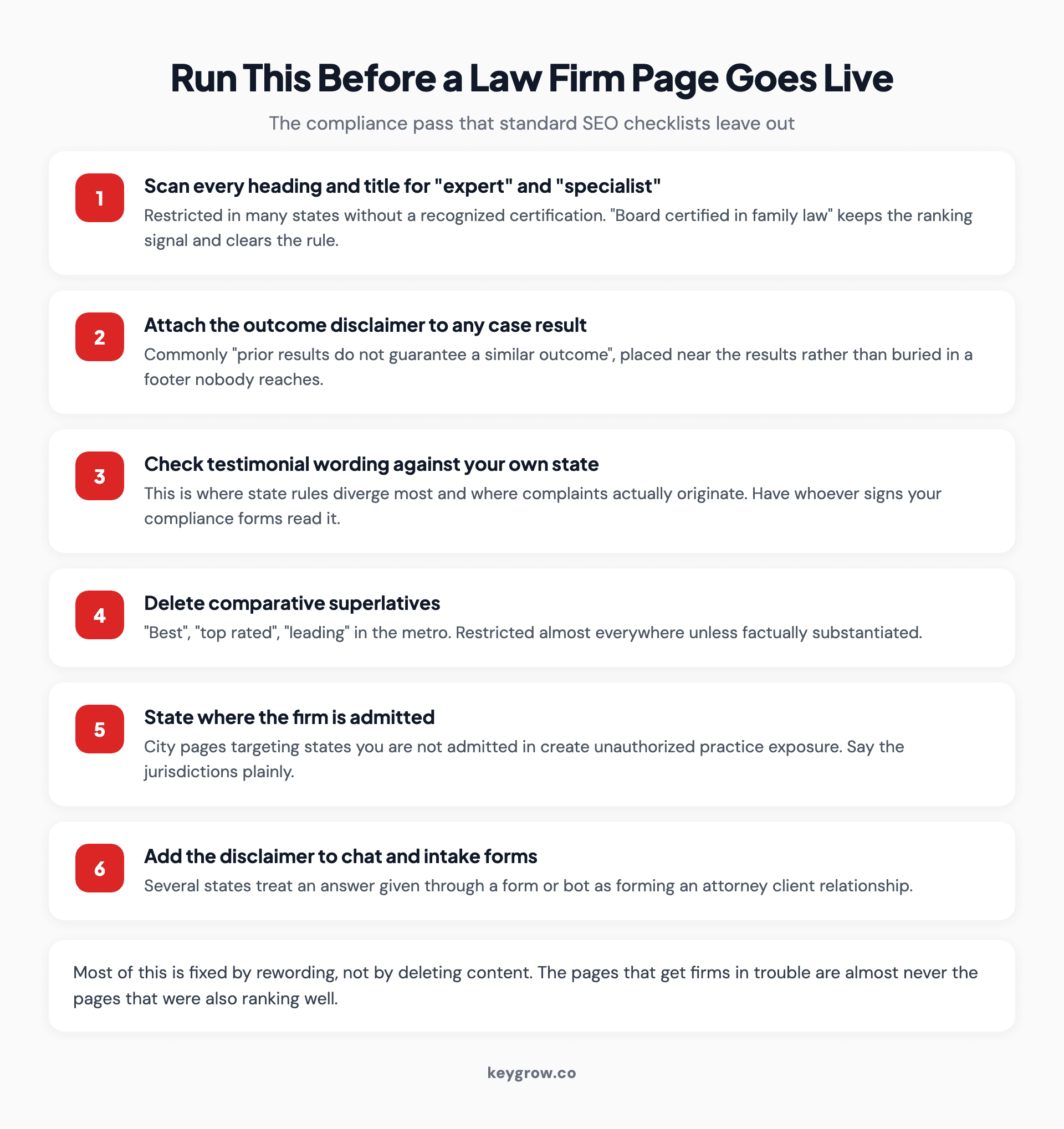
Numbered pre-publish compliance checklist for law firm web pages covering specialist language, past results disclaimers, testimonial handling, jurisdiction statements and required advertising labels.
| Standard SEO advice | Where it collides |
|---|---|
| Use "specialist" or "expert" in titles and headings | Restricted in many states unless you hold a recognized certification. Some states allow objectively verifiable claims, others do not |
| Put case results on the practice page | Widely permitted, commonly requires a disclaimer that prior results do not guarantee a similar outcome |
| Collect and display client testimonials | Permitted in most states, with state-specific rules on wording, disclaimers, and whether the client can be identified |
| Claim to be "the best" or "top rated" in the metro | Comparative superlatives are restricted almost everywhere unless factually substantiated |
| Target city pages in states where you are not admitted | Unauthorized practice exposure. Say clearly where you are admitted |
| Use a chatbot or intake form that gives an answer | Several states treat that as forming an attorney client relationship. Add the standard disclaimer |
Two things make this manageable rather than paralyzing. First, most of the friction is fixed with wording rather than by deleting the content: "board certified in family law" instead of "family law expert" keeps the ranking signal and clears the rule. Second, the disclaimers themselves are short and go in the footer or under the results block, where they cost you nothing in rankings.
The one place I would not improvise is testimonials and case results, because that is where the rules differ most between states and where the complaints actually come from. Have the person who signs your compliance forms read that section before it publishes.
Local rankings when clients come from six counties
Your map pack radius is set by your office address, and no amount of content changes it. What you control is how far your organic pages reach beyond it.
Firms consistently misunderstand this. Ranking in the map pack for a suburb 30 miles from your office is close to impossible unless you have an office there, because proximity is one of Google's three stated local ranking factors and it is not negotiable. Ranking organically, in the blue links underneath, for "[practice area] attorney [that suburb]" is very possible, and for legal that traffic converts, because people will drive for a lawyer in a way they will not drive for a haircut.
So run two plays. For the office city, do the full local job: complete Google Business Profile, correct primary category, real photos, hours, service areas, and steady review flow. For the surrounding areas, build organic city pages with content that could only have been written about that place, and accept that you are competing in the organic results rather than the map.
If you have one office and a wide service radius, that split tells you where the effort goes. Most of it goes into organic pages, not into trying to force the map pack to do something it will not do. There is more on the profile side in our Google Business Profile guide.
Reviews carry more weight here than almost anywhere
Reviews are a ranking factor and a conversion factor at once, and legal is the vertical where the second one dominates. Somebody choosing a lawyer is making a high stakes decision with no way to evaluate quality directly, so they read reviews the way other people read them before booking surgery.
The problem is that most firms are bad at asking. Not because of the bar rules, which generally permit soliciting reviews, but because the moment a matter closes is emotionally complicated and nobody wants to bring up Google. Build it into the file closing process anyway: a short message, a direct link, and a system that sends it rather than an attorney remembering to.
Two rules that matter more in legal than elsewhere. Never reveal anything about a matter in a review response, including confirming that the person was a client, unless your rules and the client permit it. A response that reads "we worked hard on your custody case" is a confidentiality problem in most states. The safe pattern is a short, generic, professional reply. And never incentivize a review, in any industry, because it violates both platform policy and, in many states, the advertising rules. We covered the ranking side of this in our post on responding to Google reviews.
The links a law firm can realistically earn
Forget link building as a separate activity for a moment. The link sources available to a law firm are unusually good and unusually underused.
- Bar associations and legal directories. State bar profiles, county bar listings, practice section memberships. Low effort, legitimate, and expected of a real firm.
- Law school and alumni pages. Faculty pages, adjunct listings, alumni features, clinic partnerships. If anybody at the firm teaches or guest lectures, that link exists already or is one email away.
- Being a source. Journalists writing about a local case need a lawyer to explain the procedure. Reporters covering a new state statute need somebody who has filed under it. This is the highest quality link available to any local business and lawyers have the credentials to get quoted.
- Community and pro bono work. Sponsorships, legal aid clinics, nonprofit board seats. Real involvement, real links, and they tend to come from the local domains that also help you rank locally.
- Original data or commentary. Filing trend analysis from public court records, a plain-language explainer on a new local ordinance, an annual review of a court's practices. Genuinely citable, and almost nobody does it.
What to avoid: paid guest post networks, "legal directories" that are just link farms, and reciprocal link swaps with other firms. Legal is a heavily spammed vertical and Google grades link quality here with more suspicion than average.
A page can rank and still lose the case
Ranking is the setup. The page has to close.

Busts lining a long law library gallery beside shelves of bound volumes.
An estate planning firm we worked with, Smith and Kim Law, had a site full of general information and no clear path to booking a consultation. Traffic arrived and left. We rebuilt around a single focused action, with the value of the service stated plainly and trust elements in the right places. Conversion rate went up 70 percent in 3 weeks. Nothing about their rankings changed during that window. The traffic was already there and the page was throwing it away.
That is worth sitting with before you spend a year on content. Pull your practice area pages up on a phone. Is the phone number visible without scrolling? Is there one obvious next step, or five competing ones? Does the page say what happens after somebody calls? Most firm sites answer badly on all three, and fixing that is faster and cheaper than any ranking work.
What legal SEO costs, against what the alternative costs
Legal SEO usually runs from about $1,500 a month for a single-location firm in a small market to $10,000 and up for a multi-office firm in a competitive metro. The number is high because the competition is, not because the work is different.
Here is the comparison that makes the case. According to LocaliQ's 2026 benchmarks, attorneys and legal services carry an average cost per lead of $131.63, the highest of any industry tracked, at an average cost per click of $9.87. In personal injury, in a major metro, clicks run far past that. The keyword "seo for lawyers" itself, the term this page is written for, carries a cost per click above $100.
So the arithmetic: a practice area page that produces 15 qualified inquiries a month is, at the benchmark, doing roughly $1,974 a month of work that you would otherwise be buying. It goes on doing it whether or not you fund it this month. That is the actual argument for organic in this vertical, and it is stronger here than in any trade I write about, because nowhere else is the paid alternative this expensive.
Two honest qualifications. It takes time, and the first quarter looks like nothing. Our strongest organic case, a doctor's practice in Dubai, spent months one through three looking unimpressive and finished the year at 1,519 percent organic traffic growth with 130+ patient calls a month. Legal is at least that slow. And anyone promising you page one in 30 days for a competitive legal term is either targeting phrases nobody searches or about to do something to your domain you will regret. If an agency needs a 12-month contract to hold you, the results are not doing it. We work month to month, cancel anytime, for exactly that reason. There is more detail in our SEO pricing breakdown and on our legal SEO services page.
AI answers already took the informational half of legal search
The definitional queries are going away. "What is comparative negligence" gets answered on the results page now, and that traffic is not coming back.
This sounds worse than it is, because that traffic was never worth much. Someone asking what a legal term means is usually a student, a curious person, or somebody eight steps from hiring anyone. The queries that produce clients, the ones with a place name and a problem attached, still send people to websites, because nobody retains a firm from a summary paragraph.
What it does change is what to write. Stop producing dictionary content. Write the things an AI answer cannot compress: how the process actually runs in your county, what your firm does when a specific complication comes up, what the range of outcomes looks like in your experience. Then structure it so the machines can read it, with a direct answer near the top and clean question and answer sections, which is the same thing that helps you get cited when an assistant does surface a source. Our AEO guide covers that side in more depth.
What to measure, and what to quietly ignore
Measure signed cases and consultations booked. Everything above those in the funnel is diagnostic, not a result.
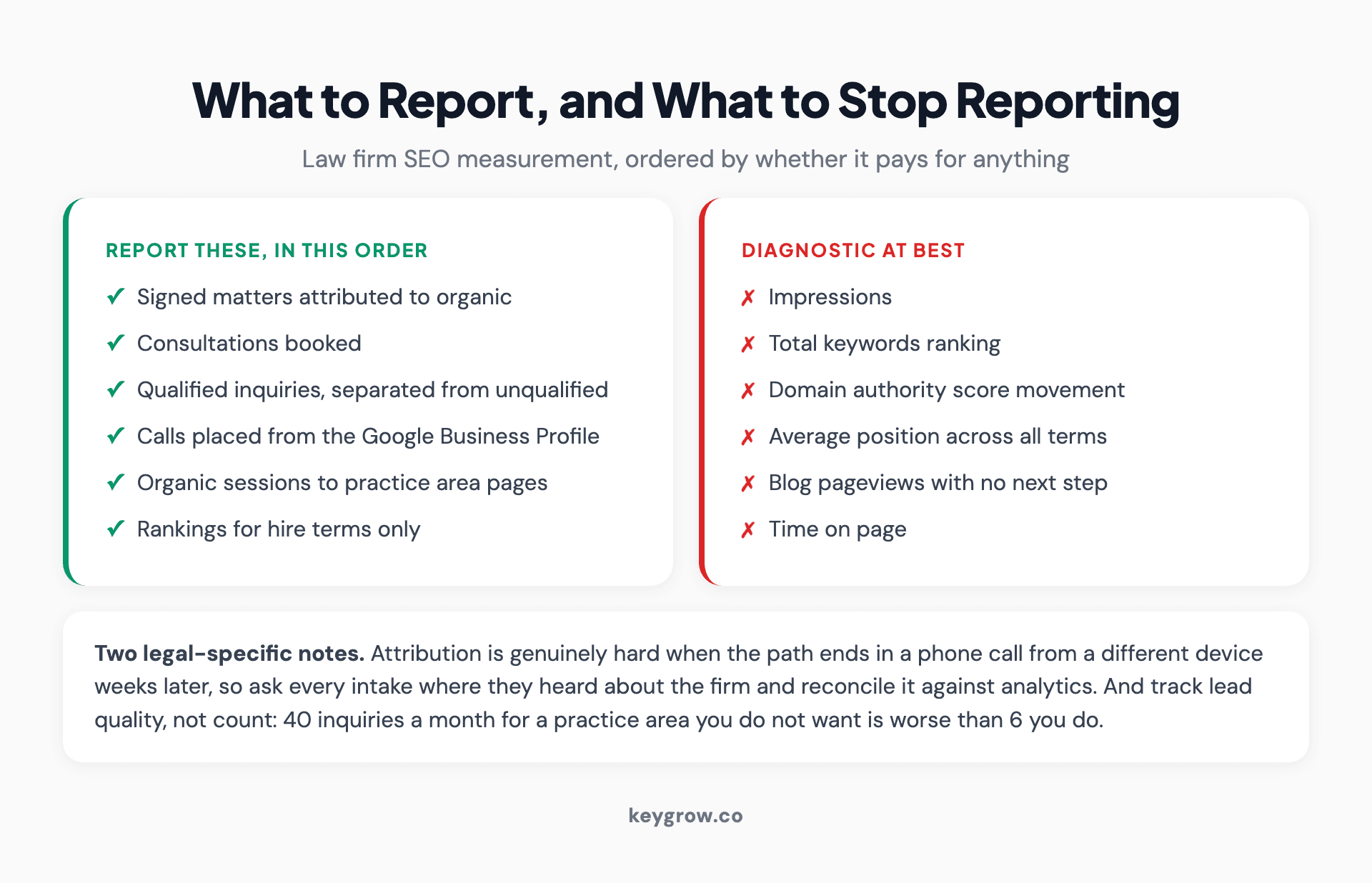
Metrics grid separating law firm SEO outcomes worth reporting, such as signed matters and booked consultations, from vanity metrics like impressions and keyword counts.
The reporting worth having, in order: signed matters attributed to organic, consultations booked, qualified inquiries, calls from the Google Business Profile, organic sessions to practice area pages, and rankings for hire terms. Anything that opens with impressions is telling you about weather, not revenue.
Two legal-specific measurement notes. First, attribution is genuinely hard because the path is long and often ends in a phone call from a different device weeks later. Ask every intake where they heard about the firm and reconcile that against the analytics rather than trusting either alone. Second, track lead quality, not just count. A page that produces 40 inquiries a month for a practice area you do not want is worse than one producing 6 you do.
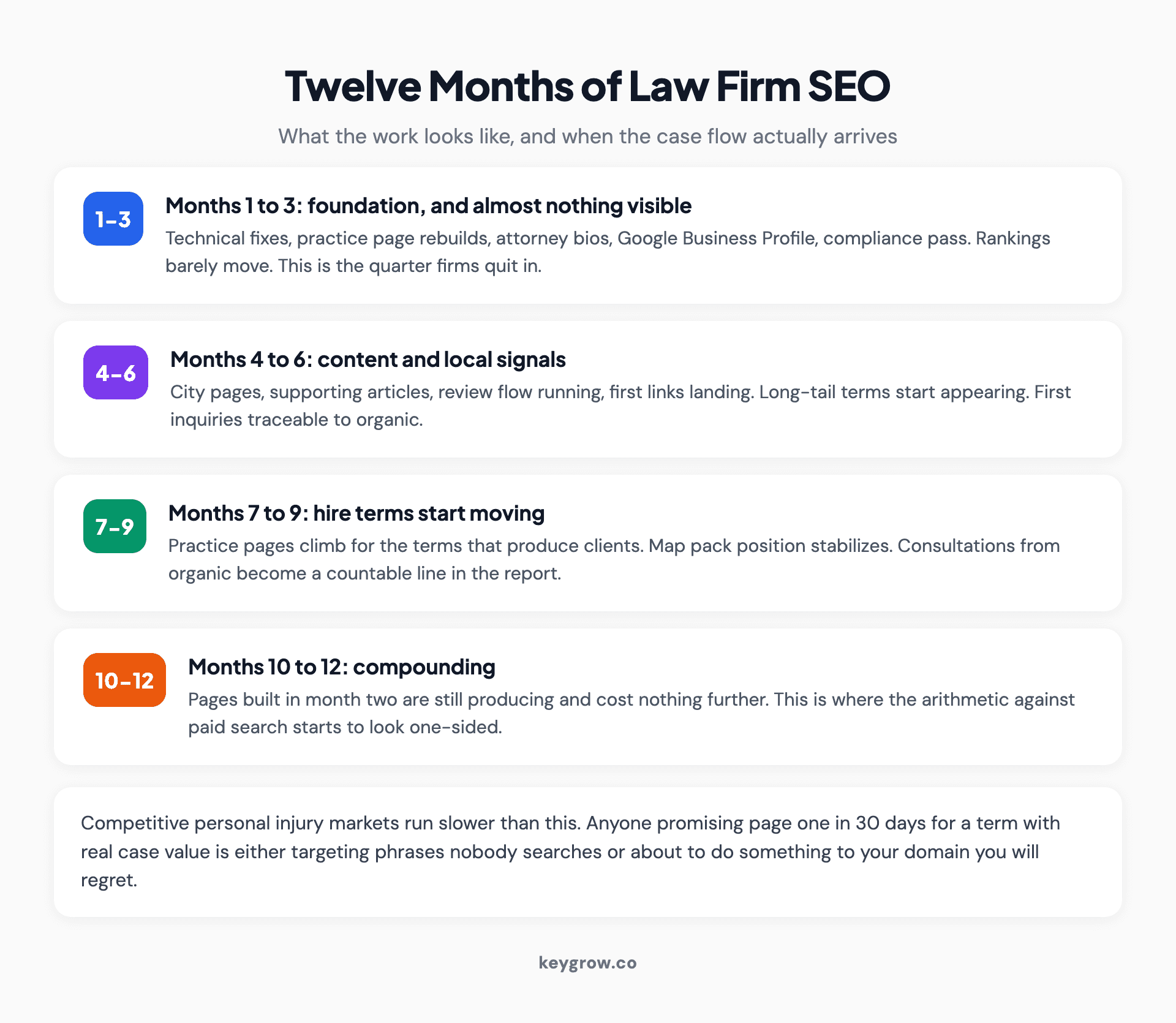
Twelve month timeline of law firm SEO showing technical and page work in the first quarter, content and local signals in the middle, and compounding case flow at the end.
Firms that should not be buying SEO yet
There are three, and I would rather say so than take the engagement.

An empty law office conference room with chairs around a table, representing intake capacity a firm has not filled.
Firms with no intake capacity. If calls already go to voicemail during business hours, more calls is not the problem to solve. Fix answering first. It is cheaper and it works immediately.
Solo practices in their first year with no service definition. If you are still working out which practice areas you want, SEO will lock you into the ones you happened to write about. Wait until you know.
Anyone who needs cases this quarter. Organic will not do it. Ads will, at a price, and that is the right tool for that timeline. We say this to prospects regularly, including ones we could have signed.
There is also a real DIY case here. A single-location firm with one practice area and a partner who has a few hours a week can claim the Google Business Profile, get the bio pages right, build one solid practice page, and set up review requests without paying anybody. That is most of the available value in a small market. Hire out when the opportunity cost of those hours exceeds the fee.
FAQs
How long does SEO take for a law firm?
Expect six to twelve months before organic becomes a meaningful source of matters, and longer in competitive personal injury markets. The first quarter is typically technical fixes, page rebuilds, and local setup, which produces very little visible movement. Firms that quit at month three have paid for the difficult part and left before the return.
How much should a law firm spend on SEO?
Most firms land between $1,500 and $10,000 a month depending on market size, number of practice areas, and how many locations need coverage. A single-location firm in a small metro sits at the bottom of that range. A multi-office personal injury firm in a large metro sits at the top or above it. Be suspicious of anything under about $1,000, because the work does not fit in that budget.
Can lawyers use the words expert or specialist on their website?
It depends on your state, and in several states the answer is no unless you hold a recognized certification. New York has held that even a domain name containing "expert" is an impermissible comparative claim. Florida permits it where the claim is objectively verifiable. Check your own rules of professional conduct before using either word in a title, heading, or URL.
Do law firm websites need a disclaimer on case results?
In most jurisdictions, yes. The common requirement is a statement that prior results do not guarantee a similar outcome, placed near the results themselves rather than buried. The underlying principle in the model rules is that a truthful past result becomes misleading if it leads someone to expect the same outcome in their own matter.
Is SEO or Google Ads better for a law firm?
They answer different questions. Ads produce cases this month at a cost per lead that in legal averages over $130, and stop the day you stop paying. Organic takes six to twelve months and then keeps producing without per-click cost. Most firms that can afford both run ads for the highest-value practice area while organic compounds underneath.
Should each attorney have their own page?
Yes, and they should be substantial rather than a headshot and two lines. Attorney bio pages rank for name searches, which is what a referred prospect types before calling, and they carry the authorship signals that legal content needs. Include admissions, courts, practice areas, education, and any publications or speaking.
Do blog posts still work for law firm SEO?
Yes, for narrower questions that sit underneath a practice area page, and no longer for definitional content that an AI summary answers on the results page. Write about process, jurisdiction-specific detail, and situations rather than definitions, and link every post up to the practice page it supports.
Where to start on Monday
If you do one thing this week, pull up your top practice area page on a phone and see whether a stranger could tell within five seconds what you do and how to reach you. That is usually the cheapest fix available and it changes nothing about your rankings.
After that, in order: get the practice area page structure right, fix the attorney bios, claim and complete the Google Business Profile, then start writing. Content last, not first. It is the part everybody wants to start with and the part that works least well on a broken foundation.
If you want somebody to look at where your firm currently stands, our SEO team does that, and we will tell you if the answer is that you do not need us yet.