


Google Ads for financial advisors has a very specific shape of problem, and it is not the one most advisors think they have. Finance and insurance is the second most clicked industry in Google's search advertising, at a 9.83% click-through rate against an all-industry average of 6.64%. It is also dead last on conversion rate, at 2.64% against an average of 8.18%. People click advisor ads more readily than almost any other kind and then do nothing at all.
So if your campaign is generating traffic and no appointments, the account is behaving exactly as the category does. The fix is not better ad copy. Your ad copy is already outperforming most industries. The fix is what happens after the click, and specifically the size of the thing you are asking for.
The best-clicked, worst-converting industry in the dataset
WordStream's 2026 benchmarks cover 13,474 US search advertising campaigns between April 2025 and March 2026. Finance and insurance ends up at opposite ends of two different rankings.
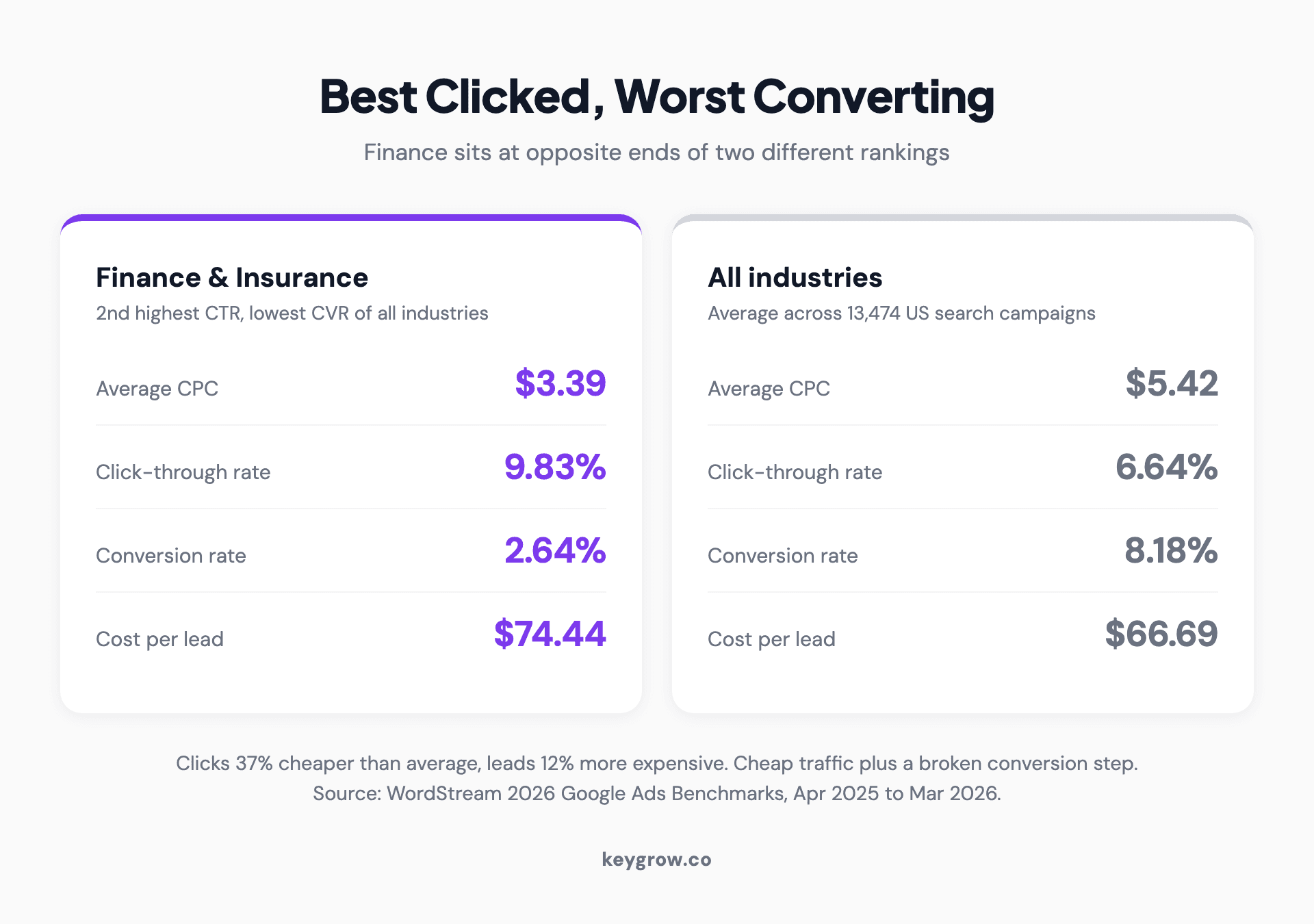
Comparison of Google Ads benchmarks for finance and insurance against the all industry average, showing a 9.83 percent click through rate against 6.64 percent and a 2.64 percent conversion rate against 8.18 percent.
| Metric | Finance & Insurance | All industries |
|---|---|---|
| Average CTR | 9.83% | 6.64% |
| Average CPC | $3.39 | $5.42 |
| Conversion rate | 2.64% | 8.18% |
| Cost per lead | $74.44 | $66.69 |
Finance and insurance posts the second-highest click-through rate of any industry in that dataset, behind only one other. It also posts the lowest conversion rate of all of them, with WordStream naming it explicitly as the bottom of the table.
Notice what that combination does to the money. Your clicks are cheap, $3.39 against a $5.42 average, and your cost per lead is still above average at $74.44. Cheap traffic plus a broken conversion step produces expensive leads. You are buying attention efficiently and converting it terribly, which is a very different problem from the one most advisors are sold a solution for.
Why the click is easy and the conversion is not
The click is easy because financial anxiety is a strong motivator and the search is usually specific. Someone typing "financial advisor near me" or "retirement planning for business owners" has a real question and wants to see who is out there. Clicking costs them nothing.
The conversion is hard because of what you are asking for next.
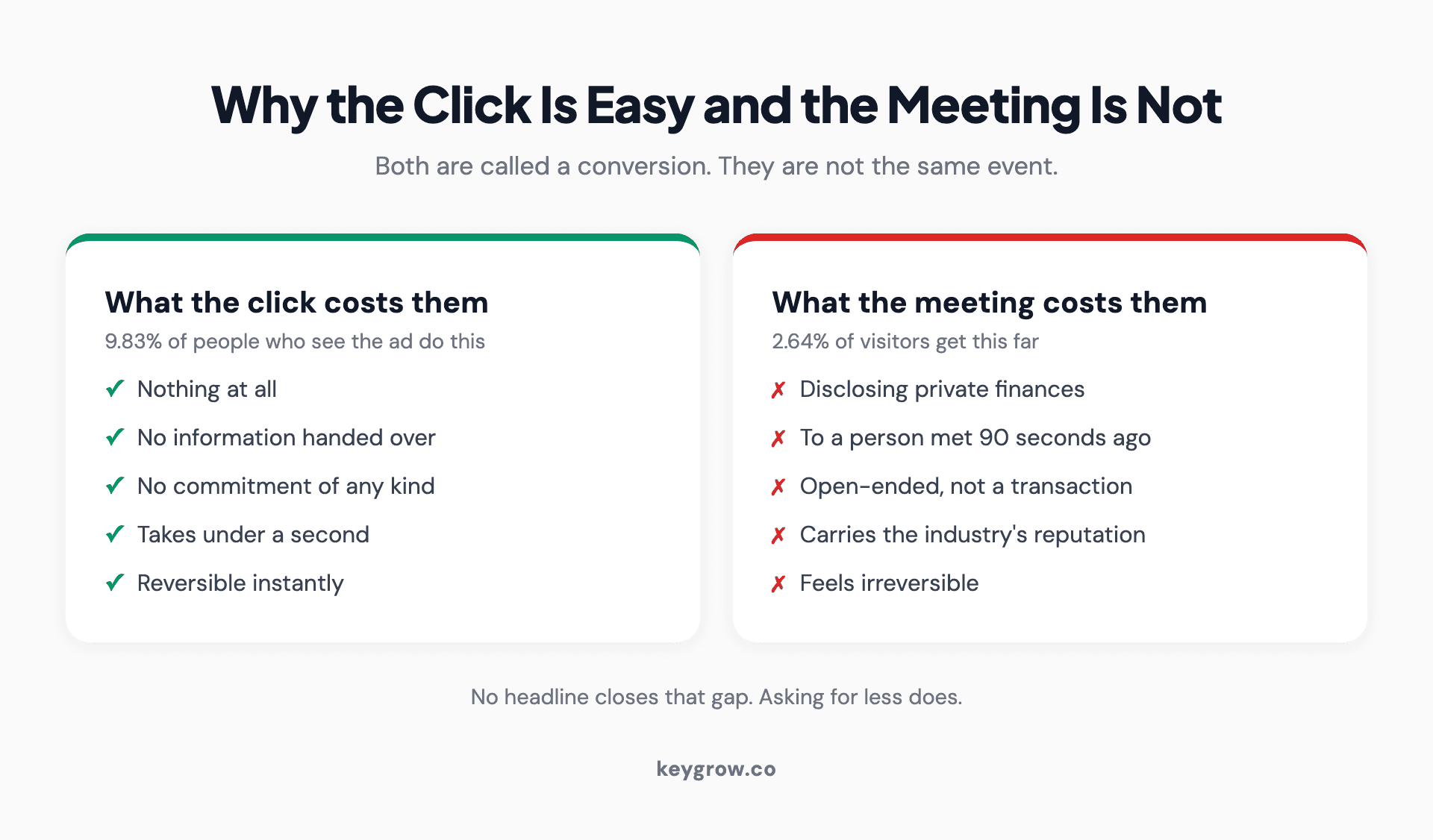
Diagram of the trust gap in financial advisor advertising, comparing the low cost of a click with the high commitment of handing personal finances to a stranger.
Consider what a standard advisor landing page requests: book a meeting, share your financial situation, discuss your assets, with someone the visitor first heard of ninety seconds ago. Compare that with what a plumber asks for, which is permission to come and fix a leak. Both are described as a conversion. They are not the same event.
Three things make the ask heavier in this category than almost anywhere else:
- The subject is private. Most people will discuss their salary less readily than their medical history.
- The commitment is open-ended. Hiring an advisor is not a transaction, it is the start of a relationship measured in years.
- The trust bar is set by other people's behavior. Every advisor pays a reputational tax for the industry's worst actors, and the visitor is carrying that suspicion into your page.
None of that is fixable with a stronger headline. It is fixable by asking for less.
Before anything else, Google has to let you advertise
This catches more advisors than it should, and it stops campaigns dead rather than merely underperforming them.
Google's financial services policy defines its scope as "products and services related to the management or investment of money and cryptocurrencies, including personalized advice." That last clause is the one advisors skim past. Personalized advice is the product. You are in scope.
The policy also states plainly that "You're required to complete a verification process to advertise financial services in some locations." Which locations, and what the process involves, varies, and Google has been expanding the requirement rather than relaxing it.
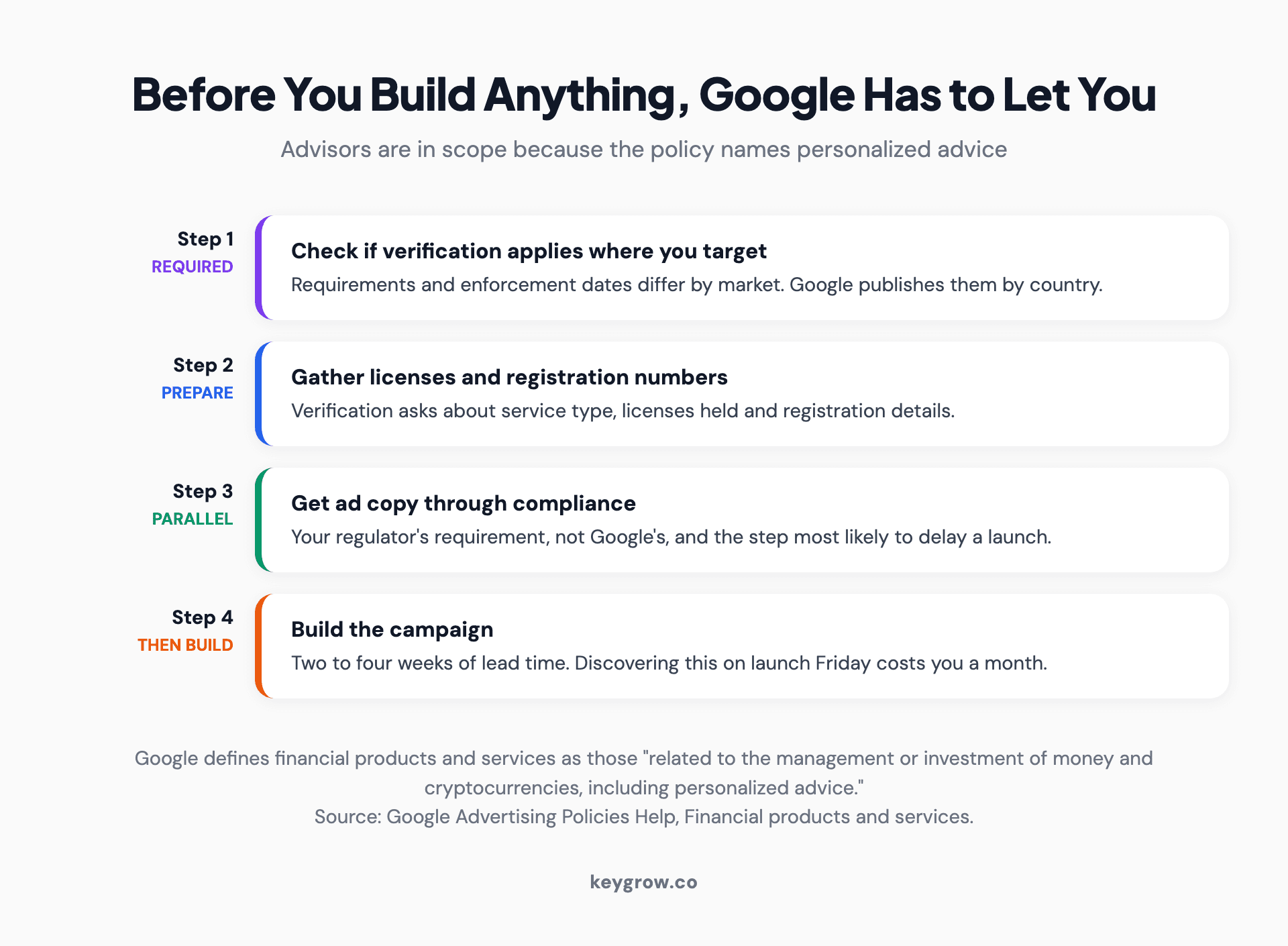
Checklist of what a financial advisor needs before running Google Ads, covering advertiser verification, financial services verification, licensing and registration details and compliance review of ad copy.
Practically, that means three things before you build a single campaign:
- Check whether financial services verification applies in the locations you target. Requirements and enforcement dates differ by market, and Google publishes them by country.
- Have your licensing and registration details ready. Verification asks about the type of services you provide, the licenses you hold and your registration numbers.
- Get ad copy through compliance before it runs, not after. This is your regulator's requirement rather than Google's, and it is the step most likely to hold up a launch by a fortnight if nobody planned for it.
Budget two to four weeks of lead time for this. An advisor who plans a Monday launch and discovers the verification requirement on the Friday has lost a month.
The first ask is too big
Here is where the 2.64% comes from, and where you can genuinely move it.
Almost every advisor campaign asks for the same thing: book a consultation. It is the highest-commitment request available short of signing paperwork, and it is being made to someone who arrived thirty seconds ago from a search result.
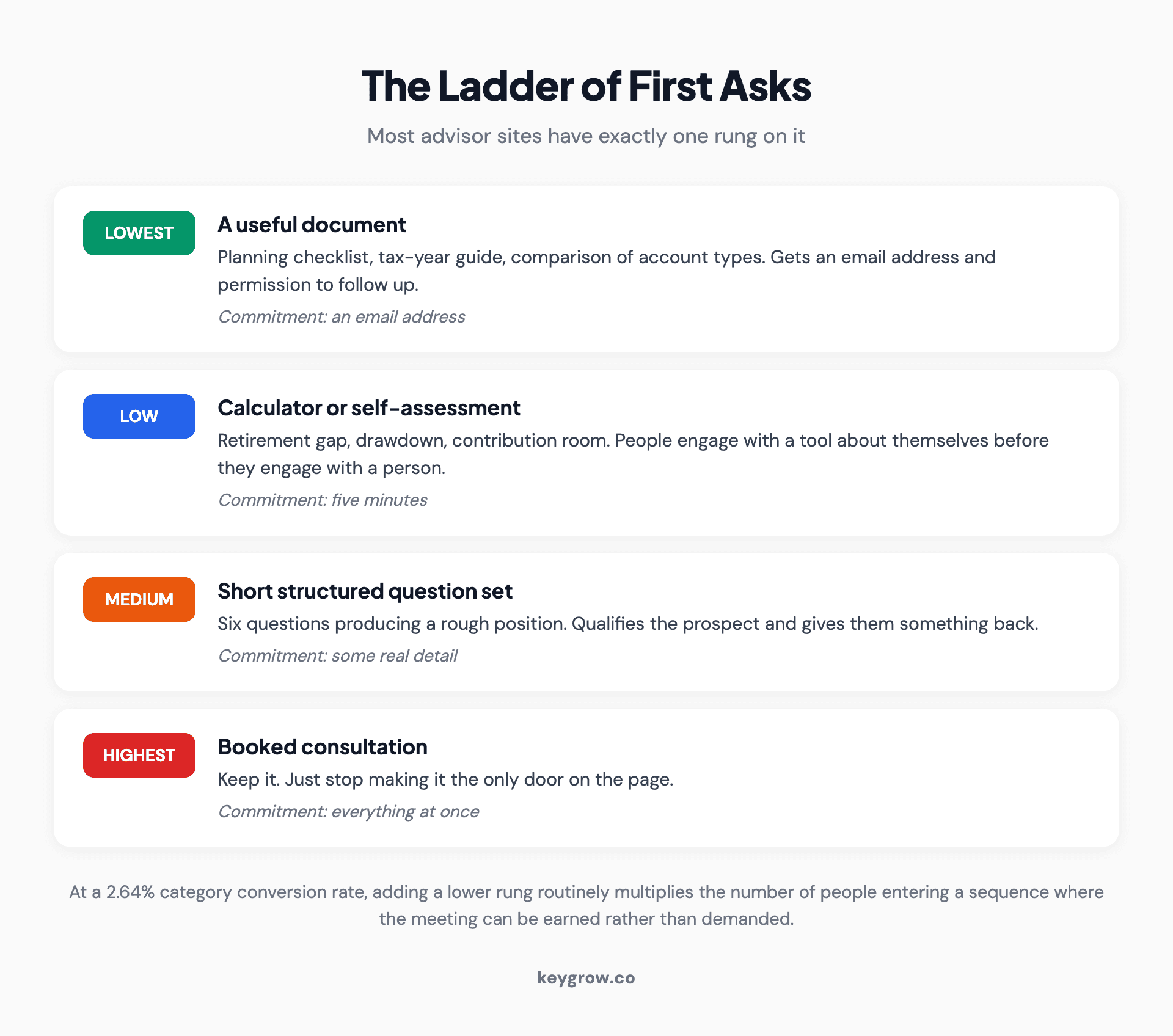
Ladder diagram of first ask options for financial advisor landing pages, from a downloadable guide and calculator through a checklist and short assessment up to a booked consultation, ordered by commitment level.
There is a ladder of asks between arriving and booking, and most advisor sites have exactly one rung on it:
- A useful document. A planning checklist, a tax-year guide, a one-page comparison of account types. Low commitment, and it gets you an email address and permission to follow up.
- A calculator or self-assessment. Retirement gap, drawdown, contribution room. People will engage with a tool that tells them something about themselves long before they will engage with a person.
- A short structured question set. Six questions producing a rough position. This qualifies the prospect for you and gives them something in return.
- A booked consultation. Keep it. Just stop making it the only door.
The reason this works is arithmetic rather than psychology. If your consultation page converts at 2.64% and a guide download converts at 12%, the guide route puts four and a half times as many people into a sequence where you can earn the meeting rather than demand it. Some of those never book. Enough do.
A law firm we worked with had the reverse of this problem: a page that asked for too much, too vaguely. Rebuilding it around one clear action lifted conversion rate 70% inside three weeks. Different profession, identical mechanism.
Qualifying in the ad, not on the call
The second thing killing advisor accounts is that they treat every lead as a lead.
If you have an asset minimum, and most advisors do, then a meaningful share of the people converting on your ads will never be clients. They cost you the same $74.44 as everybody else and then consume a call slot to find out. More traffic makes that worse rather than better. Filtering is the fix, and it belongs in the ad rather than in the meeting.
Ways to qualify before the click, roughly in order of bluntness:
- State a minimum in the ad copy. Uncomfortable, effective, and it costs you almost nothing since the people it deters were never going to be clients.
- Name the client type. Business owners, physicians, pre-retirees, equity compensation, expats. Specificity repels the wrong searcher and attracts the right one.
- Name the service level. Fee-only, fiduciary, full financial planning versus investment management. These words are filters as much as they are descriptors.
- Price signal where you are able to give one. A stated planning fee range does more qualifying work than any amount of targeting.
An investor client of ours was drowning in unusable enquiries and the fix was not more budget, it was negative keywords, tighter match types and qualifying language in the ads. Serious leads rose 600% on the same spend. The same principle applies whether you are buying houses or managing portfolios: filtering beats volume.
Keywords advisors should and should not buy
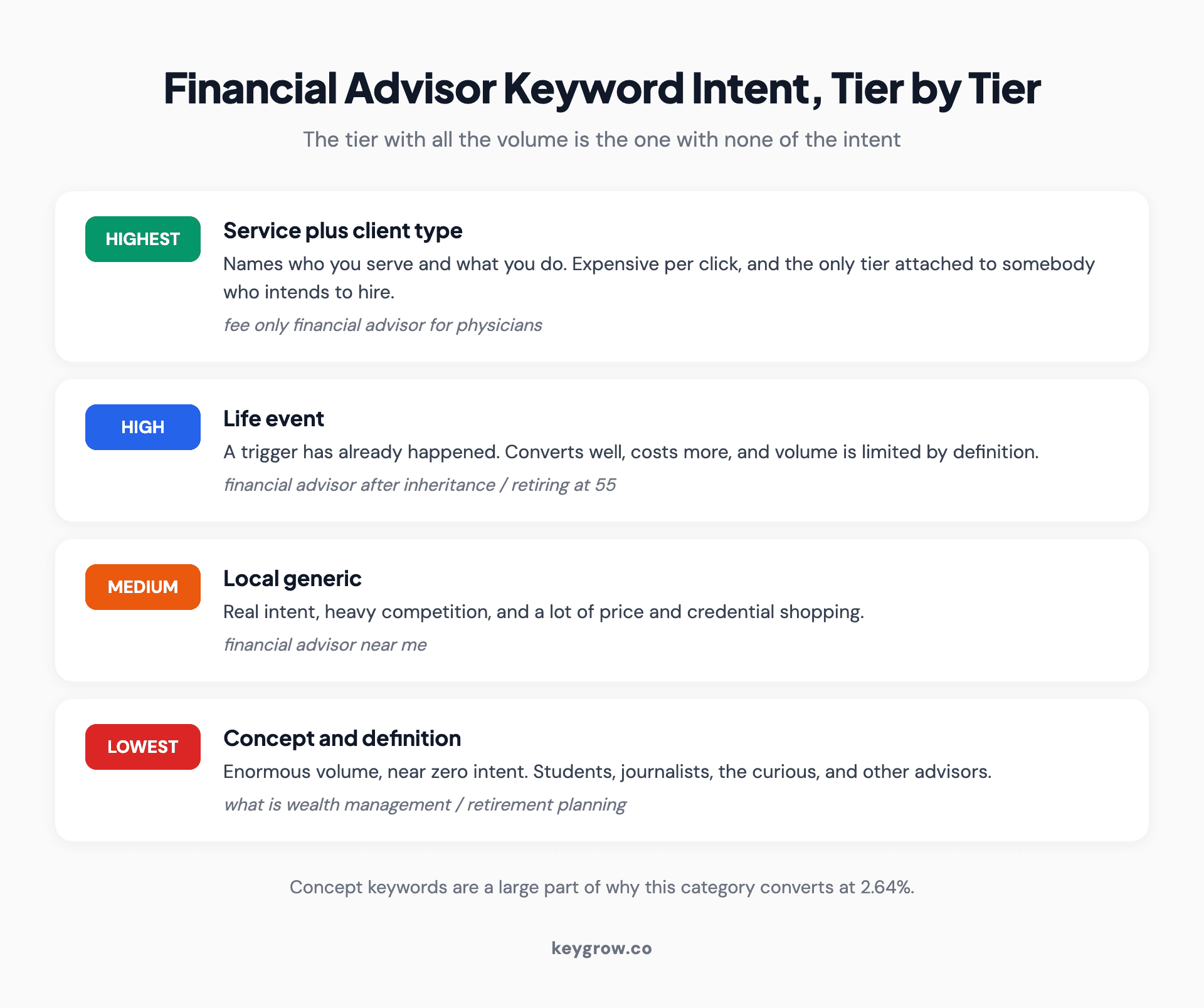
Four tiers of financial advisor keyword intent from ready to hire down to research and definition searches, with example queries and what each tier is worth.
The pattern in this category is unusually clean. Terms naming a service and a client type convert. Terms naming a life event convert well and cost more. Terms naming a concept do not convert at all, and they are the ones with all the volume.
The trap is that concept-level searches look enormously attractive in a keyword tool. Retirement planning, investment strategy, wealth management. Huge volume, low apparent difficulty, and populated almost entirely by students, journalists, curious people and other advisors. This is a large part of why the category conversion rate sits at 2.64%.
Buy the narrow, ugly, specific terms. They cost more per click and they are the only ones attached to somebody who intends to hire.
Negative keywords for an advisor account
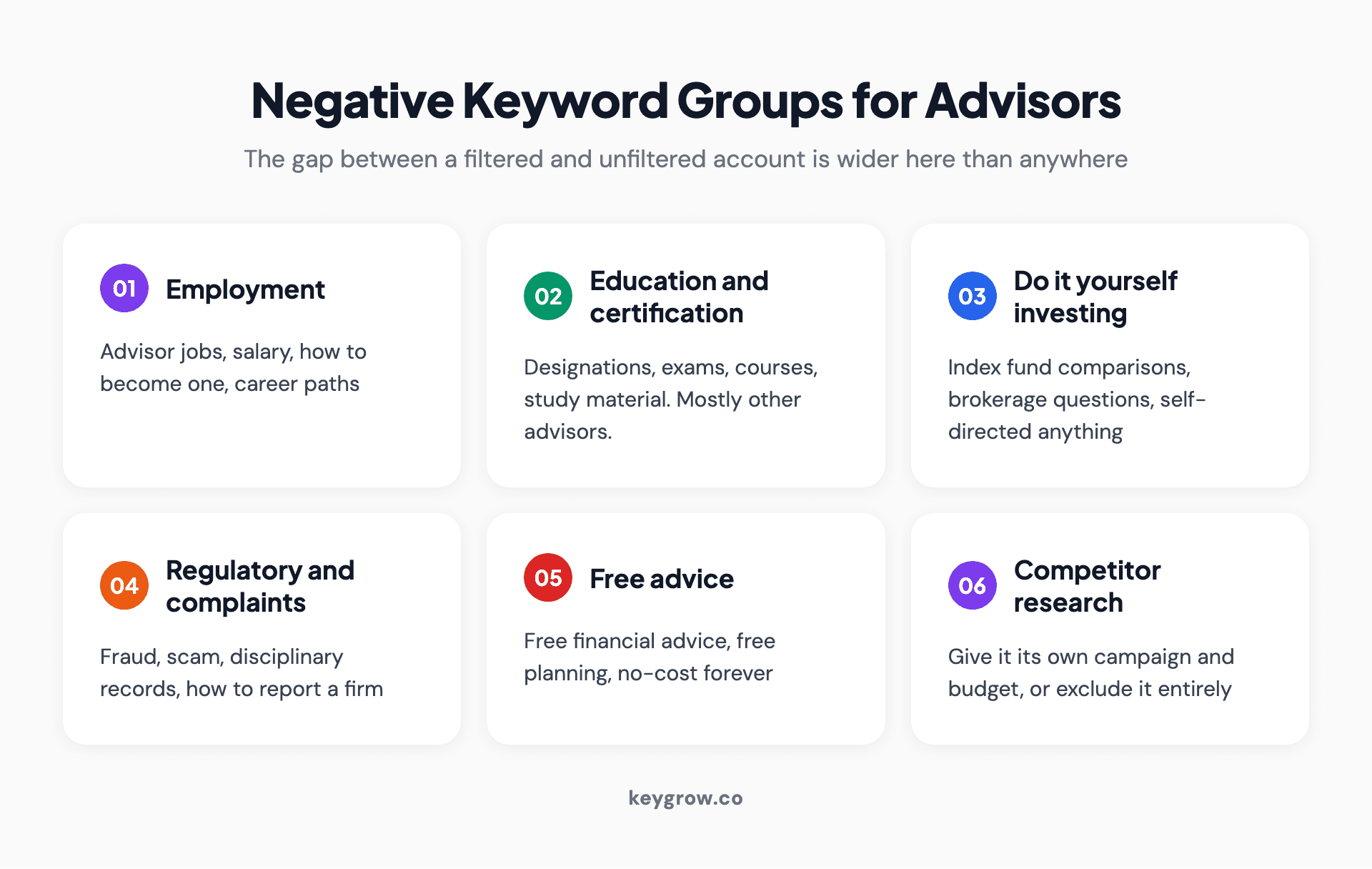
Six card checklist of negative keyword groups for financial advisor Google Ads covering employment searches, education and certification, do it yourself investing, regulatory and complaint searches, free advice and competitor research.
- Employment. Financial advisor jobs, salary, how to become one, career paths. Very high volume in this vertical.
- Education and certification. Designations, exams, courses, study material. Mostly other advisors.
- Do it yourself investing. Index fund comparisons, brokerage account questions, self-directed anything. These people are actively avoiding hiring you.
- Regulatory and complaint searches. Fraud, scam, complaints, disciplinary records, how to report. Someone researching a problem is not shopping for a provider.
- Free advice. Free financial advice, free planning, no-cost consultation seekers who mean free forever.
- Competitor and comparison research. Depending on your position you may want some of this, but it needs its own campaign and its own budget rather than leaking into your core one.
Pull the search terms report weekly for the first two months. Given the category's conversion rate, the difference between a filtered and an unfiltered account here is larger than in almost any other industry.
What the landing page has to prove
Since the visitor arrives suspicious, the page has one job before it has any other: establish that you are a real, credentialed, locatable person.
- A named human with a photograph. Advisor marketing that hides the advisor behind a firm brand is fighting itself.
- Credentials, plainly stated. Designations, registrations and how long you have held them.
- A physical address. Google's own disclosure guidance for financial products leans on this, and visitors read it the same way.
- Who you work with, and who you do not. The second half is what makes the first half believable.
- Fee structure, at least in shape. Fee-only, percentage of assets, flat planning fee. You do not have to publish a number to remove the fear of a hidden one.
- One primary action, plus a lower rung. The consultation for the ready, the guide or calculator for everyone else.
What to leave off: stock photography of handshakes, jargon that requires a glossary, and any claim about performance that your compliance officer has not signed.
Measurement when a client is worth years of fees
An advisory client is not worth one transaction, they are worth a stream of fees over a relationship that may run a decade. That makes the ordinary cost-per-lead conversation nearly meaningless.
Two adjustments matter:
- Value your conversion actions differently. A guide download, a calculator completion and a booked consultation are not the same event and should not carry the same value in the account. Set them explicitly so bidding optimizes toward the ones that lead to clients.
- Import what happens next. When a consultation becomes an onboarded client, push that back into Google Ads against the original click. Without it, your bidding is optimizing toward whichever ask is easiest, which is exactly the one least likely to produce revenue.
Judge the account on cost per qualified consultation at minimum, and on cost per onboarded client once you have enough of them to be statistically real.
When a financial advisor should not run Google Ads
Skip it if you have no capacity. An advisor at their practical client ceiling should be raising minimums, not buying leads.
Skip it if referrals fill your calendar. This profession runs on introductions more than most. If your pipeline is full from centres of influence and existing clients, paid search is an expensive way to add lower-quality volume.
Skip it if you have not solved the first ask. Sending traffic to a consultation-only page at a category conversion rate of 2.64% is a slow way to buy a lesson you can have for free by reading this section.
Skip it if compliance cannot turn work around. If every ad variation takes a month to approve, you cannot iterate, and an account you cannot iterate on will not improve.
Consider content and local presence first if you are newly independent. Building genuine authority and a complete Google Business Profile costs time rather than money, and for an advisor with more of the former it is the better first move. We would tell you that rather than take the account.
If you are past all of those, our Google Ads management covers the verification path, the ask ladder and the conversion values rather than just the keyword list.
FAQs
How much do Google Ads cost for financial advisors?
Finance and insurance averages $3.39 per click with a cost per lead of $74.44, against an all-industry average of $5.42 and $66.69. Clicks are cheaper than average and leads are more expensive, because the category converts at only 2.64%. Most advisor practices need $1,500 to $4,000 a month to generate enough volume to read the data.
Do Google Ads work for financial advisors?
They work when the offer matches the visitor's readiness. The category has the second-highest click-through rate of any industry at 9.83%, so getting attention is not the difficulty. The difficulty is that the standard ask, a booked consultation with a stranger, converts at the lowest rate in the dataset. Advisors who add a lower-commitment first step generally see the whole account improve.
Does Google require verification to advertise financial services?
Yes, in some locations. Google's policy states that advertisers are required to complete a verification process to advertise financial services in certain markets, and its definition of financial products and services explicitly includes personalized advice. Check whether the requirement applies where you target, and allow two to four weeks before launch.
What is a good conversion rate for a financial advisor campaign?
The category benchmark is 2.64%, which is the lowest of any industry measured. Anything above 4% on a consultation-only page is genuinely good. Pages offering a lower-commitment first step, such as a guide or calculator, routinely run several times higher, though those conversions are worth less individually.
What keywords should financial advisors avoid?
Employment and salary searches, certification and exam terms, do-it-yourself investing queries, regulatory complaint searches, free advice modifiers, and broad concept terms like retirement planning on their own. Concept keywords carry the most volume and almost none of the intent, which is a large part of why the category conversion rate is so low.
Should advisors advertise a minimum asset level?
If you have one, usually yes. It feels blunt and it removes prospects who were never going to become clients before they cost you a click and a call slot. Naming your client type, such as business owners or pre-retirees, achieves something similar with a softer edge.
How long before Google Ads produces clients for an advisor?
Enquiries usually start within the first two or three weeks. Onboarded clients take considerably longer, because the decision involves trust building, often a second meeting and frequently a transfer from an existing provider. Three to six months is realistic before you can judge cost per client rather than cost per lead.
Should advisors use Performance Max?
Rarely at the start. It needs conversion volume to learn from and most advisor accounts do not generate enough. In a regulated category it also gives you less control over where ads appear, which is a compliance consideration as much as a performance one. Get search campaigns and conversion values right first.
Start with the ask, not the ad
The data on this category is unusually clear about where the problem is not. A 9.83% click-through rate says your ads are working. A 2.64% conversion rate says the thing you are asking for is too large for the moment you are asking in.
So before rewriting a single headline, do three things. Confirm whether financial services verification applies where you advertise, because nothing else matters if the ads cannot run. Add a rung below the consultation so the 97% of visitors who are not ready today have somewhere to go. And put your minimum, or your client type, into the ad copy so the people you cannot help stop costing you $74.44 to discover.
If you want a second opinion on which of those three is costing you most, we will look at the account. Our piece on landing pages versus your website is a reasonable place to start in the meantime.